Mass casualty incidents (MCIs) can occur anywhere without warning and, by definition, produce large numbers of patients who need immediate medical care. The most common cause of mortality in such events is uncontrolled hemorrhage, with critically injured victims requiring immediate access to resuscitation in the emergency department (ED), operating room (OR), or intensive care unit (ICU). Reference Jacobs, McSwain and Rotondo1–Reference Elster, Butler and Rasmussen3 An effective hospital response to MCIs requires rapid mobilization of appropriately skilled personnel and availability of critical resources. In the modern health-care environment, however, it is common for hospitals to be at or beyond capacity and to lack sufficient additional surge capacity. Reference Mullins and Pines4–Reference Pitts, Pines and Handrigan8 Consequently, hospitals facing an MCI wrestle with the dual challenge of immediately adjusting their clinical operations to resuscitate arriving patients without compromising the care of existing patients. In this study, we describe our institutional MCI protocol that enlists the expertise of hospitalists to augment surge capacity. Notably, these concepts are also relevant to other public health emergencies capable of quickly generating large numbers of patients in need of immediate care, such as the current COVID-19 pandemic.
The Need: Immediate Surge Capacity
In an MCI, the first patients can present to the hospital within minutes of an event. After the 2013 Boston Marathon bombing, 118 patients arrived at area hospitals within 18 min of the explosion, with half of them having arrived within 11 min. Reference Landman, Teich and Pruitt9,Reference Gates, Arabian and Biddinger10 Our own institution, which already had 97 patients in a 50-bed ED, received 31 patients in the first hour, including 6 critically ill patients who required urgent transfer to the operating room. Reference Biddinger, Baggish and Harrington11 Following the Orlando Pulse Nightclub shooting in 2016, the Orlando Regional Medical Center began to receive patients just 10 min after notification of the event. Within 42 min, 38 patients arrived at that hospital. Reference Cheatham, Smith and Ibrahim12 Victims of the 2017 shooting on the Las Vegas Strip at the Route 91 Harvest Music Festival began to arrive to Sunrise Hospital & Medical Center less than 20 min after the shooting began, with approximately 215 patients ultimately arriving to their ED, including 31 critical patients. Eighty percent of patients arriving by ambulance were in the ED within an hour of the incident. 13,Reference Lozada, Cai and Li14
The Problem: A Chronically Overextended Environment
Given the lack of warning inherent to MCIs, the rapid pace of patient arrivals, and the critical nature of many patients’ injuries, the attention of ED providers will necessarily be drawn to caring for the arriving victims. However, the EDs in which these providers work are often already filled with patients who will continue to need attention. Crowding of EDs has previously been identified as a major challenge that adversely affects the quality of both everyday medical care and disaster response. Reference Mullins and Pines4–Reference Pitts, Pines and Handrigan8,Reference Bernstein, Aronsky and Duseja15–Reference Rasouli, Esfahani and Nobakht20 A principal reason for this crowding is a lack of available bays and personnel in EDs to accommodate arriving patients. In turn, the lack of open beds in EDs is, in part, due to high bed occupancy rates in the hospital, resulting in admitted patients waiting, or “boarding,” in the ED for hours before going to an inpatient floor. 5–7 High occupancy rates and large numbers of “boarders” in the ED limit the ability of the ED to surge its during a mass casualty scenario. 5 Since 2016, to mitigate the effect of ED crowding, our institution’s hospital medicine team has staffed a dedicated service line caring for boarding medicine patients. This ED boarder service line exists geographically in the ED.
Hospitalists: An Internal and Immediate Asset
During an MCI, hospitalists may be able to offload ED providers of some existing patient responsibilities so these staff can focus on incoming MCI patients. Hospitalists are well suited to support the immediate care of the majority of existing ED patients at the time of an MCI as the majority of patients in EDs present with medical conditions as opposed to surgical or obstetrical complaints. Reference Persoff, Ornoff and Little21,Reference Elixhauser and Owens22 A 2017 Agency for Healthcare Research and Quality’s Healthcare Cost and Utilization Project study found that medical visits to the ED (317.5 visits per 1000 persons) far outpaced visits for conditions related to injury (81.8), mental health/substance abuse (20.3), and maternal/neonatal (12.7). Reference Moore, Stocks and Owens23 Hospitalists are also commonly involved in the medical care of surgical patients not imminently in need of surgery, both pre- and postoperatively. Reference Persoff, Ornoff and Little21 Hospitalists are thus well positioned to add significant value by off-loading an overextended ED. Reference Persoff, Ornoff and Little21,Reference Moore, Stocks and Owens23–Reference Crocker and Huang25
The Department of Medicine MCI Response: Achieving Immediate Capacity
Our institution established a plan to use hospitalists to create ED capacity and provide quality care for the existing ED patients upon notice of an MCI. This solution developed initially out of our response to the Boston Marathon bombings, when hospitalists quickly and spontaneously responded to the ED. Reference Biddinger, Baggish and Harrington11 Since 2013, we have continued to refine our protocol with a goal of integrating the Department of Medicine (DOM), particularly hospitalists and the ED Boarder service, into our hospital’s overall MCI response.
The activation of the MCI protocol by ED physician and nursing staff or hospital leadership mobilizes multiple departments across the hospital to support the care of arriving patients and the continued treatment of existing patients. As the local disaster radio system is housed within the ED, it is likely that initial notification of an MCI will be received in the ED and that ED staff will generally initiate the MCI protocol. ED leadership and on-call hospital administrators are available for consultation, although their approval is not required by clinical staff in the ED for activation of this protocol. The hospital’s MCI protocol, integrated into the institution’s overall Emergency Operations Plan (EOP), is activated when an “incident is expected to overwhelm normal ED and/or hospital resources with incoming casualties, where substantial additional hospital resources will be necessary to effectively manage the event and/or will affect normal hospital operations as part of the response.” Potential triggers for the MCI protocol include: at least 5-10 critically injured trauma patients expected to arrive simultaneously (3 or more critically injured pediatric patients), 20 or more critical and/or urgent total patients expected from a single incident, or at the discretion of ED and/or trauma service.
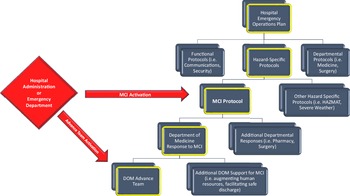
The announcement of the MCI protocol activation occurs by means of the Employee Alert System (EAS), a mass notification tool used to communicate urgent information to employees through multiple modalities including email, phone, pager, and computer desktop pop-ups. ED staff can initiate communication through the EAS by contacting the hospital operator. Most MCI activations will likely also necessitate an activation of the broader EOP and Hospital Incident Command System (HICS) to marshal a more expansive set of resources beyond those outlined in the MCI protocol (Figure 1). If the description of an incident warrants activation of the HICS, a “Code Disaster” will be declared and HICS personnel will be activated. While triggering of the MCI protocol can occur immediately upon notice of an MCI by staff working clinically in the ED, standing up the full HICS will require additional time as hospital and emergency response leadership must convene. The MCI protocol is intended to create an automatic set of procedures to ensure that all the necessary immediate response actions are executed expeditiously. The incident command system roles established through the MCI protocol can be incorporated into the overall HICS organizational structure if it is activated.
The DOM Advance Team is integrated into the hospital-wide MCI response.
The DOM Advance Team is one component of the DOM’s response to MCIs, which itself is one of many departmental responses involved in an MCI. The Advance Team is activated directly to facilitate immediate surge capacity in the ED, while additional assets are mobilized as part of the broader EOP. Abbreviations: DOM, Department of Medicine; ED, emergency department; EOP, Emergency Operations Plan; MCI, mass casualty event.

The DOM Advance Team
To generate immediate surge capacity in the ED, our institution’s MCI protocol uses the DOM’s Advance Team (AT) (Figure 1). When the MCI protocol is activated, the AT is immediately notified of the event through the EAS. The AT includes (1) the hospital medicine boarder service attending, (2) the lead nurse for the boarder service, and (3) the hospital medicine unit’s lead hospitalist and/or nurse. The principal purpose of the AT is to rapidly assume care of a subset of the existing patients in the ED to promptly free up ED providers to care for incoming trauma patients. The AT is also well positioned to funnel information to the DOM about current and anticipated medical needs.
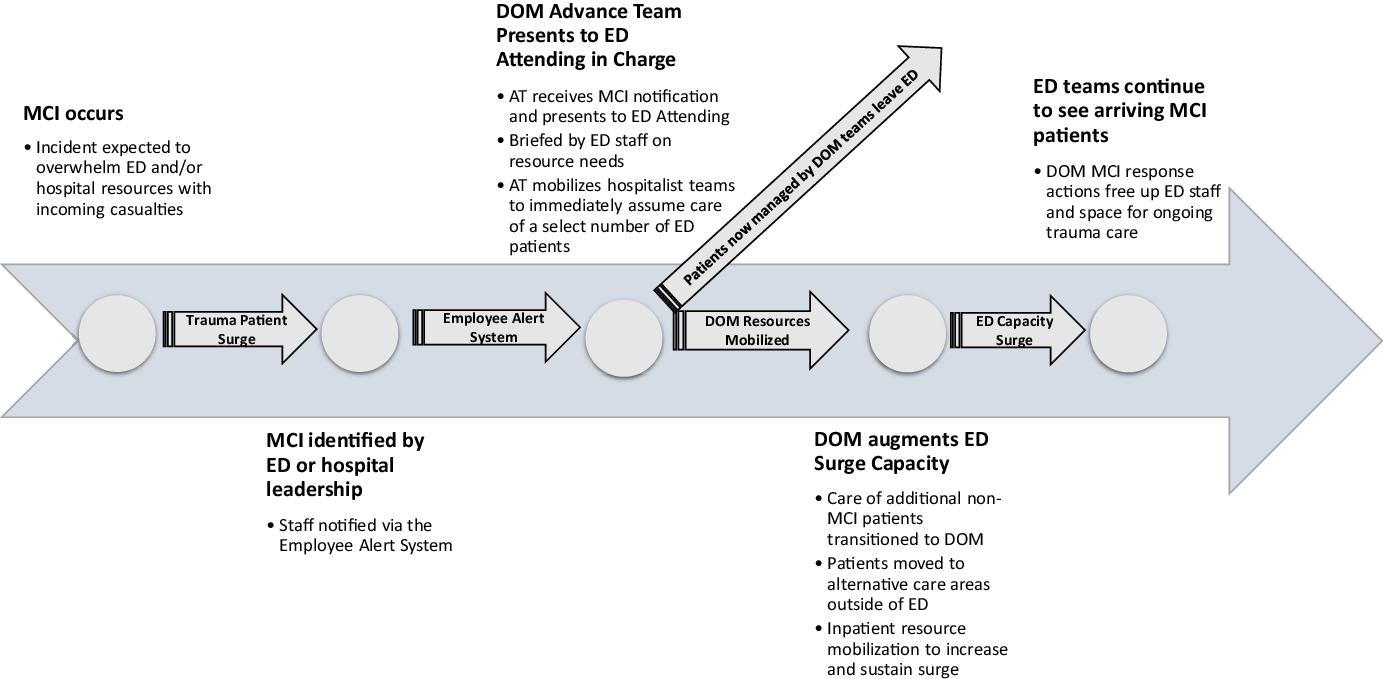
In the event of an MCI, the boarder service attending reports immediately to the ED physician in charge for a short briefing and to receive direction from ED staff about assuming care of a limited number of patients needing to be transported out of the ED (Figure 2). The boarder attending, in collaboration with the other members of the AT, will mobilize additional hospital medicine and boarder service teams to assume care of these patients, liberating space and staff for the care of incoming trauma patients. The ideal timeframe for AT action to occur is before the arrival of the first MCI patients, if advanced notice is received.
The Advance Team creates immediate surge capacity in the ED while the DOM generates additional capacity to support a sustained influx of trauma patients in the ED. Abbreviations: EAS, Employee Alert System; AT, Advance Team; DOM, Department of Medicine; ED, emergency department; MCI, mass casualty incident.

Like other hospitals with high occupancy, especially with frequent boarders in the ED, we have regular experience activating protocols to “surge” hospital bed capacity. This experience is leveraged in our planning for an MCI. In times of high ED volume, exercising these protocols enables us to make more than 10 inpatient beds available within 30 min. These beds occupy auxiliary spaces in the hospital: recovery areas, family rooms, and hallways that have been designated by the hospital as convertible into functional clinical spaces at short notice. They are all outfitted with electrical outlets, including call bell and telemetry connection.
The DOM also uses preplanned protocols to decrease bed occupancy by assessing whether inpatients may be safely and immediately discharged and whether intensive care unit (ICU) patients may be moved to an inpatient floor to create critical care bed capacity. The DOM has a downstream mechanism that it can use to meet the staffing needs associated with an influx of patients transferred from the ED. The hospital medicine unit has integrated a “surge call” in its daily scheduling. Decisions regarding these interventions are made in conjunction with the DOM and hospital leadership, operating through the HICS when activated.
Other health-care facilities have developed frameworks for the involvement of hospitalists in disaster response and mass casualty incidents, with a focus on expediting medical admissions and discharges and redistributing staff to generate surge capacity. Reference Persoff, Ornoff and Little21,Reference Smith, Cheatham and Safcsak26–Reference Bowden, Burnham and Keniston29 The New York City Department of Health and Mental Hygiene identified that over one-fifth of inpatients could be discharged in a disaster scenario to create immediate capacity. 27,Reference Jacobs-Wingo, Cook and Lang30 Hospitalists are a critical component of their strategy. 27,28 Other institutions have used hospitalists to augment critical care capacity, particularly during the COVID-19 pandemic. Reference Bowden, Burnham and Keniston29 Our institution’s use of a hospitalist AT to augment capacity within minutes of the notification of an MCI as described here may be an additional strategy health-care facilities can consider.
Implications for Hospital Disaster Planning
As all hospitals are at risk for no-notice events that have the potential to rapidly overwhelm their resources, and as the nature of mass casualty injuries requires an immediate surge in capacity, health-care facilities should consider a model that integrates hospitalists into mass casualty response. The ability to generate immediate surge capacity is also relevant to public health emergencies beyond MCIs, including infectious disease threats. Reference Paganini, Conti and Weinstein31,Reference Uppal, Silvestri and Siegler32 The redeployment of hospitalists within institutions caring for large numbers of patients with COVID-19 has increased the capacity of those facilities to manage surges in critically ill patients. Reference Bowden, Burnham and Keniston29,Reference Uppal, Silvestri and Siegler32 By creating automatic systems that appropriately make use of all available resources during MCIs and other public health emergencies, hospitals have the opportunity to ensure that their response is timely, effective, and saves lives.
Funding
The authors received no financial support for the research, authorship, and/or publication of this article.
Declaration of Conflicting Interests
The authors declared no potential conflicts of interest with respect to the research, authorship, and/or publication of this article.