Introduction
Global population ageing is accelerating at an unprecedented pace, most prominently in the Asia-Pacific region (United Nations, 2005). Correspondingly, the number of people with dementia in this region is predicted to increase from 13.7 million in 2005 to 64.6 million by 2050 (Access Economics, 2006), thereby creating increasing demand for care and services among a population with varying decision-making abilities. The Asia-Pacific region has a heterogeneous array of social and legal mechanisms for providing proxy decision-making for people who are unable to make their own decisions in relation to the key areas of health care, accommodation and money management.
Several Asia-Pacific countries, including China, Japan, Thailand, and Australia, are among the 123 signatory nations to the United Nations Convention on the Rights of People with Disabilities (United Nations, 2012). However, the interpretation of the key principles of autonomy, dignity, and equitable access to health care promulgated by the convention is clearly shaped by the unique judicial and health systems, and sociocultural and family traditions of the respective signatory nations.
Providing care for people with dementia and DMDs that is respectful of their human rights is a key challenge for the dense and rapidly ageing population in this part of the world. As a mutually advantageous exercise in awareness raising, education, and advocacy, we aim to encourage international discourse and learning about the diverse approaches to supporting people with DMDs, including the difficulties faced, the unique solutions and future challenges. In this paper, we compare and contrast these different approaches to the support of people with DMDs across the Asia-Pacific region.
Legal structures across the region
The legal structures of most Asia-Pacific countries are derived from the civil law tradition of Continental Europe. The civil law system, which originated in Europe within the framework of Roman and Napoleonic law, is based on core principles that are codified into a referable system of laws. China adopted the general principles of civil law in 1986. However, unlike other civil law jurisdictions, China has not yet consolidated its civil law into a single code. The related laws promulgated by the National People's Congress include the Laws on Tort Liability (Articles 55–56) and the General Principles of the civil law (Article 18). Japan and Thailand also have Continental civil law systems, influenced by the French and German systems.
Islands of common law within this region comprise Australia and the Hong Kong Special Administrative Region (HKSAR). Common law is the system of laws developed on the basis of the judicial decisions of courts, while statutory laws are adopted through legislation. Common law countries include England and other Commonwealth countries such as New Zealand, Canada, and India, 49 of the 50 United States, and much of Africa. The Hong Kong legal system is primarily based on common law, supplemented by local legislation according to the principle of “one country, two systems.”
Surrogate decisions in medical treatment
Despite the differences in the legal systems, there are many similarities in the responsibilities and obligations of clinicians regarding consent for medical treatment across the common and civil law jurisdictions, with some variations in regard to when doctors or family members may step in to make decisions. In China, according to the tort liability laws relating to medical treatment, doctors must explain the illnesses, relevant management, risks, and alternative options to their patients in a timely manner, and obtain written consent before proceeding with medical procedures. The presumption of capacity is held, unless circumstances arise in which the doctor judges it improper to seek patient consent, in which case the doctor will consult with and seek proxy written consent from the patient's close relatives based on the descending hierarchy of spouse, parents, and children. If a medical staff member fails to fulfil these duties and causes harm to a patient, the medical institution must bear the compensatory liability.
When the opinion of a patient or a close relative cannot be obtained in an emergency situation, such as when a patient is in critical condition, the necessary medical measures can be taken immediately with the approval of the person-in-charge of the medical institution, or an authorized person-in-charge. Such internal authorization and “relief” systems are usually based on the internal administrative structures and rules of individual medical institutions rather than being articulated in law.
Thailand shares both the principle of the presumption of mental capacity and the empowerment of doctors to act in an emergency. Upon hospital admission, patients are asked to provide written informed consent (or a fingerprint if the patient is illiterate) to all forms of in-patient treatment. However, if the treating physician designates a patient as “insane” or “incapable” (the formal legal terms), then one of the following scenarios may apply:
-
i. In an emergency situation, the doctor is allowed to make the decision regarding the patient's treatment;
-
ii. In non-emergency situations, and for patients with relative(s) the doctor can consult the relative(s) via a hierarchical system similar to that of other countries, although the clinician should consider the family member's education, economic status and understanding of the medical situation to determine his/her capacity to make a decision for the patient;
-
iii. For a patient with a power-of-attorney (POA), the doctor should consult the attorney appointed;
-
iv. For a patient without a relative or a POA but who dwells in a government-funded residential home, the director of the residential home makes the decision;
-
v. In other cases, the doctor can make decisions based on the patient's best interests.
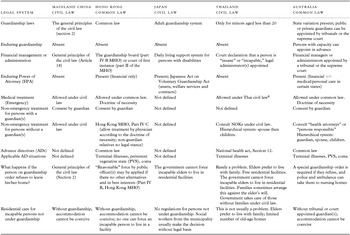
The statutory laws that support this arrangement (see Table 1) are buttressed by certain sociocultural expectations, such as the preference of Thai elders for their adult children to be involved in their medical decision-making. Thai children are expected to care for their parents, and to make medical decisions on their behalf.
A comparison of the prevailing provisions for medical-social care in China, Hong Kong, Japan, Thailand, and Australia

Key: EPA: enduring power of attorney; NOK: next-of-kin; MHO Mental Health Ordinance.
# Laws supporting this include the Declaration of Thai Senior Citizens 1999; “Person” and “Family” sections of the Civil Law; Patients’ Rights 1998; Thai Mental Health Act 2008; Aged People Act 2003 and National Health Act 2007.
The aforementioned principles of the presumption of capacity, which assumes that all adults are capable of making decisions, regardless of diagnosis, and the doctrine of necessity, which allows for emergency treatment in the best interests of patients who are unable to make their own decisions (Re F, 1989; Re T, 1992; O’Neill and Peisah, Reference O’Neill and Peisah2011) have their origins in common law, as it applies in both Hong Kong and Australia. In Hong Kong, the doctrine of necessity is extended to non-urgent cases in which there is no guardian, providing it is enacted in the patients’ best interests based on the opinion of the treating physician to improve or prevent damage to or the deterioration of the patients’ physical or mental health (Common law; Part IV C of the Mental Health Ordinance [MHO]).
Although the presumption of capacity also exists in Hong Kong, according to the Hong Kong MHO, patients diagnosed with active mental disorder(s) or mental handicaps are legally considered “mentally incapacitated persons” (MIPs), which has generated much confusion in the field. While some legal provisions address the care and supervision of MIPs and the management of their property and affairs, it is acknowledged that MIPs do not always lack the capacity to make decisions pertaining to their medical treatment, welfare arrangements or financial disposition. According to the MHO and common-law standards, mental capacity is decision, time and domain specific, in recognition of the dynamic interplay between a person's abilities and the demands of specific decision tasks (Wong and Scully, Reference Wong and Scully2003). Physicians thus assess patients’ mental capacity for specific tasks from a functional standpoint. In cases where incapacity is temporary, important decisions that can be delayed without causing serious harm to the patient are postponed until capacity is restored to preserve autonomy (Wong and Scully, Reference Wong and Scully2003). This principle also applies in Australia.
Australia has the same hierarchy of surrogate decision-makers as China and Thailand, where the legally appointed guardian tops the list. In Australia, although confounded by the diversity of laws across different states, non-urgent cases are further divided into “excluded” or “minor” (often non-intrusive and uncontroversial), “major” (often including psychotropics) and “special” (e.g. sterilization, pregnancy termination or experimental) treatments along with the corresponding designation of the need for consent from an appropriate substitute decision-maker. Thus, minor or excluded treatments do not require formal consent, and special treatments can only be consented to by the relevant tribunal (O’Neill and Peisah, Reference O’Neill and Peisah2011). Notably, in New South Wales, the use of psychotropics for a person lacking capacity must be consented to by a “person responsible,” defined according to the aforementioned hierarchy.
In Hong Kong, although it is considered good practice for a treating physician to consult the opinions of a patient's relatives, a relative can only give proxy-consent if he/she is a legal guardian. Accordingly, the treating physician may ask a patient's relative or social worker to apply for guardianship before seeking legal proxy-consent from that individual.
Notably, there is no law for surrogate decisions in medical practice in Japan. For patients who lack the capacity to consent to treatment, physicians conventionally obtain consent from family members. Although this approach has no legal basis, it has legal precedent and is supported by the traditional Japanese family structure. However, this structure has recently begun to change with the growing number of nuclear families. For patients without families, physicians tend to avoid invasive treatments. Japanese law does not allow the guardian of an adult to make any surrogate healthcare decisions. However, some physicians not cognizant of the related laws continue to seek consent from guardians. In light of the conspicuous absence of legislature on surrogate medical decision-making, the Japan Federation of Bar Associations proposed a new set of laws in 2011 based on a hierarchy of surrogate decision makers with reference to the law related to mental health and welfare of the person with mental disorder. The Legal Support Adult Guardian Centre, the largest group of professional guardians internationally (6,620 constituents as of September 2013), also recommended legal reforms for guardians to assume the role of surrogate medical decision-maker with medically and legally sound implementation guidelines.
A number of non-governmental organizations (NGOs) in Japan have also introduced initiatives to develop user-friendly, pragmatic systems for assisting decision-making and maximally respecting patient autonomy. Exemplary of these efforts is the J-DECS programme (http://j-decs.org/en/), which facilitates (i) the selection of suitable assessment tools for determining the extent of an individual's mental capacity to consent to specific tasks that are intuitive to non-specialists; (ii) the establishment of suitable guidelines for making different surrogate medical decisions in accordance with the patient's best interests; and (iii) the development of relevant management algorithms to guide stakeholders in different scenarios.
Guardianship
Guardianship systems have been evolving across the Asia-Pacific region since the late 19th century, when a simple guardianship system following the French system was launched in Japan, but infrequently adopted. In 2000, this system was replaced with a modern and refined guardianship system, again based on the French system. This new system holds a unique position in the history of Japanese civil law in that it is designed to respect a person's rights while maximizing his/her residual ability to make decisions, thereby honoring the concepts of empowerment and normalization. This new form of guardianship is classified into three categories according to the level of an incapacitated person's disability, with “assistance” being the mildest, followed by “curatorship” and “guardianship.”
All guardianship applications must be presented before a court, which appoints a guardian(s) after due investigation of the medical evidence of a person's mental incapacity and functional disability. The guardian(s) is/are responsible for managing the ward's assets and supervising his/her daily life by liaising with welfare facilities, hospitals and other community service providers as needed. Although wards were initially prohibited by law to vote in governmental elections, in June 2013 the Tokyo district court overturned this longstanding restriction. The number of users of the Japanese guardianship system has been rapidly rising (166,289 as of December 2012). However, professionals have criticized the court procedures pertaining to guardianship as being over-simplified for the sake of speeding up the process, and the decision to leave out legally non-mandatory input from specialized physicians or psychiatrists.
Additionally, in Japan, the law related to Mental Health and Welfare of the Person with Mental Disorder (1995) gave guardians the right to consent to involuntary mental hospitalization for patients judged incapable by a designated physician. The law also stipulated a hierarchy of decision-makers, following a descending order of guardian, curator, spouse, person with parental authority, court-appointed person under duty to support, and the mayor of the municipality. This order was removed in a revision of the law in 2013, and any of the persons listed above may consent to involuntary hospitalization. However, there is no such regulation for involuntary institutionalization in long-term care homes.
Systems of guardianship and financial administration have existed in Australia since the 1980s, when guardians or financial (“administration”) managers began to be appointed by guardianship tribunals or the Supreme Court under the statutory guardianship laws (O’Neill and Peisah, Reference O’Neill and Peisah2011). While similar functions (i.e. accommodation, health care, services and medical consent) can be given to guardians, financial management is always a separate issue. Importantly, to minimize intrusion and maximize autonomy, such functions are usually specific (i.e. not plenary or overarching) and appointments are usually limited (e.g. often only 12 months) and subject to review. In circumstances where a person's needs can be accommodated by means other than the appointment of a guardian, the tribunal will decline to make an appointment, in accordance with the principle of finding the “least-restrictive alternative” (Robinson, Reference Robinson2009).
In Australia, guardians may be empowered to override the wishes of a person who lacks capacity and is in need of care, and authorize their involuntary admission to a residential care facility. Guardianship tribunal applications are rapidly rising along with the ageing population (NSW, 1999: 4,533 applications; 2008: 8,338 applications) and the increased complexity of familial dispute cases (Robinson, Reference Robinson2009).
Established in 1999 under Part IV B of the MHO, the Hong Kong Guardianship Board is a quasi-judicial tribunal that appoints guardians for MIPs who are unable or limited in their capacity to make decisions about medical, financial, and other personal affairs. The Board is chaired by a person in the legal field, and the members comprise lawyers, medical practitioners, social workers, and others with personal MIP experience, which is similar to the system in Australia. In addition to giving consent to medical treatment on behalf of MIPs, legal guardians may require MIPs to reside at a specified place, attend medical appointments, and hold, receive or pay a regulated monthly sum of money for the maintenance of other benefits, thereby taking on the role of trustee.
In China, according to the general principles of the Civil Law (Article 17), certain people (e.g. spouses, children, relatives or friends) can apply for the guardianship of a mentally ill person with or without a limited capacity for civil conduct, from the neighborhood or village committee in the person's place of residence or the civil affairs department. Alternatively, in the absence of such a person, a public guardian can be arranged. The domains of guardianship include personal care (i.e. medical treatment and place of residence, with the latter being rare due to the scarcity of residential homes) and property management. No reports from the specialized medical professionals or lawyers are required to support the applications, and guardianship disputes may be settled by either the neighborhood or village committee, or in the People's Court.
Thailand's guardianship orders apply only to minors. Notably, many professionals consider guardianship in surrogate medical decisions to be irrelevant to Thai culture, and the related laws are absent. In addition, the Thai Criminal Code stipulates that it is an offence for a child to neglect his/her parent(s).
Key adjunctive legal structures to guardianship legislation are the processes that facilitate advanced planning, such as the self-appointment of enduring guardians, which often obviate the need for the formal appointment of guardians by tribunals or courts and are more supportive of individual autonomy. This system is available in Australia but has not been implemented elsewhere in the region. In Hong Kong, a recent Legislative Reform Council proposal to expand the scope of EPA to “personal” and other health matters was not successful after stakeholder consultation, due to concerns that attorneys would have overwhelming plenary authority to make every personal medical, social, and financial decision on behalf of the represented person.
Approaches towards end-of-life decisions and advance directives
Advance directives (ADs) are healthcare or medical treatment decisions made before a person loses his/her decisional capacity. In Australia, ADs are supported by common law (e.g. Hunter and New England Area Health Service v A [2009] NSWSC 761) in the states of NSW and Tasmania, and statutory law in Victoria, South Australia, Queensland, Western Australia, the Australian Capital Territory, and the Northern Territory (O’Neill and Peisah, Reference O’Neill and Peisah2011).
In Thailand, Section 12 of the National Health Act (2007) enables hospitalized patients with a terminal illness to formally voice their wishes to abandon further treatment and request to die at home. According to the law, patients with terminal illness are allowed to express their wish to not receive medical treatments that merely “prolong their terminal stage of life.” However, the patients continue to receive appropriate care to relieve pain and symptoms. Patients who are considered “capable,” and are under the supervision of their health care providers, have the right to compose their own living will. However, the patient's family should be informed about the living will (Section 12 of National Health Act 2007).
In Thailand, a hospitalized person who refuses life-sustaining-treatment (LST) is required to submit a “living will” to the treating hospital. The hospital must bring the case to a committee, which will identify whether the patient is actually suffering from a terminal illness. If the patient's request is approved, he/she maintains the right to palliative care, and can choose to die at home. The act does not allow a proxy to perform this role, irrespective of the patient's cognitive status. Furthermore, euthanasia is excluded. However, much debate ensued in Thailand after these laws were introduced.
The concept of ADs is relatively new to Hong Kong. In 2009, the government issued a consultation paper to advance the concept of ADs and seek opinions from different sectors as to whether they should be formally introduced (Ting and Mok, Reference Ting and Mok2011). Although the local Law Reform Commission facilitated the use of ADs by publishing a “model form” involving three scenarios (terminal illness, irreversible coma, and persistent vegetative state (PVS)), no specific legislation pertaining to ADs has been introduced, although like in Australia, ADs are recognized by the common law.
Nonetheless, the promotion of the use of ADs in Hong Kong has met with a number of difficulties (Au, Reference Au2009). Public understanding of the issue is influenced by the media, which has focused on euthanasia rather than advanced care planning (Au, Reference Au2009). Furthermore, patient and pressure groups suspect that ADs were promoted to limit government expenditure on palliative care, and religious groups have objected to the withholding/withdrawal of artificial nutrition and hydration (Au, Reference Au2009). There is also limited understanding of the attitudes of local elders (Ting and Mok, Reference Ting and Mok2011). Vulnerable groups such as the elderly and persons with severe disabilities may feel obliged to make ADs and feel guilty for not doing so (Au, Reference Au2009). However, an important technical advance in 2012 allowed for specific alerts to the presence of an AD to be entered into computerized and printed medical summaries of all public health records. This had a significant positive effect on AD implementation and information sharing. The same process was also recently implemented in Australia.
There are currently no AD laws in Japan and numerous versions of AD forms have been published. There have also been difficulties in promulgating the directives. Doctors are often unfamiliar with ADs, and as the arrangement is not backed by codified law, physicians often find it difficult to make healthcare decisions when a patient's family opposes the plan suggested in an AD. Furthermore, the general public in Japan tend to perceive ADs negatively, as they are often linked with euthanasia and the belief that doctors and not patients should make medical decisions. In 2013, a draft set of laws for the living wills of terminal-stage patients was rejected.
Similarly, despite rising concerns about the issue of end-of-life decisions, no laws in mainland China address ADs. Although people may draw up advanced care plans when mentally fit, their relatives can override the directives upon execution, as there are no laws to support their legitimacy.
Management of finances
As abovementioned, in many Asia-Pacific countries, the roles of guardians extend to the management of assets. In Australia, however, the two roles are considered very separate and guardians are appointed separately. When a person no longer has the capacity to manage his/her financial affairs or appoint an attorney, a financial manager/administrator can be appointed by the relevant guardianship tribunal or the Supreme Court, provided proof exists that (i) the person is incapable; (ii) the person needs a manager and (iii) the appointment is in the person's best interests (O’Neill and Peisah, Reference O’Neill and Peisah2011).
In Hong Kong, before the establishment of the Guardianship Board in 1999, any financial matter pertaining to MIPs was handled by the Court of First Instance under Part II of the MHO. However, guardians appointed by the Guardianship Board can only handle a regulated monthly amount of money (equivalent to around USD 1,300) (Chan et al., Reference Chan, Luk, Liu, Chiu, Chan and Chu2009) on behalf of a MIP for the maintenance or other benefit of that person. Therefore, for MIPs with substantial assets, an application to the Court of First Instance remains necessary if the need arises to mobilize such assets.
In Japan, a method for supporting the financial management of persons with mild disabilities, known as the “Daily Living Support System for Persons with Disabilities,” was launched in 1999. The system, which is based on the Japanese Social Welfare Act, facilitates contracts with day-care service providers under the long-term care insurance system. Individuals who are mentally competent in terms of basic contracting but require support in daily life may use this system. Contracts are arranged with the Municipal Council of Social Welfare, whereupon the individual receives financial management support and official services. The individual's mental competency to sign a contract and understand its content is evaluated according to the related guidelines promulgated by the Contract Review Board examiners.
In China, guardians have specific responsibilities to act in the best interests in managing the financial assets of persons under guardianship (“wards,”) according to the General Principles of the Civil Law (Article 18). Should the guardian act irresponsibly, the matter may be brought before the People's Court, and the guardian may be disqualified. In Thailand, a legal administrator can help manage a person's finances if the courts declare that the person is “insane” or “incapable.” This process is usually initiated by the family.
As with personal matters, there is increasing recognition of the need to facilitate advanced planning through the self-appointment of financial POAs. In Australia, since the 1980s, a capable person may be granted financial EPA to make arrangements in regard to financial matters (O’Neill and Peisah, Reference O’Neill and Peisah2011). Recently, Australian common law has increasingly provided guidance in defining when a person has the capacity to appoint an EPA, including an understanding of when the instrument “kicks-in,” knowledge of the estate (which varies according to its complexity), an understanding of the attorney's trustworthiness/appropriateness and potential actions on behalf of the donor. Notwithstanding these guidelines, with the common law starting point of a presumption of capacity, there is no mandated medical certification for such mental capacities. Instead, it is mandated in some jurisdictions and prudent practice in others, for the lawyer to certify that he/she has explained the document and that the donor appeared to understand. When doubt about capacity persists, the onus is on the solicitor to engage expert opinion.
In Hong Kong, although laws enabling the making of EPAs have been in place since 1997, the uptake has been extremely low, with only 21 cases recorded in the decade after the law was enacted (compared with 19,480 cases in England and Wales in 2006 alone) (Chiu, Reference Chiu2009). In contrast to Australia, the original Hong Kong law stipulated that a doctor should certify a donor's soundness of mind when the EPA is being signed with the lawyer. However, this was viewed as an obstacle to the use of EPAs and after widespread consultation, in August 2012 the EPA law in the MHO was updated to allow 28 days between a donor's visit to a solicitor and a registered doctor.
Japan's Voluntary Guardianship Contracts Act enables an individual to contract with a guardian if he/she is mentally fit. The guardianship becomes effective when the individual is proved to be mentally incapacitated. The guardian then holds the POA to manage predetermined assets, choose welfare service programmes and sign contracts on behalf of the MIP. Notably, in Japan, neither formal psychiatric assessment nor lawyer involvement is legally required to initiate the process. Guardianship is activated following a court review.
There is currently no legal concept of EPA in mainland China or Thailand.
Discussion
The evolution of the surrogate decision-making processes for persons with DMDs in regard to medical, social or financial matters has accelerated over the last 25 years in the Asia-Pacific region. Despite the commonalities in the various legal systems, the shape of these processes has clearly been fashioned by the different countries’ unique sociocultural contexts, which determine the respective roles that the physician, the family, and external government parties play in decision-making. These roles, in turn, are influenced by the culturally-specific philosophies regarding connectedness, autonomy, and the relative fragmentation of the family. Insights, such as those provided by this review, into cultures that still enshrine the role and obligations of the family can be of value to those struggling with the risk of the “abandonment” of those with DMDs in the name of the “mandatory autonomy” imposed by our often “aggressively individualistic” Western ethical frameworks (Kim, Reference Kim2010).
Some processes are still evolving across the region, such as those that facilitate advanced planning, as a result of the paucity of legal structures for EPA and guardianship in some regions, and the struggle to achieve consensus in regard to end-of-life decision-making processes that are favored by all stakeholders and that support the autonomy, dignity and best interests of patients. Of interest to those outside the region is the commonality in this struggle, which is no doubt due to the nature of the process (Hui, Reference Hui2007; Hertogh, Reference Hertogh2011; Le and Chapman, Reference Le and Chapman2011; Reutens and Peisah, Reference Reutens and Peisah2012).
Other processes that serve as useful models for minimizing intrusion and maximizing autonomy and dignity for people with DMDs include the moves away from the plenary powers of guardians, the preference for informal decision-making hierarchies and graded guardianship regimes. Although the formal acknowledgment of a continuum of decision-making options from autonomous to supported (Wong and Scully Reference Wong and Scully2003, Peisah et al., Reference Peisah, Sorinmade, Mitchell and Hertogh2013) and, at last resort, substitute decision-making still eludes us, initiatives such as the J-DECS scheme in Japan help make the important step of improving the assessment of capacity.
To encourage information sharing and advocacy across the Asia-Pacific region on approaches to DMD, we have elucidated both challenges and solutions that have global significance. The initiatives by organizations such as the Asia Consortium of the IPA taskforce and capacity Australia, which we have discussed in this review, provide a forum for sharing and collaboration among those with a vested interest in promoting human rights and advocating for the improved and respectful care of older people with mental disorders.
Conflict of interest declaration
Carmelle Peisah and Nick O’Neill are non-remunerated directors of Capacity Australia, a not-for-profit education and research institution.
Description of authors’ roles
JT, CP, JN, NW, TW, NN and HC contributed to the scope and content of this work. SO, MM and YK commented particularly on the situation in Japan. All of these authors contributed to the revisions.
Acknowledgments
The authors thank the other members of the IPA capacity taskforce and the anonymous reviewers of this paper for their advice.