1. Introduction
Legality and legitimacy do not easily align. What is legal by lawFootnote 1 may be of questionable legitimacy, and what is illegal may be perceived and practised as highly legitimate, as long as it “is in accord with the norms, values, beliefs, practices, and procedures accepted by a group.”Footnote 2 The incongruence between legality and legitimacy reflects the tension between law and social norm, which has long been an important focus in socio-legal studies.Footnote 3 A plethora of research has revealed how illegality is lived and experienced as socially legitimate practice in the cases of undocumented immigration, same-sex marriage, abortion, informal markets, etc.Footnote 4 Scholars have documented how moral and legal entrepreneurs in democracies often deploy frames such as rights discourse to push for legitimation or even legalization of illegal practices.Footnote 5 Such struggles tend to be highly politicized, as proponents and opponents constantly wage public fights through the mobilization of social movements, media debates, and political lobbies.Footnote 6
Yet, in authoritarian states where civil society is weak, press censorship is strong, and public participation in the legislative process is limited, social space for illegality contestation or legitimationFootnote 7 is much narrower, if not entirely non-existent.Footnote 8 Collective action for political and legal resistance is constantly seen as a serious threat to authoritarian-regime stability and, thus, is prone to various forms of repression.Footnote 9 In such contexts, not only are there fewer instances of open contestation over illegality, but also there is a lack of understanding as to whether, how, and by whom the illegal might be legitimized, to what extent such struggles would be politicized, or what legitimation frames may be deployed.
This study makes one of the first attempts to unpack illegality-legitimation struggles in authoritarian states, which will deepen our understanding of how illegality is socially constructed and contested within repressive polity. The empirical focus is transnational illegal drug brokerage. It makes a convenient site for studying legitimation struggle as a form of informal market, which is either illegal or underdefined by law but can be legitimate to some large groups who recognize and exploit economic opportunities outside the realm of formal institutions.Footnote 10 The analysis centres on a hotly contested case of transnational illegal drug brokerage in China, the largest and most powerful authoritarian country in our time. In this case, criminal charges against a broker of illegal foreign cancer drugs, Lu Yong, were questioned and withdrawn after provoking a nationwide trial by media in 2015.
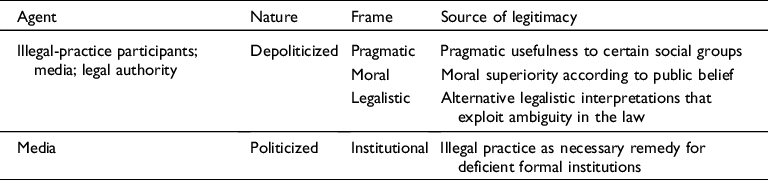
Triangulating news articles, legal documents, and interviews, the paper distinguishes between two pathways of illegality legitimation: depoliticizedFootnote 11 and politicized. I argue that the depoliticized pathway is made possible through pragmatic, moral, and legalistic frames, whereas the politicized pathway builds upon an institutional frame. The three depoliticized frames legitimized illegal activity by stressing its pragmatic usefulness to certain social groups, moral superiority according to public belief, or alternative legalistic interpretations that exploit ambiguity in the law. By contrast, the institutional frame followed a politicized pathway. It legitimized illegal practices as a necessary remedy for deficient state institutions, holding the state accountable for the systematic gap between legitimacy and legality.
Moreover, my study identifies three legitimation agents and highlights the essential role of media, which is found to be pivotal to the construction of legal consciousness and the mobilization of legal resistance under authoritarianism.Footnote 12 I argue that, while illegal-practice participants and the legal authority tend to only mobilize depoliticized frames, the media adopt all the four frames to pursue both depoliticized and politicized legitimation of illegality. By identifying different pathways, frames, and agents of illegality legitimation, the paper aims to unravel the social construction of illegality as well as the intricate relation between law, media, and society within authoritarian states.
The paper proceeds as follows. First, I review studies on illegality legitimation, showing how media may play a crucial role in authoritarian contexts. Then, I elaborate on my framework of depoliticized and politicized legitimations of illegality. Next, I introduce the case background, data, and methods, and then present the case analysis. Last, I conclude by discussing the study’s implications for socio-legal research.
2. Existing studies on illegality legitimation
2.1 Highly politicized struggles in democracies
Illegality is often fiercely contested in the public sphere of democratic societies. In this context, struggles to legitimize the illegal tend to be highly politicized, since they are usually integral to legalization movements, such as those concerning abortion, same-sex marriage, and undocumented immigrants.Footnote 13 These legitimation/legalization struggles often play out as ideological wars between opposing camps that prioritize different aspects of human rights. Examples include women’s right to self-determination vs. embryos’ right to life, gays’ right to get married vs. disciples’ right to outlaw heretics, and immigrants’ right to stay and settle vs. anti-immigrants’ right to defend national sovereignty.Footnote 14 Frequently mobilized alongside these rights-based claims are other politicized frames such as citizenship.Footnote 15 Meanwhile, depoliticized frames like moral economy have also been adopted for legitimation goals.Footnote 16
In democracies, largely thanks to widespread public participation in the legislative process, such fights penetrate all sorts of political activities, including election campaigns, business lobbies, expert advocacies, and social movements, thus involving a variety of social actors from politicians and entrepreneurs to professionals and activists.Footnote 17 Media are crucial facilitators of these legitimation struggles given their central role in disseminating legal knowledge, shaping legal consciousness, and wheeling legal mobilization.Footnote 18 Research has shown how different interest groups proactively pursue (de)legitimation agendas on media platforms to engineer legal change.Footnote 19 However, we know little about the nature of the legitimation struggle over illegality in authoritarian states, nor do we know much about the role of media in this process.
2.2 Legitimation prospects in authoritarian states: media framing and legal mobilization
Authoritarian states constantly suppress civil society, violate press freedom, and constrain public participation in the legislative process.Footnote 20 But collective action from the bottom up is still commonly observed. Scholars have documented myriads of social protests under authoritarian rule, such as those against labour exploitation, land expropriation, environmental degradation, etc.Footnote 21 However, most of these movements are fights aimed at safeguarding protesters’ lawful rights (e.g. land ownership and workplace protection). There are much fewer records of collective protests aimed at defending what is stipulated as illegal by law, not to mention movements striving for full legalization, which would be considered a direct challenge to authoritarian-regime authority and, thus, prone to various forms of repression.Footnote 22 Moreover, authoritarian states like China are especially alert to human rights accusations,Footnote 23 which are commonly used in democratic legitimation/legalization campaigns. In such a context, how is illegality legitimation possible against all the odds?
I call attention to the crucial role of media framing in legitimation struggles under authoritarianism. Framing is a concept rooted in psychology, sociology, and communication studies.Footnote 24 In this study, I define media framing as the modes of presentation that journalists and other communicators use to select some aspects of a perceived reality and make them more salient in a communicating context in a way that resonates with existing underlying schemas among their audience.Footnote 25 Although selection and salience sometimes lead to the distorting and misrepresentation of law,Footnote 26 framing is a necessary tool to reduce the complexity of an issue and make it accessible to lay audiences.Footnote 27
In authoritarian China, media framing is essential to the formation of legal consciousness, the justification of legal claims, and the mobilization of law.Footnote 28 Research reveals that the social construction of legality under authoritarian rule is not a top-down process, but a complex negotiation among multiple parties in the public sphere.Footnote 29 My study finds that the same holds true for illegality. Media are crucial negotiators not only because other spaces for legal mobilization are often repressed by the state, but also because traditional media outlets have sought to resist censorship and expand the boundaries of critical journalism, especially after embracing the Internet.Footnote 30 In China, for example, the Post-Mao media have transformed from the Party mouthpiece to a watchdog of official abuses,Footnote 31 a platform for grievance resolution,Footnote 32 and a facilitator of collective resistance,Footnote 33 though some news outlets remain important channels for state propaganda.Footnote 34 Specifically, Chinese media have been found to be an effective force in pressuring the legal authority to act fairly when exerting competitive pressure or backed by popular discontent and legal professionals.Footnote 35
However, would the media, which often identify as the guards of social justice fending off against an authoritarian legal system, go as far as legitimizing “the illegal” given the limited room for illegality contestation? Literature shows that popular trials by media can do so by turning controversial legal disputes into national sensations. However, the examples mostly include high-profile criminal cases involving dramatic death—not politically threatening, but emotionally provoking.Footnote 36 In these scenarios, the media, usually along with outraged netizens, either demand heavy sentencing for evil wrongdoers (e.g. in the case of Liu YongFootnote 37 ) or request a light punishment for choice-less perpetrators (e.g. in the case of Deng YujiaoFootnote 38 ).
Essentially, defences and legitimation of illegality in such cases—for example, Deng Yujiao, who stabbed her sexual assailant to death—are driven by a moralized populism. The gap between legitimacy and legality tends to manifest as the inconsistency between public morality and law.Footnote 39 In China, public moral belief is frequently mobilized as a useful frame in social protests.Footnote 40 The tradition of moral trials backed by populist sentiment can be traced back to the Mao eraFootnote 41 and as early as imperial times several centuries ago.Footnote 42 Similar trends also occurred in other post-communist societiesFootnote 43 and developed democracies, where “penal populism” emerged out of declining deference to the criminal justice establishment and the growing influence of popular media.Footnote 44
While populist moral trial by media may uphold social justice in authoritarian states against pushback from the legal authority (e.g. defamation litigationFootnote 45 ), scholars have pointed out its two flaws. First, such efforts tend to take on politically safe issues, only questioning local legal authorities’ performance while leaving the top levels or systemic injustice out of bounds.Footnote 46 Second, doing so might encourage political intervention and undermine judicial autonomy, thus impeding political reforms seeking to establish the rule of law.Footnote 47 Yet, for our purpose, there are several questions left unanswered: Is public morality the only frame that the media can draw from to contest and legitimize illegality? To what extent would such struggles be politicized beyond individual grievances and moralized stories?
3. From depoliticized to politicized legitimation of illegality
I argue that illegality-legitimation struggles in authoritarian states can follow both depoliticized and politicized pathways. Three depoliticized legitimation frames are identified: pragmatic, moral, and legalistic frames. They legitimize illegal activity by stressing its pragmatic usefulness to certain social groups, moral superiority according to public belief, or alternative legalistic interpretations that exploit ambiguity in the law. By contrast, I find that the politicized pathway builds upon an institutional frame, which legitimizes illegal practices as a necessary remedy for deficient state institutions, holding the state accountable for the systematic gap between legitimacy and legality.
My study also identifies three different legitimation agents and highlights the essential role of media. I argue that, when facing pressure, both illegal-practice participants and the legal authority tend to only mobilize depoliticized frames, whereas the media adopt all four frames to pursue both depoliticized and politicized legitimation of illegality. First, illegal-practice participants tend to focus on individual dispute resolution, trying to avoid direct confrontation, and appeal for mercy from the criminal justice system. This echoes Chua’s observation of the gay movement in Singapore, where social activists strategically downplay confrontation and deploy pragmatic resistance within a repressive state.Footnote 48 Yet, as shown in my case, illegal-practice participants do not necessarily organize for any political and legal reform. They can be content with living quietly in the shadow of the law, unless they are accidentally exposed and forced to defend themselves in front of the legal authority and the public. Second, under public pressure, the legal system is also likely to recognize the legitimation of illegal practices. However, it tends to only incorporate depoliticized legitimation frames into official discourse, making selective compromises to co-opt dissent and sustain authority. This exemplifies “bargained authoritarianism” in China, which depoliticizes state–society confrontation through instrumental bargaining with dissidents in order to manage popular unrest and maintain regime stability.Footnote 49
Last, and more importantly, it is the media that not only elaborate on and amplify the depoliticized pragmatic, moral, and legalistic frames, but also invoke the politicized institutional frame. I also paid special attention to two other politicized frames that are frequently observed in democratic legitimation movements: rights and citizenship. However, they are much less prevalent and only scattered around in the media coverage examined here. This indicates that, while the media’s politicized legitimation struggle can escalate a law-enforcement issue to a political problem, it tends to focus critiques on concrete formal institutions rather than the broader legal system or the general authoritarian ideology. Clearly, the legitimacy of illegality is constructed through different framing strategies in authoritarian states than that in democracies, as summarized in Table 1.
Illegality legitimation in authoritarian states

4. Case background
Transnational illegal drug brokerage is a good site for studying illegality-legitimation struggles. This is because it constitutes a huge, emerging informal market widely accepted by millions of patients but barely known to the wider public, underregulated by the state, and defined as illegal by the law. Suffering from serious drug-price inflation, millions of Chinese cancer patients have been seeking cheap but quality generic Indian drugs via informal channels, which was facilitated by the rise of electronic commerce. However, these unlicensed drugs were labelled as “illegal” and “fake” by China’s Drug Administration Law and Criminal Law. People brokering them were often accused of selling fake drugs, even though they might benefit tens of thousands of patients.
In authoritarian China, compared to other contested criminal trials with dramatic death scenes, transnational illegal drug brokerage is a high-profile case of even stronger life-and-death relevance. It exposes a long-lasting but little-noticed social problem reflecting entrenched health inequality: the widespread lack of legal access to affordable life-saving drugs. Yet, such life-and-death relevance, as well as the boundaries of legitimacy and legality, are far from self-evident. Thus, it entails significant social efforts—media exposure and elaboration, in particular—to legitimize what appears illegal, convey the complexity to the public, and exert pressure over the legal authority.
My analytical focus is on the legitimation struggles during a hotly debated legal dispute. In this case, the arrested broker Lu YongFootnote 50 became nationally renowned as “the Medicine Hero” and “the First Broker of Indian Cancer Drugs” after widespread media coverage of his charge and release in late 2014 and early 2015. This media trial was the first public exposure of the huge, emerging informal market of transnational drug brokerage. Between December 2013 and May 2017, over 100 brokers were found guilty in China,Footnote 51 with Lu Yong as the only exception. As a chronic myelogenous leukaemia (CML) patient, Lu has survived on the generic Indian drug GleevecFootnote 52 and brokered it for thousands of his fellow patients since 2005. In late 2013, he was arrested and accused of selling fake drugs by the procuratorate in Yuanjiang City, Hunan Province.
Lu’s accusation was first exposed by The Paper on 8 December 2014.Footnote 53 Finding his dramatic case very newsworthy, Southern Weekly approached LuFootnote 54 and published an in-depth report on it ten days later.Footnote 55 Immediately, Lu’s story was reported by The Beijing Times Footnote 56 and The Beijing News,Footnote 57 the two most influential newspapers in China’s capital. Before long, follow-up reports proliferated nationwide. In the following weeks, Lu was on bail waiting for trial and was interviewed by different news outlets from all over the country. Infuriated by Lu’s media presence, the local procuratorate in Yuanjiang sent police to arrest him again on 10 January 2015, when Lu arrived in Beijing for an invited television interview.Footnote 58 This second arrest provoked another round of media outcry.
Three weeks later, on 29 January, Lu was suddenly released with all the criminal charges dropped,Footnote 59 which surprised everyone. On 26 February, the procuratorate published two detailed legal opinions online to explain the charge withdrawal.Footnote 60 Afterward, the public interest in Lu’s case gradually faded away. In 2016, the charge withdrawal was set by the state as a stellar example of the legal system’s laudable responsiveness to public demand. Several years later, in 2018, a bestselling and top-rated Chinese movie, Dying to Survive (wo bushi yaoshen), brought this closed case back to the public eye. The social drama invoked another round of public debates over the legitimacy and legality of transnational drug brokerage.
5. Data and methods
The analysis centres on the original media trial in 2014 and 2015. I triangulated news articles, legal documents, and interviews to unpack how the legitimation struggle was initiated by Lu and his fellow patients, then facilitated and escalated by the media trial, and eventually co-opted by the legal authority.
First, I collected and analyzed mainstream news coverage on Lu’s case to explore the media’s role in the legitimation struggle. I searched the data set Wisesearch to collect all of the Chinese news articles reporting Lu’s case with the keywords “Lu Yong” and “Gleevec” (geliewei). Among the 5,986 valid results from 8 December 2014 to 24 April 2015, there were 272 non-redundant articlesFootnote 61 published in national and local news outlets. To filter articles with significant national influence, I selected those published in the top 100 most influential news media in China based on the People’s Daily Online ranking in 2016,Footnote 62 the total number of which was 172. In addition to an in-depth qualitative analysis of the legitimation frames in the news data, I trained two research assistants as independent coders to help to evaluate the frame prevalence using Atlas.ti. Based on my close reading of all of the articles, we started with a deductive coding scheme to conduct a pilot test for intercoder-agreement reliability. The test reported a satisfactory agreement levelFootnote 63 and we adjusted the coding scheme inductively after resolving disagreements in the test.Footnote 64 Then, the two research assistants moved on to independently code the full sample. The quantitative calculation of the frame prevalence was based on their final report.Footnote 65
Second, I scrutinized the legal documents in Lu’s case to explore how the legal authority co-opted the legitimation struggle. I first analyzed the detailed official discourse that explained Lu’s charge withdrawal. Then, I compared it with other similar cases that attracted little media attention. I collected 84 adjudication decisions involving 127 transnational drug brokers issued between December 2013Footnote 66 and May 2017 from online databases PKULawFootnote 67 and China Judgements Online.Footnote 68 I also found 12 decisions not to prosecute over suspects accused of selling fake drugs from Case Information Disclosure of the People’s Procuratorate of the People’s Republic of China.Footnote 69 These other brokers attracted little public attention and failed to gain any legitimacy recognition from the legal authority.
Last, I conducted 17 interviews with different stakeholders involved in the case to understand its evolution in the legal system and media, with special attention on the legitimation frames used in the process. Testimonies from Lu, his lawyer, his fellow patients, and journalists who were early reporters of his story, along with other written evidence, were particularly informative in helping me to understand how the legitimation process was initiated in the first place. Other interviewees consisted of political, economic, and professional elites who either explained or defended the illegal nature of transnational drug brokerage from an establishment perspective. They were law professors, medical experts, former and current government bureaucrats, and representatives from pharmaceutical companies. I recruited most of them in a post-case Beijing conference held in April 2015, which reflected upon Lu’s case and discussed how to revise the Drug Administration Law accordingly. Their testimonies revealed intra-state controversies over the legitimacy and legality of transnational drug brokerage and helped me to identify what was highlighted or downplayed in the media discourse. While I mainly rely on textual data drawn from news articles and legal documents to trace how the media and legal authority legitimized the illegality of Lu’s brokerage, I cite interviews with Lu Yong and his fellow patients to understand the legitimation efforts made by the illegal-activity participants.
6. The contestation initiated by the broker
Within the patient group, Lu’s brokerage was unanimously accepted as legitimate, but his arrest in 2013 forced them to confront and contest its illegality. In 2014, after almost a year of futile private efforts to get immunity from criminal charges, Lu and his fellow patients initiated a jointly written letter online.Footnote 70 The letter acknowledged the illegality of Lu’s brokerage but stressed its legitimacy in the hope of collecting public signatures to appeal for charge withdrawal. The goal was to save Lu from jail rather than push for any substantive legal/policy reform. In fact, Lu and his fellow patients thought that politicizing this appeal (e.g. organizing offline protest) might end up being more of a hindrance than a help, and they were very cautious not to “irritate the procuratorate.”Footnote 71 Adopting this non-confrontational attitude, their letter appealed for mercy from the legal system. It used three depoliticized framesFootnote 72 to legitimize Lu’s brokerage as pragmatically useful, morally good, and legalistically unproblematic.
Unfortunately, and not surprisingly, this appeal went unnoticed at first. However, Lu refused to give in and resorted to the media, believing that a public trial could grant him justice. Lu explained to me in the interview:
It would be very difficult to reverse the verdict if they found me guilty in court. I couldn’t accept [that]. Why was saving lives illegal? Why should I become a criminal for doing the good deed? I did nothing wrong. Before they judge me in court, let the people judge me first.Footnote 73
The trial by media did change everything. The original joint letter was short and not very detailed, yet the media enriched and amplified, as well as further escalated and politicized, its legitimation effort. It is worth noting, however, that no one, including Lu himself, had expected such enormous media attention or the following dramatic turns in the legal authority’s decisions.
In fact, the only time Lu actively contacted the media was when he reached out to the first reporter of his story. Afterward, Lu became quite popular among media outlets nationwide, which either approached him for an interview or further investigated into the criminal charge (e.g. consulted experts and interviewed other patients). Hence, the legitimation struggle in this national sensation is better perceived as driven by a media trial that exposed, escalated, and politicized an individual grievance rather than by a well-organized social movement for any substantive political or legal change.
7. The trial by media
The price discrepancy between Chinese and Indian anti-cancer drugs has fostered an emerging online market of Indian drug brokerage in China since around 2010. However, this informal market caught little media attention before the exposure of Lu’s case. From July 2011 to November 2014, there were only 39 reports of transnational drug brokerage nationwide.Footnote 74 These reports maintained an overwhelmingly negative tone: the unlicensed foreign drugs were untrustworthy, and Indian drug brokerage was illegal and illegitimate because it led to the proliferation of Chinese-made counterfeits in the name of “Indian miracle drugs.” But the media changed their attitude dramatically when they discovered Lu’s story. In this section, I first elaborate on how the media deployed both depoliticized and politicized frames to legitimize the illegal brokerage. Then I provide a quantitative presentation of the media frames’ prevalence.
7.1 Depoliticized legitimation efforts
As mentioned above, Lu and his fellow patients initiated the three depoliticized frames—pragmatic, moral, and legalistic—to legitimize what seemed to be deemed illegal. Yet, such contestation would not have been exposed to the general public without the trial by media, which enriched their messages and amplified their legitimation efforts in great detail.
7.1.1 The pragmatic frame
The pragmatic frame enabled depoliticized legitimation by highlighting the pragmatic usefulness of the illegal activity to social groups in need. Adopting this frame, the news reports legitimized Lu’s brokerage by featuring the good quality and low price of Indian Gleevec. They stressed that the Indian drug was illegal and labelled as “fake” merely due to its unlicensed status, and that its efficacy and cost-effectiveness should distinguish it from de facto harmful fake drugs. The reports adopted this pragmatic frame by detailing (1) how Lu and other patients validated the drug’s authenticity; and (2) how his brokerage reduced the financial burdens for numerous patients. This is best shown in the most frequently reprinted article:
In 2002, Lu Yong was diagnosed with CML. … Having the medicine (Gleevec), he could stabilize his condition and live a normal life, but he had to take it constantly. The drug sold at 23500 yuan ($3790) per box, and a CML patient must consume one box every month.
… He spent 600–700 thousand yuan (around $100,000) in the first two years and almost went broke.
In June (2004), Lu Yong (diagnosed in 2002) came across an English news report, showing that many Korean CML patients had been using Indian generic Gleevec, which was equally efficacious but sold at only 4000 yuan ($645) per box. Afterward, he learned that the Korea Blood Cancer Association made a comparative test on Swiss and Indian Gleevec, and the result showed that they were 99.9% equivalent.
…
… He called the Indian company, finding that directly purchasing the drug from India cost only 3000 yuan ($484) per box.
Better yet, after taking Indian Gleevec for one month, Lu Yong went to hospital for a test, and all the indexes turned out to be normal.
Lu Yong founded the first online CML patient QQ group (an online chat room) in China as early as in April 2004 with the original purpose of sharing information on bone marrow transplantation. After testing the efficacy of Indian Gleevec on his own, he shared the hope of survival with his fellow patients there in August 2004.
Many patients have started taking the Indian drug since then, and Lu’s QQ group expanded gradually. Currently, he has 5 groups of 4000 members, and over 1000 people are purchasing the drug through him. Lu says, the price of the drug has been decreasing all the time, and the group discount lowered the price to 200 yuan ($32) per box last September.Footnote 75
As emphasized here, the first pillar of the pragmatic frame was the drug’s good quality. This quote described how Lu tested the efficacy of Indian Gleevec with his own life. Other reports further detailed how Lu’s fellow patients reached out to professional institutions for equivalence tests between the original and Indian Gleevec at the molecular level. For example, West China City Daily told the story of Wang Peng, who was introduced to Lu’s QQ group in 2011.Footnote 76 Wang admitted that he and his friends used to suspect the liability of Lu’s channel. To dispel the doubts, Wang sent the brand-name and Indian Gleevec to a test institute, only to find the same result: the two were 99% identical. “We were finally assured that it (Indian Gleevec) is real,” Wang Peng told the journalist. “As long as it’s real. This is our only concern.”Footnote 77 As such, while most news media questioned the authenticity of Indian drug before the exposure of this case,Footnote 78 they abandoned the negative tone and unanimously advocated the good quality of Indian Gleevec to defend Lu’s brokerage.
The second pillar of the drug’s pragmatic legitimacy was its much more affordable price.
Most news articles reporting Lu’s case fiercely condemned the sky-high price of brand-name Gleevec. As the quote showed, while brand-name Gleevec sold in China cost 23,500 yuan ($3,790) per box, the price of the generic Indian version dropped from 4,000 yuan ($645) to 200 yuan ($32) per box.Footnote 79 Many reporters simply presented the “23,500 vs. 200” contrast whenever they wanted to illustrate this striking price difference. In this way, the much lower price and the equally good quality of the brokered drug constituted a powerful pragmatic frame, which convincingly legitimized Lu’s brokerage as pragmatically useful to a large patient population.
7.1.2 The moral frame
Building upon the pragmatic legitimation, the media also mobilized a moral frame to justify the contested illegal practice by highlighting its moral superiority. The reports amplified the moral frame presented in the joint letter, portraying Lu as a tragic hero and complimenting the altruistic motivation of his work. Lu’s heroic story was thus framed as an unfortunate result of moral belief colliding with law. Specifically, the media elaborated at length on how he helped desperate fellow patients to overcome language and institutional barriers to obtain Indian drugs without charging any brokerage fee.
The major challenge for Lu’s fellow patients who needed Indian Gleevec was payment completion. The difficulty was especially daunting for those who could not read English. Lu had bought generic Gleevec from a small Indian company called Cyno for years and established a regular payment channel for himself. However, many new patients from China had little experience in overseas remittance. Before the rise of digital banking, Lu altruistically taught his fellow patients to complete the cumbersome paperwork of traditional remittances step by step. Later, as online money transfer became possible in 2013, a new challenge emerged. The patients urged the Indian seller to open a Chinese bank account to facilitate online payment, which turned out to be difficult and costly to operate from overseas. Once again, feeling obligated to secure this life-saving channel for his fellow patients, Lu promised to help. To avoid misunderstanding and reduce risks, he convinced two rural patients to lend their bank accounts in exchange for free drugs provided by Cyno. The strategy worked well at first, but the two volunteers withdrew the offer very soon. Lu had no choice but to purchase an illegal credit card to continue the job until it accidentally exposed him to the Yuanjiang police. Given the huge sum of money transferred through the account, the police speculated that Lu must be an accomplice to fake-drug sales.
The media restored this story in great detail.Footnote 80 They stressed that Lu did not charge any brokerage fee and that he offered help purely out of altruism. In contrast to most profit-seeking informal brokers, Lu was an altruistic exception. Many news articles questioned the criminal charge against Lu as a tragic result of the collision between moral belief and inhumane law—a struggle between ethicsFootnote 81 and law. They pointed out that public moral belief prioritized the inalienable right to life and health, whereas the inhumane law let formal rules triumph over all else.
In sum, the media portrayed Lu as the “Medicine Warrior”—an altruistic hero fighting against all odds to save lives. The reports also presented how Lu enjoyed high reputation and wide support among his fellow patients. For instance, the most frequently reprinted report cited comments from a patient who was grateful to Lu and indignant at his accusation: “Lu Yong is the lifesaver of us leukemia patients. He was doing the good thing. How many families and lives have been saved by his efforts? He never charged any fee.”Footnote 82 As such, Lu’s brokerage gained great legitimacy through a moral frame, which emphasized its moral superiority in the eyes of the public.
7.1.3 The legalistic frame
In addition to amplifying the moral frame, the media also echoed the legalistic frame that originated from the joint letter. The legalistic frame seeks legitimation through alternative legalistic interpretations that exploit ambiguity in the law. Although the law explicitly classified the unlicensed drug as illegal and fake, it was vague on what constitutes “sales” or “selling fake drugs.” Exploiting this ambiguity, the letter and the media interpreted his brokerage as “non-sales” with him being the representative of domestic customers rather than the agent of foreign sellers. This alternative interpretation challenged the procuratorate’s indictment, which insisted that Lu was an accomplice to fake-drug sales despite his not-for-profit motivation because he “helped the Indian company sell drugs that had not obtained an import permit from China Food and Drug Administration.”Footnote 83
Few bought the procuratorate’s use of law. Many news outlets amplified the alternative interpretation initiated by Lu’s lawyer and supporters: Lu’s provision of bank accounts was a favour to the buyers rather than the seller, and Lu was a representative of numerous self-saving CML patients rather than an agent of the profit-seeking Indian company. This was originally put forward in the online joint letter:
None of the patients in the CML QQ group is Lu Yong’s client. Rather, we are his fellow patients. All the CML patients, including Lu Yong, are patients taking anti-leukemia drugs produced by Cyno. We recognize Lu Yong, beyond all doubt, as the representative of our entire patient group, regarding communicating and negotiating with Cyno.Footnote 84
Many news articles either cited this letter or highlighted the agency of the broker. They sometimes even added testimonies from other legal experts, who were often invited to comment on controversial legal cases as an impartial third party.Footnote 85 At stake was the following question: Was Lu primarily concerned with helping his fellow patients to survive or with helping the Indian company to profit? Lu identified himself with the former, which was firmly verified by his fellow patients and widely publicized by the media, as exemplified by Wu’s article:
The fact that the patients united and helped each other should be distinguished from selling fake drugs. To offend the law and seek to survive, or to obey the law and wait to die? This should not be the “Hamlet’s dilemma” for patients.Footnote 86
There was only scant mention of the fact that Lu did receive gift packages or group discounts from the Indian company, which was followed by Lu’s explanation that it was considered a present for customers rather than profits for salesmen. He clarified in the media interviews that he received stable, considerable revenues from his own export business, thus he had no interest in making petty profits out of the brokerage. Moreover, he sometimes even advanced the payment for poor fellow patients with his own money. This identification as the representative of patient customers, along with the declaration that Lu not only did no harm, but even brought benefits to society (no criminal intent or consequence), effectively legitimized Lu’s brokerage as “non-sales” through a legalistic frame.
7.2 Politicized legitimation efforts
The three frames above were highly effective but rather depoliticized. They focused on legitimizing Lu’s specific practice and contesting the details of law enforcement. What about transnational illegal drug brokerage as a general market phenomenon? While sympathizing with Lu and echoing his appeal for criminal-charge withdrawal, many reporters and commentators further investigated into the root cause of Lu’s dilemma. They made more general, politicized legitimation efforts by deploying an institutional frame.
7.2.1 The institutional frame
The institutional frame legitimizes illegal practice as a necessary remedy for deficient state institutions that leave a large population with no choice but to embrace illegality. “The patients had little option but to seek Indian Gleevec” was the dominant tone recurring in the trial by media. It accused the flawed formal institutions of failing to guarantee affordable legal access to quality cancer drugs. The media revealed this institutional deficiency from all angles: inadequate health insurance, problematic price regulation, overly strong patent protection compared to that in India, restricted import of Indian drugs, incompetent local generic drug industry, slow drug-market entry, etc. The message was clear: ultimately, it was the state’s fault.
Two institutions were the media’s major targets: drug-price regulation and national health insurance. On the one hand, many articles criticized the problematic drug-price regulation in China, which allowed the prices of prescription drugs like Gleevec to become the highest in the world.Footnote 87 The media attributed the ridiculous drug-price inflation to the regulatory incompetence of various government ministries (e.g. commerce, health, and drug administrations). They often cited India as a model where generic drugs came to market very quickly at a very low price thanks to its patent regime, which was much weaker than China’s and allowed fast and cheap generic production. On the other hand, the media highlighted the government’s failure to provide adequate health-insurance coverage. They criticized the locally funded social health-insurance scheme as failing to cover cancer-drug expenses in many regions. Only a few provinces covered anti-CML drugs like Gleevec in their local health-insurance schemes, with varying reimbursement rates.Footnote 88 Many news articles built upon Lu’s case to call for health-insurance expansion and drug-regulation reforms to solve the dilemma faced by millions of patients,Footnote 89 as commented on by Liang from Jinchu Net:
Our country has already had comprehensive arrangement and insurance for serious diseases yet failed to cover deadly diseases like leukemia. Obviously, the protection and aid provided by the current system are far from adequate. … In recent years, the emergence of new trends revealed the gap between policy and reality, ethics and law, as well as the conflict between specific institutions and public demand. In my opinion, instead of making every effort to stress the rigidity and authority of the law, frequently investigating and punishing fake drug sales, or forbidding the act of transnational cancer drug brokerage, the government should reform the rules of drug inspection and regulation, manage to open more “life-saving channels” to satisfy the real demand based on the principle of “putting people first.”Footnote 90
As such, by holding the state accountable for the systematic gap between legitimacy and legality, the institutional frame was highly politicized. It argued that illegal drug brokerage would remain legitimate unless the state moved to correct its institutional failure. Such a frame powerfully legitimized Lu’s brokerage as a necessary remedy for deficient state institutions.
7.3 Media-frame prevalence and mutual relations
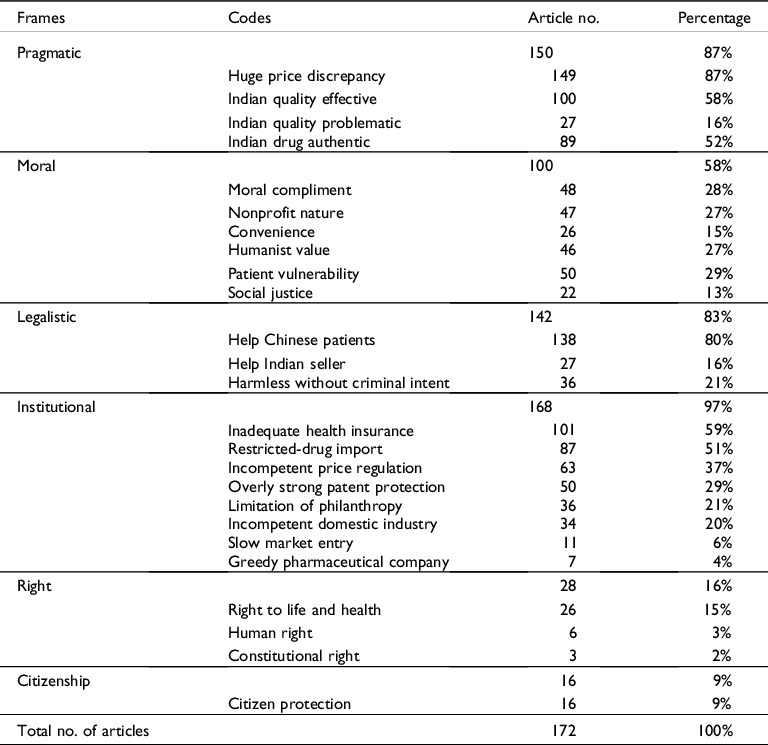
To better characterize the media’s legitimation efforts, my research assistants coded all of the news data to identify the frames used by each of the articles. In the end, we detected and distinguished between six legitimation frames: pragmatic, moral, legalistic, institutional, rights, and citizenship. The first four all had a high degree of prevalence. The other two are rights and citizenship frames: the former mentioned the right to life and health, human rights, or constitutional rights; the latter referred to the protection deserved by citizens. There was little elaboration except the mention of several key words such as the human right (renquan). As more radical politicized frames, these two were much less prevalent and only scattered around. We thus considered them marginal in the legitimation struggle. We also rejected the class frame given the little evidence of its presence. There was some description of vulnerable patients from low-income or rural households who could not understand English and, thus, desperately relied upon Lu’s help. Yet, this emphasis on patient vulnerability was mainly used to highlight Lu’s altruism within the moral frame. We found no systematic investigation into or critique of “class inequality” among the patients. Below, I first introduce our coding rationale for each frame and then I present our quantitative calculation of frame strengths.
First, we labelled the clarification that the Indian drug was illegal but authentic as “Indian drug authentic” and coded comparisons between domestic and Indian Gleevec with labels “huge price discrepancy,”Footnote 91 “Indian quality effective,”Footnote 92 and/or “Indian quality problematic.”Footnote 93 Then, we marked articles with any of the first three codes as using the pragmatic frame.
Second, we coded specific moral judgements on Lu’s brokerage with labels “moral compliment,”Footnote 94 “non-profit/altruistic,”Footnote 95 and/or “convenience,”Footnote 96 marking articles with either “moral compliment” or the combination of the other two codes as containing the moral frame. We also labelled discussions of morality and law conflict as “humanist value,”Footnote 97 “patient vulnerability,”Footnote 98 and/or “social justice,”Footnote 99 coding articles with any of these labels as using a moral frame.
Third, we coded interpretations of Lu’s agency as a broker with the labels “help Chinese patients purchase,”Footnote 100 “help Indian company sell,”Footnote 101 and/or “harmless with no criminal intent,”Footnote 102 marking articles with either the first or third code as deploying the legalistic frame.
Fourth, we coded critiques of deficient formal institutions with labels such as “inadequate health insurance,”Footnote 103 “problematic price regulation,”Footnote 104 “overly strong patent protection,”Footnote 105 “restricted drug imports,”Footnote 106 and/or “incompetent domestic industry,”Footnote 107 marking articles with any of these codes as mobilizing the institutional frame.
Last, we labelled articles mentioning key words such as “right to life and health” (shengming quan, jiankang quan), “human right” (renquan), or “constitutional right” (xianfa), marking articles with any of these codes as using a rights frame. Likewise, we coded articles mentioning “citizen protection” (gongmin baozhang) as containing a citizenship frame.
Table 2 summarizes the coding results. It shows that, while 150 (87%), 100 (58%), 142 (83%), and 168 (97%) out of 172 articles, respectively, deployed the pragmatic, moral, legalistic, and institutional frames, only 28 (16%) and 16 (9%) articles mentioned rights and citizenship.
Frame/code prevalence

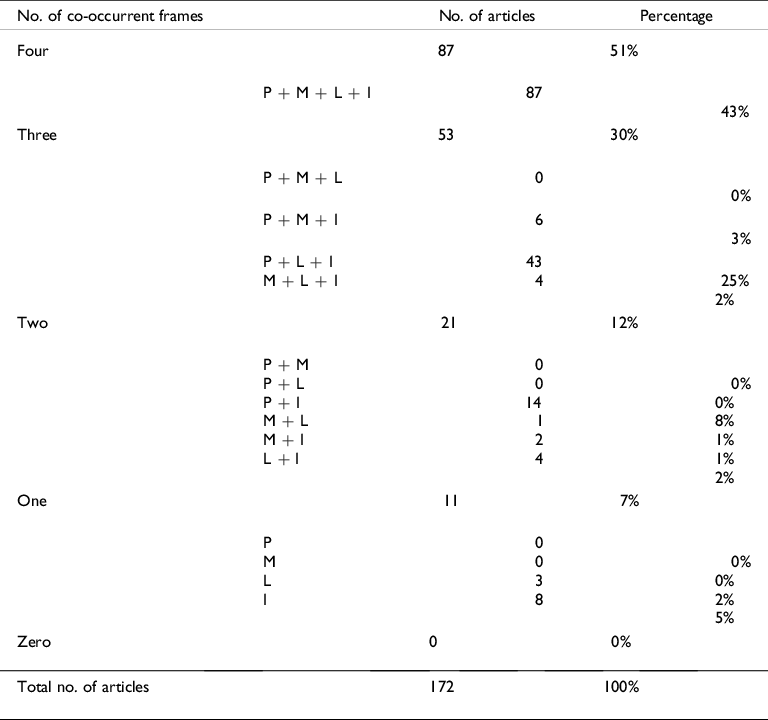
I also made a brief assessment of the relationships between the four major legitimation frames. My qualitative analysis indicates that they mutually reinforced one another despite different logics. For transnational drug brokerage, the pragmatic frame laid the foundation for the other three, since no legitimacy would be obtained if the drug itself turned out to be inauthentic. Likewise, the institutional frame was strengthened by the moral and legalistic frames. To better depict their relationships, I calculated the number of articles containing co-occurrent frames and their percentages. The result in Table 3 shows that 81% of articles invoked three or four frames at the same time: 87 articles (51%) contained all four frames and 53 articles (30%) had three co-present. As for the rest, 21 articles (12%) included two frames, 11 articles (7%) invoked only one, and none of the articles did not use any of these frames.
Numbers of articles containing co-occurrent frames and their percentages (P = Pragmatic; M = Moral; L = Legalistic; I = Institutional)

8. The response of the legal authority
Ultimately, under the public pressure, the Hunan provincial procuratorate carried out a thorough investigation into the case. Before long, it ordered the local Yuanjiang procuratorate to drop the charge against Lu, a “perfect victim” of a wrongful prosecution. In the two published legal opinions, the procuratorate recognized the pragmatic, moral, and legalistic legitimacy of Lu’s illegal brokerage, but ignored the more politicized institutional critiques. By depoliticizing the dispute, the legal authority successfully co-opted dissent and sustained authority through flexible law enforcement.
On 26 February 2015, the Yuanjiang procuratorate published two detailed legal opinions online to justify their decision to withdraw the charge. In the opinions, the procuratorate changed its previous stance, which insisted that Lu was at least an accomplice to the crime of selling fake drugs. Now, it claimed that Lu’s brokerage did not constitute the crime, for the following reasons:
(1) his acts were non-sales: …
(a.) Lu Yong and the leukemia patients were the buyers of anti-cancer drugs sold by the Indian Cyno company…. Lu Yong helped fellow patients without charging anything.
(b.) The bank account provided by Lu Yong was to serve the fellow patients and was part of the leukemia patients’ group purchase of drugs.
(2) his acts did not violate anyone’s right to life and health since … the leukemia patients who received Lu’s help did not get hurt after purchasing and consuming the drugs, some of which were efficacious; and some patients testified that they thanked Lu for extending their lives.Footnote 108
In addition to these pragmatic and legalistic frames, the procuratorate further elaborated on why punishing Lu’s moral acts would violate moral values of criminal justice. It would go against the principle of “justice for people,” against humanitarian concerns for the disadvantaged, and against human rights protection, a major goal of the Criminal Procedure Law reform. The only missing piece was the institutional frame, which was not surprising, since criticism of the state never had a place in official legal opinions.
Although specifying to what extent and how the media exposure led to the change in the local procuratorate’s decision is beyond the scope of this paper, it was clear that the Hunan provincial procuratorate directly intervened and ordered its Yuanjiang subordinate to “correct the mistake.” On 11 March, in a public interview published in Procuratorial Daily, the vice procurator of Hunan Province, Lu Leyun, explained the provincial procuratorate’s response to the public concern over Lu’s case.Footnote 109 She stated that the procuratorate “had impartially and openly executed procuratorial power in accordance with the law” by organizing thorough investigations into the dispute. She also stressed that “the charge withdrawal was a fact-based result of taking law as the criterion, which reflected the procuratorate’s spirit of responsible supervision and ‘mistakes must be corrected.’” She even repeated the explanation of the charge withdrawal published in the two legal opinions in great detail.
Clearly, the procuratorate hoped to co-opt dissent and sustain authority by resolving the dispute as a law-enforcement issue rather than a political problem. This conforms to He’s finding that upper-level legal authorities closely supervise the misconducts of their local subordinates, especially those that might threaten social instability.Footnote 110 Such a “mistake correction” was soon selected as one of the Ten Legal Supervision Cases of the Procuratorial Organ in 2015.Footnote 111 It was praised as a stellar example of the legal system’s transparency and responsiveness. However, such a depoliticized recognition of Lu’s brokerage may contribute little to, if not impede, the legitimation of the larger informal drug market, which was pragmatically and institutionally justifiable but lacked moral and legalistic legitimacy due to its for-profit nature.
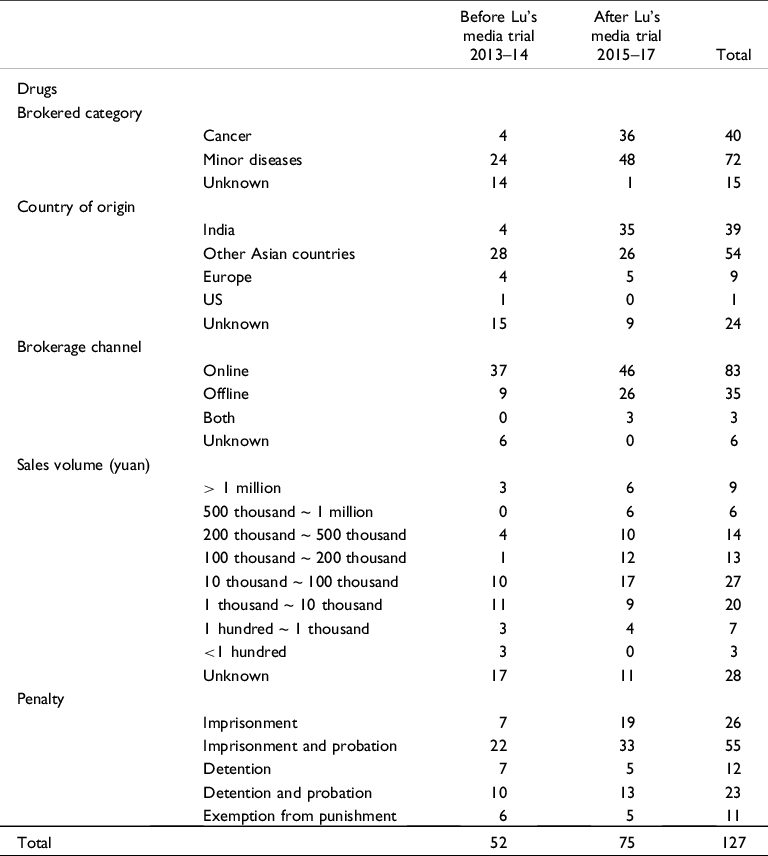
This reveals the limitation of the partially politicized, media-driven legitimation struggle based on one specific case. Just as the media warned that “the problem remains” after Lu’s charge withdrawal, more and more patients began to seek drugs from informal for-profit brokers. These other brokerage cases attracted much less media attention and gained little recognition from either the public or the legal authority. None of the four frames identified in this paper can be found in the open legal documents of other similar drug-brokerage cases. The 84 adjudication decisions collected and analyzed by the author involved 127 convicted transnational drug brokers, the characteristics of whom are summarized in Table 4.
Characteristics of convicted transnational drug brokers

In these cases, the amount of illegal sales volume varied from 28 yuan ($4.5) to 4,900,000 yuan ($790,000). The penalties ranged from (at a minimum) an exemption from criminal punishment to as modest as several years of detention or as severe as ten years of imprisonment. Thirty-five out of the 39 Indian convicted cancer-drug brokers received their verdicts after Lu’s trial. The relatively small number of accusations indicates that, in general, the local police and procuratorate tended to turn a blind eye to this huge informal market, following the principle of “no whistle-blowing, no arrest.”Footnote 112 When they did press criminal charges, however, unless the number of brokered drugs was extremely small (e.g. several boxes), the suspects were invariably found guilty of the crime of selling fake drugs even without making any profits, whether or not they were convicted before or after Lu’s media trial. Not surprisingly, in the adjudication decisions of these other cases, I found no evidence of any of the legitimation frames.
Given the large amount of drug sales in Lu’s brokerage, therefore, it is reasonable to speculate that, without public attention, there would have been little room for him to legitimize the illegal acts or get exempted from criminal penalty. The case of Shi and Zhao, which shared many similar traits with Lu’s case, can help to illustrate this point. Shi was also a leukaemia patient who first used Indian Gleevec himself and then brokered Indian cancer drugs for other patients. The major difference was that Shi did it for profit. The sales volume of the drugs he brokered reached 1.44 million yuan ($232,000) and he earned a net profit of 410,000 yuan ($66,000). According to the final criminal judgment, Shi was given a light punishment (two years of imprisonment) because he was “a leukemia patient, who truthfully confessed to the crime after his apprehension, showed repentance, and actively provided clues to the police.”Footnote 113 His cousin, Zhao, who simply helped him with drug packaging and did not make any profit, got exempted from criminal punishment but was still convicted as “an accomplice to the selling fake drug crime.”Footnote 114 The judgments did present some witness testimonies mentioning that the Indian drug was “efficacious.” However, they never acknowledged the drug’s pragmatic usefulness and showed no sign of moral discourse, let alone alternative legalistic interpretation or institutional critique.
Moreover, according to the 12 decisions not to prosecute regarding other drug brokers, all the charges were dropped simply because the number of brokered drugs was too small and the circumstances were too minor. Thus, it is reasonable to speculate that, if Lu’s case had gone to trial without media attention, he would have been convicted at least as an accomplice to fake-drug sales despite the absence of any profit evidence, because the sum of the drug sales in his case was simply too large to get him exonerated. Apparently, the legal authority would not acknowledge the legitimacy of illegality unless facing widespread public pressure. In other words, by 2017, although the public legitimation effort identified in this paper went beyond the single case through the media’s institutional frame, it remained case-specific in the official discourse. More widespread legitimation efforts might have been made in the public sphere after the success of the movie Dying to Survive, released in 2018. But it entails future research to explore how the movie could have deepened the legitimation of illegality in authoritarian China.
9. Discussion and conclusion
I have given a detailed analysis of different illegality-legitimation agents, pathways, and frames in the case of transnational illegal drug brokerage in China. As one of the first attempts to understand illegality-legitimation struggles in authoritarian states, this study highlights the crucial role of media in seeking both depoliticized and politicized legitimation through four frames: pragmatic, moral, legalistic, and institutional. While illegal-practice participants and the legal authority both tend to pursue the depoliticized legitimation of illegality, the media go further to make politicized efforts. In my case, the four frames mutually reinforced one another. However, it is worth noting that the relationships between these frames are likely to change dramatically in other contexts, where different frames might work in opposite directions. In post-communist countries, for instance, legitimation agents of “illegal” private ownership might deploy a pragmatic frame highlighting economic efficiency, whereas opponents may invoke a moral frame attacking capitalist greed that goes against socialist morality, which could be a politicized pathway of de-legitimation. Indeed, it might be rare to see the co-presence of all of the four frames in one struggle. More common might be the separate use of different frames depending on the issue in dispute and the agent’s stance (e.g. the media may split into different camps). Future research needs to explore the possibility of other potential actors and frames that may be mobilized to legitimize illegality in authoritarian states, as well as how one same frame may be endowed with different meanings in other contexts.
One may wonder whether and to what extent Lu’s media trial, especially the politicized institutional frame, spurred law and policy reforms. First, media reports showed that it did encourage the expansion of local health-insurance schemes by pressuring some provinces to add Gleevec onto reimbursement lists.Footnote 115 It in turn propelled the national-insurance-coverage expansion in 2018.Footnote 116 Moreover, in the most recent amendment to the Drug Administration Law, promulgated on 26 August 2019, “unlicensed foreign drug” was finally distinguished from “fake drug,” though transnational brokerage of these drugs remained illegal. Lu’s case, and the 2018 movie based on it, were said to have been a crucial catalyst in this legal change.Footnote 117
While the media’s politicized legitimation efforts might have been conducive to advancing law and policy reforms, their legal impact must not be exaggerated. My data revealed the media’s relative disinterest in those more politically radical frames (e.g. rights, class, and citizenship), which have been highly prevalent and effective in democratic legitimation movements. In my case, these frames were either scattered around or completely absent from the media discourse. As Repnikova’s comparative analysis of Chinese and Russian critical journalists shows, the Chinese journalists “position themselves in a fluid partnership—or a governance nexus—with the party-state,” whereas the Russian counterparts are more radical “system antagonists.”Footnote 118 This might partly explain why, in Lu’s case, no one, including the critical media, went as far as engaging in rights-based mass mobilization for illegality contestation. It could invite immediate repression by the Chinese state, whose censorship apparatus allows government criticism but suffocates collective action.Footnote 119 Further research must explore whether and how variations in the state–media relationship might account for different pathways and frames of illegality contestation across authoritarian contexts.
Indeed, the withdrawal of Lu’s charge was just another common co-operative practice within the “iron-triangle” legal system made up of the police, the procuratorate, and the court, which possess enormous power over criminal defence lawyers and defendants.Footnote 120 When “mistakes” are made, the court (sometimes the police too) simply asks the procuratorate to withdraw the prosecution to “digest” the case from within. This is to disguise any illegal practice in investigation or prosecution and evade state compensation to the wronged defendant.Footnote 121 Lu told me that he chose not to bring up any request for compensation to avoid further trouble, knowing that “the procuratorate withdrawing the charge was already a big compromise.”Footnote 122 Unsurprisingly, both Lu and his defence lawyer were excluded from the decision-making process, having no choice but to passively accept the result.
This conspicuous power asymmetry may well explain illegal-practice participants’ preference for depoliticized legitimation frames: they are very well aware of the high stakes. In fact, Lu’s “victory” may have contributed little to, if not impeded, addressing the structural injustice underlying the dispute. For sure, the media have mobilized the institutional frame to question the illegality of drug brokerage as a systematic problem. Yet, as my data showed, the legal authority only recognized the legitimacy of Lu’s singular case, a personalized and dramatic story loved by commercialized media,Footnote 123 rather than that of transnational drug brokerage as a general type of illegal activity. Hence, ironically, propagandizing Lu’s “successful legitimation struggle” only highlighted the responsiveness and concealed the oppressiveness of China’s criminal justice system. By conveniently depoliticizing the case as a petty law-enforcement mistake that had been properly corrected, such propaganda obscured and even concealed the systematic gap between the legitimacy and legality of transnational drug brokerage—either for profit or not—as a highly prevalent phenomenon. This gap has yet to be adequately addressed beyond Lu’s singular case. The depoliticization tendency in legitimation struggles may keep the legal production of illegality immune from public scrutiny, and the political opportunity for legalization movements of this or any sort (e.g. same-sex marriage) would thus remain rather limited and prone to repression. Ultimately, legitimacy and justice are transient and case-specific without the organized representation of public demand or institutionalized supervision of systemic dysfunction.
Acknowledgements
I thank the editor and three anonymous reviewers for their valuable feedback. Special thanks to Sida Liu and Ke Li for their constructive comments on the latest revision of the paper. I am grateful to Charles Camic, Bruce Carruthers, Steve Epstein, William Hurst, Heather Schoenfeld, Jane Pryma, Josh Basseches, Tianlong You, Yongjun Zhang, Hui Sun, and my cohorts from the Northwestern community for their helpful feedback in the different stages of this research, as well as Emily Barman, Erica Coslor, Yan Long, and Kenneth Pomeranz for their insightful comments on the early version of the draft. I also thank Mian Chen and Dantong Jiang for their research assistance. This project was funded by the Alumni Award for Second-Year Paper Research from the Department of Sociology, Northwestern University.