INTRODUCTION
Parasites have profound effects on individuals, populations, and ecosystems and may be considered indicators of ecosystem health (Hudson et al. Reference Hudson, Dobson and Lafferty2006) or threats to conservation of wildlife (Daszak, Reference Daszak2000). Parasite-host relationships are shaped by a multitude of interacting factors, including host availability, parasite community structure (Jolles et al. Reference Jolles, Etienne and Olff2006; Telfer et al. Reference Telfer, Lambin, Birtles, Beldomenico, Burthe, Paterson and Begon2010), and environmental heterogeneity at multiple scales (Biek and Real, Reference Biek and Real2010).
Islands are one source of environmental heterogeneity. Similar to trends in host populations, parasite communities on islands have reduced diversity and increased niche breadth compared with mainland communities (Goüy de Bellocq et al. Reference Goüy de Bellocq, Sarà, Casanova, Feliu and Morand2003; Nieberding et al. Reference Nieberding, Morand, Libois and Michaux2006). Season also exerts strong influences on parasite-host dynamics and has complex consequences on host populations (Altizer et al. Reference Altizer, Dobson, Hosseini, Hudson, Pascual and Rohani2006). Current and on-going changes in climate and landscape use have the potential to alter parasite-host relationships (Giraudoux et al. Reference Giraudoux, Craig, Delattre, Bao, Bartholomot, Harraga, Quere, Raoul, Wang, Shi and Vuitton2003; Kutz et al. Reference Kutz, Hoberg, Polley and Jenkins2005; Despommier et al. Reference Despommier, Ellis and Wilcox2006; Greer et al. Reference Greer, Ng and Fisman2008). Consequently, baseline knowledge is important in monitoring parasite-host relationships for changes that could affect or reflect wildlife, human or ecosystem health, particularly in island environments.
As top predators, wolves (Canis lupus) host diverse gastrointestinal parasite communities that vary primarily in relation to prey (Mech, Reference Mech1970; Kreeger, Reference Kreeger, Mech and Boitani2003; Craig and Craig, Reference Craig and Craig2005). Wolf parasites have been well-studied throughout much of their range; however, there are no data from the central and north coasts of British Columbia (BC), Canada. Here, wolves are considered ‘evolutionarily significant subunits’ based on genetic, ecological, behavioural and morphological differences compared with interior wolf populations (Muñoz-Fuentes et al. Reference Muñoz-Fuentes, Darimont, Wayne, Paquet and Leonard2009). This distinction makes knowledge of potential conservation threats such as parasites or other pathogens important. Relative to wolf populations elsewhere, wolves in coastal BC have not experienced recent large-scale changes in habitat and are rarely hunted. Therefore, these wolves might provide insight into host-parasite relationships in a landscape relatively unaltered by modern anthropogenic disturbances. Moreover, coastal wolves consume numerous marine resources (Darimont et al. Reference Darimont, Paquet and Reimchen2008a, Reference Darimont, Paquet and Reimchen2009), potentially exposing them to parasites not often encountered in a terrestrial diet.
Feces are often used to reflect gastrointestinal parasite assemblages in wildlife, especially when collected to examine temporal and spatial trends (e.g., Turner and Getz, Reference Turner and Getz2010; Stronen et al. Reference Stronen, Sallows, Forbes, Wagner and Paquet2011). In accordance with our own ethical framework and that of local First Nations, we considered fecal samples the only option for studying parasites in this distinct coastal population (Darimont et al. Reference Darimont, Reimchen, Bryan and Paquet2008b). Objectives of this study were to (1) generate a comprehensive profile of gastrointestinal helminths and protozoans in wolves from a naturally structured population across an extensive, remote area and (2) investigate spatial and seasonal factors that affect parasite occurrence in wolf feces. This information comes at a critical time; new parasites could be introduced or disease dynamics altered by dramatic increases in economic activity in coastal BC (Price et al. Reference Price, Roburn and MacKinnon2009) combined with climate change (Greer et al. Reference Greer, Ng and Fisman2008).
MATERIALS AND METHODS
Study area
The study area extends from the northern end of Vancouver Island (51°46′N, 127°53′W) to north of Prince Rupert (55°37′N, 129°48′W), British Columbia (Fig. 1). The coastal landscape can be generally classified as mountainous mainland, hilly inner islands, and lower outer islands (Darimont et al. Reference Darimont, Price, Winchester, Gordon-Walker and Paquet2004). Islands vary in size from <1 to >22 00 km2 and are separated from other islands and mainland areas by <100 m to >13 km (Darimont et al. Reference Darimont, Price, Winchester, Gordon-Walker and Paquet2004; Paquet et al. Reference Paquet, Alexander, Swan, Darimont, Crooks and Sanjayan2006). Prey species available to wolves include a subspecies of mule deer known as Sitka black-tailed deer (Odocoileus hemionus sitkensis), 5 species of Pacific Salmon (Onchorhynchus spp.), mustelids, ursids, birds, rodents, marine mammals and invertebrates (Darimont et al. Reference Darimont, Price, Winchester, Gordon-Walker and Paquet2004, Reference Darimont, Paquet and Reimchen2009).
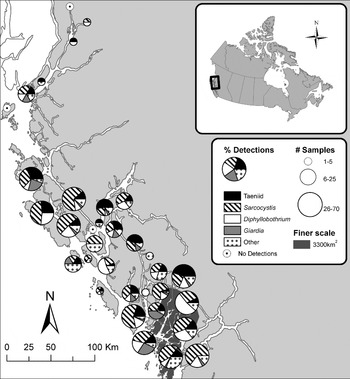
Map of fecal collection locations from 34 wolf packs across a 60 000 km2 area on the central and north coasts of British Columbia, Canada, in 2005–2008. Data from these feces were used to compare parasite prevalence on island and mainland areas. Eight of these packs occupying known home ranges over 3300 km2 (area in dark grey) were sampled consistently in 2 years and 2 seasons to allow for seasonal comparisons. Circles represent wolf packs sampled during autumn collections. Pie charts show the proportion of parasite detections per pack attributed to taeniids, Sarcocystis sp., Diphyllobothrium sp., Giardia sp., and all other taxa combined.

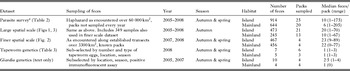
To investigate spatial and seasonal patterns in prevalence of parasite stages in feces, we collected wolf feces at 2 spatial scales (Table 1; Fig. 1). Across a 60 000 km2 study area, we collected feces (n=718) haphazardly as encountered from 34 wolf packs in the autumn of 2005, 2007 and 2008 (Table 1; Fig. 1). Due to logistical limitations and the expanse of the study area we could not sample all packs in all years, nor were sample collections equally productive from each pack. At a finer spatial scale (3300 km2), we collected feces (n=923) along established transects from wolf packs with home ranges on 4 islands (n=467) and 4 mainland areas (n=456) in spring and autumn 2007 and 2008 (Table 1). These 8 packs were sampled because they have known home ranges with established transects and are logistically feasible to sample (Darimont et al. Reference Darimont, Paquet and Reimchen2008a). We assumed the 8 packs were representative of the larger population.
Summary of datasets shown in this paper, including sampling procedure, feces examined and packs sampled

a Dataset includes 23 samples collected in August 2006 and 6 collected in August 2007.
Within eight hours of collection, fecal samples were frozen at −20°C and later transported to the University of Saskatchewan for subsequent diagnostic processing. There, samples were kept at −80°C for 3 days to kill any Echinococcus eggs (Hildreth et al. Reference Hildreth, Blunt and Oaks2004). Although freezing may affect recovery of parasite stages from feces (Foreyt, Reference Foreyt2001b), we considered these steps necessary for practical and safety reasons.
Morphological analysis of parasite stages
For the purposes of this paper, we define: ‘parasites’ as gastrointestinal helminths and protozoans that shed larval stages in feces; ‘parasite stages’ as eggs, oocysts, sporocysts, cysts, and larvae shed in feces; and fecal prevalence as the proportion of fecal samples in which we detected parasite stages.
Quantitative parasitological analysis was conducted on 4 g of feces using a modified Wisconsin Sugar Flotation Method, which is suitable for detecting many common parasite stages in canine feces (Foreyt, Reference Foreyt1989; Foreyt, Reference Foreyt2001b; Stronen et al. Reference Stronen, Sallows, Forbes, Wagner and Paquet2011). Most parasites were identified under X100 total magnification with the exceptions of Sarcocytis sp. sporocysts and Isospora sp. oocysts, which were counted at X400 total magnification. To determine the presence or absence of Cryptosporidium sp. and Giardia sp. (oo)cysts, we used a commercial immunofluorescent assay (Cyst-a-glo™, Waterborne, Inc. 6045 Hurst Street, New Orleans, LA 70118, USA) with modifications described by Stronen et al. (Reference Stronen, Sallows, Forbes, Wagner and Paquet2011). All observers were trained in parasite identification for a minimum of 10 days by a parasitologist (B.W.) and scored >90% when tested for correct identification of parasite stages.
PCR and sequencing of parasite stages
To complement morphological parasite data, we performed genetic analyses on a small subset of fecal samples (Table 1). Taeniid and Diphyllobothrium sp. eggs were isolated from fecal samples and identified by sequencing of NAD1 as previously described (Himsworth et al. Reference Himsworth, Jenkins, Hill, Nsungu, Ndao, Andrew Thompson, Covacin, Ash, Wagner, McConnell, Leighton and Skinner2010). Amplifications were performed with primers JBl 1 (5′-AGA TTC GTA AGG GGC CTA ATA-3′) and JB12 (5′-ACC ACT AAC TAA TTC ACT TTC-3′) (Bowles and McManus, Reference Bowles and McManus1993), which amplify a portion of the NADH dehydrogenase subunit I (NAD1) gene of helminths. A 509 bp PCR product was obtained from 12 fecal samples, then purified and sequenced using the amplification primers. High quality, nearly complete or full-length sequences were obtained for 8 of 12 samples and a short (139 bp) sequence was obtained for 1 sample. The PCR products from 3 samples were not detectable or not interpretable due to the presence of multiple sequences. Sequences were compared to the National Center for Biotechnology Information Genbank non-redundant nucleotide database using BLASTn (Altschul et al. Reference Altschul, Gish, Miller, Myers and Lipman1990). Representative NAD1 sequences were deposited in Genbank (Accession numbers HQ423292-HQ423300).
Samples positive for Giardia spp. were sent to Murdoch University, Australia, where 19 were sequenced to determine the predominant Giardia sp. genotypes. Polymerase chain reaction (PCR) and sequencing was performed on 14 samples as previously described to amplify a segment of the G. duodenalis β-giardin gene (Covacin et al. Reference Covacin, Aucoin, Elliot and Thompson2011).
Statistical analysis
To examine the effects of season, year, and pack on parasite presence or absence in feces, we used logistic regression models on data collected from the 3300 km2 spatial scale. Separate models were tested for Diphyllobothrium sp., taeniids, and Sarcocystis sp. One wolf pack (My) was analysed with an adjacent pack (BC) because only 1 sample was collected in 2007. Interaction terms and habitat (mainland versus island) were not included in models to avoid excessive zero categories. Variance inflation factors ranged from 1·0 to 1·7. We did not conduct logistic regression on large spatial scale data because of uneven sample sizes per pack and because not all packs were sampled each year. Moreover, we pooled all data from islands and mainland because of these limitations and performed Fisher's exact tests to compare the proportion of parasites in wolf feces on islands and mainland areas. All analyses were carried out using R statistical software (http://www.R-project.org). We consider these analyses to be hypothesis generating due to non-independence of fecal samples.
RESULTS
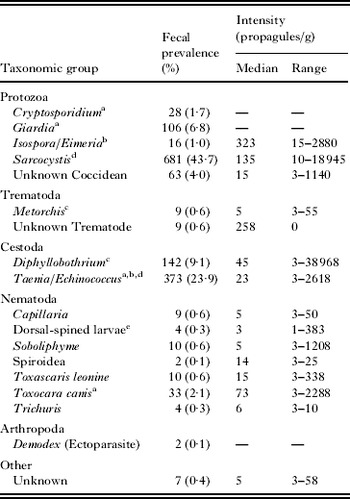
There was evidence of at least 1 parasitic infection in 975 of 1558 (62·6%) wolf fecal samples. Morphological identification of eggs and (oo)cysts revealed ⩾14 distinct parasite taxa (Table 2). Of these, 4 occurred in >5% of fecal samples (Sarcocystis sp., Taeniidae, Diphyllobothrium sp., and Giardia sp.)
Prevalence, median intensity and range of parasite stages (eggs, oocysts, sporocysts, cysts and larvae) detected in 1558 wolf feces collected from the central and north coasts of British Columbia, Canada, between 2005 and 2008

a Taxa in which some species have zoonotic potential from contact with infected feces.
b Taxa identifiable only to family.
c Parasites with indirect lifecycles likely transmitted to wolves via fish.
d Parasites with indirect lifecycles likely transmitted to wolves via deer.
e One sample identified as Parelaphostrongylus odocoilei (Bryan et al. Reference Bryan, Sim, Darimont, Paquet, Wagner, Muñoz-Fuentes, Smits and Chilton2010).
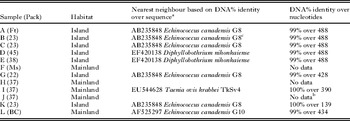
Genetic sequencing of parasite eggs from 9 feces revealed at least 2 species of taeniid tapeworms, Echinococcus canadensis and Taenia ovis krabbei, as well as the fish tapeworm, Diphyllobothrium nihonkaiense (Table 3). Of 6 taeniid egg isolates, 5 most closely matched E. canadensis strain G8 and 1 E. canadensis strain G10. Genetic analysis of Giardia cysts revealed Giardia duodenalis assemblage A in 3 samples and assemblage B in 11 samples.
PCR and sequencing of partial NAD1 sequences of taeniid or Diphyllobothrium sp. eggs isolated from 12 wolf feces

a Primer sequences were removed prior to analysis.
b Sequence was consistent with mixed template.
c Sequences identical over available nucleotides.
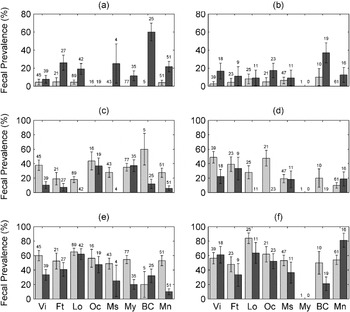
Season emerged as an important factor affecting parasite prevalence in wolf feces, although the effect varied across parasite species, packs and years (Fig. 2). Based on a logistic regression model including season, year and pack as main effects, Diphyllobothrium sp. eggs were 7·57 times more likely in feces collected in autumn compared with those collected in spring (Fig. 2a,b; P<0·01, 95% Confidence Interval 4·35–13·15). The magnitude of the difference was not consistent across packs and years but the prevalence of Diphyllobothrium sp. was consistently higher in autumn in all but 1 pack over both years. In contrast, taeniid eggs were 0·31 times less likely to occur in autumn (Fig. 2c,d; P<0·01, 95% Confidence Interval 0·21–0·45). This trend was consistent in direction across 7 of 8 packs sampled in 2007 (Fig. 2c) and 5 of 7 packs in 2008 (Fig. 2d). Sarcocystis sp. sporocysts were 0·48 times less likely to occur in autumn (Fig. 2e,f; P<0·01, 95% Confidence Interval 0·36–0·64). The direction of this trend was the same in 7 of 8 packs sampled in 2007 (Fig. 2e) and 5 of 7 packs in 2008 (Fig. 2f). At least 2 levels of pack were significant for each parasite but the effect of year was significant only for Sarcocystis sp. (P=0·02). Toxocara canis eggs were 2·95 times more likely to be detected in autumn (Fisher's exact test P<0·01; 95% Confidence Interval 1·30–7·29).
Seasonal patterns in fecal prevalence of Diphyllobothrium sp. (a) 2007 and (b) 2008, Taeniidae (c) 2007 and (d) 2008, Sarcocystis sp. (e) 2007 and (f) 2008 in 8 wolf packs. Feces were collected from the central and north coasts of British Columbia in spring (May–June, grey bars) and autumn (September–October, black bars). The first 4 packs (Vi, Ft, Lo, Oc) occupy islands and the rest (Ms, My, BC, Mn) are from mainland areas. Giardia was not plotted because of low fecal prevalence per pack. Error bars represent standard error of prevalence estimates for each pack. Sample sizes are plotted above each bar.

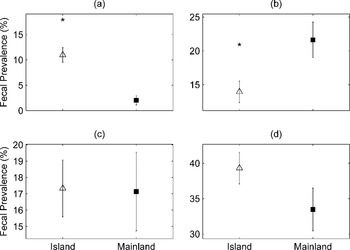
Across the entire study area, islands showed a higher fecal prevalence of Giardia sp. infections and a lower prevalence of Diphyllobothrium sp. relative to mainland sites (Fig. 3a,b; Fisher's test P<0·001, 0·01, respectively). The fecal prevalence of taeniid and Sarcocystis sp. infections was similar across mainland and island sites (Fig. 3c,d; Fisher's test P=1·00, 0·14, respectively).
Fecal prevalence and standard error of Giardia sp. (a), Diphyllobothrium sp. (b), Taeniidae (c), and Sarcocystis sp. (d) collected from islands (△; n=473) and mainland areas (■; n=245). Collectively, these 4 taxa represent 86% of all parasite detections and each occurred in >5% of fecal samples. Wolf feces were collected from 21 island wolf packs and 13 mainland packs on the central and north coasts of British Columbia in autumn 2005, 2007 and 2008. Prevalence was calculated as total parasite detections in feces collected from islands or mainland.

DISCUSSION
Ecology and diversity of parasites detected inwolf feces
The most common parasites in feces relate to coastal wolves’ diet of terrestrial and marine prey. Sarcocystis sp. sporocysts and taeniid eggs had the highest fecal prevalence, reflecting wolves’ overall annual diet of >80% deer across the population (Dubey and Odening, Reference Dubey, Odening, Samuel, Pybus and Kocan2001; Jones and Pybus, Reference Jones, Pybus, Samuel, Pybus and Kocan2001; Darimont et al. Reference Darimont, Paquet and Reimchen2008a). The high fecal prevalence of taeniid eggs (23·9%) is similar to a metaprevalence of 28·2% reported in Alberta and southern Alaska and >19% worldwide (Craig and Craig, Reference Craig and Craig2005).
Genetic analyses provide further support that taeniids are passed to wolves via deer and suggest that these parasites may be maintained in a sylvatic wolf-deer cycle. E. canadensis is thought to cycle primarily between wolves and large cervids such as moose (Alces alces) (Messier et al. Reference Messier, Rau and McNeill1989; Jenkins et al. Reference Jenkins, Romig and Thompson2005; Thompson et al. Reference Thompson, Boxell, Ralston, Constantine, Hobbs, Shury and Olson2006; Foreyt et al. Reference Foreyt, Drew, Atkinson and McCauley2009). Moose have expanded into parts of the study area within the past 100 years but remain absent on most islands (Darimont et al. Reference Darimont, Paquet, Reimchen and Crichton2005). It is possible that moose introduced E. canadensis to the area; however, several samples came from sites where moose do not occur, suggesting that the cycle can be maintained even where Sitka black-tailed deer is the only cervid.
Despite limited genetic analyses, E. canadensis is a significant finding because the G8 and G10 (cervid) strains have zoonotic potential (Jenkins et al. Reference Jenkins, Romig and Thompson2005). Case-based evidence suggests that these strains are less pathogenic to humans than are strains of Echinococcus from domestic animals (Pinch and Wilson, Reference Pinch and Wilson1973). A human case in Alaska, however, revealed that the G8 strain—which we detected in 5 of 6 samples—can cause severe disease (McManus et al. Reference McManus, Zhang, Castrodale, Le, Pearson and Blair2002). Moreover, these results provide further support that the G8 and G10 strains co-occur and should be considered the same species as proposed by Thompson (Reference Thompson2008).
Our finding of T. ovis krabbei in one sample is consistent with morphologic identification of adult worms from wolf carcasses collected on nearby Vancouver Island (H. Bryan, unpublished data). T. ovis krabbei had a metaprevalence of 25% in wolves from southern Alaska and Alberta and has been linked with a diet of cervids (Craig and Craig, Reference Craig and Craig2005). We found no evidence of other Taenia spp. commonly reported in wolves, notably T. hydatigena, which may reflect the absence of large cervids (e.g., moose, elk [Cervus elaphus canadensis], and caribou [Rangifer tarandus]) and lagomorphs in the area and low prevalence of rodents in the diet of coastal wolves (Darimont et al. Reference Darimont, Price, Winchester, Gordon-Walker and Paquet2004). We likely did not detect the full diversity of taeniids due to the small number of samples subject to genetic analysis and limited temporal sampling.
Compared with other reports in canids (Bagrade et al. Reference Bagrade, Kirjusina, Vismanis and Ozolins2009; Craig and Craig, Reference Craig and Craig2005; Stien et al. Reference Stien, Voutilainen, Haukisalmi, Fugelei, Mørk, Yoccoz, Ims and Henttonen2010), we found a high—9·1% overall and 16·6% in fall—prevalence of Diphyllobothrium sp. This reflects coastal wolves’ dietary shift of up to 70% Pacific salmon in the fall. Sequences from Diphyllobothrium eggs matched D. nihonkaiense, a species that infects salmonids (O. gorbuscha and O. keta) commonly available to coastal wolves (Scholz et al. Reference Scholz, Garcia, Kuchta and Wicht2009).
Notably, we found no evidence of the trematode Nanophyetus salmincola that carries the causative agent of salmon poisoning disease in canids, Neorickettsia helminthoeca (Foreyt, Reference Foreyt, Williams and Barker2001a). Salmon poisoning disease is transmitted by flukes that infect salmonids or other species of fish and is highly fatal in domestic and wild canids that consume raw fish (Foreyt, Reference Foreyt, Williams and Barker2001a). It is possible that wolves in coastal BC have immune or behavioural mechanisms to avoid infection with N. helminthoeca (Darimont et al. Reference Darimont, Reimchen and Paquet2003). Alternatively, N. salmincola, Neo helminthoeca, or its snail intermediate hosts may not occur in the study area (Booth et al. Reference Booth, Stogdale and Grigor1984; Foreyt, Reference Foreyt, Williams and Barker2001a) or infected hosts may have died rapidly making collection of infected feces unlikely. Given the possible conservation implications of salmon poisoning disease for coastal wolves, combined with potential climate-driven changes in distribution of the intermediate host, regular monitoring for N. helminthoeca and N. salmincola in coastal BC would be a sound strategy.
In addition to parasites with indirect life cycles, we found at least 9 genera with direct life cycles. Of note are the protozoans Giardia sp. and Cryptosporidium sp., which include species with zoonotic potential. We found the fecal prevalence of Cryptosporidium sp. was similar to that reported in wolves from interior Canada (Stronen et al. Reference Stronen, Sallows, Forbes, Wagner and Paquet2011). In contrast, the prevalence of Giardia sp. (6·8%) was lower (21·9–46·7%; Stronen et al. Reference Stronen, Sallows, Forbes, Wagner and Paquet2011). Differences may relate to the immune status of wolves or prey availability, habitat and other ecological characteristics influencing transmission of Giardia. Notably, we detected only the zoonotic Giardia assemblages A and B and not the specific dog assemblages C and D (Thompson, Reference Thompson2004). This finding suggests that the zoonotic assemblages are dominant in wolves even in remote locations where current human population density is low.
Several parasitic taxa—Soboliphyme, Parelaphostrongylus odocoilei, and oocysts we identified as possibly Eimeria—are not known to infect wolves. One logical explanation for these occurrences is that wolves consumed the viscera or feces of an infected definitive host and excreted eggs and/or larvae in their feces (Bryan et al. Reference Bryan, Sim, Darimont, Paquet, Wagner, Muñoz-Fuentes, Smits and Chilton2010). Nematodes Trichuris sp., Toxocara canis, and Toxascaris leonina, which are potentially pathogenic to wolves, occurred rarely in fecal samples. Landscape or climatic conditions might limit transmission of these parasites to adult wolves. In pups (<6 months), prevalence might be higher because of age-related immunity. Alternatively or concomitantly, the low prevalence of these parasites may reflect the general good health of wolves and their relatively intact habitat.
Seasonal patterns in parasite occurrence
Strong seasonal differences in the fecal prevalence of Diphyllobothrium sp., taeniid eggs, and Sarcocystis sp. oocysts reflect coastal wolves’ known dietary shift to salmon in fall. Similar seasonality in Diphyllobothrium sp. has been reported in black (Ursus americanis) and grizzly (Ursus arctos) bears (Frechette, Reference Frechette1978; Gau et al. Reference Gau, Kutz and Elkin1999). Although the mechanism for these changes is unknown, it is possible that the worms have a long dormancy period between seasons, that most adults complete their life cycle and are expelled between seasons, or that a seasonal change in host immunity promotes expulsion of adults. Alternatively or concomitantly, Diphyllobothrium sp. could compete with taeniids in the gastrointestinal tract of their host (Read, Reference Read1951; Roberts, Reference Roberts2000; Bush and Lotz, Reference Bush and Lotz2000; Conlan et al. Reference Conlan, Vongxay, Fenwick, Blacksell and Thompson2009). Notably, a lower prevalence of Taeniids and Sarcocystis sp. in fall may also be explained by decreased consumption of deer when salmon are available.
Seasonality may be adaptive for Diphyllobothrium sp. Intense egg-shedding when wolves or other definitive hosts are near salmon-spawning streams would maximize transmission of eggs to zooplankton intermediate hosts and subsequently, to anadramous Pacific salmon which may retain pleurocercoids for several years during their time at sea (Arizono et al. Reference Arizono, Shedko, Yamada, Uchikawa, Tegoshi, Takeda and Hashimoto2009; Scholz et al. Reference Scholz, Garcia, Kuchta and Wicht2009). Seasonal shifts could also benefit parasites if host immunity wanes between seasons and increases host susceptibility. A higher prevalence of T. canis eggs in fall may be due to pups (<6 months) that are susceptible to infection from their mothers or the environment and then clear the infection by the following spring. Seasonal changes in parasitic infections may also reflect overall population health. Most wolves in healthy populations should clear infections when no longer exposed to larval stages whereas immunocompromised populations might show increasing levels of parasites over time (Gentes et al. Reference Gentes, Whitworth, Waldner, Fenton and Smits2007).
Spatial patterns in parasite occurrence in wolf feces
Across the 60 000-km2 area, fecal prevalence of Diphyllobothrium sp. and Giardia sp. differed between island and mainland sites separated on average by only 1·5 km. These differences over a small geographical scale within a wide-ranging wolf population (average home range size 200 km2) mirror known variation in resource availability. For example, island areas host lower salmon spawning density (unpublished data), which might explain why the prevalence of Diphyllobothrium sp. in feces is lower on islands. Geographical factors may also play a role; differences in topography, precipitation, or water flow between islands and mainland areas may influence Giardia sp. prevalence (Biek and Real, Reference Biek and Real2010). Alternatively, hosts that could be a source of environmental contamination, such as seals or seabirds (Lasek-Nesselquist et al. Reference Lasek-Nesselquist, Bogomolni, Gast, Welch, Ellis, Sogin and Moore2008), might have a higher density on islands. These ecological discontinuities demonstrate potential effects of increasing habitat fragmentation and other landscape change on parasite-host relationships.
In conclusion, this study provides a comprehensive picture of gastrointestinal parasite stages in feces from a wolf population that is relatively undisturbed by recent, large-scale anthropogenic activities and is likely among the least human-influenced in the world. The survey could serve as a useful comparison with other studies of parasites in wolves and for monitoring future change that could affect ecosystem or wolf health.
ACKNOWLEDGEMENTS
We thank the Heiltsuk, Kitasoo/Xai'xais, Gitga'at and Wuikinuxv Nations for allowing sample collection in their traditional territories. Dr Chelsea Himsworth generously demonstrated genetic analyses. For field and laboratory support, we are grateful to Doug Brown, Maёlle Gouix, Ronan Eustace, Amanda Adams, Rosemary Invik, Heather Recker, Nathan DeBruyn, Gudrun Pflueger, Chris Wilmers, Brenda Trask, and Raincoast Staff. Dr William Foreyt kindly provided Nanophyetus salmincola specimens. Tasha Epp, Jill Johnstone, Peter Ehlers and Julian Ehlers helped with statistical analyses. We are grateful to two anonymous reviewers for their helpful comments.
FINANCIAL SUPPORT
This work was funded by the Raincoast Conservation Foundation; the Paquet Family Foundation; the Wilburforce Foundation; the Vancouver Foundation; the Summerlee Foundation; the World Wildlife Fund; the University of Saskatchewan Undergraduate Student Experience Program; the Western College of Veterinary Medicine Summer Undergraduate Student Research Award Program; H.M.B. was supported by a National Science and Engineering Research Council (NSERC) Industrial Postgraduate Scholarship and C.T.D. by an NSERC Post-doctoral Fellowship.