Introduction
Symbiotic relationships, such as phoresy, parasitism, and parasitoidism with arthropods, most frequently insects are typical phenomena that have evolved in many heterostigmatic mites (Acari: Trombidiformes: Heterostigmata) (Kaliszewski et al. Reference Kaliszewski, Athias-Binche and Lindquist1995). Among these mites, all members of the family Caraboacaridae have a bizarre association with variety of Carabidae (Coleoptera) (Eidelberg Reference Eidelberg1993; Hajiqanbar et al. Reference Hajiqanbar, Khaustov, Kamali, Saboori and Kamali2008). Based on Cross (Reference Cross1965) and Nickel and Elzinga (Reference Nickel and Elzinga1969), these mites are suspected to be ectoparasites of their host beetles with regard to enlarged chelicerae and some biological observation upon their inserted chelicerae into the veins of the hind wing of their host. However, the fact that no male and other instars of caraboacarid mites have been recovered from their hosts, cast serious doubt upon the occurrence of parasitism in these mites (Kaliszewski et al. Reference Kaliszewski, Athias-Binche and Lindquist1995). Therefore, the nature of this association remains ambiguous.
The genus Caraboacarus Krczal, Reference Krczal1959 (Heterostigmata: Caraboacaridae) was established for Caraboacarus stammeri Krczal, Reference Krczal1959, which was recovered from several species of German carabid beetles. The genus was originally placed in the family Pyemotidae and was redescribed by Cross (Reference Cross1965) and placed in the subfamily, Acarophenacinae (Pyemotidae). Subsequently, Mahunka (Reference Mahunka1970) changed the classification of this genus to the family Caraboacaridae (superfamily Pyemotoidea). This family was later transferred to the superfamily Trochometridioidea by Kaliszewski et al. (Reference Kaliszewski, Athias-Binche and Lindquist1995). Walter et al. (Reference Walter, Lindquist, Smith, Cook and Krantz2009) retained the Caraboacaridae in the superfamily Pyemotoidea, but noted that this classification is uncertain due to the absence of information on male attributes and whether they have free-living larvae.
Previously, the family Caraboacaridae had two genera, Caraboacarus Krczal, Reference Krczal1959 and Minicaraboacarus Hajiqanbar and Khaustov, 2008. The latter was described from Iran based on the species Minicaraboacarus quadridiscalis Hajiqanbar and Khaustov, 2008 (Hajiqanbar et al. Reference Hajiqanbar, Khaustov, Kamali, Saboori and Kamali2008). The genus Caraboacarus includes the following species: C. stammeri; C. karenae Nickel and Elzinga, Reference Nickel and Elzinga1969; C. towsleyi Husband and Husband, Reference Husband and Husband1984; C. calosomae Husband, 1986; C. bernardi Haitlinger, 1990; and C. krczali Eidelberg, Reference Eidelberg1994 (Eidelberg Reference Eidelberg1993, Reference Eidelberg1994). Caraboacarus krczali was redescribed by Mortazavi et al. (Reference Mortazavi, Hajiqanbar, Khaustov and Saboori2011) based on materials from Iran, Senegal, and Ukraine. In this paper, we follow Walter et al. (Reference Walter, Lindquist, Smith, Cook and Krantz2009) regarding to the placement of this family in the superfamily Pyemotoidea.
During the comprehensive survey of heterostigmatic mites associated with beetles in northern Iran, a new genus and species of the family Caraboacaridae was discovered. The purpose of present work is to describe this new genus and species, and to provide a comparison between the new and previously described genera. In addition an illustrated key to world genera of the family Caraboacaridae is presented and the distribution of all species of this family is reviewed.
Materials and methods
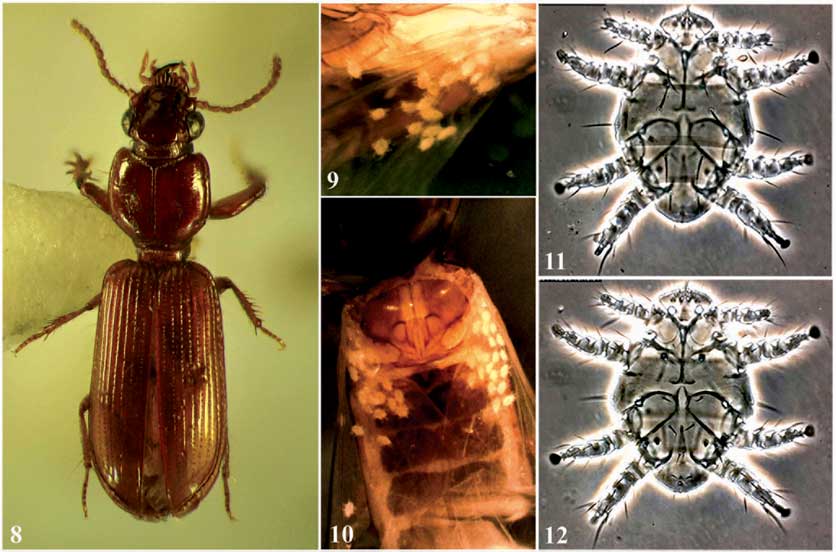
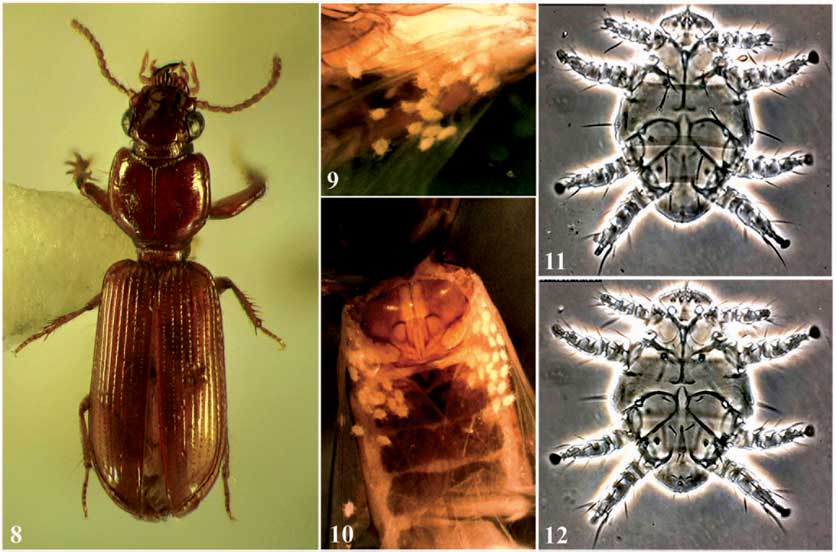
Mites were collected from under elytra, on the membranous hind wings of several specimens of Clivina ypsilon Dejean, 1829 (Coleoptera: Carabidae) (Figs. 8–10). The host beetles were captured by attracting to a light trap in Noor Forest, Mazandaran Province, Iran. The mite specimens were cleared in a mixture of Lactophenol and Nesbitt’s solution (80:20, volume/volume) and mounted on microscope slides in Hoyer’s medium. The morphology of mites was studied using Olympus BX51 light microscope (Tokyo, Japan) equipped with phase contrast illumination and photographs were taken with the aid of microscope eyepiece camera (Dino-Eye, DinoAM7023B, Dino-Lite Digital Microscope, Taiwan). Host images were captured using Olympus SZX9 stereomicroscope equipped with a Sony CCD digital camera (Tokyo, Japan). All measurements in the description are given in micrometers (μm) for the holotype and five paratypes (in parentheses). The terminology and setal notation were adapted from Lindquist (Reference Lindquist1986) and on coxisternal setation from Hajiqanbar et al. (Reference Hajiqanbar, Khaustov, Kamali, Saboori and Kamali2008). Details of the geographical positions were recorded using a GPS mobile device.
The holotype of the new species is deposited in the Acarological Collection, Department of Entomology, Faculty of Agriculture, Tarbiat Modares University, Tehran, Iran. One paratype was deposited at each of the following institutions: United States National Museum of Natural History, Washington, DC, United States of America; Zoological Institute, University of Hamburg, Hamburg, Germany; Zoological Museum of Tyumen State University, Tyumen, Russia; and Acarological Collection, Zoological Museum, College of Agriculture, University of Tehran, Karaj, Iran. The rest of paratypes and host beetles are retained with the holotype.
Systematics
Intercaraboacarus Katlav and Hajiqanbar, new genus
Type species. Intercaraboacarus clivinus Katlav and Hajiqanbar new species, here designated.
Description. Female. Gnathosoma: gnathosomal capsule large, ~2× as wide as long, with subtriangular habitus in dorsal aspect; cheliceral stylets short (nearly 1/3 as long as gnathosomal length), somewhat sturdy and recurved basally; palpi indiscernible, coalesced with gnathosoma to form a large gnathosomal capsule; pharynx widened, subquadrangular and not subdivided.
Idiosomal dorsum: Prodorsum with two pairs of setae (v 1 and sc 2) and a pair of clavate trichobothria (sc 1); tergite C tripartite with two pairs of setae (c 1 on median plate and c 2 on lateral plates); tergite D with one pair of setae d; tergite EF possessing only seta f (seta e absent); tergite H possessing only seta h 1 (seta h 2 absent).
Idiosomal venter: All venteral apodemes (including ap5) well developed. Coxisternal plate I possessing one pair of simple setae 1b and one pair of circular adhesive structures (modified setae 1a); coxisternal plate II with two pairs of setae (2a and 2b); coxisternal plates III–IV separated from each other medially by area of soft cuticle; coxisternal plates III and IV possessing three pairs of setae each; setae 4b situated on distinct triangular sternal plate located between coxisternal plates III. Aggenital plate with two pairs of aggenital setae (ag 1 and ag 2). Pseudanal segment with one pair of setae (ps).
Legs: leg I; slightly shorter than other legs, five segmented, without ambulacrum and claws; setal formula (solenidia in parentheses): Tr 1; v’- Fe 4; d, v”, l’, l”- Ge 3; v’, v”, l’- Ti 6; d, k, v’, v”, l’, l” (φ 1, φ 2)- Ta 12; p’, p”, tc’, tc”, ft’, ft”, pl’, pl”, pv’, pv”, u’, u” (ω 1, ω 2). Leg II; tarsus with well-developed empodium and two claws; setal formula: Tr 1; v’- Fe 3; d, v”, l’- Ge 3; v’, l’, l”- Ti 4; d, v’, v”, l’ (φ)- Ta 7; p’, pv’, pv”, tc’, tc”, u’, u” (ω). Leg III; tarsus with well-developed empodium and two claws; setal formula: Tr 1; v’- Fe 2; d, v’- Ge 3; v’, l’, l” - Ti 4; d, v’, v”, l’ (φ) - Ta 7; p’, pv’, pv”, tc’, tc”, u’, u”. Leg IV; slightly thicker than other legs, five segmented; tibia and tarsus separated; tarsus with vestigial claws, empodium well developed, with robust stalk; seta tc” modified, conspicuously large and expanded proximally; setal formula: Tr 1; v’- Fe 2; d, v’- Ge 2; v’, l”- Ti 4; d, v’, v”, l’ (φ)- Ta 6; p’, tc’, tc”, pv’, pv”, u”.
Etymology. The generic name is derived from “Inter” as “between or among” (referring to intermediate characters of the new genus between genera Caraboacarus and Minicaraboacarus) and “caraboacarus” (the root name of Caraboacaridae).
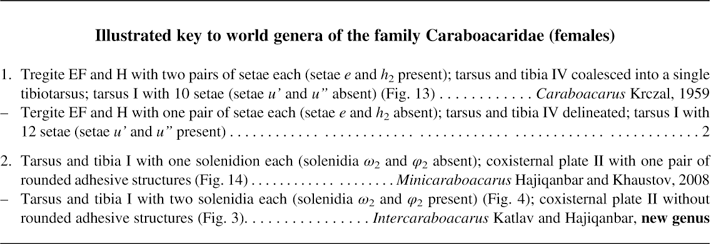
Differential diagnosis. The new genus is distinguished from the genus Caraboacarus by the following characters: tergites EF and H lacking setae e and h 2, respectively (present in Caraboacarus); tarsus I possessing setae u’ and u” (setae u’ and u” absent in Caraboacarus); tibia and tarsus IV distinctly separated (in Caraboacarus tibia and tarsus IV fused into a large tibiotarsus). It is distinguishable from the genus Minicaraboacarus by absence of rounded adhesive structure (modified seta 2c) on coxisternal plate II (present in Minicaraboacarus) and presence of solenidia ω 2 on tarsus I and φ 2 on tibia I (absent in Minicaraboacarus).
Intercaraboacarus clivinus Katlav and Hajiqanbar, new species
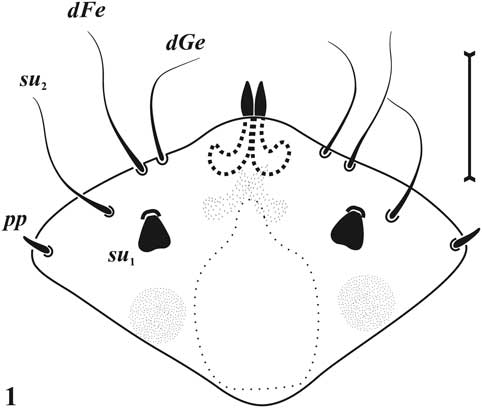
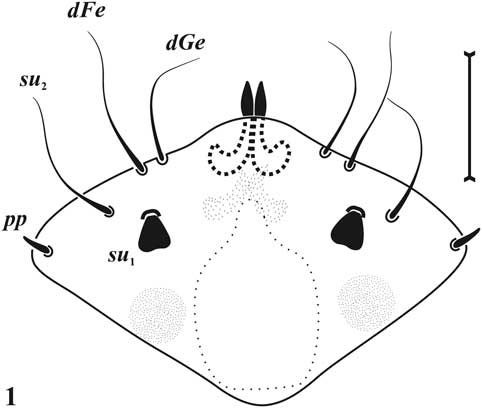
Intercaraboacarus clivinus new genus, new species, female: gnathosoma in ventral view. Scale bar=10 μm.
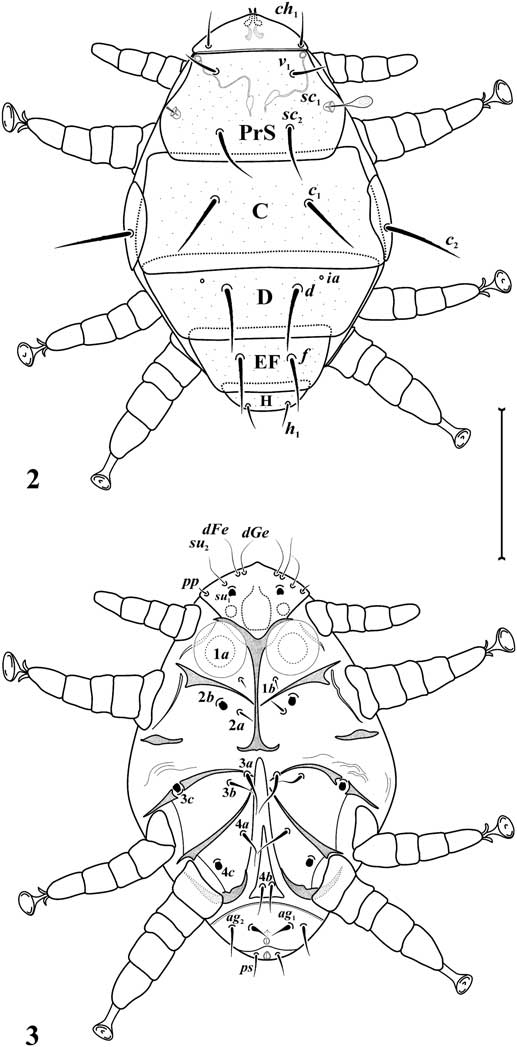
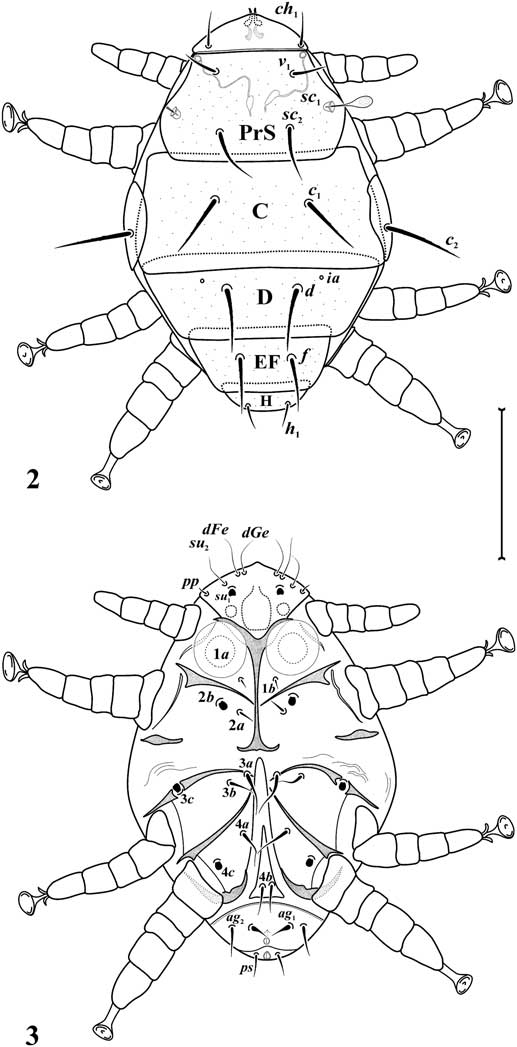
Intercaraboacarus clivinus new genus, new species, female: 2. body in dorsal view; 3. body in ventral view. Scale bar=50 μm.
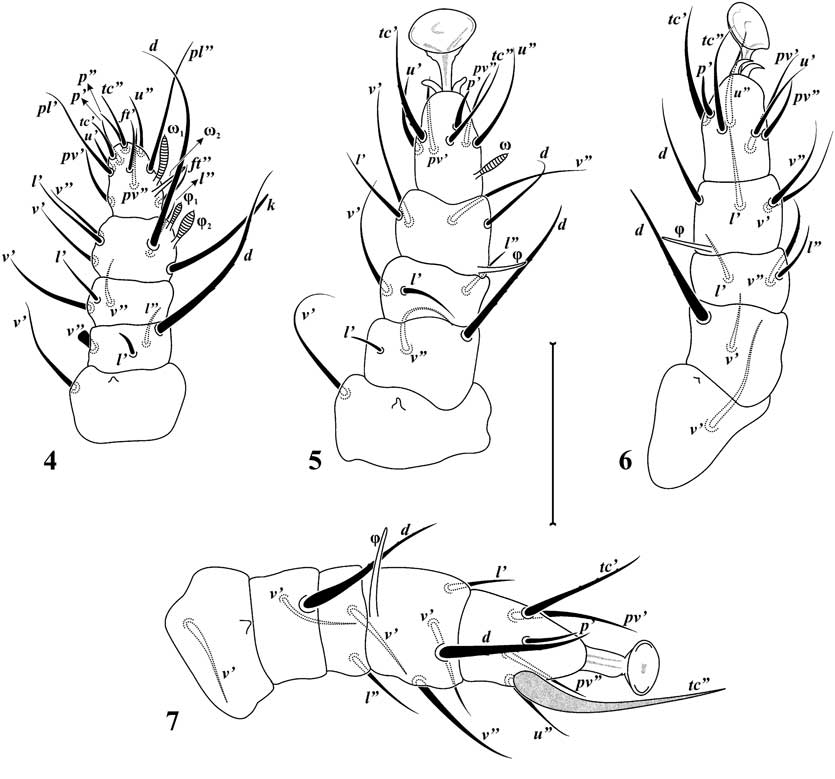
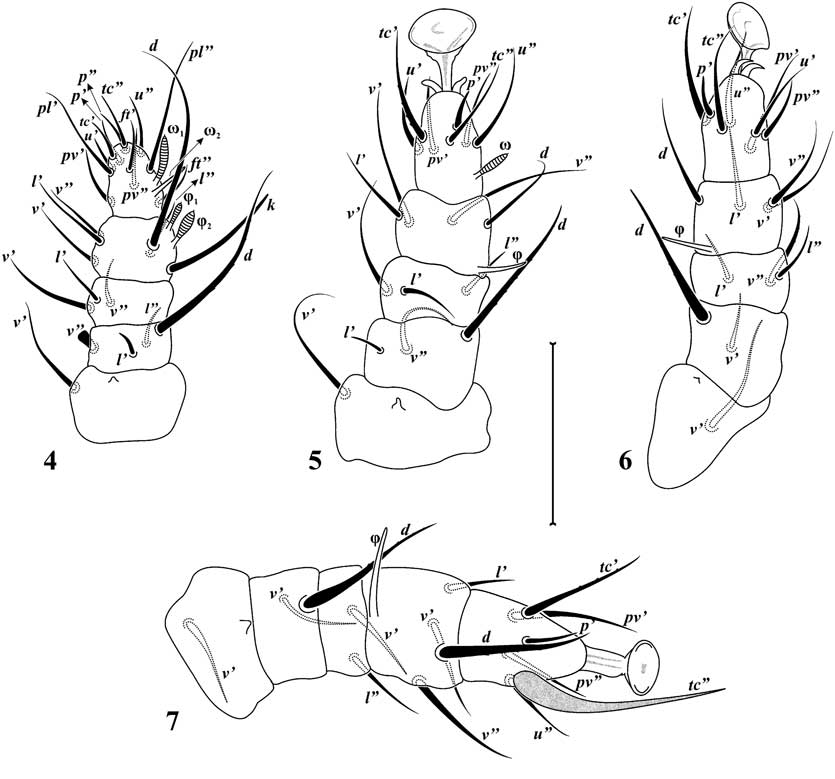
Intercaraboacarus clivinus new genus, new species, female: legs I–IV, respectively. Scale bar=30 μm.
Holotype description (with paratype variation in parenthesis). Female. Length of idiosoma 125 (127–139), width (measured on widest part of segment C) 94 (90–97).
Gnathosoma (Figs. 1–3): length of gnathosoma 23 (22–24), width 38 (37–40), length of stylets 9 (8–9), pharynx width 11 (10–11); Gnathosomal capsule widened subtriangular in dorsal aspect; dorsally with a pair of pointed and smooth cheliceral setae ch 1 13 (12–13), ventrally with three pairs of slender and pointed setae (dGe, dFe, su 2), a pair of short and needle-like postpalpal setae (pp), and a pair of modified and heart-shaped setae su 1; length of ventral setae: dGe 10 (8–10), dFe 10 (10–11), su 2 12 (12–13), pp 3 (3–4).
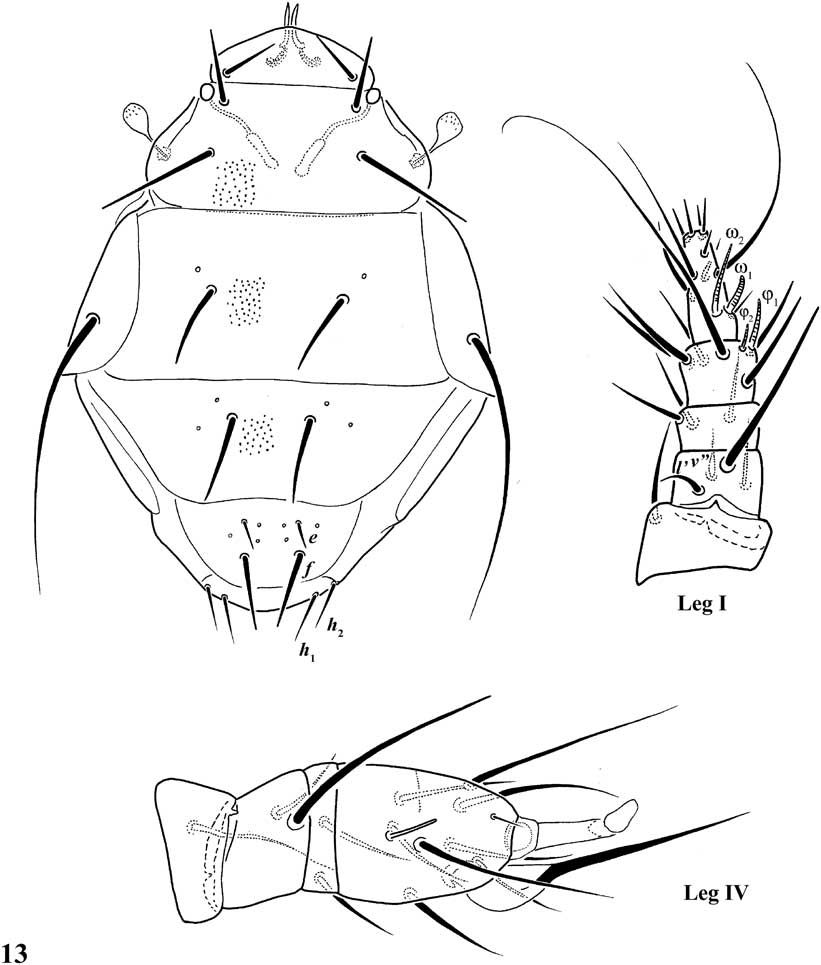
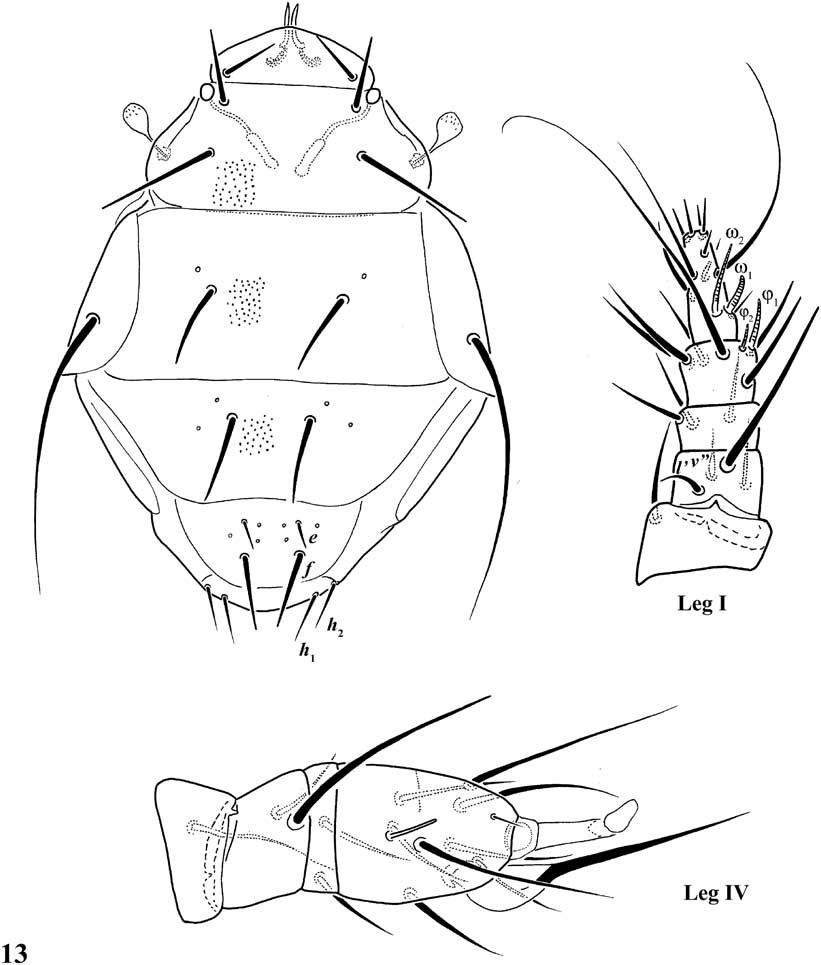
Idiosomal dorsum (Figs. 2, 11): subrhomboid in shape; all tergites sparsely ornamented with tiny and rounded dimples; one pair of distinctly rounded stigmata situated at anterolateral corners of prodorsal plate (PrS), tracheal system and atria well discernible, somewhat reaching mid-level of prodosum; prodorsal plate subhexagonal, wider than long, with nearly straight anterior and wider posterior margins, with setae v 1 16 (14–16) and sc 2 21 (20–21) and a pair of thin stemmed and capitate trichobothria (sc 1) (with broken sensilia in some specimens), setae v 1 smooth and blunt-ended, setae sc 2 weakly barbed and pointed. Median plate of tergite C possessing weakly barbed and pointed setae c 1 22 (20–22); lateral shields overlapping the median plate and bearing setae c 2 26 (25–27) stiff, weakly barbed and pointed. Tergite D with a pair of weakly barbed and pointed setae d 24 (21–23) and one pair of cupuli ia. Tergite EF with a pair of weakly barbed and pointed setae f 20 (18–20). Setae h 1 on tergite H 8 (8–9) smooth and needle-like, shortest on idiosomal dorsum. Distances between dorsal idiosomal setae: v 1–v 1 25 (26–28), sc 2–sc 2 24 (23–26), c 1–c 1 26 (33–36), d–d 41 (39–44), f–f 20 (19–21), h 1–h 1 16 (14–16).
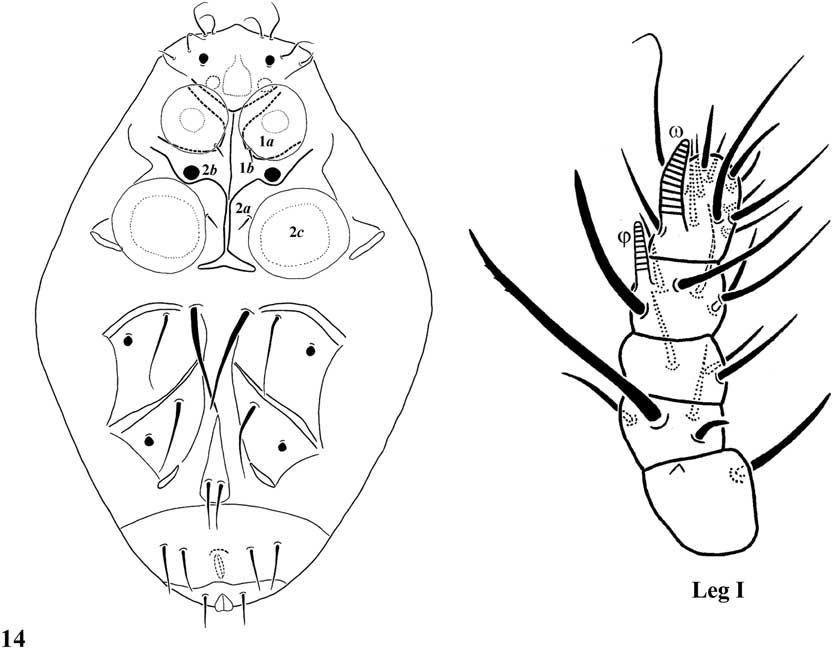
Idiosomal venter (Figs. 3, 12): all ventral plates smooth; all ventral apodemes (ap1–5) well developed, apodemes 1 and presternal apodeme (appr) consolidating into a Y-shaped structure with arched and thickened anterior branches; apodemes 2 nearly curved medially, not joined to presternal apodeme, with thickened falciform habitus in their anterolateral ends; sejugal apodeme (apsej) evident only in its median and lateral parts, fused medially with presternal apodeme; poststernal apodeme (appo) vestigial; apodemes 3 distinctly tapered in their anterolateral ends, extending beyond base of 3a and medially interrupted with button-like setae 3c; apodeme 5 strongly arched and sclerotised, anteriorly undulated and its posterolateral half extending beyond base of trochanter IV; posterior sternal plate with distinctly concave posterior margin; posterior margin of aggenital plate with a protuberance in middle part; all ventral setae smooth; coxal fields I with one pair of rounded adhesive structures and one pair of tiny and needle-like setae 1b 3 (3–4); coxal fields II with one pair of short and needle-like setae 2a 5 (5–6) and one pair of modified and button-like setae 2b; coxal fields III with two pairs of pointed setae 3a 11 (10–11) and 3b 14 (13–14) and one pair of modified and button-like setae 3c, setae 3b not extending to the anterior apex of triangular midsternal plate; coxal fields IV with two pairs of pointed setae 4a 13 (12–13) and 4b 10 (9–11), and pair of modified and button-like setae 4c; setae 4a almost as long as 3a, not reaching to the base of 4b; setae 4b located on a triangular midsternal plate; caudal plate bearing two pairs of pointed setae ag 1 6 (6–7) and ag 2 10 (8–10), setae ag 1 distinctly thickened basally; pseudanal plate with one pair of needle-like setae ps 8 (7–8).
Legs (Figs. 4–7): leg I (Fig. 4): Tarsus: solenidion ω 1 8 (7–8) prominent, large and finger shaped with a tiny apical prickle; solenidion ω 2 7 (7–8) stiff and tapered, as long as ω 1; primilateral setae pl’ and pl” whip-like, seta pl” almost 1.4 as long as pl’; eupathidial setae tc’ and tc” blunt ended, tc” longer than tc’. Tibia: solenidion φ 1 6 (5–6) thinner and shorter than solenidion φ 2 7 (7–7), both slightly club-shaped and thin-stemmed with a tiny apical prickle; eupathidial seta k stiff and distinctly blunt ended; seta d elongate and whip-like, exceeding the tip of seta pl” on tarsus, setae v’ and v” subequal and somewhat shorter than seta l’. Genu: seta v’ longest on the segment; setae l’ and v” subequal. Femur: seta l’ slightly curved and blunt ended; setae d elongate and pointed, only barbed seta on leg I; seta v” modified, thickened and spatulate. Trochanter: seta v′ pointed and subequal to femoral seta v’.
Leg II (Fig. 5): Tarsus: solenidion ω 7 (7–7) prominent, slightly clubbed with a tiny apical prickle; eupathidial seta p’ thickened and blunt ended, shortest setae on the tarsomere; seta u’ weakly barbed and subequal to seta tc”; the other setae of the tarsomere smooth and pointed. Tibia: solenidion φ 8 (7–8) stiff and tapered; all tibial setae attenuated and pointed. Genu: seta v’ attenuated and pointed, longer than pointed setae l’ and l”. Femur: seta d stiff, somewhat blunt ended and weakly barbed; seta l’ short and needle-like, barely reaching base of the genu. Trochanter: seta v’ attenuated and pointed.
Leg III (Fig. 6): Tarsus: eupathidial seta p’ blunt ended, shortest seta of the leg; the rest of setae on the tarsomere smooth and pointed. Tibia: solenidion φ 8 (7–8) stiff and tapered; all setae of the tibia tapered and pointed. Genu: setae l’ and l” subequal, both shorter than seta v’. Femur: seta d stiff, indistinctly barbed and fairly blunt ended. Trochanter: seta v’ attenuated and pointed.
Leg IV (Fig. 7): Tarsus: seta tc” modified and thickened proximally (blade-like); seta p’ slightly blunt ended, shortest seta of the leg; seta tc’ pointed, sparsely barbed in its distal half; the rest of setae of the tarsomere smooth and pointed. Tibia: solenidion φ 15 (14–15) stiff and tapered, nearly 2x as long as solenidia φ on tibiae II–III; all setae of the tibia pointed; seta d distinctly stout and sparsely barbed. Genu: setae l” and v’ subequal, both smooth and pointed. Femur: seta d stiff, pointed and indistinctly barbed in its distal half. Trochanter: seta v’ pointed and shorter than seta v’ on trochanters I–III.
Male and immatures unknown.
Type material. Holotype female AK-20130727-1 and 134 paratypes were recovered as four colonies from under elytra of four specimens of Clivina ypsilon. Each beetle specimen harboured more than 30 adult females. The host beetles were collected by night sampling using a light trap by senior author from Noor Forest, Noor, Mazandaran Province, northern Iran, 36°34′N, 52°03′E, 4 m, 27 July 2013.
Etymology. The species epithet “clivinus” refers to the generic name of the carabid host – Clivina.
Beetle host Clivina ypsilon and the mite Intercaraboacarus clivinus new genus, new species, female: 8. Beetle host in dorsal view; 9–10. Colonies of the mite beneath elytra attached to the membranous hind wings of the beetle host; 11. Dorsal view of the holotype; 12. Venteral view of the holotype.
Caraboacarus krczali Eidelberg. Dorsum of the body, legs I and IV (adapted from Mortazavi et al. Reference Mortazavi, Hajiqanbar, Khaustov and Saboori2011).
Discussion
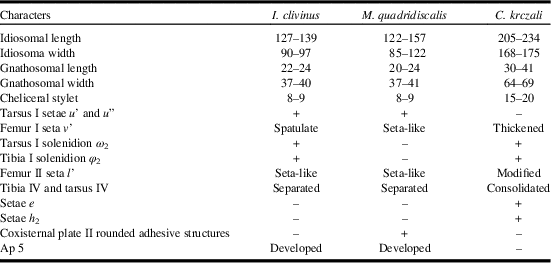
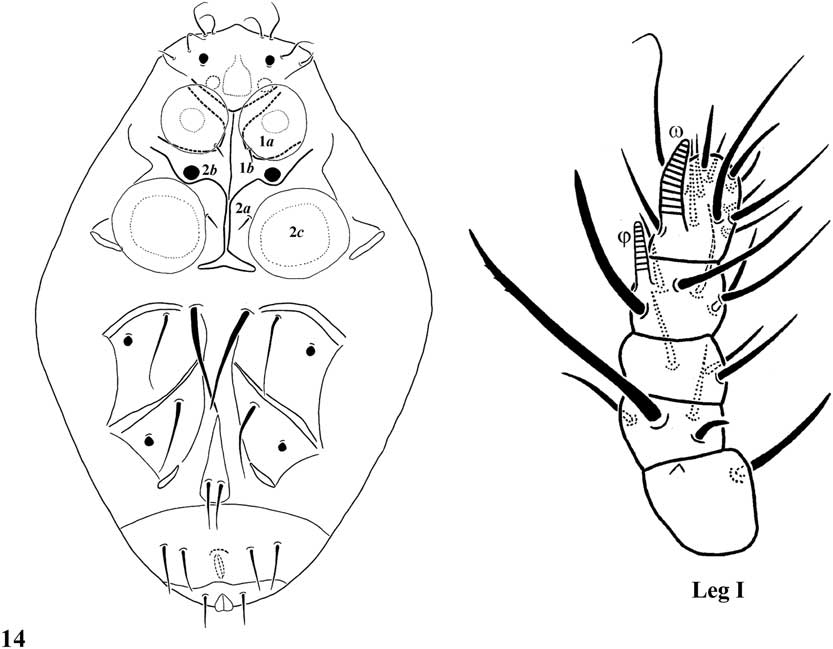
The detailed comparison of chaetotaxy and solenidiotaxy of Intercaraboacarus with the two previously described genera (summarised in Table 1) revealed a mixture of shared character states with Minicaraboacarus and Caraboacarus. Among the all members of the family Caraboacaridae, two remarkable character states are exclusively known for Miniaraboacarus: possession of rounded adhesive structures on coxal field II and presence of only one solenidion on both tarsus I and tibia I. Within the superfamily Trochometridioidea (sensu Kaliszewski et al. Reference Kaliszewski, Athias-Binche and Lindquist1995), only the family Trochometridiidae shares the character state of the reduction of the solenidion on tarsus I (Hajiqanbar et al. Reference Hajiqanbar, Khaustov, Kamali, Saboori and Kamali2009), which may be an example of reductive parallelism. The consolidated tibia and tarsus IV into a single structure, the tibiotarsus, is a unique character state for the genus Caraboacarus.
Comparison of selected characters of Intercaraboacarus clivinus, Minicaraboacarus quadridiscalis, and Caraboacarus krczali.
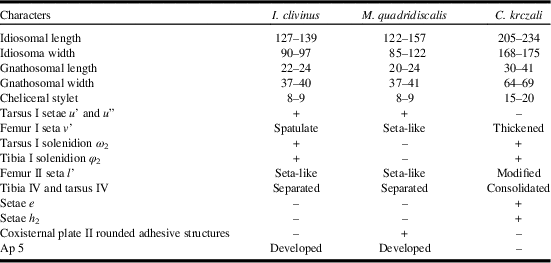
Note: Dashes (–) and plus (+) indicate absence and presence of characters, respectively.
Intercaraboacarus is characterised by having 12 setae on tarsus I (setae u’, u” present) and seven setae on tarsus II (seta pl” absent). These character states are similar to those found in M. quadridiscalis. In Caraboacarus, the number of setae on tarsus II is variable; some species have seven setae (e.g., C. krczali) while others have eight (e.g., C. stammeri).
Modified seta v” on femur I is a character state shared by I. clivinus and all representatives of the Caraboacarus in contrast to M. quadridiscalis, which has setiform v”. Furthermore, in I. clivinus and M. quadridiscalis seta l’ on femur II is seta-like in contrast to all described members of the genus Caraboacarus, which have this setae modified and curve-tipped.
In view of the array of mixed shared character states of Intercaraboacarus, Minicaraboacarus, and Caraboacarus, we hypothesise that Intercaraboacarus is phylogenetically intermediate between the two other genera. However, a phylogenetic analysis must be performed for all described genera and species of the Caraboacaridae before conclusions can be made about the origins of the character states.
Mounting and site selection behaviour of caraboacarid mites has been studied by Nickel and Elzinga (Reference Nickel and Elzinga1969). It is likely that the hind wings of carabid beetles are the most preferential attachment sites for most female caraboacarid mites, as shown in Figs. 9–10. In this case, the enlarged sucker-tipped empodia on tarsi II–IV as well as the epimeral rounded adhesive structures presumably facilitate their attachment during the high motility and fast fluttering of the hind wings of the host during flight.
The family Carabidae encompasses 34 subfamilies and more than 37 000 species (Anichtchenko et al. Reference Anichtchenko, Barsevskis, Gebert, Panin, Toribio and Weisner2014). Thus far, mites of the family Caraboacaridae have been recorded from carabid beetles of the subfamilies Carabinae, Harpalinae, Pterostichinae, Platyninae, Trechinae, Scaritinae, and Brachininae. Among the mentioned subfamilies, Harpalinae as the largest subfamily with the most abundant species, and may constitute the most preferential group (especially the tribe Harpalini) for both C. stammeri and C. karenae (Nickel and Elzinga Reference Nickel and Elzinga1969; Eidelberg Reference Eidelberg1993). However, it seems that C. calosoma, C. bernardi, and C. krczali are more preferably associated with the subfamily Carabinae, especially beetles of the genus Calosoma Weber (Mortazavi et al. Reference Mortazavi, Hajiqanbar, Khaustov and Saboori2011). Hajiqanbar et al. (Reference Hajiqanbar, Khaustov, Kamali, Saboori and Kamali2008) found M. quadridiscalis from under elytra of the carabid beetle Cymbionotum semelederi (Chaudoir, 1861) to include the subfamily Melaeninae to this host range. In the present work, Intercaraboacarus clivina was found from the carabid beetle Clivina ypsilon belonging to the subfamily Scaritinae and tribe Clivinini. This new finding represents the second time that a mite of the family Caraboacaridae has been collected from beetles of the tribe Clivinini. Previously, Nickel and Elzinga (Reference Nickel and Elzinga1969) found C. karenae from Kansas, United States of America in association with eight carabid species including Aspidoglossa sitbangulata (Chaudoir 1843), which belongs to the tribe Clivinini. Among the all caraboacarid mites, the least host specificity is known for C. stammeri. It was not only recorded from more than 30 species of carabid beetles (Eidelberg Reference Eidelberg1993) but also has recently been documented in association with the predatory Ablattaria laevigata (Fabricius, 1775) (Coleoptera: Silphidae) (Trach and Khaustov Reference Trach and Khaustov2012).
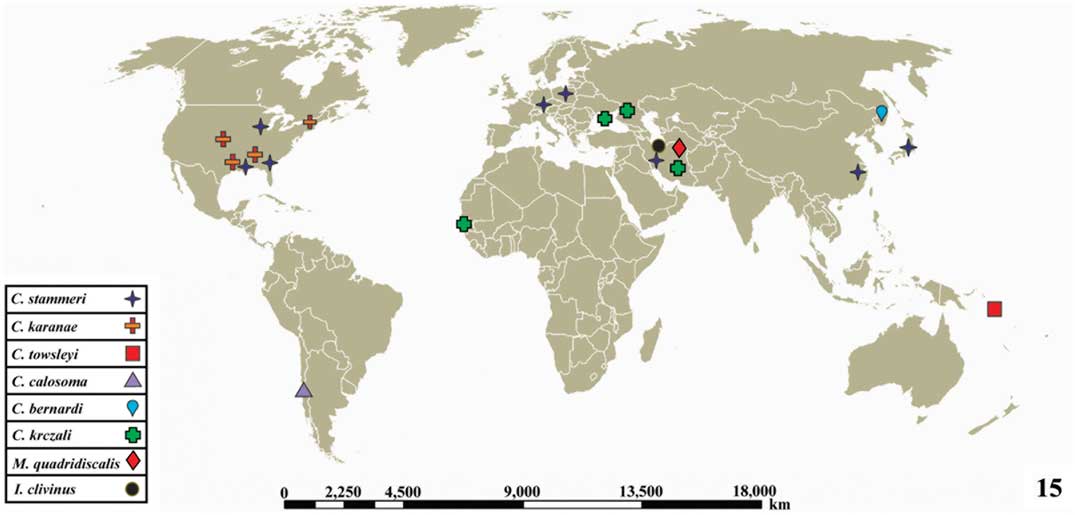
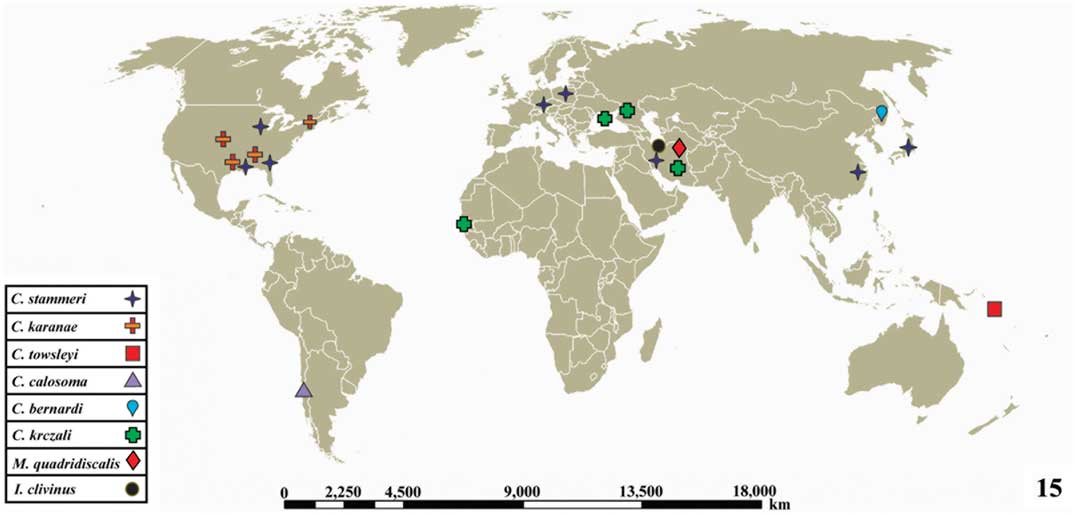
Including Intercaraboacarus clivinus, the family Caraboacaridae now contains three genera and eight species. The genera Mincaraboacarus and Intercaraboacarus have only been recorded from the Palaearctic region so far, however, Caraboacarus has representatives in almost all major zoogeographical realms of the world except the oriental region (Fig. 15). The Palaearctic and Nearctic regions together contain about 75% of described caraboacarid species. Several records of Caraboacarus stammeri from the Palaearctic and Nearctic realms, and Caraboacarus krczali from the Palaearctic and Afrotropical realms may indicate that these species have more expanded distribution rather than other species (Krczal Reference Krczal1959; Kurosa Reference Kurosa1980; Husband and Husband Reference Husband and Husband1984; Eidelberg Reference Eidelberg1994; Szczepanska and Magowski Reference Szczepanska and Magowski2003; Mortazavi et al. Reference Mortazavi, Hajiqanbar, Khaustov and Saboori2011).
Minicaraboacarus quadridiscalis Hajiqanbar and Khaustov. Venter of the body and leg I.
World distribution of genera and species of the Caraboacaridae.
In the course of evolution towards host–mite specificity, some lineages in the Heterostigmata have gradually evolved independently from a simple, free-living mode of life in the habitat or nest of their host to a more closely symbiotic relationship such as parasitism or parasitoidism. Some of the behavioural traits of the phoresy phenomenon, namely host-seeking, host’s signal recognition, and synchronisation with the host phenology, are similar to those of parasitoidism or parasitism. This can lead to the hypothesis that phoresy, especially in its obligatory form, is a transitional or temporal stage in the life history of a species toward highly specialised parasitism or parasitoidism (Athias-Binche and Morand Reference Athias-Binche and Morand1993; Kaliszewski et al. Reference Kaliszewski, Athias-Binche and Lindquist1995). The family Caraboacaridae is presumably in the middle of this evolutionary pathway. So far, these mites have not been observed to uptake host haemolymph and undergo any obvious morphological change (swelling) while attached to their host. Moreover, males and other life stages have not been discovered on their hosts. Therefore, occurrence of parasitism in this family is doubtful. However their association could be far more than a simple facultative phoresy. Although a recent finding shows a phoretic relationship of a common caraboacarid species, Caraboacarus stammeri, on silphid beetles (Trach and Khaustov Reference Trach and Khaustov2012), these mites are mostly in association with carabid beetles. It can be speculated that nutrient strategy of the caraboacarids may be correlated with aforementioned beetles and it is more likely that their life cycle is somehow synchronised with that of these beetles. Based on Kaliszewski et al. (Reference Kaliszewski, Athias-Binche and Lindquist1995), parasitoidism is a possible mode of life for these mites. This assumption can be corroborated with the following morphological adaptations seen in gnathosoma of Caraboacaridae: cheliceral stylets enlarged, palpi reduced and pharyngeal pump entire and well developed. The same patterns have been evolved in some other heterostigmatic families including Pyemotidae and Acarophenacidae whose females have been observed to be parasitoids of pre-imaginal stages of wide variety of insects (Cross Reference Cross1965; Cross et al. Reference Cross, Moser and Rack1981; Goldarazena et al. Reference Goldarazena, Ochoa and Jordana1999). The extensive swelling of a female’s body during feeding before reproduction (physogastric process) and suppression of immature stages to produce numerous, even-aged, mature progeny are remarkable implications for parasitoidism that are seen in two aforementioned families (Kaliszewski et al. Reference Kaliszewski, Athias-Binche and Lindquist1995). However, for all known Caraboacaridae, adult females have not been found in a physogastric condition, perhaps because they have not been found in association with immature instars of their hosts. Therefore, future studies on the natural history and life history of the caraboacarid mites are required to address their life strategy, and determine whatever life stages these mites have.
Acknowledgements
The authors thank Dr. A. Anichtchenko (Institute of Systematic Biology, Daugavpils University, Latvia) for help with the identification of the carabid host beetles and Mrs. Shamsi Paryad, the senior author’s mother, for her help during sampling. This research was partly funded by a grant (No. 92022910) from the “Iran National Science Foundation: INSF” and partly from the Office of Vice President for Research Affairs, Tarbiat Modares University, Tehran, Iran, which is greatly appreciated.