Introduction
Violence is a major public health problem worldwide. The Small Arms Survey Global Burden of Armed Violence (GBAV) report estimated that the global annual average of violent fatalities between the years 2007 and 2012 was 508,000, of which approximately 70,000 were attributable to conflict. 1 Based on data from the World Health Surveys, Obermeyer et al estimated that for the period 1955-2002, there have been 5.4 million conflict-related fatalities in 13 countries.Reference Obermeyer, Murray and Gakidou 2 The GBAV report suggested that firearms are a major mechanism of fatalities from both conflict and non-conflict violence; the report estimated that out of 377,00 intentional homicides, firearm-related injuries accounted for 46.3% of fatalities. 1 The proportion of fatalities by firearm-related injuries in conflict settings were highly variable due to technological differences between theaters of conflict; the injury mechanisms in a conflict predominantly using aerial bombardment is different from that of a conflict where small arms are predominate. 1 However, by using data from several conflicts, the GBAV report estimated that overall, firearm-related injuries accounted for approximately one-third of direct conflict fatalities. 1
The circumstances and weapons that characterize fatal injuries from violence in conflict settings are distinct from those in non-conflict settings. In conflict zones, militaries, militias, and insurgents engage in combat characterized by the use of assault rifles (carbines with a detachable magazine and capable of fully automatic fire) and explosive ordnance such as grenades and mortars. 3 By contrast, non-conflict violence is primarily characterized by interpersonal incidents, often in the context of crime.Reference Riedel and Welsh 4 Due to limited availability of assault rifles and other military weapons in non-conflict settings, handguns are predominantly used.Reference Riedel and Welsh 4 The United States Bureau of Justice Statistics (Washington, DC USA) suggests that fully automatic weapons are only used in eight percent of criminal incidents in the United States.Reference Zawitz 5 This observation is further supported by data from the Republic of South Africa, where assault rifles were used in only 6.5% of robberies between 1997 and 1998.Reference Hennop 6 In theaters of conflict, non-conflict-related fatalities may also increase; a multi-national comparative analysis of homicide statistics from 110 countries and 50 different wars indicated that there was a substantial increase in the rate of homicides in the post-war period, and that these increases were present in both large-scale and small-scale conflicts.Reference Archer and Gartner 7
Iraq has remained a country in conflict since the removal of Saddam Hussein’s regime after the 2003 invasion, experiencing sustained insurgency and sectarian violence. The ongoing conflict has resulted in excess mortality. A recent retrospective mortality study by Hagopian et al estimated that between 48,000 and 751,000 excess fatalities occurring during the period 2003-2011 are attributable to the conflict.Reference Hagopian, Flaxman and Takaro 8 Since 2011, following the withdrawal of coalition forces, the terrorist group known as Islamic State of Iraq and Syria (ISIS) has gradually scaled up activities, with escalating violence in 2013, followed by territorial gains and the capture of Mosul, Tikrit and other key cities in 2014. 9 - Reference Lewis 11 Since 2014, Iraqis, with the support of the US and coalition partners, have been resisting the group’s expansion through a combination of intelligence gathering, bombing campaigns, and special operations. 12
Previous research from Iraq has demonstrated that firearm-related fatalities were responsible for a majority (63%) of violence-related fatalities, more than double the proportion from explosives (28%); the remaining nine percent were from undetermined mechanisms.Reference Hagopian, Flaxman and Takaro 8 However, there remains a gap in the understanding of the epidemiology of firearm-related fatalities in this context. Additionally, more recent trends in firearm-related fatalities, such as those resulting from the rise of ISIS, are not captured in retrospective mortality surveys. Similarly, more detailed information on the circumstances of injuries would enhance Iraqi ability to monitor efforts to prevent fatalities from firearms, including new regulations around civilian possession and public carrying.Reference Butchart, Mikton and Krug 13 This research therefore aims to describe the characteristics of these firearm-related fatalities in terms of time, place, person, and circumstances to provide evidence to inform appropriate public health action against violence in Iraq. The authors further aim to compare the epidemiology of firearm- and explosion-related fatalities as documented in previous research.
Method
Data on firearm-related fatalities were obtained from the Injury Mortality Surveillance System operated by the Iraqi Ministry of Health (MoH; Baghdad, Iraq). As reported previously, this surveillance system collects data on all fatalities caused by injury reported by coroner offices from eight of the 18 governorates of Iraq: Baghdad, Al-Anbar, Basrah, Erbil, Kerbala, Maysan, Ninevah, and Al-Sulaimaniya (spelling of governorate names is consistent with that used by the Iraq Central Organization for Statistics and Information Technology [COSIT]; Baghdad, Iraq). 14 , Reference Bilukha, Leidman, Sultan and Jaffar Hussain 15 These eight governorates represent all reporting sites involved in injury surveillance during the period under investigation. The Iraqi MoH and the Kurdistan Regional Government MoH (Kurdistan, Iraq) initiated the system of improved surveillance with technical support from the World Health Organization (WHO; Geneva, Switzerland) and the US Centers for Disease Control and Prevention (CDC; Atlanta, Georgia USA).
Trained clerks at the coroner offices collected the data on fatal injuries using a standardized surveillance form. Information collected included the date and location of the incident, victim demographics, death certificate number and date of issue, mechanism of injury, and circumstances of the incident. Information was extracted from police reports, results of examination at the coroner offices, and interviews with family members. Iraqi Law No. 148 makes it compulsory to register all births and fatalities. 16 , Reference Al-Rabie 17 Additional regulations require that fatalities must be reported to the coroner offices for investigation before a death certificate is issued. 18 Previously published population-based studies from Iraq have shown that death certificates were available for 91% (74% witnessed by surveyor during the interview, 17% reported to be present but not witnessed) of fatalities from 2003-2011.Reference Hagopian, Flaxman and Takaro 8 These data were entered at the coroner offices and transmitted to the MoH for aggregate analysis.
The case definition used by the Iraqi injury surveillance system included all individuals killed as a result of an external injury, including both intentional and unintentional injuries; injuries resulting from police interventions were excluded. A subset of all injuries was used for this analysis. The subset included individuals killed by firearm-related injuries, excluding fatalities due to intentional self-harm or negligent discharges. Data were collected on all fatal injuries, both civilians and combatants. Fatalities that died immediately on impact as well as fatalities with a delayed death were included. Fatalities of unknown intent (n=966) were included in the analysis based on the assumption that they were likely to have predominantly resulted from intentional interpersonal incidents. Of all firearm fatalities, 7,019 fatalities resulted from an intentional interpersonal incident while only 60 fatalities resulted from intentional self-harm or negligent discharges.
The database was checked for duplicate entries by comparing victim demographics, the time and location of incident, and mechanism of injury. Analysis included 7,985 firearm-related fatalities that occurred between 2010 and 2013 in the eight reporting governorates. Fatalities due to deliberate self-harm (n=25) and negligent discharges (n=35) were excluded. The Iraq COSIT-projected population estimates were used for analysis. 14 Statistical analysis was performed using STATA statistical software Version 13.1 (StataCorp LP; College Station, Texas USA). This study was submitted through the CDC human subjects review process and was determined to not involve human subject research because it entailed secondary analysis of routinely collected public health surveillance data. Personal identifiers were not included in the final dataset used for analysis.
Results
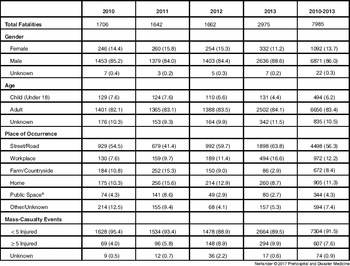
The annual number of fatalities remained relatively stable between 2010 and 2012 (range: 1,642-1,706), and then increased by approximately 80.0% (to 2,975 fatalities) in 2013 (Table 1).
Distribution of Fatalities due to Intentional Firearm-Related Injuries, Selected Governorates in Iraq, 2010-2013 (n=7,985)Footnote b

a Public space includes markets and public gatherings.
b Data are presented as number (% of group).
Among all fatalities, 86.0% were male and 13.7% were female, the sex of 22 (0.3%) was unknown. Overall, 83.4% were adult and 6.2% were children under 18 years of age; age was unknown in 10.5% of fatalities. The proportion of females (range 11.2%-15.8%) and children (range 4.4%-7.6%) remained relatively stable during the study period, despite fluctuations in the number of total firearm-related fatalities. The proportion of females and children among fatalities was lowest in 2013. However, in absolute terms, 2013 saw the greatest number of fatalities for these two groups, particularly for women.
The majority of fatalities occurred on a street or road (56.3%), followed by workplace (12.2%) and home (11.3%). The proportion of fatalities occurring in the workplace nearly doubled during the study period, increasing annually from 7.6% to 16.6%. Between 2011 and 2013, the proportion of fatalities occurring on a street or road increased (from 41.4% to 63.8%), whereas the proportion of fatalities from injuries occurring in the home decreased (from 15.6% to 8.7%; Table 1). Overall, 7.6% of fatalities occurred in mass-casualty events, defined as an event involving five or more casualties. The proportion of fatalities that occurred in mass-casualty events increased annually from 4.0% in 2010 to 9.9% in 2013 (Table 1).
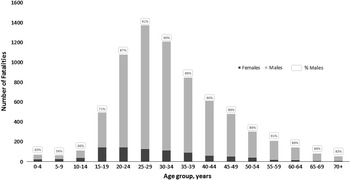
The number and sex distribution of fatalities by five-year age cohorts is presented in Figure 1. The greatest number of fatalities was in the age group 25 to 29 years. The number of fatalities declined in each subsequent older age cohort. In all age groups, including children and the older adults, the majority of fatalities were male. In the age cohorts 15-19 years and above, males account for more than seven out of 10 fatalities. Males in the four age cohorts with the most fatalities (20-24, 25-29, 30-34, and 35-39) accounted for 56.3% of all fatalities where age and sex was known.
Age and Sex Distributions of Fatalities Caused by Intentional Firearm-Related Injuries, Select Governorates in Iraq, 2010-2013 (n=7,149). Note: Not shown - 836 (10.5%) fatalities with unknown age and/or gender.

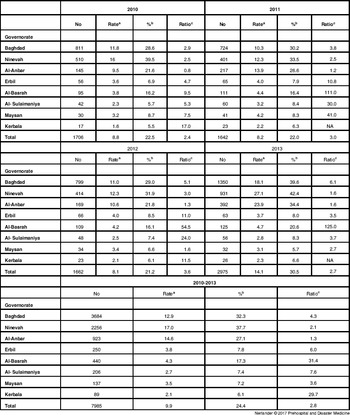
Table 2 presents four metrics by which to evaluate the magnitude and trends in fatalities by year and governorate: (1) the total number; (2) population-based rates; (3) proportion of firearm-related fatalities among all fatal injuries of any cause; and (4) ratio of firearm-related fatalities to explosion-related fatalities. The number of explosion-related fatalities, published previously by Bilukha et al,Reference Bilukha, Leidman, Sultan and Jaffar Hussain 15 as well as the total number of fatal injuries from any cause, were collected from the same eight reporting coroner offices collecting firearm-related fatality data. As noted, the number of firearm-related fatalities increased in 2013, following a period of relative stability between 2010 and 2012. The rates suggested the same trend. The rate in 2013 (14.1 per 100,000 per year) represented a nearly 75% increase in the rate reported in 2012 (8.1 per 100,000 per year). The proportion of firearm-related fatalities among all fatal injuries was also higher in 2013 (30.5%) than in any previous year (range: 21.2%-22.5%). The ratio of firearm-related fatalities to explosion-related fatalities did not follow the same trend, but instead increased gradually between 2010 and 2012 from 2.4 to 3.6, before declining to 2.7 in 2013.
Number and Incidence of Fatalities Caused by Intentional Firearm Injuries, Proportion of Firearm-Related Fatalities among All Fatal Injuries, and Ratio of Firearm-Related Fatalities to Explosion-Related Fatalities by Year and Governorate, 2010-2013 (N = 7,985)

Note: NA signifies that no explosives-related fatalities occurred.
a Rate per 100,000.13
b Fatalities from intentional firearm-related injuries as a percentage of all fatal injuries reported at the coroner office.
c Ratio of firearm-related fatalities to fatal explosives-related injuries from Bilukha et al.14
Of all firearm-related fatalities, more than 85% were recorded in Baghdad (46.1%), Ninevah (28.3%), and Al-Anbar (11.6%). These three “high-burden” governorates also reported the highest rate of fatalities and the greatest proportion of firearm-related fatalities as a share of total fatal injuries. The increase in fatalities documented in 2013 was also more dramatic in these governorates relative to the other five lower burden governorates. The number of fatalities increased by 93.4% between 2012 and 2013 in high-burden governorates compared to 7.9% in low-burden governorates. The increase in rates between 2012 and 2013 was greater in the three high-burden governorates compared to the low-burden governorates, 88.4% and 5.0%, respectively. The proportion of all fatalities attributable to firearm-related injuries increased between 2012 and 2013 in high-burden governorates (by 57.6%) but decreased in low-burden governorates (by 15.3%). Both in terms of the number and rate of firearm-related fatalities, the percent increase between 2012 and 2013 was greatest in Al-Anbar, followed by Ninevah.
In high-burden governorates, there were an estimated 2.6 fatalities from firearm-related injuries for every fatality attributed to explosions. The proportion was higher in Baghdad (4.3:1) than Ninevah (2.1:1) or Al-Anbar (1.3:1). During the peak of the violence in 2013, the ratio of firearm to explosion fatalities in Baghdad (6.1:1) was nearly four times that of Ninevah or Al-Anbar (1.6:1 for both). In Baghdad, the ratio increased annually during the study period. Given the small number of explosion-related fatalities in the five lower burden governorates, the annual ratios were generally higher and showed unstable trends.
Discussion
This study shows that firearm-related fatalities in selected governorates of Iraq nearly doubled in 2013, following a period of relative stability between 2010 and 2012. This finding is consistent with the previously published trends in explosion-related fatalities observed at these same eight reporting governorates; Bilukha et al documented 2.4 times more explosion related fatalities in 2013 (n=1,101 fatalities) than in 2012 (n=458).Reference Bilukha, Leidman, Sultan and Jaffar Hussain 15 Surveillance data provide epidemiologic evidence of an increase in fatalities that corresponds with a surge in ISIS activity. Political scientists suggest that a multi-year campaign by ISIS targeting individuals loyal to the government culminated in an operation between July 2013 and June 2014 termed the “soldier’s harvest.”Reference Knights 10 , Reference Lewis 11 This operation was characterized by attacks on members of the Iraqi Security Forces (ISF) with the intention of weakening their capacities ahead of offensives in 2014. The first six months of “soldier’s harvest” saw a 150% increase in well-coordinated, close-range attacks on checkpoints and targeted improvised explosive device (IED) attacks on officials.Reference Knights 10 , Reference Lewis 11 The increase in firearm-related fatalities in 2013 observed by this study can therefore likely be explained as marking an escalation in insurgent activity, nearly a year before insurgent groups under ISIS leadership took the city of Mosul (the second largest city in Iraq) in Ninevah governorate, infiltrated cities in Anbar governorate, and made other significant strategic gains. 9
More than 85.0% of all fatalities were concentrated in three high-burden governorates: Baghdad, Al-Anbar, and Ninevah. These governorates also had the greatest fatality rate and proportion of firearm-related fatalities among all injuries. The overall increase in fatalities documented in the eight reporting governorates in 2013 is largely explained by the increased number of fatalities in these three governorates, where the total number of fatalities nearly doubled between 2012 and 2013. By contrast, the total number and rate of firearm-related fatalities did not increase substantially in any of the low-burden governorates. A similar relationship was observed with respect to explosives-related fatalities. Fatalities in Baghdad, Ninevah, and Al-Anbar accounted for 95.6% of all explosives-related fatalities in the eight governorates.Reference Bilukha, Leidman, Sultan and Jaffar Hussain 15 As with firearm-related fatalities, the most significant increases in explosion-related fatalities occurred in Ninevah and Al-Anbar between the years 2012 and 2013. 14 These governorates contain key cities such as Mosul, Ramadi, and Fallujah that were of strategic value and were therefore priority targets for insurgent groups. 9
More than eight out of 10 fatalities in this study were male. Previous research from the region has consistently documented the phenomenon of males representing a large majority of firearm-related fatalities. A review of 64 firearm-related fatalities in Dammann, Saudi Arabia between 2002 and 2006 found that 92.2% were male.Reference Al-Rabie 17 Out of 34 interpersonal firearm-related fatalities documented in eastern Saudi Arabia between 1985 and 1994, all were male. 18 A review of 444 firearm-related fatalities in Diyarbakir, Turkey between 1996 and 2001 found 83.8% of the 296 fatalities classified as homicides to be male.Reference Al Madni, Kharosha and Shotar 19 Similarly, a retrospective study of 89 firearm-related fatalities in Tehran, Iran between 2002 and 2003 found that all but three (94.4%) of the 54 fatalities identified as homicides were male.Reference Amiri, Sanaei-Zadeh, Zavarei, Ardestani and Savoji 22 Moreover, in this study, young adult males appear to be at increased risk; males aged 20-39 years accounted for 56.3% of total fatalities where age and sex were known (n=7,149). Similarly, this age-sex group accounted for 88.0% of interpersonal firearm-related fatalities in eastern Saudi Arabia.Reference Elfawal and Awad 20 When considered as a proportion of all firearm fatalities, young men accounted for a majority of all 444 fatalities in Diyarbakir, Turkey, while males aged 19-25 constituted one-half of all 89 fatalities in Tehran, Iran.Reference Goren, Subasi, Tirasci and Kemaloglu 21 , Reference Amiri, Sanaei-Zadeh, Zavarei, Ardestani and Savoji 22
Studies from Iraq assessing explosion-related fatalities and all-cause injury fatalities similarly found males to represent a majority of fatalities. A retrospective mortality study of excess fatalities in Iraq for the period between 2003 and 2011 found the sex ratio of all violent fatalities to be 8.5 males for every female; the study does not provide details on whether the sex ratio differed by mechanism of violence.Reference Hagopian, Flaxman and Takaro 8 A comparable observation was made in the previous study on explosives-related fatalities, where approximately nine out of 10 fatalities were male, and 61.5% of total fatalities being among males aged 20-39 years.Reference Bilukha, Leidman, Sultan and Jaffar Hussain 15 The high proportion of males among fatalities from violence may be due to increased exposure if males in Iraq spend more time than females outside the home. Additionally, young males more likely to be targeted by insurgents as combatants are predominantly males of this age group.
The majority of firearm-related fatalities occurred in the street or road (56.3%), followed by workplace (12.2%). The proportion of injuries occurring in these two locations increased over the study period, peaking in 2013. Previous research from Turkey found that just over one-half of firearm-related homicides that took place between 1996 and 2001, during a period of insurgency activity, occurred in the street.Reference Goren, Subasi, Tirasci and Kemaloglu 21 More than one-half (58.9%) of all explosion-related injuries documented in eight governorates of Iraq during the same study period also took place in the street.Reference Bilukha, Leidman, Sultan and Jaffar Hussain 15 The US Army urban warfare doctrine identifies streets and roads as primary venues of approach for military forces in urban terrain, as surrounding buildings can canalize forces moving along them. 23 This offers a potential explanation of the observation that the streets were a common venue for conflict-related fatalities. Given the relatively high proportion of firearm-related fatalities in the workplace, and the doubling of this proportion during the study period, additional study may be warranted to understand if some professions, such as those entailing work in government buildings, place individuals at increased risk of violence as conflict escalates.
This study documents similarities in the epidemiology of firearm-related fatalities and explosion-related fatalities in terms of the trends, demographics, and location. The magnitude, however, is different. Between 2010 and 2013, there were 2.8 firearm-related fatalities for every one explosives-related fatality.Reference Bilukha, Leidman, Sultan and Jaffar Hussain 15 The finding that firearms caused more deaths than explosions is supported by data from previous research on fatalities in Iraq. Hagopian et al estimated that there were approximately two firearm-related fatalities for every one explosion-related fatality.Reference Hagopian, Flaxman and Takaro 8 These findings run in contrast to media reports which have highlighted the prominence of IEDs and other explosions in Iraq.Reference Gregory 24 Additionally, explosives remain a leading cause of fatalities in American service personnel in Iraq.Reference Eastridge, Mabry and Seguin 25 Trends in the number of firearm-related fatalities relative to explosions help to better describe changing insurgent tactics. For example, in Baghdad, the ratio of firearms to explosion-related fatalities more than doubled from 2.9 in 2010 to 6.1 in 2013, indicating that firearms more than explosives accounted for the increase in fatal violence in Baghdad. Similarly, the ratio doubled (from 0.8 in 2010 to 1.6 in 2013) in Al-Anbar, suggesting the increased use of firearms relative to explosives in this governorate. Differences in the number of fatalities from firearms and explosives may, however, be explained by either differences in the number of injuries from each mechanism or differences in the lethality of injuries. It is possible that explosives wound more individuals than firearms, but that firearms have a greater case fatality rate. Based on their analysis of global data on terrorist attacks for the period between 1968 and 2004, Bogen et al demonstrated that while explosives caused on average twice as many fatal injuries than firearms, the case fatality rate of events involving firearms was 2.5 times higher than for those involving explosives.Reference Bogen and Jones 26 As the total number of non-fatal injuries from firearms and explosives in the eight governorates under study was unknown, it is not possible to estimate the case fatality rate of firearm or explosive-related injuries in Iraq during the period of study.
Very high ratios of firearm-related fatalities to explosives-related fatalities were only observed in low-burden governorates where very few explosives-related fatalities were reported. Since explosives are very seldom used outside of conflict, this may indicate that violence in these five low-burden governorates is predominantly interpersonal in nature rather than conflict-related. Previous reports corroborate the observation that Erbil, Al-Basrah, Al-Sulaimaniya, Maysan, and Kerbala represent areas in Iraq that have been largely spared from conflict.Reference Bilukha, Leidman, Sultan and Jaffar Hussain 15 , 27 In these governorates, rates ranged from 2.1 to 4.3 firearm-related fatalities per 100,000 per year. These rates appear to be comparable to neighboring non-conflict countries. Data from the United Nations Office on Drugs and Crime (Vienna, Austria), which compiles data on homicide rates and proportion of homicides by firearm, indicate that the rate of firearm-related fatalities per 100,000 population was 2.3 in Egypt in 2011; 2.1 in Lebanon in 2006; and 1.3 in Jordan in 2005. 28 Additionally, a retrospective investigation of autopsies by Ayub Medical College (AMC) in Pakistan determined the rate of homicide by firearm for Abbottabad, Pakistan to be 4.2 per 100,000 in 2002.Reference Hassan, Shah and Bashir 29 A separate study by AMC determined the rate for Faisalabad, Pakistan to be 8.3 per 100,000 for the period between 2001 and 2002.Reference Bashir, Saeed, Khan, Aslam, Iqbal and Ahmed 30 The similarity of the rates in the low-burden governorates to other countries in the Eastern Mediterranean region not experiencing conflict supports the hypothesis that fatalities in these governorates are primarily non-conflict-related. Data on firearm-related fatality rates from these governorates prior to 2003 are needed to determine whether or not violence in these areas has been affected as a result of the ongoing conflict in neighboring governorates.
Data on the proportion of fatalities from mass-casualty events highlight an additional difference in the epidemiology of firearms and explosives. The proportion of firearm-related fatalities resulting from mass-casualty events in this study was less than eight percent, much lower than the reported proportion (40%) for explosives-related fatalities.Reference Bilukha, Leidman, Sultan and Jaffar Hussain 15 Data from Operation Iraqi Freedom (OIF) also suggests that mass-casualty events result in more hospital admissions due to injuries from explosions compared to those caused by firearms. A retrospective review of patients admitted into combat support hospitals due to an injury resulting from a mass-casualty event during OIF found that 73.0% of injuries were due to explosives, while 27.0% were firearm-related.Reference Beekley, Martin, Spinella, Telian and Holcomb 31 The observation that mass-casualty events predominantly were caused by explosives may be explained by differences in the mechanism by which firearms and explosives injure; explosives employ a combination of pressure and shrapnel to affect multiple targets simultaneously when detonating. Firearms do not have the same capacity to inflict instantaneous injury on many targets. Additionally, the observation that the proportion of fatalities from mass-casualty events increased in 2013 is supported by documentation of ISIS tactics during the study period. According to the Combating Terrorism Center at West Point (New York USA), ISIS almost always began a raid against enemy positions with a mass-casualty attack on checkpoints or headquarters.Reference Knights 10
Limitations
This study is subject to several limitations. First, as with previous studies of violence in countries of conflict, the analysis presented here does not differentiate between conflict- and non-conflict-related fatalities.Reference Hagopian, Flaxman and Takaro 8 , Reference Depoortere, Checchi and Broillet 32 , Reference Herp, Parqué, Rackley and Ford 33 Coroners could not always distinguish with confidence between conflict-related and other types of interpersonal violence, as the intent could not be determined from physical examination alone, and interviews with police and family did not always provide sufficiently reliable information to make the determination. Second, the population estimates used in this analysis are annual estimates reported by COSIT using projections from the 1987 census for Kurdish governorates (Erbil and Al-Sulamaniya) and the 1997 census data for all other governorates. 14 These projections may not accurately capture the population movement resulting from the conflict. Third, the data presented here represent only fatalities; non-fatal injuries caused by firearms and resulting burden of disability are not captured. Fourth, there remains the possibility of un-reported fatalities, particularly in high-threat areas where transport of a cadaver to the coroner may be a greater risk during times of increased conflict. However, due to legislation requiring registration of all deaths, as well as previous research documenting nearly universal registration of deaths amidst the conflict, the authors believe the sensitivity of the system to be high.Reference Hagopian, Flaxman and Takaro 8 , 16 - 18 Fifth, approximately one in 10 fatalities had unknown age. This may result when a fatality died away from home and no friend or relatives could be identified to provide information to the coroner. However, for determining the quality of surveillance data, WHO suggests that data can be considered high quality if less than 20% is coded as missing or with “dump” codes.Reference Bhalla, Harrison, Shahraz and Fingerhut 34 Lastly, to ensure the surveillance system is simple and does not put undue burden on coroner office staff, the number of variables collected in this injury surveillance system is limited. Collecting a number of additional variables would help better understand the circumstances of injury and thus better inform potential prevention strategies. Such additional information includes fatality-related variables (eg, whether the victim is combatant or civilian, and armed or unarmed) and weapons-related variables (eg, type of weapon used, or number of entrance wounds). Ballistic trauma from pistols, shotguns, and rifles result in highly differentiated and characteristic forensic findings.Reference DiMaio 35 Shooter-related variables are more challenging to collect but could include shot placement as a proxy. Multiple shots that are tightly clustered close to the mediastinum and head can indicate a skilled shooter, such as a trained insurgent, while scattered shot placement is indicative of an untrained assailant.Reference James and Dyer 36
Conclusion
This manuscript presents the epidemiology of firearm-related fatalities in Iraq from 2010 to 2013, the first in-depth analysis of the epidemiology of these fatalities including the period since the rise of ISIS. The data suggest that firearm-related injuries are a major cause of fatality in Iraq, resulting in more deaths than explosives. Trends during the four years of the study provide evidence of an increase in violence in 2013, as well as several measures of severity which together demonstrate that violence disproportionately affected three of the eight governorates under study. The data suggest that young males are disproportionally affected by firearm-related fatalities. Roads, streets, and workplaces appear to be common locations where injuries from firearms occur.
These data provide evidence to monitor public health and public policy efforts to control firearm-related fatalities. Iraq already regulates civilian possession of automatic weapons, handguns, rifles, and shotguns. Carrying of firearms in public places is also regulated under Iraqi law.Reference Butchart, Mikton and Krug 13 However, evidence of increasing numbers of fatalities from firearms may suggest the need for enhanced enforcement, particularly given the large proportion of fatalities occurring in public places. As the increase in fatalities is likely conflict-related, coinciding with the rise of ISIS, the effectiveness of regulation in areas of active armed conflict may be limited relative to other non-conflict settings. Improved data on existing trauma care services by governorate would allow for further analysis of the fatality surveillance data to inform public health interventions. Mapping of fatalities against metrics of access to trauma care (such as density of ambulances or response times) could, for example, help target resources to ensure they are distributed based on greatest need.
Acknowledgements
The authors thank all focal points at all coroner offices and emergency departments for their long-standing commitments in collecting data from victims of injury in Iraq, as well as the Director of the Operational Center and the Director General of Medical Operation and Specialized Services, Iraqi Ministry of Health, for their logistics support of the Iraqi Injury Surveillance System.
Authors’ Contributions
EL, ASSS, AH, SJH, and OB designed the study; ASSS and AH collected the data; EL, MPN, and LBB analyzed the data; MPN, EL, and OOB interpreted the data; MPN, EL, and OBB drafted the manuscript; LBB, ASSS, AH, and SJH critically revised the manuscript for important intellectual content. MPN, LBB, EL, ASSS, AH, SJH, and OB read and approved the final manuscript. MPN is a guarantor. All authors had full access to all of the data and take responsibility for the integrity of the data and the accuracy of the data analysis.