Introduction
Seattle, Washington is home to one of the most socially and politically organized communities of people who are both Deaf and Blind in the world. Since the mid 1980s, a tactile variety of American Sign Language (ASL) has been emerging in this community, along with a tactile way of life. Many members of this community were born deaf,Footnote 1 and due to a genetic condition called Usher Syndrome, are losing their vision slowly over the course of their lives. They grew up attending residential schools for the Deaf or Deaf programs in hearing schools, participating in Deaf organizations and social networks, and in some cases attending Deaf universities. As these visual environments became less and less tenable, they were drawn to Seattle as a Deaf-BlindFootnote 2 sociopolitical center where jobs and communication resources were more readily available.
This article focuses on how one Deaf-Blind woman and her interpreter find entry points into a vibrant, rhythmic, social field in a sculpture park on the waterfront in downtown Seattle. The interpretation is accomplished in large part through the use of classifier constructions and constructions that exhibit similar characteristics. These constructions are pervasive in this context because they allow for the embedding of language-internal temporalities, such as aspect marking, in temporal orders external to language such as the “rhythms of everyday life” (Lefebvre Reference Lefebvre2004). Formally, all utterances in signed languages must manifest patterns of motion and rest in order to be articulated. Modern urban settings are also organized by patterns of motion and rest, speed and slowness, that have emerged out of the lived time of exchange: the work week, the lunch break, cycles of hunger and thirst, wakefulness and drowsiness, the commute, the dead line, the break up, and so on, which the subject shaped by postindustrial capitalism is attuned to (Lefebvre Reference Lefebvre2004:7). In the communicative framework examined here, temporalities in the articulation of linguistic forms and the temporalities of urban landscapes are gathered into rhythmic relation with one another by the Deaf-Blind person and her interpreter, who by virtue of being modern urban subjects, are sensitive to these rhythms as structuring elements of their environment.
The approach taken in this study has been heavily influenced by the practice approach to language or PAL (Hanks Reference Hanks2005a, Reference Hanks2005b, Reference Hanks2009, Reference Hanks2010), which is discussed in depth in the next section. The discussion includes comparisons of PAL to other nontraditional approaches to language in context. Next, problems encountered in the description of classifier constructions in signed languages are explored and an alternative analysis is proposed from a practice perspective. In the following section, particular aspects of PAL are extended to include temporal dimensions relevant to the communicative events being studied. This is followed by a description of the methodology used in this research and its relevance to the literature on Deaf-Blind communication. Finally, the data that comprise the main focus of the article are presented and examined and implications for PAL are stated.
The practice approach to language
Saussure writes that the difficulty in delimiting language as an object of analysis is that “[t]he object is not given in advance of the viewpoint. Far from it. Rather one might say that it is the viewpoint adopted that creates the object” (1915/1972:8). This is why a phonetic transcript looks nothing like a syntax tree, which looks nothing like an interview, which looks nothing like a nod, or a twitch, or a smile, or the rhythms of argumentation that feel like home. And yet, all of these objects cohere under different analytic perspectives. Structuralism imbues language with this kind of iridescence,Footnote 3 a different object coming into view depending on the angle of approach and the distance one assumes. The practice approach to language (PAL) is resolutely structuralist in this way. It asks its practitioners to circle around an encounter, utterance, or event, approaching from various angles and distances, with an eye to the suggested outlines of a complex, relational object. Formal, phenomenological, and sociohistorical perspectives are all likely to be relevant, though none of these perspectives on its own will yield an object of analysis adequate to the communicative event as a whole (Hanks Reference Hanks1996:230). PAL is unlike Saussurian structuralism, however, in that its wholes, or totalities, are part of what must be apprehended a posteriori rather than what is posited a priori. Key analytics established for this purpose include the semantic field, the deictic field, and the social field (See below). These constructs are defined according to the distinct principles that govern them. Each one provides a way of looking or an angle to be taken in attempts to discern the contours of a complex, relational whole.
PAL draws on Bourdieu's practice theory (Bourdieu Reference Bourdieu1990), treating communicative practices as a kind of social practice. Practice theory describes how binaries such as objectivity/subjectivity, mechanism/finalism, and structure/agency are dialectically mediated in practice. A first degree reading of Bourdieu yields a vision of the social order reflected in the image of language. Hanks opts instead for a second degree reading that treats linguistic systems as one category of objective structures, which through the dialectics of use, structure the fields within which they are instantiated (Hanks Reference Hanks2005b:72–73). This is a central part of his notion of “communicative practice” (1996), which as a framework, accounts for the seemingly contradictory fact that under a formal perspective, language appears systematic, and autonomous, and yet, when viewed from the perspective of the language user, it appears to be invaded on all sides by nonlinguistic phenomena. In this model, analysis of communicative practices is guided by a triadic heuristic that points toward mutual dependencies between structure, activity, and common-sense notions that social actors have about both (ibid.). This framework was then developed into the broader practice approach to language, which directs analysis toward the processes whereby particular social orders come to seem concrete and natural and how, apart from the intentions of individuals, those orders are replicated and transformed (Hanks Reference Hanks2005a, Reference Hanks2005b, Reference Hanks2009, Reference Hanks2010).
From the perspective of PAL, formal analysis of language holds the potential to break into circles of naturalness, illuminating the communicative processes through which naturalness is generated in particular, historically situated circumstances. For example, Hanks shows the key role translation played in the phase of Spanish Colonization in Yucatán Mexico known as “the peaceful conquest” beginning in 1547. Through careful linguistic analysis of historical texts, he argues that in the process of translation, the surface of the Maya language remained intact, while the fields to which it articulated, shifted radically beneath it. Colonial conduct, colonial organization of built space, and colonial language mutually reinforced one another, creating an internally consistent colonial world, which was eventually sealed off in its own self-evidence (Hanks Reference Hanks2010:365). However, as the circle was closing, this world was subtly being appropriated and made thoroughly Maya.
The trinity would now speak in Maya, without the need for any Spanish or Latin gloss. Jesus would walk the land of Yucatán, and the maseual ‘peasant,’ sanctified, would be protected. In this logic, Christianity is incorporated but fundamentally alienated from its erstwhile owners. God is now Maya.” (Hanks Reference Hanks2010:368)
It was this Mayan, Christian God, who spoke to Maya rebels and told them to cast off the Spanish. Hanks explains:
The place to which the rebels retreated they called Chan Santa Cruz ‘Little Holy Cross.’ The name came from the central figure of resistance, a charismatic cross through which God spoke to the Maya. The cross appeared miraculously in the trunk of a great mahogany tree in late 1850, and it addressed the people in both speech and writing, through its mouthpiece, Juan de la Cruz. It spoke the words of the Trinity, the Father, Son, and Holy Spirit, and it assured the Maya that it would protect them from the Enemy, that is, the dzul. The time had come, it said, to throw them off the back of the maseual ‘peasant’ once and for all.” (Hanks Reference Hanks2010:366)
Approaches to language that at first glance would appear to have something in common with a practice approach—such as cognitive linguistics, grammaticalization theory, and integrationist linguistics—will never lead the analyst to a project in which processes of colonization and missionization are understood in new ways through linguistic analysis of historical texts. In PAL, linguistic systems are one of several views taken on a historically specific a posteriori whole. In these alternate approaches, the world in which language exists and changes is taken into account insofar as it explains facts about language. This is a fundamental difference, which derives in part from the kinds of questions that are asked at the outset.
In contrast to cognitive approaches to language (Langacker Reference Langacker2008;Footnote 4 Liddell Reference Liddell and McNeill2000;Footnote 5 Fauconnier & Turner Reference Fauconnier and Turner2002Footnote 6), the practice approach asks not what universal human capacities make a given utterance possible, but how relations between embodied, historically situated actors, and the deictic and social fields they are embedded in, make a given utterance feasible, and relevant (Hanks Reference Hanks1996:231). These relations reveal themselves when the analyst looks at a phenomenon through the constructs of habitus and field (see below). These relations then form a complex object, which only comes into view under several distinct perspectives—all aimed at understanding a total event (such as religious conversion and colonization in sixteenth century Yucatán). Thus although there is overlap in cognitive and practice approaches, each demands a great amount of detail where the other makes vague suggestions. For example, both practice and cognitive approaches to language posit form-meaning correspondences, which are available to the language user prior to the interaction. However, PAL urges the analyst to enact a bidirectional procedure, whereby form-meaning correspondences are drug at length through the particularities of the fields in which they are embedded and then extracted again—transformed but still comparable to systems in other languages. Cognitive linguistics, in contrast, is unconcerned with embedded particularities and instead aims to understand the universal cognitive capacities of humans. A practice approach seeks to demonstrate how an utterance is feasible and relevant in a world of social facts, whereas a cognitive approach seeks to show the cognitive capacities that make an actually occurring utterance possible. If one instance occurs in a natural setting, this is evidence for a cognitive linguist. From the perspective of PAL, there must be density and repetition, observed over long periods of time, so that what is feasible, relevant, and expectable from the perspective of language users is intuitive for the researcher. The researcher then goes beyond this intuition in the analysis. The aim at this point is not to add social context to linguistic form, correlate social and linguistic categories, or describe linguistic aspects of social activities, but to find a way in to a historically particular moment in a world by breaking the seals of naturalness that would normally prevent objectification, and therefore inquiry. In this article, temporal dimensions of practice are key in accomplishing this aim. In the next section, I move further into temporality in PAL and discuss some additional differences between PAL and alternate approaches to language.
Temporalities of schematic and emergent aspects of practice
In PAL, aspects of the communicative event that cohere under a formal perspective cannot cohere completely, since they must remain open to relations with other aspects of practice. Therefore, they fall under the heading of “schematic” elements, meaning that they are “relatively stable, prefabricated aspects of practice that actors have access to as they enter into engagement” (Hanks Reference Hanks1996:233). They are schematic in the sense of being underspecified as well (ibid.). In order to illustrate the notions of schematicity and emergence, I draw on an example used by Hanks throughout Language and communicative practice (1996), which involves a fictive domestic scene between Jack and Natalia. At 7:28 am in Chicago, Jack and Natalia are beginning their morning routine. Jack is drinking coffee and Natalia is cleaning the dining room table. Hanks writes (1996:1):
(1) Gazing vacantly at his coffee cup, still drowsy, Jack says,
‘D’the paper come today, sweetheart?'
She says,
‘Its right on the table.’
It is easy, Hanks says, to assume that these words are transparent, literal expressions of stable meanings. Jack's utterance is a simple request for information, and Natalia's utterance is a literal response to his question. However, if you look closely you see that there is more ambiguity in the utterances themselves than there appears to be at first glance. Jack's question could be interpreted as demanding a simple yes or no answer, and yet Natalia gives him information about the location of the paper. This is because she knows that Jack reads the paper every day at approximately the same time, and this tacit knowledge allows her to safely assume that Jack's question is not an inquiry into the details of newspaper delivery (Hanks Reference Hanks1996:3). This kind of knowledge is part of everyday life, and everyday life is composed of more than just talk.
In itself, language is neither the cause nor the measure of the world as we live it. Much of what makes the headlines would happen without talk, and we are instinctively wary of words for their ability to deceive. The dining room would still be there, and Jack and Natalia could still take their coffee, by habit, at the table. He would undoubtedly have found the paper on the table even if he never asked, and she could have just pointed. Virtually asleep, his words express little of what we would call meaningful, and his eyes glaze over the paper, barely focusing on the information it announces… (Hanks Reference Hanks1996:2–3)
When extracted from the patterns of everyday life (to the extent that this is possible), words have a wide range of potential meanings. Within the patterns, however, their meanings are locked down by the overlapping coordinate structures of habitual action in familiar places. There, meanings become so unambiguous that they appear self-evident. And yet, even in the thick of an irreducible, unrepeatable moment, we have a sense that some things have been encountered before and will be encountered again—certain utterances, words, and other linguistic elements. Analytically, the first challenge this presents is finding an adequate conceptual vocabulary for such elements, and the second is finding a method for extracting them from the life worlds in which they are encountered. In building this conceptual vocabulary, Hanks resists appealing to “types” as repeatable elements, which are instantiated as “tokens,” or unrepeatable elements.
The threshold of sameness and difference upon which the token-type relation depends has been raised to such a level as to make it almost vacuous… [T]he type level leaves unexplained most of the features of practice we are trying to get at, since these involve adjustments made on the spot, like feasibility, timing, improvisation, and features of reception not predictable by the type of the initiating utterance. [To address this problem, we must] let go of the notion of types, with its promise of timeless closure and unlimited replication. The aim [for PAL] is to generalize across verbal practices, to bring together those features that are repeatable, as distinct from those that are not. (Hanks Reference Hanks1996:233)
Motivated by this aim, Hanks proposes a dialectical relation between schemacticity and emergence that replaces the identity relation endemic to type-and-token. As was stated previously, schematic elements of practice are prefabricated and indeterminate. Once they come into relation with the patterns that constitute everyday life, their meanings tend to become determined. This process requires shared knowledge of the kind Natalia has about Jack's daily routines, or the kind of knowledge they both have about habitual relations between objects, talk, and lived, domestic space. In other words, it is the filling in of all that goes without saying that produces these specific, less repeatable, nonambiguous meanings (Hanks Reference Hanks1996:234).
Schematic elements of practice stand in contradistinction to emergent elements, or “those parts of practice that emerge over the course of action, as part of action. Emergent aspects are not already given prior to engagement and so they are neither prefabricated nor stable. They are in process.” (Hanks Reference Hanks1996:234). Intimate relationships like Jack and Natalia's are brought into being through small histories of habitual action and exchange. The linguistic elements that Natalia and Jack have access to prior to activity are schematic, which is to say, under a formal perspective, they are prefabricated. But once these elements are incorporated into Jack and Natalia's history of exchange, their meanings are transformed by the coherent, lived, domestic world of which they have become a part. Therefore, emergent elements are ordered, just as schematic ones are, but this order can only be apprehended a posteriori.
Importantly, schematic and emergent elements of practice also have distinct temporalities. The temporality of schematic aspects of practice is more lasting than the temporality of emergent aspects. For example, the formal manifestation of a deictic grammatical particle is more perduring than the unification of a deictic grammatical particle and a deictic gesture in the individuation of a particular object of reference that is accessible to both speaker and addressee at a given moment in time. This communicative event as a whole is less likely to be reproduced in its exact form than the deictic particle is, and is in this sense emergent. The same is true of the instance of pointing, which might include some stable aspects (such as a handshape), but is also likely to include some aspects that emerge over the course of action, such as the path-movement of the same instance of pointing. In addition, schematic aspects are underspecified, while emergent aspects are overspecified—each one indeterminate in a way that is complementary to the other. Heuristically, schematic and emergent elements can be distinguished, but in practice, they are mutually constituted.
From what has been said so far, the ways in which PAL is distinguished from other approaches to language that view grammar as an “emergent” phenomenon may be unclear to the reader. For example, Hopper's observations about the “incompleteness of language” (Reference Hopper and Tomosello1998:157) point to the same aspects Hanks refers to as schematic. Likewise, grammaticalization, as a research framework, points to “the relative indeterminacy in language and [to] the basic non-discreteness of categories” and “highlights the tensions between the fixed and the less fixed in language” (Hopper & Traugott Reference Hopper and Traugott2003:2). Similarly, cognitive grammarians take grammatical rules to be patterns of usage that crystallize at higher levels of abstraction, forming “schemas” (Langacker Reference Langacker2008:23).Footnote 7 What most clearly distinguishes PAL from all of these approaches is the constraints that it posits. Once the constraints are in place, a wide range of phenomena appear as problems to the analyst working in a practice approach that would not occur to an analyst working in alternate frameworks (see below).
Another significant difference between PAL and the alternatives that have been mentioned thus far lies in its status as an approach as opposed to a theory. A theory should make testable claims, or hypotheses, and then seek out support or falsification of those claims in empirical cases. This may be possible for language as it has been delimited as an object of analysis in modern linguistics since the nineteenth century (Saussure Reference de Saussure1915/1972; Bloomfield Reference Bloomfield1926; Benveniste Reference Benveniste and Benveniste1971a,Reference Benvenisteb; Chomsky Reference Chomsky and Katz1985), but the objects that PAL yields are more complex in that they are always embedded in a set of relations between formal systems, embodied activity, and common-sense ideas social actors have about both. As complexity increases in the phenomenon, the “theory” must grow more complex, and less determinate, since a feasible, relevant utterance is suspended in the density of a world that has grown out of histories, memories, patterns of behavior, economic, social, and political processes, and so on, each of these dimensions governed by very different principles of organization. Therefore, what is posited about the meaning of forms must remain highly schematic to allow for the sensitivity of those forms to any number of nonlinguistic factors. Complexity and indeterminacy together make PAL a powerful approach for a wide range of phenomena. However, these attributes also mean that, as a framework, it requires more of the individual researcher than mere application. It is not a set of claims, posited a priori and subsequently located in the contingencies of disparate places and historical configurations. Rather, it is an approach, or a way of looking at phenomena, and producing recognizable, if particular, objects. The comparability of various aspects of those objects is determined after the fact, not before.
Constraints in the practice approach to language
What is possible to say in PAL is constrained by more than the internal, combinatory capacity of the linguistic system, the universal cognitive capacities of humans, the frequency of use across a group of language users, or the macrosociological category to which a given language user belongs. However, what is possible to say is not constrained by mutual recognition of intention either (as in Grice Reference Grice, Steinberg and Jakobovits1971, Reference Grice1989), or by a narrow range of institutional legal frameworks (as in Austin Reference Austin1965). Rather, constraints on what can be said derive from the articulation of habitus and field in the flow of activity. Relations between fields are governed by principles of embedding. Each of these key terms—habitus, field, and embedding—are summarized below.
Habitus
Habitus derives from socially and historically specific patterns of perception, thought, and action weighed against notions of correctness, appropriateness, and politeness. These patterns take shape through processes of socialization early in life, but they continue to solidify throughout life (Bourdieu Reference Bourdieu1990:53). To occupy a habitus is not to plan one's actions according to rules, but to be subject to principles that “generate and organize practices and representations that can be objectively adapted to their outcomes without presupposing a conscious aiming at ends or an express mastery of the operations necessary in order to attain them” (ibid.). According to Bourdieu, we are socialized to recognize certain immediate and urgent triggers to say something or not say it, to act or not act, and to identify certain objects in the environment as relevant or not relevant. There is an automaticity in the loop that hides the fact that all of these acquired patterns and schemes that predispose us to respond to stimuli in particular ways are themselves predisposed to reproduce the systems and regularities that created them (Bourdieu Reference Bourdieu1990:55). Out of this circularity, whereby actions snap to grids of intelligibility and regularity without conscious reflection on the part of social actors, a ground of “reasonable” and “common-sense” ideas and behaviors begin to solidify (Bourdieu Reference Bourdieu1990:58). This ground of common sense is “embodied history, internalized as second nature and so forgotten as history” (Bourdieu Reference Bourdieu1990:56). Children are socialized to accept common sense as such, naturalizing historical effects into that which is taken for granted, or goes without saying.
According to Hanks, Bourdieu's formulation of habitus can be traced to Erwin Panofsky, who took “cultural production [to be] profoundly shaped by the ways of the thinking of its time” (Hanks Reference Hanks2005b:70). Panofsky proposed that there are homologies between philosophical thought and the thought procedures of cultural producers in a given period, which ultimately give rise to widespread, underlying logics of cultural production. Bourdieu drew heavily on Panofsky's thinking, but under the influence of Maurice Merleau-Ponty, he went on to propose “that the body, not the mind, was the ‘site’ of habitus” (Hanks Reference Hanks2005b:71). Panofsky's notion of habitus was further modified through its synthesis with two additional conceptual strains. First, the Aristotelian notion of hexis—the meeting of an intention (or desire) to act with judgments of that intention against frames of social value and meaning; and second, phenomenological notions of habituality and embodiment. Much of the phenomenological dimension was taken from Merleau-Ponty, who conceives of the body as the site of a particular kind of knowledge or “grasp” that social actors have of being a body— a “corporeal schema”, which is transmitted by the habitus (see Hanks Reference Hanks1996:69).
This embodied dimension of the habitus is folded into PAL's treatment of temporality such that any analysis of language includes not only “transcript time” but also the way lived time is grounded by language in the body as part of the field of production and reception. Hanks writes that through engaging in ordinary activities, the body participates in and responds to the social order through its “physical occupancy of social space” (1996:249). This view, he says, is “most often ignored by intellectualist treatments of the body. It tends to be the least visible and the most subtle realization of corporeality in language, precisely because it is neither the focus of description nor the perceptible means of expression, and yet,” he argues, “it is inscribed on language form and speech practice” (ibid.). This fundamentally nonintellectualist treatment of temporality, which is taken up as the analyst views one aspect of a complex object, provides insights not only from the perspective of the scholar of language, but also from that of the language user. As discussed below, attending to lived time is useful in accounting for how rhythms of language and of everyday life are configured vis-à-vis the corporeal schema of one Deaf-Blind person and her interpreter in the examples to follow.
Field
PAL posits three kinds of fields that are relevant to any communicative event where language is used. The first is the semantic field, which broadly speaking, is made up of “any structured set of terms that jointly subdivide a coherent space of meaning” (Hanks Reference Hanks2005a:192). The analyst knows that the semantic field is relevant when the use of different forms systematically invokes different aspects of setting (Hanks Reference Hanks2005a:200). Language use also entails a deictic field, comprised of (i) “the positions of communicative agents relative to the participant frameworks they occupy,” (ii) “The position occupied by the object of reference,” and (iii) “The multiple dimensions whereby agents have access to objects” (Hanks Reference Hanks2005a:193). This notion of field is a synthesis of Erving Goffman's “situation” (1972) and Karl Bühler's Zeigfeld (Hanks Reference Hanks2005a:192).Footnote 8 Lastly, the social field, which is central to Bourdieu's practice theory, is summarized by Hanks as follows:
(a) A form of social organization with two main aspects: a configuration of social roles, agent positions, and the structures they fit into and (b) the historical processes in which those positions are actually taken up [and] occupied by actors (individual or collective). (Hanks Reference Hanks2005a:72)
Positions in the social field are produced by power and individuated by means of contrastive opposition. Following Bourdieu, Hanks frames speaking and discourse production as ways of taking positions in social fields of practice. He emphasizes that these position-takings do not imply unimpeded action on the underlying structure of the field. In position-taking, “habitus and field articulate: social positions give rise to embodied dispositions. To sustain engagement in a field is to be shaped, at least potentially by the positions one occupies” (Hanks Reference Hanks1996:73). This is how, despite our best intentions, we tend to reproduce rather than change power structures when we engage them. This happens by means of legitimation and authorization. Legitimation accrues to styles and genres of language use, knowledge of which is limited by social and economic position. Constraints on who has access to legitimate styles and genres in turn serves to limit access to power, reinforcing unequal power relations (Hanks Reference Hanks1996:76). Authorization, by contrast, accrues to the positions social actors occupy. This dual constraint of legitimation and authorization acts on any attempt to take a position.
Embedding
In PAL, embedding operates both as an analytic and as an aspect of practice. In both cases, it is the means by which highly schematic form-meaning correspondences undergo “reshaping,” “conversion,” and “transformation” according to patterns that crystallize in the relations between semantic, deictic, and social fields (Hanks Reference Hanks2005a:194). The difference between embedding as analytic and embedding as element of practice has to do with the order in which each field operates on the others. As a tool for analysis, embedding begins with the semantic field, but when it is viewed as an aspect of communicative practice, embedding begins with the social field.
Embedding as analytic
From the perspective of the analyst, embedding requires a bidirectional procedure, whereby highly schematic form-meaning correspondences are posited a priori, observed in the flow of activity for long periods of time, and then reconsidered. Once radically indeterminate categories in language have fallen into a world of struggle, relation, and fact, they are transformed.Footnote 9 Posttransformation, form-meaning correspondences are viewed again under a given perspective, and a different object coheres than the one that was posited a priori under that same perspective.
Embedding in practice
In embedding in practice, by contrast, the social field is posited first, since it is the precondition for any communicative act. If there is no authorized position in the field to take up, there is no legitimate position-taking to be done and no form-meaning correspondence to be embedded. This is why Hanks emphasizes that authorization, which accrues to positions in social fields, “is not an ad-on to reference after the fact but a condition of possibility for referring” (2005a:210). The social actor, in practice, never apprehends herself or another as a “speaker” or an “addressee” and rarely responds to form-meaning correspondences as if they were radically indeterminate. Rather, she is always already deep in the middle of things, immersed in activities which overdetermine meanings prior to construal or characterization. Embedding in practice, then, is the state of everyday life—events include particular people who are also particular kinds of people engaging in deictic fields in ways that are, to some degree or another, already familiar, routine, or expectable (ibid.). Ultimately, the object of analysis in a practice approach is glimpsed in the patterns that arise out of a posteriori relations between fields and not in the patterns that inhere in any one of them.
Practical equivalences, counterparts, and rules of thumb
Hanks defines three mechanisms of embedding that account for relations between semantic, deictic, and social fields. These mechanisms include practical equivalences, counterparts, and rules of thumb. Practicalequivalences are correspondences between “modes of access that interactants have to objects” (Hanks Reference Hanks2005a:202). Hanks cites the example of a semantic distinction between two enclitics in Yucatec Maya, a' and o', which when combined with any one of four deictic bases, produce a proximal/distal distinction (Hanks Reference Hanks2005a:198–89). This a priori distinction is then immersed in an actual circumstance: a father comes home from traveling and observes that one of his sons is not present. He says:
(2) Kux tuún le páal o', tz'ú chan xantal má'a tinwilik
‘How about that kid? It's been a while since I've seen him.’ (Hanks Reference Hanks2005a:201)
Hanks points out that the denotatum is neither proximal nor distal to the speaker, but rather, off-scene. Nonetheless, o' is used. The choice of a distal deictic, in this case, then, requires a practical equivalence to be established between off-scene and distal modes of access that are, in actuality, nonequivalent. However, this nonequivalence does not appear as such to the language user because the correspondence between semantic and deictic fields has been naturalized and the embedding is seamless.
Counterparts, rather than establishing relations between modes of access, establish relations of identity between objects (Hanks Reference Hanks2005a:202). One example by Hanks is given below in (3) (2005a:201).
(3) Don Chabo, a shaman, refers to the image in the divining crystal he is holding in his hand at the moment of utterance. A young man has arrived unaccompanied at Don Chabo's asking for a divination to diagnose his infant daughter's illness. Since the man has not brought the infant with him, the diagnosis will be long-distance. For this Don Chabo needs the name and hometown of the child, and he learns that she is Laura from the town of Akil. He recites and opens the crystals. Immediately upon finishing the opening prayer, while holding a crystal and staring intently into it, he makes his first statement of diagnosis.
Le chambal a', chokow yoól ká ‘uúch ti’
dnom n predadj her-n comp vb to-ø
this child (was) hot her heart when (it) occurred (to her)
‘This child was overheated when it (illness) happened to her.’
Because there is a visual trace of the actual child in the divining crystal, the a' form can be used. The image of the child and the actual child are linked by a counterpart relation, whereby the former object is identified with the latter. Importantly, this relation is guaranteed not by the language itself or by the spatial arrangement of objects relative to the speaker, but by Don Chabo's theology and local common-sense ideas about the abilities of shamans (Hanks Reference Hanks2005a:201). There is also a practical equivalence at work, since the image in the crystal is tactually and visually immediate, while the actual child is not. Therefore, tactual/visual immediacy is being construed by the use of a' as practically equivalent to spatial proximity. However, Hanks emphasizes that this construal cannot be made by just anyone. Don Chabo is authorized to construe the actual child as spatially proximal because he occupies the position of a shaman. This position comes with the authority to interpret images in the divining crystal, just as the position of a radiologist authorizes the interpretation of x-rays (ibid.).
The counterpart relation relies for its intelligibility on the embedding of the utterance in a full-blown deictic field. There is nothing in the language and nothing in the Zeigfeld that can anchor this. My claim then, is that whenever reference relies on counterpart relations like this one… it relies thereby upon social embedding which authorizes the deferred reference. (Hanks Reference Hanks2005a:201)
The counterpart relation here is comparable to counterpart relations in cognitive science, or what Fauconnier calls “mappings.” Fauconnier (Reference Fauconnier1997:1) writes, “A mapping, in the most general mathematical sense, is a correspondence between two sets that assigns to each element in the first a counterpart in the second” (see also Facuconnier & Sweetser Reference Fauconnier and Sweetser1996). Hanks recognizes that mappings “are at the heart of the unique human cognitive faculty of producing, transferring, and processing meaning” (Hanks Reference Hanks2005a:201). However, in PAL, this notion is not, as it is in cognitive science, a means of illuminating universal cognitive capacities, but rather of understanding the relations that are established by social actors between semantic, deictic, and social fields. Counterpart relations are important because they describe a relation that accounts for the naturalness of actual worlds within which actors communicate.
Lastly, rules of thumb guide speakers in responding to commonly occurring or “stereotypical” situations (Hanks Reference Hanks2005a:206). The language user identifies a situation as being of a familiar type and then construes the meaning of the form that is routinely associated with that type of situation. Hanks uses greetings as an example, given in (4).
(4) A is a neighbor or familiar figure, usually located in his or her yard or place of work, and B is passing by on foot or bicycle. B's response makes reference to the forward path using the a' form. This utterance tells A nothing about where B is going or how far away it is, only that he is heading there.
A: 'oólah wiil! Tú'un ka bin?
‘Hi, Will, where'ya goin’?'
B: chén té'el a'
‘Just over here.’
The rule of thumb is therefore, simply, in pragmatically contrastive contexts such as greetings and scoldings, to treat [Speaker's] field as a' and [Addressee's] field as o'. (Hanks Reference Hanks2005a:206)
Rules of thumb like this do not derive from the language, but rather from a routine association between a common type of interaction, a socially determined spatial zone, which is assigned intuitively by interactants to speakers and addressees, and a deictic expression. Rules of thumb emerge out of routine patterns of exchange and action (Hanks Reference Hanks2005a:207).
These mechanisms—practical equivalences, counterpart relations, and rules of thumb—are the relations that crystallize between elements in distinct fields through associative linkages that become naturalized in practice. Once an a priori semantic distinction, such as proximal/distal, is submerged by the ethnographer in the circumstances that give rise to these relations and then viewed again under a semantic perspective, the range of meanings attributable to formal contrast is more complex for the analyst to determine. However, they are also more true to the automaticity with which they are used by social actors. For social actors, embeddedness is the state of everyday life, and the particular relations that constitute it are a product of distinctions in various fields cross-cutting each other, forming dense, seamless worlds in which meaning tends to be overdetermined.
Part of what contributes to this density is the horizon, made up of everything that goes without saying, which is a part of every world. Objects link up with other objects through routine patterns of reference in familiar circumstances. The associations between the objects form part of this horizon. Hanks writes:
Any object makes available many other objects, according to its association… From the diagnosis to the medicine, from the leg injured to the pain felt, from the bird song to the bird. The horizon leads from the object to many others, and any act of referring lays the groundwork for further references. At the moment of any utterance, the universe of reference is already structured, and this is a simplifying resource for speakers… Objects also come to be denoted in typical ways, and this is part of the horizon of background knowledge… The question then, is not how interactants manage to identify referential objects but how they manage to limit the chain of reference to a unique individual. (Hanks Reference Hanks2005a:211)
Associative referential chains are a product of repetition and difference, each act of referring adding more density to the horizon against which future objects are individuated. This is where a contribution can be made to the development of PAL through the study conducted here. In what follows, I show the means by which semantic distinctions are embedded in deictic and social fields when the associations that form the horizon of common sense, or naturalness, are disrupted. When Deaf-Blind people transition from a primarily visual life-world to a primarily tactile life-world, there are turning points when relations between linguistic systems, embodied social activity, and common-sense notions about both fail to orient the actor. However, before moving on to the analysis, the properties of classifier constructions in signed languages must be discussed. This is because in transitional phases, like those described above, the use of classifier constructions and constructions that exhibit similar characteristics play an important role.
A preliminary typology of classifiers in signed languages
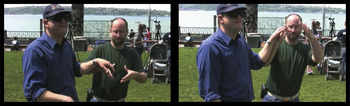
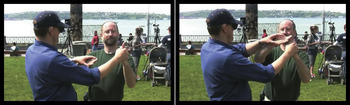
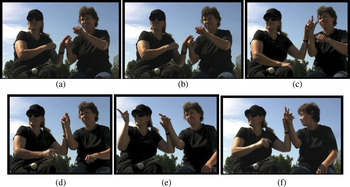
Classifiers in spoken and signed languages are dissimilar in both form and function. However, grounds for comparison is based on the presence of morphology that classifies one of the verb's nominal arguments according to semantic criteria (Aronoff, Meir, Padden, & Sandler Reference Aronoff, Meir, Padden and Sandler2000). Many aspects of this comparison have become contentious, including characterizing classifiers, or aspects therein, as morphological, as gestural, or as some combination of the two.Footnote 10 At least three categories of signed language classifiers have been proposed (Schick Reference Schick1990; Engberg-Pedersen Reference Engberg-Pedersen1993; Aronoff et al. Reference Aronoff, Meir, Padden and Sandler2000:67; Schembri, Jones, & Burnham Reference Schembri, Jones and Burnham2005). First, there are size-and-shape specifiers, which represent shapes, outlines, or relative sizes of objects. In the following images (Figures 1 and 2), the interpreter on the right is describing nearby apartment buildings in Tactile ASL. He uses a B-handshapeFootnote 11 to represent the height and shape of the building, and then to represent the sloped roof.
B-handshape representing the vertical sides of the building.

B-handshape representing one vertical wall and the sloped roof that meets the wall.

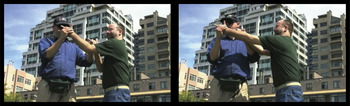
The second kind of classifier is an entity classifier, also known as “verbs of motion and location,” which represent categories of noun objects, often moving in a particular manner and/or direction. An example commonly cited incorporates the hand shape of the number 3,Footnote 12 and is used to represent boats and ground vehicles (see Aronoff et al. Reference Aronoff, Meir, Padden and Sandler2000:67). In Figure 3, the interpreter is describing the relative movement of two ferries across a body of water.
3-handshape representing two boats moving across a body of water.

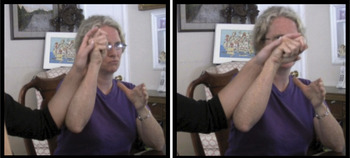
The third kind of classifier is the handling classifier, which represents a hand manipulating an object. In Figure 4, the interpreter is describing a cooking demonstration. The cook scoops peanut butter up with a spoon, turns it over, and then tries to get the peanut butter to fall off into the bowl, but finds that it is stuck. The interpreter's hand represents the handling or manipulating of the spoon, as opposed to some aspect of the spoon itself.
The interpreter “handling” a spoon.

One problem with this typology, evident at the outset, is that it conflicts with the definition that served as grounds for comparison to begin with. Formally, the comparison between spoken and signed language classifiers requires morphology, incorporated into the verb complex that classifies a nominal argument according to semantic criteria. It is not clear in these examples what constitutes the “morphology”Footnote 13 or the “verb complex,” nor is it clear the degree to which “classification” of the nominal argument is systematic or based on semantic criteria. Although the B-handshape contrasts systematically with other handshapes such as the C-handshape to distinguish between shapes (i.e. flat ≠ round), the path-movement and orientation of the handshape relative to the body do not vary systematically in the same manner. The meanings of the path-movement and orientation are derived as much from the shape of the building, or at least from its momentary cognitive salience, as from language-internal systematics. This leads toward a cognitive explanation, like the definition of classifiers attributed to Grinevald (Reference Grinevald1996) by Schembri (Reference Schembri2003:21) who states, “a classifier classifies in the sense that it denotes some salient inherent or perceived characteristic of the referent represented by an associated noun.” In response to analyses like these, however, Zeshan argues that cognitive classification is a pervasive phenomenon, and yet “we do not speak of classification in a linguistic sense in all cases of cognitive classification” (2003:117). To narrow cognitive classification enough to consider it a systematic linguistic phenomenon, there must be identifiable, formal objects of analysis: “no classification without classifiers” (Zeshan Reference Zeshan2003:117).Footnote 14 Since, in the case of size and shape specifiers (SASS), we cannot account for the entire form according to strictly semantic criteria, it is difficult to achieve a convincing formal analysis. Similar problems arise in all three categories of classifiers. In the next sections, each category of signed language classifier will be considered from a practice approach.
SASS classifiers in a practice approach
From the perspective of PAL, the features of SASS classifiers described above would be neither surprising nor problematic. PAL predicts that formal analysis will only ever account for part of the meanings that arise out of communicative action. The semantic field is not expected to account for more than highly schematic form-meaning correspondences in a field of contrastive oppositions. Recall that the semantic field includes “any structured set of terms that jointly subdivide a coherent space of meaning… insofar as they define a space of oppositions linked to contrasting linguistic forms” (Hanks Reference Hanks2005a:192). The semantic field of color, for example, is structured according to oppositions such as white ≠ black ≠ red (ibid.). Handshapes, as a parameter of SASS classifier constructions, when considered only within the semantic field, jointly subdivide a field of possible sizes and shapes. In the example above, two B-handshapes are used to characterize the sloped roof of a building. The sloped roof is itself made up of two flat sides. In ASL, flat ≠ round. Oppositions like this allow the interpreter to characterize the referent according to conventional categories that are available prior to the interaction. However, when the path-movement and orientation parameters of the classifier construction are considered, the form not only has a characterizing function, but also an indexical function. The first function derives from the semantic field, and the second derives from the deictic field. Analytically distinguishing between these fields means that it is not necessary account for deictic facts with semantic principles. In the deictic field, the building is individuated as an object of reference relative to the Deaf-Blind person and his interpreter. Recall that deictic reference, in Hanks' scheme, has the following structure (2009:12), given in (5) below.

In this case, the speaker and addressee have nonreciprocal sensory access to the object. The addressee has (i) his memory of what a high rise building and a sloped roof looks like; (ii) probably some outlines, or contrasts of light and dark, that he can grasp visually; and (iii) the conventional category selected by the interpreter that can be used to integrate (i) and (ii). The signer has visual access to the object, which despite the tacit character of his visual perception, probably involves similar kinds of integration. These processes cannot be accounted for with the semantics of the language. Furthermore, part of what grounds reference is the activity frame of tactile interpreting itself, which was established through sociopolitical processes beginning in the 1980s. The way in which meaning accrues to form in the deictic field cannot be understood without recognition of the sociohistorical field out of which tactile interpreting practices, and participation frameworks, emerged. This accounts for how the fairly abstract roles of speaker and addressee are transformed into the historically and socially specific roles of Deaf-Blind person and tactile interpreter, which are in turn a precondition for the availability to the Deaf-Blind person of subsequent social roles. For example, individuating the building might allow the Deaf-Blind person to inhabit the social position of a sightseer, or a dog walker, or a man in the park.
Entity classifiers in a practice approach
Entity classifiers, or verbs of location and movement, can also be located in a semantic field and have been shown to be part of certain, limited paradigms.Footnote 15 For example, in ASL handshapes are distinguished according to semantic categories as in the case of vehicle ≠ bird ≠ person. Given the typology of classifiers we began with, these handshapes should be related grammatically to the other elements in the utterance in order to define it as a classifier. To do this would require either considering the movement of the handshape to be part of the verb complex, or taking the handshape itself to be an autonomous predicate. In the first case, how would the verb complex be listed if it were an idiosyncratic path through space that is based on cognitive salience as opposed to a systematic field of contrastive elements? The second case would require accounting for the movement of the handshape in its description, at which point the same problem of formal stability surfaces. These problems no longer appear as problems, however, if we posit highly attenuated form-meaning correspondences, which accrue emergent specificity as they are embedded in deictic and social fields. The characterizing or symbolic function of the entity classifier is stable and available prior to the interaction. However, when it is instantiated, an unavoidable indexical ground is put into play.
Handling classifiers in a practice approach
In the case of the handling classifier described above, a hand is being used to represent a hand scooping peanut butter into a bowl. However, it is not difficult to imagine other ways to hold a spoon that would be equally plausible for this signer in this context. Even if the peanut-butter-scooping handshape were formally stable across contexts, which it does not seem to be, the problem just raised for entity classifiers would still arise—would the handshape's path movement in space be considered a morpheme that the handshape morpheme is affixed to? What about the pause, during which the hand is trying to shake off the peanut butter? Would these elements together constitute the verb complex? If so, how would we list the construction formally? Handling classifiers, in particular, highlight the difficulties with trying to analyze these kinds of constructions without appealing to the analytic constructs of deictic and social fields.
Debates about the linguistic description of signed language classifiers
The problems described above have been encountered by many scholars of signed languages, and the debates are ongoing. Although a definition for classifier constructions is far from agreed on, two things are clear at this point. First, classifier constructions are common to all signed languages encountered thus far (Emmorey Reference Emmorey2003:ix), and second, their description is difficult to accomplish with solely linguistic analytics, depending on how language proper is circumscribed. Schembri (following Slobin, Hoiting, Anthony, Biederman, Kuntze, Lindert, Pyers, Thurmann, & Weinberg Reference Slobin, Hoiting, Anthony, Biederman, Kuntze, Lindert, Pyers, Thuman and Weinberg2000) calls classifiers in Australian Sign Language polycomponential verbs (PVs), a term motivated by his claim that the classificatory function of PVs is too weak to be their defining feature (Schembri Reference Schembri2003:3). Schembri also points out that a more specific term is precluded by the fact that the levels themselves have not been sorted out for signed languages. This problem has yielded other nonspecific, and perhaps noninformative terms like Edmondson's “reference marker” (Edmonson Reference Edmondson2000). Liddell, instead of questioning the levels themselves, argues that “classifier predicates” are a blend of linguistic and nonlinguistic features, the boundary between the two hinging on analyzability and listability (Liddell Reference Liddell and McNeill2000:218). Other distinctions combined in analyses of classifiers are “categorical and gradient,” “morphemic and gestural” (Emmorey & Herzig Reference Emmorey and Herzig2003:221), “discrete and analogue” (Emmorey & Herzig Reference Emmorey and Herzig2003:243), and “classificatory and selectional” (Zeshan Reference Zeshan2003:18).
With differing features demarcating the language/nonlanguage border, and various degrees of surprise at transgressions of it, what these analyses share is the recognition of a field of compositional units that can be analyzed and recombined in systematic ways, units that fall under the umbrella of what Hanks calls schematic aspects of communicative practice (1996:233). In the case of classifier constructions, the schematic aspects derive from the semantic field. This is a field that currently available descriptive categories for spoken languages seem to accommodate quite well. Additionally, and equally important however, are gradient, analogue values that cannot be analyzed and recombined pre- or post-use. These elements fall under the umbrella of what Hanks calls “emergent” aspects of communicative practice. What makes classifier constructions so descriptively difficult for linguists is their persistent irreducibility to either category, schematic or emergent—hence the problem accounting for path movements and handshapes in the same analytic framework. PAL accounts for both within one unified framework by positing relations of embedding between distinct fields. This allows descriptive adequacy, without attributing to language processes that are governed a broader set of principles.
Embedding along temporal dimensions
In the following sections, PAL is extended to account for particular temporal features of the communicative events under consideration. It is argued that articulatory time, lived time, and historical time, as dimensions of the semantic, deictic, and social field, respectively, are embeddedFootnote 16 to yield an immediate surround that is accessible to both the Deaf-Blind person and the interpreter. In other words, the term “embedding” here describes the synthesis and negation of (i) the temporal regularities of sign production in Tactile American Sign Language, (ii) the temporalities of movements or actions in the deictic field, and (iii) the temporal structures which derive from the “rhythms of everyday life” or the postindustrial, urban field of rhythm. Recall that embedding in practice begins with the social field. Temporal sensibilities that accrue to the Deaf-Blind person as a modern, urban subject are a precondition for the intelligibility of particular kinds of rhythmic activity in the immediate surround (Lefebvre Reference Lefebvre2004). From the perspective of the analyst, though, the temporality of articulation in producing schematic elements of classifier constructions is posited a priori. This temporality is then embedded in representations of temporalities in the deictic field, which are further embedded in temporalities ordered by distinctions in the social field. After the schematic elements of the classifier and classifier-like constructions have been posited and viewed in their embedded state, they are retrieved and re-examined to determine the ways in which they have been transformed. This analytic process of embedding should be understood in contrast to modes of analysis that take categories such as morphology and gesture as two salient layers or parts, which are added onto one another and taken apart again, without consequence for form or meaning.
Methodology and relevance to the literature on Deaf-Blind communication
The linguistic anthropological approach taken in this research diverges from approaches taken in prior work on communication practices among Deaf-Blind people. Apart from biographical accounts of the lives of Deaf-Blind individuals such as Helen Keller (Davidson Reference Davidson1969; Herrmann Reference Herrmann1998) and Laura Bridgman (Freeburg Reference Freeburg2001; Gitter Reference Gitter2001), the bulk of research about Deaf-Blind people comes out of the fields of education and vocational rehabilitation, primarily oriented toward teaching and counseling methods for individuals (Bruce 2002; Bourquin & Sauerburger Reference Bourquin and Sauerburger2005; Janssen, Riksen-Walraven, & van Dijk Reference Janssen, Riksen-Walraven and van Dijk2003 Nelson Reference Nelson2005; Arthur-Kelley, Foreman, Bennett, & Pascoe Reference Arthur-Kelley, Foreman, Bennett and Pascoe2008; Correa-Torres Reference Correa-Torres2008; Dammeyer Reference Dammeyer2009; Parker Reference Parker2009) and practical instruction for signed language interpreters (Sauerburger Reference Sauerburger1993; Smith Reference Smith1994; Frankel Reference Frankel2002; Metzger, Fleetwood, & Collins Reference Metzger, Fleetwood; and Collins2004; Nuccio & Smith Reference Nuccio and Smith2010). This project builds, instead, on the few studies that have sought to describe language and interaction among Deaf-Blind people (Collins & Petronio Reference Collins, Petronio and Lucas1998; Mesch Reference Mesch2001; Collins Reference Collins and Petronio2004; Petronio & Dively Reference Petronio and Dively2006). However, my research differs from these studies in two respects. First, following traditional methods in linguistics and sociology, previous researchers chose participants who best approximated “ideal speaker-listeners.” This project focuses instead on the processes through which Deaf-Blind people adjust to persistent changes in sensory orientation. This includes periods of time when individuals are comfortable using language, and interacting in their habitual environments, but also times when they are struggling to identify ordinary objects and produce and receive communicative signals. Convention in the Seattle Deaf-Blind community does not demand identical sensory experience or forms of language-use among its members, but shared ways of accommodating changing and nonreciprocal sensory orientations.
All of the data directly cited in this article were collected in a four-month period of fieldwork in the spring of 2008.Footnote 17 In this study, eight dyads composed of one Deaf-Blind person and one sighted person (either deaf or hearing) were video recorded for 1.5–3.0 hours engaging in a variety of activities such as dog walking, grocery shopping, or attending an event. For those interactions where the subjects were walking, I walked in front of them and recorded them with a camera mounted on a harness and pointed backward over my shoulder. Field notes were collected throughout, and these notes form the basis for much of the ethnographic description. I also conducted interviews with Deaf-Blind people in order to understand their perspectives on how interpreters who interpret visual information are useful in building a tactile world. I selectively transcribed the video data using a transcription program called ELAN,Footnote 18 slowing the speed of interaction and glossing bodily movements, environmental details, utterances, and gestures. However, I also draw on longer-term ethnographic involvement and interviews with members of this community.
In the examples presented here, a Deaf-Blind woman, Chantelle,Footnote 19 and a tactile interpreter, Deanna, with whom Chantelle worked many times before are visiting the Olympic Sculpture Park in Seattle. In a separate interview with Chantelle, I asked if detailed information about people's bodily features, faces, and orientations in space had been useful to her when incorporated into tactile translations. A translation of her answer is given below in (6).Footnote 20
(6) It's really useful when the interpreter comments on the environment at the same time I am looking at it. I think it's because when my eyes take in information, my brain mis-interprets it. So I have to try really hard to ignore the information my eyes are giving me, and focus on the information the interpreter is giving me through my hands. Then I can start to use my eyes as a secondary source of information, rather than a primary source, and my brain and the environment start exchanging signals again. I should have realized that sooner. It's the same thing with facial expressions—you can interpret furrowed brows in any number of ways. Maybe the person is frustrated, or sad, or emotional. But does that mean that the furrowed brows always mean the same thing? No. As your vision starts to go, and you are relying on just what details you can see, you start to realize that this kind of interpretation of cues is complicated. When I get information through my hands from an interpreter, I can cross reference that with my new vision, my memories of what I knew before with my old vision, and I can understand what is going on.
An important part of orienting to the immediate environment is building a horizon of potential. This requires the ability to link typical categories to past instances, and to anticipate potential, future instances (see Hanks Reference Hanks1996:131). What Chantelle is saying in (6) is that the inner horizon of typesFootnote 21 (linguistic, perceptual, and social) cannot be located with her eyes alone because her vision has changed too much. She is losing the ability to compare past tokens remembered through her past vision, with current tokens that she knows with her current vision and her tactile sensibilities. One way she addresses this problem is to work with interpreters. In these interactions, she is not merely “gaining access” to a given world, but correlating her past system of relevances with the vivid experiences of a world overfull with specificity. The analysis that follows, then, seeks to understand how Chantelle and her interpreter find relevant relations between elements in distinct fields in order to link aspects of past tokens with aspects of current tokens. In the process, I ask if the three mechanisms posited thus far by Hanks—practical equivalences, counterparts, and rules of thumb—account for the observed embeddings in interactions between Chantelle and Deanna.
Finding a way in: Integration as embedding
In the first video clip, Chantelle and Deanna are sitting at the edge of a park watching people go by on a trail that runs along the waterfront in downtown Seattle. They chose this park because they had never been there and wanted to know what kind of place it was. They also wanted to be a part of what was going on outdoors on one of the first sunny days of the year in Seattle. As they approached the park, Deanna told Chantelle that there were many couples out walking around together, smiling. Chantelle said that last week everyone had been walking around frowning, but now that the sun was out, everyone was smiling! She stopped walking and sort of hopped in place saying the sun was making her so happy. A few days after this, I went to a dog park with Helen, another Deaf-Blind woman in the community, and her regular interpreter, Kate. While Kate was looking for parking, Helen gave me an in-depth debriefing on the difference between the kind of vitamin D you get from food and the kind of vitamin D you get from the sun. She had been reading up on it because she was a biologist and wanted to know the biological explanation for why the sun had been making everyone so happy. She explained that it was a physiological response to the end of a vitamin D deficiency— the kind of vitamin D you can only get from the sun. The sun was a topic of conversation around this time, and not only for members of the Seattle Deaf-Blind community. Every year at the end of the winter in Seattle, there are diagnoses, rationalizations, and realizations. When the sun comes out, burdens become lighter, decisions are reconsidered, and people are reminded that there are true physiological effects from the absence of sunlight. I emphasize this because in Seattle, and no doubt in other places where there are long, wet winters, the first days of sun are important and are a part of many encounters that take place. We return to this point in the analysis below.
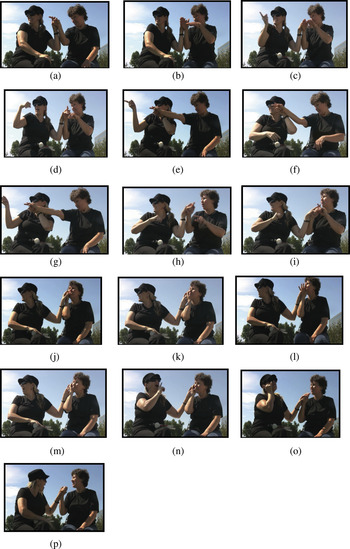
In Figure 5,Footnote 22 the interpreter (on the right) begins by signing two iterations of the sign CYCLE, indicating a particular speed, followed by a sign that is often glossed as GONE but that suggests a quick leaving (something leaving so quickly that it is already gone). This second sign traces the direction of the leaving as well as its speed. Lastly, the interpreter signs FIRST and SECOND, following the path-movements of the cyclists relative to one another with the articulation of each number.
Deanna and Chantelle individuate an object of reference. (See online: http://dl.dropbox.com/u/3711257/Edwards_2012_Movie_1.mov)

The form-meaning correspondences that can be posited a priori are the signs pictured in the frames above: CYCLE, GONE, FIRST, and SECOND, as well as the handshape Chantelle uses to point with. Each one of these first four signs has a conventional meaning (which the glosses are meant to approximate).Footnote 23 The formal aspects of the signs that are linked to those meanings include handshape, location, orientation, and movement. In order to distinguish between relations like these that inhere in the semantic field and those that inhere in the deictic field, I would like to start with some categories Liddell (Reference Liddell and McNeill2000) proposes for Visual American Sign Language.
Liddell makes a three-way distinction between categories of signs in American Sign Language based on their spatial relation to the body of the signer, and to referents that influence the location of articulation. The first category is characterized by articulatory uses of space, where a change in location results in an entirely different sign. His example is the pair ONION/APPLE. These signs are identical in all respects except the location of contact on the body of the signer. The former is articulated on the cheekbone, and the latter is articulated on the lower cheek. If the location moves to the chin, a “possible but non-existent sign” is produced (Liddell Reference Liddell and McNeill2000:332). The second category of signs, rather than coming into contact with a particular location on the body or face, is articulated in a particular location in space relative to the body. An example of this is the pair POINT/GOAL. These signs are, again, identical in all respects but location. The former is articulated at the level of the abdomen while the latter is articulated at the level of the forehead. The third category, which includes deictic gestures, “can be made in what appears to be an unlimited number of locations”Footnote 24 (Liddell Reference Liddell and McNeill2000:333). In contrast to the first two categories,
[d]irecting [these signs] spatially adds meaning to the basic meaning of the sign. For example, the ASL pronoun PRO has the meaning and syntactic function one expects of a pronoun. In addition, it can be directed toward entities which are present in the signer's environment. A signer could direct PRO toward any one of a large number of people sitting in a room. The direction of the movement of the sign would be different, depending on the location of the person toward whom the sign was directed. Indicating verbs, locative verbs, and classifier predicates present a picture very similar to pronouns, since the signs in these categories also ‘use space.’ (Liddell Reference Liddell and McNeill2000:333)
Liddell does not include temporality, which is incorporated into the “movement” rather than the “location” parameter of the sign. However, temporal dimensions of the first two categories of signs differ from that of the third, just as the spatial aspects do. In the first categories, the temporality of articulation derives from language-internal distinctions. In the third case, the temporality of signs that are directed toward or motivated by movements of referents in the immediate environment derive from relations in the deictic field.
In Liddell's typology, the signs used by Deanna would normally be excluded from the third category. The citation form of CYCLE is conventionally articulated in front of the chest without contact with the body. The citation form of GONE is conventionally articulated in a path beginning near the face and moving forward. The citation forms of FIRST and SECOND are conventionally articulated in neutral signing space in front of the torso. None of these signs require a deictic construal to be meaningful. Once they are embedded in the deictic field, however, the spatiotemporal properties of the location and movement parameters shift, taking on properties of signs in Liddell's third category. The temporal features of CYCLE that inhere in the semantic field include articulatory time, or the temporal aspect of the movement required for production, and an aspectual distinction, which signals that the represented event is ongoing. This is a documented aspectual function in at least some signed languages (Rathmann Reference Rathmann2005). Both of these temporal features characterize the observed event according to language-internal distinctions. In addition, there is a temporal dimension that indexes the speed and rhythm of the cyclists.
As Deanna is signing GONE GONE, Chantelle points toward an object, which Deanna takes up as a question about the location of the referent. Deanna confirms that the direction Chantelle is pointing in is in the direction of the referent by aligning the handshape of the next sign FIRST with Chantelle's outstretched arm. The pointing handshape functions both as confirmation of Chantelle's localization of the referent and the beginning of the sign FIRST. SECOND is then articulated in a spatial relation to FIRST such that the path between them aligns with the path-movement of GONE GONE. FIRST is articulated at the end of the path established by GONE, and SECOND is articulated at the beginning (the first cyclist is further along the path than the second). As described in the interview segment above, Chantelle is triangulating here between (i) visual memory of what cyclists looks like, (ii) the degraded visual image of the cyclists she and Deanna are pointing to, and (iii) the tactile input given by Deanna.
However, there is more to the individuation of an object of reference than its naming or its localization in space. Part of what grounds reference, at least for the interpreter as a sighted person, is that the cyclists are typified in more fine-grained terms than the category “cyclist” entails. It is not uncommon to see cyclists riding by in a public place in Seattle, and out of that regularity, types of cyclists emerge. These cyclists are of the serious variety—they are agile, riding in time with one another, moving at a good clip through a crowded area. They are attired in spandex, cycling shoes, and aerodynamic sunglasses—they aren't wearing jeans or carrying a box of groceries balanced on their back fenders. For Chantelle, it is precisely this link between instances and the typical categories to which they refer that is disrupted. How, then, do Chantelle and Deanna, who have nonreciprocal access to the deictic field, establish a horizon against which object can be individuated? What are the relations between semantic, deictic, and social fields that yield a common structure of relevance?
My claim is that because temporality is as much a feature of tactile worlds as it is of visual worlds, it offers a dimension that articulates to fields organized along tactile lines, as well as those organized along visual lines. For Chantelle, motion is no longer a visual phenomenon, but her feet still hit the pavement at regular intervals when she walks; tactile language is still ordered according to particular patterns of motion and rest; the work week still trudges on until the weekend breaks it up; and the cloistered months of rain still open onto a world of possibility on the first sunny days of the year. These regularities converge in unrepeatable, accidental unities that create a sense of being somewhere in particular, as opposed to merely being in an example of a place, or a type of place.
In the portion of the interaction examined thus far, regularities derive from fields that can be analytically distinguished. Patterns of motion and rest are a feature of articulation, which is part of the ground against which other temporal regularities cohere. Temporal features of the deictic field are also characterized explicitly. In American Sign Language GONE ≠ GO ≠ LEAVE. This set of terms jointly subdivides a space of meaning that can be described as “speed of departure.” There is a temporality and an unmarked path-movement associated with the citation forms of these signs. In all cases, the path-movement begins near the body and moves forward into neutral signing space. Once GONE is embedded in the deictic field, its path-movement shifts. Rather than beginning near the face and moving away into the signing space, it is produced horizontally, indicating an idealized path of the cyclists who have just gone by. At this point, the relation has been established in the articulation of the sign CYCLE, the sign GONE, and the pair FIRST, SECOND. In each case, there are shifts in temporal regularity once the sign is embedded in the deictic field. Rather than being articulated in neutral signing space, FIRST and SECOND are produced in two locations along a path that corresponds with the paths of the cyclists and the path of articulation of the signs GONE, GONE. Lastly, all three pairs of signs sync rhythmically with one another: CYCLE CYCLE, GONE GONE, FIRST SECOND—1, 2; 1, 2; 1, 2.
These rhythmic patterns in language can articulate to fields organized along visual lines just as they can articulate to fields organized along tactile lines. Having lived in a visual world most of her life, every time Chantelle remembers or refers to a visual scene, the action of articulation in referring has both a visual dimension (in memory or sight) and a haptic dimension (in the expression of that memory or sight in American Sign Language). In this way, American Sign Language, whether instantiated in a visual world or a tactile world, has a tactile dimension for sighted and blind people alike. In Chantelle's case, this formal continuity is still part of her corporeal schema, and it comes into play in efforts to translate across visual and tactile modes of knowing. The integration of articulatory time with the felt time of the cyclists in the deictic field constitutes a relation between the semantic and deictic fields that is accessible to both Chantelle and Deanna. The challenge from there lies not in localizing or describing elements in the deictic field, but in linking semantico-deictic structures, established in interaction, to the social field. As the interaction unfolds further, we see how rhythmic repetition further seals the semantic and deictic fields to one another by producing a kind of density that accrues to the relations between these fields. Further, we see how this density leads Chantelle into a problem space where she can inquire about relations between semantico-deictic structures and the social field, if not establish them outright.
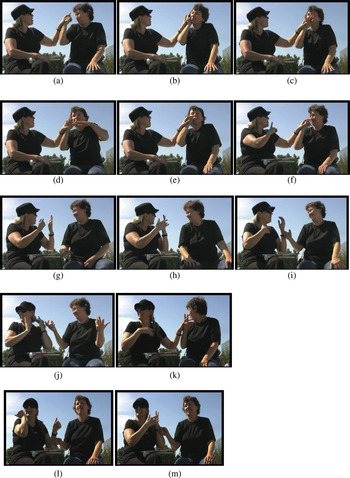
In the second clip (Figure 6),Footnote 25 Deanna points out a nearby woman walking by and incorporates temporal dimensions of her speed and direction, explaining that the woman is also talking on a phone. There are three iterations of WALK, which jointly signify that the represented event is ongoing. The interpreter points both before and after the sign WALK, tracing a path corresponding to the path-movement of the walker. The spatial and temporal features of WALK, which derive from distinctions in the semantic field are transformed upon embedding in the deictic field. Because WALK is not phonologically amenable to internal spatial modifications the way it is amenable to temporal modifications, the pointing action occurs sequentially.
Mutually available deictic relations begin to diverge for Chantelle and Deanna in the social field. (See online: http://dl.dropbox.com/u/3711257/Edwards_2012_Movie_2_.mov)

Again, the citation form of WALK is not treated as a deictic. As it is instantiated here, however, it is transformed as it is embedded in the deictic field to index spatiotemporal dimensions of the immediate surround. Therefore WALK moves into Liddell's third category of signs, in which “the direction of the movement of the sign [is] different, depending on the location of the person toward whom the sign [is] directed” (2000:333).
If we consider the broader field of postindustrial urban rhythm, interpretive possibilities are further restricted. This is the rhythm of fe2et that know where they are going, attached to a person with a purpose in mind. They are the feet of a local, maybe an athlete, not a Sunday dog walker, a window shopper, or a tourist. These are not the rhythms of articulation, or the patterns of motion and rest in the deictic field. Modern time, according to Lefebvre (Reference Lefebvre2004:74), “divides itself into lots and parcels: … various forms of work, entertainment, and leisure… [E]very ‘doing’ has its time.” These temporal lots and parcels converge in space in semistructured but ultimately unpredictable accidents, forming what Lefebvre calls, the “rhythms of everyday life.” The integration of these rhythms into the patterns of motion and rest in the language and in the deictic field can literally be felt in the reception of the translation. Insofar as these rhythms articulate to both visual and tactile fields, they can serve as points of entry for both parties to the interaction.
There is a sequential, temporal organization in the back-and-forth of conversation between Chantelle and Deanna that is consequential as well—a temporal order Enfield calls “enchronic” (Reference Enfield2009:10). Deanna says there is a woman who is walking (which she has said of other people) and then says BUT, followed by TALK-ON-PHONE, TALK-ON-CELL and TALK. BUT indicates that what will follow is a unique characteristic of the referent, something that distinguishes her from the other people walking in the park. TALK-ON-PHONE is signed three times, using two different handshapes (glossed as both TALK-ON-PHONE and TALK-ON-CELL-PHONE). Each time she signs TALK-ON-PHONE, Deanna pauses with the phone by the ear. After she signs TALK, she pauses again. These pauses are taken up by Chantelle as a request for commentary, and she responds by saying REALLY and mimicking a woman talking on the phone. Then her mouth drops open and she leans toward Deanna.
In the third clip (Figure 7),Footnote 26 Deanna repeats what she has just said, with a few changes. She signs WALK slightly faster, and bookends the description with evaluative statements: at the beginning with an expression that suggests reflection, roughly equivalent to saying “hmmmm” or “wow”Footnote 27 and at the end, with the sign FUNNY (adding up to something like “wow, that woman is out to get some exercise, and meanwhile is talking away on her cell phone. That's funny.”). Although Deanna does not sign “exercise,” this is a possible interpretation of the rhythm of articulation in WALK. In the second utterance, Deanna signs WALK with more strength and speed. Chantelle again has been put in a position to comment, so she says, “Really? New technology! My god!” Whatever Deanna expected Chantelle to say, this was not it, as the indeterminate gesture Deanna makes in the next turn reveals. Chantelle's response has disrupted the steady back-and-forth of conversation, which has in turn, opened up an inquiry into the relation between the semantico-deictic structures established thus far and the social field. More specifically, this brings them from articulatory time, used to represent spatiotemporal features of the immediate surround, into the social field of technological innovation, which is intimately linked to the temporal orders already established. Chantelle interprets Deanna's gesture as meaning that the technology is not in fact new and that perhaps Chantelle should have known this. Chantelle says, “Wow, I'm behind on technology.”
Individuation of object allows Chantelle to inquire into relations between deictic and social fields. (See online: http://dl.dropbox.com/u/3711257/Edwards_2012_Movie_3.mov)

The temporality of technological innovation, and the way it is recognized in space, is a feature of the social field. Failing to keep up, as is clear in this example, can engender what Lefebvre would call an arrhythmic response (2004:29): a moment of shock in which the ongoing synthesis of linguistic, physical, and social fragments is halted as when Chantelle reflects that she has “fallen behind on technology.” This realization is not exclusively discursive. It affects her embodied orientation to the immediate environment, and as such is highly consequential for her orientation to the deictic field.Footnote 28 The possibility of exercising while talking on the phone integrated into Chantelle's structures of anticipation in her everyday life prompts a broader restructuring of an anticipatory field encapsulating the Olympic Sculpture Park in Seattle, or park life in the city, or city life more generally. With repetition, reference to objects that can be referred to this category (a person walking in public while talking on a cell phone) will dissolve into the horizon of everyday life in the city, and Chantelle will move differently through the city. Without repetition, they will not.
In addition to the rhythms of technological innovation, the participant framework within which the interaction occurs is also part of the social field. Up until this point, Chantelle and Deanna have been occupying the roles of “Deaf-Blind person” and “interpreter,” which are given by the tactile interpreting frame, and which authorize the communicative activity of both participants. This frame does not exist everywhere that there are individuals who cannot hear or see. When Deaf-Blind people from Seattle go other places where Deaf-Blind individuals are, like meetings of the American Association of the Deaf-Blind (AADB), communication is frustrating and slow, and the degree to which Deaf-Blind conversation and interaction are not conventionalized outside of Seattle becomes apparent. Communicative practices have become conventional as a result of social and political action and have been subject to historical contingencies. They are not merely the interactional outcome of a physiological condition. Thus, these practices are shaped not only in the course of interaction, but also by prescriptive discourses about how to be a tactile interpreter, which in turn are shaped by broader legal discourses that make interpreting services like these a right.
The language of the Americans with Disabilities Act (ADA), for example, focuses on the rights of the individual, and requires that “reasonable accommodations” be made to ensure those rights. From this perspective, the Deaf-Blind person is not constituted in interaction, or by history, but is always already an individual with rights, and the interpreter is the means by which accommodation is accomplished. This discursive frame implies that the role of the interpreter is to “provide access” to a given world, and the Deaf-Blind person is merely a receptacle for “information” about that world. The ADA thus valorizes visual forms of common sense over tactile common sense. Though it is not determinant, this model shapes the interaction between Chantelle and Deanna. In referring to the woman talking on the phone, many things go unsaid by Deanna, including the common sense that a woman who exercises while talking on her cell phone is one type of woman—perhaps in this case a type that should be distinguished from us. But based on Chantelle's response, we know that this is the common sense of a visual world. Visual common sense will always, in the interpreting frame, trump the common sense of a tactile world insofar as human rights discourses such as those embedded in the ADA structure these interactions by treating knowledge acquired tactually as subordinate to knowledge acquired visually. Of course, addressing this asymmetry is not merely a matter of correcting the language of the ADA, debunking the notion of a given world, or implementing an egalitarian ideology of sensory orientation. The problem, as practice theory would predict, runs much deeper than that.
Several years ago, I was walking with a Deaf-Blind woman into an apartment building. She said she was impressed that the building was fancy. I disagreed, informing her that it wasn't fancy at all. She sighed, and instructed me to close my eyes, take her cane, and walk. As I swept the cane back and forth, slowly shuffling my feet forward, the marble tile felt immaculately clean, smooth. The cane seemed to float across it. A faint smell of perfume drifted out of the manager's office and mixed with the fading, subtle smell of soap on the floor. I conceded. And yet, as I opened my eyes to the peeling green paint on the walls and the rusting mailbox numbers, I was struck by the concreteness of the visual world I inhabit. It was difficult for me to adopt a tactile perspective, despite the evidence that it was just as coherent as mine, precisely because of the sense that what I saw was utterly concrete. In closing my eyes and feeling the texture of the tile floor with the cane, I did not develop a tactile habitus. I gained a momentary insight, which would not necessarily accrue to the horizon against which categories and relations of relevance would emerge for me in the future. The same is true to some degree for Chantelle. A momentary insight into a visual world is likely to be useful, but it is not the same thing as having “access” to it. The aim, as Chantelle stated in her interview, is to use these insights in building continuity between the fading visual world she is relinquishing and the tactile world into which she is venturing. This aim is disjunctive with the access model of disability discourse, but these discourses must be continually reproduced in order to secure funding to pay for interpreters and other services. These discourses are part of the social field rather than the semantic or deictic fields, and yet they have a direct impact on how the actual structure of the interaction unfolds and the degree to which it can serve the purposes of Deaf-Blind people in bringing a tactile world into being.
I have shown in these sections that the analytics of semantic, deictic, and social fields are all necessary to understand how Chantelle uses interpreted interactions to build an inhabitable tactile world. I have also shown how disparate elements are drawn into relation with one another through processes of embedding that rely on the integration of temporal regularities across fields. In the next section, integration is proposed as a fourth mechanism of embedding alongside counterparts, equivalences, and rules of thumb in the practice approach to language.
Integration as principle of embedding
Recall that embedding is the means by which highly schematic form-meaning mappings undergo reshaping, conversion, and transformation according to patterns that crystallize in the relations between semantic, deictic, and social fields (Hanks 2005:194). In each example above, relations between elements in distinct fields are established by embedding language-internal temporal regularities in the lived temporalities of deictic and social fields. These rhythmic composites are expressed in the movement parameter of the signs. Each composite is the outcome of a transformation of a priori categories with which the analysis began. In the instance of CYCLE, we begin in the semantic field, where articulatory time combines with repetition to yield an aspectual meaning derived from language-internal distinctions. Once CYCLE is considered in its relation to the other signs in the utterance and in its relation to the deictic field, its meaning is transformed. The signs CYCLE CYCLE, GONE GONE, FIRST SECOND must be viewed as part of a larger rhythmic pattern, which in addition to characterizing the cyclists, indexes the temporal coordination of the cyclists with one another, and their speed and their path relative to Chantelle and Deanna. There are further meaning effects when one considers the temporal regularities of CYCLE from the perspective of the social field. These are cyclists of the serious variety, agile enough to ride quickly and in sync with one another through a crowded park. Their time is the time of training or preparation more than leisure or transport. These are distinctions that cannot be found in either the semantic or the deictic fields.
The relations of embedding I have just described can be distinguished from those laid out by Hanks (Reference Hanks2005a) since, in this case, not only are the meanings converted, but also the forms. The articulation of CYCLE integrates temporal distinctions that do not derive from the language but from the fields to which linguistic distinctions articulate. It is the movement itself that is meaningful in distinct ways across three fields, and as the movement parameter is successively embedded, its form is reshaped along with its meaning. Because of this formal reshaping, neither a practical equivalence nor a counterpart can account for the relation that is established between the fields. This is because in each of these relations some formal element must remain constant across contexts. To capture this difference, I propose a relation of integration, whereby formal aspects in each of the embedded fields are mutually transformed along with their meanings.
Counterparts are identity relations between objects, which are established in referring to them, or construing them using the same linguistic form (Hanks Reference Hanks2005a:202). Therefore, a counterpart relation requires a stable, mediating linguistic unit. Likewise, practical equivalences establish correspondences between modes of access according to a stable, mediating formal unit. In these examples, temporal elements in distinct fields are integrated into a unified temporality, one that is not equivalent in either form or meaning to the elements that gave rise to it. Lastly, rules of thumb emerge out of a kind of regularity that is not a characteristic of Chantelle's ordinary interactions at this point in her transition to tactility. The naturalness of encounters, such as greetings and their conventional linkage to certain phrases, is precisely what is at stake in the work she is doing to build a world. Therefore, rules of thumb do not account for the links between fields that emerge out of this communicative context. In contrast to counterparts, practical equivalences, and rules of thumb, integration implies a partial projection of elements from two domains into a third. The third domain manifests a structure that is not present in either of its inputs, and in this sense is emergent (Fauconnier & Turner Reference Fauconnier and Turner1998:133; Fauconnier & Turner Reference Fauconnier and Turner2002).Footnote 29 In the examples described here, formal and conceptual elements of each sign are selectively incorporated into the formal and conceptual structure of the embedded sign, thereby manifesting a relation of integration.
Conclusion
In this article, I have shown some of the ways that Chantelle and Deanna engaged local communicative conventions to build continuity between a fading visual order and an increasingly legible tactile order. I draw on and develop embedding, as set forth in the practice approach to language, as a way of thinking about the integration of temporalities across modalities and fields. The discussion views form-meaning correspondences, including their temporal dimensions, under multiple perspectives—semantic, deictic, and sociohistorical—and considers a complex, relational object. In order to account for key features of this object, I posit the notion of integration, contributing to our understanding of the principles that govern processes of embedding and, more broadly, the means by which social actors establish relations between language, the body, and the physical and social surround.
 B-handshape (see
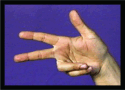 3-handshape (see