Over recent decades the field of second language acquisition (SLA) has witnessed a continuous proliferation of studies on second language (L2) morphosyntax development. However, less attention has focused on L2 pronunciation development despite ample theoretical proposals designed to account for various aspects of the pronunciation development process (e.g., structural conformity hypothesis [Eckman, Reference Eckman1991]; optimality theoretic of phonological categorization [Escudero & Boersma, Reference Escudero and Boersma2004]). Although such proposals presented scientifically sound and intriguing approaches to L2 pronunciation, they often had little to contribute to the development of L2 pedagogical applications of the theories. Recent L2 pronunciation research has begun to bridge the gap between relevant theories and teaching practices by addressing the growing needs for research on potential variables that should be considered in L2 pronunciation instruction (e.g., Munro & Derwing, Reference Munro and Derwing2015).
One theoretical view receiving mounting attention regarding L2 instruction is the interactive alignment model (IAM) first articulated by Pickering and Garrod (Reference Pickering and Garrod2004). In a series of recent studies, Trofimovich and his colleagues have applied the framework of interactive alignment to L2 instructional contexts, suggesting alignment occurring between peers during collaborative tasks may lead to the development of L2 pronunciation as well as grammar (e.g., Trofimovich, McDonough, & Foote, Reference Trofimovich, McDonough and Foote2014; Trofimovich, McDonough, & Neumann, Reference Trofimovich, McDonough and Neumann2013). The IAM posits a parity of representation between language production and comprehension systems (i.e., activation of the representation of a word in comprehension maintains its activation during production). According to the IAM, interlocutors tend to align the language forms they use during conversational interaction by reusing each other’s expressions, grammatical structures, and patterns of pronunciation. Principal mechanisms for promoting such instances of interactive alignment are auditory, lexical, and structural priming. Priming refers to the phenomenon in which prior exposure to specific language forms or meanings influences a speaker’s subsequent language comprehension or production (McDonough & Trofimovich, Reference McDonough and Trofimovich2009). Researchers have shown how speakers achieve the goal of mutual understanding during conversation by converging on their language at different levels (e.g., phrase structures: Branigan, Pickering, Pearson, & McLean, Reference Branigan, Pickering, Pearson and McLean2010; lexical expressions: Brennan & Clark, Reference Brennan and Clark1996; phonetic realizations of words: Pardo, Reference Pardo2006). In L2 research, the concept of alignment within the cognitive processing perspective is still new, and researchers have only recently begun to examine it in light of priming mechanisms, primarily within the IAM framework (e.g., Trofimovich et al., Reference Trofimovich, McDonough and Foote2014; Trofimovich et al., Reference Trofimovich, McDonough and Neumann2013).
Within SLA research literature, three types of priming have been defined: structural priming, auditory priming, and lexical priming. Of these different priming types, auditory priming has recently been suggested to have the potential to help promote the learning of patterns of word stress in English (see Trofimovich et al., Reference Trofimovich, McDonough and Foote2014) and is of a particular interest to this study. Auditory priming refers to the tendency for people to process a spoken word or word combination more quickly and more accurately when they have had previous exposure to that word or word combination in recent speech (e.g., Trofimovich & Gatbonton, Reference Trofimovich and Gatbonton2006). The focus of the current study is to determine the possible relevance of auditory priming to the learning and teaching of lexical stress (i.e., word-level stress) during collaborative communicative tasks.
In terms of task implementation factors, previous research has introduced various characteristics of task repetition: exact task repetition (the exact tasks are repeated; henceforth task repetition), procedural repetition (procedure of tasks is repeated with different content), and content repetition (the content of tasks is repeated with different procedures; Kim & Tracy-Ventura, Reference Kim and Tracy-Ventura2013; Patanasorn, Reference Patanasorn2010). Previous studies found that different types of task repetition are associated with different aspects of L2 development. Thus, the current study’s purpose is to examine the role of different characteristics of task repetition on learning English word-stress patterns through auditory priming tasks.
LITERATURE REVIEW
Acquisition of L2 Lexical Stress Patterns
Lexical stress is one of the prosodic elements that have been found to have a greater impact on intelligibility compared to other factors such as segmental features (phonemes) or accentedness (Anderson-Hsieh, Johnson, & Koehler, Reference Anderson-Hsieh, Johnson and Koehler1992). Lexical stress information plays a key role in recognizing and distinguishing words as it is part of a word’s underlying identity (e.g., PREsent vs. preSENT) (Ashby & Clifton, Reference Ashby and Clifton2005). Past research has demonstrated that accurate production of lexical stress enhances the intelligibility of nonnative speech (Field, Reference Field2005). For example, Trofimovich and Isaacs (Reference Trofimovich and Isaacs2012) found that inaccurate word-stress assignment has a more negative impact on intelligibility than grammatical errors. However, the perception and production of lexical stress patterns have been shown to be difficult for L2 learners (e.g., Field, Reference Field2005; Munro & Derwing, Reference Munro and Derwing1995).
Of a variety of sources of such difficulties, researchers have suggested that the transfer of first language (L1) features may be a primary source of difficulty in acquiring L2 lexical stress (e.g., Erdmann, Reference Erdmann1973; Lord, Reference Lord2001). For example, in their investigation of the influence of the L1 on the production of L2 Dutch lexical stress, Caspers and Kępińska (Reference Caspers, Kępińska, Lee and Zee2011) found that learners with varying L1 backgrounds (French, Mandarin Chinese, Polish, and Hungarian) not only assign stress to L2 words based on their L1 but also tend to overgeneralize L1 rules of lexical stress to the L2 system. Their findings support Erdmann’s (Reference Erdmann1973) claim that learners do not produce L2 stress patterns on a random basis but create a new system. Although the rules of the new system seem to reflect applications of the L1 system and not approximations of the L2 rules to be acquired, they do tend to be systematic and patterned. Altmann (Reference Altmann2006) also presented interesting findings about learners’ production of L2 English stress and the influence of the L1. The results from her study showed that native speakers of Chinese, Korean, and Japanese, whose L1s lack anything like the English word-stress system, performed much less accurately in the production of English word stress when compared to participants who were native speakers of Spanish, Turkish, and Arabic.
In sum, these studies have indicated that L1 acoustic characteristics may interfere with one’s ability to produce an L2 at the suprasegmental level and accordingly, pose difficulty for acquiring L2 suprasegmental features such as lexical stress patterns. However, little attention has been given to different ways of assisting learners whose L1 has a typologically distinct prosodic system from the target language to develop L2 stress patterns in instructional contexts. Therefore, the current study targeted Korean English language learners because lexical stress patterns are not a feature of Korean phonology.
Auditory Priming and Pronunciation Development
To date, most priming studies have focused on the development of morphosyntax using structural priming tasks (e.g., dative construction, McDonough, Reference McDonough2006; wh-question formation, McDonough & Kim, Reference McDonough and Kim2009; and active/passive constructions, Kim & McDonough, Reference Kim and McDonough2008). These studies document benefits of using priming techniques in teaching grammatical forms within instructional contexts. Compared to structural priming techniques, auditory priming has received little attention in L2 research, and only a handful of studies have investigated the role of auditory priming in teaching pronunciation, particularly in connection with a focus on English patterns of lexical stress.
As increased emphasis is given to speech intelligibility enhancement for L2 pronunciation learning (e.g., Grant, Reference Grant2014), a few researchers have begun to examine the utility of collaborative priming activities for L2 pronunciation instruction (Trofimovich et al., Reference Trofimovich, McDonough and Foote2014; Trofimovich et al., Reference Trofimovich, McDonough and Neumann2013). For instance, Trofimovich and colleagues (Reference Trofimovich, McDonough and Neumann2013) examined the effectiveness of priming activities designed to provide learners with targetlike L2 models at two linguistic levels: grammar and pronunciation. They found that communicative tasks successfully promoted both auditory and structural priming during peer interaction. Moreover, learners were more likely to produce targetlike linguistic features when they were exposed to L2 models with multiple priming targets such as pronunciation and grammar (i.e., integrated priming). In Trofimovich and colleagues (Reference Trofimovich, McDonough and Foote2014), the researchers were particularly interested in the role of interactive alignment in the teaching of L2 pronunciation in university-level English as a second language (ESL) classroom settings. They discovered that learners tended to produce target-stress patterns more accurately after hearing an interlocutor’s accurate primes but not if the interlocutor had produced an inaccurate pattern. In addition to the beneficial role of interactive alignment, Trofimovich and colleagues (Reference Trofimovich, McDonough and Foote2014) demonstrated that collaborative tasks flooded with target pronunciation patterns may provide learners with more optimal practice opportunities.
Both Trofimovich and colleagues (Reference Trofimovich, McDonough and Neumann2013) and Trofimovich and colleagues (Reference Trofimovich, McDonough and Foote2014) provide evidence to support application of interactive alignment activities in language teaching, including the teaching of pronunciation. They operationalized the occurrence of auditory priming as an instance, in which a learner produced a prompt word with an accurate stress pattern after hearing the interlocutor’s accurate production of the same stress pattern (i.e., prime). The studies suggest that communicative priming activities may hold great promise for teaching word stress of multisyllabic words in ESL and English as a foreign language (EFL) classrooms. They further illustrate that teachers can design and use pedagogic priming tasks to provide learners with opportunities to proceduralize (e.g., automatize) information about the L2 phonological system recently featured during classroom instruction (DeKeyser, Reference DeKeyser, VanPatten and Williams2007). However, as Trofimovich and colleagues (Reference Trofimovich, McDonough and Foote2014) indicated, their study did not provide a firm link between auditory priming effects and L2 pronunciation development. A complication was that they had not applied a pretest-posttest and control-experimental group design to track the impact of priming on learning target-stress patterns. To date, a large body of SLA research has attested to the sustained link between interaction and the development of lexis and grammar; however, far less research has explored whether interaction promotes development of L2 phonology (Mackey, Abbuhl, & Gass, Reference Mackey, Abbuhl, Gass, Gass and Mackey2012). Moreover, although past L2 structural priming research demonstrates that priming materials designed to prompt learners to produce particular structures with a wider variety of lexical verbs (i.e., high type frequency) are likely to facilitate learners’ subsequent production of target grammatical structures (e.g., wh-question with inversion; McDonough & Kim, Reference McDonough and Kim2009), we do not know if something comparable would hold true for auditory priming effects. Thus, we examined the extent to which repeating the same primes and prompts impacts auditory priming effects by manipulating the task repetition conditions.
The Role of Task Repetition in Task-Based Instruction
The benefits of tasks in language learning have been supported by numerous SLA studies (e.g., Samuda & Bygate, Reference Samuda and Bygate2008), and researchers have investigated various factors that positively impact task-based language learning. Among such task design and implementation factors, we found task repetition to be of particular interest because of its relevance to the frequency of lexical items in primes and prompts during priming tasks (i.e., different types of words that learners are exposed to during priming tasks). Previous research has demonstrated that the lexical items provided in the primes and prompts targeted in priming tasks may affect learners’ immediate and subsequent production of the target structures differently. More specifically, researchers have shown that producing the target structure with diverse lexical items during priming tasks had a positive effect on L2 learners’ subsequent production (McDonough & Kim, Reference McDonough and Kim2009). Furthermore, based on the findings of previous research on task repetition, it is expected that learners’ task performance might be affected by repeating different aspects of tasks (e.g., content, procedure).
Bygate (Reference Bygate, Willis and Willis1996, Reference Bygate, Bygate, Skehan and Swain2001) explains potential psycholinguistic benefits of task repetition using Levelt’s (Reference Levelt1989) speech production model. Bygate (Reference Bygate, Bygate, Skehan and Swain2001) claims that when carrying out oral tasks, learners are primarily concerned with content generation; however, once learners are familiar with the message content (i.e., after they have already completed the task), they can shift the focus of their attention away from the content being featured to the selection and monitoring of appropriate language forms. As a result, he hypothesized that task repetition could facilitate the quality of oral production. In addition to repetition of the same task, Bygate discusses the potential benefits of repeating only the procedure of tasks (i.e., same task types). He argues that this kind of task familiarity can also impact the amount of attentional resources available during formulation and articulation because familiarity with a specific task type or discourse type is thought to be stored in long-term memory.
To date, several studies have tested these claims by investigating the effect of different aspects of task repetition (i.e., procedure and content) on three main dimensions of L2 oral performance: complexity, accuracy, and fluency as well as specific task-induced linguistic forms (e.g., simple past) (Kim & Tracy-Ventura, Reference Kim and Tracy-Ventura2013; Patanasorn, Reference Patanasorn2010). Three possible task repetition combinations exist in the literature: repeating the same content and procedure, repeating the same content with different procedures, and repeating the same procedure with different content.
Studies that have implemented the same tasks illustrate that fluency, accuracy, and complexity improve when learners repeat the same exact task (e.g., Ahmadian & Tavakoli, Reference Ahmadian and Tavakoli2011; Bygate, Reference Bygate, Willis and Willis1996). Another line of task repetition research has focused on repetition of the same task procedure but with different content. Lynch and Maclean (Reference Lynch and Maclean2000) found that immediate repetition of task procedures has positive effects on both accuracy and fluency of oral production. Bygate (Reference Bygate, Bygate, Skehan and Swain2001) included two treatment groups and a control (N = 48) in his study of L2 English. The treatment groups completed different task types (either narratives or interviews), and each group repeated both the same exact task and the same task procedure with different content. A total of 12 tasks were completed by both treatment groups, some of which were repeated twice and others only once. The last four tasks were treated as posttests: Learners repeated the same two tasks that they previously completed on the first day, and 10 weeks later carried out two new tasks of the same task type. The findings indicated that repetition of the same exact task has positive effects on fluency and complexity but not on accuracy. Additionally, results of this study suggest that practicing the same task type did not impact participants’ later performance on new versions of the same task type.
As research began to demonstrate the role of different characteristics of task repetition in improving learners’ task performance, Patanasorn (Reference Patanasorn2010) examined the effects of procedural, content, and task repetition using collaborative treatment tasks among 92 Thai EFL learners. Procedural repetition was operationalized as carrying out tasks with identical procedures but different content, whereas content repetition was operationalized as carrying out tasks with identical content but different procedures. Finally, task repetition was operationalized as carrying out the exact same tasks each time. Findings indicated that different characteristics of task repetition result in different learning outcomes, showing that only the procedural repetition group developed accurate use of the targeted grammatical feature, whereas the content repetition group improved regarding global fluency.
In a recent study, Kim (Reference Kim2013) investigated Korean EFL learners’ attention to form during task performance as they repeated three collaborative tasks in two conditions: task repetition and procedural repetition. The results showed that the procedural repetition group produced significantly more language related episodes (LREs) than the task repetition group, possibly because the task repetition group was already familiar with the content and the procedure and did not need to negotiate meaning as often as when the content changed. In a follow-up study, Kim and Tracy-Ventura (Reference Kim and Tracy-Ventura2013) found that both task repetition and procedural repetition were beneficial for accurate production of a task-induced linguistic feature, whereas only procedural repetition enhanced syntactic complexity development. By contrast, neither type of task repetition significantly promoted faster rate of speech.
In sum, as described thus far, empirical evidence from the L2 task repetition literature demonstrates that different characteristics of task repetition are associated with different aspects of L2 development. However, the role of repeating different aspects of tasks on the learning of target-stress patterns through collaborative priming tasks has yet to be examined. Moreover, although past L2 structural priming research demonstrates that priming materials designed to prompt learners to produce particular structures with a wider variety of lexical verbs (i.e., high type frequency) are likely to facilitate learners’ subsequent production of target grammatical structures (e.g., wh-question with inversion; McDonough & Kim, Reference McDonough and Kim2009), we do not know if something comparable would hold true for auditory priming effects.
As an extension of Trofimovich and colleagues’ (Reference Trofimovich, McDonough and Foote2014) study, the current research aims to address the previously mentioned research gaps by employing a pretest, immediate posttest, and delayed posttest research design to examine whether priming of word-stress patterns during collaborative tasks facilitates L2 phonological development. Our study also investigates how differences in the operationalization of task repetition affect learners’ development in the production of particular word-stress patterns before and after two different task repetition treatments: (a) task repetition (same content, same procedure) and (b) procedural repetition (different content, same procedure). These contrastive implementations of task repetition enabled us to examine how repeating the same content and vocabulary words would impact learners’ subsequent production of target-stress patterns. The study was guided by the following research questions:
-
1. Are there any significant differences between primed and unprimed production of target-stress patterns? If so, how do different characteristics of task repetition (task repetition vs. procedural repetition) affect the amount of primed production of the target-stress patterns during collaborative priming tasks?
-
2. Do auditory priming tasks facilitate learners’ development of English word-stress patterns? If so, how do different characteristics of task repetition (task repetition vs. procedural repetition) impact learners’ development of English word-stress patterns through collaborative priming tasks?
METHOD
Participants
Participants were 57 Korean high school students (15 males and 42 females) who were enrolled in the same private co-ed school in South Korea. Their ages ranged from 16 to 18 years, with a mean age of 16.56 years (SD = 0.60). All participants had taken at least four years of required English classes, and the average amount of previous English instruction was 7.49 years (SD = 0.63). Each participant was randomly assigned to one of three groups: control (N = 18), auditory priming with task repetition (N = 22), and auditory priming with procedural repetition only (N = 17). The students participated in the current study on a voluntary basis during their summer vacation in 2014.
Target Word-Stress Patterns
Word stress was targeted in the communicative tasks because missing or misplaced stress contributes to listeners’ perceptions of accentedness (i.e., the degree to which the quality of a nonnative English speaker’s pronunciation is different from the quality of pronunciation anticipated by a proficient English language listener; Derwing, Reference Derwing, Levis and LeVelle2010) and comprehensibility (i.e., perception of the degree of difficulty a listener encounters when trying to understand an utterance; Field, Reference Field2005) and is challenging for L2 speakers to acquire (Murphy, Reference Murphy2004). In particular, as addressed in the preceding section, Korean speakers have often been identified as those who struggle with acquiring English word-stress patterns due to a lack of a comparable prosodic feature in Korean. In Korean, lexical stress is not a significant pronunciation feature because stress does not change meaning. A speaker may use stress for emphasizing or attracting listeners’ attention, but, without such intention, a speaker puts stress evenly across all syllables in a word or on all words in a phrase (Sohn, Reference Sohn1999). Korean is also known as a syllable-based language, in which the syllables have approximately the same loudness (intensity), length, and pitch, as opposed to a stress-based language like English with dynamic patterns of full vowel and reduced vowel productions. Furthermore, tone patterns constitute the basic building block of Korean prosody, whereas stress accent is a defining characteristic of English prosody. And, whereas tone patterns are associated with an intonational unit (accentual phrase) in Korean, stress accents are associated with lexical words in English.
The target word-stress patterns featured in this study were three- and four-syllable words with the primary stress on the second syllable (i.e., 3-2 [exísting] and 4-2 [envíronment] words, respectively; see Murphy, Reference Murphy2004, for further discussion of the numeric system used for stress pattern identification). In total, 72 target words corresponding to the 3-2 and 4-2 stress patterns were selected from Korea’s National English Curriculum (Ministry of Education, Science & Technology, 2009), which provides a list of words required to be taught by the end of ninth grade. Also, these stress patterns are two of the three most frequent patterns in the academic word list (Coxhead, Reference Coxhead2000), accounting together for nearly 28% of all polysyllabic words in the academic word list (Murphy & Kandil, Reference Murphy and Kandil2004).
Materials
Priming Tasks.
To elicit production of the target words, two communicative information-exchange priming tasks were designed based on those developed by Trofimovich and colleagues (Reference Trofimovich, McDonough and Foote2014). The words with the target-stress patterns were embedded into the tasks. The communicative priming tasks required both participants to exchange information with each other to facilitate communicative interaction. Both tasks featured a reading component as participants were required to exchange information based on reading materials. Because Korean high school students generally have few opportunities to use their linguistic knowledge for a genuine communicative purpose, these information-exchange tasks were designed to encourage the participants to practice their integrated (i.e., reading and speaking) language skills while participating in speaking activities with the researcher.
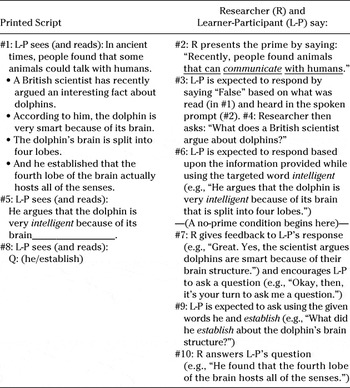
Each task consisted of 18 short reading passages around eight themes (e.g., Picasso’s Guernica, the development of aspirin). These themes were selected from Mackey and Savage’s (Reference Mackey and Savage2011) Read This! Level 2 and Savage’s (Reference Savage2010) Read This! Level 3. To participate in the task, the researcher had 18 belief statements and the learners were provided with 36 note cards with reading passages. Two note cards were prepared for each activity unit to set up a prime and no-prime conditions, which would enable us to determine whether priming (manifested as alignment) occurs after a learner hears the researcher’s correct production of the target-stress pattern. One of the note cards contained a prompt word that the learners were asked to produce after hearing the researcher’s speech including a prime (i.e., a prime condition), whereas they were asked to produce the other prompt word provided on the second note card without any model presented in the preceding utterance of the researcher (i.e., a no-prime condition). Table 1 shows an example of one belief statement with two note cards from the collaborative priming task (i.e., one activity unit). The first card had four to five sentences of supplementary information along with a sentence fragment that embedded a prompt word with the target-stress pattern (either 3-2 or 4-2; see #2 in Table 1). For each reading passage, when the researcher read a belief statement—which contains a word with the target-stress pattern (e.g., commúnicate; #2)—to the learner, the participant answered whether the statement is true or false referring to the information in the reading passages (#3). Then, the researcher would ask a follow-up question (#4). The learner could answer this follow-up question by completing the given sentence fragment, which contains a prompt word (e.g., intélligent; #5 and #6). In the second phase of the activity, the learner’s answer was followed by the researcher’s comment, which did not contain a prime (#7; no-prime condition begins) and the researcher encouraged the learner to ask a question pertaining to the topic. Finally, the learner asked a question using a subject and a verb (a prompt word; e.g., estáblish in #8) provided on the second note card and the researcher answered the question (#10). A total of 18 activity units were included in each session of the task. Each unit contained one prime and its corresponding prompt with either of the two target-stress patterns (i.e., 3-2 or 4-2) in the prime condition and only a prompt without a prime presented by the researcher in the no-prime condition. The learners did not receive any explicit information about word-stress patterns or what the task would be testing.
Sample activity material

Note. Words with target-stress patterns are italicized. The numbers correspond to the order of utterance during collaborative auditory priming task.
To examine the impact of vocabulary type frequency on auditory priming effects, the number of target words was manipulated for the two experimental groups. Previous studies have shown that priming materials with lexical diversity promoted subsequent production of target linguistic features (McDonough & Kim, Reference McDonough and Kim2009). In our study, the task repetition group repeated the same task twice, whereas the procedural repetition group performed a task with the same procedure but with different content on the second day. Accordingly, the procedural repetition group encountered twice as many prime words containing the target-stress patterns as those in the task repetition group.
Testing Materials.
To measure learners’ development of accurate production of target-stress patterns, three versions of a sentence-read-aloud task (SRAT) were designed. To prevent learners from receiving any additional input, the SRAT was conducted individually. Each version of the test included 25 sentences, each of which contained one to as many as five target words (both prime and prompt words) as shown in the following examples:
-
Sample Item 1: They considered (3-2) stability (4-2) to be especially (4-2) important (3-2).
-
Sample Item 2: Try pronouncing (3-2) the word precisely (3-2).
A total of 72 words (39 with the 3-2 pattern and 33 with the 4-2 pattern) were placed in the 25 sentences. Learners were asked to read each sentence clearly without looking up any sources. Each version of the tests served as either the pretest, posttest, or delayed posttest. The order of the three versions of the test was counterbalanced across participants to minimize potential test effects.
PROCEDURES
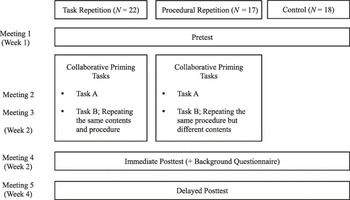
The priming and measurement tasks were administered over a 4-week period. The researcher met with each student five times; each meeting took approximately 30 to 40 minutes. As shown in Figure 1, the pretest was carried out during the first week, and the two priming tasks and immediate posttest were completed during the second week. The two priming sessions were offered to each student on two consecutive days, and the immediate posttest was administered one day after the second priming task. Each learner performed the delayed posttest 2 weeks after the posttest. During the priming task, the researcher met each participant individually in a laboratory setting. Whereas the task repetition group repeated the first task two times, the procedural repetition group repeated the same task procedure (exchanging information with the researcher) but with different content that included a different set of target words each time. The control group completed the pretest and the two posttests only.
Procedure of the study.

The interactions between the researcher and each student-participant as well as the participants’ performances on the SRAT were recorded using a digital audio recorder.
Analysis of Stress Patterns
To create the coding scheme for the current data, all three co-authors met and listened to 10% of the entire data. Through multiple discussions, we decided to follow the criteria established in previous research (Trofimovich et al., Reference Trofimovich, McDonough and Foote2014; Trofimovich et al., Reference Trofimovich, McDonough and Neumann2013), which auditorily determines stress placement based on three physical attributes or correlates of stress in English: vowel length (duration), vowel intensity (loudness), and pitch height. The most prominent syllable was determined by one or more of these attributes. For accurate identification and verification of word stress produced by learners, we used Praat (Boersma & Weenink, Reference Boersma and Weenink2015), a free software package for speech analysis that visually displays components of word stress. We also employed the coding scheme used in Trofimovich and colleagues (Reference Trofimovich, McDonough and Foote2014) as well as in previous corpus-based priming research (Collentine & Collentine, Reference Collentine, Collentine, McDonough and Mackey2013) to determine the occurrence of priming in the prime and no-prime conditions. Two counts—learner’s accurate production of the target-stress pattern and learner’s inaccurate production of the target-stress pattern—were generated under each of (a) the prime condition where the researcher accurately produces the target-stress pattern and (b) the no-prime condition where no prime word is presented to a learner.
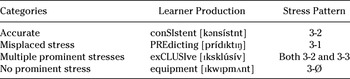
Although past studies have analyzed prompt words produced by students in terms of correct and incorrect word stress, we found that inaccurate stress was multidimensional and could be further analyzed into many different categories based on several sources of incorrectness. Thus, we identified three patterns of inaccurate stress (i.e., misplaced stress, multiple prominent stresses, and absence of prominent stress) in addition to correct stress as described in Table 2.
Examples of learner production of lexical stress

One point was assigned to a word produced with an accurate stress pattern, whereas production of a word with any of the three inaccurate stress patterns was given zero point. The best possible score was 72 for each version of the production test (SRAT). After devising the coding scheme, the first researcher coded all the transcripts, and the second and the third researchers coded a randomly selected sample of 15% of the entire data independently to ensure interrater reliability. Cohen’s kappa was .87, and alpha was set at .05.
Statistical Analyses
To answer the first research question, a two-way analysis of variance (ANOVA) was carried out to see (a) whether learners produced targetlike L2 stress patterns more frequently after hearing a model (i.e., in the prime condition) as compared to in the no-prime condition and (b) whether there was any significant difference between the task repetition and procedural repetition groups in the amount of primed production of the target-stress patterns. Group (task repetition vs. procedural repetition) was included as a between-subject variable and the prime condition (prime vs. no-prime) as a within-subject variable. To avoid Type I error due to multiple comparisons on a single dataset, we adjusted the significance level to 0.0125, and considered values of p ≤ 0.01 to be significant. For the second research question, a two-way mixed ANOVA was conducted to explore the developmental trend of the target-stress patterns across the three production tests. Learner performance in the SRAT served as the dependent variable, whereas time (pretest, immediate posttest, and delayed posttest) was a within-subject variable and the task repetition condition (task repetition, procedural repetition, and control) was a between-subject variable.
RESULTS
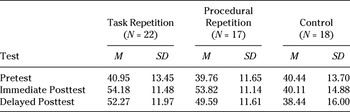
Before answering the two research questions, the three participant groups’ knowledge of the target word pronunciation was compared to ensure that the three groups did not differ from one another. In terms of the learners’ performance in the pretest (i.e., SRAT), the scores of all three groups were similar: a mean score of 40.95 for the task repetition group, 39.76 for the procedural repetition group, and 40.44 for the control group (see Table 4). A one-way ANOVA did not show any significant between-group differences, indicating that all three groups began the experiment on an equal footing: F(2, 54) = 0.040, p = .450.
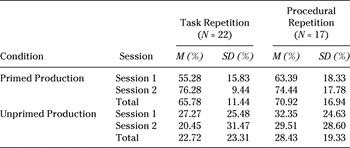
Following Trofimovich and colleagues (Reference Trofimovich, McDonough and Foote2014), successful priming effects refer to a learner’s accurate production of the target-stress pattern following the researcher’s production of the same stress pattern (i.e., prime). For the first research question, the magnitude of the priming effect was operationalized by comparing the occurrence of primed production of targetlike stress patterns and unprimed production of targetlike stress patterns. Table 3 displays descriptive statistics for the occurrence of priming during the two treatment sessions in both conditions. Because the control group did not perform any priming tasks, priming data is not available for the control group.
Descriptive statistics for the occurrence of priming

A two-way ANOVA was conducted after checking the assumptions for using parametric tests. First, the results demonstrate that the main effect for the prime condition was statistically significant, F(1, 37) = 957.161, p < .001, η p 2 = .963, with a significantly higher amount of primed production of the target-stress patterns in the prime condition than in the no-prime condition. This finding indicates that the learners could produce the prompt words more accurately after hearing a prime presented in the preceding utterance compared to when they did not receive any model. Regarding the impact of different characteristics of task repetition on the auditory priming effects, there was no statistically significant difference between the task repetition and procedural repetition groups in the amount of primed production of the target-stress patterns: F(1, 37) = 1.370, p = .249. Accordingly, the interaction between the two factors was not significant: F(1, 37) = 1.019, p = .319. These results seem to suggest that different characteristics of task repetition did not affect the amount of primed production of the target-stress patterns in both prime and no-prime conditions.
The second research question examined whether collaborative auditory priming tasks are beneficial for promoting development of L2 learners’ pronunciation, particularly word-stress patterns. Table 4 shows descriptive statistics for the development of accurate production of the target-stress patterns. The results demonstrate that accuracy scores of both the task repetition and the procedural repetition groups increased between the pretest and immediate posttest and between the pretest and delayed posttest, whereas no noticeable change was observed for the control group.
Descriptive statistics for accuracy development

To test whether these results were statistically significant, a two-way mixed ANOVA was conducted with time (pretest, immediate posttest, and delayed posttest) as a within-subject variable, task repetition condition (task repetition, procedural repetition, and control) as a between-subject variable, and learner performance in the SRAT as the dependent variable. The mixed ANOVA revealed a statistically significant main effect for time, F(2, 54) = 53.707, p < .001, η p 2 = .499; for group, F(2, 54) = 3.309, p = .011, η p 2 = .109; and for the interaction between time and group, F(2, 54) = 16.537, p < .001, η p 2 = .380.
The group differences indicate that both task repetition and procedural repetition groups produced significantly more accurate stress patterns than the control group, F(1, 38) = 5.245, p = .001, η p 2 = .121, and F(1, 33) = 3.739, p = .005, η p 2 = .102, respectively. Furthermore, post hoc Bonferroni tests found no significant difference between the task repetition group and the procedural repetition group (p > .0125), but statistically significant differences were observed between the control group and the experimental groups (p < .0125 for both comparisons). The significant Time × Group interaction effects seem to be attributed to the fact that, whereas there was no difference in the pretest, F(2, 54) = 0.040, p = .450, a significant difference was found among the three groups in the immediate posttest, F(2, 54) = 7.561, p = .007, η p 2 = .781, and delayed posttest, F(2, 54) = 6.085, p < .001, η p 2 = .225.
To delve into the developmental patterns of the experimental groups, post hoc pairwise comparisons were also conducted for each group using a Bonferroni correction, with the level of statistical significance taken as p < .0125. Results revealed that the task repetition group significantly improved between the pretest and immediate posttest (p < .001, d = 1.058), and the development was retained in the delayed posttest (p = .109). In terms of short- and long-term learning effects, whereas procedural repetition resulted in significant improvement between the pretest and the immediate posttest (p < .001, d = 1.233), this group’s score decreased significantly between the immediate posttest and the delayed posttest (p = .001, d = .372). Despite such score change, the procedural repetition group still produced the target-stress patterns significantly more accurately in the delayed posttest than in the pretest.
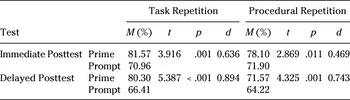
To understand the test results more clearly, we conducted three sets of follow-up analyses. First, we examined whether treatment of the words (i.e., prime vs. prompt) impacted learners’ performance in the immediate and delayed production tests. Specifically, we used paired t tests to investigate whether there was any significant difference in learners’ production of the words that they heard as primes and those that they produced during the priming activities. This is an important issue because priming involves both listening to primes and producing targets. Yet, to date, there has been little, if any, exploration of the extent to which each mechanism contributes to L2 learning through collaborative priming tasks. For this analysis, proportion scores were calculated and reported because the number of target words provided to each experimental group differed due to different repetition conditions. Results revealed that for both task repetition and procedural repetition groups, learners performed significantly better on the words provided in the primes than those given as prompts in the immediate and delayed posttests (see Table 5).
Production of prime and prompt words

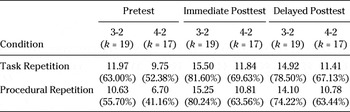
Our second follow-up analysis focused on whether learners’ performance differed depending on the number of syllables of a target word. We report proportion scores in parentheses in addition to raw numbers for this analysis due to the imbalanced number of 3-2 and 4-2 words in the production tests. As shown in Table 6, learners of both experimental groups tended to produce 3-2 stress patterns more accurately than 4-2 patterns in a consistent manner over time.
Accurate production of the target-stress patterns

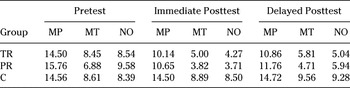
Finally, we further analyzed error types with English stress patterns on production tests to understand whether their error types changed as a result of priming tasks in addition to the production of accurate English stress patterns. As illustrated in Table 7, erroneous stress patterns produced by the Korean learners fell into three categories: misplaced stress, multiple stresses, and no primary stress (see “Analysis of Stress Patterns” section). Of the three error types, the most frequent across all three groups was misplaced stress assignment. Multiple stresses and no primary stress were found to occur to a similar extent. Regarding the effects of priming tasks, both task repetition and procedural repetition groups exhibited a marked decrease in the frequency of overall erroneous production between the pretest and the immediate posttest and a slight increase between the immediate posttest and the delayed posttest, whereas the control group showed little change over time.
Types and percentages of erroneous production of target stress by group

Note. TR = Task repetition; PR = Procedural repetition; C = Control; MP = Misplaced stress; MT = Multiple stresses; NO = No primary stress.
An interesting learning trend was found in the learners’ performance throughout the study’s procedure overall. For example, as shown in Example (1), a learner appeared to go through a certain learning path until she attained correct stress assignment of a target word intelligent (4-2) after being exposed to the target-stress pattern in the researcher’s primes (i.e., the prime condition) during the two priming sessions, whereas learning did not occur for the word, establish (3-2), in the no-prime condition:
Example (1)
-
1. Pretest (no primary stress): He is intelligent [ɪntɛlɪʤΛnt] and responsible for his job.
-
2. Priming task 1 (multiple stresses and misplaced stress in the prime and no-prime condition, respectively)
-
R: Recently, people found animals that can communicate [kǝmjúnǝkeɪt] with humans.
S: (referring to the reading materials) False.
R: What does a British scientist argue about dolphins?
S: (referring to the reading materials) He argues that dolphins are very intelligent [ɪnt
 $\mathop \varepsilon \limits^\prime $
líʤǝnt] because of their brains that are split into four areas.
R: Great. Yes, the scientist argues dolphins are smart because of their brain structure.
R: Okay, then it’s your turn to ask me a question.
S: (using a subject [he] and verb establish) What did he establish [ɪstӕblíʃ] about the dolphin’s brain structure?
R: He found that the fourth lobe of their brain hosts all the senses.
-
-
3. Priming task 2 (accurate stress in the prime condition only)
-
R: Recently, people found animals that can communicate [kǝmjúnǝkeɪt] with humans.
S: (referring to the reading materials) False.
R: What does a British scientist argue about dolphins?
S: (referring to the reading materials) He argues that dolphins are very intelligent [ɪnt
$\mathop \varepsilon \limits^\prime $
lɪʤǝnt] because of their brains that are split into four areas.R: Right, he argues dolphins are very smart because of their brain structure.
R: Okay, then it’s your turn to ask me a question.
S: (using a subject [he] and verb establish) What did he establish [ɪstӕblíʃ] about the dolphin’s brain structure?
R: He found that the fourth lobe of their brain hosts all the senses.
-
-
4. Immediate posttest (accurate stress): Being intelligent [ɪnt
$\mathop \varepsilon \limits^\prime $
lɪʤǝnt] and creative, he will contribute to his team’s adventure. -
5. Delayed posttest (accurate stress): He is enormously intelligent [ɪnt
$\mathop \varepsilon \limits^\prime $
lɪʤǝnt] but cannot communicate it.


This example seems to demonstrate that a learner ultimately acquired a certain stress pattern of the target language by attempting to align her language with the interlocutor’s as a function of auditory priming, particularly in the prime condition. Initially she did not assign stress to the target word perhaps due to L1 interference (to be discussed in detail in the “Discussion” section). However, through interactive alignment, she became aware of the need to place stress on the word in the first session of the priming task and eventually learned the correct stress pattern in the second session. It may be premature to suggest that such awareness occurred during interaction and led to learning but that seems plausible from our qualitative analysis of the data. Future research is warranted to further investigate this issue.
To summarize, for the first research question, the learners produced an accurate stress pattern more frequently after they heard the same stress pattern in the researcher’s speech as compared to when they were asked to produce a prompt word without the presentation of a prime in the preceding utterance. Moreover, different characteristics of task repetition did not appear to impact the quantity of primed production of the target-stress patterns, showing similar effects for enhancing auditory priming effects. For the second research question, which concerned the benefits of collaborative priming tasks for promoting L2 pronunciation development (i.e., word-stress patterns), both characteristics of task repetition were revealed to facilitate L2 learners’ development of pronunciation; however, repeating the exact same task was more effective in sustaining learning of word-stress patterns over time (in contrast to repeating the same procedure with the incorporation of different content).
DISCUSSION
The purpose of the study was to determine the extent to which auditory priming tasks would be successful in providing learning opportunities, which in turn may lead to learners’ development of target-stress patterns. The study also examined whether differences in the operationalization of task repetition impact learners’ development of particular word-stress patterns before and after two different task repetition treatments: (a) task repetition (same content, same procedure) and (b) procedural repetition (different content, same procedure).
Regarding interactive alignment, the study’s findings are in line with Trofimovich and colleagues (Reference Trofimovich, McDonough and Foote2014) who found that collaborative priming tasks including words with target-stress patterns not only elicited successful alignment of word stress between L2 speakers but also provided ample opportunities for practice. The results showed that participants in the two experimental groups produced a high proportion of accurate stress patterns in the prime condition throughout the two priming sessions (i.e., 65.78% for the task repetition group and 70.92% for the procedural repetition group). On the contrary, the learners produced accurate stress patterns to a much lesser degree in the no-prime condition (i.e., 22.72% for the task repetition group and 28.43% for the procedural repetition group). These findings may demonstrate that the learners were more likely to align with the researcher’s L2 pronunciation patterns after hearing a prime as a function of auditory priming than when the target-stress pattern was not presented in the researcher’s preceding utterance. However, the study did not find any significant effect of different characteristics of task repetition (task repetition vs. procedural repetition) on the amount of primed production of the target-stress patterns in both prime and no-prime conditions.
As a follow-up study of Trofimovich and colleagues (Reference Trofimovich, McDonough and Foote2014), the findings of the current study provide evidence for the learning value of interaction-based alignment in pronunciation. By adopting the pretest-posttest, control group design, this study revealed the positive impact of alignment on L2 pronunciation development. Although it may be premature to suggest that the findings of this lab-based study could be extended to L2 classrooms or naturalistic settings of even more authentic L2 use, we speculate that collaborative, communicative tasks targeting linguistic alignment (e.g., collaborative priming tasks) may hold considerable promise as an important component of pronunciation instruction as also suggested by Trofimovich and colleagues (Reference Trofimovich, McDonough and Foote2014).
The current findings are also consistent with Kim (Reference Kim2013) in terms of the equal benefits of the two different task repetition types for learning task-induced target features. That is, repeating the same procedure with or without the same content, in combination with interaction, may provide L2 learners with valuable opportunities to enhance the intelligibility of their speech on the dimension of lexical stress. Furthermore, the current study extends the grammar-focused findings of Kim to a phonological feature (i.e., lexical stress). In terms of delayed learning effects, a similar picture was found when we probed the sustainability of learning in the two repetition conditions. A noticeable improvement between the pretest and the posttests was observed in both groups, and both groups maintained their performance until the delayed posttest. However, although no difference was found between the immediate posttest and delayed posttest for the task repetition group, there was a significant decrease between the two posttests for the procedural repetition group, which seems to indicate that the task repetition condition might be more beneficial for delayed learning effects. This suggests that hearing and producing the same words containing the target-stress patterns repeatedly while participating in collaborative meaning-focused tasks was helpful in developing better control of L2 lexical stress in English. This also suggests that although grammar learning through collaborative priming tasks was enhanced with more variety of verbs in prompts (McDonough & Kim, Reference McDonough and Kim2009), knowledge of word stress might be more fully proceduralized and automatized through repeated practice with the same words (DeKeyser, Reference DeKeyser, VanPatten and Williams2007).
Both researchers (e.g., Field, Reference Field2005) and pronunciation instruction specialists (e.g., Celce-Murcia, Brinton, Goodwin, & Griner, Reference Celce-Murcia, Brinton, Goodwin and Griner2010; Murphy, Reference Murphy2004) characterize correct word-stress assignment as an essential contributing factor for the enhancement of both intelligibility and comprehensibility of L2 speech (Munro & Derwing, Reference Munro and Derwing2015). Despite its significant role in L2 pronunciation, word stress has sometimes been characterized as an unteachable linguistic feature (Jenkins, Reference Jenkins2002), and teaching L2 word-stress patterns has been neglected in L2 classrooms (Lord, Reference Lord2001). However, the current findings suggest that collaborative tasks, which include words with target-stress patterns, may have the potential to facilitate L2 learners’ more accurate control over target language patterns of word stress.
The findings also suggest that on both posttests, learners produced accurate stress patterns significantly more with the words provided in the primes than in the prompt words. This may indicate that, whereas opportunities for exposure to the target-stress patterns (i.e., primes) are associated with higher production accuracy on the immediate and delayed posttests as compared to opportunities to produce target-stress patterns embedded in prompt words. It is tempting to suggest that whereas exposure to the target prosodic features may be vital to learning L2 pronunciation, production opportunities (i.e., prompts) did not necessarily result in the development of the target-stress patterns in the present study. However, further investigation is necessary to determine whether the provision of exposure (input) or production (output) opportunities is a significant determiner of learning.
Moreover, in-depth analyses of the data revealed interesting trends regarding pronunciation errors. First, previous research has shown that the number of syllables in the words appeared to be very important for correct stress assignment (e.g., Fokes & Bond, Reference Fokes and Bond1989). In the present study, L2 learners were found to have fewer problems with correct stress assignment when words consisted of three syllables, whereas their accuracy score was lower for four-syllable words. In Fokes and Bond, four-syllable words were more problematic to L1 Korean speakers with respect to the acoustic-phonetic correlates of stress (fundamental frequency, duration, amplitude) than three-syllable words, which were produced corresponding well to expected native speaker values. However, the remarkable improvement in both 3-2 and 4-2 target-stress patterns exhibited by the present study’s two groups of learners between the pretest and posttest appear to indicate that both stress patterns were susceptible to positive priming effects. Further, both types of repeating collaborative priming tasks were beneficial for development of lexical stress patterns in general, irrespective of the number of syllables contained in the target words.
As to possible sources of the observed stress-related error patterns, Anderson (Reference Anderson1993) and Pennington (Reference Pennington and Morley1994) speculate that the influence of learners’ L1 in combination with incomplete mastery of the English prosodic system contribute to L2 pronunciation difficulties. According to Pennington, the phonological distance between the rhythmic patterns (e.g., word stress) of learners’ L1 and the target language impacts processing of rhythmic information. In addition, Erdmann (Reference Erdmann1973) claimed that learners develop the intermediate stress system on the basis of regular patterns, not random guesses, and that the rules of the new system are elaborations of learners’ L1 and not in concordance with the L2 rules to be mastered. Given that the learners’ L1 is Korean, which has a prosodic system that is typologically distinct from English (Swan & Smith, Reference Swan and Smith2001), it could be surmised that at least some of the sources of identified erroneous stress patterns—multiple stresses and no primary stress in particular—could be attributed to the typological distinctiveness of the two languages. The learners in the current study were found to struggle with changing pitch height and/or intensity in their pronunciation of certain words or to use pitch movement and intensity on every single syllable or more than two syllables when producing certain words. However, the number of errors associated with (1) the absence of primary stress, (2) multiple stresses as well as (3) misplaced stress decreased noticeably after participating in the study’s auditory priming tasks.
IMPLICATIONS
The study’s results have several implications for L2 pronunciation instruction. First, the current research confirmed that collaborative tasks designed to elicit alignment at a phonological level during interaction positively impacted EFL adolescent learners’ development of the target word-stress system. The study also illuminates benefits of repeating collaborative priming tasks in pronunciation development, particularly when both content and procedure were repeated twice. Given that teachers often recycle materials and activity types in classroom contexts to provide more language learning opportunities (Kim, Reference Kim2013), the current findings may be used to support repeated use of the same task and of the same task type in pronunciation instruction. However, it should be noted that such benefits are more likely only when the tasks are implemented in ways that provide students with ample opportunities to practice targeted linguistic features (e.g., lexical stress) during collaborative oral activities with a primary focus on meaning (McDonough, Neumann, & Trofimovich, Reference McDonough, Neumann and Trofimovich2015). It should also be noted that the results of the current study cannot necessarily be generalized to repeating the exact same tasks more than twice.
Previous research has suggested that learners would benefit from collaborative tasks designed to elicit alignment with target pronunciation patterns (Trofimovich et al., Reference Trofimovich, McDonough and Foote2014) as opposed to convergence on typical pronunciation errors (see Walker, Reference Walker2010). While carrying out tasks, learners should be provided with ample tokens of lexical items pronounced with reliable (i.e., targetlike) patterns of word stress, which in turn will aid their development of perception and production skills (Trofimovich et al., Reference Trofimovich, McDonough and Foote2014). Building upon research procedures featured in the study, teachers may sometimes serve as an activity participant during collaborative classroom tasks. When structuring learner-learner interactions, collaborative tasks may be set up so that one member of each dyad is provided unambiguous visual supports through which patterns of word stress are clearly indicated to support accurate production of target words (e.g., enlarged font size, bolding, and/or underlining of pri mary stressed syl lables; a diacritic positioned directly above stressed syllables).
The study’s findings showed that in the posttests of the production test, learners performed better at producing prime words that were spoken by the researcher as a model than the prompt words that they actually produced during the interaction. This seems to lend support to Derwing and Munro’s (Reference Derwing, Munro and Grant2014) proposal on the crucial role of perception in learning targetlike forms. Proponents of this proposal maintain that it is important to expose learners to a variety of target forms, which may help learners produce targetlike or more intelligible forms as well as enhance their listening comprehension (Goodwin, Reference Goodwin, Celce-Murcia, Brinton and Snow2014).
Finally, the current findings on the effectiveness of repeating collaborative priming tasks seem to hold particular promise for EFL contexts where English is not used daily and has no immediate function within the society beyond the classroom. As illustrated with an example in the previous section, learners seemed to go through a developmental sequence for acquiring word-stress patterns through repetitive exposure to an L2 model. For example, they initially pronounce a word without stress. As they are repeatedly exposed to accurate production of the target-stress patterns, they recognize the need to assign primary stress and produce an erroneous stress pattern (wrong placement or multiple stresses). Provided with sizeable targetlike input, they finally can place primary stress accurately. Pronunciation is sometimes perceived as a feature of language acquired merely as a result of exposure to native speaker input (e.g., direct method, the natural approach). However, EFL learners generally have limited access to real-life communication with proficient speakers of English, and, accordingly, pronunciation teaching is sometimes deemed of only peripheral concern (Sato, Reference Sato2007) and as representing unrealistic goals for EFL contexts (Pica, Reference Pica1994). Past SLA research, however, has suggested that considerable exposure to L2 input and practice with the L2 are crucial factors in shaping cognitive representations on which learners base their pronunciation of the target language (Derwing & Munro, Reference Derwing, Munro and Grant2014; Sifakis, Reference Sifakis2014) and that intelligible nonnative speech samples along with native speech samples should be included as integral parts of pronunciation teaching (Murphy, Reference Murphy2014). In this regard, collaborative priming tasks seem to hold great promise for teaching pronunciation, in particular lexical stress, in EFL contexts.
Limitations of the study should also be acknowledged as many of them imply a need for further research. First, we did not manipulate the frequency of repetitions; all the learners repeated the priming tasks twice on two consecutive days. As indicated in Kim (Reference Kim2013), it would be intriguing to investigate how much repetition of certain task aspects is essential for pronunciation development. Future research may consider addressing this issue by manipulating the frequency of repeating different task characteristics. Second, the current study was conducted with EFL adolescent learners who were homogenous in terms of age of acquisition, English learning experiences, and proficiency level. Therefore, we are cautious about extending the results of this study to different L2 learner groups studying English in different contexts (e.g., adult ESL learners, learners studying in nontraditional settings). Future studies would benefit from replicating the current study with different learner populations in a variety of settings. In addition, it could be said that the study lacks ecological validity because the collaborative tasks were carried out in a laboratory setting between the researcher and individual students. Future research may be interested in examining more diverse interactional contexts, especially within language classrooms. Finally, further studies are called for to determine to what extent the two types of repetition of collaborative tasks would be beneficial for the development of aspects of English pronunciation other than patterns of lexical stress (e.g., thought grouping, sentence-stress, intonation, vowel quality, tones) and in the acquisition of phonological characteristics of other target languages.
CONCLUSION
The results of the current study echo findings of previous research on the effectiveness of collaborative tasks in eliciting auditory priming and the benefits of different types of task repetition in interaction-driven language learning. Participating learners in the current study attempted to align their linguistic representation at a suprasegmental level (i.e., word-stress assignment) during interaction as a function of auditory priming. Furthermore, regarding the impact of different implementations of task repetition, both task repetition and procedural repetition were found to enhance learning of word-stress patterns. However, repeating the same content and procedure with the same vocabulary items (i.e., task repetition) seemed to be more conducive to learning over time. These findings have implications for pronunciation instruction, casting light on what we believe is the considerable potential of collaborative priming tasks as an effective pedagogical tool that can assist L2 learners in enhancing the intelligibility of their speech during well-structured meaning-focused interactions.