I. INTRODUCTION
The study of nanomaterials has been the subject of a huge number of researches during the last two decades. Because of their large surface-to-volume ratio, metal and semiconducting nanoparticles (NPs) in general have properties that depend heavily on their sizes and shapes. The problem of the control of their size and shape has been the subject of several reviews and books and so far it is an open issue, being one of the highly topical research fields in the current literature.Reference Corain, Schmid and Toshima1–Reference Peng and Yang5 Thus, it is not strange that the development of precise in situ synthesis methods of NPs with different sizes and shapes has become an area of intensive research.
The growth of NPs from atomic or molecular precursors, such as inorganic salts, complex species, or organometallic compounds appears as one of the most promising methodology to produce NPs.Reference Corain, Schmid and Toshima1–Reference Peng and Yang5 Strong reducing agents, like borohydride, are often used to produce NPs due to their ability to quickly induce the nucleation stage.Reference Corain, Schmid and Toshima1, Reference Grzelczak, Pérez-Juste, Mulvaney and Marzán6, Reference Goubert, Ding, Brust, Wang and Pileni7 However, the resulting size distribution is widespread, because nucleation and growth take place simultaneously.Reference Mariscal and Dassie2, Reference Peng and Yang5, Reference Park, Joo, Kwon, . Jang and Hyeon8, Reference Finney and Finke9
Using wet chemical methods, a proper control over NP sizes and shapes has been achieved in some experiments using NPs as seeds.Reference Park, Yang, Corredor and Weaver10–Reference Tao, Habas and Yang27 This type of growth is an example of heterogeneous nucleation. The initial nucleation stage, that is, the appearance of small clusters in the bulk of the solution, is practically absent in this methodology. In a seed-mediated growth experiment, preexisting NPs (called seeds) are immersed in a growth bath where the growth process only occurs on the surface of the seed-NPs. This growth, involving a lower activation barrier than homogeneous nucleation, usually uses milder conditions (i.e. weak reducing agents, like ascorbic acid), thus allowing for a more precise tuning of the final NP size.Reference Corain, Schmid and Toshima1, Reference Mariscal and Dassie2
In the particular case of an electrochemical experiment, precise potential control has enabled the deposition of a thin shell of dimensions comparable to those of a monolayer, and even of fractions of it on the surface of NPs.Reference Park, Yang, Corredor and Weaver10, Reference Mulvaney28 This is possible through a phenomenon known as underpotential deposition (upd).Reference Sudha and Sangaranarayanan29, Reference Leiva30 In the upd process, metal ions are deposited on a foreign substrate at potentials more positive than those predicted by Nernst equation. This phenomenon is characteristic of systems (some selected metal couples) where the interaction of the adsorbate with the substrate is stronger than the interaction of the adsorbate with its bulk material.Reference Leiva31Upd on NPs has been recently studied by Compton et al.Reference Campbell, Zhou and Compton32–Reference Zhou, Rees and Compton34 with the finding of remarkable size effects that occur when NP size is reduced below 50 nm, where the upd phenomenon seems to vanish. Such a curious transition from upd to overpotential deposition (opd) depending on nanoparticle size has been predicted by theoretical calculations, although the modeling involved some approximations, like ignoring configurational and vibrational entropy.Reference Oviedo, Leiva and Mariscal35, Reference Oviedo, Negre, Mariscal, Sánchez and Leiva36
Many experimental routines use the upd phenomena on seed-NPs as a starting point for subsequent modifications, the most important being:
(i) Spontaneous galvanic replacement. This was achieved by the spontaneous galvanic replacement of an upd deposited layer by a more noble metal. In this experimental methodology, the stoichiometry of the replacement reaction enabled precise control of the amount of material deposited.Reference Park, Yang, Corredor and Weaver10 The thickness of the shell may be controlled by a sequence of replacements and may even generate well-controlled tri-shell NPs.Reference Tang, Chen, Wang, Nie, Kuang and Yao12, Reference Liu, Ge, Wang, Ma and Ding13
(ii) Blocking of selected facets via the inclusion of a foreign metal. Jana et al.Reference Jana, Gearheart and Murphy14 pioneered the use of foreign metal ions for shape control of nanostructures. In that work Au nanorods were obtained by addition of Ag ions to Au-NPs used as seeds. The results were interpreted as a direct consequence of the effect of Ag+ ions, which promoted the appearance of more open surface facets on Au nanorods. This synthesis strategy has been extended to different Au-NPs morphologiesReference Seo, Park and Song15–Reference Zhang, Langille, Personick, Zhang, Li and Mirkin19 and to other adsorbates, like Cu,Reference Sun, Guan, Shang, Gao, Xu and Zhu20 Pd,Reference DeSantis, Peverly, Peters and Skrabalak21, Reference Lu, Prasad, Wu, . Ho and Huang22 and Rh,Reference Zhang, Li, Jin, Zeng, Yu, Yang and Xia23 which have recently been used to direct the growth of Au-NPs. More recently, Personick et al.Reference Personick, Langille, Zhang and Mirkin26 used Ag-upd on selected faces of seed Au-NPs to block the subsequent growth of Au on them. Since bulk Ag growth is avoided by proper potential setting, only growth of Au on naked facets was allowed, and hence, controlling the final morphology of the NPs.
We can summarize the current situation in the field by stating that there has been great progress in the development of synthesis strategies to control the size and shape of NPs using redox reactions, many of them using the upd phenomenon. However, in spite of the intensive use of upd in nanosized applications, there is relatively little theoretical research in this direction.Reference Campbell and Compton33, Reference Zhou, Rees and Compton34 The present manuscript attempts a novel contribution to this area, using state-of-the-art computer simulations. Thus, the main goals of the present work are 2-fold: first, to clearly state the relationship between overpotential η and the chemical potential μ of the adsorbed species. Second, to perform for the first time, realistic computer simulations of the selective growth of NPs. The first point is relevant for the second, since the present computer simulations are made within the Grand canonical ensemble, where μ is the control parameter that determines the number of adsorbed particles. Furthermore, the present simulations allow for the first time the introduction of a number of ingredients absent in the previous modelingReference Campbell and Compton33, Reference Zhou, Rees and Compton34: Fluctuations in the energy, fluctuations in the number of particles and introduction of thermal motion, which also contributes to the free energy of the system. Thus, vibrational and configurational entropic effects, not previous included in the free energy calculations, are now implicit in the modeling.
The present work is organized as follows. In Sec. II we describe the theoretical model. Section III describes the calculation method used. Section IV is devoted to results and discussions and Sec. V presents the most relevant conclusions.
II. THE MODEL
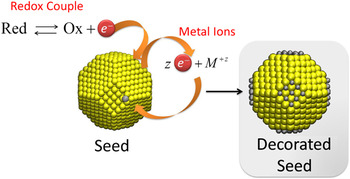
As shown on the left of Fig. 1, we consider an initial state consisting of a NP made of a metal S (seed-NP), in contact with metal ions MZ+ of different chemical nature M present at the concentration cMz+, yielding the activity aMz+. A redox couple Red/Ox, providing the electrons for the reduction of the M metal ions, is allowed to establish electronic equilibrium with the seed-NP. As final equilibrium state, shown at the right of Fig. 1, we consider a seed-NP decorated by NM atoms of type M, at the chemical potential μM (call this structure core/shell). As we will see below, depending on the interaction between the metals (S and M) participating in this reaction, the core/shell structure may be thermodynamically stable, metastable or unstable. The existence of a thermodynamically stable or metastable state will be determined by a dual equilibrium: on one side, an electronic equilibrium, where the electrochemical potential of the electrons in the NP will be equal to the electrochemical potential of the electrons in the redox system (Fig. 1). On the other side, an ionic equilibrium, where the electrochemical potential of the ions deposited on the NP will be equal to the electrochemical potential of the metal ions in solution.
Scheme of the decoration of a seed-nanoparticle made of a metal S with atoms of type M to yield an S/M core/shell structure. A redox couple is used to control the electrochemical potential of electrons at the nanoparticle.

Thus, the reactions involved in the process are:

where we have assumed for the sake of simplicity a one-electron transfer in the redox couple. We will also assume that the concentrations of Red and Ox species are large enough to undergo a relatively small change upon reaction with Mz+ to yield M. Thus, the electric potential at the surface of the NPs will be determined by the Red/Ox ratio and will remain relatively unchanged. This is analogous to potentiostatic control in an electrochemical experiment. However, we will see that there are subtle differences in the meaning of overpotential for both systems. According to this picture, the driving force for deposition of the metal is two-fold:
(i) Metal deposition (M on S) is enforced by the electrochemical potential of the electrons in the redox system, in equilibrium with the electronic system of the NP.
(ii) Metal deposition (M on S) will also be promoted by a larger concentration (activity) of the Mz+ ions in solution.
In the Appendix we show that the chemical potential of the adatoms on the NP μM is related to the chemical potential of the bulk metal atoms  according to the equation:

where η is the overpotential set by the redox couple with respect to the bulk deposition potential of metal M.
Let us now discuss on the meaning of Eq. (2) for the present situation, taking into account that the chemical potential μM corresponds to the free energy change for the insertion of an atom of type M in the seed-NP. If a metal atom deposited on the seed-NP is more stable than in the bulk, μM will be more negative than  and we will have
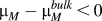 , which is compatible with condition η > 0. Thus, the atoms will subsist on the seed-NP at more positive potentials than the Nernst reversible potential for bulk M deposition, and we will be in the presence of the upd phenomenon. The reverse situation will take place when
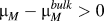 , yielding η < 0 or a situation of opd. This is clearly an unstable situation for a core/shell geometry, since when η < 0 the bulk deposit can be formed, so that the application of an overpotential allowing the decoration of the seed-NP should inevitably drive it to bulk growth, at least from a thermodynamic viewpoint. Although a free energy barrier may eventually turn the core/shell state a metastable one (see below).
From the previous discussion, it appears that when 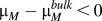 , upd on the seed-NP will take place. However, there may be many structures satisfying this condition. The question is: which one will be stable at each η, or in other words, which will be the coverage degree of the seed-NP for a redox couple fixing the overpotential at the value η > 0 ? Let us denote with
 the excess of free energy required to generate a core/shell structure made of a shell containing NM type M atoms, starting from the seed-NP made of
 atoms and the bulk material M. Thus,
 is given by:
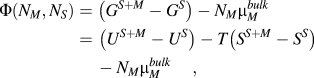
where GS+M is the free energy of the core/shell structure, GS is the free energy of the naked core and  is the chemical potential of the bulk material. U and S denote the corresponding energy and entropy contributions, and the volume changes have been neglected.Reference Oviedo, Leiva and Rojas37 The free energy change for the electrochemical generation of the core/shell NP is given by:

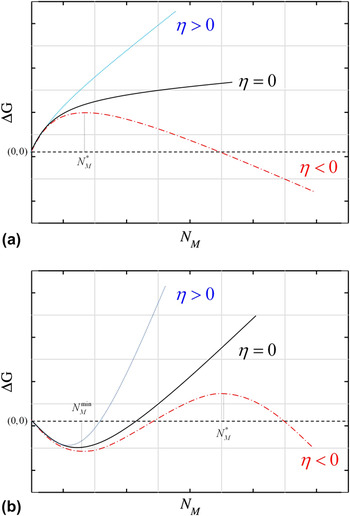
The detailed derivation of this equation may be followed in refs. Reference Campbell and Compton33,Reference Luque, Reinaudi, Serra and Leiva38. Figure 2 depicts the qualitative behavior of  as a function of the number of deposited atoms in the case of seed-NP systems that may present opd (a) and upd (b). In the case of opd, the behavior of
 is similar to that of the classical nucleation and growth phenomena. At zero or positive overpotentials (
 ), the curve shows a monotonic growth, indicating that the generation of the core/shell is not spontaneous. At negative overpotentials, the curve exhibits a maximum, corresponding to the critical nucleus size. Smaller core/shell will dissolve, while larger ones will evolve toward the bulk state. This type of curves is typically found when the deposited metal interacts with the seed-NP more weakly than with itself (M-M). The upd behavior, found in Fig. 2(b), corresponds to the case where the M-S interaction is stronger than the M-M one. A relatively strong M-S interaction may generate a minimum (eventually several minima) in the
 versus NM, indicating the occurrence of thermodynamically stable upd structures. This can be shown by taking the derivative of Eq. (4) with respect to
 , using the condition for an extremum, along with Eq. (3):

Qualitative scheme of the excess Gibbs energy  as a function of the number of atoms NM for the electrochemical formation of a core/shell nanostructure. (a) corresponds to a situation where the interaction of the deposited atoms with the substrate is weaker than the interaction with each other, (b) opposite case of (a).

Since  is nothing but the chemical potential of the M atoms in the seed-NP, μM, Eq. (5) leads to Eq. (2). At zero or positive overpotentials (
 ), the minimum found in the upd systems shown in [Fig. 2(b)] is a global one, corresponding to a thermodynamically stable state. However, if this minimum is deep enough it also may subsist at η < 0, yielding a metastable core/shell structure. At very negative overpotentials, η << 0, the system will be able to surmount the free energy barrier and will grow, evolving toward the bulk structure.
The situation of real seed-NP is more complex than the schematic representation of Fig. 2, especially in the case of upd systems. Early results based only on energetic considerationsReference Campbell and Compton33 showed a saw-tooth behavior, corresponding to the decoration of the different facets of the seed-NP, indicating that multiple states occur with very similar energies. These approximate results were obtained using a number of simplifications, like local energy minimization at 0 K, thus excluding vibrational and configurational entropic effects. The fine analysis that may be drawn from the previous work lack all the rich behavior provided by thermal and material equilibriums.
For improving this situation, we present here for the first time Grand Canonical Monte Carlo (GCMC) simulations of seed-NP decoration, where thermal equilibrium and particle number fluctuations naturally arise in the simulation. We also note that this ensemble naturally gives the sequence of formation of the core/shell under thermodynamic control.
III. CALCULATION METHOD
Grand canonical Monte Carlo simulations
The standard ensemble to simulate crystal growth is the Grand Canonical one, where the parameters fixed during the simulation are the volume of the simulation box (V), temperature (T), and the chemical potential (μ) of the atoms being deposited. Thus, we have performed extensive GCMC simulations to study the decoration of Au-seeds by Ag, using realistic semiempirical interatomic potentials. The seeds were shaped as truncated octahedra (TO) made of NS atoms, denotes as TONS.The interactions between atoms were calculated according to the embedded atom method (EAM),Reference Foiles, Baskes and Daw39 which is well known for reproducing the main characteristics of the metallic bond, due to the many-body character of the functional form. The Metropolis Monte Carlo algorithmReference Frenkel and Smit40 was used to sample the configuration space. The importance of sample scheme in our GCMC procedure, involves the following trial moves:
1. Atomic vibration
This is attempted within a small region, around the coordinate of the ith atom. The transition between the old (j) and the new configuration (k) is accepted with the probability:

where  is the potential energy change associated with the motion of the ith atom. These trial moves mimic the lattice vibration, as well as the self-diffusion processes.
2. Insertion (deposition) of an atom
An attempt is made to insert an atom at a random position on the surface of the NP. The new configuration is accepted with a probability:

where  and Vacc is an accessible volume where the particles are created,
 is the De Broglie wave length and
 the potential energy change due to the creation of an atom on the system. This trial moves mimic the deposition process.
 is chosen to satisfy the so-called detailed balance condition.
3. Elimination (desorption) of an atom
An atom is chosen at random and a removal attempt is accepted with probability:

where now  ,
 is the potential energy change due to the elimination of an atom on the system. This trial moves mimic the dissolution process.
For improving the efficiency of the GCMC algorithm, Vacc was not the whole volume of the system but a restricted portion of it, located in the neighborhood of the seed-NP. Therefore, Vacc is the accessible volume to create/delete particles, which is defined as  : where ns represent the total number of spheres of radius rs where atoms can be added/deleted for satisfying detailed balance. Attempts to trial move mimic the adsorption/dissolution process were only established for the metal M.
We consider here the particular case of the decoration of Au seed-NPs by Ag atoms. There are three main reasons for this choice. First, the upd deposition of Ag on Au has been thoroughly studied on single crystal faces, especially the case of Au(100) and Au(111)Reference Budevski, Staikov and Lorenz41–Reference Staikov43 which are the facets that more often occur in face-centered cubic (FCC) NPs.Reference Ferrando, Jellinek and Johnston44 Second, as we mentioned in the introduction, upd deposition of Ag on Au-NPs are considered responsible for stabilizing various surface facets that enclose NPs, thus providing the way to their shape control. Third, we can contrast the present simulations containing all contributions to the free energy of the system, with the first estimations made in our previous work.Reference Campbell and Compton33 All the results are reported as a function of the number of deposited Ag atoms. We made this choice because the definition of the coverage degree is somewhat arbitrary for nanoparticles. However the reader may easily refer the coverage to the number of surface atoms in TO shape by using the equations and table given in reference.Reference Oviedo, Mariscal and Leiva45
IV. RESULTS AND DISCUSSIONS
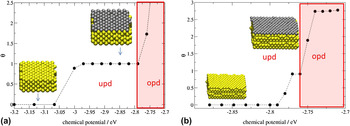
For the sake of comparison of the present results with those obtained for planar surfaces, sets of GCMC simulations were performed for the depositions of Ag on Au(100) and Au(111). The results for these simulations are shown in Fig. 3. It is found there that Ag deposition on Au(hkl) presents a very important underpotential shift, of 260 mV on the (100) face, and a small underpotential shift on the (111) face, of the order of 10 mV. In both cases the monolayers are filled very rapidly at room temperature, this reflects the strong attractive interaction between the metal particles. Comparison with electrochemical experimental data is not straightforward due to the existence of expanded phases, probably related to the interference of anions.Reference Chen, Vesecky and Gewirth46 However, it can be stated that in the case of the (100) pseudomorphic and quadratic phases are found below 200 mV, while in the (111) face the pseudomorphic phase is found at 60 mV, yielding a reasonable qualitative agreement.
Coverage degree (θ) of Ag atoms on Au infinite surfaces as a function of the chemical potential, μAg for Ag deposition on (a) Au(100) and (b) Au(111), according to Grand Canonical Monte Carlo simulations.

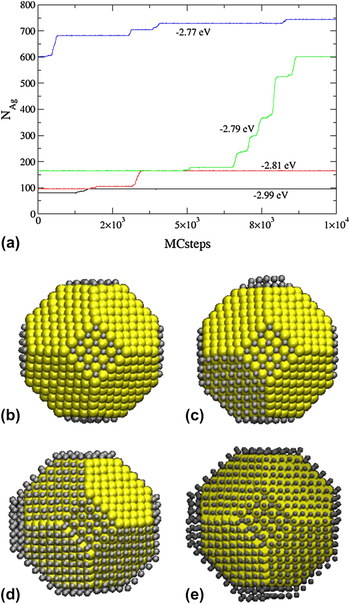
Figure 4 presents the results obtained from a GCMC simulation for the NPs system. We show therein the number of Ag atoms deposited on a TO1289 seed-NP as a function of the number of Monte Carlo steps (MC steps). Representative snapshots of these simulations, corresponding to the portions of the curves pointed by the arrows, are presented on the right of the Fig. 4. These results were obtained by stepping the chemical potential of Ag atoms, μAg, starting from a relatively large negative chemical potential (μAg = −3.50 eV), only the Au seed-NP is observed (curve not shown in the Fig. 4). Decoration of the (100)-facets starts at  , which is considerable more negative than the bulk Ag chemical potential,
 . Thus, in the electrochemical jargon, this would indicate the existence of upd on these facets, with an underpotential shift of 250 mV. Decoration of all (100)-facets is already complete at
 , which is the first chemical potential shown in the Fig. 4. Increase of μAg up to −2.81 eV leads to the further decoration of one of the (111)-facets, along with the occurrence of a bilayer on the (100)-facets. At
 , the onset of bulk Ag deposition, a number of steps occur in the NAg versus MC step curve, leading to a situation where only one of the (111)-facets remained free, while several of the (100)-facets showed a bilayer decoration. Going beyond the bulk deposition threshold by the application of μAg> −2.77 eV, leads to full coverage of all the facets and to multilayer growth, but the core/shell still subsists in a metastable state. Increase of μAg beyond −2.75 eV triggers Ag bulk deposition.
(a) Number of Ag atoms on a Au(TO1289) core as a function of the number of MC steps. (b) Atomic configurations taken at μAg = −2.99 eV, (c) −2.81 eV, (d) −2.79 eV and (e) −2.77 eV, respectively.

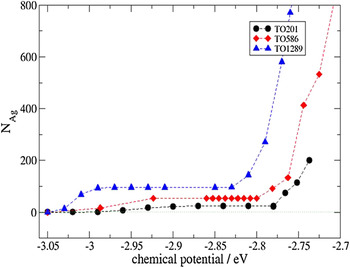
GCMC simulations similar to the previous ones were also performed on TO201 and TO586 seed-NPs, with the results shown in Fig. 5, where we plotted the number of deposited Ag atoms as a function of μAg. It is found that full decoration of the seed-NPs takes place at progressively more positive potentials as seed-NP size increases. This can be understood in terms of the fact that smaller NPs present smaller terraces, leading to a lower coordination of the deposited atoms, thus increasing their energy. Thus, a larger excess of chemical potential is required to get the same fractional coverage degree.
Number of deposited Ag atoms as a function of the chemical potential, μAg for the three Au core structures considered in this work.

Comparison of the results in Fig. 5 with those of Fig. 3 shows that the 1289 atoms seed-NP starts to exhibit features, which can be understood in terms of the planar surface. In fact, the decoration of the (100)-facets start to take place at μAg values similar to those of the (100) infinite surface. However, the decoration of the (111) facets of the TO1289 NP at  indicates that these facets have become covered at lower μAg than those one would expect from the observation of the (111) infinite surface in Fig. 3. In fact, it can be observed in this figure that Ag deposition on the Au(111) infinite surface starts around
 . This occurs because the decoration of (111)-facets of TO1289 is triggered by the presence of Ag atoms in their neighboring (100) ones. This effect was not observed in our previous modeling and represents an important improvement brought by the present computer simulations. These two effects, the shift of the decoration of the (100) and (111) facets in opposite directions is a typical “nano” effect, showing that the behavior of NPs with the present sizes cannot be straightforwardly predicted from the superposition of that of planar surfaces.
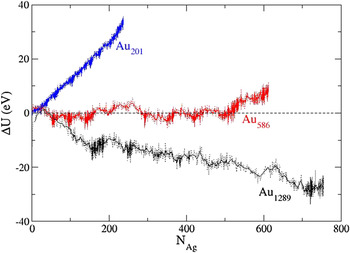
Another way to envisage the decreasing decoration of the NPs with decreasing size is to state that NPs with smaller curvature radius exhibit a higher energy, a feature that is described in the literature as curvature energy.Reference Fiolhais and Perdew47 For considering this effect, we define an energy excess, analogous to Eq. (3), as:

Equation (6) is useful for analyzing the energetic stability of the deposited atoms with respect to bulk material. A negative value of  indicates that the M atoms in the shell are more stable than the bulk material; while the opposite is true if
 is positive. According to this, seed-NPs size effects can be followed in Fig. 6, where we have plotted the
 as a function of the number of deposited Ag atoms. It can be seen there how the Ag deposited atoms are considerably less stable on the TO201 seed-NP than in the other seed, thus requiring a larger overpotential for their deposition. Deposition on the TO586 seed-NP leads to some particular structures that appear to be energetically more stable than bulk Ag, as denoted by the presence of some minima with
 on the
 versus
 curve. Finally, in the case of the TO1289 seed-NP, practically all simulated structures show lower energies than that corresponding to the bulk Ag material.
Excess energy  as a function of the number of deposited Ag atoms for the three Au seed nanoparticles considered in this work.

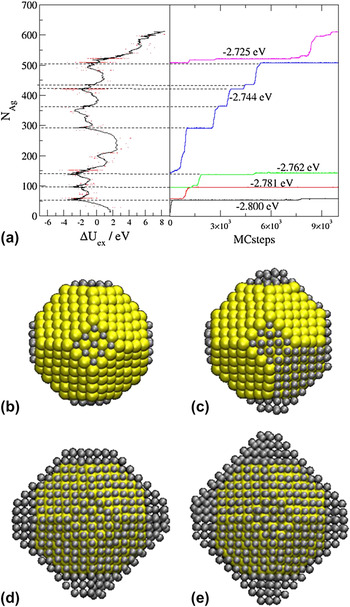
Although the stability of the different structures is properly determined by the  function defined in Eq. (4), excess energy curves may be useful to identify metastable structures, even when they have a transient existence, as shown in Fig. 7.
(a) Correlation between average excess energy  and the arrests found in GCMC simulations. Left: Excess energy (horizontal axis) versus the number of deposited Ag atoms (vertical axis). Right: number of deposited Ag atoms versus number of GCMC steps for the deposition of Ag atoms on Au TO586. Follow the horizontal broken lines to note how the arrests in the NAg versus MCsteps curves correlate with the occurrence of minima in the energy excess versus NAg curves. (b) Atomic configurations taken at μAg = −2.880 eV, (c) −2.762 eV (d) −2.744 eV and (e) −2.725 eV respectively.

Following the horizontal broken lines, we can clearly see in Fig. 7 how local minima in the  –
 profile correlate with the occurrence of arrests in the
 curve along the GCMC simulation. We point out this fact, because some of these structures could be frozen in a dynamic experiment, leading to an interesting manifold of decorations.
Figure 7 together with the relations shown in Eq. (4), is helpful in understanding the rich behavior that may be found in these systems. The existence of multiple minima in the excess function  leads to the possibility of allowing the transitions between different structures just by applying small changes in the overpotential η. In the case of the present system, the flatness of
 may make it difficult to get a single type of structures, although some of them appear to be quite robust. Among them, a particularly stable one appears to be the Ag decoration of the (100)-facets of the Au-seed, since this is the first minimum –for increasing NM—in the excess energy curves, with the prediction of an underpotential shift as large as 250 mV. These results support the hypothesis put forward by JanaReference Jana, Gearheart and Murphy14 and PersonickReference Personick, Langille, Zhang and Mirkin26 concerning the stabilization of more open surface facets by Ag upd, leading to different Au nanostructures.
V. CONCLUSIONS
We have discussed the decoration of metal nanoparticles acting as a seed, by a foreign metal under equilibrium conditions using a redox couple. Similarities and differences with respect to the underpotential deposition on planar surfaces were analyzed. The main point to be stressed is that potential control via a redox couple introduces a change in the inner potential of the solution. The direct relationship between chemical potential and overpotential remains valid if the overpotential is measured with respect to a solution where the metal ions are at the same electrochemical potential (but not at the same activity). We have presented for the first time Grand Canonical Monte Carlo simulations describing the decoration of Au-seed of different sizes by Ag atoms that may be extended to similar systems. It is found that depending on seed size, nanoparticle decoration may be expected to be stable or unstable. This system seems to be particularly relevant due to its practical application in nanoparticle shape control. There are two striking features of these systems that bear relevance for practical applications. One of them is that the more open facets are the first being decorated, from an energetic viewpoint. Thus, if the electric potential of the system is set to a value that is high enough to selectively cover this face but not the others, selective growth along the other directions may be achieved. The other is the fact that the so-called underpotential effect (metal deposition at higher potentials than the reversible one) becomes progressively lost for smaller nanoparticles. This effect could be interpreted in thermodynamic terms of the concept of line tension. Smaller nanoparticles present an increasing relative contribution of this positive quantity due to the increasing relative weight of edges with respect to the facets. Thus, selective growth may become problematic for very small particle sizes due to border effects.
ACKNOWLEDGMENT
The authors wish to acknowledge CONICET PIP: 112-200801-000983, Secyt UNC, Program BID (PICT 2007 N1 00340, PICT 2006 N 946, PICT-BICENTENARIO-2010-123, and PME: 2006-01581 for financial support.
APPENDIX A
The duality of the driving force leading to the decoration of NPs by M adatoms can also be clarified by writing the chemical potential of the atoms being deposited, say μM, in terms of the electrochemical potentials of ion cores  and the electrochemical potential of electrons
 , which are the constituents of the system controlling the adatom coverage:

where IZ is the energy required to split the M atom into the ion core Mz+ and its z electrons.
The physical meaning of Eq. (A1) is straightforward: the free energy change obtained when bringing an atom from infinity up to the NP is equal to the free energy change of the following process:
i. split the M atom into a core ion Mz+ and z electrons.
ii. take the core ion from infinity to the NP.
iii. take the z electrons from infinity to the NP.
Since the metal ions Mz+ are free to move across the solution/nanoparticle interface,  is equal to the electrochemical potential of the ions in the bulk of the solution. The second term on the rhs of Eq. (A1) can thus be written as:

where  is the standard chemical potential of the Mz+ ions and
 is the electrostatic potential in the bulk of the solution.
On the other hand, if we consider the electrochemical potential of the electrons in the NP we have:

where  is the chemical potential of the electrons in the NP and
 is the value of the average electrostatic potential in it. If equilibrium is established between the electrons in the redox couple and those in the NP,
 will be equal to the electrochemical potential of the electrons in the redox system, say
 .
Since the initial activity of metal atoms on the NPs is zero, some of them will be electrodeposited on the NPs, increasing the coverage degree of M until Eq. (2) is satisfied. This equation states that the chemical potential of the atoms on the NP contains the sum of the electrochemical potential of the Mz+ ions in the solution plus the electrochemical potential of the electrons in the redox couple. This process may yield a core/shell structure as shown on the right of Fig. 1. We write “may yield” because the driving force provided by the redox couple and the ions in solution may also lead to a bulk deposit of the metal on the NP.
Replacement of Eq. (A3) and (A2) into (A1) yields:

This equation now clarifies the dual driving force addressed to above: the fourth term on the rhs is that represented by the ion activity, and the fifth term on the rhs is that produced due to the redox couple. Sometimes it is useful to refer μM to the chemical potential of the metal atoms in the bulk, say  . With this purpose, let us think of a piece of bulk metal M immersed in a solution, in contact and at equilibrium with Mz+ ions at the same electrochemical potential as before. Let us denote with
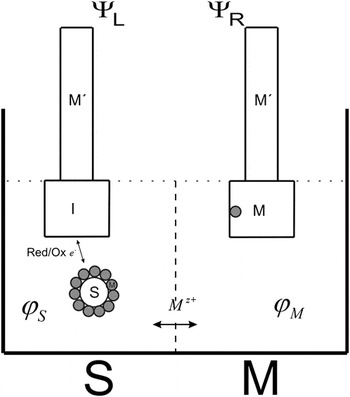
 the potential difference across the bulk metal M/solution interface. An experimental arrangement for potential measurement in this system is shown in Fig. A1. On the left, we see an inert electrode (I) in contact with the Red/Ox couple, on the right we find a piece of the metal M. Both electrodes are connected to a potentiometric device by two pieces of a metal
 . The membrane separating both compartments is assumed to be permeable to the Mz+ ions but not to the Red/Ox components. Thus, the equality of electrochemical potentials of Mz+ ions in both compartments is granted, so we have:

Scheme of an experimental arrangement for the measurement of underpotential shifts of free nanoparticles. The nanoparticles are made of the metal S, being decorated with the metal M. The electrode I should allow reversible electronic exchange with the Red/Ox system, and should not undergo underpotential deposition of M on it.

We have for chemical potential of the bulk electrode material M the analogous to Eq. (A4):
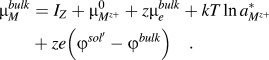
Note that  may be slightly different from a M z+ due to the fact that the inner electrostatic potential of the solution phase may be affected by the presence of the redox couple.
Thus, subtracting Eq. (A6) from Eq. (A5) we get:

where to simplify the previous equation, we have used the equality of chemical potentials of MZ+ ions previously stated. While  and
 cannot be measured directly, we will now show that their difference can be measured. The electrons in the NPs on the left are in equilibrium with the redox couple, which is in turn in equilibrium with all the metals on the left, leading to the equality:

where  is the chemical potential of electrons in the metal
 and
 is the external potential of the electrode on the left.
For their part, for the electrons on the right electrode it is equivalent to:

where  is the external potential of the electrode on the right. Thus, replacement of Eqs. (A8) and (A9) for (A7) yields:
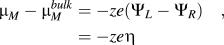
where we denoted as overpotential the potential measured in a system where the ions being electrodeposited are at the same electrochemical potential as those in equilibrium with the bulk reference material. Eq. (A10) is formally identical to that derived for metal upd, showing that the difference of chemical potentials between and adsorbate and its bulk material may be obtained from a potential measurement. However, there is a nontrivial subtlety, generated by the presence of the redox couple: in the case of upd on planar surfaces, Eq. (A10) is valid if the measurement is made with the same activity of the Mz+ ions in both solutions, namely, upd electrode and bulk solutions. On the other hand, in the case of NP decoration, where the potential is determined by a redox system, Eq. (A10) is valid only if the Mz+ ions are present at the same electrochemical potential in both half-cells, a more general condition that may involve different activities of the Mz+ ions.