Union soldiers during the Civil War found themselves entering not only into armed conflict with Confederates, but unknowingly into a cultural contest with other Unionists. The visual narrative and depiction of the war were at the core of this latter struggle, which historians have neglected. This article examines dissimilar depictions created by two Union soldier-artists of one battle, Stones River (December 1862–January 1863). The two subjects considered are musician Alfred Mathews of the 31st Ohio Infantry and Captain Adolph Metzner of the 32nd Indiana Infantry. Soldiers created war art within the context of a prevailing “heroic-war” narrative which William F. Thompson identifies in his examination of the Civil War illustrated press. Mainstream image makers emphasized the war as a just and moral crusade, whilst trumpeting the superiority of the Union citizen soldier and the inferiority of the morally degenerate Rebels.Footnote 1 They relied on sanitized depictions of war and represented battlefield deaths as heroic spectacles. But, as idealized imaginings of war clashed with lived reality, a number of soldier-artists rejected these propagandistic depictions by producing their own representations which focussed on the war's violence and tedium. Thus advocates of the idealized narrative contested the war's representation with their critics. I will analyze their images comparatively to illustrate how heroic-war conventions limited the soldier-artist's ability to depict battle, whilst showing that others were able to break “almost entirely with the accepted conventions” and create a new visual “language and vocabulary with which to engage the complexities of historical ‘truth.’”Footnote 2 I will challenge the soldier-artist's previously peripheral status in Civil War histories by emphasizing his work not merely as an illustration of the written record, nor necessarily as a continued promotion of “heroic war,” but as complex, nuanced representations in their own right. Soldier-artist's images offer a new understanding of Civil War martial cultures and highlight the innovative means they employed to record and manage their wartime experiences.
This article contributes to the ongoing debate over the Civil War as an “unresolvable representational crisis” by urging the consideration of soldiers’ war art.Footnote 3 Historians Steven Conn and Andrew Walker argue that no Civil War painting “has attained any kind of iconic national status” due to the fact that antebellum artistic conventions, which heroic-war imagery rested on, were “incapable of representing the tremendous impact the Civil War wrought.”Footnote 4 Whilst Mathews's lithograph illustrates the difficulties that those beholden to artistic convention faced, Metzner created striking images of war through his rejection and manipulation of popular stylistic strategies. The German-born soldier-artist was one of a small but significant number to recognize that a “newly mechanized and impersonal form of warfare left symbolic languages of heroic struggle and patriotic commemoration untenable.”Footnote 5 Both were devoted volunteers, but they clashed over the war's visual representation. Whilst Mathews's image celebrated a military gain through a propagandistic lens, Metzner represented the same engagement by examining its toll with a focus on Confederate casualties. As they weighed the war's costs and gains, Mathews idealized the contest in a way conducive to the war effort whilst Metzner confronted the internal strife suffered by soldiers as they attempted to reconcile the war's suffering and their part within it. The Union Image contains a short examination of Mathews's lithograph and concludes that it was more accurate than other popular prints, but I will demonstrate that heroic-war conventions still limited Mathews's ability to depict the battle.Footnote 6 This study employs these pictures not only because they are conspicuous examples of soldiers’ alignment with and rejection of the heroic-war narrative, but also because they offer a unique opportunity to examine two dissimilar pictures of one specific event. Though one commonly finds a multitude of written accounts concerning one particular engagement, it is more difficult in the pictorial record. By considering soldiers as contributors to the visual archive of the war, I will challenge Lucretia Hoover Giese's observation that “artists felt little responsibility to depict the conflict” by widening her scope to the grassroots level.Footnote 7 Sarah Burns's study of David Gilmour Blythe notes that it was “impossible to produce images to elevate the meaning of a conflict whose meaning (and outcome) remained unclear.”Footnote 8 My comparative analysis affirms this: Mathews's transformation of a grisly stalemate into a propagandistic depiction of a sweeping Union victory stands in stark contrast to Metzner's ambiguous representation of war's universal suffering.
Scholars recognize professionals whose artwork was an exception to the heroic-war narrative. Blythe and Winslow Homer stand as the notable examples, but belonged to the professional class of artists. I urge the consideration of soldier-artists to demonstrate that the shift in visual arts was not just the work of a few avant-garde specialists, but that a host of ordinary Americans contributed to its emergence. There was not only a pictorial shift, but a literary one too. Ambrose Bierce was the most significant American writer to fight in the war, though he did not begin to publish his war stories, “often cited as the beginnings of modern war literature,” until the 1880s. In private correspondence and in diary entries, many soldiers wrote viscerally of the war's destruction as it happened, but many more acknowledged that their experiences were incommunicable.Footnote 9 In visual culture, Metzner's war art illustrates that it was not only image makers like Blythe whose “dark vision” allowed him to grapple immediately and “seriously with the war's magnitude, tragedy, and horror in memorable pictorial language.”Footnote 10 Scholars should consider soldier-artists like Metzner alongside professionals such as Homer, for they too understood that the themes of “ambiguity, ambivalence, and even irony” were key to the war's depiction.Footnote 11 Unsurprisingly, soldier-artists made their comrades and enemies their most frequent subjects, foreshadowing Homer's efforts to restore “compassion for combatants” by neglecting battlefield narratives and individual heroics to focus instead on the common soldier.Footnote 12 But, as I will demonstrate, the complexity of the soldier-artists as a group rejects such a simple affiliation with professional artists. Homer's artistic transition owed much to his embeddedness within the troops. But soldier art was borne from their experiences of directly engaging in military service (rather than spectating, albeit closely, like Homer).Footnote 13 A multitude of variables, including intended audience and censorship, further necessitate that scholars draw distinctions between the civilian sketch artist and the soldier-artist.
If studies of imagery seldom attend to the common soldier, soldier studies rarely acknowledge the significance of visual culture. I will demonstrate that ordinary soldiers’ war art stands as an essential, but largely neglected, historical source alongside the written record. I argue that the democratization of pictorial culture in the antebellum era ensured visual literacy amongst the Union soldiery. James M. McPherson identifies the unique juncture at which the Civil War occurred: literacy rates were at their highest whilst official martial censorship only operated in the confines of prisoner-of-war camps. Consequently, he argues, the written record permits the historian “to peer farther into the minds and souls of Civil War soldiers than those of any other war.”Footnote 14 McPherson is undoubtedly correct, but I will elevate soldiers’ art to its deserved position in soldier studies by contending that the images’ use as illustrations and supplements to written records has “robbed them of the power they once held to provoke responses from their viewers.”Footnote 15 The few scholars who recognize the value of analyzing soldiers’ war art too often consider the individual's images in isolation, an issue that this article will rectify. Robert E. Bonner includes an examination of soldiers’ art in The Soldier's Pen and received recognition for revealing “new angles of vision, literally, on what ordinary soldiers experienced.”Footnote 16 Bonner does not locate these soldiers’ creative activities within a broader tradition of nineteenth-century visual culture. Earl J. Hess notes that soldiers “quickly rejected the more unrealistic images of combat … History books, pictures from the illustrated newspapers, and poetic descriptions of combat paled in comparison to the unadorned reality of what they saw in their first engagements.”Footnote 17 Some civilians responded similarly. After witnessing the aftermath of the Battle of Antietam (17 September 1862) whilst searching for his wounded son and viewing Alexander Gardner's “The Dead of Antietam” photographs, Oliver Wendell Holmes Sr. noted that whilst many “fanciful portraits” of battles existed, he had gained “some conception of what a repulsive, brutal, sickening, hideous thing” war was.Footnote 18 Though unquestionably traumatized, Holmes himself denied a full conception of war's suffering.Footnote 19 My comparative analysis will emphasize the diversity of soldier art as it reveals how Mathews clung to the tenets of the heroic-war tradition whilst Metzner rejected it in favor of a new pictorial language. As both attempted to depict the battle experience with distinct stylistic strategies, they contributed to two competing cultures of war. To successfully trace these dissimilarities it is necessary to marry the two Civil War subfields of soldier studies and art history.
Michael L. Wilson notes the failure of historians to engage with visual culture, arguing for a greater knowledge of how the visual has functioned in past societies.Footnote 20 Broadly, this article employs an ocularcentric approach whilst acknowledging the influence of the full sensory experience. The current trend amongst historians working with sensory history is to elevate nonvisual sensory phenomena, and scholars have reached a consensus that the print revolution and the Enlightenment did not empower vision as much as has been assumed.Footnote 21 Mark M. Smith has ably demonstrated that the tendency to denigrate the nonvisual undermines the historiography of the Civil War, but a study of soldiers’ war art (visual records borne from bearing witness to lived experiences) necessitates a primary focus on optics.Footnote 22 Though many soldiers frequently conceded that the sights, sounds, smells, tastes, and touches of war were indescribable, they ultimately employed visual culture as an effective medium with which to convey their experience of the conflict. A Harper's New Monthly Magazine article held that the senses were “powerful agents in life” that acted as “our perpetual bodyguards.” The author noted that the eyes “should not be injured by resting on a vulgar confusion of colors, or clumsy, ill-proportioned forms,” and that “each sense should be preserved in its purity.”Footnote 23 Mathews's war art demonstrates that some soldiers could fortify antebellum sensory notions through the promotion of the heroic-war narrative, whilst Metzner's reveals how others employed impure sensory experiences resulting from war in their depictions. Metzner makes no attempt to sanitize the battle experience. His representation of wounded soldiers alludes to olfaction, tactition, and audition, drawing upon the constellation of the senses, but vision remains dominant as the primary mode of recording the combat experience. The war art of Mathews and Metzner exhibits the complexity and variety of the Union soldier's wartime creativity. Moreover, though soldiers founded both their pictorial and written records of the war on what they observed firsthand, by focussing on the neglected pictorial archive I will establish new avenues of inquiry with which to better understand the Union soldier's martial culture.
Alfred E. Mathews was born in Bristol, England in 1831. His family emigrated to the US two years after his birth, and he learned his first occupation, typesetting, whilst working for the Ohio Democrat in New Philadelphia, Ohio.Footnote 24 He made a living as an itinerant landscape delineator and bookseller before the war. Letters sent by Mathews during this period present him as an “artist in feeling; [who] liked to travel … he was observant and shrewd.”Footnote 25 The close of 1860 found Mathews teaching in Tuscaloosa County, Alabama, as the state prepared to leave the Union. When a local militia official informed him that it was his duty to assist in “defending the rights of the South,” he chose instead to take a walk, and “kept on walking until [he] got out of the State.” Mathews was a Union man, and on reaching the Free States, he opined that a “reign of terror” operated in the South: “slavery is a power that controls all – is feared by all; and men can and do commit deeds of outrage and violence in the name of slavery with impunity.”Footnote 26 Mathews entered US service as a musician in the 31st Ohio Infantry Regiment until he took on “extra duty” as the regimental artist.Footnote 27 He was ambitious, submitting two sketches to Harper's Weekly during his first year of service that were subsequently published in its 23 November 1861 edition. One depicts his camp's headquarters and the other illustrates the 31st Ohio fording the Kentucky river at Boone's Knob. A surgeon in the 16th Ohio Infantry recorded meeting the soldier-artist, and wrote of his pictures, “They are all good. His lithograph view of ‘Boon's Knob’ where the turnpike crosses the Kentucky River, is very beautiful and true. He has his drawings lithographed in Cincinnati.”Footnote 28 There was a consensus that Mathews's work depicted his subjects realistically. Even General Ulysses S. Grant commended Mathews, writing in 1863 that his views of the Siege of Vicksburg were “the most accurate and true to life I have ever seen. They reflect great credit upon you as a delineator of landscape views.”Footnote 29 Mathews's wartime catalogue does not exhibit any significant change in his artistic style. He neglected camp scenes and pictorial studies of the common soldier. As Robert Taft observes, Mathews's “sense of perspective and proportion was none too good … his human figures are all too frequently stiff and formal.”Footnote 30 Instead, he favored extensive depictions of battles, marches, and parades in which he could use his skills in landscape representation to his advantage. His final war art project was a panoramic series depicting significant events in the western theatre. According to an undated newspaper clipping from Steubenville, Ohio, the panorama (which was on display in 1864 and early in 1865), was well received by veterans, “who were in many of the battles represented.”Footnote 31 Mathews's biographical fragments establish him as Unionist and enemy of slavery, and as an itinerant individual driven by a love of nature. Though his lithographs were undoubtedly well received, his talents evidently drew him away from studies of ordinary soldiers in favor of comprehensive depictions of grand events. As any privilege resulting from his position in the regiment is unknown, it is unknown whether Mathews distanced himself from the rank and file.
Adolph Metzner was born in Lorrach along the Wiese river in Baden-Württemberg, Germany in 1834. He earned a degree in prescription pharmacy at the University of Freiburg.Footnote 32 Unlike many notable German-born soldiers in the Civil War, the failure of the 1848 revolutions did not urge him to the US. He emigrated later, in 1856, and established a pharmacy with another German migrant in Louisville, Kentucky. When the war broke out in April 1861, Metzner did not immediately join the Union Army but enlisted in the 32nd Indiana Infantry Regiment four months later. Though few textual records relating to Metzner remain, we might infer that his motives for serving centered more on a desire to prove himself worthy of US citizenship than on viewing the Civil War as an extension of the mission for unity, justice, and freedom begun in Europe over a decade earlier with the 1848 revolutions. Metzner was fourteen during the latter period. His opinions are unknown, making it unclear if a liberal perspective harried him to the US eight years later. Regardless, he was a devoted soldier. He completed his term of service, despite receiving a bullet wound to his right leg at the Battle of Chickamauga in 1863. Though he must have painted for pleasure before the war, he apparently held no formal graphic occupation until his assignation as a topographical engineer in the Army of the Cumberland's Second Division after the Battle of Stones River.Footnote 33
Metzner's artwork was initially characterized by a comical outlook, quite in line with the positive outlook carried by callow soldiers in the early war period; depicting screaming officers, marches without purpose, camp comedians, and lounging enlisted men. However, following the loss of comrades at the Battle of Rowlett's Station in December 1861, his war art took a dark turn.Footnote 34 By the Battle of Shiloh in April 1862, where William G. Mank, a comrade of Metzner's, noted that the regiment “slept on the battlefield that night among the dead and wounded,” the elements of comedy notable in his early works had disappeared.Footnote 35 In several striking mid-war illustrations Metzner depicted Confederate soldiers as mutilated ghouls. By the war's end, death was a common element in his artwork, common enough that the soldiers in his depictions coolly smoke pipes as bullets ricochet about them.Footnote 36 Metzner's artworks are private reflections of his war experience: he never exhibited them to the public or attempted to profit from them, though it is probable that he shared his caricatures with his comrades in the early war period. Unlike Mathews, Metzner was comfortable creating close studies of the human form, which his medical training likely facilitated. A shared experience at Stones River would unite the two soldier-artists as they attempted to depict their involvement in the battle. But as I will demonstrate, their dissimilar backgrounds and perspectives equated to wildly different depictions of that day's combat. In visually recording the Union charge on the evening of 2 January and its aftermath, they exhibited the ranging creative spectrum along which soldier-artists positioned themselves with their depictions of the war.
Between 31 December 1862 and 2 January 1863, Union Major General William S. Rosecrans's Army of the Cumberland challenged Confederate General Braxton Bragg's Army of Tennessee at the Battle of Stones River in middle Tennessee. In short, both armies attempted to strike at each other's right flanks, but the Confederates struck first at dawn on 31 December. Repeated charges and stubborn resistance characterized much of the fighting, and Stones River was the deadliest battle of the war in proportion to numbers engaged. The result was technically a victory for Rosecrans, but the Confederates so crippled his army that it could not resume offensive operations for several months.Footnote 37 Though the battle's tactical result was ambiguous, its strategic repercussions had far-reaching consequences. The Confederacy effectively lost Tennessee and “some ten thousand irreplaceable veterans,” whilst its principal western army's high command was left divided. The Union's close victory added weight to President Abraham Lincoln's 1 January 1863 Emancipation Proclamation, provided a much-needed success following the recent disaster at the Battle of Fredericksburg, and reduced the potential for British and French recognition of the Confederacy.Footnote 38 For Metzner and Mathews, the most prominent day of the fighting came on 2 January. A Confederate attack routed a Union division occupying a hill east of Stones River, but the former's gains left them exposed to enfilading fire from fifty-eight pieces of Federal artillery. Union infantry later made a counterattack, in which Metzner participated and Mathews spectated. The Union soldiers swept the Confederates from the hill and, twinned with the bombardment, slaughtered 1,500 Rebels in one hour. One of Metzner's comrades, writing for the Louisville Anzeiger, noted that the Federals dealt the enemy a “murderous fire” as “our cannon played delightful music.” As night fell, the German regiment charged once more on another enemy position, forcing the Confederates to retreat. They left their dead and wounded behind.Footnote 39 Mathew's depiction illustrates a portion of the Federal charge carried out by his brigade; Metzner's image, though not fully identified, likely depicts Confederate casualties resulting from the Union cannonade and the first charge, or from the 32nd Indiana's second assault later that evening.
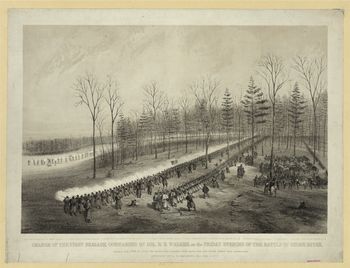
Mathews's depiction exists today as a lithograph with the weighty title of Charge of the First Brigade, Commanded by Col. M. B. Walker, on the Friday Evening of the Battle of Stones River, January 2nd, 1863; in Which the Rebels Were Repulsed with Heavy Loss, and Driven behind Their Breastworks (Figure 1). That Mathews's image is a lithographic print is vital. Though by no means a professional artist, he supplied his images to Middleton, Strobridge, & Co. of Cincinnati, Ohio, a lithographing and engraving firm that would convert them for commercial sale.Footnote 40 His artwork, conforming to the heroic-war conventions, naturally lent itself to reproduction through lithographing. The Cincinnati engravers reproduced Mathews's initial draft in a “small folio” size (50.1 × 66.7 cm). The dimensions of the image correspond to its intended use: consumers generally displayed images of a similar format on interior walls for “intimate, domestic viewing.”Footnote 41 Its intended placement meant that engravers censored negative aspects of images in order to make them more palatable for civilian consumers.Footnote 42 Without a copy of Mathews's first draft, it is difficult to ascertain the extent to which printmakers manipulated his image. But a recent unearthing of a Homer sketch, Berdan Sharp Shooters (1862), illustrates how printmakers might disregard an artist's original sketch. Homer's submitted picture showed a bullet striking a Union soldier in the head, but in the vignette published by Harper's, the soldier had undergone a resurrection and was very much alive. As Lucretia Giese and Roy Perkinson note, the image was “domesticated, in effect.”Footnote 43 The same was true for countless published pictures during the Civil War. Mathews's panoramic perspective denied close studies of violence, but it is possible that Union dead and references to the confusion of battle may have been present in his original sketch. It is unlikely though. Soldiers were aware of the role of images in shaping public sentiment, and the citizenry's continued support relied on the image makers’ ability to deflect war-weariness by creating war-positive images.Footnote 44
Alfred Edward Mathews and Middleton, Strobridge, & Co., Charge of the First Brigade, Commanded by Col. M. B. Walker, on the Friday Evening of the Battle of Stones River, January 2nd, 1863; in Which the Rebels Were Repulsed with Heavy Loss, and Driven behind Their Breastworks, lithograph, 1863, LC-DIG-pga-02197, Prints and Photographs Division, Library of Congress.

Furthermore, the reliability with which the printmakers reproduced the original sketches depended entirely on their expertise. Intended messages could be unintentionally undermined by poor printmakers. Thompson notes that even the prints featured in prominent newspapers such as Harper's and Frank Leslie's at times suffered at the hands of abominably bad engravers and goes as far to suggest that “without exception” their alterations failed to improve the original sketches.Footnote 45 Though no record exists of Mathews's engagement with his wartime lithographers, a postbellum letter regarding the production of a geological chart identifies his exasperation with their interventions. He noted that the images “were all spoiled by the lithographers … Lithographers seem quite free to make promises, but do not fulfil them. I shall do all my work myself, as then I cannot lose … they do not print them well.”Footnote 46 Mathews undoubtedly faced similar frustrations with Middleton, Strobridge, & Co. But as he had published several images with the firm in 1862 and continued to employ them at least into mid-1863, he found their faults forgivable. Regardless, Mathews's interactions with engravers complicate the authorship of his pictures. Engraving companies could easily stifle artists, whether it be their stylistic techniques or their wartime subject matter. But Mathews's biographical information and pictorial catalogue do not suggest that he subscribed to any artistic avant-garde: he held a similar artistic perspective to his lithographers, and they evidently saw commercial value in his works.
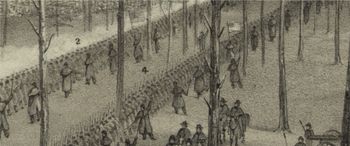
Mathews's lithograph presents the spectator with a panoramic battle view that combines the features of both the popularized wilderness aesthetic of American landscape views and those of traditional European history painting.Footnote 47 It is, in effect, a wilderness scene populated with martial figures, and one that taps into the popular stylizations of conventional, commercialized imagery. But Mathews's aptitude in depicting landscapes truthfully does not indicate an ability to effectively represent the battle experience. Mathews's contemporaries recognized his creative prowess, but the competing and emergent mode of artistic realism practiced by soldier-artists such as Metzner highlights the limitations of Mathews's method. Mathews faced a similar challenge to professional artists attempting to depict the war. Landscape painters, particularly those of the Hudson river school, who had visualized the ideologies of national identity by looking west, found their methods incapable of representing the internal crisis unfolding in the East.Footnote 48 But through landscape representations, the professionals could “express human emotions metaphorically … convey[ing] the intensity of emotion usually reserved for the human narrative.”Footnote 49 Here, Mathews fails. There is no storm gathering above the view, and gently rolling terrain implies tameness. Specifically, Mathews's use of gently curving horizontal lines to delineate the ground emphasizes calm. Tree stumps and a few severed tree limbs are noticeable in the woods as the only obvious indicators of the damage to the landscape caused by the engagement. In the foreground the skeletal nature of the deciduous trees alludes to death, but such subtle references would not resonate with all viewers. Their foremost use is didactic: they place the battle in its wintry context. Regardless, the verticality of the trees overwhelms these scattered references to destruction by offering an overall sense of stability: it is no coincidence that their uprightness parallels the posture of the Union soldiers.
Detail of Charge of the First Brigade revealing poor depiction of distant soldiers (compared to the officers and file-closers at the rear, particularly in terms of proportion). Note also how the soldiers pass easily through the trees without breaking ranks.

Charge of the First Brigade, details showing tree stumps, broken tree limbs, branches, etc.

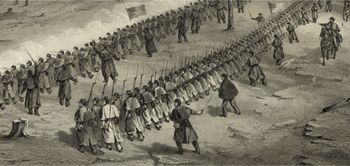
As the brigade charges, every foot steps forward at the same time and every soldier levels his rifle in a uniform position. Those in the rear regiment, notable by their annotation as the 82nd Indiana Infantry Regiment, carry their weapons in an upright position so that they are perpendicular to the woods.Footnote 50 Taken together, they suggest an aura of stability and discipline on the right side of the image. Mathews's employment of a diagonal arrangement for the brigade accentuates its sweeping charge towards the Confederate line. Linear warfare, as experienced in the Civil War, was rarely so efficient. The landscape of the majority of battlefields was characteristically rolling and rugged, often denying regiments visibility and cohesion.Footnote 51 The soldiers’ martial efficiency is incompatible with the terrain they cross, and the historian Larry J. Daniel notes in his study of the battle that Brigadier General James S. Negley's Second Division, of which the First Brigade depicted in Mathews's lithograph was a regiment, was badly intermingled in the “large, if not somewhat disjoined, counterattack.”Footnote 52 Union soldiers testified that the picture makers exaggerated their abilities. Colonel Walker, commander of the First Brigade, had his soldiers lie upon the ground to reload. This feature was ignored by Mathews for it “did not fit the heroic conventions of battle art” for the advancing Union troops.Footnote 53 A Pennsylvanian soldier noted that during his four years’ service he had only witnessed one assault “that was like the pictures in the newspapers.”Footnote 54 Furthermore, this distant, panoramic perspective, though useful for providing an overview of the terrain and making a comprehensive statement regarding the effective discipline of the Union forces, ultimately denies the observer any opportunity to relate to the soldiers’ perception of the fighting. Mathews reduces these vital participants, including his own regiment, to miniature figures in a homogeneous mass. He emphasizes the Union collective rather than the individual soldier. It is a marked departure from the majority of soldier-artists’ wartime work, which are notable for their efforts at self-representation and for offering a sympathetic view into the minutiae of the soldier's life and routine.Footnote 55 Although this technique distances the image from the heroic-war tradition's emphasis on individual combat between martial notables, Mathews's depiction renders his ordinary comrades unidentifiable and instead affirms the superiority of the army as a whole.
But his superiors receive recognition. Mathews's focus on the officer class (achieved through captioning) and the centrality of the flags further the lithograph's alignment with heroic-war traditions. W. J. T. Mitchell recognizes the proliferation of imagetexts, “composite synthetic works … that combine image and text,” during the war.Footnote 56 Captioning was a popular means of contextualization, and one that, alongside the testimonial, artists employed to prove the authenticity of their images. However, this method cements Mathews's lithograph as a didactic overview of the action on 2 January.Footnote 57 In attempting to authenticate the image with instructive captions Mathews’ fails to recognize ordinary soldiers. Instead, he reduces them to minute participants who only bear significance when considered as components of their designated regiment. The only notable individuals are the officers: the first annotation allows one to identify the left-most regiment as the 31st Regiment of Ohio Volunteers, “Lieut. Col. F. W. Lister, Command'g,” whilst the fifth recognizes “Col. M. B. Walker, and Staff,” who oversaw the brigade's charge.Footnote 58 But even the representation of the officers is flawed. The officer leading the charge of the secondary regiment, pictured at center right with his sword drawn, was not a common sight. Such occurrences were so rare following the early war period that its inclusion would invite criticism from veterans. Reverend A. M. Stewart, chaplain of the 102nd Pennsylvania Volunteers, noted following the Battle of Fredericksburg in December 1862 that pictures “of officers with drawn swords riding before their men into battle” led soldiers to “shout out with mocking irony; all played out.”Footnote 59 Mathews's officers are minute figures, but his captioning allows spectators to identify particular officers based on their unit's position. Furthermore, the image centralizes two US flags. The flag borne by the leading regiment rises triumphantly from the smoke before the engagement has started. Though regulations dictated that the national and regimental flags be carried at the center and head of regiments, soldiers soon learned that flags, as a result of their visibility, did much to draw fire from the enemy. It was not unheard for every member of a ten-strong color guard to be shot down before a battle was over.Footnote 60 The centrality of the flags and the invincibility of their bearers is more reminiscent of the idealized lithographs of the US–Mexican War.Footnote 61 Whilst the distant nature of that earlier conflict invited a more imaginative depiction by artists, the Civil War's immediacy to the population quickly revealed such images as fictitious.
Charge of the First Brigade, details of Union soldiers firing and marching with almost robotic precision. Note that the officers and file-closers at the rear are the only figures permitted individualized postures.

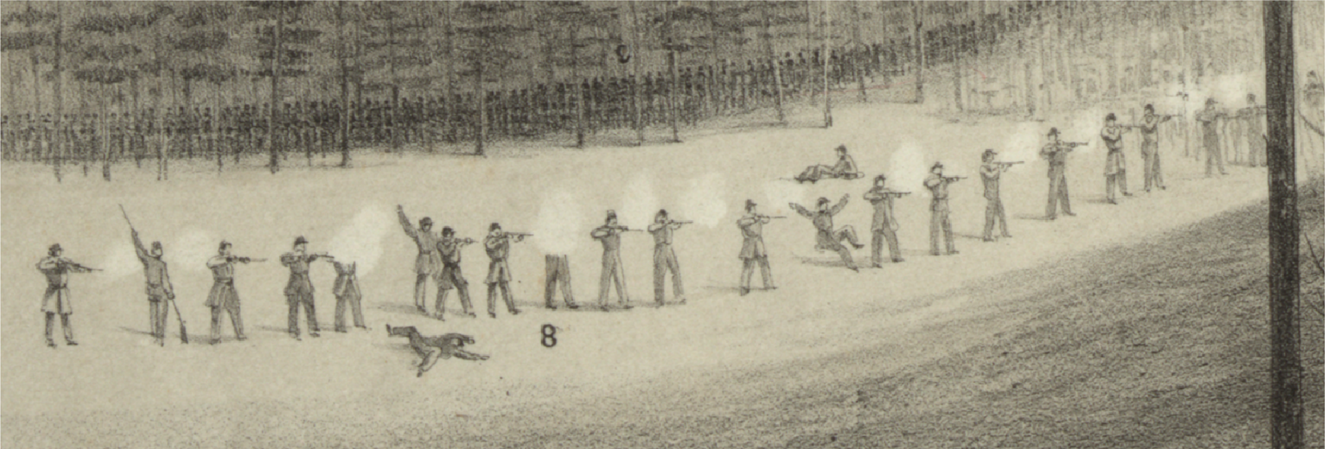
Mathews's depiction of the Confederate opposition is distinctly different, though equally imaginative. Those in the woods, though described by their annotation as “in force in the edge of the Cedar Woods,” are a minute and distant enemy. The closest soldiers stand in a skirmish line (an irregular and open formation), which, although commonly employed, stands in stark contrast to the ordered discipline of the Federal regiments.Footnote 62 Furthermore, whilst Mathews depicts the Union forces as invincible, there are several casualties notable on the Confederate line. But they are peripheral. Although the lithograph's caption informs the viewer that “the Rebels were repulsed with heavy loss, and driven behind their breastworks,” the image depicts none of that carnage. The image instead provides suspense, illustrating the charge in its initial stages and calling upon the viewer's imagination to visualize the ensuing combat. For the soldier this was possible. Some admitted that lithographic images were a good foundation, which they could then augment with their own recollections. One soldier wrote that a lithograph of the “terrible ‘Salient’” where he had fought during the Battle of Spotsylvania Courthouse in 1864 was “very good,” but that it lacked representations of the “Dead men … who had been there 7 days.” The engravers censored these corpses from the image.Footnote 63 However, for those unexposed to combat, the tenets of the heroic-war tradition would figure in their visualization of the ensuing fighting.
Charge of the First Brigade, detail of a Union officer at the head of his troops, though it is important to note he leads a supporting regiment.

The image romanticizes the battle, making it devoid of the realities that caused soldiers to “abandon many of the war's initial tenets” and the “idealism [they] brought with them into the army.”Footnote 64 The result is a depiction of Stones River that, despite being one of the bloodiest battles of the war, spectators would consider inoffensive to refined sensibilities. By relegating the common soldiers to the role of insignificant parts of a warring machine, Mathews neglects their experience of battle. Instead, the image is propagandistic as it emphasizes the sweeping power of the brigade as it is about to wash over its adversary. Though useful insofar as the image educates the spectator on the brigade's order of battle and the positions of its officers, it consequently serves more effectively as a mapping of the engagement rather than as an opportunity to relay a soldierly experience. In a broader sense, Mathews's triumphant depiction was in conversation with a watershed moment in war. At a time when northern war fervor lagged due to repeated battlefield failures, particularly in the eastern theatre, the two, albeit close and costly, victories at Antietam and Stones River ballasted Lincoln's Emancipation Proclamation. Although the Proclamation would prove decisive, its initial impact was uncertain.Footnote 65 Mathews's lithograph makes no reference to the transformative war policy but instead celebrates the endurance and ability of those white Unionists whose recent battle performances legitimated it. Whether Mathews wanted to explicitly celebrate white soldiers’ facilitation of the Proclamation, or to instead to focus on their ability to ultimately gain victory without it, is unknown. Despite any higher intentions, the triple influence of Mathews's background in landscape art, his intention to offer his images for commercial sale, and the engraver's domestication of his war art hindered his ability to effectively communicate the battle experience. In contrast, Metzner, uninfluenced by creative conventions and unburdened by commercial considerations, produced a distressing depiction that mused on the shock of battle as experienced by its combatants.
Charge of the First Brigade, detail of the Confederate skirmish line, with the main body pictured in the woods. Note that in Mathews's depiction, the Confederates are standing, despite the fact that military manuals called for skirmishing troops to “take advantage of any cover which the ground may offer, and should lie flat on the ground whenever such a movement is necessary to protect them from the fire of the enemy” (William Joseph Hardee, Hardee's Rifle and Light Infantry Tactics (Memphis, TN: E. C. Kirk & Co., 1861), 34.) Whilst advancing Union troops could not be depicted lying down, defending Confederates were rendered incompetent for doing so.

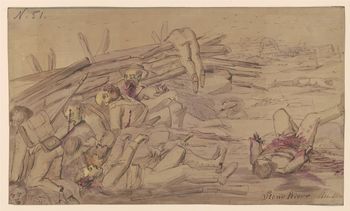
Metzner's depiction of Stones River (Figure 7) is strikingly different to Mathews's, and illustrates the ways in which soldier-artists could protest the traditions of heroic war whilst simultaneously destabilizing prevailing artistic conventions. The watercolor is devoid of any text other than the title Stone River Rebel Line. Stone River was the originally intended title, for Metzner evidently added “Rebel Line” as an afterthought.Footnote 66 The extended title, featured on the mat, tinges the picture with irony as it titles the scene a “Cozy Corner.” His watercolor, which is considerably smaller than Mathews's (21 × 36 cm) depicts casualties in a portion of the Confederate breastworks that the 32nd Indiana assaulted on 2 January. There is no evidence that Metzner attempted to reproduce the image for sale, or even circulate it within the confines of his regiment or his home circle. Judging by its content and format, it was a concentrated and private reflection of Metzner's recent exposure to the violence of battle. Unlike Mathews's depiction of the charging brigade, Metzner's image does not fit neatly into the confines of his composition. Instead, the faint outlines of bodies stretch into the distance, gore spills off the canvas at center right, and at the bottom left a surprised expression characterizes one living soldier as he gazes down along the line towards the viewer. Metzner's rejection of a formal border to frame his watercolor expresses the magnitude of the violence he was witness to.
Adolph Metzner, Stone River [Rebel Line], or The Rebel Line at Stones River, (Murfreesboro), Jan. 1863. “A Cozy Corner.,” watercolor, 1863, DRWG/US – Metzner, no. 47 (A size), Adolph Metzner Civil War Collection, Prints and Photographs Division, Library of Congress

Suffering and carnage are Metzner's core subjects. The dead and dying Confederates lie strewn over a split-rail fence. The image is particularly emphatic as it flagrantly illustrates death at the moment of happening. Officers, non-commissioned officers (NCOs), and privates lie pell-mell in heaps. An officer's or NCO's sword, a symbol of martial authority and of southern honor and chivalry, is notably protruding from the mass of the dead.Footnote 67 At left, a sergeant's body presses face-first against the barricade. There is no formal hierarchy in this death scene. The system of martial discipline, that which drilled volunteers into a cohesive and ordered force that could withstand and inflict such carnage, is the cause of its own obliteration. Whilst Mathews employs captioning to easily identify the officers in his lithograph, consequently affirming martial hierarchies, Metzner forces his audience to search through the dead to distinguish between the ranks. His graphic focus renders soldiers anonymous as they die facedown and as their wounds mask them. One soldier, at center, his jaw shot away so that his tongue lolls from the wound, carries an alarmed expression as he clasps at his commanding officer. At right, a cannon's shell has met with another soldier, offering an illustration of the destructive potency of the fifty-eight-gun barrage that preceded the Union counterattack. The bombardment decimated the southern ranks: one shell exploded in the midst of a Kentucky company, hurling eighteen dead and wounded men in every direction. One soldier died instantly when a round passed through his thighs, severing both of his legs.Footnote 68 Whilst the deaths of ordinary soldiers rarely received special attention from Civil War image makers, artists were likely to depict the death scenes of officers in a manner reminiscent of Benjamin West's The Death of General Wolfe (1770), or by using similar symbolic devices that emphasized the heroic virtue of the deceased. Metzner's illustration is striking in that it throws together soldiers of all ranks in one chaotic and unpretentious death scene.
Stone River [Rebel Line], details showing techniques employed by Metzner to emphasize the magnitude of the scene. Effectively, he depicts the carnage resulting from the battle as uncontainable and limitless.

Metzner's scene resembles Gardner's Antietam photographs, though it lacks the detail arrested by Gardner with the camera's documentary lens. Metzner employs a multitude of symbolic devices to affirm suffering in his picture. All but one of the subjects are blemished with a yellowish-green coloring. Excepting the one soldier in the bottom left corner, Metzner tinged those pictured with their eyes open with the yellowish hue. The employment of yellow shades traditionally alludes to cowardice in martial cultures. Historian Peter Cozzens notes that the “suddenness and completeness of the Confederate collapse” following the barrage surprised the Federals, with one Illinoisan writing to his mother that many Rebels fell to their knees and begged for mercy, claiming to be conscripts forced to serve.Footnote 69 But one of Metzner's comrades noted that the Confederates at Stones River were “bold fellows and were not embarrassed at all to march freely against our breastworks under a violent fire,” so the coloring may not infer cowardice.Footnote 70 Metzner represented one soldier, his eyes closed, with darker shades, verging on blackness. Though Gary Laderman writes that the “physiological processes of decomposition reminded some observers of markers that differentiated the races, particularly skin color,” it evidently signifies that the blackened individual is deceased, whilst those with light shading are in their death throes. Unlike Mathews, who was relieved from combat duty in order to record his regiment's role at Stones River, Metzner was unable to produce an on-the-spot sketch during the battle. His proximity to the scene is strikingly different to Mathews's distant and panoramic perspective. Initial sketching must have taken place whilst, or immediately after, surveying the aftermath of the engagement. Sergeant William Newlin of the 73rd Illinois wrote of the unburied dead on another portion of the Stones River battlefield:
Some … looked as though they had just fallen asleep … Others appeared as if their last moments had been spent in extreme pain – eyes open, and apparently ready to jump from their sockets; hands grasping some portion of their garments and their features all distorted and changed.Footnote 71
Had Metzner produced the watercolor later, processes of decomposition would be in heightened stages so that blackness would characterize all of the bodies. Metzner's use of red to accentuate wounding and bleeding is exceptional not only for its rarity in the broader visual archive of the war, but also for the fact that it emphasizes to the viewer that they are witnessing soldiers in the act of dying. The blood apparently still flows as Metzner depicts the scene. In particular, its employment to highlight particularly graphic wounds, such as the mangled soldier at center right, could only find a similarly arresting rival in the detail captured in photographs of the war dead. The most significant aspect of Metzner's use of color is that he only employs it to underscore suffering, wounding, and mortality. In direct contradiction to prevalent sensibilities, Metzner highlighted that which was taboo in the exhibition of heroic war.
A subtler reference to suffering exists in the inclusion of faint lines delineating carrion birds as they gather above the wounded in the distance. It is a reference to the lack of appropriate treatment for the casualties. Antebellum comprehensions of death noted that in the corpse remained “something of the former selfhood,” and “in the prevailing Protestant doctrine, something of the future and immortal selfhood as well.”Footnote 72 As one Confederate wrote, “It is dreadful to contemplate being killed on the field without a kind hand to hide one's remains from … the gnawing of animals and buzzards.”Footnote 73 With the heightened fragility of the body on the battlefield, Civil War soldiers doubted how their essential selves could remain if their bodies were destroyed or lost. In an even greater departure from the traditions of heroic war, Metzner's scene suggests anxieties over the futility of improper deaths, despite the fact that the casualties are his adversaries. Metzner's representation of the Confederate soldiers is negative but vacant of the propagandistic devices employed by the mainstream press. Most image makers operated in some way to create “an unfavorable image of the enemy,” but they were far removed from the battles and with a propagandistic agenda to tow, wanted the American citizenry to “believe the worst about the Confederates.”Footnote 74 Artists in the field, particularly soldier-artists, generally moved away from these exaggerated depictions as the war progressed. The sketch artist Edwin Forbes noted that northern soldiers regarded their enemy with a “wholesome respect, even a reasonable fear.”Footnote 75 Metzner's negative depictions are condemnations of the war and its suffering more broadly, rather than of the South specifically. Metzner's close studies of the soldiers’ destroyed forms are contemplative and mournful reflections of recent traumas, and, though focussed on southerners, depict fates universal to all combatants. Whilst Mathews avoided depictions of violence, and image makers more broadly attempted to depict death through heroic and virtuous symbolism, Metzner exhibited mortality and agonizing wounds as a core feature of his war art. The universality of war's suffering is most acute with Metzner's employment of a pietà at center left.
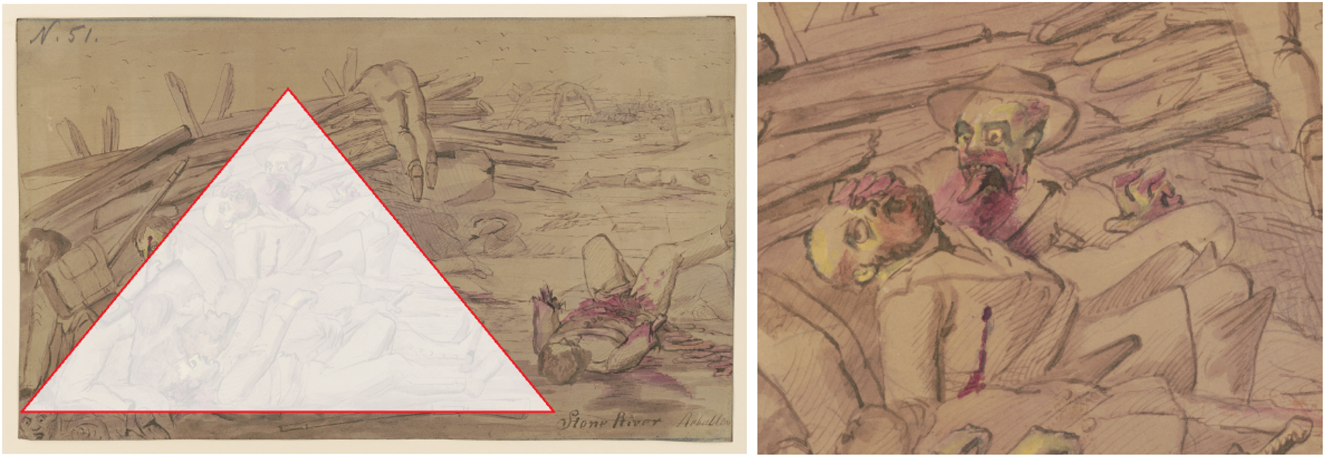
The two interacting subjects bear religious and sacrificial symbolism. Metzner emphasizes the ambiguity and uncertainty of war as he represents their deaths without an apparent reference to the motives that bore them to battle. The pyramidal composition, which artists traditionally employ to represent order and stability in conventional artworks, is that which draws the spectator's eye to the unfortunate pair. It is no coincidence that the two subjects form a pietà, particularly in view of the similarity in the location of the bullet wound on the officer's right breast and Christ's chest wound as caused by the Holy Lance. But in this representation Metzner reveals such sacrifice as useless, for the only reward is to face an impending and unheroic death in his paradoxically cozy corner, and to hope for mercy from unfamiliar adversaries and the ravenous animals. Even so, Metzner renders the soldier's desperate attempt to grasp at his commander the most humane act in this depiction of battle, making the depiction an ironic statement on the conventions of the Good Death. The Good Death was a prominent notion regarding the way one should die in the antebellum era, and its doctrines dictated that death should occur with family and friends in observance. They would provide “solicitude, emotional comfort, and some reassurance for the departing.” In contrast, an “unattended death sparked terror and signified a great spiritual and emotional loss.”Footnote 76 The death of Eva in Uncle Tom's Cabin was the most famous example of a Good Death in antebellum popular culture. Ira Owen of the 74th Ohio left a poignant description of one dying soldier on the Stones River battlefield who longed for his family's care:
One poor fellow who was near me was wounded in the head. He grew delirious in the night, and would very frequently call his mother … The poor fellow died before morning with no mother near, to soothe him in his dying moments, or wipe the cold sweat from his brow.Footnote 77
Stone River [Rebel Line], detail (left) shows Metzner's employment of a triangular composition; detail (right) exhibits Metzner's manipulation of the traditional pietà.

His account underscores the anxieties of a passing unattended by kin. Sudden, violent deaths on distant battlefields eroded the conventions of the Good Death during the Civil War. Metzner fully exhibits war's irony by showing the desperate attempt by the Confederates to provide reassurance in their passing. In Metzner's scene, it is the closest to a Good Death that a soldier can attain.
Metzner suggests empathy rather than any hatred for the enemy. This is no exhibition of Union military triumph, but instead a mournful scene illustrating the sheer trauma of modernizing warfare. Civil War soldiers had a very different relation to killing than those of subsequent wars with “levels of impersonality and anonymity that reduced the burden of individual responsibility endured by Civil War infantry.”Footnote 78 The use of outdated tactics, coupled with advanced weaponry, rendered many Civil War engagements indecisive. On the surface, Stones River was no exception, though it would have far-reaching consequences. Tactically, Cozzens identifies Stones River as a draw whilst Daniel notes that it accomplished little more than an enormous body count. One Rebel wrote in frustration after the battle, “I don't think [the war] will ever be stopped by fighting, the Yankees cant whip us and we can never whip them.”Footnote 79 In another allusion to Gardner's series, Metzner's deceased and disfigured Confederate soldiers exhibit the destructive power of nineteenth-century armaments. Though new innovations in armament development occurred in the antebellum era, increasing the range and accuracy of infantry small arms, most combat continued to occur at a range of about a hundred yards, meaning that it was impossible to facilitate emotional distance from destructive acts.Footnote 80 The destructive intimacy of Civil War battlefields not only eroded the possibility of one's own Good Death, but distorted the lines between justified killing and cold-blooded murder. Metzner's work reveals the internal struggle that countless soldiers battled with, as the work of killing marked a significant departure from their understandings of themselves as human beings and Christians.Footnote 81 The bodies are a microcosm of the violence of a war that left at least 620,000 dead and a further 130,000 disfigured for life.Footnote 82 That Metzner's artwork was a private reflection, not a sanitized depiction for concerned family members or commercial sale, meant that he could grapple more graphically with the battle experience than any textual correspondence or public artwork would permit. This is not to argue that this meditation on war characterized the totality of his service, nor that mortality and suffering typified his visual record. But, as Faust observes in her study of death in the war, many soldiers were “never quite the same again after seeing fields of slaughtered bodies destroyed by men just like themselves.”Footnote 83 Scholars recognize the multitude of ways that Civil War soldiers became hardened to death, and the war experience more broadly.Footnote 84 In relation to idealized presentation of battle compared to its realities, Warren Olney, a Union private, put it emphatically when he wrote that combat “exploded all my notions derived from histories and pictures, of the way men stand up in the presence of an enemy.”Footnote 85 Metzner's watercolor offers an understudied opportunity to analyze this hardening in two ways: he wrestled with the prevailing assumptions regarding life's value whilst destabilizing the romantic images that enticed countless volunteers to service.
Metzner's picture is one of the most emphatic departures from the mainstream visual narrative of the Civil War. In contrast to the popular, published images of the period, Metzner confronted the war's inherent anxieties (death, wounding, and subsequent care for the body) in thoughtful pictorial studies. By titling the useless breastworks a cozy corner and by questioning the sacrifice of his enemy, Metzner recognizes the ambiguity and irony of war, specifically the incompatibility of romantic images of war with unheroic, unrecognized deaths. His work is a visual anticipation of the suffering wounded of Bierce's literary realism: it gave visual form to what soldiers privately penned in their letters and diaries, and cemented as core features of his war art taboos that even established writers were wary of employing.Footnote 86 Moreover, there is an immediacy to Metzner's wartime art that is lacking in Bierce's postwar writings. For Metzner, the war was his artistic stimulus. Unbound by artistic convention, his images are a direct response to his lived realities. Metzner's watercolor is not a visual assault on the Confederate soldier, but a distressing representation of the fate that frequently befell victims on both sides of the conflict. A visual memento mori, it signals both the impermanence of a soldiers’ life and the fragility of the Good Death in war.
Mathews's and Metzner's Stones River pictures give insight into the multitude of ways in which combatants pictured the war. Their images stand in almost total opposition, permitting us to consider the Civil War soldier-artist as an individual who could ally with a particular artistic interpretation of the war, or straddle varying perspectives. Mathews's lithograph validates his alignment to the mainstream envisioning of the war, whilst Metzner's watercolor demonstrates how others abandoned popular visual conventions in search of new ways to represent that which their contemporaries so often deemed indescribable. Through comparative analysis this article has revealed the ways in which individual soldiers employed varying stylistic strategies in order to circulate, or privately mediate, reflections from the battlefield. Despite acknowledging how the romanticized notions of heroic war could limit the soldier's ability to illustrate combat, it has not been the article's intention to denigrate Mathews's artwork. Instead, it is important to remember that his work, even after the war was over, resonated with soldiers who had fought in the very battles he represented. There existed a seditious element to the heroic framing of the war, but this same romanticism evidently permitted soldiers to manage their experiences by providing a positive lens through which to remember them. As Neely and Holzer note in their brief consideration of Mathews's image, the lithograph anticipated the gaudier battle series concocted in the postwar era.Footnote 87 Metzner was the outlier, even by the war's end. Many soldiers had rejected propagandistic depictions by 1863 and instead graphically explored the war's taboos in both their visual and textual records, but few went to the extent that the German-born captain did in depicting war's suffering and violence.
Some came close, whilst others never produced a negative representation of the war. The US's insistence on fielding a small professional army, which volunteer citizen soldiers would supplement in times of national emergency, ensured that thousands of creatively minded individuals would find themselves donning uniforms and shouldering muskets. The war would sweep draughtsmen, printers, publishers, sketch artists, engineers, and photographers from their peaceful pursuits and thrust them into the rigorous environs of the military. Collectively, they produced what remains a neglected visual record of the conflict from the view of the common Union soldier. A 1962 estate sale unearthed the lost diary and notebook of an engraver's son, Alfred Bellard, who fought with the 5th New Jersey and produced numerous self-taught depictions of his war experience. An unexpected discovery in a Connecticut bank vault in 1994 yielded a trove of more than five hundred watercolors depicting the architect and engineer Robert Knox Sneden's service with the 40th New York Volunteers. Charles Wellington Reed of the Massachusetts Light Artillery innovated his correspondence to his mother with an impressive number of on-the-spot sketches of army life. More who remain unidentified contributed to the pictorial record as well, like the unrecognized “Sojer” of the 44th Massachusetts who kept a satirical cartoon book of his service in North Carolina. But as this article has demonstrated, it is an archive fraught with tensions as soldier-artists with varying influences, backgrounds, and worldviews sought to depict the totality of experiences associated with the soldier's Civil War. Their productions will illuminate our understanding of Civil War soldier-artists, and in doing so, permit historians with angles of vision to better comprehend the war's impact on both martial and pictorial cultures in the American nineteenth century.