INTRODUCTION
The multifaceted nature of word learning
At a very young age, children learn to master the complex web of words and rules with which a natural language is woven. However, this is a daunting challenge. To understand the complexity it presents, consider that infants must solve two problems in a relatively short time. First, to achieve language proficiency, infants must find the words embedded in a speech stream. However, there are no clear signs of segmentation that separate words in spoken language. Second, to use language productively, they must master the system of rules and determine how the finite number of linguistic elements combines to form novel structures, by first recognizing and eventually generating new complex combinations from the words extracted from the stream.
Yet the problems of finding the basic elements of language and that of identifying the structural information that makes language productive are not independent. Sentences are composed in a systematic way, and knowing how they are composed (e.g. knowing that noun phrases can be exchanged with other noun phrases, or verb phrases with other verb phrases, without loss of grammaticality) is at the root of language productivity. However, words are also composed in a systematic way. Consider the word unexpectedly. In this word, a prefix and a suffix are attached to the stem expect to modify its meaning and its syntactic category. While the internal structure of sentences is crucial to explain the productivity of language, the internal structure of words is also crucial because words can also be productive: if unexpectedly is a word, so is unhappily or unintentionally. Indeed, whether syntactic relations are realized between or within words varies dramatically among languages (Payne, Reference Payne1997). Some languages, such as English, have a morphology that is relatively spare, whereas other languages exhibit various degrees of morphosyntactic complexity, expressing many syntactic relations directly within words. These relationships can range from basic grammatical facts, realized by agglutinating or fusing affixes with roots to convey the case, tense, gender, or number (e.g. the Italian mangio/mangia ‘I eat'/‘he/she eats’, with the last vowel encoding the person and tense, or the Italian bambina/bambine ‘girl’/‘girls’, with the last vowel encoding the gender and number), to a wide range of grammatical and semantic properties, such as in highly agglutinative languages, which can form complex expressions with one word (e.g. inikwihlminhih'isita ‘several small fires were burning in the house’ in Nootka; Aronoff & Fudeman, Reference Aronoff and Fudeman2011).
A further complication is that syntactic relations, both when they are realized between words, such as in sentences, or within words as morphological phenomena, often occur among non-adjacent elements. This fact is evident in sentences, which require a listener to keep track of dependencies between elements separated by intervening lexical items. However, the same phenomenon occurs in morphology. Several languages contain parasynthetic constructions, in which novel words are created by simultaneously adding different affixes which may fuse with a root. For example, in Italian, the word arrossito ‘blush’ is created by adding the prefix–suffix couple ad (+ phonological regressive assimilation with r) and ito to the root ross. Because lexical items, such as arrosso or rossito, do not exist, the prefix–suffix combination is applied simultaneously to the root; hence, this creates a non-adjacent relationship between syllables within the word. This diffuse and productive construction in Slavic and Romance languages (Vilares, Cabrero & Alonso, Reference Vilares, Cabrero and Alonso2001; Bisetto & Melloni, Reference Bisetto and Melloni2008; Lavale Ortiz, Reference Lavale Ortiz, Honrubia and Rosique2011) is also present in English, as the words downhearted, embolden, or able-bodied exemplify.
Words, word structure, and distributional information
The examples above show that even the first steps into the construction of a lexicon contain several layers of complexity, spanning from the need to identify words inside a continuous speech stream to the search for the internal structure of words. An infant has to cope with all of these factors when analyzing the unpredictable and difficult-to-interpret speech stream produced around her. This input does not allow her to clearly separate the search for words and the search for word structure because words often contain syntactic information: the problems of finding words and finding rules within words must be solved together. This paper investigates the origin of these abilities in infants. Specifically, we focused on when and under what conditions infants become sensitive to within-word relations, possibly requiring the establishment of non-adjacent relations between word syllables.
We focused on 7- and 12-month-old infants. These ages are interesting to consider for several reasons. At approximately 8 months of age, infants can already track various distributional properties to organize linguistic and non-linguistic continua. Notably, they can use the conditional frequencies with which syllables strictly follow each other (that is, their ‘transitional probabilities’; hereafter, TPs) to begin segmenting a continuous stream into word-like units. They can exploit distributional information both when exposed to artificial speech (Saffran, Aslin & Newport, Reference Saffran, Aslin and Newport1996; Aslin, Saffran & Newport, Reference Aslin, Saffran and Newport1998) and when exposed to real speech (Pelucchi, Hay & Saffran, Reference Pelucchi, Hay and Saffran2009), suggesting that TP computations could indeed be involved in real-world language acquisition. Eight-month-olds can also identify morphemes and functional parts of a language, which is potentially useful to start decoding the language's morphosyntax (Shi, Werker & Cutler, Reference Shi, Werker and Cutler2006; Gervain, Nespor, Mazuka, Horie & Mehler, Reference Gervain, Nespor, Mazuka, Horie and Mehler2008a; Shi & Lepage, Reference Shi and Lepage2008). These abilities could help in solving the problem we investigate in the current paper. However, as we discussed above, infants need to learn much more than unanalyzed syllable chunks to achieve the language competence typical of even very young toddlers. They need to extract structure from tokens. To do this, they must track relations within subcomponents of words, separating stems from the productive parts of the lexicon.
At approximately 12 months of age, infants begin the process of consolidating basic elements of the natural language they will soon speak, beginning their journey from organized perception to organized production. Around their first birthday, they have tuned their discrimination abilities to the sound patterns of their language (Werker & Tees, Reference Werker and Tees1983, Reference Werker and Tees1984); they can identify language-specific functors (Shi et al., Reference Shi, Werker and Cutler2006), they begin building their lexicon deploying word-specific learning strategies (Stager & Werker, Reference Stager and Werker1997; Halberda, Reference Halberda2003; Johnson, Jusczyk, Cutler & Norris, Reference Johnson, Jusczyk, Cutler and Norris2003), and they start being sensitive to how grammatical properties of words determine their syntactic roles (Hirsh-Pasek & Golinkoff, Reference Hirsh-Pasek and Golinkoff1996). Between 12 and 18 months of age, infants also show the ability to recover structural/grammatical information from natural and artificial speech, both when such information is contained in a sentence and when it is contained inside a word. Thus, when exposed to an artificial language, 14-month-old German infants can categorize a novel word as a content word if it follows a determiner, suggesting a skilled ability to identify parts of the signal carrying grammatical information even before the development of an extended lexicon (Höhle, Weissenborn, Kiefer, Schulz & Schmitz, Reference Höhle, Weissenborn, Kiefer, Schulz and Schmitz2004). At approximately the same age, infants can analyze the morphosyntactic composition of some natural language words. Mintz (Reference Mintz2013) exposed 15-month-old infants to naturally pronounced pseudo-words containing either a real natural language affix (such as the English -ing in the pseudo-word Gorping), or an affix non-existing in their language (such as -ot in Gorpot). Infants only needed to hear a few pseudo-words containing the real suffix to process it as a separate entity from the potential root Gorp, although the root and suffix were heard as agglutinated in a single lexical item. However, this capacity may still not be fully functional to identify morphosyntactic patters requiring infants to track non-adjacent relations. For example, even if infants can represent -ing as a suffix as of 15 months, before 18 months they may not be able to track non-adjacent dependencies involving such a suffix, such as those existing between auxiliaries and verb endings (is … -ing; Santelmann & Jusczyk, Reference Santelmann and Jusczyk1998).
Finally, under certain conditions, infants can find arbitrary relations at a distance among artificial tokens composing a potential sentence. Gómez and her collaborators familiarized infants with sets of separate pseudo-words in which the items were connected by either adjacent relations (e.g. alt comoo, alt kicey, …) or non-adjacent relations (e.g. pel wadim rut, pel kicey rut, …). At approximately 15 to 18 months of age, infants could exploit both types of dependency (Gómez & Gerken, Reference Gómez and Gerken1999; Gómez, Reference Gómez2002; Gómez & Lakusta, Reference Gómez and Lakusta2004; Gómez & Maye, Reference Gómez and Maye2005), but only when they were exposed to a sizable measure of variability for the intervening item. While these last results seem to suggest that non-adjacent relations cannot be easily captured before 12 months, infants in these experiments were familiarized with sets of separate words. By contrast, the relations typical of many morphological processes are established within words. Perhaps the ability to detect between-word and within-word non-adjacent relations appear together, but this is not known.
In sum, the potentialities to process word and word structure are available early, but we still do not have a clear picture of when and under what input conditions infants start to find structures within words, thus becoming capable of identifying the regularities typical of morphosyntactic processes.
The onset of sensitivity to word structure: the current research
At the early stages of speech production, children show a mastery of a wide array of relatively abstract syntactic and morphosyntactic properties. For example, when children begin producing two-word sentences between 1·7 and 2·3 years of age, they respect the order of their native language; this is a sign indicating mastery of the Head Direction Parameter (Guasti, Reference Guasti2002). They use order information to interpret novel sentences, even at the cost of making errors (Gertner & Fisher, Reference Gertner and Fisher2012). At the same time, when they speak morphosyntactically rich languages, such as Italian (Pizzuto & Caselli, Reference Pizzuto and Caselli1992; Guasti, Reference Guasti1993; Caprin & Guasti, Reference Caprin and Guasti2009), Spanish or Catalan (Torrens, Reference Torrens, Schütze, Ganger and Broihier1995), toddlers and children produce sentences by respecting morphological regularities, such as subject–verb or tense and case agreements, which imply a mastery of parts of the morphosyntax. Thus, by the onset of linguistic production, infants analyze words as being composed of stems and affixes. However, as discussed above, the resources to identify words in the speech stream are available earlier. What happens between the periods when infants start tracking statistical relations and when they start producing words? Specifically, at what point and via what resources do infants begin organizing their lexicon systematically? In learning a lexicon that in a few months will grow spectacularly, infants would greatly benefit from grasping word structures as they are building their native language vocabulary. Thus, it is reasonable to suppose that as early as they begin focusing on their native language and can create the appropriate phonological representation to parse sounds into words, infants may attempt to also parse the internal structure of the words they begin acquiring.
Artificial speech as a tool to investigate natural speech processing
Our experiments aimed to probe the cognitive precursors grounding the ability to learn morphosyntax, by testing when infants become sensitive to word-internal structure and under what input conditions this can be accomplished. We studied how infants learn within-word relations after exposure to artificial language streams. While extrapolations from artificial to natural language learning must be performed with care, artificial language learning offers several advantages. It is possible to control a series of parameters, such as the prosody, speech rate, or previous exposure to the stimuli, which may allow us to better understand aspects of language acquisition that are difficult to capture with natural language.
Furthermore, a consistent set of studies has found that the processes triggered during exposure to artificial speech are not very different from those active when participants listen to natural speech. First, neural evidence suggests that the brain areas and the connectivity patterns elicited by artificial speech largely overlap with those activated while listening to natural speech (De Diego-Balaguer, Toro, Rodriguez-Fornells & Bachoud-Levi, Reference De Diego-Balaguer, Toro, Rodriguez-Fornells and Bachoud-Levi2007; de Diego-Balaguer & Lopez-Barroso, Reference de Diego-Balaguer and Lopez-Barroso2010; Lopez-Barroso, de Diego-Balaguer, Cunillera, Camara, Münte & Rodriguez-Fornells, Reference Lopez-Barroso, de Diego-Balaguer, Cunillera, Camara, Münte and Rodriguez-Fornells2011; López-Barroso, Catani, Ripollés, Dell'Acqua, Rodríguez-Fornells & de Diego-Balaguer, Reference López-Barroso, Catani, Ripollés, Dell'Acqua, Rodríguez-Fornells and de Diego-Balaguer2013) both in adults and children (McNealy, Mazziotta & Dapretto, Reference McNealy, Mazziotta and Dapretto2006, Reference McNealy, Mazziotta and Dapretto2010). Second, in several cases, the processes involved in artificial language learning have been shown to mimic processes involved in natural language acquisition. This has been observed both in word learning and in tasks aimed at studying sensitivity to syntactic structure. Thus, while calling a syllable sequence extracted from an artificially synthesized stream a ‘word’ may stretch the meaning of the word ‘word’, under appropriate conditions, infants are willing to accept such sequences as meaning-carrying sounds (Lany & Saffran, Reference Lany and Saffran2010). Likewise, 8-month-old infants prefer to listen to snippets of artificial speech which are coherent with the distribution of functors and content words in their natural language (Gervain et al., Reference Gervain, Nespor, Mazuka, Horie and Mehler2008a; Yoshida et al., Reference Yoshida, Iversen, Patel, Mazuka, Nito and Gervain2010). Importantly, such preference can be elicited simply by familiarizing infants to sequences in which the item frequency mimics the distribution of functors and content words in their natural languages, suggesting that even a very brief exposure to artificial speech elicits the same processes of analysis that infants naturally apply to real speech. Even in the more complex case of bilingual infants learning languages with opposite word orders, artificial speech can be used to reveal learning processes by manipulating the pitch, prosody, and frequency of artificial streams (Gervain & Werker, Reference Gervain and Werker2013a). Similar phenomena occur with adult participants (Gervain et al., Reference Gervain, Sebastián-Gallés, Díaz, Laka, Mazuka, Yamane, Nespor and Mehler2013).
These findings and other reasons suggest that the learning processes induced by artificial speech may allow researchers to exercise a good control of stimuli while tapping into processes potentially involved in real morphosyntactic acquisition. The current research is based on this speculative, but grounded, assumption.
AXC languages as a tool to study early sensitivity to the morphosyntactic structure of words in an artificial speech stream
Several experiments in artificial language learning have shown that when adult participants are exposed to artificial speech streams that contain even minimal cues of segmentation, they can separate the streams into word-like items; furthermore, they are quickly capable of extracting the structure of these items, even when it is defined by internal, even non-adjacent, word subcomponents, such as separate syllables within the same words. However, when the stream is continuous and segmentation cues are absent, adults are unable to detect the rules of word composition, even if they can still extract words from the stream (Peña, Bonatti, Nespor & Mehler, Reference Peña, Bonatti, Nespor and Mehler2002; Bonatti, Peña, Nespor & Mehler, Reference Bonatti, Peña, Nespor and Mehler2005; Endress & Bonatti, Reference Endress and Bonatti2007; Toro, Nespor, Mehler & Bonatti, Reference Toro, Nespor, Mehler and Bonatti2008). For example, Peña et al. (Reference Peña, Bonatti, Nespor and Mehler2002) exposed adults to a continuous stream of trisyllabic sequences characterized by internal, non-adjacent TPs of 1·0 and a varying middle syllable (for brevity, an ‘AXC language’). The stream could contain sequences such as Puliki, Puraki, or Pufoki, mixed in a continuum of other syllables. The stream was designed so that neither the syllable frequency nor the adjacent TPs were informative to identify words and their structure. However, by computing non-adjacent TPs among syllables, it was possible to accomplish both tasks. In Peña et al.,'s experiments, after exposure to a continuous stream, adults could find the words, but failed to grasp their structure, despite the fact that the same computation may have sufficed to identify it. In contrast, the ability to project regularities about the internal structure of words appeared if participants were familiarized with a segmented stream, even after very brief exposures. In these experiments, the segmentation cues were short pauses inserted between words, but the specific segmentation marks are not crucial. Prosodical phrase markers (Shukla, Nespor & Mehler, Reference Shukla, Nespor and Mehler2007) or final vowel lengthening (Saffran, Newport & Aslin, Reference Saffran, Newport and Aslin1996) work equally well. Indeed, insofar as learners find signs marking word boundaries, they seem to be able to grasp the internal word structure (Langus, Marchetto, Bion & Nespor, Reference Langus, Marchetto, Bion and Nespor2012).
The AXC languages designed by Peña et al. (Reference Peña, Bonatti, Nespor and Mehler2002) are suitable for investigating the onset and the development of sensitivity to morphosyntax. Such languages contain both statistically coherent units that can be identified by computing TPs between adjacent or non-adjacent syllables (henceforth, ‘words’) and morphosyntactic information because the words are characterized by a common internal structure. In the following experiments, we adapted Peña et al.,'s AXC streams to 7- and 12-month-old infants. We took as granted that infants could compute adjacent TPs among syllables in artificial languages, because there is evidence that they can do it even at 5 months of age (Thiessen & Erickson, Reference Thiessen and Erickson2013). The issue we explore is: What is the developmental course of the simplest next step necessary to break into word structure? Our strategy was to present infants with the easiest contrast that may reveal sensitivity to morphosyntax, asking them to differentiate between ‘words’, or ‘rule-words’, and ‘non-words’. Here, ‘words’ are sequences of three syllables characterized by non-null, but not perfect, adjacent TPs and perfect non-adjacent TPs. ‘Rule-words’ are sequences of three syllables obtained by replacing the middle syllable of words with another syllable. Thus, rule-words never occur in the stream, but maintain the same relations as words among non-adjacent syllables. ‘Non-words’ are sequences of three syllables that never occur in the stream in that sequence and do not maintain the same relations among adjacent or non-adjacent syllables as words. While, by design, such comparisons fall short of addressing many issues related to the origin of morphosyntactic abilities, they have a marked advantage over more difficult comparisons. They test the minimal computations that infants must be able to do to compare items with and without internal structure in the easiest possible way. Thus, successes, as well as failures, are informative about the onset of morphosyntactic abilities. If infants at a given age fail a relatively easy contrast involving a single small step moving beyond adjacent TPs towards the identification of word structure, then they most likely do not possess the computational resources to analyze morphosyntactic patterns. Conversely, a success is an indication that when listening to unknown speech streams containing cues to word segmentation, they do not limit themselves to memorizing token words, but they try to parse their internal structure.
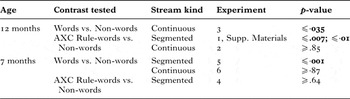
We present a series of experiments testing the abilities necessary to differentiate words or rule-words from non-words after exposure to either segmented or continuous artificial speech streams. In Experiments 1–3, we tested sensitivity to the words of an artificial language and to their morphosyntax, after exposure to either a segmented stream (Experiment 1) or a continuous stream (Experiments 2 and 3) in 12-month-old infants. If, at approximately one year, infants begin developing an awareness of the morphosyntax of their crescent lexicon, then we predicted that, similar to adults, they should be able to identify rules within words after exposure to a segmented stream (Experiment 1), but not to a continuous stream (Experiment 2), even if they can identify the words of the familiarization language (Experiment 3). In Experiments 4–6, we assessed to what extent 7-month-old infants could find the morphosyntactic properties of words in the same languages. At that age, infants have not completed the process of perceptual reorganization needed to properly represent a language-specific lexicon (Werker & Tees, Reference Werker and Tees1984). Thus, if an advanced process of convergence towards a native language is a prerequisite for the construction of a structured lexicon, then 7-month-old infants might not be sensitive to within-word relations despite the fact that they can compute adjacent relations among syllables (Saffran, Aslin, & Newport, Reference Saffran, Aslin and Newport1996) and could, in principle, identify abstract relations between isolated tokens (Marcus, Vijayan, Rao & Vishton, Reference Marcus, Vijayan, Rao and Vishton1999). Table 1 contains a summary of the structure of the experiments and their results.
An overview of the experiments and their p-values

EXPERIMENT 1
Participants
Thirty-two infants from Italian-speaking families, aged 1;0 (M = 1;0·25; Range = 1;0·2–1;1·02) with a minimum APGAR of 8 and no hearing or vision problems, were included in the analysis (13 girls). Twenty-three additional infants were excluded from the analyses (22 for fussiness, and 1 because s/he looked longer than 65 cumulative s in more than two test trials, on the assumption that such infants were sticky-fixating on our attractor stimuli instead of responding to the test sounds). The criteria for participant selection were identical in all reported experiments. Such a rejection rate is high, but not uncommon. Slaughter and Suddendorf (Reference Slaughter and Suddendorf2007) ran a meta-analysis of infant experiments reporting rejection rates ranging from 0 to 68%. These authors showed that such variation does not systematically influence experimental outcomes.
Stimuli and procedure
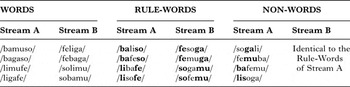
We created two artificial speech streams (A and B) by pseudo-randomly concatenating four continuous sequences of three Consonant–Vowel (CV) syllables, with the constraint that one word could not occur twice in a row. The languages contained two word pairs with identical first and last syllables, differing only in their middle syllable (see Table 2). We refer to these pairs as ‘word families’. Thus, the languages could be described as composed of two AXC word families characterized by minimal variability. In each stream, words were repeated 48 times. TP was 1 between the first and last syllables of each word and 0·5 between adjacent syllables. Adjacent TPs across word boundaries were also 0·5; thus, adjacent TPs, while non-null, could not be informative about word boundaries. Each trisyllabic sequence was separated from the next by a 200 ms silence.
Items used to compose the familiarization stream and the test phase of Experiment 1 (the bold face in Rule-Words and Non-Words identifies syllables that appear in the same positions as in the words of the respective familiarization streams)

Test items were either non-words (i.e. sequences of three syllables that never occur in the stream in that sequence) or rule-words (i.e. sequences of three syllables obtained by replacing the middle syllable of words with another syllable). The non-adjacent probability relations among syllables in the two streams were such that the rule-words of Stream A became the non-words of Stream B. To realize this inversion, in Stream A, two non-words had CBA' structure (where C and B stand for the third and second syllable of one family, and A' stands for the first syllable of the other family), and two non-words had an AC'B structure, whereas in Stream B, the non-words had a BB'A or a BAA' structure (Table 2). In either stream, non-words had 0 frequency, as well as both adjacent and non-adjacent 0 TPs, whereas rule-words had 0 frequency and 0 adjacent TPs, but 1 non-adjacent TP.
The material was synthesized with the Mbrola speech synthesizer (Dutoit, Pagel, Bataille & Vreken, Reference Dutoit, Pagel, Bataille and Vreken1996) using the FR-2 database, setting flat prosody, 116 ms phoneme length and 200 Hz pitch. Mean word length was 696 ms. The familiarization stream was synthesized with increasing and decreasing amplitude in the first and last 5 s, respectively, to avoid providing direct cues to word onsets. The stream lasted 2 min 52 s.
In a modified version of the headturn preference procedure (Marchetto & Bonatti, Reference Marchetto and Bonatti2013), infants sat on their caretaker's laps in a dimly lit, quiet room with three monitors positioned at their front and sides. The caretakers listened to masking music and were instructed not to interact with the infants during the experiment. During familiarization, a visual stimulus (a movie of a moving hand) attracted the infants towards the center while the speech stream played. In the test phase, two trials for each of the eight test stimuli were presented in a pseudo-random order, with the constraints that the same item could not be repeated in the immediately succeeding trial and that no more than three items of the same type could occur in a row. In each trial, the attractor appeared at the center first. After 1·5 s of continuous fixation, it disappeared and reappeared on one of the side monitors. As infants oriented towards it, the test item started playing repeatedly from loudspeakers hidden behind the monitors until infants looked away for 2 s consecutively or looked for more than 65 s cumulatively. Test items were repeated after a 500 ms ISI. An Apple G5 controlled by PsyScope X ran the experiment (http://psy.cns.sissa.it; Cohen, MacWhinney, Flatt & Provost, Reference Cohen, MacWhinney, Flatt and Provost1993). Infants' looking behavior was recorded by a camera hidden behind the center monitor. The camera also allowed the experimenter to control the experimental procedure on-line; thus, the test trials began and ended contingent upon the infant's looking behavior. Looking time was successively coded off-line. Looking times shorter than 1 s or 3 SD beyond the general mean computed for each test item type were excluded from further analysis. Across all experiments, excluded data ranged between 2·8% and 3·8%.
Results and discussion
We ran a mixed-design, repeated-measure ANOVA, with Stream (A or B) as a between-participant factor, test item type (Non-words vs. Rule-words) as a within-participant factor, and participants as a random factor nested in Stream.
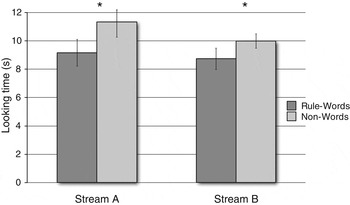
Infants looked longer while listening to non-words than to rule-words (Figure 1; M Non-words = 11·06 s, SE = 0·64; M Rule-words = 9·29 s, SE = 0·62, F(1,30) = 8·6, p ⩽ ·007). There was no effect of stream (F(1,30) = 0·67, p = ·41) and no interaction between stream and test item type (F(1,30) = 0·62, p = ·43). Thus, infants responded to the nature of the test stimuli as rule-words or non-words, despite the changes in familiarization stream, test items, and non-word structure. These results suggest that phonotactic, phonetic, or phonological features of the test items or of the familiarization stream were not determining factors in the infants' looking behavior. Both infants (Mattys, Jusczyk, Luce & Morgan, Reference Mattys, Jusczyk, Luce and Morgan1999) and adults (Peña et al., Reference Peña, Bonatti, Nespor and Mehler2002, footnote 17; Onnis, Monaghan, Richmond & Chater, Reference Onnis, Monaghan, Richmond and Chater2005) are sensitive to such information and can use it to segment and learn words (Gonzalez-Gomez & Nazzi, Reference Gonzalez-Gomez and Nazzi2012; Gonzalez-Gomez, Poltrock & Nazzi, Reference Gonzalez-Gomez, Poltrock and Nazzi2013). Nevertheless, these factors alone could not explain the results of Experiment 1. Further, simple monitoring of bigrams in the familiarization stream could not account for the results. Both in non-words and in rule-words, the bigram frequency (that is, the frequency of co-occurrence of two adjacent syllables) was 0.
Results of Experiment 1. Mean looking time (s) and SE for test items in 12-month-old infants listening to rule-words/non-words after a segmented familiarization (Experiment 1). Streams A and B are structurally identical, but the statistical relations among their syllables are such that the non-words in Stream A become the Rule-Words in Stream B.

Because of the construction of the material in Streams A and B, Experiment 1 excludes that infants responded by only monitoring differences between test items and either the first or second syllable of familiarization words. Indeed, two of the non-words in Stream B had structure CBA' and two had structure AC'B. Thus, in two of the four non-words, the initial syllable was identical to that of words (and hence of rule-words). In the other two non-words, the initial syllable was not identical to that of words, but the middle syllable was. Infants did not react differently to the two types of non-words, suggesting that they did not monitor one single syllable in either initial or middle position. However, Experiment 1 does not exclude that infants responded by only monitoring differences in the last syllable of test items. To control for this possibility, we ran a control experiment reported in the Supplementary Materials. We maintained the familiarization and rule-words from Stream A of Experiment 1, but we created two novel non-words with BAC' structure, with a last syllable identical to that of words. Even in this case, infants looked longer while listening to non-words than to rule-words, and did not react differently to the two types of non-words, suggesting that infants do not respond to simple mismatches between test items and words in familiarization in one single position (see Supplementary Materials).
In Experiment 1, neither rule-words nor non-words appeared during familiarization. Therefore, infants' preference for non-words may indicate that 12-month-olds learned the structural regularity underlying word structure and generalized it to novel sequences containing it.
The results of Experiment 1 indicate that 12-month-olds possess the resources to grasp morphosyntactic regularity, even when exposed to little variation and few exemplars of it. They suggest learning strategies consistent with the ‘less is more’ hypothesis (Newport, Reference Newport1990). Specifically, for the onset of morphosyntax, they also document the presence of one crucial tool to analyze within-word relations (i.e. tracking multiple positional variations), which may be their entry point into the morphosyntax of their lexicon.
Peña et al. (Reference Peña, Bonatti, Nespor and Mehler2002) showed that adults can find words in a continuous speech stream on the basis of non-adjacent relations between syllables, but can generalize to their structure only if the stream is segmented. In Experiment 1, infants exposed to segmented streams succeeded in finding the morphological-like regularity underlying words. If infants respond to the same stimulus properties as adults, then when they are familiarized with a continuous stream, they may fail to find differences between rule-words and non-words, even when they can distinguish words from non-words. This pattern of results would strongly suggest that infants analyze a speech stream by responding to the same structural properties as adults, thus possibly using the same mechanisms. In the next two experiments, we exposed infants to streams with the same statistical properties of Experiment 1, but without pauses between words. We then tested their ability to discern either the contrast rule-words/non-words (Experiment 2) or the contrast words/non-words (Experiment 3).
EXPERIMENT 2
Participants, stimuli, and procedure
Sixteen infants, aged 1;0 (M = 1;0·19; Range: 1;0·3–1;1·3), were retained for analysis (9 girls). Seven additional infants were excluded (4 fussed; 2 exceeded maximum looking criteria; 1 for equipment failure). Because Streams A and B did not yield different results in Experiment 1, we based this experiment on Stream A and its test items. We synthesized a new stream containing the same syllable sequences of Stream A, but we eliminated the pauses marking segmentations between the words. The stream was 2 min 14 s long. Infants were tested with the same rule-words and non-words as Experiment 1, Stream A (see Table 2). All other aspects of the procedure were identical to Experiment 1.
Results and discussion
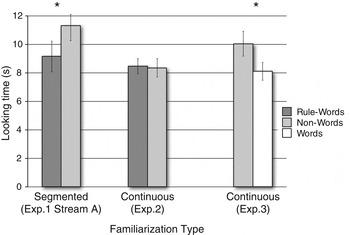
Infants looked equally to both test items (M Non-words = 8·67 s, SE = 0·69; M Rule-words = 8·79 s, SE = 0·55, F(1,15) = 0·04, p = ·85; Figure 2). Thus, unlike Experiment 1, they failed to extract any structural information after familiarization to a continuous stream. To further validate the different reactions between exposure to a segmented or a continuous stream, we ran common analyses of the infants who were exposed to Stream A in Experiments 1 and 2 with and without segmentation marks, respectively, and were exposed to the very same test items. A mixed-design, repeated-measure ANOVA, with the Experiment (1 or 2) as a between-participant factor, the test item type (Non-words vs. Rule-words) as a within-participant factor, and the participants as a random factor nested in Stream showed no main effect of Experiment or test item type, but a strong tendency towards an interaction of the two factors (F(1,30) = 3·83, p ⩽ ·059). Scheffé post-hoc analyses showed that, as reported, infants exposed to a segmented stream looked longer at non-words than at rule-words (p ⩽ ·013), but infants exposed to a continuous stream did not (p = ·41).
Results of Experiments 1 − 3. Mean looking time (s) and SE for test items in 12-month-old infants listening to rule-words/non-words (Experiment 2, continuous familiarization) or to words/non-words (Experiment 3, continuous familiarization). For comparison, the graph reports the results of Experiment 1, Stream A (segmented familiarization), from which the familiarization of Experiment 2 was constructed by removing the segmentation indexes.

Experiments 1 and 2 suggest that infants need segmentation cues to capture within-word generalizations. Only when they were exposed to a segmented stream could they develop a sense of the structure underlying the words in the AXC language, similar to adults (Peña et al., Reference Peña, Bonatti, Nespor and Mehler2002; Bonatti et al., Reference Bonatti, Peña, Nespor and Mehler2005; Endress & Bonatti, Reference Endress and Bonatti2007).
However, it is also possible that in Experiment 2 infants failed to manifest a differential behavior when listening to the rule-words and non-words during the test phase, not because they could not find the word-internal structure, but because they could not compute anything from the continuous stream to which they were exposed during familiarization. If so, then after the same familiarization, they should also fail to differentiate words from non-words. Experiment 3 tested this alternative explanation.
EXPERIMENT 3
Participants, stimuli, and procedure
Sixteen infants, aged 1;0 (M = 1;0·21; Range: 1;0·2–1;1·13), were retained for analysis (8 girls). Eight additional infants were excluded because they fussed. Infants were familiarized with the same continuous stream from Experiment 2, but they listened to words and non-words in the test phase. The experiment was otherwise identical to Experiment 2.
Results and discussion
Infants looked longer when listening to non-words than to words (M Non-words = 10·42 s, SE = 0·83; M Words = 8·42 s, SE = 0·66, F(1,15) = 5·38, p ⩽ ·035; Figure 2), indicating that 12-month-olds are sensitive to statistical relations among syllables after familiarization with a continuous stream. This result can be interpreted both as evidence that, after being familiarized to a continuous stream, infants could exploit the within-word non-adjacent TPs of 1, or that they could exploit TP differences as low as 0·5. According to this second possibility, infants may succeed because they note that words have 0·5 adjacent TPs, but non-words have 0 adjacent TPs. While this account is possible, it is unlikely for several reasons. First, there is currently no clear evidence showing that infants can segment elements out of a continuum by exploiting low TPs. Aslin et al. (1998) did show that infants at 8 months can differentiate trisyllabic sequences with TPs of 1 from sequences with TPs of 0·5. However, the demands of the current task are different. In Experiment 3, it is the highest TP level holding groups of syllables together that is at 0·5. Thus, items favored by a possible computation of adjacent TP relations have a very high level of noise. In contrast, in Aslin et al. (Reference Aslin, Saffran and Newport1998), words were clearly identified by noiseless TPs of 1 among adjacent syllables. Perhaps infants of this age cannot tolerate a high level of noise when computing adjacent TPs. Second, because both word-internal and cross-word TPs in the stream are 0·5, computing only adjacent TPs would not allow infants to single out any particular syllable triplet. Hence, the test words should appear as arbitrary as non-words, unless we attribute to infants the ability to retain a very long string from which they can recall uniform snippets and compare them to other syllable combinations. This ability seems even harder than computing non-adjacent relations among syllables. Thus, we suggest that success at Experiment 3 may be due to the computation of the perfect TPs of 1 among non-adjacent syllables.
Taken together, Experiments 1–3 show that 12-month-olds find words and word-internal structure in the same conditions as adults: when exposed to a segmented stream, they appear to capture word-internal structure (Experiment 1), but when the stream is continuous, they are unable to extract this information (Experiment 2), even though they may find its words (Experiment 3). As recalled, Mintz (Reference Mintz2013) showed that 15-month-old infants can identify affixes of their natural languages, suggesting that by that age infants can begin morphosyntactic analysis of a natural language lexicon. We found that at approximately one year of age, when infants are exposed to an artificial speech stream, they can already deploy the computational resources to extract the morphosyntactic properties of its words, provided that the words have already been segmented out of a continuum.
In the next experiments, we explored the onset of morphosyntactic sensitivity. We exposed 7-month-olds to the same segmented artificial streams with which 12-month-olds were familiarized, and we tested their abilities to differentiate rule-words or words from non-words. This age comparison is interesting for several reasons. At 7 months, infants can detect adjacent TPs between differing syllables in a continuous stream (Saffran, Newport, & Aslin, Reference Saffran, Newport and Aslin1996); they can detect some rule patterns when familiarized to a set of discrete items (Marcus et al., Reference Marcus, Vijayan, Rao and Vishton1999); and they begin to spot words in natural speech (Jusczyk & Aslin, Reference Jusczyk and Aslin1995; Bergelson & Swingley, Reference Bergelson and Swingley2012). However, the process of perceptual convergence towards the phonological repertoire of their native language is not complete. Therefore, the lexical representations they can construct are necessarily partial. It is an interesting question whether such representations are solid enough to incorporate some structural properties of the lexical items. Seven-month-olds have all the necessary resources, when considered separately, to do such an analysis, but they may not yet be able to use their computational abilities in a conjoined way, or they may not feel the pressure coming from the emergence of a natural language system. If all that is needed to discover within-word relations are general statistical abilities, then they should succeed in our tasks, possibly under the same exposure conditions as 12-month-olds. However, if sensitivity to within-word structure develops only after infants are well advanced into the process of convergence towards their native language, then 7-month-olds may not attend to the internal construction of word-like items, despite their proven abilities at capturing statistical relations in sounds and other stimuli. We first asked if 7-month-olds can find word structure after exposure to a segmented stream, similar to the 12-month-olds in Experiment 1.
EXPERIMENT 4
Participants
Thirty-two infants, aged 0;7 (M = 0;7·19; Range: 0;7·12–0;8·7), were included in the analysis (14 girls). An additional 28 infants participated, but were excluded (27 fussed, 1 exceeded maximum looking criteria).
Stimuli, procedure, and results
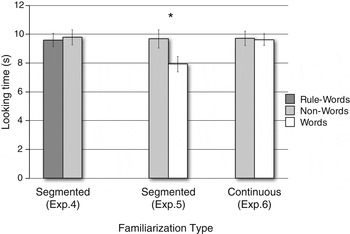
The experiment and the data analyses were identical to Experiment 1. Infants showed no tendency to look differentially at rule-words or non-words (Figure 3; M Non-Words = 10·16, SE = 0·55, M Rule-Words = 9·95, SE = 0·49, F(1,30) = 0·21, p = ·64). Furthermore, there was no effect of stream type (F(1,30) = 0·77, p = ·38), and there was no interaction between the two factors (F(1,30) = 2·63, p = ·11).
Results of Experiments 4 − 6. Mean looking time (s) and SE for test items in 7-month-old infants listening to rule-words/non-words (Experiment 4) and to words/non-words after a segmented (Experiment 5) or continuous (Experiment 6) familiarization.

To test whether 7-month-olds and 12-month-olds behaved differently, we ran common analyses of the 12-month-olds in Experiment 1 together with the 7-month-olds in the current experiment. A mixed-design, repeated-measure ANOVA, with Age (7 or 12 months) as a between-participant factor, the test item type (Non-words vs. Rule-words) as a within-participant factor, and the participants as a random factor nested in Age showed no main effect of Age (F(1,62) = 0·08, p = ·67). There was a main effect of test item type (F(1,62) = 5·42, p ⩽ ·023) but also an interaction between Age and Test Item Type (F(1,62) = 5·12, p ⩽ ·027). Exploring the interaction, Scheffé post-hoc analyses showed that 12-month-olds looked significantly longer at non-words than at rule-words (p ⩽ ·018), but that 7-month-olds did not (p = ·9). That is, the main effect of Test Item Type was entirely due to the differential behavior when listening to rule-words or non-words in the 12-month-olds, whereas the 7-month-olds did not contribute to it.
The results suggest that, at 7 months, the computational resources to find within-word structural relations are not yet available or are not deployed for this purpose. However, as may happen with a novel design yielding null results, it is also possible that 7-month-olds did not respond to it. Perhaps they can extract information about the structure of artificial words present in a segmented stream, but our design was not sensitive enough. We thus tested whether 7-month-olds could find words, rather than word structure, when tested with our design, familiarizing them to the streams of Experiment 4. If infants succeeded, then their failure in Experiment 4 may be specifically related to their inability to detect word structure.
EXPERIMENT 5
Participants, stimuli, and procedure
Thirty-two infants, aged 0;7 (M = 0;7·22; Range: 0;7·6–0;8·2), were retained for analysis (20 girls). Seventeen additional infants were excluded (16 fussed, 1 exceeded maximum looking criteria). The experiment was identical to Experiment 4, with the crucial difference that test items were words and non-words.
Results and discussion
The data analyses were identical to Experiments 1 and 4. Infants looked longer at non-words than at words (M Non-Words = 10·03 s, SE = 0·68; M Words = 8·22 s, SE = 0·57, F(1,30) = 13·2, p ⩽ ·001). There was a main effect of Stream (M StreamA = 10·73 s, SE = 0·73; M StreamB = 7·53 s, SE = 0·38, F(1,30) = 9·82, p ⩽ ·004). Importantly, however, the Stream factor did not interact with the Test Item Type (F(1,30) = 0·26, p = ·62). Post-hoc tests with the Scheffé method showed that infants in both familiarization groups looked longer at non-words (M Words-StreamA = 9·7 s, SE = 0·91, M Non-Words-StreamA = 11·8 s, SE = 1·11, p ⩽ ·003); M Words-StreamB = 6·8 s, SE = 0·54, M Non-Words-StreamB = 8·3 s, SE = 0·48, p ⩽ ·034). We attribute the main effect of Stream, which we found in no other experiment, to group differences.
The results show that 7-month-olds did process the information contained in the segmented familiarization streams used in Experiments 4 and 5. They can find words in these streams. Hence, the failure to find rule-words in Experiment 4 can be interpreted as a specific lack of sensitivity to within-word relations. To better understand the 7-month-olds' computations, we explored what cues they may use to identify the words in the stream of Experiment 5. They could be exploiting distributional information, such as adjacent TPs between syllable bigrams or non-adjacent syllable TPs, or they could use the segmentation marks separating words. Experiment 6 probed the causes of the infants' success in Experiment 5. If they computed distributional information, then infants should also be able to extract words from a continuous stream because the absence of pauses does not modify the statistical relations among syllables. Instead, if they found words by exploiting the segmentation marks between them, then, when these marks are removed, 7-month-olds should fail to find the same words they successfully found in Experiment 5.
EXPERIMENT 6
Participants, stimuli, and procedure
Thirty-two infants, aged 0;7 (M = 0;7·22; Range: 0;7·11–0;8·13), were included in the analysis (15 girls). Nineteen additional infants were excluded (16 fussed, 2 exceeded maximum looking criteria, 1 for equipment failure). The procedure and data analyses were identical to Experiment 5, with the difference that the familiarization streams had no pauses separating words.
Results
Infants showed no tendency to look differentially at words or non-words (M Non-Words = 10·07, SE = 0·52, M Words = 9·9, SE = 0·44, F(1,30) = 0·02, p = ·87). There was no effect of stream (M StreamA = 9·9 s, SE = 0·49; M StreamB = 10·15 s, SE = 0·48, F(1,30) = 0·09, p = ·63), and no interaction between the two factors (M StreamA = 9·9 s, SE = 0·49; M StreamB = 10·15 s, SE = 0·48, F(1,30) = 0·09, p = ·63). To compare the effect of a continuous or a segmented familiarization on the ability to tell words and non-words apart at 7 months, we ran common analyses of the participants in Experiments 5 and 6. A mixed-design, repeated-measure ANOVA, with the Familiarization Stream (with/without pauses) as a between-participant factor, the test item type (Non-words vs. Rule-words) as a within-participant factor, and the participants as a random factor nested in the Familiarization Stream showed no main effect of the Familiarization Stream (F(1,62) = 1·62, p = ·21). Infants in both experiments looked equally longer at test items regardless of whether they were exposed to a continuous or a segmented familiarization. The test item type did have an effect (F(1,62) = 6·53, p ⩽ ·013). However, the interaction between Familiarization Stream and Test Item Type was also significant (F(1,62) = 5·25, p ⩽ ·025). Scheffé post-hoc analyses showed that only those infants exposed to a segmented stream looked longer at non-words than at words (p ⩽ ·010). By contrast, those infants exposed to a continuous stream did not (p = ·85). Thus, apparently, being exposed to a segmented stream was necessary for infants to tell words apart from non-words.
Discussion
Surprisingly, infants failed to segment words from the continuous stream. They could not segment them out, even if the words were statistically favored with respect to non-words, having perfect non-adjacent TPs of 1 (against 0), adjacent TPs of 0·5 (against 0), and a higher bigram frequency. This failure is particularly informative. Seven-month-olds can track adjacent syllable co-occurrence in a continuous speech stream when their TPs are perfect (Saffron, Newport, & Aslin, Reference Saffran, Newport and Aslin1996; Aslin et al., Reference Aslin, Saffran and Newport1998). They are also sensitive to bigram frequency (Aslin et al., Reference Aslin, Saffran and Newport1998). The current result suggests that, in our case, infants could not compute any of these measures, suggesting that 7-month-olds' abilities at tracking statistics in the signal are rather weak and are likely limited to very high adjacent relations. Indeed infants could not even exploit multiple statistical redundancies in the signal.
The negative result of Experiment 6 allows us to better interpret what 7-month-olds did in Experiment 5, where they succeeded at differentiating words from non-words. It suggests that the infants succeeded not because they computed any sort of statistical relation among syllables but most likely because the segmentation marks in the familiarization streams provided a grouping advantage for words over non-words. Once these marks were removed, the infants were unable to detect a difference between test items. Together, Experiments 5 and 6 suggest that infants' first headway into a lexicon may be particularly influenced by words heard in isolation (e,g., Brent & Siskind, Reference Brent and Siskind2001; Lew-Williams, Pelucchi & Saffran, Reference Lew-Williams, Pelucchi and Saffran2011), and utterance boundaries or other prosodic segmentation cues (e.g. Shukla et al., Reference Shukla, Nespor and Mehler2007), rather than by the computation of statistical relations from natural language streams. Indeed, these relations, in a natural context, are often well below the perfect or quasi-perfect TPs between adjacent items (Yang, Reference Yang2004) that appear to be the limit of computational abilities in infants.
Experiments 4, 5, and 6 also allow us to clarify the results obtained with the 12-month-olds. Experiments 1–3 showed that 12-month-olds reacted differently to non-words and rule-words after exposure to a segmented stream. We suggested that this behavior could be due to infants' sensitivity to word-internal structure. However, two other interpretations were possible. First, 12-month-olds might have responded to the relation between syllables and pauses, rather than to word-internal structure. In a segmented stream, words are preceded and followed by pauses. Thus, pauses could have created an ‘edge effect’ during familiarization, making both edge positions particularly salient (Endress, Scholl & Mehler, Reference Endress, Scholl and Mehler2005; Endress & Mehler, Reference Endress and Mehler2009). Indeed, edges of words and syntactic constituents are particularly important in natural language. For example, word stress is always defined relative to word edges (e.g. word-initial, or word-final). Likewise, affixation most often occurs at word edges. Or, syntactic and phonological phrases are always aligned at least in one edge (Nespor & Vogel, Reference Nespor and Vogel1986; see Endress, Nespor & Mehler, Reference Endress, Nespor and Mehler2009, for an overview). Therefore, sensitivity to edges may be a plausible determinant of the 12-month-olds' results.
This interpretation raises the possibility that infants could have responded on the basis of primitive perceptual mechanisms not related to morphological structure. Together, Experiments 4 and 5 render this explanation implausible. Such primitive mechanisms are present even before 7 months (Gervain, Macagno, Cogoi, Peña & Mehler, Reference Gervain, Macagno, Cogoi, Peña and Mehler2008b). If infants only monitored the syllables preceded or followed by pauses, then, after being familiarized to a segmented stream, 7-month-olds should have succeeded both when comparing rule-words against non-words and when comparing words against non-words because both contrasts are identical in this respect. Yet they succeed in the latter, but not in the former, contrast. Thus, edge effects are not sufficient to explain the results.
By a similar argument, a second alternative interpretation of the 12-month-olds' behaviors now appears implausible, if not impossible. The interpretation held that 12-month-olds responded differently to rule-words and non-words in Experiment 1 not because they captured the words' internal structure but because they monitored positional differences between familiarization words and the test items. However, although to our knowledge the issue has not been directly studied, several studies indicate that infants can monitor positional variations even at 7 months. For example, Marcus et al. (1999) showed that 7-month-olds detect a difference between AAB and ABA or ABB and ABA patterns, and this implies that infants can detect positional variations at an even more abstract level. Furthermore, in a paradigm more closely resembling the current experiments, Gervain et al. (Reference Gervain, Nespor, Mazuka, Horie and Mehler2008a) showed that, after exposure to a continuous stream of artificial syllables containing frequent and infrequent items, 8-month-olds (but not 6-month-olds; see Yoshida et al., Reference Yoshida, Iversen, Patel, Mazuka, Nito and Gervain2010) are already sensitive to the frequency and position of the syllables because they can match the frequent–infrequent pattern of a polysyllabic element with the frequent/infrequent order of syntactic elements in their native language. To succeed in discriminating between test items, infants in our studies must be sensitive to positional changes of even one single position in a string. Yet 7-month-olds failed to differentiate rule-words and non-words even after a segmented familiarization. This failure shows that success in our task does not come just from tracking syllable positional information in words. The conclusion holds for 7-month-olds and, a fortiori, for 12-month-olds.
In conclusion, the pattern of results we found with 7-month-olds is unlikely to be explained by some shallow properties of the test items, such as a simple violation of positional information, and strongly suggests the same conclusion for the results with 12-month-olds. The infants' reactions appear to be driven by a deeper level of analysis of the stimuli heard in familiarization – a level that 12-month-olds, but not 7-month-olds, are able to master.
GENERAL DISCUSSION
To acquire a language, a learner must build a lexicon and find the productive rules generating an infinite set of novel sentences. However, the problems of finding the words of a language and that of finding the words' structure are not independent. Most rules are hidden within words, as the widespread presence of morphosyntactic rules in natural languages attests. How do infants solve the simultaneous problems of finding words and structure within words? In this paper, we began probing the origins of morphosyntactic abilities by studying how infants acquire elementary artificial languages. While they are a far cry from real natural languages, artificial languages share commonalities with real natural language stimuli. They activate broadly overlapping brain circuits, they mimic the processes involved in the acquisition of structural elements of a natural language, and they produce representations that carry some of the crucial features that the representations attached to words have in a natural language, such as being content-carrying sounds. Thus, it seemed reasonable to us to assume that, to some extent, the sensitivity to the internal structure of artificially induced ‘words’ may reveal abilities of morphological analysis that can be precursors or direct components of a nascent sensitivity to the morphosyntax of natural language words. In a series of artificial language experiments, we tried to reproduce word learning and morphosyntactic learning in the laboratory. We induced infants to segment an artificial stream into trisyllabic elements that could be possible word candidates. We then asked when and under what conditions infants begin finding a structure within such trisyllabic elements.
There are many possible strategies that preverbal infants could deploy. At the extremes, one conservative strategy is to wait and see: keep collecting data (in this case, words) until you can extract the correct rules of composition by cross-tabulating variations among words. At the other extreme, a more aggressive strategy is to boldly project structure (Newport, Reference Newport1990; Bonatti, Reference Bonatti, Carruthers, Laurence and Stich2008): as soon as you have a few words in your lexicon, try to find out how they are built. The former strategy would predict a late, or very late, onset of morphosyntactic abilities. The latter strategy would predict that infants try to look at the structure within words as soon as they begin converging towards their native language – perhaps not earlier, but not much later. Given their limited cognitive resources, the aggressive strategy could pay off better for infants. Instead of recording every word occurrence with its context, an efficient, but limited, system would benefit from projecting structure before the vocabulary size becomes unmanageable. Our main findings can be summarized as follows.
-
(i) At 12 months, infants can capture the word-internal structure of an artificial language after exposure to a segmented speech stream (Experiment 1), without the need of extensive exposure or the need to perceive extensive variability in the token words. In contrast, 7-month-olds fail the same task (Experiment 4), despite the fact that they can extract the words after exposure to the same stream (Experiment 5).
-
(ii) At 12 months, infants can extract words from a continuous speech stream, by computing non-adjacent probabilities or less than perfect adjacent TPs (Experiment 3). In contrast, 7-month-old infants fail to exploit the same statistical cues (Experiment 6) and seem to rely predominately on clear segmentation cues to identify units in an artificial speech stream (Experiment 5).
-
(iii) At 12 months, infants fail to grasp the internal structure of words after exposure to a continuous speech stream (Experiment 2), although they can identify these words after exposure to the same stream (Experiment 3) and could, in principle, use the same distributional properties that allow them to find words in order to extract word structure. We discuss these results in turn.
Finding structure in the words of an artificial language at 12 months
We showed that 12-month-old infants briefly exposed to segmented, but not to continuous, streams could identify word-internal structural properties. The perception of word-internal relations does not need extensive familiarization or extensive variability of the middle element, suggesting that the tendency to find structure over-regularizing from an impoverished input – a phenomenon documented in older children (Kam & Newport, Reference Kam and Newport2005, Reference Kam and Newport2009) – may already be present at the end of the first year. Although further research is needed to establish the exact computation that leads infants to succeed in our tasks, our results show that, at 12 months, infants can delve into the internal composition of words in an artificial language, looking for structural information starting from a scant and novel potential lexicon. In contrast, 7-month-olds showed no sensitivity to word structure. At that age, infants possess the ability to grasp structural information inside clearly separated sequences of sounds (Marcus et al., Reference Marcus, Vijayan, Rao and Vishton1999). These abilities do not seem to translate into the ability to analyze within-word relations. This failure to find word structure, despite a successful identification of the words contained in the stream, suggests that specific operations of proto-morphosyntactic analysis may be absent.
We proposed to locate the onset of morphosyntax at a developmental phase in which proper representations of a natural language lexicon can be constructed. At 7 months, infants could not even construct complete representations of natural language words, if nothing else because the process of phonological narrowing has not been completed. It may even be detrimental to the development of a functional morphosyntax to project within-word productive rules at this stage. When infants can represent sequences of sounds as potential candidates for word-ness in their language, then they may begin building a proper lexicon, and they may also become interested in delving into the internal composition of their nascent lexicon. Our data are compatible with this hypothesis. In the following sections, we explore other aspects of this potential interpretation.
The role and time course of TP computations in finding words and word structure
Many studies have documented remarkable statistical abilities in very young infants, but the exact power of such abilities is still relatively unknown. In our studies, 12-month-olds could find words inside an artificial continuous stream. They may have performed so by computing high non-adjacent TPs or by distinguishing less-than-perfect adjacent TPs from sequences without statistical coherence. Whatever the exact computation, we documented that, at this age, infants possess more powerful statistical abilities than previously known.
Unlike 12-month-olds, 7-month-olds failed to find words after exposure to the same continuous stream. This failure is surprising. At this age, infants can compute adjacent TPs under many different conditions. To distinguish words from non-words in our experiments, it is sufficient to detect the difference between adjacent syllable transitions with 0·5 probability and the 0-probability transitions characterizing non-words. Our findings suggest that 7-month-olds can segment syllable groups out of a continuum only when one of the contrasting classes is identified by an extremely clear signal, such as that communicated by perfect TPs. When the signal is degraded, the power of statistical computations that infants of that age possess is not sufficient to solve the problem of word segmentation. When they identify words in natural language, as they do (e.g. Jusczyk & Aslin, Reference Jusczyk and Aslin1995; Shi et al., Reference Shi, Werker and Cutler2006; Bergelson & Swingley, Reference Bergelson and Swingley2012), they may exploit other properties of the signal, such as prosody (Shukla, White & Aslin, Reference Shukla, White and Aslin2011), that do not reduce to TP computations.
The words in our experiments are also identifiable by perfect non-adjacent TPs between their first and last syllables. Thus, the failure in 7-month-olds may also be interpreted as suggesting a lack of sensitivity to non-adjacent relations. When non-adjacency is realized as identical syllable repetition (e.g. pu-ne-pu), infants do succeed in identifying relations at a distance (Gervain and Werker, Reference Gervain and Werker2013b). Perhaps the support of basic, most likely non-linguistic, mechanisms such as repetition detectors (Gervain et al., Reference Gervain, Macagno, Cogoi, Peña and Mehler2008b; Endress & Mehler, Reference Endress and Mehler2009) may boost a still very primitive ability.
Under either interpretation, our data show that statistical abilities in 7-month-olds are quite frail, and very far from dealing with TP values present in real natural language samples (Yang, Reference Yang2004). Other evidence seems to lead to this conclusion. For example, Johnson and Tyler (Reference Johnson and Tyler2010) showed that by simply using words of different lengths in an artificial language, even 8-month-olds failed to use TPs to segment words from a continuous stream, unless the stream contained other cues, such as familiar words in the infant's natural language, which may help them to tune their computations to its relevant parts (Mersad & Nazzi, Reference Mersad and Nazzi2012). Arguably, words of different lengths are very common in natural speech, suggesting that TP computations may have a limited role in more natural settings than those explored until now. The exact strength or weakness of TPs in real word segmentation is a topic that requires further research.
Segmentation, generalization, and the properties of the speech signal
Perhaps the most surprising finding in our experiments is that 12-month-olds could find words after exposure to a continuous stream, but showed no sensitivity to word-internal structure after listening to the same stream. At the same time, they could extract such information after being exposed to a segmented stream. Remarkably, the results of the 12-month-olds closely resemble those of Peña et al. (Reference Peña, Bonatti, Nespor and Mehler2002): adults could find words in a continuous speech stream, they showed no sign of sensitivity to non-adjacent word structure, but they could easily grasp the morphological structure when the words were separated by even minimal segmentation cues (Peña et al., Reference Peña, Bonatti, Nespor and Mehler2002; Endress & Bonatti, Reference Endress and Bonatti2007). Endress and Bonatti (Reference Endress and Bonatti2007) proposed that this dissociation signals the presence of two mechanisms analyzing a speech stream. One mechanism, relying on general-purpose statistical computations, breaks the continuum into its components. The other mechanism, more akin to the projection of general structures from exemplars than to statistical data gathering (Bonatti, Reference Bonatti, Carruthers, Laurence and Stich2008), is responsible for structure extraction. This second mechanism can act upon previously segmented material and can quickly extract generalizations among the segmented components, even when they are realized among non-adjacent elements. Recent neurophysiological evidence suggests that different brain circuits support the initial process of identifying words and the detection of word structure after exposure to streams very similar to those used by Peña et al. (Reference Peña, Bonatti, Nespor and Mehler2002) (De Diego-Balaguer et al., Reference De Diego-Balaguer, Toro, Rodriguez-Fornells and Bachoud-Levi2007; De Diego-Balaguer, Fuentemilla & Rodriguez-Fornells, Reference De Diego-Balaguer, Fuentemilla and Rodriguez-Fornells2011). These results suggest that the construction of a lexical database in the process of natural language acquisition and the identification of its morphosyntactic rules may be due to different processes, potentially dissociable in their brain representation.
The similarity between infants and adults exposed to comparable conditions may suggest that similar mechanisms are active in the infant brain, characterized by different developmental timecourses. However, by design, our experiments cannot directly inform us about the mechanisms underlying infants’ abilities. Alternative explanations of 12-month-olds’ success at differentiating rule-words and non-words after exposure to a segmented stream (appealing, for example, to merely the position of syllables within words, or of word edges) are possible. However, our data show that it is not easy to elaborate them.
While our results leave many issues wide open, they suggest that learning words and discovering word-internal structures are distinct tasks and present different levels of complexity. These abilities seem to appear at different moments in early development. Infants can compute both words and word structure from a speech stream (Saffran & Wilson, Reference Saffran and Wilson2003), but in different ways and at different ages. Our experiments document how quickly the focus of language learning switches from the identification of chunks of sound patterns to the organization of lexical knowledge at a deeper level of abstraction. A few months after infants can segment a continuum, they can already see words of an artificial language as more than simple unanalyzed syllable groups. This suggests that, at the end of their first year, when the needs to break into one's own native language, to learn it and eventually to produce it, become pressing, infants may already code words as entities structured by internal rules of generation that they quickly set out to discover, thus building the morphological structure together with their lexicon.
SUPPLEMENTARY MATERIALS
The supplementary material referred to in this paper can be found online at <http://www.journals.cambridge.org/JCL>.