1. INTRODUCTION
The paradigm of mass customization through the concepts of product platform, modularity, and configurability is considerably relevant to face the current need for higher competitiveness. In order to achieve mass customization, companies have been forced to conceive the product as a platform where multiple solutions can be easily obtained by configuring product features and design alternatives. As far as mechanical products are concerned (e.g., production machines, lifting equipment, and plants), they can be seen as the combination of parts with certain properties and ports represented by the geometrical interfaces connecting them to each other.
The design of a new mechanical product rarely starts with completely new concepts. In most cases, existing products are redesigned either by adding or removing certain functionalities or by defining new instances out of a predefined product platform and a set of standardized modules to be configured differently. In mechanics, the result of the design activities is often represented by a three-dimensional (3-D) virtual prototype that allows the creation of all technical documents to launch production. It is a representation of the product to simulate and verify its behavior and, finally, to feed production systems (Wang, Reference Wang2002; Zorrassiatine et al., Reference Zorrassiatine, Wykes, Parkin and Gindy2003). Its construction starts with the building of a geometrical model using computer-aided design (CAD) tools.
From the above-mentioned considerations, companies require tools and methods to effectively support the configuration stage of new products. Every time it is necessary to conceive a new product and meet a set of specific requirements, a configuration problem has to be solved (Mittal & Frayman, Reference Mittal and Frayman1989; Sabin & Weigel, Reference Sabin and Weigel1998). Therefore, it is desirable that the benefits of product configuration tools extend also to CAD-based activities so as to generate geometrical definitions of configuration instances. The combination of configuration approaches with downstream design automation methods and tools enhances the reduction of cycle time and overall cost.
This paper describes an approach for the development of tools to support the design process of mechanical products from the configuration stage to the creation of detailed geometries. The approach is based on the definition of configurable virtual prototypes (CVPs) that consist of an extended concept of parametric 3-D CAD models. They are the basic elements where implicit and explicit knowledge is stored and include information on product structure, layout, assembly constraints, and so on. They can be defined as intelligent blocks that encapsulate configuration rules and design parameters.
The limitation of the CVP approach is mainly determined by the required level of geometrical configurability and modularity that must be incorporated by the products. However, considerable portions of mechanical products fulfill this requirement.
A modular framework is defined to operate on the configuration virtual prototype. The first module manages the product from a geometrical point of view; the second one treats configuration knowledge; the third one is related to product specifications. This structure is used to manage specific geometrical solution instantiation in terms of building assembly models out of templates.
The paper is organized as follows. Section 2 reviews existing configuration systems in terms of design knowledge capturing methods, product structure formalization techniques, and design automation capabilities. Section 3 presents the framework based on CVPs that are adopted as the basis to represent design knowledge and structure product platforms. The focus is set on the aspects concerning geometrical product definition. The approach is exemplified in Section 4 through a real case study in the field of turbo gas ducts design. The real case study illustrates the benefits and limitations of the proposed approach in terms of tool usability and flexibility in the configuration of new variants. Section 5 presents the conclusions of the study.
2. STATE OF THE ART
2.1. Configuration and its application in mechanics
Given a set of components with certain properties and ports connecting them, configuration can be defined as the activity of finding a solution in combining such components while fulfilling a set of constraints (Sabin & Weigel, Reference Sabin and Weigel1998; Hulubei et al., Reference Hulubei, Fruder and Wallace2003). The set of constraints that restricts product variants is related to technical limitations, economic factors, and production processes.
With the growing complexity of configurable products, the required methods and related supporting software systems (also referred to as knowledge-based configuration systems) have been improved and successfully applied to industrial environments, as widely reviewed by Anselma et al. (Reference Anselma, Magro, Torasso, Cappelli and Turini2003), Felfernig et al. (Reference Felfernig, Friedrich, Jannach, Stumptner and Zanker2003), and Felfernig (Reference Felfernig2007).
Starting from the early 1980s, various approaches have been proposed to automatically solve configuration constraints. These tools are used to improve many business processes with respect to reducing lead time and the number of faulty configurations, and therefore to reduce costs of a mass-customization business model (Ardissono et al., Reference Ardissono, Felfernig, Friedrich, Goy, Jannach, Petrone, Schäfer and Zanker2003). In relation to the two current main streams, the first one is based on predicate logic or various simplified variants thereof, specifically, constraint-based systems (including their dynamic and generative variants) and resource balancing methods. The second approach uses description logics as a knowledge representation and reasoning mechanism (Anselma et al., Reference Anselma, Magro, Torasso, Cappelli and Turini2003).
In this paper, configuration is restricted to the specific view of mechanical product design. In this same field, other concepts (such as modularity, modules configuration, product platform, and analysis of commonality) have been investigated in detail to manage product variety, as reported by Simpson et al. (Reference Simpson, Siddique and Jiao2006).
The great advantage of modular products is the ease in configuring specific solutions (or variants) in order to satisfy new emerging customer specifications. The specific instance belongs to a family that consists of a collection of products derived from a common platform. Variability is then achieved through scaling the platform, modular architecture, or a combination of both. On the basis of modularity, suitable product architectures and platforms that minimize manufacturing efforts and facilitate product modularization have been investigated (Jiao & Tseng, Reference Jiao and Tseng1999; Gonzalez-Zugasti & Otto, Reference Gonzalez-Zugasti and Otto2000; Fujita, Reference Fujita2002; Martin & Ishii, Reference Martin and Ishii2002; Simpson et al., Reference Simpson, Siddique and Jiao2006). Zha and Sriram (Reference Zha and Sriram2006) have presented an analysis of knowledge-based tools to manage the configuration of modular products. The application of these devices becomes more useful if properly correlated with design software tools that are generally used in technical departments.
The term geometrical configuration must be mainly intended as the definition of the geometrical shape of components and their arrangement in assemblies and subassemblies as a consequence of previous product design activity. The research focused on the autonomous definition of geometric shapes is also known as design automation. In Raffaeli et al. (Reference Raffaeli, Mengoni, Germani and Mandorli2009), a review of the evolution of configuration tools dedicated to geometrical product definition can be found. Proposed approaches include rule-based systems, concept hierarchies, structure-based approaches, constraint-based systems, resource-based approaches, case-based configuration, backtracking, and variants of backtracking (Gunter and Kuhn, Reference Gunter, Kuhn and Puppe1999).
The first notable commercial systems in the field of parameterized geometric configuration were ICAD™ and The Concept Modeller™. They were based on object-oriented languages to define product architecture, part parameters, and methods to choose dimensions and build assemblies. Following this, applications such as RuleStream™ and Selling Point™ by Oracle™ were the natural evolution of these systems.
Industrial applications in similar fields can be found in the automotive and aerospace sectors. Examples of these are reported in Bermell-Garcìa et al. (Reference Bermell-Garcìa, Fan, Li, Porter and Butter2001), Germani and Mandorli (Reference Germani and Mandorli2004), Colombo et al. (Reference Colombo, Girotti and Rovida2005), and Tseng and Huang (Reference Tseng and Huang2008).
2.2. Design synthesis automation and geometric configuration tools
Mechanical design activities are nowadays strongly supported by parametric feature-based 3-D CAD systems. The word parametric refers to the capability of updating and rebuilding the solid geometry as a consequence of changing some parameter values stored by the model itself (e.g., thickness, length, or fillet radius).
Models are then usually hierarchically arranged in assemblies and subassemblies. Relative part positioning is ensured by the so-called mating constraints, which are sets of geometrical constraints based on parallelism, axes coincidence, perpendicularity, and so on, among model faces, edges, or vertices. Orienting parts by direct assignment of coordinates and angles is avoided in parametric environments because intuitive and interactive constraint definitions are translated into complex spatial transformations. Furthermore, the resulting model is not at all robust with regard to modifications.
In the area of design synthesis automation for configurable products, research aims to extend CAD tools in order to support rapid generation of different design variants. It refers to a wide range of tasks, from geometric model generation and modification using parametric CAD tools, to single component generation in embodiment design (Lin et al., Reference Lin, Shea, Johnson, Coultate and Pears2009). Current CAD technologies are limited in their support of detail design by automating modifications to existing geometries. The inclusion of support for rapid and automatic generation of topologically different design solutions for a given problem specification is under investigation. The expected outcome is the automation of activities such as component arrangement and dimensioning, 3-D geometry modeling, two-dimensional (2-D) drawings extraction, multiview bill of materials and technical documentation compilation, and cost estimation.
In mechanical engineering applications, apart from the specific area of structural topology optimization (Saitou et al., Reference Saitou, Kazuhiro, Shinji and Papalambros2005), few methods have transitioned from research to implementation in practice. An interesting review in computational synthesis can be found in (Lin et al., Reference Lin, Shea, Johnson, Coultate and Pears2009), where conventional knowledge-based engineering systems using symbolic representations are compared to shape grammars that operate both to generate new shapes and to transform the geometry of existing ones. Examples include vehicle styling (McCormack et al., Reference McCormack, Cagan and Vogel2004), aircraft systems (Heisserman et al., Reference Heisserman, Callahan, Mattikalli and Gero2000), and microelectromechanical system devices (Agarwal et al., Reference Agarwal, Cagan and Stiny2000). However, human reasoning is not easily understandable even if some empirical models have been proposed (Todeti & Chakrabarti, Reference Todeti and Chakrabarti2009).
Roach (Reference Roach2003; Roach et al., Reference Roach, Cox and Young2003) introduced an interesting approach called the product design generator. The product design generator forms a flexible methodology for product development where product variation is built into the product development process and is achieved through scalable, and in some instances modular, parametric models, taking advantage of the latest CAD, computer-assisted manufacturing, and computer-assisted engineering tool capabilities.
Finally, it is worth mentioning that some CAD system packages offer environments, often referred to as knowledgeware modules, to define dimensioning rules on the basis of some design parameters (Bodein et al., Reference Bodein, Rose and Caillaud2009). Even though integrated with CAD, those environments often require coding using dedicated languages to define conditional expressions and show limited functionalities. Moreover, as demonstrated in the study by Salehi and McMahon (Reference Salehi and McMahon2009a, Reference Salehi and McMahon2009b), to work with parametric associative CAD systems, a generic integrated approach is required because many difficulties arise in real design environments linked to the possibility of obtaining well-structured models.
2.3. Discussion
Configuration systems have been quite successful on the market. In contrast, design automation software tools have received scarce attention and the majority of developed applications are restricted to give support to the sales activities, where product geometrical details and technical documentation are limited (Schotborgh et al., Reference Schotborgh, Kokkeler, Tragter and Van Houten2009).
The reason is that design automation systems are not able to efficiently gather and process the outcomes of configuration systems. As a consequence, the resulting design activities are manually performed with a considerable amount of time wasted in repetitive tasks. Some specific systems have been proposed, but they are tight on the specific application field and therefore poor in their flexibility. They often show their potentiality only in rapidly arranging product geometries among a restricted set of predetermined variants.
Significant improvements have been achieved in design automation tools concerning user-system interaction, tool interface, and information technology (IT) infrastructure potentialities (Khalid & Oon, Reference Khalid, Oon, Tseng and Piller2003; Steger-Jensen & Svensson, Reference Steger-Jensen and Svensson2004). However, the methodological approach is still weak. These tools are considered as product platform development environments, where designers are often requested to cope with data structures and coding. Even if users could update the system, they are not willing or not prepared to do it. Design knowledge is usually represented through graphs, sets of formulae, and code routines. Despite tools being general purpose and flexible, efforts are required in implementing new design solutions. As a result, they are restricted to the original application field and soon become obsolete.
In conclusion, two important gaps are shown in the linkage between configuration system outputs and design automation environments. One is the distance between configured and technical product models and, hence, between sales and design departments.
Configuration tools provide new product requirements (PRs) out a set of possible and often conflicting options. Such new product specifications and requirements should be incorporated without the necessity of costly implementation phases and requirement translations. This is basically a need of flexibility.
Knowledge regarding product and production systems should be formalized in a way that is familiar to the designer's background. Geometrical configuration requires the introduction of alternative product structures, design parameters, rules, and conditional expressions in order to completely represent design rationale. Such input is mainly based on trees, rules, expressions, coding, pseudocoding, and basic shapes.
3. THE PROPOSED APPROACH
The aim of bringing designers closer to automation tools can be reached as long as the approach to the everyday design activity is maintained. Designers are familiar with CAD tools and use them to represent their ideas and elaborate solutions through 3-D geometry, parameters, and attributes. Geometrical configuration tasks can benefit from the knowledge that is found in the results of this everyday activity: component CAD models, assemblies, and spatial layouts.
The first part of this section introduces the CVP framework, while the second focuses on the system architecture for product configuration.
3.1. The CVP framework
The CVP is introduced to gather the results of a product configuration activity and to achieve technical geometrical models. The CVP is a framework and acts as a structure to provide guidelines in implementing design automation tools for mechanical products characterized by a strong connection with CAD systems. It allows the following:
• PRs to be determined,
• the product modular and physical structure to be identified,
• the geometrical and nongeometrical parameters to be computed,
• a geometrical solution to be obtained from the modification of existing models, and
• the bill of materials and the technical documentation to be produced.
The design process that typically benefits from such an approach regards modular products with a significant level of required customization. In particular, the following are the characteristics of a product that is treatable through the CVP concept:
• The product should have a recognizable tree structure that is shared among the possible variants. That does not exclude the possibility of removing tree branches or repeating them.
• The product is geometrically modular. This means it is composed of exchangeable parts or assemblies.
• The parts forming the product should be parametric: geometrical shape must be driven by some variables.
• Relative parts and assembly positioning should be realized through mating constraints. When resizing or substituting a part with a variant, interfaces should be kept unchanged and consistent.
Significant portions of mechanical product categories fulfill these requirements. CAD revision activities could be required to add parameterization to existing models and make them compliant to such requirements.
Interactively created CAD models form the main input for a CVP. The collection of stored CVPs somehow forms the company repository of past solutions and knowledge of the products. The expected output from the system is represented by new product instances as new sets of requirements come from product configuration activities. Rules and knowledge in the CVP allows requirements for stored solutions to be mapped and then rearranged to produce new designs.
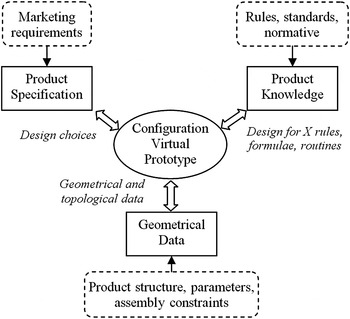
Three main different domains give a CVP definition, as shown in Figure 1: product specification, geometrical data, and product design knowledge. Product specification refers to the configuration phase, where requirements are translated into technical choices solving constraints and elaborating required design parameters. Geometrical data refers to predefined geometrical solutions to be modified and rearranged to get the desired product instance. Such geometrical data representation is also called a template. Product design knowledge is represented by rules mapping requirements, design solutions, hierarchical product structures, dimensioning rules, and assembly building strategy. It can be either explicit, if expressed in terms of formulas or if-then-else statements, or implicit, if found in geometrical models.
A representation of the configurable virtual prototype concept.

3.1.1. Product specifications and product knowledge
The analysis of product development processes in several companies shows that the strategic choices related to new product lines are characterized, in the first phases, by the definition of market requirements (MRs) and PRs. MRs are determined by marketing experts on the basis of customers' analyses. PRs are the technical perspectives of the product concept. Their elaboration leads to the realization of the specific new solution. They are usually interrelated and structured through priority and dependence relations.
Domain knowledge, depending on the specific applicative context, is generally explicit and invariant. In contrast, strategic design knowledge, useful to conceive product design, is generally tacit, dispersed along the whole design chain, connected to individual know-how, and hence rarely formalized (Ishino & Jin, Reference Ishino and Jin2002).
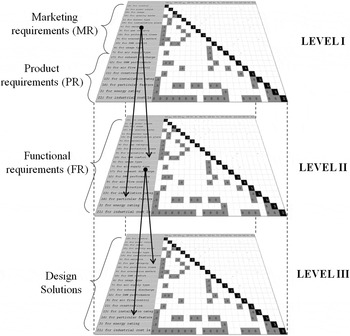
In the CVP approach, strategic knowledge is arranged in three levels: the first level concerns the relationships between MRs and PRs; the second level consists in the translation of the product into functional requirements (FRs); and the third level maps FRs with specific design solutions identifying product structure. The design structure matrix (DSM) methodology uses matrices to represent interdependency relations (Lindemann et al., Reference Lindemann, Maurer and Braun2009). In this context, it is applied to support knowledge formalization and elaboration. It allows the information managed through flat models to be ordered by arranging them on different levels with different degrees of priorities. Each level and the relevant information are interconnected by dependence relations.
The functional specifications are reported at the CVP level, which is influenced and constrained by the choices established at a higher level (Fig. 2).
A multilevel design structure matrix for product specification management in a configurable virtual prototype.

The simplicity and immediacy of the DSM representation is important because it allows experts to focus on dependency relations between two parameters, neglecting the priority rules that are generally expressions of tacit design knowledge. The parameters are reported in the relative matrices in an arbitrary order, and then the following partitioning and tearing operations (Browining, Reference Browining2001) redeploy them according to an order coherent with the dependency relations. Through banding algorithms, groups of design decisions to be simultaneously performed are identified. By reordering matrix columns, it is possible to minimize feedback loops (Yassine et al., Reference Yassine, Whitney, Daleiden and Lavine2003). This implies the determination of the basic sequential steps for the user to determine wanted PRs.
3.1.2. Geometrical data and design process
In the proposed approach, it is assumed that output part models are obtained by opening an interactively built model; by modifying parameters, dimensions, or the number of repetitions; by suppressing or reactivating features; by writing nongeometric properties as codes, project numbers, descriptions, and so on; and by saving the obtained model as the output of the process.
Thanks to advances in parametric CAD modeling, this approach covers a wide range of possible part modifications, especially in fields where design automation is advantageous. Designers are able to produce highly configurable parts by paying attention to the correctness of 2-D profile constraints of the modeling features (in the sense commonly indented in parametric feature-based CAD environments) and by defining opportune driving dimensions. Such interactively defined models are referred to as templates.
Part templates are arranged in assembly templates, which establish positioning relations and further parameters. Configuration of assemblies is obtained by replacing components with new correctly dimensioned ones; by modifying parameters, number of repetitions, and mating distances; by writing nongeometric properties; and by saving the model with a new name.
The usage of parametric CAD systems allows designers to input information using semantics, which is affine to their standard working environment. Produced models are then loaded into the CVP supporting tool in order to be enriched by configuration rules expressed by intuitive semantics.
From an operational point of view, the design process can be summarized in the following steps. New product specifications (MRs and PRs) are mapped to FRs and allow a new CVP definition to be instantiated making use of a constraint satisfaction tool. It is an initial configuration phase that does not produce a list of components as in the traditional tools. FRs, the constraints of the problem, determine the requirements and the functional structure of the product. This allows identifying a CVP with its modular structure, its main characteristics, and parameters that represent the output variables. Then required modules are configured from parametric CAD models recovered from the company database. Parts and assemblies to create the final product model are selected and instantiated in the necessary quantities and shape on the basis of the rules contained by the CVP. At the end of such a process the geometrical definition of a product and its bill of materials are obtained. A CVP IT system manages these operations in a semiautomatic manner.
3.2. Modules of a CVP-based supporting system
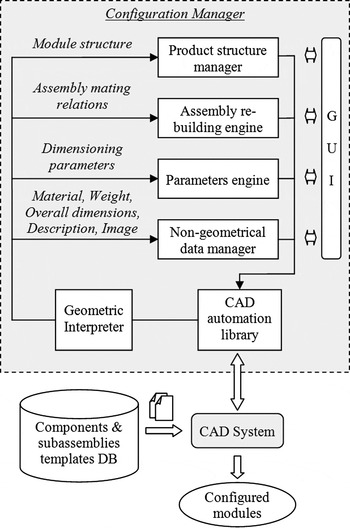
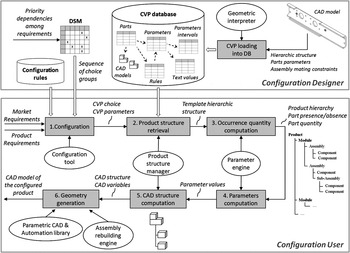
This section introduces the main modules that form the CVP IT supporting system called configuration manager (CM). Figure 3 shows these modules and their connections. The CM system is composed of modules to manage the product structure, the parameters, the rules, nongeometrical data, and the assembly rebuilding process.
The configuration manager system scheme.

3.2.1. PSM
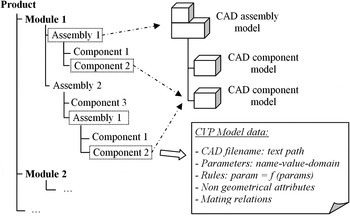
In order to accomplish geometrical configuration, it is necessary to manage the product structured tree of parts and assemblies. This task is delegated to a PSM. It operates on data structure schematically represented in Figure 4.
A product structure schematic representation in terms of part tree, models, data, and connecting linkages.

This structure is formed by a double-layered product structure tree. The term occurrence refers to the generic element of the set of components or subassemblies of an assembly. One layer identifies the product structure in terms of occurrences, parameters, and rules. The other tree is the CAD model structure and does not contain duplicates of identical instances of parts.
The PSM tasks are identifiable with a CVP model hierarchy creation and administration tool:
• to contain a list of product parts and assemblies with parent–child linkages, usually known as a bill of materials;
• to represent each part (both component and assembly) through a name, a geometric CAD model, and an occurrence name used as an identifier in the parent assembly;
• to store a list of geometrical and nongeometrical parameters for each part; and
• to implement a comparison functionality to identify similar product parts. The comparison functionality evaluates names, CAD model references, the list of parameters, and also the list of occurrences in the case of assemblies. This is used to build the list of effective distinct parts whose geometries must be subsequently generated.
The main operators working on the PSM are the following:
• functionalities to rename, delete, or add parts to configure an original structure;
• a tool to partially or entirely read and repeat a structure from an already existing assembly CAD model; and
• a replacing tool provided to substitute a part with others while maintaining structure coherence and linkages, in particular the possibility of parent assembly to identify new child occurrence.
3.2.2. Parameter engine
The configuration activity provides a template model as the basis for the design automation activity. The PSM reads the tree structure of the template and the parameters and the rules of each tree node from a repository.
Parameters refer to dimensions and variables that control parametric part geometries. The parameter engine recognizes such parameters by querying the CAD system data structure. Parametric modeling systems often make use of tables that collect parameters introduced by the feature definitions. The user can often rename parameters with significant and recognizable identifiers.
Rules are logical and dimensioning expressions among variables in the form of equalities. The syntax always expects the left part of the equal to be a single variable while the right part can be any complex expression. Circular references are not allowed.
Some examples of rules are the following:
 $$\matrix{Component{\it1!}Thickness=IF \lpar Component{\it2!}Width \cr \lt 10\semicolon \; 5\semicolon \; 0.2\,^{\ast}\, Component{\it1!}Height\rpar \cr Component{\it1!}QUANTITY=Assembly{\it1!}Height / 100 \cr Component{\it1!}Position=150+100\,^{\ast} \,Component{\it1!}INDEX}$$
The syntax is intuitive and commonly understood because it is used by popular software such as Microsoft Excel™. The character “!” that appears in the variable identifier separates the actual parameter name from the parent part name.
A parser is able to understand the syntax and solve the formulae identifying variable names, mathematical operators, and nested parentheses. This is accomplished in the following way:
• Dependent variables are identified as those appearing on the left side of one equality.
• Independent variables are those referred to on the right side and never on the left; they need to be assigned some input values to allow the set of rules to be solved.
• The rules are sorted in a list order of their variable dependencies.
• The list starts with rules that merely specify the assignment of a specific value to a parameter.
• Every other rule appears after all rules that contribute to computing the values of variables that are used in the rule.
• The rules can then be processed according to the list order.
QUANTITY and INDEX are reserved variable names that are automatically introduced by the parameter engine. The first one denotes the number of occurrences of the component or assembly. When solving the expression, if the QUANTITY is 0, the part is discarded from the product structure. If the QUANTITY is more than 1, the occurrence is instantiated multiple times and every instance is identified by a different value of INDEX.
Because the number of occurrences depends on the QUANTITY variable values, the set of rules is processed first to determine the necessary occurrences in the product structure. Then the set of rules is composed again and finally processed to gain all the values of the variables. For instance, let us assume an occurrence defines a rule to compute one of its parameters. As a result of the first solving stage, this part comes with a QUANTITY greater than 1, so its parameters and its rule are instantiated multiple times. The second stage in the solving process allows the values of the new parameter instances to be computed.
3.2.3. Geometric interpreter and CAD automation library
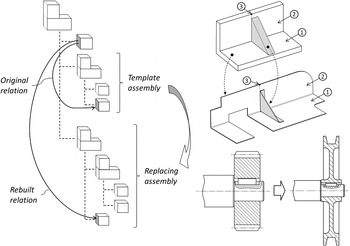
Besides updating parameters, models of configured modules require the creation of assembly files for parts defined in the product structure and the automatic instantiation of spatial relationships. Knowledge for this operation is recovered from mating relations interactively entered by the designer in template models. During template modeling activities, the designer has already implicitly defined how and in which order parts must be assembled. Sets of mating constraints, for instance, pairs of planar faces, are defined for the relative positioning of components. A geometrical and topological search of corresponding entities is used to sort out geometrical entities to be mated. The mechanism has been described in a previous work (Raffaeli et al., Reference Raffaeli, Cicconi, Mengoni and Germani2010) and is illustrated by some examples in Figure 5.
Identification of corresponding mating entities in replacing model occurrences. Some examples are provided on the right-hand side.

In the upper right part, the strategy of positioning a stiffening rib is captured and reproduced between two differently shaped sheet metal parts. Two planar mating relations and a point coincidence are rebuilt. In the lower right-hand side, a pulley is substituted for a gear. Shaft axes coincidence, adjacency to shaft shoulder, and contacts with the keyway sides are the mating constraints being identified and recreated.
Finally, the nongeometrical data manager takes care of data that is not strictly related to part dimensioning. This includes product data management such as the project number, the parts description, and the author's names. The data regarding the parts also includes material, images, overall dimensions, and weight.
The four presented modules comprise the CM framework. Because the system often refers to data implicitly stored by the 3-D geometries, an additional geometric interpreter block is necessary to recover meaningful data, especially dimensioning parameters and geometrical entities for the assembly rebuilding engine.
The whole system works as an extension of CAD system functionalities. Data is imported by CAD models, reworked by the CM, and then transferred back to the CAD to generate new configurations. The CAD automation library allows this mechanism. It provides a set of functionalities to access CAD data structure to read and pilot the system. Connection to commercial CAD system uses application programming interfaces, typically based on Microsoft COM technology. A graphical user interface completes the system in order to interact and edit data structures.
3.3. The CVP-based configuration process
Figure 6 is a flowchart of the activities that start from a new product configuration definition and lead to the final geometry. The chart highlights the input and outputs for each step. The figure shows the CMS modules with ovals and how they are involved in the process steps.
The configurable virtual prototype based process from configuration to product geometry.

Two main stages and two related figures are considered: the configuration designer and the configuration user. The first one is basically responsible for inputting the configuration rules, establishing the sequence of choice groups through the above-described DSM approach, and building the CVP database (CVP DB). The investigation of the constraints-based system and how configuration rules are stored and managed is beyond the scope of this paper. The CVP DB is a standard database containing a list of models, relative parameters, rules, and CAD models. A dedicated environment allows such data to be loaded from parametric CAD models and the definition of parameters, variants, and rules. The CM application manages the design workflow and the data exchange activating the required modules on the basis of the type of user.
The second figure shows the process used for everyday design activity of customized products. The process is based on six steps:
1. The initial configuration of the product from the requirements. The output is the choice of a particular CVP model and its main definition parameters. This phase is accomplished by a constraint-based system. The variables are represented by the parameters of the CVP rather than the components of the product.
2. Product structure retrieval from the CVP DB and instantiation. Because the CVP definition is hierarchical, the branches of the tree are recursively loaded from the DB. Associated parameters and rules are recovered.
3. The presence of certain occurrences as well as their number is dependent on the values assumed by the parameter QUANTITY. This parameter is obtained solving a rule, which determines its value. On the basis of the results, branches of the product structure are discarded or repeated.
4. A new set of rules is formed as a consequence of the previous step. Parts being repeated introduce new parameters and rules. A new resolution round is executed to determine the whole set of parameters.
5. The PSM computes the required CAD model structure. The PSM recognizes that distinct parts of the product structure share the same template model and the same set of parameter values. In this case, a single instance of the geometric model is created and repeatedly used in the assembly. This step is fundamental to have a correct product bill of materials. The computation of model structure may include parameters that may or may not correspond to geometrical dimensions. Only the first type is translated in the model structure.
6. The last step regards the generation of the CAD models by updating template files. They are copied and renamed. Parameters are updated leading to a new geometry. Template assemblies are rebuilt substituting the new occurrences, starting from the leaves toward the root of the hierarchy tree.
4. APPLICATION IN THE INDUSTRIAL CONTEXT
4.1. Gas turbine ducts design
The work belongs to long-term research carried out in collaboration with several companies designing and manufacturing exhaust gas ducts for turbo gas plants in which geometric configuration tools are extremely useful. The proposed approach has already been applied in the automation of design activities of products such as air treatment units, lift structures, agricultural harvesters, and plastic molds. The number of CAD systems integrated in the framework demonstrates system flexibility and interoperability: SolidEdge™ (by Siemens) to SolidWorks™ and CATIA V5™ (by Dassault System).
The common goal of these projects was the development of innovative methodologies and tools to support the definition of new solutions through the combination of the benefits of automatic product configuration systems, the flexibility required in modern design context, and people's skills.
In this paper, gas turbine ducts have been chosen as the most representative and significant test case. The research was carried out in collaboration with Tallarini srl, an Italian supplier company of General Electric. In this case study, the different aspects presented in Section 3 have found a comprehensive application. Even though the whole framework has not been implemented in a single supporting tool yet, the various required functionalities have been explored with prototypical solutions.
Design of exhaust gas ducts involves competences from different fields such as acoustics, fluid dynamics, and structural analysis. From the very beginning an original framework has been proposed and developed as an integration of a collaborative environment. In Germani et al. (Reference Germani, Raffaeli, Bonaventura and Mandorli2005), details regarding the problem and the first results were presented. In the subsequent project development, the necessity of flexibility in part definition and arrangement has led to a rewriting activity of the tool in order to approach the tasks and knowledge formalization in a more structured manner, based on the CVP model.
The functional analysis of numerous plant typologies allowed the modularity of the systems to be identified. In particular, a product platform has been determined and represented in a product model structure. Such a model contains all the information and rules useful for the detailed plant geometric configuration and for selective and immediate data eliciting (geometric and nongeometric), used as input for the CVP. Finally, classification of product variants allowed suitable design choices procedures to be implemented on the basis of DSM approach results.
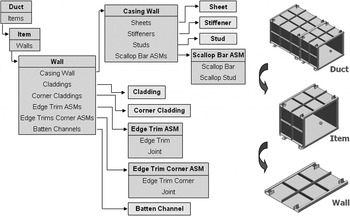
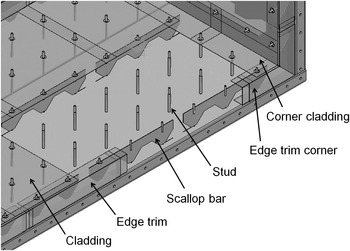
It has been recognized that a duct is an ordered set of modules called items along a 3-D mean axis made of line segments. Each item is generally made of four walls. A wall is made of the structural part, the casing wall, and insulation. The casing wall consists of sheet metal panels, some stiffeners, and parts to support insulation, which are studs and scallop bars. In contrast, insulation is made of cladding pieces (claddings), edge trims, and batten channels, which are all sheet metal parts containing insulation fibers.
The results of such analysis have confirmed the hypotheses to use the CVP approach. The resulting hierarchical structure is shown in Figure 7. Product analysis has led to fixing this structure as the most general representation of possible variants. The elements of the structure can be replaced by variants and compared in multiple instances as required by the CVP framework.
Part of the hierarchical product structure formalization. ASM, assembly; ASMs, object collections.

A software package has been developed to provide a graphical user interface and formalize duct object structure and configuration rules. The system has been interfaced with a commercial 3-D modeling kernel (SolidEdge™ by Siemens) and a database (Microsoft Access™) where data regarding components is stored. The software application has been developed using Microsoft™ .NET languages.
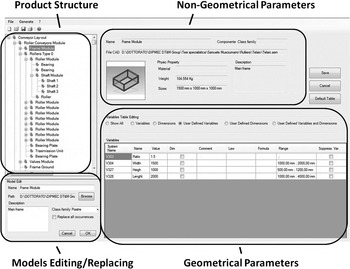
Figure 8 shows the Windows-based user interface of the system. The DSM approach has been used to sort requirements and their interdependences. In this way, the right sequence of choices has been determined and organized. The outputs of the system are represented by a complete list of parts without repetitions, unique part codes, detailed 3-D CAD models, technical documentation (2-D drawings, bills of materials, costs account, etc.), and the definition of geometrical information for structural, acoustic, and fluid dynamic analysis tools. In the context of the specific project, this tool has been developed and customized with additional functionalities to satisfy specific partner needs.
The configuration manager graphical user interface.

PSM and parameters engine modules have been implemented to represent the product in the form of objects linked by a tree. Such object definitions are retrieved by the database and instantiated from presence rules introduced by the user in a dedicated interface. Then geometric parameters are computed by parsing the formulae discussed in Section 3.2.2. Finally, the CM traverses the object structure to define the required CAD model structure and to generate part instances, geometries, and documentation.
A wide usage of assemblies composed of part templates has been made as a mating relations source. During the assembly reconstruction phase, the tool traverses the template assemblies and imports component references and mating relations. Afterward, a new assembly is introduced by finding corresponding occurrences in the product structure. Mating constraints are automatically created using the same typology of the ones in the assembly template. Entities to be mated (faces, edges, and vertices) are recognized using an algorithm based on geometrical and topological likeness, as previously mentioned.
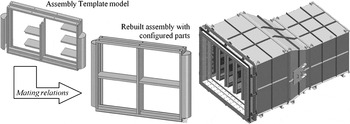
Figure 9 shows an example. The silencer panel has a structure made of bent sheet metal. The overall geometry is dimensioned accordingly to the product's acoustic requirements. Parameters have been identified as panel thickness, panel length, panel height, sheet metal thickness, number of vertical stiffeners, and number of horizontal stiffeners. Each part parameter is computed from this set of parameters through formulae stored by the silencer panel CVP. The CM software system drives the CAD to model the required parts. It also rebuilds the panel assembly on the basis of the mating relations of the template model. Finally, the panel is mounted inside the duct and replicated as necessary.
Silencer panel assembly dimensioning and mating relations rebuilding.

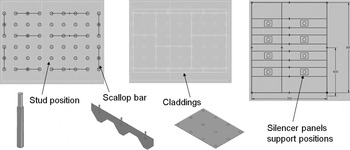
The software system to support turbo gas duct configuration has been essentially conceived on the basis of the CM scheme described in Section 3.2. However, in order to reach a higher level of flexibility in insulation definition, a strategy based on simplified 2-D layouts has been introduced. It basically consists of the substitution of complex shapes with elementary geometrical entities in the definition of the geometrical arrangement of cladding pieces, studs, and the other parts of the insulation. Figure 10 shows strategies in use for a simplified representation of parts.
Examples of simple geometrical entities used to define panel insulation geometry.

Studs are characterized by revolution geometry and are welded on the panels. Circle centers will represent their position. Scallop bars are represented by segments that, combined with stud circles, provide all the necessary geometrical parameters. Cladding pieces are represented by closed paths passing through stud centers. An offset operation during generation will add extra surface to reach the necessary extension.
The software tool automatically provides an insulation layout on the basis of input dimensions, in terms of wall extension and a possible component arrangement. This layout is obtained from rules stored in the system. Then the user can modify and complete the layouts, customizing the solution to specific needs. Each insulation component type is drawn in a specific SolidEdge “Sketch” feature. The system reads the CAD sketches and extracts data for the PSM to instantiate the required parts.
Figure 11 shows the result of the process. Components and subassemblies are dimensioned and assembled to their final configuration.
An example of item generation results. Insulation components are in their final arrangement on the basis of a respective simplified layout.

4.2. Results and limitations
The development of the application and the test activity on industrial applications demonstrates both the benefits and some issues concerning the proposed approach. Each duct is generally composed of 5 to 10 items. Each item includes at least 100 to 150 parts to be configured, assembled, detailed in drafts, and exported in a format useful for production. Manually, a department made of four to five designers would require around 2 weeks to prepare the documentation. The developed configuration tools reduce developing time to approximately 3 h per item, including a couple of iterations to improve the solution.
From an operational point of view, designers appreciate the possibility of being able to import existing product structures into the PSM and apply modifications. The possibility of linking the quantity of part occurrences to some parameters allows flexibility in product structure instantiation. Afterward, the possibility of quickly generating a detailed geometrical model is fundamental to shorten development times and to concentrate on more stimulating activities.
By contrast, some open issues have emerged. The first one is related to the generalization of the field of application. Thus far, the approach has been tested on products conceived as assembly of configurable components or modules. In this case, it has provided good results. Extension of the approach to more complex and integral architectures requires a deeper analysis of the exchangeability of parts.
Moreover, some designers have found the introduction of the rules too intricate and cumbersome, especially for assemblies with more than 10 parts. However, this problem is mitigated by being able to define the expressions once, and then retrieve and reuse them from the CVP model every time it is considered necessary.
The second observation concerns the validity of the heuristics used for the geometric recognition of corresponding entities among parts. Hypotheses on models are not too restrictive, because only orientation is required to be homogeneous between the parts to be exchanged. However, the algorithm does not always produce valid solutions, and often it is conceptually impossible to maintain the same set of assembly constraints. Evaluation of the exchangeability of parts and assemblies is still delegated to designers and not supported by the system. However, the automatic replacement of parts facilitates the configuration designer work and allows the entire space of configured products to be obtained, starting from a minimum set of templates.
5. CONCLUSIONS
The approach of traditional configuration tools has shown many benefits in industrial practice. However, further advantages can be achieved in the mechanical field by combining configuration with design automation capabilities in order to support variant configuration. Moreover, it is necessary to support the evolution of products as technical solutions change, new features are introduced, and therefore the geometries of the parts change.
This paper presents a framework to develop tools in which configuration capabilities are combined with CAD geometry generation. The concept of the CVP has been introduced as a way to manage information on a certain product class, taking into account three main domains: specifications, geometrical data, and design knowledge.
Connection among the three design levels through DSMs helps to explicit, store, and reuse design knowledge and rationale. Parametric CAD models of template product instances are used as a source of geometrical solutions, design parameters, and mating constraints between parts. The CM supporting tool has been presented to obtain a final solution also by reusing and reconfiguring previous solutions through replacing functionalities based on geometry analysis.
The long-term aim is to conceive a software tool that operates as far as possible from a specific industrial domain. This is possible through the further investigation of the functionalities introduced by the CVP framework. The prototypical implementation illustrated in the test case section has shown the feasibility for some industrial applications.
Roberto Raffaeli is an Associate Researcher in the Department of Industrial Engineering and Mathematical Science of the Università Politecnica delle Marche. He graduated with a degree in mechanical engineering from the same university in 2002 and received his PhD in 2008. His topics of research are design theory, CAD/computer-assisted manufacturing and CAx systems, mass customization, reverse engineering, and geometric modeling. His research also focuses on the application of such methodologies and tools on fields from mechanical to medical. He is the author of approximately 45 international scientific publications, 12 of them in international journals.
Maura Mengoni is an Assistant Professor of mechanical engineering at the Università Politecnica delle Marche, where she teaches courses in virtual prototyping, tools and methods for product data management, and CAD modeling. After attaining her PhD from the Faculty of Engineering at the same university, her research activities have focused on virtual prototyping techniques and virtual reality technologies and applications, human–computer interaction and user-centered design methods and tools, and computer-supported cooperative work. She is the author of more than 70 international publications and has participated in several national projects, becoming a scientific advisor of the CO-ENV consortium in 2007, which carries out research and development activities in the field of IT for about 15 small to medium enterprises and 5 large enterprises.
Michele Germani is an Associate Professor in the Department of Industrial Engineering and Mathematical Sciences at the Università Politecnica delle Marche. His main research topics are modular and configuration methods, advanced virtual prototyping tools, ecodesign methodologies, and human–machine interaction evaluation through virtual reality/augmented reality systems. He is the author of 160 scientific papers published in international journal and conference proceedings, and he is responsible for several European and national research projects.