


We regard the capacity to formulate cases psycho-dynamically as a key clinical skill that all psychiatrists should be ready to apply to any case material. Its applications are potentially beneficial in many ways. Formulation should not have to wait until formal psychotherapy is being considered as a treatment option, and great theoretical sophistication is usually not required. An appreciation of the purpose of psychodynamic formulation is key not only to doing it effectively, but also to teaching it.
The purpose of psychodynamic formulation
A psychodynamic formulation should summarise the dynamics of a clinical situation, allowing its apparent motivation to be grasped by someone who is otherwise unfamiliar with it. The formulation will explain the nature and timing of key developments up to the present and will facilitate predictions of what is likely to happen in the future. It incorporates a summary of relevant background information, alongside a series of systematic inferences drawn from this. As a clinical report, it must account for symptoms and disabilities in the light of adverse events and developmental patterns. As a psycho-dynamic explanation, it will discuss interpersonal and intrapsychic mechanisms. It is therefore likely to refer to internal conflict, developmental difficulties or unconscious processes.
A psychodynamic formulation has a number of clinical uses. It helps any psychiatrist to see what a person is doing, thinking and feeling, and to explain why. It helps in anticipating how that person may behave in the future and how they may respond to adverse events and to different treatments. This is particularly relevant in the assessment of new patients for psychological therapies, where a principal task of the assessor is to arrive at an adequate formulation in order to make recommendations for further work. Formulation can also guide the treating psychotherapist by providing a map of treatment. This can be used by both therapist and supervisor to keep a treatment ‘on track’ and also to evaluate the progress made as the treatment continues.
The principal uses of formulation are summarised in Box 1. Item 3 probably corresponds to the most commonly recognised function of formulation – that it tries to provide a psychological account of why this patient is having this problem at this time. Items 5 and 6 are closely linked to item 3, in that a formulation of what is responsible for the onset and maintenance of difficulties will be used during the treatment designed to remove them, as well as in the evaluation of that treatment. These are not always appreciated in teaching about formulation. Items 1, 2 and 4 represent ways in which psychodynamic formulation remains useful irrespective of the aetiology of the presenting problem or the treatment that is eventually chosen. Unless the potential usefulness of formulation in understanding habitual ways of coping is appreciated, it will not be attempted as often as it should.
-
1 To understand and predict how a particular individual responds to being ill
-
2 To understand and predict an individual’s likely responses to treatment
-
3 To summarise psychodynamic factors contributing to current difficulties
-
4 To draw up recommendations for further treatment
-
5 To evaluate the effectiveness of any subsequent psychotherapy
-
6 To guide therapists and supervisors providing psychotherapy
Formulation also has educational value independent of its clinical usefulness. Asking for a formulation will provide evidence of a trainee’s current capacity to think psychodynamically. In addition to the clinical uses summarised in Box 1, formulation is useful as a tool with which trainees can be helped to organise ideas, and through which their growing competence in psychodynamic thinking might be assessed.
Formulation v. diagnosis
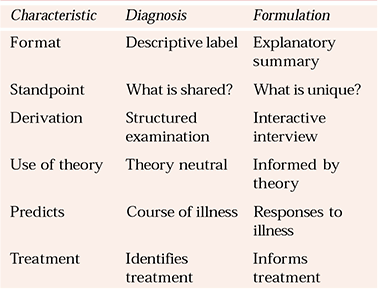
At first glance, some of the functions of formulation can appear to be those of diagnosis. Although diagnosis and formulation share an interest in summarisation and in prediction, they remain distinct (Table 1). We believe it is essential to grasp how psychodynamic formulation differs from a psychiatric diagnosis in order to understand what formulation is about. A diagnosis is generally thought of as a summary label such as paranoid schizophrenia or dysthymic disorder. Ideally, it should be more than this, being a multi-axial summary of psychiatric syndromes, personality, non-psychiatric illness, social and situational factors. However, it rarely takes this form in practice. Furthermore, although multi-axial diagnosis potentially offers information about more aspects of a patient’s current state, its statistical function means that descriptors under any given heading will always be chosen from a limited menu of standardised terms. All diagnosis therefore remains fundamentally an exercise in naming what this patient has in common with others, leaving it to formulation to identify and explain what is unique about this patient’s presentation.
Some basic differences between diagnosis and formulation
| Characteristic | Diagnosis | Formulation |
|---|---|---|
| Format | Descriptive label | Explanatory summary |
| Standpoint | What is shared? | What is unique? |
| Derivation | Structured examination | Interactive interview |
| Use of theory | Theory neutral | Informed by theory |
| Predicts | Course of illness | Responses to illness |
| Treatment | Identifies treatment | Informs treatment |
Diagnosis requires that information about symptoms and signs be gathered from a mental state examination and a history be taken that provides facts concerning several types of event in the patient’s life. These are matched against the criteria for candidate diagnoses in order that the most appropriate ones can be selected.
Formulation requires additional kinds of information, such as a sense of how the patient feels and responds in a variety of situations. It is concerned with why events have followed one another and the meaning of these for the patient. Apart from detailed questioning, the interviewer may use the experience of being with the patient to gather information. For instance, the way patient and assessor interact and how a trained assessor feels after an interview can help him or her to infer characteristic ways in which the patient responds to painful experiences and relates to others.
Although psychiatric diagnoses always identify a recognised cluster of symptoms, they differ from most other medical diagnoses in their failure (or refusal) to refer to a presumed cause or aetiology for these. Diagnostic terms are also expected to avoid theoretical connotations. However, the explanatory nature of formulation means that it is inevitably theory laden. Moreover, there can be distinct levels of sophistication (or esotericism) in the theory that is used.
One longstanding function of diagnosis is that it should aid prediction of what is likely to happen. The disorder that a diagnosis names is presumed to have a typical history. Yet there are real differences in the utility of this predictive function: most diagnoses in psychiatry are indistinguishable on the basis of their natural history, lacking the predictability of organic syndromes such as the dementias. Formulation, however, strives to take sufficient factors into account to differentiate one individual’s expected prognosis from another’s. Its predictive validity can be checked only against subsequent events. If things develop in unexpected directions, the formulation is likely to need modification even if the patient’s diagnosis is unchanged.
Diagnosis is also expected to be a guide to treatment. In other medical specialties, there is a close link between this function and what the diagnosis conveys about aetiology and prognosis. Although this function is relatively weak for most psychiatric diagnoses, the current rules of evidence-based practice are reinforcing expectations that an accurate diagnosis carries clear implications for treatment. In the field of psychological treatments, however, diagnosis by itself remains a poor way of choosing a treatment that is likely to be effective. There are real differences between individuals in their responsiveness to most treatment methods, but diagnosis remains a poorer guide to prognosis than other patient characteristics such as defensive style (Reference Perry, Miller, Luborsky and BarberPerry, 1993). An argument can therefore be made that, in drawing on other kinds of clinical knowledge, formulation provides a sounder basis than diagnosis on which to identify and choose treatments.
Formulation comes into its own in providing a blueprint of the likely targets to be addressed during a treatment in order for the presenting difficulties to be resolved. It is a reference against which the actual outcome of the treatment can be judged. Although its content may be unique to an individual patient, it is possible for formulation to follow a systematic method that produces comparable results with different formulators, facilitating its use in the routine assessment of clinical progress (for an example, see Reference Malan and OrsimoMalan & Orsimo,1990).
What is a formulation like?
One of the reasons why it is difficult to give (or even to find) examples of psychodynamic formulations is that there is no generally agreed format for them to follow. Some significant attempts have been made (Reference Perry, Cooper and MichelsPerry et al, 1987; Reference AvelineAveline, 1999; Reference Kassaw and GabbardKassaw & Gabbard, 2002), but these tend to confirm that ‘psychodynamic formulation’ has been linked to a range of types of summary rather than a universal model. There can also be confusion over the distinction between diagnosis and formulation: the term ‘case formulation’ is sometimes encountered as inclusive of both diagnosis and psychoydnamic formulation (Reference Eells, Kekjelic and LucasEells et al, 1998). Furthermore, psychodynamic formulations proper vary in the thoroughness of the explanation that is sought, as well as the theoretical sophistication with which it is expressed. While explanation is key to proficiency at formulation, a survey (Reference Eells, Kekjelic and LucasEells et al, 1998) has confirmed our own impression that many ‘formulations’ remain essentially descriptive, without a full transition to explanation and prediction.
The four-level model
We shall distinguish between different levels of formulation in terms of what they demand from the clinician (Box 2).
-
1 Recognising the psychological dimension
-
2 Constructing an illness narrative
-
3 Modelling a formulation
-
4 Naming the elements
First comes an appreciation that factors specific to the patient are necessary in explaining what has happened to this person, even if their contribution cannot be clearly articulated. Second comes a willingness to draw these and other known facts together. This will yield a narrative account of the individual’s situation that conveys an understanding of why things happened in the way they did. Third is an attempt to think about these summarily. This combines systematic identification of past and present factors that explain the onset and maintenance of difficulties with some conceptualisation of conflicts that underpin the patient’s disclosures and actions. A summary of this kind should be sufficiently cogent to permit prediction about future behaviour. At the final, fourth level, explanation is assisted by sufficient psychodynamic theory for the formulation to be systematically articulated and refined. Theory is most useful as a foundation for descriptions of individuals’ underlying strengths and vulnerabilities; in providing a consistent framework for identification of conflicts with which their symptoms are associated; and in describing enduring aspects of their interpersonal style. The differences between these levels will become clearer using the following case vignette as illustration.
Case vignette: Arthur
Arthur is a married man of 35 who works as an accountant. He was referred after being taken by his wife to his general practitioner (GP). He had been lying in bed for days and then she found him searching in their attic in the dark. He refused to tell the GP what he was doing there, but on questioning admitted to very interrupted sleep, loss of appetite and feeling worthless. He had been expressing fears that he was incapable of doing his job well for several weeks beforehand. He had stopped working, was staying indoors and had begun to express a view that others would be better off without him. He told the GP he was very afraid his wife would leave him, although he could not explain why.
Arthur is reluctant to talk about his past and tells enquirers everything was ‘fine’. He has no formal psychiatric history although his GP had recommended he see a psychiatrist when he had taken several weeks off school at the age of 13. He had also been unable to work for several weeks when a girlfriend left him in his early 20s. His wife described him as a workaholic and a perfectionist who was devastated if he made a small mistake.
Level 1: Recognising the psychological dimension
A patient is seen not only as an example of someone with diagnosis X, but as someone whose difficulties need to be understood in relation to events and their own characteristic ways of reacting and relating.
Arthur clearly has depressive symptoms that are becoming sufficiently severe for him to earn a diagnosis of a unipolar affective disorder. There is little information to suggest why this is happening to him at this time, although the onset is apparently recent. However, there is information that he has withdrawn from others in a very similar way in the past and clear precipitants for him doing so then could also be relevant now.
Level 2: Constructing an illness narrative
The intelligibility of the patient’s story increases as an account is developed that links past and present. This indicates when major changes in the patient’s subjective experience occurred and what may have brought them about.
Let us continue with the vignette.
Further interviewing reveals more aspects to Arthur’s story. At first he has simply described his father as ‘old-fashioned’ and ‘strict’. Subsequently, he provides illustrations of how his father used to berate him in front of family and friends for being stupid, leading Arthur to believe that his school reports were never good enough. While he feared his father more than his mother, he was never sure that she would defend him. When he had shown his mother how unhappy his father’s taunts made him, she became unwell and went to stay with her sister, leaving Arthur to face his father’s sarcasm alone. Although Arthur was too afraid even to think of arguing with his father, he remembered feeling vengeful and becoming bullying towards his younger sister, whom his father adored.
While at school, Arthur had tried to work hard. When he was bullied for a period he had been afraid to ask for any help, but had to see the headmaster because he lost his temper and savagely beat another boy after one attack too many. It was shortly after this reprimand he became so withdrawn that the GP was called in and psychiatric assessment considered. Arthur spoke of feeling humiliated by the whole experience. After leaving school he had been mostly studious, but would become quite violent if he drank too much. He was cautioned by the police on one such occasion, and his girlfriend said she would have nothing more to do with him. Arthur recalls feeling abandoned and also being terrified his name would appear in the newspaper just before he spent several weeks off work with what he refers to as ‘depression’.
Turning to recent events, Arthur admits to having felt under pressure from his wife to ask his boss for some leave. The plan was for Arthur to look after their young disabled son while his wife went to a family wedding abroad. His boss had refused, saying the company was too busy to spare him at the time he wanted to go. Arthur took this as a rebuke that he had not worked hard enough to allow him time off. He suppressed any wish to argue with his boss, but felt inadequate afterwards. This feeling increased after his wife upbraided him at home for letting her down and for not being firm enough. Arthur found himself shouting at their son and felt very guilty at this. Just days later he was found in the attic.
The narrative that has built up now gives a more comprehensive picture of how Arthur experienced particular events. It puts the appearance of his symptoms in the context of exposure to increasingly intense and unwelcome feelings (of shame, resentment, rejection and guilt) with him feeling increasingly useless before he withdraws from his family.
Level 3: Modelling a formulation
The aim at this stage is to acquire a more structured and dynamic understanding of how different pathogenic factors operate and interrelate with each other.
The traditional framework of predisposing, precipitating and maintaining factors can be adopted in a selective reorganisation of information that has been gathered during systematic enquiry. This allows statement of one or more conflicts between conscious or unconscious wishes that underpin the persistence of the presenting problem and the (often underestimated) distress it brings. Whether or not the patient immediately recognises the conflict, there is no place for jargon or shorthand here. Too often, jargon can be a cloak for sloppy thinking. It can also lead to confusion because different people can mean very different things by terms such as Oedipal, narcissistic and psychotic.
In Arthur’s case, we might see factors predisposing him to depression in his mother’s tendency to respond to his needs with avoidance, leading him to fear being abandoned if he expresses them; and in his father’s very critical and demanding attitude, which has left him fearful of criticism and humiliation.
Precipitating features include shame in relation to perceived criticism of his work; helplessness in the context of the recent confrontation with someone in authority (his boss); and a sense of abandonment following his wife’s criticisms and withdrawal from him. These are reflected in ideas noted on mental state examination such as his apparently irrational fear of being abandoned by his wife.
Maintaining factors usually divide into internal and external ones, the former being most likely to be overlooked. Arthur has clearly internalised a tendency to be harshly critical of himself, which is likely to be self-fulfilling because it is reinforced by his perfectionism. This means he sets standards that are impossible to meet, resulting in frequent self-criticism. Other maintaining factors can involve vicious cycles between his own actions and others’ subsequent responses to these. An example is how Arthur’s angry outbursts might lead others to shun him and he might feel very ashamed about his behaviour. However, if his sense of inadequacy persists, he may remain liable to extreme anger at the slightest provocation, perpetuating the problem. In Arthur’s case, things are quite complicated. Other external maintaining factors that are evident include a work environment where his boss’s behaviour appears likely to reinforce his internal fears of being criticised and humiliated, and a home where his wife’s apparent ambivalence can reinforce his longstanding fear of being abandoned when he seeks unconditional support.
This analysis allows us to see which features of Arthur’s story have particular dynamic significance and how different factors, past and present, interact. It also helps inference concerning the dynamic core of Arthur’s difficulties. We recommend that this is expressed in terms of a conflict between the wishes or impulses that the patient evidently finds it hard to realise and the psychological factors that oppose these. Arthur’s case can be understood in terms of a conflict between asserting himself and his fears of being crushed and abandoned if he does so.
The features we believe a simple psychodynamic formulation should include are summarised in Box 3.
-
• Summary of presenting problem(s)
-
• Predisposing factors
-
• Precipitating factors
-
• Maintaining factors:
-
• internal
-
• external
-
-
• Statement of core conflict(s) associated with problem(s)
A model of this kind allows simple predictive hypotheses to be made about how patients are likely to react in future, including their relationships with professional helpers. In our example, Arthur could be said to be particularly vulnerable to becoming depressed (and to withdrawing) in situations where he is faced with demanding behaviour that he feels he cannot resist, or where he is likely to interpret apparently inconsequential events as meaning he is about to be abandoned.
Level 4: Naming the elements
This stage leads to a theoretically sophisticated formulation of identified dynamics. One of the problems in enlisting theory to underpin a formulation is that many alternative, and potentially conflicting, frameworks are available. For instance, Reference Holmes and MaceHolmes (1995) recommended specific dynamic understandings in terms of defence mechanisms, characteristic object relations or attachment style as particularly helpful. From a North American perspective, Reference Perry, Cooper and MichelsPerry et al (1987) explored the relative virtues of ego psychology, self psychology and object relations as frameworks for detailed formulation. None of these frameworks necessarily covers all pertinent aspects. Although they are not necessarily exclusive of each other, there has been little consensus about how they might be combined.
A formulation model
One recent method for devising psychodynamic formulations that are theoretically coherent as well as reliable proposes a dimensional approach. Drawing on many previously proposed templates for psychodynamic formulation, operationalised psychodynamic diagnostics (or OPD) incorporates three truly dynamic dimensions. These concern enduring structural factors such as defensive style and attachment patterns; characteristic patterns of interpersonal relations (and the feelings typically associated with these); and conflicts that currently underpin a patient’s preoccupations or distress. They are summarised in Boxes 4–6 and discussed in further detail below. The system is grounded in object relations theory, but its terminology is eclectic. A complete OPD formulation also includes two other dimensions – one for the patient’s experience of illness and prerequisites for treatment, the other for a standard (ICD) diagnosis. We confine description here to aspects of the three psychodynamic dimensions that recommend it as a device for teaching sophisticated formulation; a full account may be found in the literature (OPD Task Force, 2001).
-
• Self-perception
-
• Self-regulation
-
• Maturity of defences
-
• Object perception
-
• Communication
-
• Capacity for attachment
-
• Patient’s (repeated) experience of others
-
• Patient’s (repeated) experience of him/herself
-
• Others’ (repeated) experience of the patient
-
• Others’ (repeated) experience of themselves in interaction with the patient
-
1 Dependence v. autonomy
-
2 Submission v. control
-
3 Desire for care v. autarchy
-
4 Valuing self v. valuing object
-
5 Guilt conflicts
-
6 Oedipal/sexual conflicts
-
7 Identity conflicts
By requiring the dimensions of structure, relationships and conflict to be thought about independently for each patient, and by providing nomenclature and a system for noting the conclusions that are reached, the OPD system helps clinicians to produce a consistently structured formulation covering intra-psychic and interpersonal dynamics. As well as increasing the explanatory value of a formulation, the system enables clinical teams conversant with the underlying theoretical model to communicate effectively about patients’ needs, vulnerabilities and likely responses.
In clinical practice, production of a psycho-dynamically articulate formulation needs to draw both on observations available only during active interaction with a patient and on reported information. This is evident from the requirement to base formulation of a patient’s characteristic interpersonal behaviours on observations of others’ experiences of the patient and of how the patient repeatedly makes them feel. Interviewers’ own observations of how a patient makes them feel (i.e. their countertransference to the patient) are indispensable for this.
To return to our case example, consider now what happened once Arthur was referred for further interview with a (male) psychiatrist experienced in psychotherapy.
Arthur rang up on the day of his appointment to try to cancel the interview, but an experienced secretary persuaded him to attend. He presented as a rather worn man, older than his years, who looked anxious and haunted as well as downcast. Explaining his attempt to cancel the appointment, he said that he had felt someone else was bound to make better use of the appointment than himself and he had not wanted to waste anybody’s time. He admitted to feeling anxious in a way that had become much worse that morning. When the assessor suggested he may also have been worried about being judged if he came, he agreed that was so. He talked about how he was often worried about this and how he was frequently judged very unfairly by others, citing his boss’s disapproval of him. The psychiatrist encouraged him to say why he felt his boss was disapproving of him and Arthur started to recount how his leave was refused. When the interviewer commented that the boss may have behaved as he did because he valued Arthur’s work, Arthur checked himself, becoming less willing to talk about his boss and looking at the assessor with more reserve. Arthur commented rather sharply that his wife had felt the interview would not get anywhere either. The psychiatrist asked him carefully what it was that his wife had said about him coming to the assessment. After a very significant pause, Arthur replied that she had said it wouldn’t do any good if he tried to hide things and because he was bound to do so it would be ‘another offer wasted’. His interviewer suggested Arthur must be feeling very trapped between other people’s demands on him. Arthur clenched his fists, staring at the psychiatrist, then looked away, before starting to sob quietly.
The psychiatrist was moved by this encounter and took care to record his feelings. These ranged from irritation at Arthur’s attempts to back off to a wish to protect him from others’ unreasonable demands. Taking what was already known together with these observations of how Arthur had behaved, it was possible to sketch an outline of positions Arthur adopted in relation to others that appeared relatively fixed and repetitive. For instance, Arthur’s experience of others as blaming and demanding leads him to react with an (unfulfilled) wish to attack them and by isolating himself. This causes others to experience him as subtly attacking and as withdrawing from them, and they are left feeling he does not want them but that they should protect him. Arthur, however, experiences these attempts to protect him as controlling and he further withdraws. Once others react instead to their irritation by wanting to get rid of him, he is very sensitive to this and feels abandoned. Recurrent cycles of interaction based on the identified core experiences are set out in just this way within a formulation of interpersonal relations.
In describing conflict, the principal types listed in Box 6 need to be considered. Although more than one type is often present, precedence is given to those deemed most significant in their impact, whatever their position in the list. From what is known about Arthur (and we still have relatively little information about his relationships with his current family), two types of conflict are particularly prominent. Submission v. control seems to organise his (passive) orientation to his boss and wife, and his difficulties in establishing a comfortable position in relation to his own control induce much resistant behaviour before and during the interview. A second prominent conflict, the desire for care v. autarchy (being self-sufficient), intersects with this in Arthur’s life: his usual passive willingness to enjoy being cared for in a way that emphasises his sense of need and others’ autonomy relative to his own leaves him particularly exposed at the moments the interviewer refused to go along with these expectations.
Systematic consideration of the character traits in the dimension of structure (Box 4) reveals the degree of integration Arthur shows with each one. They are each compromised to a moderate degree: compromised self-perception is evident in the dominance of negative feelings and his response to stress; in self-regulation he overregulates aggressive impulses and esteem; impaired maturity of defenses in the rigidity of his obsessionality; his perception of others and of their feelings is inconsistent and rigidly limited (as in the earlier formulation of interpersonal relations). This also compromises his capacity to communicate with others (as seen in the interview) and the attachments he forms in his relationships (as in his presenting account).
This kind of formulation therefore provides a detailed psychodynamic footprint across the interconnected aspects of relations, conflict and internal structure, but names these in a way that facilitates reference to psychodynamic theory. (The full OPD system also provides a way of systematically recording a patient’s attitudes to illness and treatment.) Operationalised psychodynamic diagnostics is not the only way of achieving this, and it is continuing to develop through field tests. Among other objectives, these are identifying when items on the different axes are most likely to be associated, so that the clinical significance of particular patterns becomes clearer. As it stands, OPD can be applied by experienced raters with relatively good reliability and it therefore recommends itself for teaching (reliability has been found to be highest for the structural items (Box 4) when experienced raters formulate video sequences (M. Cierpka, personal communication, 2005)).
Making a formulation in practice
As we hope our model makes clear, what needs to go into a formulation will depend on the type of formulation it is. An active process of gathering information before formulating will be necessary –what Harry Stack Reference SullivanSullivan (1953) referred to as ‘reconnaisance’ before ‘summarising’. Quite detailed information is likely to be necessary about early life and previous crises as well as the onset of recent difficulties, to allow likely predisposing and precipitating factors to be identified.
In the course of an interview, questions need to focus on eliciting the patient’s subjective feelings and meanings behind possibly significant events. In judging the significance of these, interviewers should be guided by the way in which patients express themselves.
In addition to this form of history-taking, the interviewer should also be making observations based on the interview itself. This becomes especially important in level 4 formulation, which can help aspects of interpersonal dynamics and conflict to be defined that were not readily apparent at level 3. From the first moments of the encounter, observations should be made concerning how the patient reacts towards the interviewer. Are they unduly timid, assertive, seductive, aloof and so on – and what might this signify in terms of characteristic dynamic patterns? How do they behave when talking (or avoiding talking) about their feelings? Interviewers need also to monitor their own feelings, noting when these appear to be a response to the patient that was not previously present, rather than a response to unrelated events or thoughts.
Conclusions
Psychodynamic formulation needs to be understood and valued as a process distinct from psychiatric diagnosis. To produce a formulation, it is necessary to have a clear idea of what should go into it and what the product should look like. Formulation styles appropriate for senior house officers and specialist registrars are described here. The final formulation will always depend on the interaction between patient and psychiatrist and the latter’s clinical acumen, as well as the patient’s predicament.
MCQs
-
1 Uses of psychodynamic formulation include:
-
a organising waiting lists
-
b predicting response to treatment
-
c providing behavioural therapy
-
d trainee assessment
-
e collation of NHS summary statistics.
-
-
2 In psychiatry, diagnosis differs from formulation in that:
-
a diagnosis explains causes
-
b diagnosis has a standard format
-
c diagnosis summarises features shared with other cases
-
d diagnosis helps to predict what will happen
-
e psychotherapists find diagnosis more useful.
-
-
3 Common problems with formulation include:
-
a its purpose is not understood
-
b formulations are too descriptive
-
c formulations fail to explain
-
d formulations are not used in supervision
-
e examiners ignore formulation.
-
-
4 A senior house officer should be able to:
-
a identify predisposing features from early history
-
b describe dynamics in terms of self psychology
-
c explain why the problem is occurring now
-
d identify a patient’s four core defences
-
e distinguish between internal and external maintaining factors.
-
-
5 Operationalised psychodynamic diagnostics:
-
a includes a DSM diagnosis
-
b has six principal axes
-
c provides a map of archetypes
-
d records countertransference
-
e places little emphasis on conflict.
-
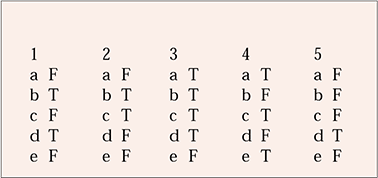
MCQ answers
| 1 | 2 | 3 | 4 | 5 | |||||
| a | F | a | F | a | T | a | T | a | F |
| b | T | b | T | b | T | b | F | b | F |
| c | F | c | T | c | T | c | T | c | F |
| d | T | d | F | d | T | d | F | d | T |
| e | F | e | F | e | F | e | T | e | F |




eLetters
No eLetters have been published for this article.