INTRODUCTION
Some patients with left brain damage (LBD) encounter difficulties when using familiar tools such as a hammer or a knife but also novel tools (see below), because of a disorder labeled apraxia of tool use. For several decades, this disorder has been viewed as resulting from impaired motor programs about how the hand interacts with tools (also called gesture engram, visuo-kinesthetic engram, manipulation knowledge; e.g., Heilman & Watson, Reference Heilman and Watson2008; Heilman, Rothi, & Valenstein, Reference Heilman, Rothi and Valenstein1982; Rothi, Ochipa, & Heilman, Reference Rothi, Ochipa and Heilman1991; van Elk, van Schie, & Bekkering, Reference van Elk, van Schie and Bekkering2014). However, recent evidence indicates that it could be rather due to the inability to reason about physical object properties (i.e., technical reasoning), thereby explaining why patients could select inappropriate tools or perform irrelevant mechanical actions (for a review, see Baumard, Osiurak, Lesourd, & Le Gall, Reference Baumard, Osiurak, Lesourd and Le Gall2014). In this context, a fundamental issue is to understand the residual capacity of those LBD patients in tool selection. In this article, we address this issue by reporting results from three LBD patients with apraxia of tool use (hereafter called apraxic patients).
For the last 2 decades, a series of studies have examined how LBD and right brain-damaged (RBD) patients are able to actually use familiar tools or solve mechanical problems with novel tools (Goldenberg & Hagmann, Reference Goldenberg and Hagmann1998b; Goldenberg & Spatt, Reference Goldenberg and Spatt2009; Hartmann, Goldenberg, Daumüller, & Hermsdörfer, Reference Hartmann, Goldenberg, Daumüller and Hermsdörfer2005; Heilman, Maher, Greenwald, & Rothi, Reference Heilman, Maher, Greenwald and Rothi1997; Jarry et al., Reference Jarry, Osiurak, Delafuys, Chauviré, Etcharry-Bouyx and Le Gall2013). Three conclusions can be drawn from these studies. First, only LBD patients are impaired on both familiar and novel tool use tasks, even if subtle difficulties can be observed in RBD patients because of visuo-spatial deficits. Second, there is a strong link between these two tasks. Third, lesions to the left inferior parietal cortex generate difficulties in both tasks. In summary, these findings suggest that there is a common neurocognitive basis in the left brain hemisphere for the use of both familiar and novel tools. Neuroimaging evidence also provides support for this (see Reynaud, Lesourd, Navarro, & Osiurak, Reference Reynaud, Lesourd, Navarro and Osiurak2016).
The technical reasoning hypothesis has been developed in this context (Goldenberg, Reference Goldenberg2013; Osiurak, Reference Osiurak2014; Osiurak & Badets, Reference Osiurak and Badets2016; Osiurak, Jarry, & Le Gall, Reference Osiurak, Jarry and Le Gall2010). It assumes that tool use requires reasoning about the physical object properties of tools and objects, irrespective of whether tools are familiar or novel. This reasoning is based on mechanical knowledge, which contains information about physical principles or mechanical actions acquired with experience (e.g., gravity, cutting). Thus, when we are engaged in an everyday activity (e.g., preparing a meal), mechanical problems arise (e.g., to cut the tomato in half). So, we reason to solve these problems, by finding abstract solutions provided by our mechanical knowledge (e.g., cutting corresponds to an action involving something sharp and rigid enough relatively to a target object). Then, we apply these solutions to the situation (e.g., something sharp and rigid enough relatively to the tomato), leading us to select and perform the mechanical action intended with an appropriate tool.
As illustrated in this example, every mechanical action requires taking into account several physical properties (e.g., for cutting: sharpness, rigidity, solidity, shape, and so on). Therefore, a first important question is whether apraxic patients have greater difficulties in processing some physical properties over others. For instance, is it easier for them to select a tool long enough than a tool rigid enough? This can be particularly informative to determine whether all physical object properties are contained within the so-called mechanical knowledge. A second question is whether the difficulties decrease as the number of physical properties to process decreases. A positive answer could suggest that apraxic patients benefit from feedback provided by the effect of their actions, thereby opening avenues for future rehabilitation programs. In the present article, we tackle these questions by presenting data from three apraxic patients in a novel tool selection task.
METHOD
Participants
The study was conducted with the ethical standards of the 1964 Declaration of Helsinki. Informed consent was obtained from all the participants. The six patients included in this study suffered a first unilateral cerebral vascular accident. They were assessed in a relatively acute stage (less than 1 month after the stroke). LBD01 was a female, retired medical assistant (80 years old; 13 years of education). LBD02 was a female, retired secretary (82 years old; 9 years of education), and LBD03 a male, retired plumber (71 years old; 12 years of education). They were recruited because of the presence of apraxia of tool use confirmed by pathological scores on the familiar tool use task developed in our team (LBD01: 22/100; LBD02; 19/100; LBD03: 19/100; Controls: n=104; 5th centile: 42; 25th centile: 50; unpublished data; but see Baumard et al., Reference Baumard, Lesourd, Jarry, Merck, Etcharry-Bouyx, Chauviré and Le Gall2016; Lesourd et al., Reference Lesourd, Baumard, Jarry, Etcharry-Bouyx, Belliard, Moreaud and Osiurak2016).
They also obtained very low scores on the mechanical problem solving task developed in our team, confirming the link between familiar and novel tool use (LBD01: 9/30; LBD02; 7/30; LBD03: 12/30; Controls: n=104; 5th centile: 7; 25th centile: 13; unpublished data; but see Baumard et al., Reference Baumard, Lesourd, Jarry, Merck, Etcharry-Bouyx, Chauviré and Le Gall2016; Lesourd et al., Reference Lesourd, Baumard, Jarry, Etcharry-Bouyx, Belliard, Moreaud and Osiurak2016). LBD01 had damage to the postcentral cortex, insula, and supramarginal gyrus; LBD02 to the middle temporal gyrus; and LBD03 to the superior temporal gyrus and supramarginal gyrus.
Three RBD patients were also included as control patients. RBD01 and RBD02 were male, retired engineer (82 and 75 years old, respectively; both 17 years of education). RBD03 was a male, retired butcher (75 years old; 7 years of education). They did not have apraxia of tool use (Familiar tool use: RBD01: 48/100; RBD02: 51/100; RBD03: 47/100; Mechanical problem solving: RBD01: 20/30; RBD02: 15/30; RBD03: 15/30). Two RBD patients have elementary sensory-motor deficits (i.e., hemiparesis). No patient shows evidence of any forms of visuo-spatial deficit (i.e., good performance on cancellation tasks also confirmed by normal performance on semantic matching tasks).
RBD01 had damage to the insula, middle temporal gyrus, and occipital gyrus; RBD02 to insula; and RBD03 to the precentral cortex and premotor cortex. Six control subjects were also recruited and matched in terms of sex, age, and years of education with LBD patients (four females/two males; mean age: 76.3; mean level of education: 11.3; Mini-Mental State Examination Score > 27). No participant had previous history of neurological or psychiatric disease. All participants were right-handed. LBD patients and controls performed the task with their left hand, and RBD patients with their right hand.
Novel Tool Selection Task
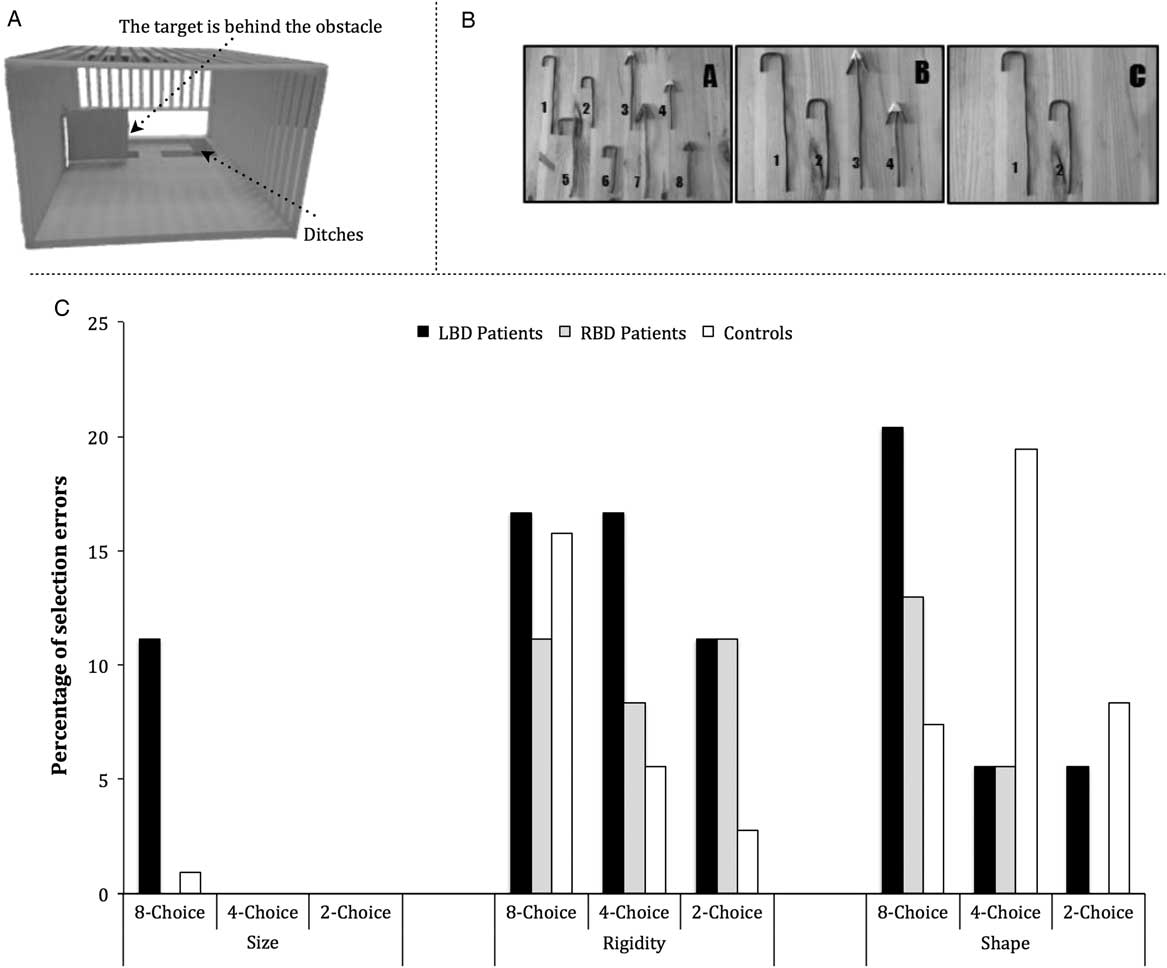
The novel tool selection task consists in extracting a target out from a box (Figure 1a). The target was a small, plastic red cube, placed inside the box behind an obstacle. The box contained ditches, so that the target had to follow a specific trajectory not to fall into them. The position of the obstacle and the target was counterbalanced across trials. In half of the trials, they were on the left, and in the other half they were on the right. The target could be extracted only by the front door, by selecting the relevant tool.
The novel tool selection task. Panel A shows the plastic box used for the task. As explained in the main text, participants had to extract a target out from the box, without falling it into ditches and by avoiding the obstacle. Panel B displays the tools used in the 8-Choice condition (a), in the 4-Choice condition (b), and in the 2-Choice condition (c). For the 8-Choice condition, the relevant tool was 1 (Long, rigid and H-Shaped). Tools 1, 2, 3, and 4 were rigid, and 5, 6, 7, and 8 flexible. Tools 1, 2, 5, and 6 were H-Shaped, and 3, 4, 7, and 8 V-Shaped. Tools 1, 3, 5, and 7 were long, and 2, 4, 6, and 8 short. The example given for the 4-Choice condition illustrates a trial where rigidity was blocked. Thus, Tool 1 was long/H-Shaped relevant), Tool 2 was short/H-Shaped (irrelevant), Tool 3 was long/V-Shaped (irrelevant), and Tool 4 was short/V-Shaped (irrelevant). The example given for the 2-Choice condition is a trial where both rigidity and shape were blocked, so that the choice was only between a long tool (one/relevant) and a short tool (two/irrelevant). Panel C provides additional information about the percentage of selection errors for the three groups (LBD patients, RBD patients, and Controls) in function of the criterion (Size, Rigidity, and Shape) and the condition (8-Choice, 4-Choice, and 2-Choice). Explanations are given in the main text.

Three criteria were used to design this tool. First, the target was ballasted with a piece of steel. So, only a tool rigid enough could move it. Second, the target was positioned at a specific distance from the front door. The box was also designed in such way that participants could not insert their hand, whatever the size of the hand. Thus, only a tool long enough could reach it. Third, the ditches and the obstacle were specifically designed so that only a tool with an appropriate, hook shape (hereafter called H-shaped) could move the target while avoiding the ditches. As shown in Figure 1b, we also built seven irrelevant tools based on these criteria and according to a factorial design: Long versus Short; Rigid versus Flexible; H-Shaped versus V-Shaped. Note that the long, rigid, and H-shaped tool was always the relevant tool. Moreover, to avoid the constant repetition of the same stimuli, two sets of eight tools were made by following this procedureFootnote 1 . The presentation of these sets was also counterbalanced across the trials. For the sake of clarity, we will continue to describe the task as if there was only one set.
There were three conditions (Figure 1b). All the participants performed first the 8-Choice condition, then the 4-Choice condition, and finally the 2-Choice condition. We did not counterbalance the order of conditions to avoid that patients found more easily the solutions in the 8-Choice condition because of the presence of the successive presentation of 8-Choice and 2-Choice trials. Whatever the condition, participants had to select only 1 tool. No time limit was imposed for the selection. However, when the tool was selected (i.e., introduced into the box), participants had only 20 s to extract the target out form the box (this time limit was chosen to keep the duration of the task to a reasonable time). If the target was extracted within the time limit, the trial was recorded as “success.” In each condition, there were 18 trials. In the 8-Choice condition, the set of eight tools was presented. In the 4-Choice condition, only four tools were given so that one of the aforementioned criteria was systematically blocked. For instance, if the criterion “rigidity” was blocked, four rigid tools were provided. Nevertheless, their characteristics varied on the two other criteria: (1) Long/H-Shaped (relevant); (2) Long/V-Shaped (irrelevant); (3) Short/H-Shaped (irrelevant); (4) Short/V-Shaped (irrelevant).
There were also 18 trials in total, but given the blocking of one criterion for each trial, there were only 12 trials for which participants had to process each criterion (e.g., 12 trials where rigid vs. flexible tools were given and 6 trials where rigidity was blocked). In the 2-Choice condition, only two tools were presented. Their characteristics varied only on one criterion so that the two others were systematically blocked. For instance, the choice could be between a long and a short tool. Nevertheless, both of them were rigid enough and with a H-Shape. This condition also consisted of 18 trials. Therefore, there were only six trials for each criterion.
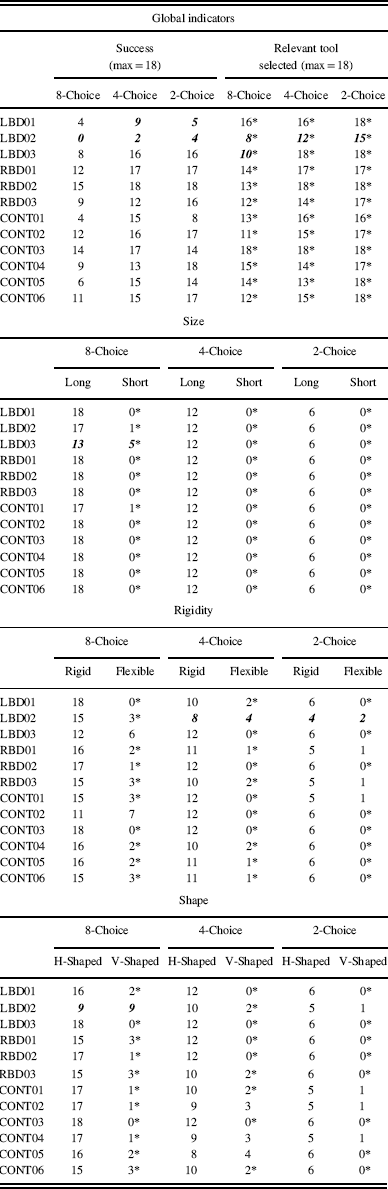
In sum, participants had to select tools based on the criterion x in 18 trials in the 8-Choice condition, in 12 trials in the 4-Choice condition, and in 6 trials in the 2-Choice condition. We could have decided to homogenize the number of trials across the condition (e.g., 18 trials for each criterion in each condition). However, this would have forced us to considerably increase the number of trials in the 4-Choice (27 trials instead of 18) and 2-Choice (36 trials instead of 18) conditions. Therefore, given the repetitive nature of the task and the time associated, we preferred not to do so. The corollary is that both the 8-Choice and 4-Choice conditions are more informative than the 2-Choice condition. No between-group analysis was performed considering the small size of samples. We only focused on individual preference and performance (Table 1). These two aspects were assessed separately, the former giving information about both selection and execution skills and the latter about selection skills more specifically.
Results obtained on the novel tool use selection task

Note. Values in bold and italics are values for which LBD patients obtained a score below the range of controls (i.e., cut-off). * means that the participant’s choice differs from chance at p < .05. For the number of relevant tools selected, χ 2 tests were used for 8-Choice and 4-Choice conditions, and binomial tests for the 2-Choice condition. For size, rigidity and shape, binomial tests were used irrespective of the Choice condition because participants had one chance in two of selecting a long tool versus a short tool, a rigid tool versus a flexible tool, or a T-Shaped tool versus a V-Shaped tool.
RESULTS
Global Indicators
Results are given in Table 1. Controls were far from obtaining perfect performance on the task (Success: M 8-Choice =9.33/18; M 4-Choice =15.17/18; M 2-Choice =14.67/18; Relevant tool selected: M 8-Choice =13.83/18; M 4-Choice =15.17/18; M 2-Choice =17.33/18). LBD01 and LBD02 were globally below the cutoff values concerning the number of successes for the three conditions. LBD03 met difficulties to select the relevant tool in the 8-Choice condition, and LBD02 in the three conditions. Nevertheless, the selection of the relevant tool was better than chance for both controls and LBD patients. RBD patients performed within the range of controls, if not better, confirmed by high selection scores.
Size, Rigidity, and Shape
Results are shown in Table 1. The percentage of selection errors for the three groups (i.e., LBD patients, RBD patients, and Controls) in function of the condition is also given in Figure 1c. First, all participants but LBD03 (8-Choice condition) were able to easily select a tool long enough to reach the target, whatever the condition. Second, several participants from all groups met difficulties to select a tool rigid enough, particularly in the 8-Choice condition. Both RBD patients and Controls improved their choice in the 4-Choice condition and, as a result, in the 2-Choice condition. By contrast, LBD02 still had significant selection errors for rigidity in the 4-Choice and 2-Choice conditions. Third, controls committed a relatively high number of selection errors concerning shape, particularly in the 4-Choice condition wherefive of the eight controls did not select the H-Shaped better than chance. LBD02 also showed considerable difficulties in the 8-Choice condition. RBD patients only show some selection errors in the 8-Choice condition.
DISCUSSION
First, the novel tool selection task is not as easy as it looks, as evidenced by the relatively low number of successes in controls. Nonetheless, all participants including LBD patients selected the relevant tool better than chance in the three conditions. This suggests that apraxic patients possess residual, technical reasoning skills based on partial mechanical knowledgeFootnote 2 . This may seem at odds with the fact that apraxic patients, including the three patients reported here, have serious difficulties to solve mechanical problems (see Osiurak & Badets, Reference Osiurak and Badets2016). However, it is not. The mechanical problem-solving task consists of open-ended problems, requiring generating a mechanical solution (e.g., making a hook by folding a wire to extract a target out from a box; the solution is not provided; the goal assigned to the participant is just to extract the target).
By contrast, the novel tool selection task is a closed-ended problem because the solution is provided (i.e., using a tool as a perch). Taken together, these findings suggest that impaired mechanical knowledge (1) can be highly prejudicial when no solution is provided, making patients perplex about the mechanical action to be performed and the tools to be selected (Osiurak, Jarry, Lesourd, Baumard, & Le Gall, Reference Osiurak, Jarry, Lesourd, Baumard and Le Gall2013), but (2) can orient the tool selection even if difficulties can persist as shown by the high number of irrelevant tools selected by LBD02 and LBD03 in the 8-Choice condition.
Let us turn now to the two questions addressed in introduction. The first was whether apraxic patients have greater difficulties in selecting some physical properties over others. We found that all participants including LBD patients committed less selection errors for size than for rigidity and shape. So, the answer is positive in that it is easier to select a tool with an appropriate size. Note, however, that this does not suggest that mechanical knowledge does not contain any information about size. Particularly, LBD03 encountered difficulties to select tools long enough in the 8-Choice condition, suggesting a deficit of reasoning about size. It is more likely that mechanical knowledge contains information about any physical property that is critical to a given mechanical action. Simply, for size, patients could benefit from visual feedback (i.e., no contact between the tool and the target) and thus learn what is the length necessary to reach the target. Said differently, the reduction of choice, or practice, could compensate the loss of some physical properties contained in mechanical knowledge.
Nevertheless, for some properties such as rigidity, visual feedback could be less obvious (i.e., the target is reached and can slightly move). In this case, the selection of the relevant tool could be problematic even with practice or when the choice is reduced, as evidenced by LBD02 who had selective difficulties to choose a tool rigid enough in the three conditions; by contrast, the selection of a tool with the relevant shape clearly improved between the 8-Choice condition and the 4-Choice and 2-Choice conditions in LBD02.
The second question was whether selection improves as the number of alternatives is reduced. The answer is also positive. We found that the number of relevant tools globally increases as the number of alternatives decrease in all participants. However, this pattern was not always true. For instance, LBD02 made selection errors for rigidity in the three conditionsFootnote 3 . Regardless, even if apraxic patients have difficulties to select tools based on their physical properties, their performance can improve with the reduction of alternatives or practice. For methodological reasons described above, these two factors were confounded factors in the present study. So, future research is needed to specify their respective role in improvement.
To conclude, these findings open avenues for future rehabilitation programs. However, they also raise the question as to whether a task such as the novel tool selection task can be useful to help apraxic patients to understand the physical properties useful for performing some mechanical actions. More particularly, an alternative is that the patients just learnt the tools that are useful for solving the task without understanding the underlying physical principle. This interesting issue could be addressed in future research by adding transfer tasks (Goldenberg & Hagmann, Reference Goldenberg and Hagmann1998a; Goldenberg, Daumüller, & Hagmann, Reference Goldenberg, Daumüller and Hagmann2001).
ACKNOWLEDGMENTS
The authors declare no conflict of interest. This work was performed within the framework of the LABEX CORTEX (ANR-11-LABX0042) of Université de Lyon, within the program “Investissements d’Avenir” (ANR-11-IDEX-0007) operated by the French National Research Agency (ANR).