Congenital heart disease is the most common form of birth defect, occurring in approximately 1% of live births.Reference Gillum1–Reference Marelli, Mackie, Ionescu-Ittu, Rahme and Pilote4 In developing countries, congenital heart disease may go unrecognised, resulting in serious morbidity and high mortality rates.Reference Kuehl, Loffredo and Ferencz5 Each year, as many as 15 million children in the developing world die or suffer devastating consequences secondary to treatable or preventable cardiac disease.Reference Yacoub6
Guatemala is one of the few developing countries where specialised congenital heart disease treatment is available and affordable. In 1997, the Unidad de Cirugia Cardiovascular Pediatrica (Pediatric Cardiovascular Unit of Guatemala) was built in Guatemala City. The Unidad is the only comprehensive paediatric cardiac unit in Central America, the only referral centre for the treatment of congenital heart disease in Guatemala, and the only institution in Guatemala where paediatric cardiac surgery is performed. Furthermore, this treatment is available at the Unidad at no or low cost.
Since its inception, the Unidad’s surgical volume has grown quickly. From 67 surgeries performed in 1997, the Unidad currently performs 500 surgeries per year, placing it on a par with large paediatric cardiac surgery programmes in the United States. In addition, surgical outcomes at the Unidad have improved significantly in a short period of time.Reference Larrazabal, Jenkins and Gauvreau7 This improvement was maintained during a transition from none to 95% of surgical procedures being performed by locally trained surgeons, thus establishing the Unidad as a self-sustaining unit.
Despite these great strides, surgical treatment of neonatal and complex congenital heart disease in Guatemala remains limited.Reference Stolf8 Fewer than 25% of the patients undergo surgery at younger than the age of 1 year, and 60% of the procedures are performed on patients with simple shunt lesions. The low percentage of neonatal and complex surgeries compared to the percentage in developed nationsReference Donald C.9 suggests that many of these patients die before reaching the Unidad. However, at present, the state of congenital heart disease detection in Guatemala is unknown and the best tools for studying congenital heart disease detection in underserved populations remain unclear.
A useful tool in the study of underserved populations is the human development index, developed in 1990 by the United Nations. The human development index is a composite measure of life expectancy, literacy, education, and standard of living, which thereby assesses both the social and economic development of a nation. Human development indexes are now also available for subgroups within a country. These subgroup-specific, or disaggregated, human development indexes include geographical regions, gender, and ethnicity10–Reference Sharma12 and are used to highlight the stark disparities and inequalities that exist across subgroups.Reference Porter and Purser13 The human development index is used to study the rates of infant mortality, depression, infectious diseases, dental caries, and malnutrition.Reference Lee, Park, Khoshnood, Hsieh and Mittendorf11, Reference Cifuentes, Sembajwe, Tak, Gore, Kriebel and Punnett14–Reference Hobdell, Lalloo and Myburgh20 It is suggested that the human development index may correlate with access to cardiac surgery (Dr Luis Alesandro Larrazabal, personal communication), although its relationship with congenital heart disease detection remains to be explored.
The Unidad’s unique position as the nation’s only referral centre renders Guatemala an ideal country in which to study the epidemiology of congenital heart disease detection in the developing world. By studying the Unidad’s referral patterns, one can evaluate congenital heart disease detection for the entire country and each of its regions. More importantly, the Unidad can provide specialised therapy for the Guatemalan children who are diagnosed with cardiac defects so that interventions directed at improving the detection rate can lead to significantly improved outcomes. The first aim of this study was to determine the rate and timing of congenital heart disease detection in Guatemala, by comparing the rate of congenital heart disease and the age at presentation to the Unidad with the expected incidence. The second aim was to determine whether the regional human development index correlates with the regional congenital heart disease detection rates in Guatemala. For this purpose, we compared the congenital heart disease detection rate and the human development index for each of the 22 regions in Guatemala.
Methods
Expected incidence of congenital heart disease
To estimate the annual incidence of congenital heart disease in Guatemala, we obtained birth rates for each of the 22 regions in Guatemala from the National Ministry of Health database. We averaged birth rates obtained over the past 10 years in order to eliminate error caused by annual fluctuations. Eliminating this error was particularly important because our detection protocol included children of various ages, so that their birth dates were not linked to the year of study. We then calculated the expected number of children born with congenital heart disease in Guatemala each year, using an incidence of 10 per 1000 live births.Reference Gillum1–Reference Marelli, Mackie, Ionescu-Ittu, Rahme and Pilote4 In addition, the expected number of children born with severe cardiac lesions was calculated using an expected incidence of 35 per 100 children with congenital heart disease.Reference Gillum1, Reference Hoffman and Kaplan3 We chose to estimate the incidence rather than the prevalence of congenital heart disease for multiple reasons. The prevalence of congenital heart disease in Guatemala is extremely difficult to determine when a large portion of the population has limited access to health care, whereas the incidence is relatively consistent across different populations.Reference Gillum1–Reference Marelli, Mackie, Ionescu-Ittu, Rahme and Pilote4 Furthermore, our main focus was on infants with severe cardiac lesions who would benefit most from early detection, and thus incidence at birth was more relevant to this study population.
Detection of congenital heart disease
In order to determine the current rate of congenital heart disease detection in Guatemala, we retrospectively assessed the number of new referrals for congenital heart disease made to the Unidad in 2006. Patients were included if they were 18 years of age or under, were native to Guatemala, had congenital heart disease, and were diagnosed in the year 2006.
For patients who met the inclusion criteria, we collected several variables via retrospective chart review, including age at time of diagnosis, region of origin, specific cardiac diagnosis, and, when applicable, age at first intervention (therapeutic catheterisation or surgery) and outcome. We then compared the number of congenital heart disease cases detected, per region, with the expected incidence. This comparison yielded the percentage of expected congenital heart disease cases diagnosed per region, or the regional congenital heart disease detection rate.
Correlation with the human development index
The human development index for each of the 22 regions in Guatemala was obtained from the published United Nations 2006 Development Program Report.10
Statistical analysis
Analysis was performed using the Statistics Package for Social Science Version 15. Categorical variables were analysed with a chi-square statistic and interval data with analysis of variance. The relationship between the regional congenital heart disease detection rate and regional human development index was evaluated using Spearman’s rank correlation.
Institutional review board approval
This project was approved by the Institutional Review Board, Committee on Human Research, University of California (San Francisco, California, United States of America). Data were entered into a password-protected and encrypted database through a joint Wiki webpage maintained by the Unidad and the University of California.
Results
Expected incidence of congenital heart disease
The population in Guatemala in 2006 was 12,293,545. The overall birth rate, averaged over the 10 preceding years, was 393,565, ranging from 4176 births in the region of El Progreso to 65,796 births in the region of Guatemala City. This yields an estimated overall incidence of congenital heart disease of 3935 live births per year in the country, ranging from 41 infants in El Progreso to 657 children in Guatemala City. Of these, 1380 infants (35%) were expected to have severe cardiac lesions requiring surgical correction in the first year of life.
Detection of congenital heart disease
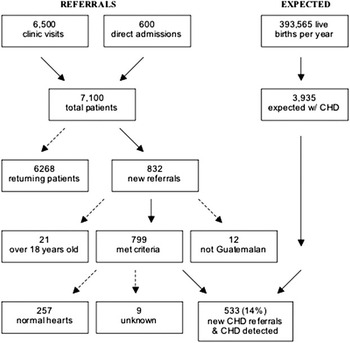
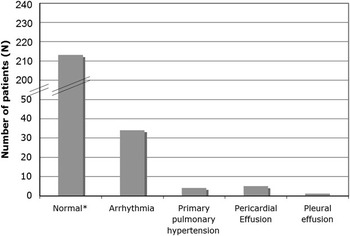
A total of 7,118 patients were seen at the Unidad in 2006, of which 832 were new referrals (Fig 1). Of the new referrals, 21 were excluded for age over 18 years, and 12 were excluded for not being native to Guatemala. Of the remaining 799 patients, 257 (32.2%) were excluded for having structurally normal hearts and nine (1.1%) were excluded for incomplete data – four died before diagnosis and five had missing records. Patients with normal cardiac anatomy were referred for reasons ranging from evaluation of murmur to treatment of arrhythmias and effusions (Fig 2). Therefore, only 533 children, an estimated 14% of all children with congenital heart disease, were diagnosed in 2006 and subsequently analysed in our study.
Comparison of congenital heart disease referrals made to the Unidad and expected congenital heart disease incidence for 2006.

Distribution of new referrals with normal cardiac anatomy in 2006; *normal includes referrals for functional murmur, chest pain, and syncope.

New referrals with congenital heart disease tended to be older at the time of diagnosis than new congenital heart disease referrals seen in developed countries.Reference Donald C.9 Only 3.9% of new cardiac referrals were diagnosed at less than 1 week of age and 11.5% at less than 1 month of age. There were 39% who were diagnosed between 1 month and 1 year of age, and 49.7% at greater than 1 year of age.
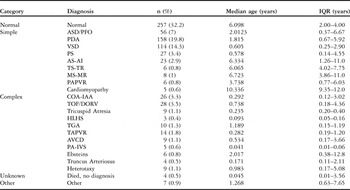
Older age at the time of diagnosis was found across all congenital heart disease types (Table 1), regardless of lesion severity. Only patients with pulmonary atresia with intact ventricular septum (1% of congenital heart disease), and those who presented at the point of death and died before their diagnosis being confirmed, had a median age of diagnosis of less than 1 month. The majority of patients were greater than 1 year of age, including those with transposition of the great arteries, whose median age of diagnosis was 14 months.
Age at the time of diagnosis, according to specific diagnosis.

AS-AI = aortic stenosis-aortic insufficiency; AVCD = atrioventricular canal defect; COA-IAA = coarctation-interrupted aortic arch; HLHS = hypoplastic left heart syndrome; IQR = inter quartile range; MS-MR = mitral stenosis-mitral regurgitation; PA-IVS = pulmonary atresia with intact ventricular septum; PAPVR = partial anomalous pulmonary venous return; PDA = patent ductus arteriosus; PFO/ASD = patent foramen ovale/atrial septal defect; PS = pulmonary stenosis; TAPVR = total anomalous pulmonary venous return; TGA = transposition of the great arteries; TOF/DORV = tetralogy of Fallot/double outlet right ventricle; TS-TR = tricuspid stenosis-tricuspid regurgitation; VSD = ventricular septal defect
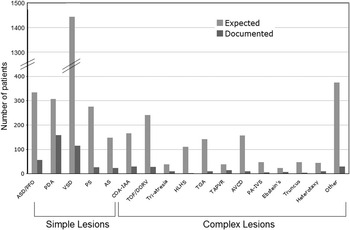
The distribution of congenital heart disease diagnoses also differed from the distribution typically seen in developed countries in which simple lesions were over-represented (Fig 3). Of the new referrals with congenital heart disease, 62% had simple shunt lesions, whereas only 1.5% had a transposition of the great arteries, and 0.5% had hypoplastic left heart syndrome. In developed countries, 50% of patients with congenital heart disease have simple shunt lesions, 3.2% have transposition of the great arteries, and 2.8% have hypoplastic left heart syndrome.Reference Hoffman and Kaplan3
Expected and documented frequency of congenital heart disease diagnoses, as number of patients. Expected frequencies are obtained from Hoffman and KaplanReference Hoffman and Kaplan3; AS= aortic stenosis; ASD/PFO = atrial septal defect/patent foramen ovale; AVCD = atrioventricular canal defect; COA-IAA = coarctation-interrupted aortic arch; HLHS = hypoplastic left heart syndrome; PA = pulmonary atresia; PDA = patent ductus arteriosus; PS = pulmonary stenosis; TAPVR = total anomalous pulmonary venous return; TGA = transposition of the great arteries; TOF = tetralogy of Fallot; VSD = ventricular septal defect.

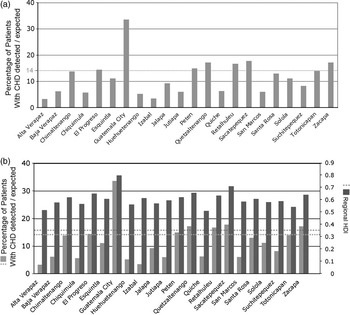
The percentage of patients in Guatemala with congenital heart disease who were actually detected and referred to the Unidad varied greatly by region (Fig 4a). The region surrounding Guatemala City had the greatest congenital heart disease detection rate (34% of that expected), whereas the regions of Alta Verapaz and Izabal had the least (3.2% and 3.4% of that expected, respectively).
(a) Percentage of patients with congenital heart disease detected in the various regions of Guatemala. Congenital heart disease detected/expected was 14% for Guatemala overall (b) Percentage of patients with congenital heart disease detected/expected versus human development index by region in Guatemala. Congenital heart disease detected/expected was 14% for Guatemala overall. The human development index for Guatemala overall in the year 2006 was 0.689; CHD = congenital heart disease; HDI = human development index.

Congenital heart disease detection rate correlation with the human development index
The percentage of patients with congenital heart disease detected by region in Guatemala correlated with the regional human development index (r = 0.75, p < 0.0001; Fig 4b). When the region of Guatemala City was excluded, the regional congenital heart disease detection rate continued to correlate with the regional human development index (r = 0.72, p < 0.0001). Age at the time of diagnosis and disease severity did not correlate with the regional human development index. However, regions with a higher human development index did tend to have more patients referred for shunt lesions (p > 0.05). All regions, regardless of the human development index, had dramatically lower levels of diagnosis of complex cardiac disease than was expected.
Discussion
This study shows that the current rate of congenital heart disease detection in Guatemala is very low, despite the presence of a high-quality referral centre for paediatric cardiac care at little or no cost. We found that fewer than 14% of all Guatemalan children with congenital heart disease were diagnosed. In addition, this study shows that region-specific human development indexes correlate with regional congenital heart disease detection rates in Guatemala (r = 0.75, p < 0.0001).
From these data, we predict that the mortality rate among Guatemalan neonates with complex congenital heart disease is very high. Few patients (11.5%) were diagnosed in the first month of life, whereas in developed nations, over a third of patients are diagnosed in the early newborn period.Reference Donald C.9 Furthermore, the majority of those diagnosed with cardiac defects (62%) had simple shunt lesions. Children with simple shunt lesions can survive several years without interventionReference Craig and Selzer21–Reference Minette and Sahn23 and for this reason may be over-represented in our study. In contrast, children with complex lesions require surgery in the first year of life in order to survive. For example, 95% of patients with transposition of the great arteries die by the age of 1 year if untreated.Reference Massin24, Reference Liebman, Cullum and Belloc25 In developed countries, the majority of transposition of the great arteries patients are diagnosed in the early neonatal period, and have a 95% long-term survival rate following the arterial switch operation.Reference Massin24, Reference Scott, Rigby, Miller and Shinebourne26 In Guatemala, the median age of diagnosis for transposition of the great arteries was 14 months. Therefore, given the incidence of transposition of the great arteries and its late age at diagnosis, it is reasonable to conclude that the vast majority of neonates in Guatemala with this common severe lesion die before diagnosis. In fact, 80% of the patients diagnosed with transposition of the great arteries at the Unidad were found to have additional lesions, such as ventricular septal defect, which allowed them to survive despite the lack of surgical treatment. In comparison, only 30% of transposition of the great arteries in patients born in developed nations have such additional lesions.Reference Hoffman, Kaplan and Liberthson27 Unfortunately, those who survive frequently develop cardiac failure, pulmonary hypertension, and neurologic injury, ultimately rendering a treatable disease inoperable.
To prevent the high morbidity and mortality resulting from missed and late diagnosis, the rate and timing of congenital heart disease detection in Guatemala needs to be improved. Obstacles contributing to delayed cardiac surgery in Guatemala include living in a rural area, living far from the Unidad, and lacking access to primary medical care.Reference Kowalsky, Newburger, Rand and Castaneda28 One way to overcome these obstacles is through the development of foetal and neonatal outreach programmes. In developed nations, such programmes have led to earlier detection of congenital heart disease, reduced neonatal mortality, and improved outcomes.Reference Donald C.9, Reference Kovalchin and Silverman29–Reference Tworetzky, McElhinney, Reddy, Brook, Hanley and Silverman32 The oldest congenital heart disease outreach programme is the New England Regional Infant Cardiac Program established in 1969.Reference Donald C.9, 33 This programme laid emphasis on teaching nursery workers the signs of neonatal congenital heart disease in addition to establishing community contacts and referral infrastructure. In only a few years, the New England Regional Infant Cardiac Program increased the number of neonates diagnosed with congenital heart disease within the first 48 hours of life from 20% to 34%. In comparison, currently only 3.9% of new congenital heart disease referrals made in Guatemala were diagnosed within 1 week of age. Thus, the development of a targeted neonatal outreach programme designed to teach healthcare workers the signs of neonatal congenital heart disease may greatly improve detection rates in Guatemala.
We suggest that the human development index can be a useful tool in the development of a directed neonatal outreach programme in Guatemala because it correlates with regional congenital heart disease detection rates. It is imperative that outreach programmes are cost-effective and are designed to render the greatest benefit to the most individuals. The regional human development index correlates with congenital heart disease detection rates and therefore should be considered when exploring the cost/benefit ratio of implementing a neonatal congenital heart disease outreach programme. However, the regional human development index did not correlate either with age at the time of diagnosis or with lesion severity. This lack of correlation may be explained by the observation that regions with lower human development indexes tended to have small sample sizes, whereas regions with higher human development indexes tended to have large sample sizes encompassing more patients of every age and every lesion severity.
Our study has several limitations. Primarily, our methods assume that the incidence of congenital heart disease in Guatemala, along with the frequency of specific lesions, is similar to that found in other nations. Despite the incidence of some specific lesions being found to be higher in certain ethnic groups,Reference Lien, Chen and Chen34 most epidemiologic studies have found a similar overall incidence of congenital heart disease across different countries.Reference Hoffman35, Reference Guitti36 More recently, Mangones et alReference Mangones, Manhas, Visintainer, Hunter-Grant and Brumberg37 reported that in one region of New York, the prevalence of cardiac lesions in Hispanic children less than 2 years of age was lower than that found in other ethnic groups (9/1000 vs. 12–14/1000). However, it is difficult to determine how socio-economic factors may have influenced these results and how the prevalence of congenital heart disease in this group reflects congenital heart disease incidence. Specifically, in Guatemala, the frequency of cardiac lesions was studied among children with Down syndrome undergoing surgical repair at the Unidad.Reference Vida, Barnoya, Larrazabal, Gaitan, de Maria Garcia and Castaneda38 In this subgroup, patent ductus arteriosus and ventricular septal defects were found to be at a higher frequency than atrioventricular canal defects, which are more common among children in the United States of America with Down syndrome. However, it is unclear how many patients with Down syndrome were missed in this study, and more importantly, how these results relate to the overall frequency of cardiac lesions in Guatemala.
Our estimate of congenital heart disease incidence may further be flawed by factors that may impact overall foetal survival in Guatemala, such as maternal health and nutritional status, altitude, and genetic isolation of certain ethnic subgroups. Unfortunately, the lack of adequate data regarding regional differences in foetal survival, maternal health, and ethnicity prevented us from controlling for these variables in our analysis. The error caused by these factors, however, does not negate our primary finding that the vast majority of infants with congenital heart disease are not being diagnosed because the overall detection rate calculated using our estimated incidence was so low at only 14%.
Our methods secondly assume that detection and treatment of congenital heart disease did not take place outside of the Unidad. Despite the Unidad being the only referral centre for the treatment of cardiac lesions in Guatemala, a few patients do have the financial means to seek medical treatment abroad, whereas others rely on the treatment offered by visiting medical teams. However, these patients most likely comprise a very small portion of the entire population and the error caused by their exclusion is probably negligible. More importantly, it is impossible to determine how many patients may have been referred to the Unidad for treatment and decided not to go because of cultural beliefs, personal biases, or perceived financial burden on the family.
Finally, this study is a retrospective review, and thereby has intrinsic flaws, including its cross-sectional nature and reliance on incomplete medical records. However, it does provide the groundwork needed to develop a prospective study to determine the true incidence of congenital heart disease and evaluate the impact of future neonatal outreach programmes on early congenital heart disease detection in Guatemala.
In summary, we found that the current rate of congenital heart disease detection in Guatemala is extremely low. Furthermore, those diagnosed with congenital heart disease were found to be older and to have simpler lesions than those typically seen in developed nations, implying a high mortality rate among neonates with complex cardiac defects. We suggest that the implementation of outreach programmes educating healthcare workers on the neonatal presentation of cardiac defects may improve the current rate of congenital heart disease detection in Guatemala. Finally, we show a strong statistical correlation between congenital heart disease detection rates and the region-specific human development index. The cause and clinical importance of this relationship, and most importantly, the implication for intervention, require further exploration. Our current study supports the concept that regional human development indexes may be a useful tool in understanding the cost/benefit ratio in targeting specific regions in Guatemala when developing future neonatal outreach programmes.
Acknowledgements
The authors thank Dr Carlos Kummerfeldt for his assistance in data entry, and Dr Elissa Lee for her assistance with statistical analysis. There are no sources of funding or financial support to disclose.