Introduction
During in vitro culture from oocytes to embryos, approximately 50% of developmental arrest (DA) occurs in the first week (Hardy et al., Reference Hardy, Spanos, Becker, Iannelli, Winston and Stark2001; Racowsky, 2002). This study focuses on one aspect of the phenomenon: zygote arrest (ZA) observed at the first cleavage stage, which marks the transition from zygote to embryo.
The known causes of ZA include suboptimal culture conditions and inadequate oocyte maturation (Favetta, Reference Favetta, St John, King and Betts2007). Apoptosis also plays a determinant role in DA (Hardy et al., Reference Hardy, Spanos, Becker, Iannelli, Winston and Stark2001). A high proportion of chromosomal abnormalities have been found in blocked zygotes (Benkhalifa et al., Reference Benkhalifa, Kahraman, Caserta, Domez and Qumsiyeh2003), although this finding was also related with some degree of cytoplasmic or nuclear immaturity.
The human zygote inherits its mitotic potential from the male gamete. In most species, (the mouse is a notable exception), the centrosome is paternally inherited (Palermo et al., Reference Palermo, Munné and Cohen1994; Sathananthan et al., Reference Sathananthan, Ratnam, Ng, Tarín, Gianaroli and Trounson1996). However, other factors influence this process. Zygote arrest 1 (Zar 1) is a maternal-effect gene critical for the oocyte-to-embryo transition (Wu et al., Reference Wu, Viveiros, Eppig, Bai, Fitzpatrick and Matzuk2003) and thus participates in the initiation of embryo development and the control of fertility in mammals.
Other factors may play an important role; Rawe et al. (Reference Rawe, Brugo Olmedo, Nodar, Poncio and Sutovsky2003) suggested that abnormal molecular nucleo-cytoplasmic trafficking might accompany human fertilization arrest.
In addition to genetic and molecular factors, dysmorphic zygotes with pronuclear size differences of more than 4 μm show significantly increased DA (Sadowy et al., Reference Sadowy, Tomkin, Munné, Ferrara-Congedo and Cohen1998). The notion that there may be other easily observable morphological aspects related to initial DA prompted this study. Although the rate of ZA at the cleavage stage is low (circa. 2%), a rapid, simple method of early ZA prediction would benefit any assisted reproduction centre for embryo selection at the initial stages.
Material and methods
We performed a prospective observational study of 2105 zygotes at 16–18 h post-insemination, using an inverted microscope with magnification of × 10–20–40 (Diaphot; Nikon Corporation). The zygotes were obtained from consecutive patients undergoing IVF or ICSI treatment at our Human Reproduction Unit.
Ovarian stimulation
Pituitary suppression was achieved using a long gonadotrophin-releasing hormone analogue (GnRHa, Decapeptyl; Ipsen) protocol, followed by ovarian stimulation with recombinant follicle stimulating hormone (Gonal; Serono Laboratories). Transvaginal ultrasound guided follicle puncture took place 34 to 36 h after human chorionic gonadotrophin injection.
IVF/ICSI procedures
For IVF procedure, the oocytes were cultured at 6% CO2 and 37°C for at least 3 h and after that time placed in a plate with macrodrops (100 μl) of a suspension of IVF (Medicult) with the spermatozoa (300,000 to 500,000 spermatozoa/ml).
For the ICSI procedure, the cumulus-corona cells were initially removed by exposure to a flushing medium (Medicult) with 80 IU/ml of hyaluronidase (Hyaluronidase type IV-S) for 1 min. After removing the corona cells, only metaphase II oocytes were injected, and cultured in 30 μl microdrops of ISM1™ (Medicult).
Evaluation at day +1
At 16–18 h post-insemination, normal fertilization was confirmed by the presence of two pronuclei (PN) and two polar bodies (PB). All zygotes were then observed under the inverted microscope at × 10, 20 or 40 magnification to determine the following morphological features:
• Comparative size of the male versus female PN categorized as equal or unequal.
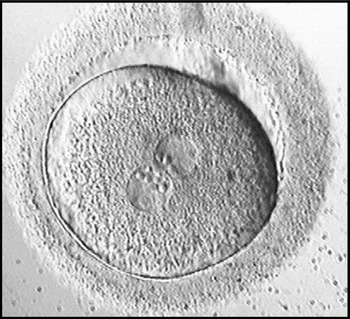
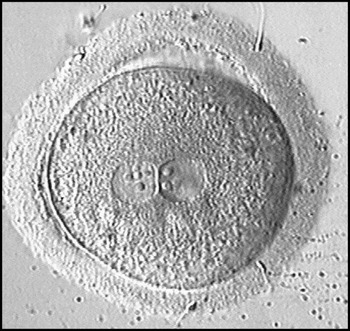
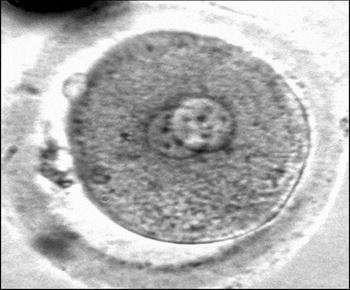
• Degree of NPB organization categorized as aligned, semi-aligned or non-aligned with respect to the PN abuttal line. (Figs. 1–3).
• Presence of a light halo (Fig. 1), defined as visibly less dense cytoplasm in the outer cortical zone. This was best observed using a magnification of × 10.
• Presence of a dark halo, defined as visibly denser and darker cytoplasm in the central zone, around the PNs. This too was best observed using a magnification of × 10.
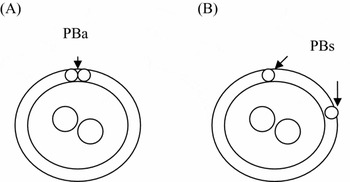
• Placement of PBs, categorised as adjacent or separate (Fig. 4).
• PB fragmentation categorized as fragmented if either of the PBs showed fragmentation or non-fragmented if neither PB showed fragmentation.
Pronucleus (PN) with nucleolar precursor body (NPB) aligned (A). Light halo.

Pronucleus (PN) with nucleolar precursor body (NPB), semi-aligned (S).

Pronucleus (PN) with nucleolar precursor body (NPB), not aligned (NA).

Polar body (PB) placement. (A) PB adjacent (PBa); (B) PB separate (PBs).

Evaluation at day +2
At 48 h post-insemination, zygotes that had failed to cleave were identified and only these were included in this study.
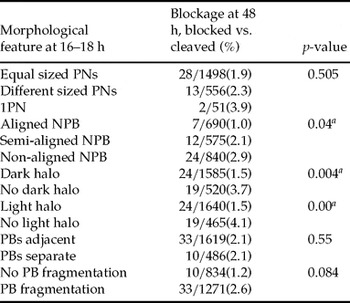
We compared the blocked versus cleaved zygotes in terms of morphological features observed at 16–18 h post-insemination (Table 1).
Zygote morphological features and incidence of blockage/cleavage.

aStatistically significant (p < 0.05).
NPB, nucleolar precursor bodies; PB, polar body; PN, pronucleus.
Statistical analysis
We used Windows SPSS (version 10.0), applying Pearson's chi-squared test, and Fisher's exact statistical test. A value of p < 0.05 was considered as significant.
Results
Of 2105 zygotes, we found blockage in 43, which represents 2% of the total. This 2% was our reference point when evaluating the incidence of ZA for each morphological feature. Table 1 shows the comparison of blocked versus cleaved zygotes in terms of morphological features observed at 16–18 h post-insemination.
Three of these morphological parameters proved statistically significant with respect to the incidence of zygote arrest:
1. The degree of NPB organization. Thus, the lower the organizational degree, the higher the percentage of ZA: non-aligned (2.9%) > semi-aligned (2.1%) > aligned (1.0%), p < 0.05.
2. The presence of a light halo is a favorable morphological feature. Its absence significantly correlated with ZA: light halo (1.5%) < no light halo (4.1%), p = 0.001.
3. Similarly, the presence of a dark halo is favorable. This is usually observed together with the former feature. Its absence significantly correlated with ZA: dark halo (1.5%) < no dark halo (3.7%), p < 0.005.
With respect to the remaining features, in this series the comparative pronuclear size did not significantly correlate with ZA (p = 0.0505) but it could be considered that unequal pronuclear sized zygotes had a tendency to have more ZA, and polar body placement or fragmentation showed no correlation with ZA (NS).
Discussion
Fertilization reprogrammes the human egg and sperm from non-dividing, fully differentiated cells into totipotent cleaving blastomeres. Totipotency persists for three or four cell doublings, from the single cell zygote to the 8- to 16-cell morula. The stage of embryonic genome major activation is crucial for the success of preimplantation embryo development that means a correct maternal to embryo transition of gene expression (Kiessling, Reference Kiessling, Bletsa, Desmarais, Mara, Kallianidis and Loutradis2009).
Developmental arrest in embryos is a well known and much studied phenomenon (Chi, Reference Chi, de Jesus, Adler, Grifo, Berkeley and Krey2000; Hardy et al., Reference Hardy, Spanos, Becker, Iannelli, Winston and Stark2001; Racowsky, 2002; Favetta, Reference Favetta, St John, King and Betts2007), however, failure of the zygote to cleave at all and thus become an embryo, is far less frequent and, consequently, has been little studied. What is known is that the ZAR-1 gene may be considered as one of the transcriptional regulators acting during oocyte-to-embryo transition of gene expression (Uzbekova, Reference Uzbekova, Roy-Sabau, Dalbiès-Tran, Perreau, Papillier, Mompart, Thelie, Pennetier, Cognie, Cadoret, Royere, Monget and Mermillod2006).
Also is a fact that the process that controls the centrosome and centriole duplication and the formation of a meiotic spindle during syngamy is distinct from that which takes place in somatic cells. If the centrosomes of both gametes become functional, mosaicism may be induced following the formation of abnormal meiotic spindles (Palermo et al., Reference Palermo, Munné and Cohen1994). In human reproduction, it is the sperm centrosome that controls the first mitotic division after fertilization. Functional failure of this centrosome may be responsible for failure of the first mitotic division.
From the molecular point of view, Rawe et al. (Reference Rawe, Brugo Olmedo, Nodar, Poncio and Sutovsky2003) have suggested that abnormal biogenesis or function of the zygotic centrosome could affect the recruitment of nuclear pore complexes and cytoplasm trafficking of annulate lamellae in some arrested zygotes, mainly in those showing pronuclear apposition.
Mammalian oocytes must undergo full cytoplasmic and nuclear maturation to at least metaphase II before they can develop viable embryos (Howlet & Bolton, Reference Howlet and Bolton1985). Certain oocyte polypeptides are directly involved in embryogenesis by reorganizing the chromatin in preparation for DNA replication and activation of embryonic transcription. Premature insemination may interfere with these molecular processes, leading to ZA.
Chromosome disorder has been linked with early embryo development blockage and implantation failure and it is known that the vast majority of blocked zygotes and unfertilized oocytes show chromosome abnormalities (Benkhalifa et al., Reference Benkhalifa, Kahraman, Caserta, Domez and Qumsiyeh2003).
With respect to morphological features and ZA, zygotes whose pronuclei differed in size by more than 4 μm have significantly increased frequency of DA (Sadowy et al., Reference Sadowy, Tomkin, Munné, Ferrara-Congedo and Cohen1998). One of the limitations of this study was that we did not measure differences in diameter size: our data were qualitative, and all pronuclei pairs of different sizes were categorized as ¨different¨. Thus, we were unable to confirm this finding. However, we found a better developmental prognosis when pronuclei pairs were of equal size (NS). Of note, we not only included PNs of equal and different sizes but also those zygotes with a single PN, as more than 80% proceed from fertilized oocytes (Munne et al., Reference Munné, Tang, Grifo and Cohen1993), and in FISH studies concerning ploidy status of 1PN-derived embryos displayed a normal ploidy number of chromosomes in nearly half of them. Probably some monopronuclear stage can be mis-defined because of the clustering of some vacuolar or pronuclear membrane remnants and the cells have a 1PN appearance at the time of observation (Zhivkova, Reference Zhivkova, Delimitreva, Toncheva and Vatev2007). In circumstances of extremely limited availability of zygotes, we may be forced to use those with a single PN. Although not significant, we observed a marked tendency for 1PN zygotes to show higher rates of ZA (3.9 vs. 1.9 and 2.3% for equal and differently sized PNs respectively). Furthermore, Manor et al. (Reference Manor, Drugan, Stein, Pillar and Itskovitz-Eldor1999) found a higher incidence of chromosomal anomalies in embryos from zygotes with pronuclear dysmorphism, and even recommended applying preimplantation genetic diagnosis (PGD) in these cases prior to transfer.
Certain authors have related pronuclear morphology with a higher incidence of chromosomal anomalies (Gianaroli et al., Reference Gianaroli, Magli, Ferraretti, Fortini and Griego2003). Others have developed a zygote morphological classification system showing correlation with improved implantation and pregnancy rates (Kattera & Chen, Reference Kattera and Chen2004). In addition to the above studies, Ebner et al. (Reference Ebner, Moser, Sommergruber, Gaiswinkler, Wiesinger, Puchner and Tews2003) reported that the presence of a light halo in the zygote has a positive prognostic value on blastocyst quality. Also, Salumets et al. (Reference Salumets, Hydén-Granskog, Suikkari, Tiitinen and Tuuri2001) showed a positive correlation of good embryo morphology with light cytoplasmic halo and NPB polarization. These studies support our findings that the absence of these features is correlated with a higher incidence of ZA.
Concerning the organization of nucleolar precursor bodies, many studies confirm that when there exist polarization in both pronuclei in addition to be of similar size, there is improved embryo quality and development (Tesarik & Greco, Reference Tesarik and Greco1999; Scott et al., Reference Scott, Alvero, Leondires and Miller2000; Gamiz et al., Reference Gámiz, Rubio, de los Santos, Mercader, Simón, Remohí and Pellicer2003), and this conclusion is in accordance with our results that ZA is incremented when pronuclei are non-aligned, the non-polarized situation of nucleolar precursor bodies.
Also, the presence of a light halo in the zygote is associated with a higher rate of preimplantation development and implantation (Ebner et al., Reference Ebner, Moser, Sommergruber, Gaiswinkler, Wiesinger, Puchner and Tews2003), and in accordance with this fact we observed that the absence of a light halo correlates better with ZA. In addition to the previous, we observed the presence or absence of a dark halo as a separated morphological feature, considering that is localized in the central area of the zygote, surrounding the pronuclei as a dense cytoplasm area appearing as darker than the rest of the cytoplasm. The dark halo used to appear when light halo is present and is a consequence of cytoplasmic rearrangements (Payne, Reference Payne, Flaherty, Barry and Matthews1997). In our observations, the absence of a light halo and the absence of a dark halo correlate with a higher incidence of zygote arrest.
The factors underlying normal or abnormal embryo development are largely pre-determined at the 1-cell stage. Environmental factors influence these, but ‘there will always be a group of embryos that will arrest and a group that will survive even under significantly substandard conditions’ (Hardy et al., Reference Hardy, Spanos, Becker, Iannelli, Winston and Stark2001). Whatever the cause of ZA (inadequate oocyte maturation, environmental and molecular factors, or genetic-chromosomal abnormalities), a single simple static observation of pronuclear morphology allows identification of those zygotes with the highest probability for arresting at the zygote stage.
All these studies support the idea of not only basing embryo selection on embryo quality at day +2 or +3, but also considering morphological features at the zygote stage. At the same time, we may be able to obtain valuable information as to the developmental capacity of each zygote.
In certain circumstances, day-2 embryos are not feasible for religious/ethical considerations, and in such cases pronuclear morphology is the sole criterion for zygote transfer (Scott & Smith, Reference Scott and Smith1998). Evaluation of morphology and knowledge of cleavage and implantation potential is of additional utility, especially for countries with legal restrictions regarding cryopreservation and embryo selection. In Germany for example, only three zygotes are allowed to be cultured for embryo transfer (Montag et al., Reference Montag and Van Der Ven2001).
To conclude, in this study developmental arrest observed at the first cleavage stage significantly correlated with three morphological features of the zygote: the absence of a light halo, the absence of a dark halo and non-aligned NPB. Given the need to improve our knowledge in zygote and embryo developmental potential to optimize the culture strategies and cryopreservation and to avoid multiple pregnancies, such information may contribute to suboptimal zygote detection.
Acknowledgements
We thank Michael Lee McLean for his help in correcting the manuscript and being an active contributor with his helpful discussions.