Listeria monocytogenes is a Gram-positive, rod-shaped bacterium. It is known to be the causative agent of listeriosis in humans that can affect susceptible populations, such as newborn children, the elderly and immunocompromised persons, with a mortality rate of 20–30 % (Lorber, Reference Lorber1997; McLauchlin et al. Reference McLauchlin, Mitchell, Smerdon and Jewell2004; Sleator et al. Reference Sleator, Watson, Hill and Gahan2009). List. monocytogenes is ubiquitous in the environment and has been isolated from a wide variety of ready-to-eat foods, such as meat, fish and dairy products (Lianou & Sofos, Reference Lianou and Sofos2007). Although List. monocytogenes is effectively inactivated by pasteurisation, post-processing contamination of dairy products has been well established and control of List. monocytogenes in processing facility environments is thus critical. The presence of List. monocytogenes in cheese made with raw or pasteurised milk has been described over the past few years (Wagner et al. Reference Wagner, Eliskases-Lechner, Rieck, Hein and Allerberger2006; Cocolin et al. Reference Cocolin, Nucera, Alessandria, Rantsiou, Dolci, Grassi, Lomonaco and Civera2009; O'Brien et al. Reference O'Brien, Hunt, McSweeney and Jordan2009; Brooks et al. Reference Brooks, Martinez, Stratton, Bianchini, Krokstrom and Hutkins2012; Schoder et al. Reference Schoder, Rossmanith, Glaser and Wagner2012; Torres-Vitela et al. Reference Torres-Vitela, Mendoza-Bernardo, Castro-Rosas, Gomez-Aldapa, Garay-Martinez, Navarro-Hidalgo and Villarruel-Lopez2012). The public health concerns associated with the occurrence of List. monocytogenes in cheese have been demonstrated by listeriosis outbreaks, for example, in France in 1980–2001 (De Buyser et al. Reference De Buyser, Dufour, Maire and Lafarge2001), Japan in 2001 (Makino et al. Reference Makino, Kawamoto, Takeshi, Okada, Yamasaki, Yamamoto and Igimi2005), Switzerland in 2005 (Bille et al. Reference Bille, Blanc, Schmid, Boubaker, Baumgartner, Siegrist, Tritten, Lienhard, Berner, Anderau, Treboux, Ducommun, Malinverni, Genne, Erard and Waespi2006), USA in 2004–2008 and 2010 (Jackson et al. Reference Jackson, Biggerstaff, Tobin-D'Angelo, Sweat, Klos, Nosari, Garrison, Boothe, Saathoff-Huber, Hainstock and Fagan2011; MMWR, 2011), Canada in 2008 (Gaulin et al. Reference Gaulin, Ramsay and Bekal2012) and Austria/Germany in 2009–2010 (Schoder et al. Reference Schoder, Rossmanith, Glaser and Wagner2012). European Union legislation places responsibility for safety on the food producer (EC, 2005), so it is important that the potential of food products to support growth of List. monocytogenes is understood. In many studies, the determination of growth in food is achieved using shelf-life challenges and/or mathematical modelling (Carrasco et al. Reference Carrasco, Valero, Pérez-Rodríguez, García-Gimeno and Zurera2007). These approaches have been used on various food matrices to assess the influence of different factors on the growth of List. monocytogenes. For example, the influence of packing conditions was investigated for shrimp (Mejlholm et al. Reference Mejlholm, Kjeldgaard, Modberg, Vest, Bøknæs, Koort, Björkroth and Dalgaard2008), the storage temperature for smoked fish (Uyttendaele et al. Reference Uyttendaele, Busschaert, Valero, Geeraerd, Vermeulen, Jacxsens, Goh, De Loy, Van Impe and Devlieghere2009) and the type of matrix for ready-to-eat salad (Skalina & Nikolajeva, Reference Skalina and Nikolajeva2010). For cheese, salt content, type of milk (raw or pasteurised), pH, aw, initial level of contamination and ripening temperature have already been investigated to predict the growth of List. monocytogenes in different types of cheeses (Angelidis et al. Reference Angelidis, Boutsiouki and Papageorgiou2010; Finazzi et al. Reference Finazzi, Daminelli, Serraino, Pizzamiglio, Riu, Giacometti, Bertasi, Losio and Boni2011; Schvartzman et al. Reference Schvartzman, Belessi, Butler, Skandamis and Jordan2011a, Reference Schvartzman, Maffre, Tenenhaus-Aziza, Sanaa, Butler and Jordanb; Shrestha et al. Reference Shrestha, Grieder, McMahon and Nummer2011). A database, ComBase (www.combase.cc), for predictive microbiology has also been available since 2004 to estimate microbial responses to various food environments (Baranyi & Tamplin, Reference Baranyi and Tamplin2004). However, the models developed in laboratory conditions are simplified descriptions of growth of List. monocytogenes in complex food matrices (Vermeulen et al. Reference Vermeulen, Devlieghere, De Loy-Hendrickx and Uyttendaele2011; Rosshaug et al. Reference Rosshaug, Detmer, Ingmer and Larsen2012) and they do not always reflect the reality of a food matrix. For example, Schvartzman et al. (Reference Schvartzman, Belessi, Butler, Skandamis and Jordan2011a) showed that in 40 % of cases where ComBase predicted growth, no growth actually occurred in cheese.
List. monocytogenes can occur on dairy farms and in associated cheesemaking facility environments. In Ireland, Fox et al. (Reference Fox, O'Mahony, Clancy, Dempsey, O'Brien and Jordan2009, Reference Fox, Hunt, O'Brien and Jordan2011) reported that 19 % of dairy farm samples and 13 % of processing area samples were positive for List. monocytogenes. Its occurrence in the environment may pose the problem of List. monocytogenes transfer from the environment to the cheese, even though the routes of contamination are not always clearly identified. Molecular subtyping of List. monocytogenes strains by methods such as Pulsed-Field Gel Electrophoresis (PFGE) have provided clear evidence that different List. monocytogenes subtypes can persist in dairy farms and processing facilities (Ho et al. Reference Ho, Lappi and Wiedmann2007). Environmental sampling is an effective way to assess hygiene and prevent future contamination events (Tompkin, Reference Tompkin2002). A stringent Listeria control programme, even in small processing facilities, and measures to prevent and control persistent Listeria contamination in niches in processing facilities are essential.
Owing to its elaborate physiological adaptation mechanisms, List. monocytogenes can survive and even proliferate in a variety of foods under adverse environmental conditions such as low pH, high salinity and low temperature (Khelef et al. Reference Khelef, Lecuit, Buchrieser, Cabanes, Dussurget, Cossart, Dworkin, Falkow, Rosenberg, Schleifer and Stackebrandt2006). In Europe, regulations permit up to 100 cfu/g in certain ready-to-eat foods that cannot support growth of List. monocytogenes (EC, 2005). In ready-to-eat foods that can support growth, absence in five 25 g samples is required, unless the manufacturer can show that numbers will not exceed 100 cfu/g throughout the stated shelf-life of the product. Thus, the responsibility for ensuring that the permitted concentration of List. monocytogenes is not exceeded is placed with the manufacturer. In addition, it is necessary to determine whether or not a food can support the growth of List. monocytogenes; this will determine the regulation that applies.
The aim of this study was to investigate potential routes of contamination of a raw milk farmhouse Cheddar cheese from the processing environment and to assess the ability of naturally contaminated cheese to support the growth of List. monocytogenes.
Materials and methods
Environmental sample collection
Samples from an Irish farmhouse cheesemaking facility with an associated farm providing milk for the cheesemaking were collected in April, June and September 2012 and in January 2013. At each sampling time, approximately fifty samples were collected and analysed. Samples were collected from non food contact surfaces (NFCS) and food contact surfaces (FCS) in the processing area, and from outside the processing environment (yard, entrance of milking parlour). Raw milk, curd and whey were also sampled. Swab samples were collected using pre-moistened with neutralising broth sponge-sticks (3M, St Paul, Minnesota, USA). Liquid samples were collected using 100-ml sterile dippers. All samples were collected during cheese production, wearing gloves and appropriate protective clothing, were individually packaged to prevent cross-contamination, placed in a cool box with ice packs and transported directly to the laboratory where they were analysed immediately.
Microbiological analyses
The two-step enrichment method ISO 11290-1 was used for detection of List. monocytogenes (ISO, 2004a), except that only chromogenic (agaALOA agar, Oxoid, Hampshire, UK) was used. After each enrichment step, 20 μl was spread on an ALOA plate and incubated for 48 h at 37 °C. At least two presumptive-positive List. monocytogenes colonies (blue-green with a surrounding halo) were isolated per positive sample and frozen at −20 °C after purification, pending further analysis. Isolates were purified by streaking a single colony from the ALOA agar onto Brilliance Listeria Agar (BLA, a chromogenic agar selective for Listeria obtained from Oxoid, Hampshire, UK). From BLA a single colony was streaked onto BHI agar and a single colony selected for freezing at −20 °C in cryovials (VWR, Leuven, Belgium).
The enumeration of List. monocytogenes in cheese was assessed by a direct count method according to ISO 11290-2 (ISO, 2004b). Briefly, 25 g of cheese were mixed in 225 ml half Fraser broth base (Merck, Darmstadt, Germany) using a Colworth Stomacher 400 (Seward, Worthing, UK) and 1 ml (2×0·5 ml) was immediately spread onto ALOA plates. Direct counts were performed in duplicate for each cheese sample. The rest of the cheese dilution was analysed as already mentioned for the detection of List. monocytogenes.
Confirmation by PCR
All purified isolates were confirmed as List. monocytogenes using Real-Time PCR (Rodríguez-Lázaro et al. Reference Rodríguez-Lázaro, Hernández, Scortti, Esteve, Vázquez-Boland and Pla2004), as described by O'Brien et al. (Reference O'Brien, Hunt, McSweeney and Jordan2009). Samples with a threshold value (Ct value) >35 were considered negative.
Serotyping
Serotyping of the isolates was performed as described by Fox et al. (Reference Fox, O'Mahony, Clancy, Dempsey, O'Brien and Jordan2009), using a combination of antisera and serotype-specific PCR (Doumith et al. Reference Doumith, Buchrieser, Glaser, Jacquet and Martin2004).
Pulsed-field gel electrophoresis (PFGE)
PFGE of all List. monocytogenes isolates was carried out using the International Standard PulseNet protocol (PulseNet USA, 2009). Two restriction enzymes, AscI and ApaI (Thermo Scientific, Dublin, Ireland), were used and isolate similarity dendrograms were obtained using the Unweighted Pair Group Method with Arithmetic Mean (UPGMA) method in Bionumerics version 5.10 software (Applied Maths, Belgium) as previously described (Fox et al. Reference Fox, deLappe, Garvey, McKeown, Cormican, Leonard and Jordan2012).
Cheese analysis
Cheese samples from batches I and II (from the same manufacturer but made on different days) were collected after 1, 2, 3 and 5 months of ripening (May to September 2012). Cheese samples were placed in sterile plastic bags, transported to the lab in a cool box and analysed immediately. Each cheese analysis was performed in duplicate. The presence/enumeration of List. monocytogenes and isolate identification and characterisation were performed as already described.
Cheeses samples were also analysed for pH, salt and moisture after 3 months of ripening. For pH measurement, 20 g cheese were blended with 12 ml distiled water and the pH was then measured using a pH211 microprocessor pH-meter (Hanna instruments, Bedfordshire, UK). The moisture content in cheese was determined by drying 3 g cheese at 102 °C for 5 h according to IDF Standard 4:2004/ISO 5534:2004 (ISO, 2004c). The salt content in cheese was determined by silver nitrate titration according to AOAC method No. 975·20 (AOAC, Reference Helrich1990). The salt-to-moisture (S : M) ratio was then calculated.
Results
Growth of List. monocytogenes in naturally contaminated cheese
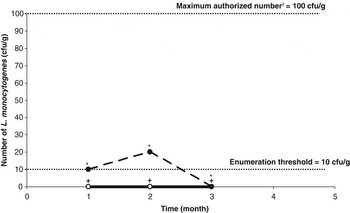
Growth of List. monocytogenes in the two independent batches of naturally contaminated Cheddar cheese was monitored. In cheese batch I, List. monocytogenes was detected by enrichment during the first three months of ripening, but the level was always under the enumeration threshold (10 cfu/g) of the direct count method (Fig. 1). In cheese batch II, the number of List. monocytogenes never exceeded 20 cfu/g (Fig. 1) for the first two months of ripening. At three months of ripening, the number dropped under the enumeration threshold of the direct count method, but List. monocytogenes was still detected by enrichment. After five months of ripening, List. monocytogenes could not be detected in either cheese batches, either by direct count or by enrichment.
Growth of List. monocytogenes in Cheddar cheese monitored by direct counts and enrichment during a five-month ripening period. ○ Number of List. monocytogenes in cheese batch I; ● Number of List. monocytogenes in cheese batch II; + List. monocytogenes detected by enrichment in cheese batch I; * List. monocytogenes detected by enrichment in cheese batch II. † Maximum authorised number in food that do not support List. monocytogenes growth (EC, 2005).

Composition of cheeses
The pH, salt and moisture contents of both cheese batches were analysed during ripening. The pH values of the cheeses were 5·54 and 5·45 in batch I and batch II, respectively. The salt contents were 2·28±0·33 % and 1·89±0·03 % in batch I and in batch II, respectively. The moisture contents were 24·9±0·4 % and 28·6±1·2 %, respectively. The S : M ratios were 9·14 and 6·61 in cheese I and II, respectively.
Occurrence of List. monocytogenes at the farmhouse cheese facility
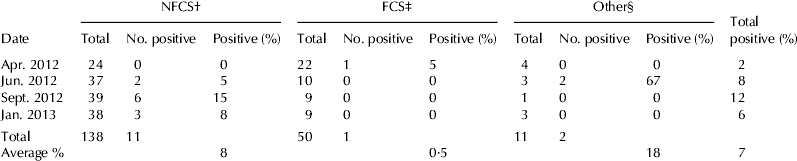
Overall, 199 samples were analysed and 185 (93 %) were negative for List. monocytogenes. The number of positive samples increased with each sampling occasion up to September 2012 with 12 % of the total samples positive (Table 1). Sampling in January 2013, following implementation of corrective actions regarding work-flows and cleaning and disinfection, resulted in 6 % total samples positive (Table 1). NFCS were responsible for the majority of positive samples, increasing from 0 to 15 % between April and September 2012 and reducing to 8 % following implementation of corrective actions. The contaminated NFCS included floors and drains in the processing area, and floors in the packing area and in the cold room and samples from the yard outside the processing facility. In the processing facility, one FCS, a vat, was positive only at one sampling time. On one sampling occasion, two products (some curd from a vat and cheese waste from the packing room) were positive for List. monocytogenes. All the tested raw materials were negative for List. monocytogenes (Table 1).
Number of samples taken at a farmhouse cheesemaking facility indicating the number and percentage that were positive for Listeria monocytogenes

† Non-food contact surface
‡ Food contact surface
§ Other: raw materials (raw milk, brine), products (whey, curd, cheese)
Characterisation of List. monocytogenes isolates and routes of contamination
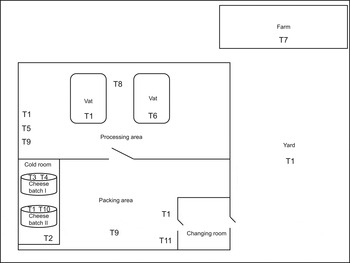
From each positive sample found between April 2012 and January 2013, two isolates were selected from each of the first and second enrichments, where possible. This resulted in thirty-nine isolates which were confirmed as List. monocytogenes by PCR. The source of these isolates is shown in Fig. 2. Eleven isolates were taken from cheese. Thirty-four isolates were serotype 1/2a and five isolates were serotype 1/2b.
Location of isolation of the 11 pulsotypes from inside and outside the cheesemaking facility.

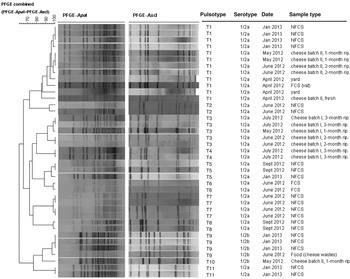
Combining PFGE patterns from both enzymes, ApaI and AscI, resulted in 11 distinguishable types (T1 to T11, Fig. 3). Strains of types T1, T5 and T9 were found in 2012 and 2013. All the other types were only found at one sampling time. The type T5 strains were all isolated at the same spot on the floor in the processing room (Figs. 2 and 3). The type T9 strains were found in cheese waste in the packing room in 2012 and on the floor in the processing area in 2013 (Figs. 2 and 3). Except for type T1, the PFGE results also indicated that no type was common to NFCS and FCS samples inside the processing area.
Dendrogram of PFGE profiles combining ApaI and AscI enzymes from isolates in this study. Eleven pulsotypes (T1 to T11) were identified and marked with symbols that are used in Fig. 2 to indicate their location in the cheesemaking facility.

The List. monocytogenes strains isolated from each batch of cheese were of two different types in each cheese. The strains from cheese batch I were identified as types T3 and T4 whereas strains from cheese batch II were types T1 and T10 (Fig. 3). In cheese batch I, the type T3 and T4 strains were isolated during the first three months. In cheese batch II, the type T10 strains could only be detected during the first month of ripening and were not isolated afterwards. The type T1 strains were found in cheese batch II in the first months of ripening and were also found in the yard and in a vat in April 2012, and also in the processing area and on the floor at the entrance to the packing room in January 2013 (Fig. 2).
Discussion
List. monocytogenes did not grow in two different and independent batches of naturally contaminated Cheddar cheese. Under these conditions, ComBase predicts List. monocytogenes growth reaching 100 cfu/g after 4 d and 108 cfu/g after 5 months of ripening whereas no List. monocytogenes growth actually occurred in the Cheddar cheeses studied. Performing challenge studies always raises questions such as, what strain to use, what should the pre-growth conditions be and what should the inoculation level be. The present study presented the opportunity to assess the growth of List. monocytogenes in the case on a natural contamination of cheese. The List. monocytogenes level never exceeded the legal threshold, even in the first months of ripening. List. monocytogenes could not be detected after five months of ripening. This is consistent with previous observations in long-time ripening cheese such as Cheddar which create a hostile environment for pathogenic bacteria (Pearson & Marth, Reference Pearson and Marth1990). The pH values around 5·5 and the S : M ratio higher than 6 % in cheese could explain the inability of List. monocytogenes to grow during ripening (Bishop & Smukowski, Reference Bishop and Smukowski2006). The presence of competitive flora like lactic acid starters could have significant potential to prevent List. monocytogenes growth in long-time ripening cheese (Buyong et al. Reference Buyong, Kok and Luchansky1998). All this implies that the ripening conditions of this farmhouse cheese do not support growth of List. monocytogenes resulting in a mature cheese suitable for consumption from a microbial safety perspective.
Deciphering the potential routes of contamination of the farmhouse cheese was also undertaken. Over a 9-month period, List. monocytogenes was isolated from 7 % of the samples collected. The prevalence of List. monocytogenes in this processing facility is consistent with results obtained in Irish farmhouse cheese processing environments (Fox et al. Reference Fox, Hunt, O'Brien and Jordan2011). These authors described List. monocytogenes prevalence ranging from 0 to 20·9 % depending on the processing facility. The present study was mainly focused on the occurrence of List. monocytogenes on NFCS and FCS, but also included some raw materials and products. It appeared that List. monocytogenes was found preferentially on NFCS rather than on FCS as it was also the case in previous studies (Barancelli et al. Reference Barancelli, Camargo, Reis, Porto, Hofer and Oliveira2011). From a food safety perspective, this means there is less chance of food contamination. The contamination of NFCS increased from April to September 2012. Advice regarding control strategies to prevent the dispersion of List. monocytogenes in the environment of the processing facility using adequate cleaning and disinfection procedures, and altered workflows was given. Once these recommendations were applied, the occurrence in January 2013 showed a decrease in the number of positive samples for List. monocytogenes. This study shows the effective contribution of environment sampling plans to the implementation of appropriate corrective actions and consequently to the improvement of food safety in cheesemaking facilities as also stated by Tompkin (Reference Tompkin2002).
PFGE is recognised as an ideal method for tracking List. monocytogenes isolates and for identifying routes of contamination in food processing facilities (Fox et al. Reference Fox, Hunt, O'Brien and Jordan2011). In the present study, use of PFGE resulted in 11 different pulsotypes. Three pulsotypes were identified in 2012 and 2013, indicating the presence of persistent strains in the processing environment. List. monocytogenes strain persistence over time is a widely described matter in several types of food processing plants. For example, Peccio et al. (Reference Peccio, Autio, Korkeala, Rosmini and Trevisani2003), Gudmundsdottir et al. (Reference Gudmundsdottir, Gudbjornsdottir, Einarsson, Kristinsson and Kristjansson2006), Keto-Timonen et al. (Reference Keto-Timonen, Tolvanen, Lundén and Korkeala2007), Lomonaco et al. (Reference Lomonaco, Decastelli, Nucera, Gallina, Manila Bianchi and Civera2009) and Chen et al. (Reference Chen, Pyla, Kim, Silva and Jung2010) reported persistent strains in meat, shrimps, ready-to-eat meals, Gorgonzola cheese and fish processing environments, respectively. In the current work, serotypes 1/2a and 1/2b were found for 34 strains and 5 strains, respectively. This is congruent with previous results showing that serotypes 1/2a and 1/2b along with serotypes 1/2c and 4b are the most prevalent in processing environments, clinical and food samples (Fox et al. Reference Fox, Hunt, O'Brien and Jordan2011; Pontello et al. Reference Pontello, Guaita, Sala, Cipolla, Gattuso, Sonnessa and Gianfranceschi2012).
In the current study, the same pulsotype was found outside the processing area (in the yard), in a vat and in a cheese in 2012, and on the processing area floor in 2013. This identified a possible route of contamination from the outside to the inside of the processing facility and finally to the cheese, although the transfer of List. monocytogenes from inside to outside the cheesemaking facility is also plausible. Nevertheless, the most likely hypothesis is that this List. monocytogenes strain could have been carried from the yard to the processing facility by the processing plant staff. The dairy farm environment is known to be a potential source of List. monocytogenes contamination (Ho et al. Reference Ho, Lappi and Wiedmann2007; Fox et al. Reference Fox, O'Mahony, Clancy, Dempsey, O'Brien and Jordan2009). Boots and footbaths with inappropriate sanitiser concentration have also been identified as potential vectors of contamination in farmhouse cheesemaking facilities (Ho et al. Reference Ho, Lappi and Wiedmann2007; Schoder et al. Reference Schoder, Melzner, Schmalwieser, Zangana, Winter and Wagner2011). In the current survey, other routes of contamination could not be clearly identified as the other pulsotypes found in cheeses, in the processing facility or on the farm were distinguishable. List. monocytogenes found in cheese and in the processing area were likely to also come from the dairy farm environment. Thus, preventing cross contamination between dairy production and processing facilities is critical to assuring the microbial safety of farmhouse cheese (Ho et al. Reference Ho, Lappi and Wiedmann2007). The presence of List. monocytogenes in cheese could also be due to other sources of contamination as pathogens may access the food-processing environment through raw material like raw milk (Hunt et al. Reference Hunt, Drummond, Murphy, Butler, Buckley and Jordan2012) or brine (Alessandria et al. Reference Alessandria, Rantsiou, Dolci and Cocolin2010). The raw material samples tested in the present work were not positive for List. monocytogenes. An increased number of raw material samples may have permitted identification of other routes of contamination, but focus was given to FCS and NFCS. Staff members, mobile equipment, leaks and openings in buildings (doors, windows) or even pests may also be the source for List. monocytogenes contamination in processing facilities (Reij et al. Reference Reij and Den Aantrekker2004).
The results of this study suggest that NFCS in cheesemaking facilities and outside the processing area may pose a risk to food contamination with List. monocytogenes and indicate that efforts to reduce processing environment contamination are worthwhile. Indeed, a potential route of contamination of cheese was identified from outside to inside of the processing area and finally to the cheese. This case of naturally contaminated cheeses offered the opportunity to assess List. monocytogenes growth in this type of farmhouse cheese. It shows that List. monocytogenes cannot grow in this cheese which is valuable information to the food business operator regarding the safety of the food produced.
This work was supported by the EU 7th Framework Programme under the project PROMISE (project number 265877). The authors wish to acknowledge the cooperation of the cheesemaker who participated in this work.