Introduction
Hot pepper Capsicum chinense Jacq (Solanaceae) is a major fresh produce export in Uganda mainly exported to the European Union (UEPB, 2006). Like most vegetables, yields of hot pepper are seriously affected by a complex of pests and diseases (Martin et al., Reference Martin, Myers, McDonald and Ravlin1998; Lawrence et al., Reference Lawrence, Edwards, Schroeder, Martin, McDonald and Gold-Smith2000; FAO, 2004). A survey done in the producing areas in Uganda found that aphids, thrips, whiteflies, mites, fruit flies and the bollworm were the main pests, whereas anthracnose, cercospora leaf spot and viral infections were the commonly encountered diseases (IPM CRSP, 2006). Consequently, farmers use calendar sprays of pesticides as the main strategy for controlling the pests and diseases. However, as hot pepper is an export produce, minimum residue levels for agricultural chemicals have to be adhered to if the country is to remain internationally competitive. There is, therefore, a critical need to devise options that serve grower needs for economic management of pest and disease populations while protecting public health and the environment.
Diversified cropping systems often support lower phytophage densities compared with monoculture systems (Perrin and Phillips, Reference Perrin and Phillips1978; Andow, Reference Andow1991a, Reference Andowb; Finch and Kienegger, Reference Finch and Kienegger1997; Skovgård and Päts, Reference Skovgård and Päts1997; Schoonhoven et al., Reference Schoonhoven, Jermy and Van Loon1998). Unfortunately, there is no information on the impact of diversified cropping systems and other cultural practices on pests of hot pepper in the region. Pesticides, though environmental and health hazards, continue to be an essential component of integrated pest management (IPM) systems. Misapplication/misuse of pesticide is often the greatest threat to many IPM programmes. The use of new chemicals and new application techniques makes pesticides more compatible with biological controls and other IPM components. Emphasis is now on greater selectivity for natural enemies and minimal environmental impact. For instance, granular applications of carbofuran were found not to significantly reduce numbers of coccinellids, chrysopids or parasitized aphids on barley, but foliar applications of the same material caused substantial reductions (Ba-Angood and Stewart, Reference Ba-Angood and Stewart1980). There is a growing interest to exploit natural plant products (bio-rationals) for insect control. These botanical pesticides, such as neem (primary active ingredient azadirachtin), break down quickly on the leaves or in the soil. Low doses of neem extract and azadirachtin on plants have been shown to reduce fecundity of several aphid species (Lowery and Isman, Reference Lowery and Isman1994; Koul, Reference Koul, Koul, Dhaliwal, Marwaha and Arora2003). This study, therefore, set out to assess the potential of cover cropping and/or less-risk pesticide usage in the management of pests and diseases of hot pepper in Uganda.
Materials and methods
A field trial was conducted at the Makerere University Agricultural Research Institute, Kabanyolo (0°28′N; 32°27′E; 1200 masl), for two consecutive seasons. Season 1 was during the second rainy season of 2007 (August–November 2007 with an average daily rainfall of 18.9 mm), whereas season 2 was during the first rainy season of 2008 (March–June 2008 with an average rainfall of 32.95 mm). A split-plot randomized complete block design with three replications was used with cropping system (main plot) and pesticide treatment (sub-plots) as the factors. There were two cropping systems: the hot pepper+cowpea system vs. a hot pepper monocrop and five pesticide treatment options: (i) prophylactic treatment of plots at transplanting with granular carbofuran; (ii) weekly sprays of nimbecidine, a neem-based formulation; (iii) combination of the prophylactic carbofuran treatment and neem, sprayed on a weekly basis starting 30 days after transplanting; (iv) sulphur sprays (10 days interval) – only implemented in season 2 after observations made in season 1 showed that the broad mite (Polyphagotarsonemus latus Banks) was a severe pest of the crop; and (v) the untreated control. The treated plots also received a blanket treatment with a fungicide at transplanting. The fungicide was Agro-laxyl MZ 63.5 WP (a formulation combining metalaxyl (7.5%) and mancozeb (56%)). Carbofuran (5 GR), nimbecidine (azadirachtin 0.03% EC), sulphur (80% WW) and the fungicide were obtained from General Allied in Kampala, Uganda, an agrochemicals dealer. Hot pepper seeds (cultivar scotch bonnet) were obtained from Icemark-Africa Uganda Ltd (Kampala, Uganda). The seeds were planted into seed boxes filled with sterilized soil. The hot pepper seedlings were transplanted when they were 5 weeks old into individual plots measuring 10 m by 5 m at a spacing of 1 m within rows and 1.3 m between rows. Cowpea was directly seeded into the field at a spacing of 20 cm within rows and was planted in between the marked lines where rows of hot pepper would be transplanted, 9 days later. Weeding was done with a hand hoe, and water was provided manually when needed.
Data collection commenced 10 days after transplanting and continued on a weekly basis for eleven consecutive weeks. Sampling was done on twenty randomly sampled plants per sub-plot. Selected plants were thoroughly assessed for insect pests in situ, and populations were then recorded. Both immatures (nymphs/larvae) and adults were counted. Infestation by the broad mite was assessed based on the severity of the symptoms as direct counting of the mites needs the use of a microscope. A severity score of 1–5 was used, where 1 = no symptom; 2 = 1–24%; 3 = 25–49%; 4 = 50–74% and 5 = >75% of the plant affected by the mite. For nematodes, sampled in season 2 only, ten plants were randomly uprooted from each sub-plot. This was done after harvesting the first fruits. The roots were removed and finely chopped to 2 mm. One hundred grams of the chopped root sample were then macerated for 30 s. The macerated sample was placed on tissue, placed on a plastic sieve and then placed in an extraction plate containing water. After 48 h, the nematode suspension was collected for counting. The suspension was concentrated to 25 ml, of which 2 ml were drawn for nematode counting under a microscope. Crop performance variables were also assessed; parameters recorded included plant height, plant width, number of branches/plant and fruit weight.
Data analysis
A univariate General Linear Model (GLM PROC) for split-plot design was used to generate ANOVA and means for each growing season (SAS; SPSS 16). The Student–Newman–Keuls test was used for separation of means. Data were log+1 transformed when necessary to conform to the assumptions of the ANOVA procedure. Reported means are from non-transformed data only.
Results
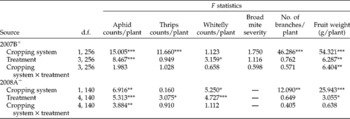
Results indicated that cropping system significantly influenced aphid infestation, hot pepper branching and fruit weight in both growing seasons (Table 1) and the nematode Meloidogyne spp. in 2007B (F = 16.39; d.f. = 1, 16; P = 0.001). The effect of cropping system on thrips and whitefly infestations was not consistent over the two seasons; there was a significant effect on thrips in 2007B only and on whiteflies in 2008A only. Pesticide treatments significantly affected aphid and whitefly infestations as well as hot pepper fruit weight in both growing seasons. Thrips only showed significant differences in 2008A. There were no pesticide treatment effects on hot pepper branching. Broad mite severity showed no significant difference for cropping system and pesticide treatment in 2007B, and there were no observed infestations of the pest in 2008A, which we attributed to the high rainfall received in the season. The interaction between cropping system × pesticide treatment had a significant effect on aphid infestation in 2008A and on hot pepper fruit weight in 2007B (Table 1).
F statistics for the combined analysis of the effect of cropping system and pesticide treatment on pest infestation and plant parameters of hot pepper for two growing seasons

Broad mite severity scale: 1, no symptom; 2, 1–24%; 3, 25–49%; 4, 50–74%; 5, >75%.
Values with asterisks indicate significance: ***0.001; **0.01; *0.05; whereas values without asterisks indicate no significance.
+ 2007B denotes the second rainy season (August–November 2007) of 2007; 2008A denotes the first rainy season (March–June) of 2008.
Effect of growing season
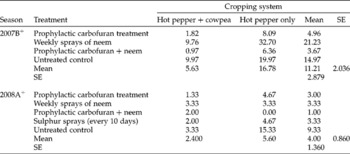
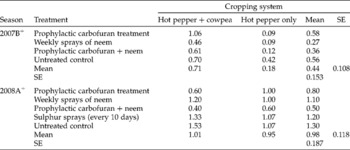
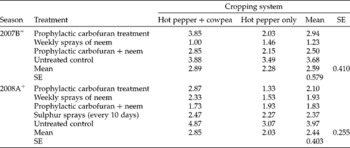
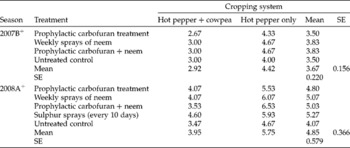
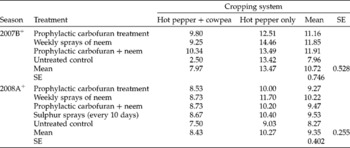
Season significantly affected infestations of aphids (F = 11.65; d.f. = 1, 412; P = 0.001) and thrips (F = 19.38; d.f. = 1, 412; P < 0.001) as well as the plant performance parameters branching (F = 285.91; d.f. = 1, 52; P < 0.001) and fruit weight (F = 27.04; d.f. = 1, 52; P < 0.001). Whitefly infestation was not affected by season. There were more aphids recorded in 2007B than in 2008A, whereas the reverse was true for thrips (Tables 2 and 3). Hot pepper branching level was distinctly lower in 2007B than in 2008A, whereas the reverse was true for fruit weight (Tables 5 and 6).
Effect of cropping system and pesticide treatment on aphid infestation (aphid counts/plant) over growing seasons

+ 2007B denotes the second rainy season (August–November 2007) of 2007; 2008A denotes the first rainy season (March–June) of 2008.
Effect of cropping system and pesticide treatment on thrip infestation (thrip counts/plant) over two growing seasons

+ 2007B denotes the second rainy season (August–November 2007) of 2007; 2008A denotes the first rainy season (March–June) of 2008.
Effect of cropping system and pesticide treatment on whitefly infestation (whitefly counts/plant) over two growing seasons

+ 2007B denotes the second rainy season (August–November 2007) of 2007; 2008A denotes the first rainy season (March–June) of 2008.
Effect of cropping system and pesticide treatment on number of hot pepper branches/plant over two growing seasons

+ 2007B denotes the second rainy season (August–November 2007) of 2007; 2008A denotes the first rainy season (March–June) of 2008.
Effect of cropping system
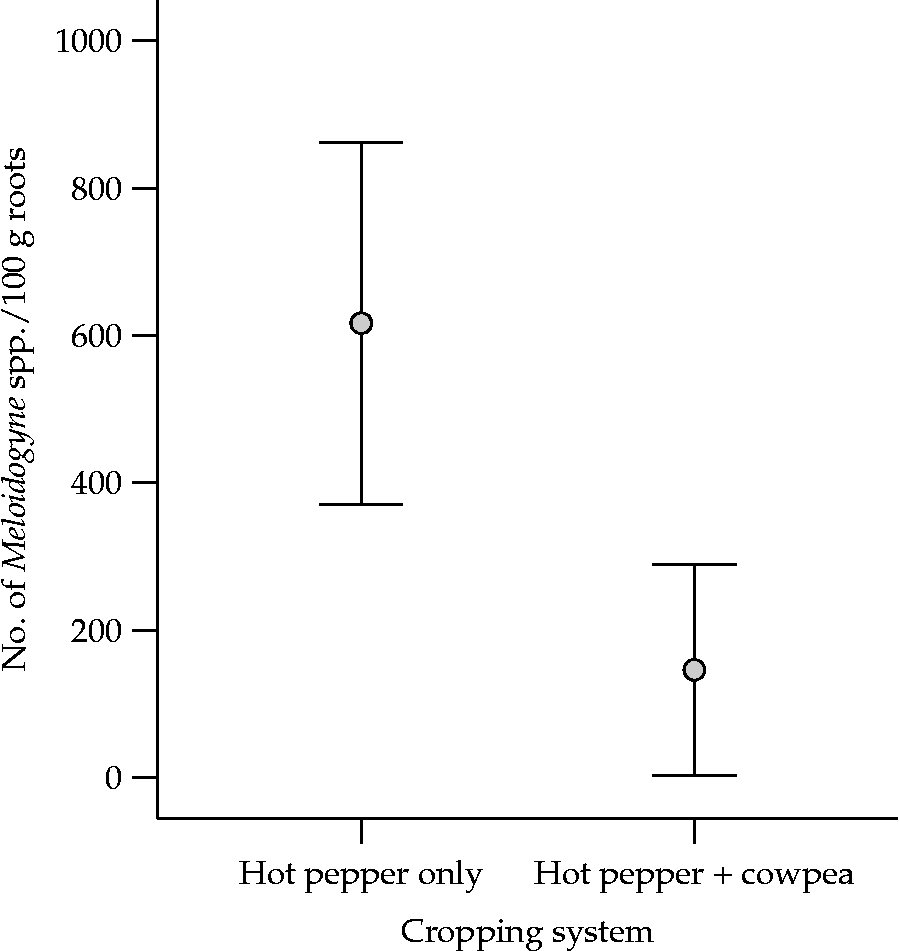
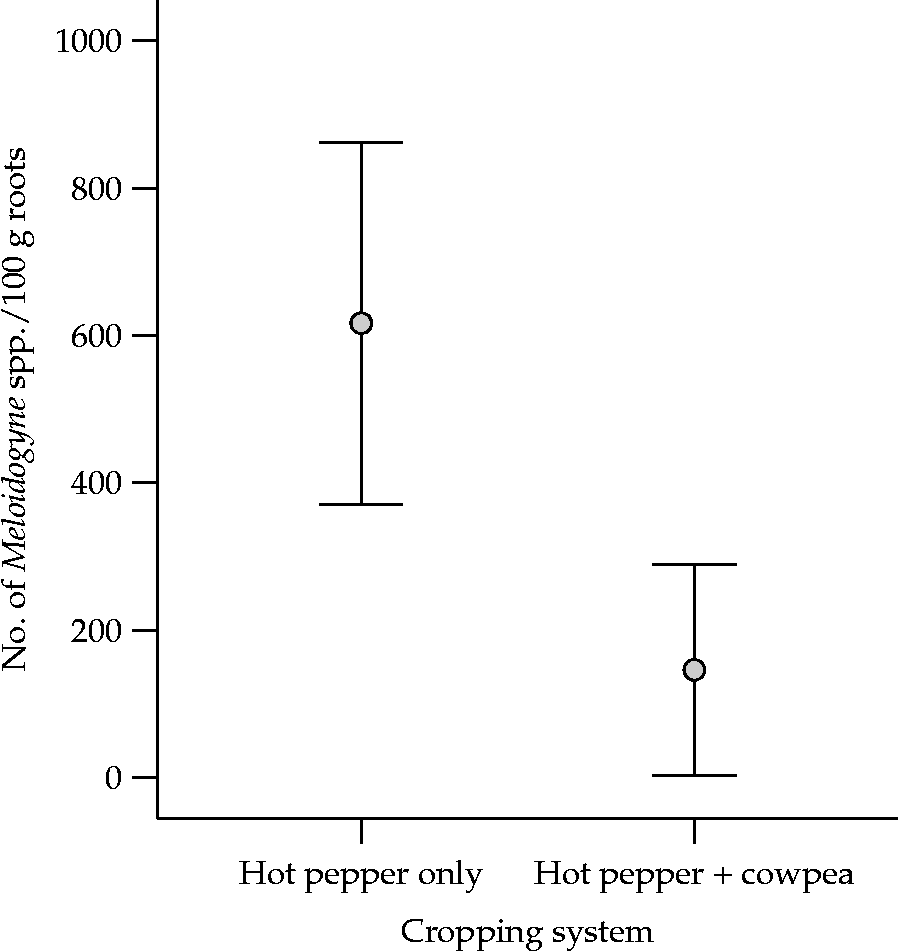
Aphids and Meloidogyne spp. infestations were significantly lower on hot pepper plants in the hot pepper+cowpea system than on the plants in the hot pepper monocrop (Table 2 and Fig. 1). On the other hand, there were higher infestation levels of thrips and whiteflies in the hot pepper+cowpea system compared with the hot pepper monocrop in 2007B and 2008A, respectively (Tables 3 and 4). Hot pepper plant performance denoted by branching and fruit weight gave lower values in the hot pepper+cowpea system compared to the hot pepper monocrop (Tables 5 and 6).
Effect of cropping system on Meloidogyne spp. infestation of hot pepper in the second rainy season of 2007 (F = 16.39; d.f = 1, 16; P = 0.001).
Effect of cropping system and pesticide treatment on fruit weight of hot pepper (weight in g/fruit) over two growing seasons

+ 2007B denotes the second rainy season (August–November 2007) of 2007; 2008A denotes the first rainy season (March–June) of 2008.
Effect of pesticide treatment options
In 2007B, treatments including prophylactic applications of granular carbofuran at transplanting greatly reduced aphid infestations, whereas weekly applications of neem only had the reverse effect; however, this trend did not hold in season 2 as plants receiving neem applications also showed a reduction in aphid infestation compared with the untreated control (Table 2). Whitefly infestations also showed significant pesticide treatment effects for both growing seasons. In 2007B, neem-only applications had a slight edge over all the other treatments in reducing infestations of the pest; in 2008A, neem-only applications were comparable to the other treatments apart from the untreated control, which had the highest infestation (Table 4). In 2008A, the least thrips infestation was on plants receiving a combination of prophylactic carbofuran and neem sprays, whereas the highest thrips infestation was on plants receiving sulphur sprays and the untreated control (Table 3). Fruit yield denoted by fruit weight varied significantly among pesticide treatments in both growing seasons with plants receiving pesticide treatments yielding better than the untreated control regardless of pesticide type in 2007B. In 2008A, plants receiving applications of neem-only sprays had the highest yield and the untreated plants had the least yield (Table 6).
Effect of sampling date on aphid counts over different pesticide treatments
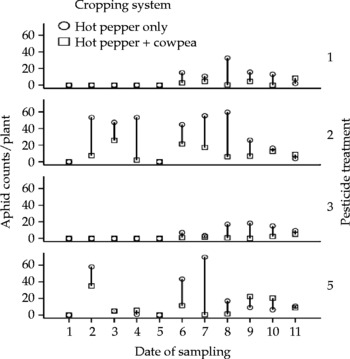
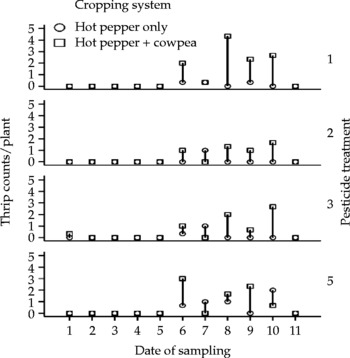
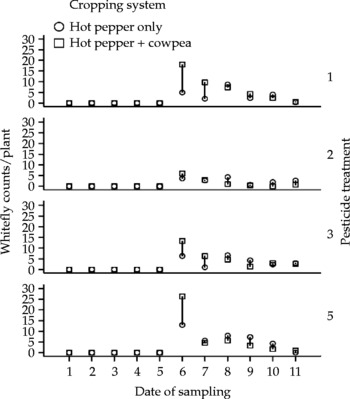
There were significant effects of date of sampling on infestations of aphids (F = 2.037; d.f. = 10, 253; P = 0.03), thrips (F = 5.103; d.f. = 10, 253; P < 0.001) and whiteflies (F = 26.733; d.f. = 10, 253; P < 0.001) in 2007B. Trends indicated that in neem-only sprayed and untreated plots, aphids were recorded as early as 17 days after planting, whereas in plots receiving prophylactic carbofuran, infestation was only observed at 45 days after planting and with relatively fewer counts thereon (Fig. 2). Cropping system effects were especially distinct on aphid counts in neem-only treated plots (Fig. 2). Thrips were only evident at 45 days after planting in all treatments with the least counts recorded in the neem-only sprayed plots; the dynamics were especially distinct between cropping systems in the carbofuran-only plots (Fig. 3). Whitefly infestation also started at 45 days after planting with the least counts in the plots receiving prophylactic carbofuran+neem sprays; the trend of infestation in the prophylactic carbofuran-only plots was more or less similar to that of the untreated control (Fig. 4).
Aphid infestation with time over pesticide treatments and cropping systems (date of sampling: 1, 10 days after transplanting (DAP); 2, 17 DAP; 3, 24 DAP; 4, 31 DAP; 5, 38 DAP; 6, 45 DAP; 7, 52 DAP; 8, 59 DAP; 9, 66 DAP; 10, 73 DAP; and 11, 80 DAP; pesticide treatment: 1, prophylactic carbofuran; 2, neem sprays; 3, prophylactic carbofuran+neem sprays; 5, untreated control).

Thrip infestation with time over pesticide treatments and cropping systems (date of sampling: 1, 10 days after transplanting (DAP); 2, 17 DAP; 3, 24 DAP; 4, 31 DAP; 5, 38 DAP; 6, 45 DAP; 7, 52 DAP; 8, 59 DAP; 9, 66 DAP; 10, 73 DAP; and 11, 80 DAP; pesticide treatment: 1, prophylactic carbofuran; 2, neem sprays; 3, prophylactic carbofuran+neem sprays; 5, untreated control).

Whitefly infestation with time over pesticide treatments and cropping systems (date of sampling: 1, 10 days after transplanting (DAP); 2, 17 DAP; 3, 24 DAP; 4, 31 DAP; 5, 38 DAP; 6, 45 DAP; 7, 52 DAP; 8, 59 DAP; 9, 66 DAP; 10, 73 DAP; 11, 80 DAP; pesticide treatment: 1, prophylactic carbofuran; 2, neem sprays; 3, prophylactic carbofuran+neem sprays; and 5, untreated control).

Discussion
The lower numbers of aphids on hot pepper plants in the hot pepper+cowpea system compared with those in hot pepper monocrop in our study further support reports that aphid populations on annual crops are consistently lowered by cover cropping (Altieri et al., Reference Altieri, Wilson and Schmidt1985; Cartwright et al., Reference Cartwright, Roberts, Hartz and Edelson1990; Costello, Reference Costello1995). The lower aphid numbers in such systems have been attributed to a decrease in the number of immigrant alates brought about by a reduction in the visual contrasts between a crop and its background (Finch and Collier, Reference Finch and Collier2000; Saucke and Döring, Reference Saucke and Döring2004). Aphids receive visual cues to land on crops when there is a clearly defined contrast in colour between tilled bare soil and the lush foliage of crops. Cover cropping reduces the contrast between the bare ground and the plant foliage so aphids do not detect their host. Diversified cropping systems have also been found to reduce populations of phytophages through promotion of natural enemies (Root, Reference Root1973; Schoonhoven et al., Reference Schoonhoven, Jermy and Van Loon1998). In a trial assessing effects of different cropping systems on dynamics of natural enemies, Natarajan and Sheshadri (Reference Natarajan and Sheshadri1988) found elevated densities of coccinellids and braconids in a cotton+cowpea system. This was attributed to the extra floral nectaries on petioles and leaflets of cowpea, which could have attracted the natural enemies.
On the other hand, cover cropping with cowpea increased thrips and whitefly infestations on hot pepper. Various studies have attributed variations in herbivore load in mixtures compared with monocultures to differences in efficacy and/or abundance of natural enemies, difference in food or resource concentration among cropping systems, and modification of crop microclimate (Root, Reference Root1973; Risch et al., Reference Risch, Andow and Altieri1983; Kyamanywa and Ampofo, Reference Kyamanywa and Ampofo1988; Ogenga-Latigo et al., Reference Ogenga-Latigo, Ampofo and Baliddawa1992a, Reference Ogenga-Latigo, Ampofo and Baliddawab; Kyamanywa et al., Reference Kyamanywa, Balidawa and Ampofo1993). Den Belder et al. (Reference Den Belder, Elderson and Vereijken2000) working with leek intercropped with clover linked the high thrips numbers in the intercrop with plant quality, an inference that is in agreement with the ‘host plant quality theory’, which stipulates that intercropping has adverse effects on the nutritional quality and chemical suitability of host plants of herbivores compared with monocrops (van Lenteren, Reference van Lenteren1998; Smith and McSorley, Reference Smith and McSorley2000; Hooks and Johnson, Reference Hooks and Johnson2003). It has also been found that the effect of intercropping on thrips numbers depends, among other factors, on the selection of plants. In some cases, it increases thrips in susceptible crops, while in others, it decreases the pest (Parella and Lewis, Reference Parella, Lewis and Lewis1997). Ramkat et al. (Reference Ramkat, Wangai, Ouma, Rapando and Lelgut2008) found that interplanting tomato with maize reduced thrips infestation on tomato, but the infestation was increased when tomato was similarly interplanted with kale or onions. They attributed the difference to the tallness of maize acting as a barrier against thrips landing, and altering the microenvironment through reduced light reaching the tomato canopy. As such, the results observed in our case on thrips and to a certain extent on whiteflies could have been due to the variation in the microenvironment in the system or the quality of hot pepper due to the undersown cowpea.
Cover cropping hot pepper with cowpea reduced infestations of Meloidogyne spp. on hot pepper. In a greenhouse pot survey of various warm season legumes, cowpea was particularly effective in reducing Meloidogyne arenaria, Meloidogyne incognita and Heterodera glycines (all Tylenchida: Heteroderidae) (Rodriguez-Kabana et al., Reference Rodriguez-Kabana, King, Robertson, Weaver and Carden1988). Other studies have also reported a reduction in nematode infestation through cover cropping with cowpea (Saha et al., Reference Saha, Wang, McSorley, McGovern and Kokalis-Burelle2007; Krueger and McSorley, Reference Krueger and McSorley2008).
The results of our experiment suggest that competition from cowpea negatively affected the performance of hot pepper plants as manifested in the reduced branching and fruit weight. Other researchers have also found a reduction in the final yield of the main crop due to competition from the cover crop (Theunissen et al., Reference Theunissen, Booij and Lotz1995; Hooks and Johnson, Reference Hooks and Johnson2002; Hamid et al., Reference Hamid, Monta and Battisti2006). This has raised a debate on the optimization of the timing of planting/sowing of the cover crop in relation to the main crop. Planting the cover crop earlier than the main crop has showed a potential to greatly reduce phytophages, but this went hand in hand with a greater penalty on yield. This is because to have a desired effect on insect pest densities, two requisites should be considered: the height of the cover crop relative to that of the main crop; and the percentage ground coverage by the cover crop (Finch and Kienegger, Reference Finch and Kienegger1997). Early planting/sowing of the cover crop ensures that the two requisites are in place, but also means that the cover crop is more physiologically advanced than the main crop, which is a competitive advantage. In hot pepper production, where harvesting can be done over a period of more than 6 months, the negative impact on yield could be outweighed in subsequent harvests by an increase in soil nitrogen as a result of the ability of cowpeas to fix nitrogen.
Prophylactic carbofuran application at transplanting showed potential in reducing infestations of aphids early in the season. Neem sprays, though not as effective on aphids, were better in reducing thrips and whitefly infestations. Previous studies elsewhere had indicated a high degree of efficacy of neem-based formulations against whiteflies (Dimetry et al., Reference Dimetry, Gomaa, Salem and Abd-El-Moniem1996; Greer, Reference Greer2000). It is especially important to reduce the three pests because of their indirect damage as vectors of viral diseases in hot pepper. Viral diseases are a big constraint for many hot pepper farmers in Uganda because of recycling of seed due to the absence of a certified seed system for vegetables (IPM CRSP, 2006). Moreover, prophylactic applications of newer and safer pesticides such as imidacloprid, even oxamyl, would have been a better option, but unfortunately, they are not available on the market; hence they were not accessible to the growers. This discrepancy in accessibility to safer pesticides between countries at different levels of economic development poses a challenge in developing IPM systems in some developing countries. For such countries to remain competitive in international export markets, the policy environment regarding registration of newer and safer agrochemicals has to be more conducive.
Conclusion
Cowpea as a cover crop offers many advantages in addition to the potential to reduce aphids and nematodes as indicated in this study; however, research on techniques of reducing its competitiveness with the main crop is essential. Focus should also be directed to acquiring and verification of biotic stress-resistant germplasm and seed certification for better IPM in hot pepper production.
Acknowledgements
Funding for this research was provided by the United States Agency for International Development through the Integrated Pest Management Collaborative Research Support Program. We are grateful to Icemark-Africa Ltd for providing the hot pepper seed.