Introduction
The coronavirus disease 2019 (COVID-19) pandemic, caused by severe acute respiratory coronavirus virus 2 (SARS-CoV-2), has significantly challenged the United States health system. Early in 2020, increasing case counts raised the specter of widespread SARS-CoV-2 transmission within workplaces, including hospitals. The rate of transmission, levels of personal protective equipment (PPE) and transmission precautions needed for suspected and confirmed infections, accuracy of diagnostic tests, and supply of PPE and tests were unknown. Consequently, the Massachusetts Department of Public Health and Commissioner of Public Health issued an order on March 16, 2020, requiring hospitals to screen all employees and visitors for symptoms Reference Kelley1 to try to minimize the number of potentially contagious persons in the facility as a key infection control mechanism.
Our institution rapidly deployed a novel digital employee screening system called COVIDPass Reference Zhang, Dimitrov and Simpson2 that included daily symptom attestations across 52 clinical sites in Massachusetts. Employees were screened daily before coming to work. Symptomatic employees were referred to Occupational Health Services (OHS) for further evaluation, including testing if indicated, before they were cleared for work. Alternatively, healthcare providers (HCPs) who were concerned about symptoms and/or exposure could contact OHS or get tested.
Although some evidence supports symptom-based screening to prevent the spread of other communicable diseases, Reference Juusola, Brandeau, Long, Owens and Bendavid3 the effectiveness of a symptom-based screening of HCP for SARS-CoV-2 has yet to be well characterized. Although the US Centers for Disease Control and Prevention recommends daily symptom screening of employees before entering the workplace, they cannot cite any evidence for it. Reference Gidengil, Fischer and Broten4 We assessed the impact of daily symptom attestation for HCP on symptom reporting, testing, case detection, and associations between symptoms and positivity.
Methods
This retrospective cohort study was approved by the Mass General Brigham Institutional Review Board.
Sources of information
Data were obtained from attestations, employee demographics, and the OHS independent database of employee SARS-CoV-2 tests. Attestations included the employee’s hospital or clinic location and whether they had a fever, sore throat, new cough, new nasal congestion or runny nose, muscle aches, new loss of smell or taste, shortness of breath, flu-like symptoms, diarrhea (the last 2 were removed shortly after rollout), or none. Symptomatic employees were required not to work until they were evaluated by OHS. Symptomatic employees who had been tested and cleared by OHS (ie, symptoms deemed due to another condition and SARS-CoV-2 test not indicated or negative) could indicate that in COVIDPass. Reference Zhang, Dimitrov and Simpson2
Attestations were submitted by employees at 52 different hospital and clinic sites, from large, tertiary-care academic medical centers to affiliated, freestanding, outpatient, primary-care or subspecialty clinics. For this analysis, we used attestations submitted between March 23, 2020, and June 30, 2020. We used July 2020 as the end date because additional mechanisms for entering attestations were activated at this point that could confound the analyses (eg, hospital-owned desktops and laptops, electronic health record).
SARS-CoV-2 tests performed within 14 days of attestation were retrieved for all employees who attested during the study period. Employee information included job title, sex, race, and spoken languages.
Data processing
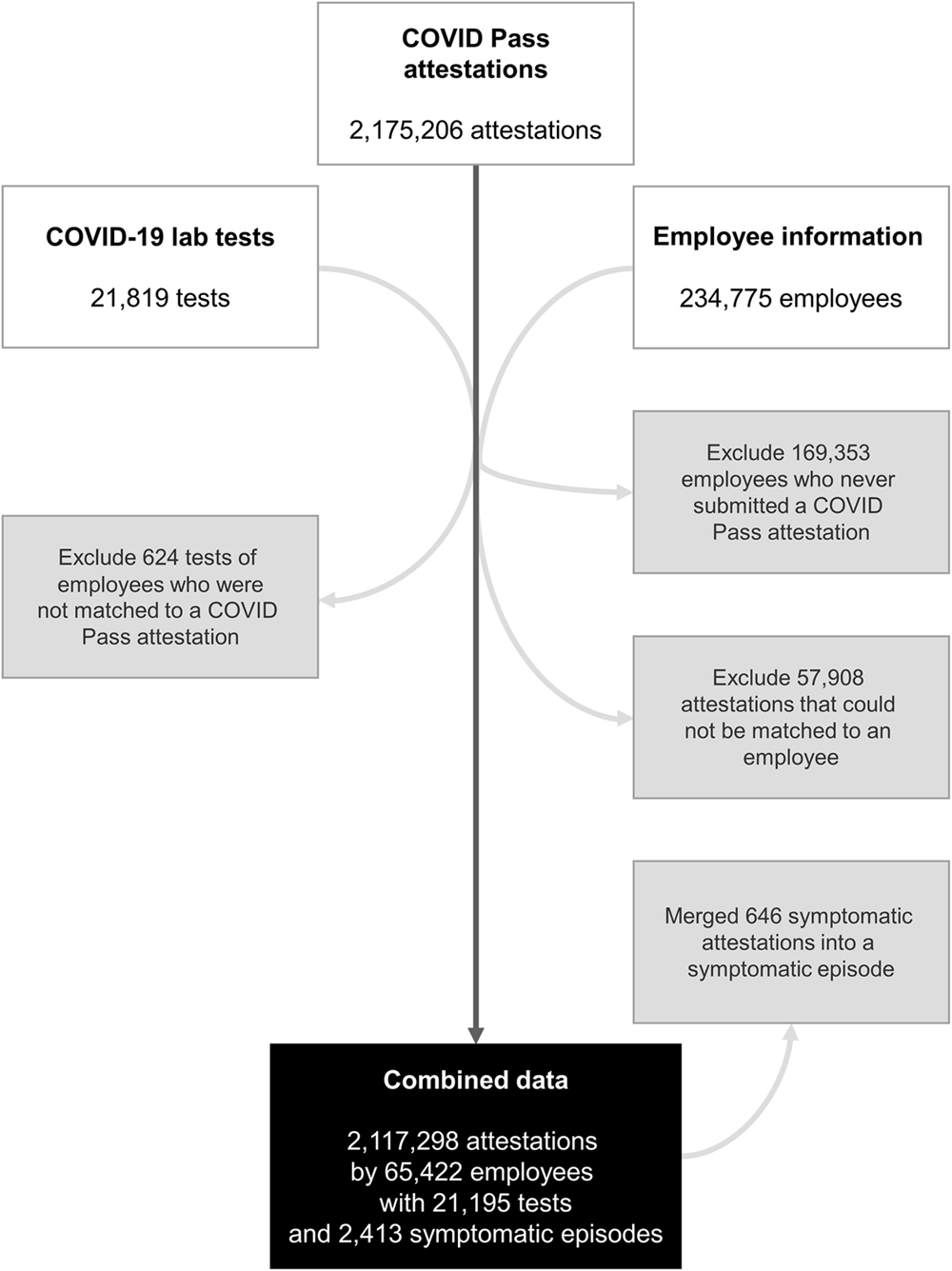
Data were linked from attestations, SARS-CoV-2 tests, and employee information files by employee identification number; employee username; occupational health identification number; or first and last name only if the name was unique in the employee information file and the prior 3 pieces of information were not correctly recorded (Fig. 1). The combined data were analyzed at multiple levels of granularity as described below.
Data flow diagram.

First, combined data were analyzed at the level of employees, and each employee characteristic was calculated once per employee. Calculated variables included the total number of attestations, number of tests performed, number of positive tests, number of attestation languages used, number of distinct hospital and clinic locations selected by that employee across all their attestations, number of spoken languages, and number of different job titles (eg, nurse and case manager). Job titles were used to categorize employees into patient-facing and non-patient-facing roles. Patient-facing roles included nurse, physician, therapist, patient transporter, phlebotomist, protective services, etc. Non-patient-facing roles included engineer, administrator, accountant, administrative assistant, etc. If an employee had multiple roles that included a patient-facing and a non-patient-facing role, then they were considered to have a patient-facing role.
Second, combined data were analyzed at the level of attestations to study the volume of attestations. Multiple attestations by the same employee during a 24-hour period were merged into 1 attestation with the maximum number of symptoms. Calculated variables included the total number of symptoms reported in the attestation and the order of attestation by an employee (ie, an attestation was the nth attestation submitted by an employee).
Third, the combined data were analyzed at the level of symptomatic episodes. Multiple symptomatic attestations by the same employee on consecutive days or separated by 1 day were merged into 1 symptomatic episode with the maximum number of symptoms. For example, if an employee submitted attestations on day 20 with a cough, day 21 with a cough, day 23 with a cough and a fever, and no symptomatic attestations on days 19, 22, or 24, then these attestations were counted as a single symptomatic episode with a cough and a fever starting on day 20 and ending on day 23.
Selection criteria
Employees were excluded if they had never submitted an attestation, even if they had a SARS-CoV-2 test result (ie, employees who worked entirely remotely during this period). Attestations were excluded if there were typographical errors in multiple identifiers.
Statistical analysis
All data that met selection criteria were included. All results are presented as associations with no claim of causality, and with a focus on hypothesis generation rather than hypothesis testing.
Descriptive statistics included χ2, Wilcoxon, and Kruskal-Wallis tests, with the significance level (α) defined at 0.05. Characteristics of employees who submitted more attestations, submitted more symptomatic attestations, and tested positive were summarized. The frequency of specific symptoms among symptomatic attestations were described in total and for association with a positive SARS-CoV-2 test. Specific symptoms were only counted once per employee per symptomatic episode.
Results
After applying the selection criteria, there were 2,117,298 attestations over 99 days submitted by 65,422 employees. There were 2,413 symptomatic episodes. Employees who used COVIDPass had 21,195 SARS-CoV-2 tests within our network during the study period.
Attestations
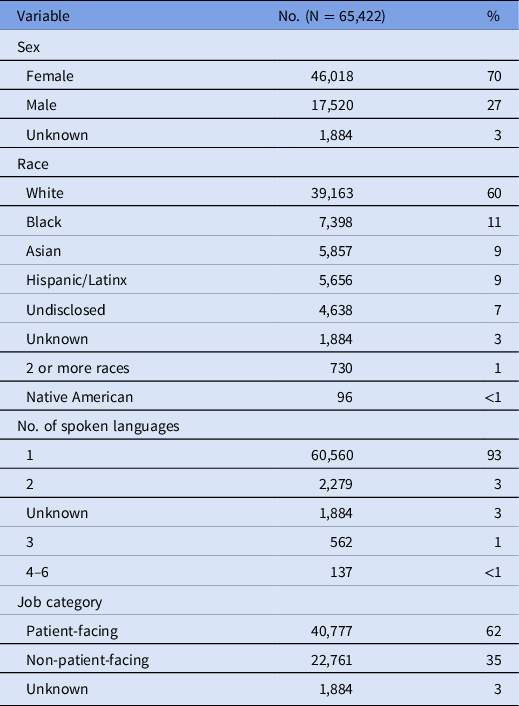
Employee characteristics are shown in Table 1. Most attestations were submitted by employees with a patient-facing role, female sex, White race, and one spoken language. Per employee, the median number of attestations was 33 (range, 1–99); the median number of COVID-19 tests was 0 (range, 0–13), and the median number of positive tests was 0 (range, 0–10). The number of languages used for attestations was 1 (range, 1–4), and the number of hospital and/or clinic locations was 1 (range, 1–14).
Employee Characteristics

Employees who attested more frequently were associated with having a patient-facing job; at least 1 SARS-CoV-2 test; attestations in multiple languages; attestations at multiple facilities; male sex; multiple job titles for patient-facing employees or 1 job title for non-patient-facing employees; multiple spoken languages; and Black, Hispanic, Latin, or Native American race. Many employees (8,589, 13%) submitted 1–4 attestations.
Symptomatic episodes
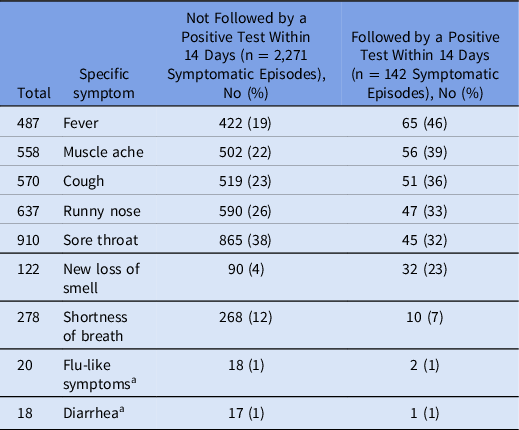
Most attestations noted no symptoms (2,114,239, 99.9%). In total, 3,059 (0.1%) symptomatic attestations were submitted by 2,026 employees. Nearly all symptomatic episodes lasted 1–5 days (2,137, 99%); the longest symptomatic episode lasted 16 days. The most common specific symptom was sore throat (25% of symptomatic attestations). As shown in Table 2, the most common symptoms associated with a positive test were anosmia (23% vs 4% without a positive test; odds ratio [OR], 7.05; 95% confidence interval [CI], 4.51–11.02; P < .01) and fever (46% vs 19%; OR, 3.70; 95% CI, 2.62–5.23; P < .01).
Specific Symptoms Associated With a Positive SARS-CoV-2 Test a

a Flu-like symptoms and diarrhea were initially included as specific symptoms and were soon removed as evidence emerged that they were less associated with COVID-19.
Attestations of employees who tested positive for SARS-CoV-2
In total, 1,289 employees tested positive for SARS-CoV-2. During the 0–14 days before their first positive test, 9% had attested to symptoms; 58% had asymptomatic attestations; and 33% had no attestations. Submission of a symptomatic attestation within 14 days prior to the first positive test was associated with male sex (P = .049) and Black race (P = .039). It was not associated with the clinical nature of their job.
Symptomatic attestations and COVID-19 tests
In total, 2,026 employees attested to symptoms on at least 1 occasion. Of these, 905 employees were tested within 14 days and 114 (13%) tested positive for SARS-CoV-2.
Discussion
The daily COVID-19 symptom attestation screening system for employees (which was comprised of symptom-screening, self-referrals to the OHS team, and/or a SARS-CoV-2 test) helped identify several cases of COVID-19 among employees and avoided potential exposure to other employees or to patients.
Overall, 99.9% of the 2.1 million attestations were asymptomatic. The most common symptoms associated with a positive SARS-CoV-2 test were anosmia (23% vs 4%) and fever (46% vs 19%), which is consistent with other COVID-19 studies. Although the number of positive cases identified was low, attestations may have helped keep some of these unwell employees off campus and may have prevented some exposures and transmissions.
Symptomatic attestations and COVID-19 tests
Overall, 905 employees were tested within 14 days of a symptomatic attestation, and 13% of these tests were positive. This rate is notably higher than the test positivity rate in our community during the same time and in multiple healthcare setting scenarios. Reference Klompas, Baker and Rhee5,Reference Shenoy and Weber6 This rate is slightly higher than the reported 10% positive tests among symptomatic healthcare personnel (HCP) reported by a small subset of our institution (outpatient surgical clinic) during a much shorter period. Reference Sacks, Dougan and McCoy7
Our screening system’s resulting positive test rate may have underestimated the effectiveness of our screening because concerned employees could skip the attestation and call OHS or independently schedule a test. In an ideal world, our positive test rate would be close to 0% because employees only submitted attestations during these months if they were coming in to work in a clinical setting.
Early in the pandemic, when COVIDPass was initially deployed, we had a shortage of SARS-CoV-2 tests and evidence about the best screening practices. Reference Shenoy and Weber6 What the optimal screening system should include remains unknown, but there is additional support for including symptoms in the assessment of who should be tested. The Mass General Brigham recently implemented a COvid Risk cALculator (CORAL) diagnostic algorithm in a clinical decision support system to quickly identify patients who should be tested for SARS-CoV-2 or should be presumed to be positive Reference Dugdale, Rubins and Lee8 ; the algorithm includes symptoms, epidemiologic risk factors, and imaging findings. Given the differences in our screening populations (HCP vs patients in the emergency department or admitted to the hospital), screening with symptoms seems to be reasonable in our setting.
Finally, not all of the 2,026 employees who submitted symptomatic attestations were tested. Only 905 (45%) were tested within 14 days of symptomatic attestation. Presumably, the other half of HCP were evaluated by OHS and were not recommended to be tested or arranged tests independently at a testing center outside our institution.
Attestations of employees who tested positive for SARS-CoV-2
Most (91%) employees who tested positive for SARS-CoV-2 had not attested symptomatic within 14 days of their first positive test; they either attested asymptomatic or did not attest at all in that period. However, the number of symptomatic HCP may have been underestimated, if they felt unwell and contacted OHS or scheduled a test at one of our centers or elsewhere. On the other hand, some employees who tested positive for SARS-CoV-2 may have been asymptomatic (eg, asymptomatic or pre-symptomatic viral shedding); some employees may have attested to being asymptomatic because they knew that a symptomatic attestation would not allow them to work (see below for discussion of presenteeism); and employees may have had “question fatigue” and stopped looking at the symptoms before clicking “no symptoms.” Effective symptom screening is challenging.
Symptomatic episodes
Most attestations were not symptomatic. Consistent with other reports of COVID-19 symptoms, Reference Marshall9,Reference Dawson, Rabold and Laws10 anosmia and fever were most often associated with testing positive.
This study had several limitations related to attested symptoms, and some were unavoidable. The screening symptoms were based on the best available information at the time. Screening using self-reported symptoms relies on employees answering honestly. American physicians often continue to work while unwell, despite some attempts to stop this potentially hazardous presenteeism Reference Widera, Chang and Chen11 due to a complicated combination of contextual and personal factors Reference Jena, Meltzer, Press and Arora12,Reference Giæver, Lohmann-Lafrenz and Løvseth13 that were likely heightened during the pandemic. Our institution had several strategies to try to reduce this effect, including a system to help reduce barriers for unwell HCP to stay home from work, enforcing and communicating to HCP supervisors if they were symptomatic, and paying HCP for days not worked due to COVID-19.
Attestations
The characteristics of employees who submitted at least 1 attestation are similar to the employee demographics of another academic medical center in the same part of the country as reported by Horng et al. Reference Horng, O’Donoghue and Dechen14 Notably, during the reported months, employees only attested when physically entering a hospital or clinic. An employee may have worked more days than the number of attestations they submitted, for instance, if they transitioned to working remotely. Indeed, many employees may never have attested if they always worked remotely or in an administrative building. More than 13% of employees submitted <5 attestations over these 99 days. Slight differences compared to distributions reported by Horng et al Reference Horng, O’Donoghue and Dechen14 are possible not only due to natural variation but also because of different employee characteristics between employees who work on site compared to those who always work remotely.
In addition to limitations already discussed, this was a retrospective study. Some data were incomplete or contained typographical errors (eg, leading to challenges in matching attestations to employee information resulting in the unknowns in Table 1). The COVIDPass system was a custom-developed software application that was expanded and modified over time, with some changes in data collection, storage, and linking.
To our knowledge, prior to this study, there was no evidence that daily symptom screening of HCP helps to prevent the spread of COVID-19 by early testing and identification of ill HCP. Notably, the screening system was part of a larger strategy that included a COVID-19 employee hotline, wearing masks, reporting breaches in safety protocols, exposure tracking of positive cases, strategic placement of suspected COVID-19 patients on units with negative pressure rooms and adequate PPE, and, much later, the mass vaccination of HCP. The results of our screening system suggest that other institutions may benefit from implementing a similar system. Even if the yield is deemed too small for the costs of implementation, which would vary among institutions, this system can still be used to monitor PPE allocation and the number of employees working on site or remotely.
In summary, our daily symptom attestation system may help identify employees who should be tested for SARS-CoV-2 while reducing exposure to patients and coworkers. It may help unwell HCP to stay home from work and could even help to start changing the prevalent culture of presenteeism in healthcare. It also raises questions about benefits of daily symptom screening of patients and visitors entering a hospital or clinic. Although it may require re-evaluation in the setting of post-COVID-19 immunizations, screening systems may be helpful in the early phase of future pandemics with limited evidence and supplies.
Acknowledgments
Financial support
E.K. received support from the National Library of Medicine Biomedical Informatics and Data Science Research Training (grant no. T15 LM007092).
Conflicts of interest
A.B.L. was previously a member of the Abbott Medical Device Cybersecurity Council. COVIDPass has been licensed to two vendors. Mass General Brigham, A.B.L., and H.M.Z. receive license fees and royalties.