

I
In 1939, Elliott Carter evaluated the state of music criticism in Manhattan with particular reference to attitudes to the American composer. Surveying the seven local dailies that then reviewed music—the Brooklyn Eagle, New York Herald Tribune, New York Journal-American, New York Post, New York Sun, New York Times, and New York World-Telegram—Carter concluded:
The critics are not well-informed about American music. How could they be? They do not cover concerts devoted to it, such for example as the WPA Composer's [sic] Forum Laboratory, or that of the Musical Art Quartet which this month [January 1939] presented four American quartets by Daniel Gregory Mason, Quincy Porter, Mark Wessel and Rudolph Forst. Two of these men have considerable reputations and yet only the Times and Tribune bothered to send even their second string reviewers, who were perfunctory enough to come late or leave early. Other papers made the kind of passing mention accorded to third rate artists.1
Elliott Carter, “Once Again Swing; Also ‘American Music,’” Modern Music 16/2 (January–February 1939): 101.
Unfortunately for the American composer, the objective of these newspapers was to review performances at the prestigious halls in Midtown (those located between Fortieth and Fifty-seventh Streets) and, typically, it was only if a new work was scheduled in one of these venues that an American composer could hope for newspaper coverage, let alone a report from a principal critic. Carter's central point was that even if critics attended, and even if they remained for the duration of the program, they were not well enough informed to be able to evaluate new works.
In the following year, this situation altered dramatically when Virgil Thomson (1896–1989) was appointed chief critic at the New York Herald Tribune. Newly repatriated from Paris, where he had earned a reputation as composer and essayist, Thomson held the view that the “general standard of music reviewing in New York had sunk so far that almost any change might bring improvement.”2
Virgil Thomson, Virgil Thomson (New York: E. P. Dutton, 1985), 321.
Virgil Thomson, Music Reviewed: 1940–1954 (New York: Vintage Press, 1967), 398, repr. from New York Herald Tribune, 14 February 1954.
Thomson, Virgil Thomson, 334. Thomson once wrote of the first movement of Beethoven's Symphony No. 3 as “a dud,” and the second movement as “a drug.” Thomson, New York Herald Tribune, 18 December 1940; quoted in Elleyn P. Berk, “An Analysis and Comparison of the Aesthetics and Philosophy of Selected Music Critics in New York: 1940–1975,” Ph.D. diss., New York University, 1978, 196.
Thomson, Virgil Thomson, 328.
Richard Franko Goldman, “Music Criticism in the United States,” Score and I.M.A. Magazine 12 (June 1955): 86–87.
Quoted in Mark N. Grant, Maestros of the Pen: Classical Music Criticism in America (Boston: Northeastern University Press, 1998), 254.
Quoted in Arthur Berger, Reflections of an American Composer (Berkeley: University of California Press, 2002), 119–20; Kathleen Hoover in Hoover and John Cage, Virgil Thomson: His Life and Music (Freeport, N.Y.: Books for Libraries, 1970), 92.
From early in his reign at the Tribune, Thomson amassed an unprecedented roster of composer-critics in his belief that composers should explain other composers. Many of those he employed either as staffers or stringers had served an apprenticeship at Modern Music, where they earned a reputation as fearless (if not savage) commentators on one another's music. In the far more public domain of a newspaper, they were obliged to review legions of debutants and recitalists as well as Philharmonic-Symphony concerts, Met productions, and occasional new music performances. Thomson insisted for the general public's sake that they report an event rather than their personal opinion of it, upbraiding one with the reasoning that “nobody gives a damn if you like it or don't like it. Who are you? Describe what happened. Include everything except your reactions. If you cover a fire in the Bronx you don't write about your reactions, you write about how many people they carried out.”9
Thomson quoted by Bowles in “Paul Bowles Meets with Ken Smith and Frank J. Oteri,” NewMusicBox, 1 December 1999, http://www.newmusicbox.org/article.nmbx?id=459.
Thomson, Virgil Thomson, 334–35.
One of the composers Thomson went to great lengths to spotlight was John Cage. In 1942, Cage arrived in New York City, where he resided until 1954. Unquestionably, Cage's advent brought new sounds and ideas that confronted the city's critics. His arrival was immediately preceded by reports in Manhattan newspapers of his concerts in Chicago; one paper announced that “They Break Beer Bottles Now to Make Music in Chicago” and a few days later printed a satirical cartoon headed “Bach, Beethoven, Brahms and Beer.”11
“They Break Beer Bottles Now to Make Music in Chicago,” New York World-Telegram, 2 March 1942, 15. “Bach, Beethoven, Brahms and Beer,” New York World-Telegram, 6 March 1942, 21. The review implied that a beer bottle was broken in Cage'sImaginary Landscape No. 3. In fact, it was broken in the third movement Foxtrot of William Russell's Three Dance Movements, his best-known work, which ended the concert.
Until the publication of Paul van Emmerik's John Cage Compendium (http://www.xs4all.nl/~cagecomp), the most comprehensive published bibliography was Robert Dunn's, included with the catalog of Cage's compositions; Robert Dunn, John Cage (New York: Henmar Press, 1962). Dunn's list represents about two-thirds of van Emmerik's; this article surveys some reviews not included in either Dunn's or Emmerik's lists.
Remarkably, more than a third of these accounts were written by composers employed at one time or another by Thomson at the Tribune, whether writing for that paper or moonlighting for others such as Musical America, Cue, or Vogue. This article will survey the critical reception of performances of concert works by Cage in Manhattan from his first public concert in 1943 until the retrospective in 1958, detailing responses of both composer-critics and music journalists (I differentiate these reviews from those by dance critics of dance performances to Cage's music, which usually appeared in their own columns of newspapers, music periodicals, or dance publications).13
Dance performances were reviewed occasionally but haphazardly by concert critics. Because of his background in dance Lou Harrison reviewed the “dance-concert” presented in April 1944; in 1946 Elliott Carter (then composing for Ballet Society) reviewed Mysterious Adventure in Modern Music. Virgil Thomson made a passing comment on Mysterious Adventure when it was presented by Martha Graham: he wrote of its “strange and delicate score” among other new works which demonstrated “to all, even, we hope, to dancing's ‘modern’ wing, that terpsichoric entertainment can be something more than cavorting to a scenario with sound effects” (Thomson in the New York Herald Tribune, 20 May 1945, repr. in The Art of Judging Music [New York: Alfred A. Knopf, 1948], 162). Although companies such as those of Merce Cunningham and Jean Erdman frequently performed dances accompanied by Cage's music, the Times, for instance, gave notice of these performances in its dance column but rarely allocated space for a review, and even when it did, discussed the dance with little or no reference to the music. Overall, comments on dance performances represent a small fraction of the total number of published accounts of Cage in these years.
Richard Kostelanetz, ed., John Cage (New York, Praeger, 1970), 61. For a discussion of Cage's reception until 1942, see Leta E. Miller, “The Art of Noise: John Cage, Lou Harrison and the West Coast Percussion Ensemble,” Perspectives on American Music, 1900–1950, ed. Michael Saffle (New York: Garland, 2000), 215–63. Among the extensive list of reviews Miller quotes is one by Alfred Frankenstein, who reviewed a Mills College concert of works by Cage, Lou Harrison, and William Russell in “A Splendid Performance Opens Red Cross Series” (San Francisco Chronicle, 19 July 1940). An excerpt describing the event as “endlessly fascinating” was printed in Time, 9 July 1940, 40. Cage sent a copy of the original review to Cowell (housed in the Cowell Papers, folder 44, Research Division, New York Public Library for the Performing Arts).
Second, I will focus on the synergy between Thomson and Cage, and explore what linked a preeminent composer-critic with one of the country's most “far out” composers. A comparable situation today—in which a prominent composer is public arbiter of another's work—would be unthinkable.15
Anthony Tommasini, a current New York Times music critic, writes: “Imagine this scenario: the chief music critic of a major New York daily newspaper is a working composer. The critic's compositions are performed by leading orchestras, chamber musicians and singers around the country, sometimes with the composer conducting. When a new composition by this critic is presented in New York, another music critic from the paper reviews it, almost always favorably. After six years on the job, the critic wins the Pulitzer Prize, not for criticism but for composition. And far from being embarrassed, the editors of the paper boast in print of the critic's accomplishment.” See Tommasini, “A Critic's Creed: Plug Yourself and Your Fellow Americans,” New York Times, 21 August 1994, 2: 24.
The observation was made by Minna Lederman in “John Cage: A View of My Own,” A John Cage Reader: In Celebration of His 70th Birthday, ed. Peter Gena and Jonathan Brent (New York: Peters, 1982), 152. Lederman recalled that whenever she visited Thomson Cage would be present, and whenever Thomson visited her, he was accompanied by Cage.
David M. Halperin, How to Do the History of Homosexuality (Chicago: University of Chicago Press, 2002), 115–16, quoted in Nadine Hubbs, The Queer Composition of America's Sound: Gay Modernists, American Music and National Identity (Berkeley: University of California Press, 2004), 87, in a discussion of Copland's pederastic mentoring of young composers.
Virgil Thomson, American Music Since 1910 (New York: Holt, Rinehart and Winston, 1971), 9.
In “The Abstract Composers,” Thomson wrote that Cage's admirers “who are many (and include your commentator), tend ever to defend it as a species rather than to attach themselves to any particular piece.” Thomson, “The Abstract Composers,” New York Herald Tribune, 3 February 1952, repr. in Score and I.M.A. Magazine 12 (June 1955): 62–64. Thomson does not appear ever to have commented on 4' 33”, which in the period under discussion seems to have received only one public performance in Manhattan, on 14 April 1954.
Virgil Thomson, “Looking Back on a Decade,” Encounter 15 (November 1960): 48.
II
In the 1940s, eight dailies reviewed music in Manhattan;21
In 1940, PM joined the seven listed previously.
On Sundays circulation numbers were 788,000 for the Times and 538,000 for the Tribune. See Richard Kluger, The Paper: The Life and Death of the New York Herald Tribune (New York: Random House, 1986), 358.
The rules as listed here were outlined by Thomson in an interview with Alix Williamson. See Alix B. Williamson, “The Critics Face the Music,” Musical Courier, 15 January 1946, 11, 65, 75. Carnegie Hall is located on West Fifty-seventh Street and now seats 2,800; Town Hall at West Forty-third Street seats approximately 1,500; Carnegie Chamber Music Hall (now Weill Recital Hall) seats 268; and the New York Times Hall (now Helen Hayes Theatre) on West Forty-fourth Street seats approximately 600. Cage's concerts were also heard at the auditorium at the Museum of Modern Art, which seated 500; the McMillin Theater at Columbia University (now Miller Theatre), which seats about 700; the Cherry Lane Theatre on Commerce Street, which seated about 180; and the Carl Fischer Concert Hall on West Fifty-seventh Street (number of seats unknown).
Thomson and his counterpart at the Times, Olin Downes (1886–1955), were the two acknowledged “deans” of music criticism in New York City; Mark A. Grant in his history of American music criticism dubs them the “twin Gotham pillars of what might be called the Second Empire” of criticism.24
Grant, Maestros of the Pen, 256.
Olin Downes, “Rodzinski Offers Music of Copland,” New York Times, 5 October 1945, 27. Elleyn Berk details more of Downes's opinions of modern music, including his reference to “the excruciating possibilities of the twelve-tone scale.” See Berk, “An Analysis and Comparison,” 124.
Downes quoted in Williamson, “The Critics Face the Music,” 65.
Olin Downes, “Six Pianists Heard in Special Concert; Join Forces in Benefit Recital at Times Hall for Purchase of Gottschalk Manuscripts,” New York Times, 23 December 1948, 23. Cage performed Amores. In what seems to have been the only other report of Cage by Downes he described Sonatas and Interludes as “incredibly vacuous” (“6th Concert Given at Columbia Fete,” New York Times, 15 May 1949, 79).
Downes, quoted by Parmenter in Leta E. Miller and Fredric Lieberman, Lou Harrison: Composing a World (New York: Oxford University Press, 1998), 239.
Parmenter, quoted in Miller and Lieberman, Lou Harrison, 239. Straus was a graduate of the University of Chicago and the Hoch Conservatory who joined the staff of the Times in 1935 (when he was in his mid-fifties). A native New Yorker, Howard Taubman joined the Times after graduating from Cornell, and was appointed chief music critic in 1955 at the death of Olin Downes. He published eleven populist books, including a biography of Toscanini. Berk argues that Taubman was extremely uncomfortable reviewing modern music and was in general anti-intellectual (see Berk, “An Analysis and Comparison,” esp. 235 and 424). Schubart, a composer and later music educator, left the Times for Juilliard in 1946. Parmenter, an exact contemporary of Cage, Berger, and Glanville-Hicks, joined the Times in 1934 at the age of twenty-two and remained there until his retirement in 1964.
Quoted in John Gruen, The Party's Over Now: Reminiscences of the Fifties—New York's Artists, Writers, Musicians, and Other Friends (New York: Viking Press, 1972), 68.
Ibid.
“Paul Bowles Meets with Ken Smith.”
During the season Thomson typically wrote a bylined article for the Sunday edition and a few reviews during the week, while he continued composing. During his Tribune years, he completed an opera, The Mother of Us All (1947), as well as music for numerous films, commissions for orchestra, and his famous portraits for piano. He became immensely powerful: he sat on boards of publication and performance organizations, refereed for Guggenheim fellowships and other prestigious awards, founded the Music Critics' Circle, wrote for various publications as well as the Tribune, and published three books. In 1949, his score for Louisiana Story won a Pulitzer Prize, the first awarded to a film score. His visibility, therefore, was monumental, and his ability to influence the reception of American music unparalleled. But the most direct way in which he propagated new music was by regular commentaries in the Tribune by himself and his staff. In the early 1940s the staff comprised Francis D. Perkins (1915–1998?), the music editor, along with Jerome D. Bohm and Robert Lawrence (dates of both unknown). Perkins, like Thomson, was a Harvard man, a “walking encyclopedia” and an all-rounder as a critic.33
Peggy Glanville-Hicks, letter to Carleton Sprague Smith [ca. April 1954], Composers' Forum correspondence files, Research Division, New York Public Library for the Performing Arts.
This list is roughly chronological. Thomson's own list in the order in which he discussed them is Paul Bowles, Arthur Berger, Edwin Denby, Jay Harrison, Theodore Strongin, Allen Hughes, Herbert Weinstock, Elliott Carter, John Cage, Lou Harrison, William Flanagan, Lester Trimble, and Peggy Glanville-Hicks. See Thomson, Virgil Thomson, 334; and Thomson, “The Paper,” in A Virgil Thomson Reader (New York: E. P. Dutton, 1981), 187. Carter wrote only twice for the Tribune, once in 1945 and once, on Cage and others, in 1953; see John F. Link, Elliott Carter: A Guide to Research (New York: Garland, 2000). It is likely Cage wrote only twice for the Tribune, providing reports on festivals he attended in Europe in summer 1949 (see n. 174).
Grant, Maestros of the Pen, 254.
Virgil Thomson, “How Composers Eat, Or Who Does What to Whom and Who Gets Paid” (1939), in The American Composer Speaks: An Historical Anthology, 1770–1965, ed. Gilbert Chase (Baton Rouge: Louisiana State University Press, 1966), 179, 181. Thomson himself was surely one of the most remunerated composers in the country, earning close to $30,000 in 1954, his last year at the Tribune; see Tommasini, Virgil Thomson: Composer on the Aisle (New York: W. W. Norton, 1997), 436. By the end of his career at the Tribune, Bowles was earning the union rate of $50 per week. See Virginia Spencer Carr, Paul Bowles: A Life (New York: Scribner, 2004), 163. Lou Harrison was offered work after writing to Thomson: “If there is to be anything for me at the Tribune is it my place to do something now like see G Parsons, or is it, as I am under the impression, in your hands. Life wavers again in the economic distorting mirror and I would like to straighten out the image for next year a little” (undated letter, Virgil Thomson Papers, MSS 29, Box 47, Yale University Music Library, New Haven). As a stringer, Glanville-Hicks was paid $8 per piece when she began writing for the Tribune in 1947 (see her pocket diary for 1948, Glanville-Hicks Papers, MS 9083/3, National Library of Australia, Canberra). Her annual income from the Tribune usually barely covered her rent.
The first communication between Cage and Thomson took place in March 1939 when Cage requested a percussion work from Thomson for one of his concerts. Thomson was too busy to respond. But when in fall 1942 Cage arrived in New York he telephoned Thomson, offering to play for him a recording of a broadcast of his works made in Chicago.37
The broadcast was of works by both Cage and Lou Harrison, which suggests it was of one of their concerts rather than of Cage's music for Kenneth Patchen's The City Wears a Slouch Hat (1942), which was broadcast on CBS. See Thomson, Virgil Thomson, 352–53. This recording may be the one that Bowles recalled having heard while observing Cage in “an ecstasy of delight” at its sound. See Paul Bowles, Without Stopping: An Autobiography (New York: Ecco Press, 1972), 249.
John Cage, “A Composer's Confessions,” John Cage: Writer: Previously Uncollected Pieces, ed. Richard Kostelanetz (New York: Limelight, 1993), 38.
Cage, quoted in Jacqueline Bograd Weld, Peggy: The Wayward Guggenheim (New York: E. P. Dutton, 1986), 279.
Quoted in Mary V. Dearborn, Mistress of Modernism: The Life of Peggy Guggenheim (Boston: Houghton Mifflin, 2004), 193.
Cage, “A Composer's Confessions,” 39.
Feldman recalls that Cage was “well liked” and that “everybody cared greatly for him” (whether or not they cared for his music). See Richard Wood Massi, “Captain Cook's First Voyage: An Interview with Morton Feldman,” in Morton Feldman, Morton Feldman Says: Selected Interview and Lectures 1964–1987, ed. Chris Villars (London: Hyphen Press, 2006), 219.
The disagreement was sparked by Cage's intention to convene a concert of percussion music at the Museum of Modern Art (MoMA). This landmark event proved the first instance in which Thomson demonstrated his support for Cage. Prompted by Henry Cowell, Cage attempted to interest the League of Composers in a concert of his music: the ensuing spat between the League and MoMA was only resolved with the intervention of Thomson. In the first place, Cage understood that Aaron Copland would not sanction the sponsorship of the League (his own “chief arm of patronage,” sniped Thomson) for such music.43
Thomson, Virgil Thomson, 353. See also Thomson's comments about Copland's antipathy to the concert in interview with Peter Dickinson, 1 July 1987, CageTalk: Dialogues with and about John Cage, ed. Peter Dickinson (Rochester: University of Rochester Press, 2006), 113.
See Frances Hawkins, letter to Virgil Thomson, 27 October 1942, Virgil Thomson Papers, MSS 29, Box 29, Yale University Music Library.
Cage, “A Composer's Confessions,” 39.
By now Cage had found a patron in Thomson. As a form of advance publicity for the MoMA concert, Thomson contrived a profile of Cage in the Tribune, in which the anonymous author declared him “well known in the Middle and Far West for his experiments in the percussion field.”46
“League Giving Novel Program Sunday Feb. 7,” New York Herald Tribune, 31 January 1943, 6:6.
Henry Cowell, “Drums along the Pacific,” Modern Music 18/1 (November–December 1940): 46–49.
Cage, “South Winds in Chicago,” Modern Music 19/4 (May–June 1942): 260–63.
Quoted in “Smashbang,” American Magazine 34/1 (July 1942): 71.
Lederman, “John Cage: A View of My Own,” 152.
Robert Bagar, “Percussion Concert Produces Cacophony,” New York World-Telegram, 8 February 1943; H.S., “It Comes in a Flowerpot, But They Call It Music,” PM, 8 February 1943 (both listed in Paul van Emmerik, A John Cage Compendium). Cage himself fomented such attitudes, telling Time that month that Xenia was “the deftest of all living flowerpot and gong whackers.” See “Percussionist,” Time, 22 February 1943, 70.
The first of the composer-critics appointed by Thomson, and the first to review Cage for the Tribune, was Paul Bowles (1910–99). Bowles had met Thomson in Paris ten years earlier and was to become his protégé and anointed heir at the paper.52
Bowles's first review appeared in the Tribune on 20 November 1942, and the last on 11 February 1946. Bowles recollected: “When Virgil resigned, he came to me and said, ‘Would you like to take over?’ And I said no.” Bowles, quoted in Paul Bowles on Music, ed. Timothy Mangan and Irene Herrmann (Berkeley: University of California Press, 2003), 271. See also Thomson, Virgil Thomson, 413.
Most, though not all, of the composer-critics were Modern Music alumni. Michael Meckna argues that Modern Music “produced an unforeseen side effect that had a profound influence on American music in the twentieth century: the development of the American composer-critic.” See Meckna, “Copland, Sessions, and Modern Music: The Rise of the Composer-Critic in America,” American Music 3/2 (Summer 1985): 198.
Thomson attended the MoMA concert when it took place on 7 February 1943, but instead of reviewing it himself he elected to commission Bowles, whom he knew had an interest in non-Western music, particularly North African music. Thomson must also have known of Bowles's friendship with Cage; this knowledge cannot be discounted in his choice of critic. The occasion may also have been an instance of Thomson testing Bowles, who recalled that assignments were made by Thomson, and that sometimes he was allotted a concert because Thomson wanted to know his opinion of it.54
When asked who selected critics for an assignment, Bowles responded: “It was all Virgil. Sometimes he gave me things he would've liked to cover himself, but he wanted to see how I would react” (“Paul Bowles Meets with Ken Smith”).
Paul Bowles, “Percussionists in Concert Led by John Cage,”New York Herald Tribune, 8 February 1943, 7. Bowles reviewed Cage once more for the Tribune, a performance of Wonderful Widow at a League of Composers concert on 14 March 1943. Bowles's comment on the work is noteworthy for its lack of enthusiasm, writing that it “comes under the heading of Dadaism. It says ‘I can write a song without any of the elements of music.'’ Before the piece began Mr. Cage carefully closed the lid of the piano.” Bowles, “Concert Given by the League of Composers,” New York Herald Tribune, 15 March 1943, 8.
Bowles, “Percussionists in Concert Led by John Cage.”
Although the MoMA concert's venue was not within the Times's usual beat, the promise of the performance of a significant number of new works must have commanded the paper's attention, and Noel Straus was assigned the concert. His review is the most disparaging that Cage was to receive in New York for almost ten years. Straus's disapproval was conveyed partly by a sub-editor's application of quotes on “music,” but more forcefully by the critic's analogy to children banging on kitchen pans. Implying his preference for the percussion in works by Rimsky-Korsakov, Stravinsky and Bartók, Straus judged that the works performed at MoMA had “next to nothing to commend them.”57
N.S. [Noel Straus], “Percussion ‘Music’ Heard at Concert; Thundersheets, Flower Pots among 40 Instruments Used at Modern Museum,” New York Times, 8 February 1943, 14.
“Percussion Concert: Band Bangs Things to Make Music,” Life, 15 March 1943, 42–43. Cage, quoted in Kostelanetz, Conversing with Cage (New York: Limelight, 1988), 13.
Arthur Berger, “Spring Season, 1943,” Modern Music 20/4 (May–June 1943): 256. Wonderful Widow was performed by Janet Fairbank in a recital at Carnegie Chamber Music Hall on 5 March 1943. Also on the program were songs by Thomson, Diamond, Van Vactor, Bacon, Wildes, Lamont, Bowles, Creston, Chanler, Sacco, Howe, and Naginski. Rorem, who was for a time her accompanist, has written that Fairbank “was American Song” (“The American Art Song from 1930 to 1960: A Personal Survey”; http://www.newworldrecords.org.liner_notes/80243.pdf). When Wonderful Widow was broadcast in the following year, Charles Mills wrote that it was “disappointingly self-enclosed and eccentrically hopeless.” See Mills, “Over the Air,” Modern Music 21/3 (March–April 1944): 191.
In the absence of other opportunities, Cage took a job at the Franziska Boas dance school and planned performances with Merce Cunningham. A combined dance performance and concert scheduled for April 1944 was accompanied solely by Cage's music and was Cunningham's first solo event, attracting reviews from dance critics at the papers as well as periodicals. Edwin Denby, appointed by Thomson as a wartime temporary dance critic at the Tribune, wrote that Cunningham's performance was “of the greatest esthetic elegance.”60
Edwin Denby, “Elegance in Isolation,” New York Herald Tribune, 6 April 1944, 13.
R. S. [Robert Sabin], “Merce Cunningham; John Cage,” Dance Observer 11/5 (May 1944): 58.
Lou Harrison, “Season's End May 1944,” Modern Music 21/4 (May–June 1944): 236. Sabin praised Cunningham as “one of the most gifted young American dancers now before the public” and Cage, who “does miraculous things with a piano” (R. S. [Robert Sabin], “Merce Cunningham; John Cage,” 58). Broadway composer S. L. M. Barlow, writing months later in Modern Music, declared that Cage's music was “not my particular cup of cyanide.” See S. L. M. Barlow, “On and off Broadway,” Modern Music 22/3 (March–April 1945): 208.
See Jeffrey Miller, Paul Bowles: A Descriptive Bibliography (Santa Barbara, Calif.: Black Sparrow Press, 1986); and Miller and Lieberman, Lou Harrison, in which Harrison's Tribune reviews, dating from 6 November 1944 to 7 May 1947, are listed in appendix 2.
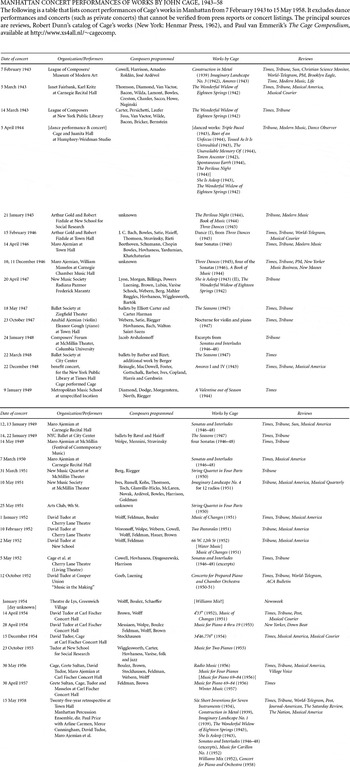
Cage wrote more than eighty works between 1943 and 1958, of which at least twenty-five (plus a few unnamed tape works) received public concert performances in Manhattan. Only a fraction of them were repeated. Sometimes repetition was achieved by opportunities to present excerpts of large works before the occasion of a complete performance (as was the case for Sonatas and Interludes) and by the opportunity for repeat performances of movements of shorter works (such asThree Dances, sections of which were performed three times in two years). The selection of works for performance was affected less by the munificence of sponsors—Cage and Cunningham funded a number of concerts themselves—than it was by the enthusiasm of performers who specialized in new music. Following Janet Fairbank's performance in March 1943 of Wonderful Widow in one of her annual recitals, the “chic” piano duo Arthur Gold and Robert Fizdale incorporated Cage into their programs of mostly new music. The virtuoso Juilliard pianists William Masselos and Maro Ajemian, as well as Maro's violinist sister Anahid Ajemian, gave occasional Midtown recitals, becoming principal exponents of Cage's works until they were succeeded in the 1950s by David Tudor.
Gold and Fizdale first performed works by Cage at a concert of prepared piano music presented at the New School for Social Research on 21 January 1945. The venue probably deterred the Times, which showed no interest. Thomson could have assigned either Bowles or Harrison to review it on behalf of the Tribune, though he was probably committed to reviewing an evening concert programmed by the League of Composers at the Carnegie Chamber Music Hall. Ultimately, Thomson himself reviewed the New School concert and sent Harrison to the League event. The prestige associated with a review by the first-desk critic is not to be underestimated. Instead of a few hundred words by a stringer, a review by Thomson ensured a banner headline, two half-columns of text, and a photo of the composer himself with a prominent caption. “Expressive Percussion” was the first of Thomson's reports on Cage, but it breached the bounds of a normal concert review by providing an intelligible discussion of Cage's current compositional procedures. Thomson began with the calculating and self-perpetuating remark that Cage was “already famous.”64
Virgil Thomson, “Expressive Percussion,” New York Herald Tribune, 22 January 1945, 9. The Perilous Night was on the program of this concert, and it may have been on this occasion that Cage despaired at a review likening his music to “a woodpecker in a church belfry.” I have not been able to locate this review. For Cage's comments on this response toThe Perilous Night, see Calvin Tomkins, “John Cage: Figure in an Imaginary Landscape,” New Yorker 40/1 (28 November 1964): 86; and Calvin Tomkins, The Bride and the Bachelors: Five Masters of the Avant-Garde (Harmondsworth, UK: Penguin, 1965), 97.
produced atonal music not by … causing the twelve tones of the chromatic scale to contradict one another consistently, but by eliminating to start with all sounds of precise pitch. He substitutes for the classical chromatic scale a gamut of pings, plucks and delicate thuds that is both varied and expressive and that is different in each piece. By thus getting rid, at the beginning, of the constricting element in atonal writing—which is the necessity of taking constant care to avoid making classical harmony with a standardized palette of instrumental sounds and pitches that exists primarily for the purpose of producing such harmony—Mr. Cage has been free to develop the rhythmic element of composition, which is the weakest element in the Schoenbergian style, to a point of sophistication unmatched in the technique of any other living composer.65
Thomson, “Expressive Percussion.”
A typically brilliant summary, the piece must have stimulated widespread interest since the onomatopoeia of the pings and thuds was in the future to be repeatedly quoted and imitated (and Thomson was not averse to quoting himself). By the end of the review, Thomson's favorable perspective is clearly evident: he concluded with the comment that “the concert was a delight from every point of view.” The extraordinariness of Thomson's gesture can be judged from the contrasting reactions of Cage, who was reported to be exultant, and the twelve-tone exponent Roger Sessions, who gossip reported was outraged.66
Tommasini, Virgil Thomson, 367.
Lou Harrison, “The Rich and Varied New York Scene,” Modern Music 22/3 (March–April 1945): 183. Kurt List, “Rhythm Sound and Sane,” The New Republic 113 (24 December 1945): 870–71.
A year later, in February 1946, Gold and Fizdale presented a concert at Town Hall, the first performance of Cage's music at one of the “legitimate” venues, which would routinely command breadth of coverage. On the program was a single work by Cage (one dance from Three Dances), with the remainder being wholly modern, comprising works by Satie, Bowles, Haieff, Stravinsky, Rieti, and Thomson.68
Peggy Guggenheim was patron of the concert. John Bernard Myers reported: “It seemed to me the most unusual recital I had ever attended. The audience did not resemble others I had seen in concert halls, since most of the people were either artists or members of what I suppose must be called international society, including Perry Empiricos, the son of the Greek shipping magnate; George Bemberg, whose family in Argentina, it was said, had caused three revolutions; the beautiful Peggy O'Brien and her famous debutante daughter Esme; Edelgey Dinshaw and his sister; the wealthy Oliver and Isa Jennings; Arthur Lopez-Wilshaw, another fabulous Argentinian multimillionaire; Alice De Lamar with her entourage; as well as the various princesses and marquesas who surrounded Tchelitchew.” Myers, Tracking the Marvelous (London: Thames and Hudson, 1984), 59.
Virgil Thomson, “New High,” New York Herald Tribune, 16 February 1946, repr. in Virgil Thomson, The Art of Judging Music (Westport, Conn.: Greenwood, 1941), 59–61.
L. B. [Louis Biancolli], “Piano Duo Blaze Trail,” New York World-Telegram, 16 February 1946, 7.
Howard Taubman, “Gold, Fizdale Give Two Piano Recital,” New York Times, 16 February 1946, 9.
“Nuts and Bolts Make Music for John Cage,” PM, 24 March 1946, 1, 4.
From this date it was the novelty of the sound world of Cage's music that drew critics' attention. The last few reviews of Cage's works in Modern Music suggest that its critics had been swayed by a sensory richness: Elliott Carter described the score for a dance set to Mysterious Adventure as “a maze of shivery strange and delicate noises,”73
Elliott Carter, “Scores for Graham; Festival at Columbia,” Modern Music 23/1 (Winter 1946): 54.
Donald Fuller, “Airborne Over New York,” Modern Music 23/2 (Spring 1946): 123.
Noel Straus, “New Music Played by Maro Ajemian,” New York Times, 15 April 1946, 22. Virgil Thomson, “Bowles, Cage and Hovhaness,” New York Herald Tribune, 15 April 1946, 16.
L. H. [Lou Harrison], “Ajemian-Masselos,” New York Herald Tribune, 11 December 1946, 26.
R. P. [Ross Parmenter], “Prepared Pianos Give Odd Program: John Cage, Inventor, Offers a Program of His Own Works without Being Seen,” New York Times, 11 December 1946, 40; see also Parmenter's comments in Miller and Lieberman, Lou Harrison, 35. Leta Miller believes it likely that Harrison advised Parmenter at concerts of Cage's music; personal conversation, 19 February 2005.
Robert A. Hague, “Odd Music from Caged Pianos,” PM, 12 December 1946, 19–20.
S[idney]. Finkelstein, “John Cage's Music,” New Masses, 7 January 1947, 30.
It is remarkable that so few reviewers found the music either infantile or incomprehensible—or at least were reluctant to say so—especially when few of them can have had access to the explanations and airings of the music available to the Tribune's reviewers from the composer himself. Thomson, for one, usually received a copy of a new score before its performance, and he along with other interested friends attended private performances.80
Thomson, “Bowles, Cage and Hovhaness.”
“Cage's Studio-Home,” Junior Harpers Bazaar, June 1946, repr. in Kostelanetz, John Cage (London: Allen Lane, 1974), 85. Glanville-Hicks noted in her diary a “Cage concert” on 30 July 1946, which lies outside the dates of the season and so was more likely to be private. Glanville-Hicks's diary for this year notes numerous lunches, dinners, and parties associated with Cage (see diary for 1946, MS 9083/3, National Library of Australia, Canberra). Other acquaintances of Cage have described regular concerts and tryouts in his apartment. One of these was Walter Trampler, a member of the New Music Quartet, which premiered Cage's string quartet in March 1951. Trampler recalled fortnightly meetings at Cage's apartment (see interview with Trampler, Wendy Beckett Papers, MS 9084/1, National Library of Australia, Canberra). Judith Malina mentions in her diary a performance of the quartet at the Ninth Street Arts Club on 25 May 1951, two months after its public premiere. See Malina, The Diaries of Judith Malina, 1947–1957 (New York: Grove Press, 1984), 167.
Lou Harrison, “Modernism ‘Sacred and Profane,’” Modern Music 23/3 (Summer 1946): 205. L. H., “Ajemian-Masselos.”
Harrison suffered a nervous breakdown in 1947; his last review for the Tribune was published 7 May 1947. In the previous year, Thomson had hired the composer Arthur Berger, and they shared the reviewing of Cage's concerts. Born in the same year as Cage, Berger was a native New Yorker with a graduate degree from Harvard. He had studied with Boulanger, taught at Mills College (as did Cage and Harrison), and in the mid-1940s wrote for Modern Music while employed as a critic for the Boston Transcript and the New York Sun, from which he was poached by Thomson. Berger believed that he had impressed Thomson with his appreciation of a performance of one of Thomson's favorite works, Satie's Socrate. In response, Thomson assured him that “being really intelligent about Satie” was “so rare, even in France, that you'd be surprised.”83
Virgil Thomson, letter to Arthur Berger, n.d., Berger Papers, Box 2, Research Division, New York Public Library for the Performing Arts. Berger quotes from the letter in his Reflections of an American Composer, 112.
Virgil Thomson, “Five New Works,” New York Herald Tribune, 16 February 1942, 11.
Berger, Reflections of an American Composer, 114. Berger told Anthony Tommasini: “When VT hired me I had the experience of no less than 3 newspapers (the low-down Hearst NY Daily Mirror, while at NYU; Boston Transcript, while at Harvard; NY Sun, full time job before being raided for the Trib). I was more of a journalist than Virgil, which is why he hired me,” and that therefore he “did not belong to the parade of composers that [Virgil] hired on a piece basis to help them make ends meet.” Berger, letter to Anthony Tommasini, 22 July 1997, Berger Papers, Box 2, Research Division, New York Public Library for the Performing Arts.
Berger, quoted in Williamson, “Critics Face the Music,” 6.
Berger, Reflections of an American Composer, 125.
A New Music Society concert toward the end of the regular season, 20 April 1947 at the New School, was overlooked by the Times. On the program was a long list of mostly modern works, including two by Cage: She Is Asleep (1943) and The Wonderful Widow of Eighteen Springs. In Harrison's absence, Thomson chose to attend, commenting only briefly on the “now familiar tiny thuds” produced by Cage's score.88
Virgil Thomson, “Really New,” New York Herald Tribune, 21 April 1947, 15.
Arthur V. Berger, “The Music,” New York Herald Tribune, 19 May 1947, 14.
John Martin, “City Ballet Unit Dances ‘Seasons,’” New York Times, 16 January 1949 (appeared in the late edition only; see Cunningham clippings, Research Division, New York Public Library for the Performing Arts).
A. V. B. [Arthur Berger], “Composers Forum; Jacob Avshalomoff Shares Program With John Cage,” New York Herald Tribune, 26 January 1948, 15.
Ibid. In October 1947, Jerome D. Bohm reviewed Anahid Ajemian's performance of Cage's violin Nocturne (ca. 1947), finding its “dreamy arpeggios” and “Tristanesque vaporings” suggestive of the “improvisations of a composer waiting for his dinner at twilight” (Jerome D. Bohm, “Anahid Ajemian: Violinist's Recital Her Second in Town Hall,” New York Herald Tribune, 24 October 1947, 17). Bohm, however, was a stand-in, and did not review Cage again.
New York critics first heard the whole of Sonatas and Interludes (1946–48) performed by Maro Ajemian on 12 January 1949 at Carnegie Recital Hall; the program was repeated the following night. Parmenter, writing for the Times, was entranced, and unequivocal in his praise. The first sentence of his review declared, “John Cage came into his own last night, both as an inventor and a composer,” finding him “one of the country's finest composers” whose “invention has been vindicated musically.”93
R. P. [Ross Parmenter], “Ajemian Plays Work by Cage 69 Minutes,” New York Times, 13 January 1949, 28.
Cecil Smith, “Ajemian Plays Sonatas by John Cage,” Musical America 69/2 (15 January 1949): 9.
Arthur V. Berger, “Cage's Sonatas; Maro Ajemian Plays 16 at Carnegie Hall Recital,” New York Herald Tribune, 13 January 1949, 17.
Ibid.
H[arold]. C. S[chonberg]., “Ajemian Presents John Cage Works; She Offers an Unusual Program of 16 Sonatas, 4 Interludes on a ‘Prepared’ Piano,” New York Times, 8 March 1950, 33.
The concert on 10 May 1951 which climaxed with the legendary performance of Cage's Imaginary Landscape No. 4 for 12 radios (1951), was a free event held at Columbia's McMillin (now Miller) Theater, sponsored by the New Music Society. Thomson in his column the previous Sunday had announced the concert and promised “rarities so rare and experiments so experimental” that it was intended for those who appreciate shock tactics from “the more advanced musical explorers.”98
Virgil Thomson, “Modernism Goes On,” New York Herald Tribune, 6 May 1951, 8: 4. As a result of Thomson's comments, Calvin Tomkins reports that the event was the “talk of the town” (see Tomkins, The Bride and the Bachelors, 113). Thomson was remarkably upbeat about Cage's work, arguing that “Picasso, Marcel Duchamps [sic], Kurt Schwitters and Max Ernst have all worked in this manner, using, instead of brush strokes, bits of wallpaper, newspaper, objects of commercial origin, burnt matches, almost anything that is common enough to lack sentimental associations.”
Berger, Reflections of an American Composer, 118–19.
Lou Harrison commented that it was to be a “fun concert.” See Harold Norse, Memoirs of a Bastard Angel (New York: Morrow, 1989), 207. Judith Malina describes the concert in her diary, The Diaries of Judith Malina, 1947–1957, 162–63, indicating that Cage performed in several of the items.
R. S. [Robert Sabin], “New Music Society McMillin Theatre, May 10,” Musical America 71/8 (June 1951): 18.
Arthur Berger, “New Music Society; ‘Imaginary Landscape No. 4’ for 12 Radios Heard,” New York Herald Tribune, 12 May 1951, 7.
Berger's report in the Tribune was apparently the only one to appear in a daily; later reviews appeared in Musical America and Musical Quarterly. Both Sabin (for Musical America) and Richard Franko Goldman (for Musical Quarterly) would have had the opportunity to read Berger's review and to discuss the event with others before writing their own, and both were noncommittal (the latter called Cage's exertions “pointedly desperate”).103
Richard Franko Goldman, “Current Chronicle: United States; New York,” Musical Quarterly 37/4 (October 1951): 580.
Arthur Berger, “Composers Are Nostalgic for the Turbulent 1920s,” New York Herald Tribune, 20 May 1951, 7.
Ibid.
Arthur Berger, “Spotlight on the Moderns,” The Saturday Review, 26 January 1952, 42.
Ibid.
Berger's opinion was supported by Gunther Schuller, who remarked: “The problem for me with John Cage—and we were very close friends—was that he just was not a very good composer in the sense of a skilled craftsman clearly in control of his craft.” Quoted in Nicholas E. Tawa, American Composers and Their Public: A Critical Look (Metuchen, N.J.: Scarecrow Press, 1995), 212. The Saturday Review printed Harry Hewitt's letter written in response to Berger's article: “Congratulations to Arthur Berger for the ‘poison pen’ treatment he gave John Cage. It seems astonishing at this late date that one of the most accomplished craftsmen in contemporary music, an artist whose work is splendidly designed and uncommonly well written, should be attacked with such venom. In fact, Mr. Berger doesn't seem to like anything he hears of the wonderful contribution to contemporary music by the Columbia people except a piece by Copland. But that's all right, Mr. Berger, he is safely among the ‘accepted’ and ‘understood’; we all like Copland too.” The editor replied that “Berger's pen has been carefully examined, and bears no trace of ‘poison.’” Hewitt's letter was reprinted in the Bulletin of the American Composers' Alliance 3/1 (Spring 1953): 16.
Even more remarkable than Berger's piece is the rebuttal delivered by Thomson a week later. Thomson had disapproved of Cage's radio venture—much to Cage's annoyance, Thomson told him it was not a work worthy of a paying audience.109
See Calvin Tomkins, Off the Wall: Robert Rauschenberg and the Art World of Our Time (Garden City, N.Y.: Doubleday, 1980), 101; and David Revill, The Roaring Silence: John Cage: A Life (London: Bloomsbury, 1992), 196.
Thomson, “The Abstract Composers.”
Tommasini, Virgil Thomson, 402. Berger's stated reason for leaving the Tribune was that the paper seemed to be in decay; there were “admonishments to use the phone sparingly, unattended accumulation of dust and decay, light bulbs that expired and were not replaced, and the like.” Berger, Reflections of an American Composer,137. This seems to have been true, but his leaving may have had as much to do with the stress of the job (which he admitted is what deterred him from a Times appointment), as well as the pending litigation by the Yaysnoff sisters.
Virgil Thomson, “How Modern Can You Be?,” New York Herald Tribune, 10 February 1952, 4: 8; repr. in the Boston Symphony Orchestra Concert Bulletin 16 (1952–53): 77–81. In her study of New York critics, Elleyn Berk notes that of thirty-four reflective articles written by Thomson in the 1950 season, only five were on the subject of composers. Hence, writing even once on Cage and his affiliates in 1952 was noteworthy; twice was exceptional. See Berk, “An Analysis and Comparison,” 472.
Henry Cowell, “New York,” Musical Quarterly 38/1 (January 1952): 123–34.
Berger eventually passed the job of reviewing Cage for the Tribune to Perkins or one of the stringers, Theodore Strongin (1918–98) or Peggy Glanville-Hicks (1912–90). Strongin was a former composition student at Juilliard and Columbia who wrote only briefly for the Tribune and ultimately became a Times critic. Glanville-Hicks was never more than a stringer, but was enlisted in October 1947, a few months after the departure of Harrison. She survived at the paper until the end of the 1954–55 season.114
Glanville-Hicks's first review appeared in the Tribune on 27 October 1947; her last review was printed on 11 May 1955. Her letters suggest that by the latter date Lang was interested in investing Tribune reviewing with “new blood.”
P. Glanville-Hicks, “John Cage … ‘A Ping, Qualified by a Thud,’” Musical America 68/10 (September 1948): 20. “Musical Explorers: Six Americans Who Are Changing the Musical Vocabulary,” Vogue 116 (15 November 1950): 134. By now Glanville-Hicks had also published studies of Thomson (for Musical Quarterly in 1949), Bowles (for Musical America in 1949) and was to write a piece on Berger (for the Bulletin of the American Composers' Alliance in 1953). Her short piano work, Obeisance to a Lucite Spectrum, was written as a birthday tribute to Cage in 1949.
P. G.-H. [Peggy Glanville-Hicks], “David Tudor, Pianist, At Cherry Lane Theatre,” New York Herald Tribune, 2 January 1952, 15. The Cherry Lane is located in a cul-de-sac at 38 Commerce Street, off Seventh Avenue South in Greenwich Village. It was rented by Julian Beck (husband of Judith Malina), an artist who had exhibited at Art of This Century. By 1951, he abandoned painting to found the Living Theater and stage experimental plays.
Ibid.
R. P. [Ross Parmenter], “Tudor Tries Hand at Experimenting,” New York Times, 2 January 1952, 20.
Strongin reviewed Tudor's next event for the Tribune, a long program including Cage, Cowell, Wolpe, Feldman, and Brown on 10 February 1952 at the Cherry Lane Theatre. The concert coincided with the second of Thomson's consecutive Sunday pieces discussing Cage. Strongin was markedly objective, consuming half the review in a list of the program but then perceiving in Cage's Pastorales that “the long silences seem designed to help the mind lose the thread from sound to sound so that true abstraction is created.”119
T. M. S. [Theodore Strongin], “David Tudor, Pianist,” New York Herald Tribune, 11 February 1952, 13. Malina described the concert in her diary, with particular reference to the antagonistic antics of Wolpe and his contingent (which had also disrupted the performance of Imaginary Landscape No. 4). See Malina, The Diaries of Judith Malina, 209–10.
Francis D. Perkins, “New School Recital,” New York Herald Tribune, 3 May 1952, 8.
J. B. [Jack Beeson], “Living Theatre Gives Concert of Moderns,” New York Times, 6 May 1952, 34. Beeson had previously worked as a critic for the Boston Transcript and New York Sun. He began teaching at Columbia University in 1945, and became professor there in 1967.
P. G.-H. [Peggy Glanville-Hicks], “Program of New Music,” New York Herald Tribune, 6 May 1952, 21.
A more significant concert took place in October that year before an enormous audience at Cooper Union. Apparently it was a rehearsal rather than a ticketed concert, with introductions, interruptions, and repetitions. Each of the reviewers, from the Tribune, Times and World-Telegram, reported that sounds such as a gong played underwater were treated with the utmost seriousness. Glanville-Hicks effused about “Cage at his best,” Parmenter settled for description, and Robert Bagar (for the World-Telegram) perceived something “indefinable and exotic.”123
P. G.-H. [Peggy Glanville-Hicks], “Rehearsal Concerts,” New York Herald Tribune, 13 October 1952, 13; Robert Bagar, undated article in the New York World-Telegram, quoted in ACA Bulletin 2/4 (Winter 1952–53): 20.
P. Glanville-Hicks, “Tapesichord,” Vogue 122 (July 1953): 108; “Sound Stuff,” Newsweek, 11 January 1954, 76. Williams Mix is not named (and it is not listed in the Henmar catalog), but the description suggests that it was included. The performance took place at the Theatre de Lys in Greenwich Village.
By 1954, Thomson's network of composer-critics was disintegrating. Harrison, Berger, and Bowles had all left New York: Harrison for the West Coast, Bowles for Morocco, and Berger to an appointment at Brandeis. Glanville-Hicks became preoccupied with a commission from the Louisville opera company. In 1952, Lester Trimble (1923–87) was appointed. Still in his twenties, he was fresh from Paris, where he had studied with Boulanger, Milhaud, and Honegger.125
Trimble studied with Milhaud and Copland at Berkshire, and in Paris with Milhaud, Boulanger, and Honegger. As a student at Carnegie Institute of Technology, he wrote for the Pittsburgh Post-Gazette, and on his return from Europe in 1952 commenced a career as a critic for the Tribune (1952–62), Musical America (1960–61), the Washington Evening Star (1963–68), and Stereo Review (1968–74). He was concurrently professor at the University of Maryland (1963–68) and then at Juilliard beginning in 1971.
Ned Rorem, Knowing When to Stop: A Memoir (New York: Simon & Schuster, 1994), 340. It is unclear when Flanagan was appointed to the Tribune, as a stringer, although it appears to have been in Thomson's time. This is alleged by Edward Albee's biographer (Albee and Flanagan met in 1948 and lived together after 1952), who also states—although this is not noted in Rorem's biography in The New Grove—that Flanagan studied with Boulanger in the summer of 1949. Flanagan continued at the Tribune under Lang and became a career critic, writing also for Partisan Review, Musical Quarterly, and High Fidelity, among others. See Mel Gussow, Edward Albee: A Singular Journey, A Biography (New York: Simon & Schuster, 1999), 72–81; Gruen, The Party's Over Now, 110; and Flanagan's obituary, New York Times, 2 September 1969, 47.
John Gruen commenced as a stringer when in Lang's time as chief critic Jay Harrison asked Thomson to recommend someone. Gruen was not a composer (see Gruen, The Party's Over Now, 110). Eric Salzman told Richard Kostelanetz that he was appointed to the Times on Thomson's recommendation. See Kostelanetz, introduction, Virgil Thomson: A Reader: Selected Writings 1924–1984, ed. Richard Kostelanetz (New York: Routledge, 2002), 4.
The mildest reaction to the concert, held at Carl Fischer Concert Hall in Midtown, came from Trimble at the Tribune. After listing the works played by Tudor (including those by Brown and Wolff), Trimble wrote: “For those who have not washed at the fountain of esthetic values from which these works seem to flow, it is not easy to perceive their meaning nor, indeed, their objectives.”128
L. T. [Lester Trimble], “David Tudor, Pianist,” New York Herald Tribune, 15 April 1954, 22.
Ibid.
J. B. [Jack Beeson], “Look, No Hands! And It's ‘Music’: ‘Work’ By Cage, 4 Minutes 33 Seconds of Silence, Is ‘Played’ by Tudor, Pianist,” New York Times, 15 April 1954, 34.
Winthrop Sargeant, “Old Horizons,” The New Yorker, 8 May 1954, 126.
T. M. S. [Theodore Strongin], “David Tudor, Pianist,” New York Herald Tribune, 29 April 1954, 22.
P. G.-H. [Peggy Glanville-Hicks], “John Cage, David Tudor,” New York Herald Tribune, 16 December 1954, 22.
The critics' door was then even more resoundingly slammed in Cage's face when Lang aired his opinion of Cage, offered from the point of view of a self-righteous crusader. In May 1956, his Tribune article “Music By Hardware” was written at the mere prospect of attendance at the performance of a work by Cage for radios (Radio Music). Urging the “true patriots of music” to crush the “infidels,” Lang argued that it was “utterly objectionable” to substitute machines for a composer with an artistic message.134
Paul Henry Lang, “Music by Hardware,” New York Herald Tribune, 20 May 1956, 4: 6. Cage's letter to Lang in response to his article, written two days later, is published in Kostelanetz, John Cage, 116–18.
In 1954, having heard a rumor that Thomson was leaving, Glanville-Hicks wrote to him as follows: “As Arthur [Berger] said, [Jay Harrison] gives everyone the feeling that we are working for him. We are not. We are working for the paper, and his abuse of his position to knofe [sic] a colleague whose prestige and journalistic authority he fears, and is trying to undermine—is not doing any service to the paper. From my point of view, it can't go on, and indeed if you are leaving, with Jay in the driver's seat it will rapidly become a department of Perkins, Harrison, and Harrison hirelings—all smaller than himself, for the sake of his ego, and because no one of any stature or dignity will be able to work with him.” Glanville-Hicks, letter to Virgil Thomson 15 May (ca. 1954), Virgil Thomson Papers, MSS 29, Box 43, Yale University Music Library.
Jay S. Harrison, “New Music Concert Given at the Carl Fischer Hall,” New York Herald Tribune, 31 May 1956, 15. Howard Rackliffe, for The Village Voice, wrote that Cage's “unmusical noises” served “only some timorous precept of the most fatuously experimental laboratory” (“Cage Untudored,” Village Voice, 6 June 1956, 6).
Ross Parmenter, “Music: Tudor Plays Modern Works,” New York Times, 23 April 1957, 34.
Cage's twenty-five-year retrospective concert, held at Town Hall on 15 May 1958, was conceived and promoted by his artist friends. It was funded by Emile de Antonio, Robert Rauschenberg, and Jasper Johns—now enjoying income as well as notoriety—and the program was selected not by Cage but by David Tudor. Appropriately, a few days beforehand the Times printed a publicity photo of Cage and Tudor brandishing a “whistle, a ‘slinky’ and a bunch of screws.”138
Caption to the photo appearing in New York Times, 11 May 1958, 2: 9.
Malina, The Diaries of Judith Malina, 406. See also Tomkins, The Bride and the Bachelors, 127. Parmenter counted about one thousand in the audience, indicating that the hall was by no means full.
Ross Parmenter, “Zounds! Sounds by John Cage at Town Hall,” New York Times, 16 May 1958, 20.
Jay S. Harrison, “John Cage Retrospective,” New York Herald Tribune, 16 May 1958, 12.
Louis Biancolli, “John Cage Gives Review of Work,” New York World-Telegram, 16 May 1958, 25.
“Music of John Cage Heard at Town Hall,” New York Post, 16 May 1958, 37.
R. S. [Robert Sabin], “Quarter Century of John Cage,” Musical America 78/7 (June 1958): 16–17.
Lester Trimble, “Music,” The Nation, 31 May 1958, 502–3. I[rving]. Kolodin, “Van Cliburn's Piano; Also John Lewis and John Cage,” The Saturday Review, 31 May 1958, 21. Kolodin began his career at the New York Sun in 1932, before becoming critic for The Saturday Review in 1947 and remaining there until 1982.
Reviews of this concert were undeniably “mixed,” as Avakian claims in his notes to the recording.146
George Avakian, “About the Concert,” liner notes to The 25-Year Retrospective Concert of the Music of John Cage (1959), issued by George Avakian as KO8Y-1499–1504, unpaginated. The recording has now been remastered on three compact discs as Wergo WER 6247-2 (1994).
Ibid.
The final words on this concert came from those who reviewed the recording. Eric Salzman, composer and parvenu at the Times, seemed to wonder what all the fuss was about, declaring that the works were “surprisingly modest efforts, strong on ideas and short on aural interest.”148
Eric Salzman, “In and out of the Piano with Cage,” New York Times, 14 February 1960, 2: 12.
H. K. [Herbert Kupferberg], “Audience Boos Add Flavor to John Cage Recordings,” New York Herald Tribune, 21 February 1960, 4: 8.
Alfred Frankenstein, “In Retrospect—The Music of John Cage,” High Fidelity 10/4 (April 1960): 63. Grant writes of Frankenstein that of all the critics outside the Boston-New York axis, he was the one who nonetheless attained a national cachet. Grant, Maestros of the Pen, 260.
Ibid.
Virgil Thomson, “John Cage Late and Early,” The Saturday Review, 30 January 1960, 38–39.
Ibid. Cage himself often quoted Thomson's opinion of the Sonatas, as worded here, as evidence of his approval. See Tomkins, “Figure in an Imaginary Landscape,” 90.
III
Thomson once granted that “no reviewer is a perfectly clear glass between the reader and the subject he is writing about; and if he pretends he is, then he is a very dark one indeed.”154
Thomson, “The Music Reviewer and His Assignment” (1953), Virgil Thomson: A Reader: Selected Writings 1924–1984, ed. Richard Kostelanetz (New York: Routledge, 2002), 246.
It is perfectly true that I helped to further [Cage's] career. I was the person who reviewed him constantly, when nobody else was reviewing him. And I was the person who either saw to it, or helped see to it, that he got Guggenheims and Fulbrights and all those various things that he got. Not that Cage wasn't awfully good, and pushing himself. But, in my very solid position at the Tribune by that time, my influence, my recommendations, and above all, my reviews of his work, my explanation of it, all served a great deal. Now, I was not a hired plugger for Cage, but I was a friend of Cage and of his music. I like it, and I think I understood it, and I explained it. I don't know why I liked his music, just as I don't know why he liked my music.155
Thomson, quoted in Gruen, The Party's Over Now, 65–66.
The principal reason Thomson gave for plugging Cage was that he was a “friend.” Indeed, in cultivating Cage, Thomson was shoring up multivalent identities: as a Francophile but Americanist composer of expressly tonal music and as a homosexual. From the first, Thomson appears to have been attracted to Cage. Minna Lederman, for one, noticed how quickly Thomson was captivated, recalling that it was during Cage's first few weeks in New York that he acquired Thomson as a patron, the two having met in the “salons of the art world.”156
Lederman, “John Cage: A View of My Own,” 152. Thomas S. Hines suggests that Cage and Thomson had met 1933–34, during the period of Cage's first residence in New York. His source is the biography of Philip Johnson; see Franz Schulze, Philip Johnson: Life and Work (New York: Alfred A. Knopf, 1994), 97. Thomas S. Hines, “Then Not Yet ‘Cage’: The Los Angeles Years 1912–1938,” inJohn Cage: Composed in America, ed. Marjorie Perloff and Charles Junkerman (Chicago: University of Chicago Press, 1994), 91–92. The suggestion is repeated in Jonathan D. Katz, “John Cage's Queer Silence; Or, How to Avoid Making Matters Worse,” in Writings through John Cage's Music, Poetry, and Art, ed. David W. Bernstein and Christopher Hatch (Chicago: University of Chicago Press, 2001), 44. In his first letter to Thomson in 1939, however, Cage misspells his name (“Mr. Thomsen”) and concludes with the businesslike words, “Very sincerely, John Cage,” suggesting that they were not yet acquainted. See letter from Cage to Thomson, 15 March 1939, Virgil Thomson Papers, MSS 29, Box 29, Yale University Music Library.
Thomson often referred to Cage's Tennessee ancestry, perhaps because this was one way in which he identified with Cage. See, for instance, Thomson, interview with Peter Dickinson (who is skeptical of the ancestry), CageTalk: Dialogues with and about John Cage, 113. Thomson told Dickinson with pride of Cage's praise for The Mother of Us All and his visceral enjoyment of the Symphony on a Hymn-Tune.
Hubbs, The Queer Composition of America's Sound, 103–6.
Gruen, The Party's Over Now, 64. Recollecting his meeting with Thomson, Rorem wrote, “His eyes were quick, his head balding, his cravat a hand-tied butterfly bow, his cigarette holder a nonfilter, his stomach already paunchy (he was forty-seven, a year younger than Father), his housecoat maroon, his slippers plush, and his manner sardonic and adult” (Rorem, Knowing When to Stop, 197). Of Cage, he wrote that he presented “craggy features framed by a manly ‘German’ haircut” (232).
Thomson, Virgil Thomson, 353; and Thomson, “Cage and the Collage of Noises,” A Virgil Thomson Reader, 477.
Philip Johnson, quoted in Katz, “John Cage's Queer Silence,” 44. In referring to Thomson's “circle,” I am mindful of the interconnectedness of circles around composers such as Copland, Cowell, and Thomson, but argue below, following Rorem, that the dominant circles of downtown composers were those surrounding Copland and Thomson. If there was, as Hubbs argues, a “skirting circle” which comprised Cage, Harrison, and Partch mentored by Cowell (Hubbs, The Queer Composition of America's Sound, 125), it was a more social (and therefore less visible) entity than Thomson's. For a discussion of Cage's relationship to Cowell, see David Nicholls, “Transethnicism and the American Experimental Tradition,” Musical Quarterly 80/4 (Winter 1996): 578; and Leta E. Miller, “Henry Cowell and John Cage: Intersections and Influences, 1933–1941,” Journal of the American Musicological Society 59/1 (Spring 2006): 47–111.
Bowles, Without Stopping, 249.
Lippold, quoted in Tomkins, Bride and the Bachelors, 74.
Thomson, Virgil Thomson, 353.
Thomson, “John Cage Late and Early,” 39.
Ned Rorem has famously observed that young American composers were “mothered” by Thomson (who in private did not disguise his effeminacy) and “fathered” by Copland (the more conventionally masculine of the two).166
Rorem, Knowing When to Stop, 207. When Lou Harrison died, Rorem told a reporter from Gay City News that “another leaf from the family tree has fallen” (“Lou Harrison, Gay Composer,” Gay City News [New York], 7–13 February 2003).
Quoted in Miller and Lieberman, Lou Harrison, 27.
See Peggy Glanville-Hicks, letter to Virgil Thomson, 23 August [1950], repr. in James Murdoch, Peggy Glanville-Hicks: A Transposed Life (Hillsdale, N.Y.: Pendragon, 2003), 65–66. In referring to the “children,” Glanville-Hicks named for Thomson those in their circle of friends she had contacted since returning to New York from the Midwest—Cage, Lederman, and Hovhaness—and provided gossip about Martha Graham, Erick Hawkins, Cecil Smith, Emeric [?], Brion Gysin, Helen [Carter?], and Ben Weber.
According to Rorem, “There wasn't sex in the family” (quoted in Gussow, Edward Albee, 79). Glanville-Hicks transgressed this rule more than once: when she had a brief affair with Bowles, and when she once professed her feelings for Thomson. His response was an angry silence (see letters from Glanville-Hicks to Thomson dated 1950, Virgil Thomson Papers, MSS 29, Box 43, Yale University Music Library).
Thomson, Virgil Thomson, 353.
Miller and Lieberman include Frank Wigglesworth in this group (Lou Harrison, 31).
Harrison, letter to Thomson, n.d., Virgil Thomson Papers, MSS 29, Box 47, Yale University Music Library.
almost done with his revision of the “three dances” which has kept him busy since Nicktide and which are really scrumptious. They are ever so alive and brilliant. The last movement is a presto, and a real one, that is giddy and whirlly [sic] and absolutely continuous. It is difficult to sustain the kind of excitement he starts out with in this and he has succeeded wonderfully well.
Virgil Thomson Papers, MSS 29A, Box 58: see Adrienne Scholtz, The Virgil Thomson Papers: Materials Received after 1985: Yale University Music Library, Archival Collection MSS 29A (New Haven, Conn.: The Library, 1996), 175–76. As late as 1956, Cage wrote to Thomson to report that his financial situation was “approaching zero” and to ask if Thomson knew of any writing assignments on magazines or newspapers that might generate some income. He signed the letter, “Very devotedly, John.” Cage, letter to Thomson, 28 March 1956, Virgil Thomson Papers, MSS 29, Box 29, Yale University Music Library.
Their intimacy is further revealed in the correspondence written during Cage's excursion to Europe over the summer of 1949. Thomson had arranged for Cage to travel to festivals in Italy and France, reporting on them for Musical America and the Tribune. Cage submitted at least one article to Cecil Smith, and two to Thomson, for which he was paid $50 (Thomson thanked him for the “lovely articles” but seems to have made no further comment).174
Cage's two festival reports for the Tribune were “Contemporary Music Festivals: A Report,” published on 15 May 1949, and “Music in Aix,” published on 13 August 1949. For Thomson's comment, see his letter to Cage, 19 May 1949, Virgil Thomson Papers, MSS 29, Box 29, Yale University Music Library. Cage was often cited by Thomson as one of his Tribune composer-critics, when this appears to be the only instance in which Cage was commissioned to write for the paper. Tommasini reports that Thomson tried Cage as a Tribune reviewer but found him “too idiosyncratic” (Tommasini, Virgil Thomson, 368). Judging by the reviews Cage wrote for Modern Music, Thomson may have found him too opinionated to print.
Thomson did not complete a piano sonata after this third, dated 1930. Anthony Tommasini reports that Thomson composed only two portraits between 1942 and 1951, one of Lou Harrison (1945) and one of Briggs Buchanan (1943). See Anthony Tommasini, Virgil Thomson's Musical Portraits (New York: Pendragon, 1986), 45.
Thomson, letter to Cage, 19 May 1949, Virgil Thomson Papers, MSS 29, Box 29, Yale University Music Library.
Cage, letter to Thomson, May 1949, Virgil Thomson Papers, MSS 29, Box 29, Yale University Music Library.
Cage, letter to Thomson, n.d. [ca. June 1949], Virgil Thomson Papers, MSS 29, Box 29, Yale University Music Library.
Thomson's entourage of the beautiful, talented, and homosexual overlapped with the composition of his staff at the Tribune.179
John Gruen referred to Thomson's “entourage of beautiful, talented and ambitious young men” (Gruen, The Party's Over Now,62).
Tommasini, Virgil Thomson, 353.
Bowles, in interview with Gena Dagel Caponi, intimated that life in New York for a homosexual was stifling, “because of the setup, the disapproval of society, the … presence of the police, the possibility of blackmail, all sorts of unpleasant things. So it was best to keep, you know, completely away.” See Gena Dagel Caponi, Paul Bowles: Romantic Savage (Carbondale: Southern Illinois University Press 1994), 215–16 et passim.
Of women known to have worked as music critics on Manhattan papers, Harriett Johnson wrote for the New York Evening Post from 1943 through the 1980s, and in 1946, Greena Bennett had been writing for the Journal-American for forty years. On Johnson, see S. Margaret W. McCarthy, C.S.J., “Women's Words about Music, Part II: Music Criticism in New York and Baltimore,” IAWM Journal 4/3 (Fall 1998): 12; and Barbara Jepson, “Women Music Critics in the United States,” Musical Woman 1 (1983): 248. Glanville-Hicks married the promising young English composer Stanley Bate in 1938 and emigrated to the United States with him, having been sponsored by Nadia Boulanger. Thomson helped to promote Bate's career as a pianist-composer in New York, and sided with him in a nasty dispute with Ralph Hawkes, but by the late 1940s Bate made his career elsewhere. The marriage ended in divorce in 1949.
Frank Perkins, the music editor, was a bachelor. Thomson coyly described him as “wedded to the job.” See Thomson, Virgil Thomson, 330–31.
In 1997, Berger wrote an impassioned defense of himself to Tommasini, aggrieved at Tommasini's critical remarks about him in Virgil Thomson: Composer on the Aisle and at what he perceived to be a slur against his professionalism and reputation as a critic at the time (see Berger, letter to Tommasini, 22 July 1997, Berger Papers, Box 2, Research Division, New York Public Library for the Performing Arts).
Berger, Reflections of an American Composer, 137. Berger certainly saw himself belonging both to the international “school” of Stravinsky and the American “family” of Copland. In his article “Stravinsky and the Younger American Composers” (1954), Berger wrote: “Most of the younger composers who are devoted to Stravinsky are devoted to [Copland], too. This may be because his own debt to the Stravinsky of such works as the Octet places him in the family and because, in or out of this family, his own stature on the American scene casts a sizable shadow as inescapable to many Americans as Stravinsky's. Certain works of the forties by members of the Stravinsky school might have been very different were it not for Copland's contribution” (205–6). Rorem depicts Copland's circle as “straight and Jewish,” including Leo Smit, Irving Fine, Arthur Berger, and Harold Shapero (Rorem, Knowing When to Stop, 346).
Susan McClary argues: “The straight boys claimed the moral high ground of modernism and fled to the universities” (quoted in K. Robert Schwarz, “Composers' Closets Open for All to See,” New York Times, 19 June 1994, 2: 24). John Hollander's review of Cage's Silence for Perspectives of New Music (Spring 1963) was notorious. Peter Yates attacked Hollander's comments when he alleged: “Cage's name keeps popping up like the Devil in Punch and Judy, to be batted down each time by verbal bludgeon or flung brick”; he then quoted from Hollander's review. See Peter Yates, Twentieth Century Music: Its Evolution from the Harmonic Era into the Present Era of Sound (London: Allen & Unwin, 1968), 308. Joseph Kerman has written of the problem Cage posed for the PNM camp, Cage representing “a rather forceful example of the complicity of theory (of a sort), and avant-garde music (of a sort). This was the very complicity that provided Die Reihe and Perspectives with their mutual raison d'être.” See Kerman, Contemplating Music: Challenges to Musicology (Cambridge, Mass.: Harvard University Press, 1985), 103.
In many ways, Thomson and Cage were not natural allies, their generational difference casting one as reactionary and the other as rebel. Nonetheless, Thomson attempted to align Cage with his own values. The most significant of these was allegiance to a nationalist cause. To the uninformed observer there may have appeared grounds for supposing that Cage had failed to identify with American culture: his early studies with Schoenberg, his interest in the work of filmmaker Oscar Fischinger, and his work at the Moholy-Nagy school in Chicago, as well as composing music that some believed mimicked the sound of a Balinese gamelan all spoke of an internationalist perspective.187
In a discussion of the term “transethnic” and the suitability of its application to Cage, David Nicholls argues that Cage possessed “innate Eurocentricism.” See Nicholls, “Transethnicism and the American Experimental Tradition,” 578.
Thomson, “Expressive Percussion.”
Harrison, “The Rich and Varied New York Scene,” 183.
List, “Rhythm, Sound and Sane,” 871.
Thomson, “John Cage Late and Early,” 39.
Copland, quoted in Tomkins, The Bride and the Bachelors, 75.
Copland, too, may have been doubtful of Cage's Americanist credentials. Cage seems to have offended Copland well before the episode of the MoMA concert in 1943.193
See Howard Pollack, Aaron Copland: The Life and Work of an Uncommon Man (Urbana: University of Illinois Press, 2000), 173.
Brown, quoted in Gussow, Edward Albee, 77.
John Cage, “South Winds in Chicago,” Modern Music 19/4 (May–June 1942): 260–63. The report is reprinted in Kostelanetz, John Cage, 67–69.
In 1949, Cage wrote to Glanville-Hicks about Antheil: “Maybe I sound terrible, but I'm against the Antheil idea. I'm convinced he is of no importance, and I don't see why we should revive something that apparently was never of any value. How he hoodwinked so many I don't know, but Virgil and Maurice say it was because you have to know him and how he lives and what he really means, because in his music it never comes through.” Cage, letter to Glanville-Hicks, postmarked 28 June 1949, Glanville-Hicks Collection, MS 6394, Box 8, Mitchell Library, State Library of New South Wales, Sydney. Unfortunately only Cage's side of their correspondence now exists; he kept little if any personal correspondence addressed to him (Dan L. Roberts, archivist of the John Cage Notations Collection at Northwestern University, e-mail to the author, 27 September 2001).
Minna Lederman, letter to George Antheil, quoted in Lederman, The Life and Death of a Small Magazine (Brooklyn, N.Y.: Institute for Studies in American Music, 1983), 20. She continued: “Cage is a serious man. If he didn't come to a favorable conclusion—that was in the lap of the gods …. Your book was provocative, it seemed to invite either rage, ridicule, or amusement. I found lots of it interesting with many penetrating observations. But I also thought it was baited to stimulate sensational reaction—and when one takes the risk—why one must suffer the consequences.”
Copland wrote in What to Listen for in Music (New York: McGraw-Hill, 1957) that the auditor “must hear the melodies, the rhythms, the harmonies, the tone colors in a more conscious fashion. But above all he must, in order to follow the line of the composer's thought, know something of the principles of musical form” (17). Thomson disagreed with Copland over the theory of structural listening, responding, “It even remains to be proved that analytic listening is possible …. I suspect that persons … do just as well to let themselves follow the emotional line of a piece … which they certainly can't do very well while trying to analyze a piece tonally.” Thomson, letter to Copland, 20 March 1939, in Tim Page and Vanessa Weeks Page, Selected Letters of Virgil Thomson (New York: Summit Books, 1988), 127.
Aaron Copland, “The New ‘School’ of American Composers,” New York Times Magazine, 14 March 1948, 18.
Thomson wrote in his letter of recommendation to Henry Allen Moe that “among the composers [applying], John Cage, is in my opinion by far the most meritorious. I consider him the most original composer in America, if not in the world. He is also the most advanced, in the professional sense. He has made major additions to the technique of his art. I consider him an important master, as well as an historical figure.” Thomson, letter to Moe, 16 December 1948, Virgil Thomson Papers, MSS 29, Box 29, Yale University Music Library (excerpt repr. in Thomson, Virgil Thomson, 354).
If the argument for Cage as a member of a unified circle of Americanists seems tenuous, the case for appropriation of Cage into a circle of musical Francophiles was equally insubstantial. Thomson was transparently pro-French: he devoted a disproportionate number of his Sunday pieces to French composers and French music, and relished reviewing unusual French repertoire. All of Thomson's collective of composer-critics were French-identified and in his benefactions he was observed favoring Americanists and tonalists who had studied in France, preferably with Nadia Boulanger.201
See Hubbs, “Frenchness as Queer Americanness,” in The Queer Composition of America's Sound, 140–45. In his introduction to Paul Bowles on Music, Timothy Mangan repeats what by now is a truism, that Thomson had a “clear agenda for American music of the Boulanger school” (xiv).
Virgil Thomson, “In Gallic Vein,” New York Herald Tribune, 23 May 1945, 14. Miller and Lieberman, speculating on the reasons for the close and durable friendship between Lou Harrison and Thomson, write: “Perhaps it was Harrison's love for the French Baroque as opposed to the German repertoire; perhaps it was [Harrison's] devotion to melody; or perhaps it was his gift for turning a phrase (both musically and rhetorically)” (Miller and Lieberman, Lou Harrison, 27). Thomson's warm description of Harrison in his autobiography suggests his enjoyment of his company, both personally and musically.
John Cage, “Grace and Clarity,” Dance Observer (1944), repr. in John Cage, Silence: Lectures and Writings (Middletown, Conn.: Wesleyan University Press, 1961), 91–92.
Thomson, “Bowles, Cage and Hovhaness.”
Ibid.
Stanley Goldstein, “John Cage,” Music Business, January 1947, 32.
Lou Harrison, “Season's End, May 1944,” 236; R. S. [Robert Sabin], “Merce Cunningham; John Cage.”
Arthur Berger, “Composers' Forum: Jacob Avshalamoff Shares Program with John Cage”; Cecil Smith, “Ajemian Plays Sonatas by Cage”; P. G.-H., “New Music Quartet,” New York Herald Tribune, 2 April 1951, 27; Edward Downes, “4 Pianists Play Tense Silences,” New York Times, 1 May 1957, 42.
S[idney]. Finkelstein, “John Cage's Music,” 30; Berger, “Modern French Concerts,” View 6/2–3 (March–April 1946): 35.
Hubbs, The Queer Composition of America's Sound, 140.
Unquestionably, Cage was assimilated into the group of composers whom Rorem defined as “Satie-French” (even if the two of them differed over what the Satie heritage implied).211
Both Thomson's and Copland's factions “were from France through Nadia Boulanger, but Copland's camp was Stravinsky-French and contained a now-vanished breed of neoclassicist like Alexei Haieff and Harold Shapero, while Thomson's camp was Satie-French and contained a still-vital breed of neo-Catholic like Lou Harrison and John Cage” (Rorem, Knowing When to Stop, 207).
On Cage and Satie, Robert Orledge writes: “Both composers had a mature insight into the importance of the seemingly trivial, and both assumed a veneer of impersonality beneath which lurked significant aesthetic and emotional issues. Both shared a desire to shock complacent middle-class listeners and an irreverent sense of humor, and it would also have appealed to Cage to focus on a French composer who few had taken seriously, though it was surely what Satie achieved in his compositions and eccentric writings that appealed more than his nationality” (emphasis mine). See Robert Orledge, “Satie and America,” American Music 18/1 (Spring 2000): 96.
Rorem, Knowing When to Stop, 392.
Cage wrote in his Tribune report that the performance of Pierrot Lunaire at Palermo by the septuagenarian Marya Freund left him trembling for some time afterward (“Contemporary Music Festival: A Report,” New York Herald Tribune, 15 May 1949, 5: 5). Cage also commented on the performance in his letter to Glanville-Hicks, dated 27 April [1949], Glanville-Hicks Papers, MS 6394, Box 8, Mitchell Library, State Library of New South Wales, Sydney. On Rorem's comment see Knowing When to Stop, 428.
Thomson, “Atonality in France,” New York Herald Tribune, 27 October 1946 (repr. in The Art of Judging Music, 233).
Ibid, 234.
Thomson, “Atonality Today,”New York Herald Tribune, 29 January and 5 February 1950 (repr. in Music Right and Left, 183).
Thomson, ”Atonality Today,” Etude, November 1951, 64.
Yet Thomson's enthusiasm for all things French also appeared as evidence of nostalgia for the fabulous 1920s—and must have seemed anachronistic to Cage, a companion of the iconoclasts of the New York School. No one could argue that the elder had “launched a trend” in chic living as Junior Harpers Bazaar did with Cage in 1946.219
[Cage's Studio-Home], Junior Harpers Bazaar, June 1946, repr. in Kostelanetz, John Cage, 84–85.
Hoover in Hoover and Cage, Virgil Thomson, 111; Rorem, Knowing When to Stop, 208.
Thomson was aware that Cage had “attached himself to a batch of modernistic painters. He used to frequent a picture gallery on Eighth Street and would give lectures there. He built up his explainable aesthetic with a great deal of help—not necessarily from the painters themselves, although he was always surrounded by them, as [much as] from their work” (Thomson, interviewed by Peter Dickinson in CageTalk, 118). Many composers, among them the composer-critics, lived in Greenwich Village cheek-by-jowl with members of the so-called New York School. Bowles in the early 1940s lived on Seventh Avenue at Fourteenth Street, at the Chelsea in 1943–44, and from about 1945 to 1947 and periodically until the early 1950s on West Tenth Street (with Jane Bowles and Oliver Smith). Harrison lived initially on the Upper East Side before moving to Prince Street and then to Bleecker Street. Glanville-Hicks lived from the mid-1940s on East Tenth Street and later West Ninth Street, Rorem on West Twelfth Street. Carter lived on West Twelfth Street. William Flanagan lived with Albee in a succession of apartments in the Village and vicinity; by 1958 they lived on West Fourth Street. Berger lived just beyond the Village's edge at Twenty-eighth Street. (Most of these addresses are given in Glanville-Hicks's address books for the 1940s, housed in the Glanville-Hicks Papers, MS 9083/3, National Library of Australia, Canberra.) With Louis and Bebe Barron, Cage rented a studio on Eighth Street while working on electronic scores. See Ross Wetzsteon, Republic of Dreams: Greenwich Village: The American Bohemia, 1910–1960 (New York: Simon & Schuster, 2002); Susan Edmiston and Linda D. Cirino, Literary New York: A History and Guide, rev. ed. (Salt Lake City: Peregrine Smith Books, 1991); Irving Sandler, “Avant-Garde Artists of Greenwich Village,” Greenwich Village: Culture and Counterculture, ed. Rick Beard and Leslie Cohen Berlowitz (New Brunswick, N.J.: Rutgers University Press, 1993).
See Irving Sandler's recollection of a conversation with Cage in “Avant-Garde Artists of Greenwich Village,” 321. Bemused critics often reported on the unusual audiences for Cage's music. Parmenter after a performance of Music for Radios in 1956 wrote: “The 240 folding chairs were all filled, and many of the auditors were avant-garde painters. One could hear why the painters were attracted, for this sort of music is definitely ‘non-representational’” (R. P., “John Cage Offers Stereophonic Concert Including Eight Radios and Four Pianos,” New York Times, 31 May 1956, 21). Yet Feldman recalled that Rothko had once said to him, “You know, Morty, my favorite composer is Mendelssohn” (Feldman, Morton Feldman Says, 218).
See Malina's entry of 12 October 1952, The Diaries of Judith Malina, 248.
Glanville-Hicks, “Musical Explorers,” 134. Calvin Tomkins describes the decor (arranged by Lippold) as “a long marble table, a beige-brown studio couch, straw matting on the floor, no chairs, a grand piano banked with plants so that it seemed almost to be floating, and Lippold's own exquisite wire sculpture, Five Variations Within a Sphere” alongside other artworks by Rauschenberg, Matta and Tobey (Tomkins, Off the Wall, 99).
For Wolff's recollections see David Patterson, “Cage and Beyond: An Annotated Interview with Christian Wolff,” Perspectives of New Music 32/2 (Summer 1994): 57–58.
“Four Artists in a ‘Mansion,’” Harpers Bazaar, July 1952, 79. Tomkins and others spell the name “Bozza,” after the owner.
See William B. Scott and Peter M. Rutkoff, New York Modern: The Arts and the City (Baltimore: Johns Hopkins University Press, 1999), 317.
[Beeson], “Look, No Hands!,” 34.
Thomson often referred to Cage as having “reinvigorated music's left wing” while acknowledging that he himself belonged to the conservative center; this declaration speaks of politics as much as aesthetics.229
Thomson, American Music Since 1910, 9. See Thomson's categorization of composers as left (atonal, serial, and percussion, which includes Cage), center (himself, Copland and Gershwin), and right (among them Piston, Sessions, Barber, and Harris) in “La Musique Américaine Contemporaire,” Vingtième Siècle, November 1945, as discussed in Michael Meckna, Virgil Thomson: A Bio-Bibliography (New York: Greenwood, 1986), 107.
Cage's aesthetic differentiated him from egocentric and heterosexually masculinist abstract expressionists such as Jackson Pollock. See Caroline A. Jones, “Finishing School: John Cage and the Abstract Expressionist Ego,” Critical Inquiry 19 (Summer 1993): 628–65. Jones writes of the construction of the New York abstract expressionist as “an isolated, autochthonic, angst-ridden male genius, alternating between bouts of melancholic depression and volcanic creativity” (639). Such aspects of Pollock's personality served to counteract the effect of being designated the greatest living American painter (by Life in 1947) and in earning as much as $8,000 a painting (worth $350,000 by the late 1950s). See Wetzsteon, Republic of Dreams, 566.
[Leon Kochnitzky], “The Three Magi of Contemporary Music,” Tiger's Eye 1 (October 1947): 79. A deliberately egalitarian (and proletarian) quarterly edited by John and Ruth Stephan, Tiger's Eye lasted for two years from October 1947 and, according to Ann Eden Gibson in Issues in Abstract Expressionism: The Artist-Run Periodicals (Ann Arbor: UMI Research Press, 1990), was “one of the most widely read of all the avant-garde magazines at the end of the forties” (26). John Stephan was a painter and member of the Artists' Club, so that New York School artists such as Rothko, Still, and Motherwell were well represented.
Parker Tyler, “Music,” View 7/3 (March 1947): 43. Tyler believed that an avant-garde magazine should “inveigh, propagandize, defy; it must be favoritist.” See his “Review of Possibilities and The Tiger's Eye,” Magazine of Art 41 (March 1948): 109. André Breton was notoriously homophobic, and hated Charles Henri Ford's View for this reason. See the recollections of David Hare in Weld, Peggy: The Wayward Guggenheim, 269–70; and John Bernard Myers's comments in Tracking the Marvelous, 35. In Knowing When to Stop, Rorem described the effeminacy of the “three graces” who ran View, Ford, Parker Tyler, and John Bernard Myers (254). He described Tyler as “a southern belle, black haired and languorous … a pretty good poet, as was Charles-Henri [Ford] with whom he had written a dirty novel” (254). John Bernard Myers recollected Tyler as strikingly handsome. “Everything about him was delicate, sensitive, exquisite—qualities heightened by his quiet reserve, considered by those who did not know him to be an affectation of hauteur. He wore ascots or flowing cravats; his wavy black hair was long; his velvet or corduroy jackets somehow stamped upon him everyone's notion of a romantic poet” (Myers, Tracking the Marvelous, 19). It seems Cage allowed others to identify him as homosexual but was reticent in doing so himself. See John Gill, Queer Noises: Male and Female Homosexuality in Twentieth Century Music (Minneapolis: University of Minnesota Press, 1995), 26–35.
Ibid.
See Tommasini's discussion of Thomson's fears of his homosexuality being made public upon arrest in a gay bordello in 1942, and again when Bohm was arrested (Tommasini, Virgil Thomson, 355–61; 424–25). Rorem wrote: “Campy and gossipy and aggressively effeminate as he was at home, so was he circumspect in the world” (Knowing When to Stop, 219).
Plainly, fellow composers were perplexed by Thomson's indulgence of the younger composer. Morton Feldman recalled that in at least one instance in the early 1950s, Thomson's backing for Cage was “the talk of the town.”235
Feldman, Morton Feldman Says, 224. Berk reports that of nine reflective articles Thomson wrote in 1940, one was on the subject of composers. The ratio for 1945 was one out of thirty-six, and for 1950, five out of thirty-four. See Berk, “An Analysis and Comparison,” 472.
Harrison won an Arts and Letters grant in 1948, Cage in 1949. Around 1952, Glanville-Hicks wrote to Thomson, begging him to recommend her for an Arts and Letters grant: “Dear poppa, I don't know at all what time of year these things are decided, or if you are as connected with the deciding, though I recall one day your putting on your hat and saying you were going out to get an Arts and Letters grant for John!” (Peggy Glanville-Hicks, letter to Virgil Thomson, dated “Thursday 15th” [ca. 1952], Virgil Thomson Papers, MSS 29, Box 43, Yale University Music Library). She was awarded an Arts and Letters grant in February 1953.
Yates and his wife, Frances Mullen, established the Evenings on the Roof concert series in Los Angeles, which later became the Monday Evening Concerts at the Los Angeles County Museum of Art. He wrote of Los Angeles in the 1940s as “a city of small cultural islands surrounded by vacant lots.” Quoted in Dorothy L. Crawford, Evenings on and off the Roof: Pioneering Concerts in Los Angeles, 1939–1971 (Berkeley: University of California Press, 1995), 13. Yates wrote several articles about Cage, the most noteworthy being “Organized Sound,”California Arts and Architecture 58 (March 1941): 18, 42; “Music,” Arts and Architecture 65 (November 1948): 18–20; “Music,” Arts and Architecture 66 (April 1949): 21–23; “Music,” Arts and Architecture 70 (July 1953): 32–34; and “Music: The American Composer,” Arts and Architecture 70 (November 1953): 4, 6, 7, 30–31.
Peter Yates, “Music,” Arts and Architecture 65 (November 1948): 20. In 1960, Yates wrote to Cage that experimental music was “the only field of contemporary music which interests me.” See Crawford, Evenings on and off the Roof, 184.
A far more alarmist attack on Thomson's advocacy of modern composers appeared in 1955 with the publication of The Agony of Modern Music, the notorious condemnation of modern music written by Henry Pleasants (1910–2000), European correspondent for the Times. He accused Thomson of inciting a “conspiracy” to defend modern music, vilifying the modern critic as “the effete descendant of a warrior clan decimated in battle and discredited by history.”239
Henry Pleasants, The Agony of Modern Music (New York: Simon & Schuster, 1955), 59. Pleasants had been a student of composition and was appointed to the Philadelphia Evening Bulletin in 1930. His career as a critic was interrupted by service in the army and the U.S. Foreign Service until 1964. According to his obituary in the New York Times, he was CIA station chief in Berlin in the 1950s: see Douglas Martin, “Henry Pleasants, 89, the Spy Who Knew His Music,” New York Times, 14 January 2000, B11). From 1945 to 1955, he was central European correspondent for the Times.
Thomson, Virgil Thomson, 327.
In this battle, Thomson's bête noir was Roger Sessions, whose biographer claims: “Mutual hostility, disguised as artistic conviction, was the rallying cry for every effective use and abuse of political power among the warring factions.” See Frederik Prausnitz, Roger Sessions: How a “Difficult” Composer Got That Way (Oxford: Oxford University Press, 2002), 167. When Eric Blom invited Glanville-Hicks to contribute entries on Americans for the fifth edition of Grove's Dictionary, she categorically refused to write the entry on Sessions. After a protracted argument with Blom, she compromised by including a lengthy quotation from Milton Babbitt. See correspondence between Glanville-Hicks and Blom, Glanville-Hicks Papers, MS 6394, Box 13, Mitchell Library, State Library of New South Wales, Sydney.
Howard Taubman, “Exit the Fifties: A Synthesis of Ideas Marked the Decade,” New York Times, 13 December 1959, 2: 13.
Thomson surely found Cage a useful ally in these maneuvers: Cage was ambitious, well connected, and irrefutably modern. Cage appears to have shared Thomson's antipathy to Teutonism. When in Europe in 1949, he wrote to several composer-critics of his dislike of manifestations of doctrinal serialism. Attending the ISCM in Palermo, dominated by serialists, and the first Congress for Dodecaphonic Music in Milan, Cage heard more than forty works—none of them American—and enjoyed very few. He wrote to Glanville-Hicks from Palermo that “the music here is devoid of the spirit.”243
Cage, letter to Peggy Glanville-Hicks, 27 April [1949], Glanville-Hicks Papers, MS 6394, Box 8, Mitchell Library, State Library of New South Wales, Sydney. Works heard at Palermo were by Armin Schibler (Switzerland), Henri Dutilleux (France), Pijper (Holland), Ginno Contillli (Italy), Hans Eisler (Austria), Matyas Seiber (Hungary), Juan Orrego Salas (Chile), Serge Nigg (France), Jean Binet (Switzerland), Bruno Maderna (Italy), Pavel Borkovec (Czechoslovakia), Yvette Grimaud (France), Hans Erich Apostel (Austria), Wladimir Woronow (Belgium), H. J. Koellreutter (Brazil), Charles Koechlin (France), Humphrey Searle (England), Lennox Berkeley (England), Vladimir Vogel (Independent), Miroslav Kabelac (Czechoslovakia), Marcel Mihalovici (Romania), Karl Amadeus Hartmann (Germany), Victor Legley (Belgium), and Jean Louise Martinet (France).
John Cage, “Contemporary Music Festivals Are Held in Italy,” Musical America 69/8 (June 1949); repr. in Richard Kostelanetz, John Cage: Writer: Previously Uncollected Pieces (New York: Limelight, 1993), 47.
Cage, letter to Virgil Thomson, written from Hotel de Bourgogne, 31 rue St. Louis en l'Ile, n.d. (ca. May 1949), Virgil Thomson Papers, MSS 29, Box 29, Yale University Music Library.
“Any composer whose music bears today, all of it, a dense and uniform dissonance saturation is clinging to the fashions and excitements of an earlier decade. This is true equally of the neoclassically schooled and of the twelve-toners. They are not technically old-fashioned, because there has been no technical advance of a major character in forty years to make them old-fashioned. But they are artistically out of date.” Thomson, “How Modern Can You Be?”
All of us [composers] are in one of two boats. The biggest boat, that of yesterday's modernism, is a stately transatlantic liner full of famous passengers. The other is a tiny tug. Who knows when the tug may have to come to the liner's rescue? Or the liner pick up a pilot off the tug?
Some years later, in a review of the decade of the 1950s, Thomson lamented the demise of the qualities of music he valued most. Having conceded that neoclassical and tonal composers had reigned over pedagogy, radio, publication, criticism, public instruction, and musical philanthropy for the previous twenty years, he recognized that they had by now “relinquished” these positions of power under pressure from atonalists. They, unfortunately, did not value qualities of “beauty and distinction.” Instead, they represented a “fad for gratuitous complexity” that had a depressingly uniform, ready-to-wear appearance.247
Thomson, “Looking Back on a Decade,” 49.
The argument against the existence of a serial “tyranny” is presented in Joseph N. Straus, “The Myth of Serial ‘Tyranny’ in the 1950s and 1960s,” Musical Quarterly 83/3 (Autumn 1999): 301–43. Michael Broyles, however, argues for the prevalence of a perception of tyranny: see Michael Broyles, “New Directions: The Serial Wars,” chap. 7 of Mavericks and Other Traditions in American Music (New Haven: Yale University Press, 2004): “Whether fact or fantasy, a sense that serialists somehow had spread a reign of terror pervaded the compositional world, and practically all young composers and many established ones felt almost helpless in the grips of a serial tyranny” (171).
By then, Thomson's friendship with Cage was undermined by disputes over the biography Thomson had commissioned from Cage in 1949. Cage had understood the goal to be recognition of Thomson's role in winning him two grants. He labored for years over the project before Thomson and Maurice Grosser rejected his draft and enlisted Kathleen Hoover to script a section on the life, leaving only “The Music” to Cage. Cage quickly realized that Thomson himself was acting as editor. Nonetheless, Cage persisted, despite humiliating bouts of corrections and amendments, and virtually no payment.249
Cage wrote to Thomson in March 1956 to report that his financial situation was “approaching zero” and to ask if Thomson knew of any writing assignments on magazines or newspapers which might generate some income for him. He signed the letter, “Very devotedly, John.” Cage, letter to Virgil Thomson, Virgil Thomson Papers, 28 March 1956, MSS 29, Box 29, Yale University Music Library.
Thomson, quoted in Kostelanetz, introduction, Virgil Thomson: A Reader: Selected Writings 1924–1984, 6.
Cage, in Cage and Hoover, Virgil Thomson, 246.
Thomson, interview with Peter Dickinson, 1 July 1987, CageTalk, 119, 120.
Ibid., 120.
Lederman, interview with Anthony Cheevers in CageTalk, 105. Cage provides an extensive description of the painful progress of the book and the ruining of the friendship in an interview with Wendy Beckett, 15 June 1989 (Wendy Beckett Papers, MS 9084, National Library of Australia, Canberra). Tomkins reports that having recently coauthored a children's book explaining how to make mud pies, Cage considered identifying himself on the jacket of Thomson's book as “John Cage—coauthor of The Mud Book” (Tomkins, The Bride and the Bachelors, 114).
IV
The present survey of Cage's reception implicitly probes several claims associated with Cage and his critics. The first claim I have addressed is the assumption that there was little serious discussion of Cage's music before 1960, and that what was published in these years was written by journalists with scant understanding of Cage's intentions.255
Charles Hamm, for example, writes: “Most of the earliest writing on Cage took the form of brief journalistic pieces: reviews of performances of his music and of the audience's reaction to it; interviews with Cage and the performers of his music; descriptions of the unusual percussion instruments and the prepared piano used in his compositions. Though written for the mainstream press, often by persons with no particular knowledge of music, some of these pieces have been useful in chronicling the events of his early career, though they have little to say about the compositional and aesthetic issues with which Cage was wrestling. In the early 1960s, Cage and his music began to be discussed in a more ‘serious’ fashion, often in scholarly journals and books.” Charles Hamm, Introduction, John Cage: Music, Philosophy, and Intention, 1933–1950, ed. David W. Patterson (New York: Routledge, 2002), 3. The bibliography of general studies on Cage in the current New Grove lists first the innocuous Musical America article by Glanville-Hicks, ignoring “Expressive Percussion,” the pathbreaking and far more authoritative article by Thomson published in 1945 and (at least) the equally informative article by List published in The New Republic in the same year. Grove's bibliography relating to the works lists first a short review of one of the Chicago concerts of 1942 (available in one of Kostelanetz's collections), despite that review not identifying any work by Cage.
Lederman, interview with Anthony Cheevers in Dickinson, CageTalk, 102.
Thomson, “Expressive Percussion”; List, “Rhythm, Sound and Sane”; Glanville-Hicks, “John Cage … ‘A Ping, Qualified by a Thud,’” “Musical Explorers,” “Tapesichord”; Tyler, “Music”; Kochnitzky, “The Three Magi of Contemporary Music”; Thomson, “Atonality Today,” “The Abstract Composers”; Cowell, “New York.” Yates, “Music,” in Arts and Architecture issues for April 1949, July 1953, and November 1953. Robert Maren, “The Musical Numbers Game,” The Reporter, 6 March 1958, 37–39.
The second claim I have investigated is that the bulk of critics repudiated Cage after 1950. In an interview given sometime before 1964, Cage told Tomkins that though his music had won critical praise before 1950, it was after this date that rejection became entrenched. This recollection is surely the product of the vagaries of memory and a tendency to mythologize an eventful life.258
Miller comments on Cage's mythologizing in her evaluation of his debt to Cowell. See Miller, “Henry Cowell and John Cage,” 98.
Tomkins, Off the Wall, 100–101. Fifteen years earlier, Tomkins had written: “From that point on [1950] he was to experience little but rejection and hostility from the New York musical establishment, which accused him of artistic irresponsibility, and a cold shoulder from the European avant-gardists, who took up his ideas one by one, often not bothering to acknowledge the source” (Tomkins, Bride and the Bachelors, 106).
Thomson decided to resign in spring 1953 but because of Berger's imminent resignation remained at the Tribune another year. Glanville-Hicks seemed aware that there would be appreciably less work for stringers from early 1954: see her letter to Beric Glanville-Hicks, 23 March [1954], Glanville-Hicks Papers, MS 6394, Box 1, Mitchell Library, State Library of NSW, Sydney.
The third claim—clearly related to the second—is that Thomson's personal support for Cage expired after 1952. Cage conveyed this view in a personal conversation with Tomkins, who argued that it wasImaginary Landscape No. 4 that “had convinced even former supporters such as Virgil Thomson that [Cage] had gone too far.” Revill, too, duly reported Cage's opinion in his biography.261
Revill, The Roaring Silence, 196. A certain amount of mythmaking on the part of Tomkins is evident. In Off the Wall he wrote “For a time in the late 1930s and early 1940s, [Cage's] career was a rising one even within the somewhat sclerotic music establishment” (68).
See, for instance, Thomson's 1985 interview with Bruce Duffie, at http://www.bruceduffie.com/vt.html.
More relevantly, Cage had renounced popularity. Whereas in his first years in New York he dreamed that attention from the formidable New York press corps would lead to fame and fortune, only a few years later he was dismayed at critics' persistent misinterpretation of his intentions. Subsequently, through his studies of Zen and a revision of his attitude to expressivity he cultivated an indifference to the press. By the early 1960s, he could inform Tomkins that he had adopted Gertrude Stein's notion “that all vigorous art was irritating, and that when it ceased to be irritating and became pleasing it was no longer useful.”263
Tomkins, Bride and the Bachelors, 106.
Tomkins wrote that Cage's “extraordinary ability, even in this era of rampant avant-gardism, to stay several jumps ahead of his followers has long been one of his more noteworthy characteristics, and there is simply no telling what astonishments he may provide in the years to come (Bride and the Bachelors, 72). Similarly Revill argues that “incomprehension by audiences and critics is an occupational hazard of art with something new to say” (Revill, Roaring Silence, 89).
Jay S. Harrison, “John Cage Retrospective Is Presented at Town Hall,” New York Herald Tribune, 16 May 1958, 12. This conforms with Foucault's concept of “author–function,” that Cage's name “manifests the appearance of a certain discursive set and indicates the status of this discourse within a society and a culture.” See Michel Foucault, “What Is an Author?,” in Contemporary Literary Criticism: Literary and Cultural Studies, 4th ed., ed. Robert Con Davis and Ronald Schliefer (New York: Longman, 1998), 369.
Appendix