Introduction
Traumatic brain injury (TBI) is a leading cause of acquired disability. Although more severe injuries have poorer outcomes overall, disabilities occur in a percentage of all injuries (Thornhill et al., Reference Thornhill, Teasdale, Murray, McEwen, Roy and Penny2000). Rehabilitation has been recommended in the literature. A Cochrane review (Turner-Stokes, Disler, Nair, & Wade, Reference Turner-Stokes, Disler, Nair and Wade2005) recommended follow-up for all patients with moderate to severe brain injury. In mild TBI (mTBI) proactive follow-up and provision of information and reassurance that symptoms are likely to resolve have been shown to result in fewer difficulties with everyday activities and significantly fewer post-concussion symptoms (PCS), in those who were admitted to hospital or had post-traumatic amnesia (PTA) of more than 1 hour (Wade, Crawford, Wenden, King, & Moss, Reference Wade, Crawford, Wenden, King and Moss1997; Wade, King, Wenden, Crawford, & Caldwell, Reference Wade, King, Wenden, Crawford and Caldwell1998). Nevertheless a gap exists between follow-up recommendations and rehabilitation services available to TBI patients in the community, particularly in areas without a specialist TBI rehabilitation unit. In some countries TBI rehabilitation guidelines have been developed to bridge this gap (see, for example, British Society of Rehabilitation Medicine & Royal College of Physicians, 2003), while in other countries guidelines have not been developed, or are confined to only some aspects of TBI rehabilitation. This means that rehabilitation pathways may not exist in an area and, when they are in place, the interventions provided for TBI patients are limited by the knowledge of available health professionals, about who should be referred and what constitutes effective rehabilitation following TBI (National Institutes of Health Consensus Development Panel on Rehabilitation of Persons with Traumatic Brain Injury, 1999).
Because national guidelines for TBI rehabilitation have yet to be developed in Australia, it is important to understand and describe existing practices and patterns of referral to rehabilitation following TBI. Previous studies have indicated that healthcare funding, and rural versus urban location, influence access to rehabilitation (Health Department of Victoria, 1991; O'Callaghan, McAllister, & Wilson, Reference O'Callaghan, McAllister and Wilson2009).
Tasmania, one of six Australian states, is an island with a population of 500,000 and one tertiary referral centre for TBI, the Royal Hobart Hospital (RHH). RHH is the only public hospital in southern Tasmania and captures the overwhelming majority of TBI cases presenting to hospital in that region. Although some cases present to the region's two small private hospitals, they are almost invariably sent to RHH for further investigation of their injury. In northern Tasmania TBI patients are generally treated in one of two regional hospitals, but very severe cases are transferred to RHH.
In December 2003, the Tasmanian Neurotrauma Register (TNTR) commenced a population-based, prospective TBI study, funded by the Motor Accidents Insurance Board. Prior to this, the incidence of TBI in Tasmania had not been examined. All adult TBI patients (≥ 16 years) presenting to the Emergency Department (ED) at the RHH, whether admitted or not, were invited to participate in the research. Outcome data were collected from participants at baseline, 1 month, 3 months, 6 months, 12 months, and then annually for up to 5 years. The establishment of this database and research programme provided the opportunity to look at patterns of referral to rehabilitation in a population-based sample, which included injuries across the spectrum of severity from very mild to very severe.
In common with other Australian states, Tasmania has two pathways for TBI rehabilitation: private and public. Those in the private sector access rehabilitation through privately owned medical facilities, and are typically funded through Tasmania's no-fault motor accident compensation system; by workers’ compensation funds or by private insurance. Those in the public system access post-acute rehabilitation services through the Community Rehabilitation Unit (CRU), an agency of the Tasmanian Department of Health and Human Services, which is the single point of referral for public outpatient multidisciplinary rehabilitation. Referrals to CRU are made by medical and allied health professionals working in acute hospitals, by rehabilitation physicians, by general medical practitioners and by allied health professionals working in the community. During the period of the current research, due to a perceived gap in service provision, referrals were also received from TNTR. The criteria used for these latter referrals were persistent physical or psychological symptoms, as measured by the comprehensive battery of tests administered at multiple time points at TNTR.
TBI Outcome
A wide range of factors have been shown to relate to poorer psychosocial outcomes following TBI. These include demographic factors, such as older age (Goleburn & Golden, Reference Goleburn and Golden2001; Susman et al., Reference Susman, DiRusso, Sullivan, Risucci, Nealon, Cuff and Benzyl2002), female gender (Farace & Alves, Reference Farace and Alves2000; Ponsford et al., Reference Ponsford, Willmott, Rothwell, Cameron, Kelly, Nelms and Kim2000), lower IQ (Vanderploeg, Curtiss, Duchnick, & Luis, Reference Vanderploeg, Curtiss, Duchnick and Luis2003) and lower (less than high school) education levels (Sherer et al., Reference Sherer, Nick, Sander, Hart, Hanks, Rosenthal and Yablon2003; Stulemeijer, van der Werf, Borm, & Vos, Reference Stulemeijer, van der Werf, Borm and Vos2008); and injury-related factors, such as previous TBI (Gronwall & Wrightson, Reference Gronwall and Wrightson1975; Iverson, Gaetz, Lovell, & Collins, Reference Iverson, Gaetz, Lovell and Collins2004; Ivins et al., Reference Ivins, Schwab, Warden, Harvey, Hoilien, Powell and Salazar2003; Ponsford et al., Reference Ponsford, Willmott, Rothwell, Cameron, Kelly, Nelms and Kim2000), violence-related aetiology (Gerhart, Mellick, & Weintraub, Reference Gerhart, Mellick and Weintraub2003; Wenden, Crawford, Wade, King, & Moss, Reference Wenden, Crawford, Wade, King and Moss1998) and hospitalisation (Lowdon, Briggs, & Cockin, Reference Lowdon, Briggs and Cockin1989). Important post-injury factors are functional disability (Greenspan, Wrigley, Kresnow, Branche-Dorsey & Fine, Reference Greenspan, Wrigley, Kreshow, Branche-Dorsey and Fine1996), psychological distress (Jorge et al., Reference Jorge, Robinson, Moser, Tateno, Crespo-Facorro and Arndt2004; Mooney & Speed, Reference Mooney and Speed2001) and high levels of PCS (De Kruijk et al., Reference De Kruijk, Lefferes, Menheere, Meerhoff, Rutten and Twijnstra2002).
Although previous researchers have reported that only 16–25% of TBI cases are hospitalised following their injury (Fife, Reference Fife1987; Sosin, Sniezek, & Thurman, Reference Sosin, Sniezek and Thurman1996), the large majority of outcome studies consider only hospitalised TBI. Hospitalisation does provide a convenient and well-documented criterion for TBI outcome studies, but there are a number of problems associated with excluding non-hospital cases. First, although it may appear reasonable to assume that those who are not admitted to hospital have relatively mild injuries and do not require follow-up, there is evidence that a proportion of mild injuries have poor outcomes (Binder, Reference Binder1986; Ponsford et al., Reference Ponsford, Willmott, Rothwell, Cameron, Kelly, Nelms and Kim2000). Second, because hospital admission criteria differ over time and across locations, it is possible that some moderate or even severe TBI cases may not be hospitalised. Their omission from outcome studies risks losing important information about the complete picture of outcome following TBI. Finally, compensation and insurance status, which studies have shown are associated with psychosocial variables related to TBI outcome (Selassie, Pickelsimer, Frazier & Ferguson, Reference Selassie, Pickelsimer, Frazier and Ferguson2004), may affect hospitalisation rates, causing a bias in outcome data based only on hospitalised TBI. The need for rigorous prospective data on TBI cases across the full spectrum of severity, including non-hospitalised cases, has been highlighted by a consensus conference on the rehabilitation of TBI (National Institutes of Health, 1999).
The Current Study
The aims of the current study were to examine some demographic, injury-related, functional and psychological characteristics of the participants of the TNTR research project, and assess which variables determined referral for post-acute rehabilitation; whether these variables differed according to the nature of the rehabilitation service (private or public); and, for the group referred to public rehabilitation, whether these variables differed according to referral source. Because the group referred by TNTR would, in most cases, not have been referred to rehabilitation, a subsidiary aim was to examine differences between this group and the group referred for public rehabilitation through the usual pathways.
On the basis of existing research, it was hypothesised that those referred for rehabilitation would be more likely to:
• be older
• be female
• have lower education (≤ grade 11)
• have lower estimated premorbid IQ
• have a history of TBI
• have more severe injuries (PTA > 24 h)
• have been injured in an assault
• be hospitalised post-injury
• have higher levels of functional disability
• have higher levels of PCS
• have higher levels of anxiety and/or depression.
Because motor vehicle accidents are compensable, it was predicted that the group referred in the private sector would contain a larger proportion of transport-related injuries, than the groups referred to public rehabilitation services. Based on research indicating that a proportion of mild injuries will experience poor outcomes, it was expected that some mTBI patients in the present sample would also be referred for rehabilitation.
Methods
Participants
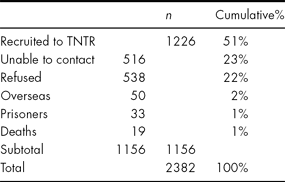
The sample comprised all (N = 1226) TNTR participants recruited between December 2003 and July 2007. Details of TNTR recruitment, including those who refused or were not contactable, are displayed in Table 1. Sixty-five per cent of the sample was male. Participants’ mean age at injury was 36.90 years (SD = 17.81) and ranged from 16 to 97 years. The median age at injury was 32.07 years. Participants reported having received an average of 11 years of education (SD = 2.31). For two-thirds of the sample, premorbid IQ was estimated using the National Adult Reading Test (NART; Nelson, Reference Nelson1982) or, for individuals with specific learning difficulty/dyslexia, the vocabulary subtest of the Wechsler Adult Intelligence Scale (WAIS III; Wechsler, Reference Wechsler1996). This showed a normal distribution with a mean of 97.71 (SD = 11.87). These demographic characteristics are similar to TBI samples reported in previous research in Australia (e.g., Hillier, Hiller, & Metzer, Reference Hillier, Hiller and Metzer1997) and overseas (Bruns & Hauser, Reference Bruns and Hauser2003; Langlois, Rutland-Brown, & Wald, Reference Langlois, Rutland-Brown and Wald2006).
Details of Tasmanian Neurotrauma Register (TNTR) Recruitment
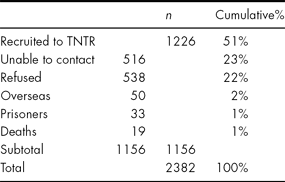
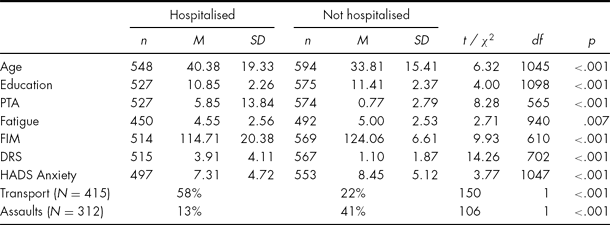
Only 48% of the sample had been hospitalised post-injury. Comparison on a range of variables (Table 2) found that hospitalisation was associated with transport-related injury, older age, fewer years of education, more severe injury, lower anxiety, poorer functional ability and more disability, compared to the group not hospitalised. Despite the large number of non-hospitalised cases, the proportion of mild TBI in the sample was lower than commonly reported in epidemiological studies, most of which indicate that moderate and severe TBI make up less than 20% of cases (Kraus et al., Reference Kraus, Black, Hessol, Ley, Rokaw, Sullivan and Marshall1984; Tagliaferri, Compagnone, Korsic, Servadei, & Kraus, Reference Tagliaferri, Compagnone, Korsic, Servadei and Kraus2006). Seventy-four per cent (n = 872) of the current sample had suffered a mild injury (PTA ≤ 24 h), 16% (n = 187) a moderate TBI (PTA 1–7 days) and 10% (n = 115) had severe injuries (PTA > 7 days). The proportion of assault-related TBI (27%) was higher than has commonly been reported. This was possibly due to the large number of non-hospitalised cases, as assault-related TBI was significantly higher in the non-hospitalised group (Table 2). The remainder of the sample had been injured in transport-related accidents (39%), falls (22%), sporting injuries (5%) and other causes (6%), or the cause of injury was unknown (1%). Seven per cent of the sample had sustained a previous TBI.
Significant Differences between Hospitalised and Non-hospitalised Participants

DRS, Disability Rating Scale; FIM, Functional Independence Measure; HADS, Hospital Anxiety and Depression Scale; PTA, post-traumatic amnesia.
Approval for the research was obtained from the Tasmanian Human Research Ethics Committee (H7116).
Materials
Materials consisted of the Westmead Post Traumatic Amnesia Scale (WPTAS; Marosszeky, Ryan, Shores, Batchelor, & Marosszeky, Reference Marosszeky, Ryan, Shores, Batchelor and Marosszeky1997) and the Galveston Orientation and Amnesia Test (GOAT; Levin, O'Donnell, & Grossman, Reference Levin, O'Donnell and Grossman1979), clinical scales for measuring the duration of PTA; the Rivermead Post-Concussion Symptoms Questionnaire (RPQ; King, Crawford, Wenden, Moss, & Wade, Reference King, Crawford, Wenden, Moss and Wade1995), a validated measure of the severity of post-concussion symptoms (Ingebrigtsen, Waterloo, Marup-Jensen, Attner, & Romner, Reference Ingebrigtsen, Waterloo, Marup-Jensen, Attner and Romner1998); the Hospital Anxiety and Depression Scale (HADS; Zigmond & Snaith, Reference Zigmond and Snaith1983), a self-assessment scale developed to assess levels of anxiety and depression in patients with a physical diagnosis in in patient and outpatient settings, which has been validated in a TBI population (Whelan-Goodinson, Ponsford, & Schönberger, Reference Whelan-Goodinson, Ponsford and Schönberger2009); NART (Nelson, Reference Nelson1982), one of the most commonly used measures of estimated intelligence in English speaking patients with suspected intellectual deterioration, or the Vocabulary scale from the WAIS-III (Wechsler, Reference Wechsler1996); the TNTR Interview Schedule, to provide demographic and relevant history data; a pain rating scale (11-point visual analogue scale (VAS) for rating the subjective experience of pain); a fatigue rating scale (11-point VAS for rating the subjective experience of fatigue); the Functional Independence Measure (FIM; Granger, Cotter, Hamilton, Fiedler, & Hens, Reference Granger, Cotter, Hamilton, Fiedler and Hens1990), a well-researched measure of functional independence for use in TBI rehabilitation (Corrigan, Smith-Knapp, & Granger, Reference Corrigan, Smith-Knapp and Granger1997; Ottenbacher, Hsu, Granger, & Fiedler, Reference Ottenbacher, Hsu, Granger and Fiedler1996); and the Disability Rating Scale (DRS; Rappaport, Hall, Hopkins, Belleza, & Cope, Reference Rappaport, Hall, Hopkins, Belleza and Cope1982), a validated measure (Gouvier, Blanton, LaPorte, & Nepomuceno, Reference Gouvier, Blanton, LaPorte and Nepomuceno1987) for assessing disability over the course of TBI recovery.
Procedure
Potential participants were approached as soon as possible after their attendance at the ED. Informed consent was obtained from those able to provide it at that time. Research assistants also made regular checks of patients on the neurosurgery, orthopaedic and surgical wards to ensure that cases of TBI who were hospitalised for other-system injuries were not overlooked, as has been shown to occur in other settings (Moss & Wade, Reference Moss and Wade1996). For those patients admitted in coma, initial consent was obtained from next of kin, and these participants were approached to provide informed consent as soon as PTA ended, as assessed by the WPTAS. PTA duration was obtained via subjective estimation using the GOAT, and a battery of neuropsychological and medical tests and questionnaires was administered at initial follow-up (median = 7 days post-trauma), and then at 1, 3, 6, 12, 24, 36 48 and 60 months after injury. The data for the current study were gathered at the initial follow-up.
At each assessment, participants were asked about the medical and rehabilitation services they had accessed post-injury. Although referral to rehabilitation services was not one of the aims of the project, TNTR research assistants began to refer some participants for rehabilitation to CRU only a few months after the research project's inception, in response to a perceived gap in services. Other participants were referred to CRU by medical and allied health professionals independently from TNTR. A third group of participants accessed rehabilitation services in the private sector, while a fourth, large group received no rehabilitation.
For the purpose of this study the sample was divided, according to rehabilitation status, into the following groups:
1. CRU-TNTR (n = 121), referred to CRU by TNTR research assistants.
2. CRU-Other (n = 54), referred to CRU by hospital and community services.
3. Private (n = 247), received rehabilitation in the private sector.
4. No-Rehab (n = 804), no rehabilitation.
The four groups were compared on the following variables:
• Gender
• Age at injury
• Years of education
• Estimated pre-morbid IQ (NART/WAIS-III Vocabulary scale)
Demographic variables
• Previous TBI
• Cause of TBI
• Severity of injury (PTA)
• Hospital admission following injury
Injury-related variables
• Post-concussion symptoms (RPQ)
• Pain (VAS)
• Fatigue (VAS)
• Functional independence (FIM)
• Disability (DRS)
• Anxiety (HADS anxiety scale)
• Depression (HADS depression scale)
Functional and psychological variables
Data Analysis
Differences between the four groups (CRU-TNTR, CRU-Other, Private and No-Rehab) on continuous variables were investigated using one-way between-groups analyses of variance (ANOVAs), followed by Tukey post-hoc tests, where appropriate. For each categorical variable, a global chi-square test was performed to determine whether, overall, there was a significant difference between the four groups. If this chi-square test was significant, post-hoc tests were performed comparing the groups, to determine which pairs differed significantly on the variable in question: for example, percentages of hospitalised cases in each group. For cause of injury, analyses were performed using only the three main causes of injury (transport, assault and falls), which together accounted for 88% of cases. As the resulting variable had three categories, separate chi-square tests were performed comparing each category with the other causes combined, followed by pair-wise tests if the initial test was significant. Because of the large number of analyses performed, a statistical significance level of p < .01 was adopted for chi-square tests.
Results
Four hundred and twenty-two participants (34% of the whole sample), were referred for rehabilitation, with over half (59%) of this number referred in the private sector. Those referred for rehabilitation in the public sector comprised 121 from TNTR and 54 from hospital and community services.
Sixty-three per cent (n = 110) of those referred to public rehabilitation were referred in the first 3 months post-injury, with no significant difference in mean time from injury to referral between the CRU-TNTR and CRU-Other groups. However, a larger percentage (p = .017) of the CRU-Other (71%) group was referred in the first 3 months compared with the CRU-TNTR group (57%). Information about time from injury to referral was not available for those referred in the private sector.
Differences between Rehabilitation Groups
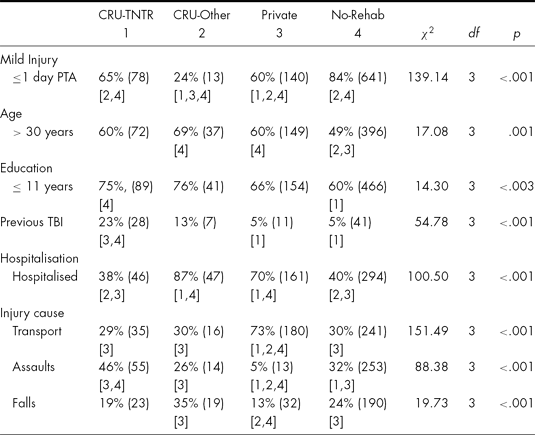
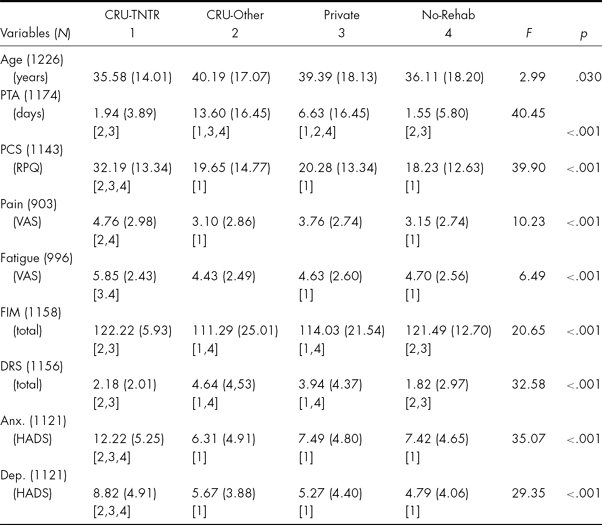
Tables 3 and 4 summarise differences between the four groups on the demographic, injury-related, functional and psychological variables examined in this study.
Percentages and Significant Group Differences (Chi-Square) for Categorical Variables
Significant group comparisons are indicated in square brackets.
Means (SDs) and Significant Group Differences (ANOVA) for Continuous Variables
Significant group comparisons are indicated in square brackets.
Anx., anxiety; Dep., depression; DRS, Disability Rating Scale; FIM, Functional Independence Measure; HADS, Hospital Anxiety and Depression Scale; PCS, post-concussion symptoms; PTA, post-traumatic amnesia; RPQ, Rivermead Post-Concussion Symptoms Questionnaire; VAS, visual analogue scale.
Demographic Variables
Older age (over 30 years) was significantly associated with referral to rehabilitation in the CRU-Other and Private groups, but not in the CRU-TNTR group, which had the lowest mean age of all the groups. Less than high school education was significantly associated with referral to public, but not to private, rehabilitation, although this association was only approaching significance for the CRU-Other group, χ2 = 5.25, p = .022. No statistically significant differences were found between the four groups for gender or estimated pre-morbid IQ.
Injury-Related Variables
Injury severity was looked at in two ways: mean PTA and the percentage of mild injuries across the four groups. Comparison of mean PTA found that more severe injury was associated with referral to rehabilitation in the CRU-Other and Private groups but not in the CRU-TNTR group. However, the Private and CRU-TNTR groups had comparable percentages of mild injuries (60% and 65%, respectively), while the percentage of mild injuries in the CRU-Other group was only 24%, compared to 84% in the No-Rehab group.
Twenty-three per cent of the CRU-TNTR group reported a previous TBI—significantly higher than the 5% reported by the Private and No-Rehab groups. The CRU-Other group, with 13% previous TBI, was not significantly different from any of the other groups, although the comparisons with the Private (χ2 = 5.52, p = .019) and No-Rehab (χ2 = 5.43, p = .020) groups were approaching significance.
Cause of injury differed significantly across the groups. The Private group, with almost three-quarters of its participants injured in a transport-related accident, was significantly different compared with each of the three other groups. The CRU-TNTR had the highest proportion of assaults, and was significantly different from the Private and No-Rehab groups on this variable. No significant association was found between being injured in a fall and referral to rehabilitation, in any of the groups. Hospitalisation was significantly associated with rehabilitation in the CRU-Other and Private groups, but not in the CRU-TNTR group.
Functional and Psychological Variables
Comparisons of mean PCS scores on the RPQ, mean anxiety and depression scores on the HADS and mean VAS pain and fatigue scores all found similar results, with CRU-TNTR reporting higher scores on all of these variables compared to the three other groups. On the functional measures, the CRU-Other and Private groups had lower scores on the FIM and higher scores on the DRS, indicating less functional independence and greater disability, compared to the other two groups.
Discussion
Characteristics of the Whole Sample
A key strength of our study is the description of referral patterns in a large, prospective, population-based sample of adults presenting to ED following a TBI, whether or not they were subsequently admitted to hospital. This contrasts with the great majority of TBI epidemiological and outcome studies which include only hospitalised cases and those who die before hospitalisation. For example, a review of 23 European reports included only two with non-hospitalised cases (Tagliaferri et al., Reference Tagliaferri, Compagnone, Korsic, Servadei and Kraus2006), and Australian studies of TBI incidence (Helps, Henley, & Harrison, Reference Helps, Henley and Harrison2008; Hillier et al., Reference Hillier, Hiller and Metzer1997; Tate, McDonald, & Lulham, Reference Tate, McDonald and Lulham1998) have also reported only hospitalised cases. When studies do include data from ED contacts, they often fail to distinguish TBI from superficial injuries to the head (see, for example, Badcock, Reference Badcock1988). This lack of information about TBI patients who are not admitted to hospital has been identified as a significant gap in the TBI epidemiological literature needed to guide estimates of the demand for, and range of, required rehabilitation services (National Institutes of Health, 1999).
Assault was the second highest cause of injury, accounting for 27% of the sample. This contrasts with most studies, which report a rate of assault of 10–16% (Helps et al., Reference Helps, Henley and Harrison2008, Hillier et al., Reference Hillier, Hiller and Metzer1997; Kraus et al., Reference Kraus, Black, Hessol, Ley, Rokaw, Sullivan and Marshall1984; Tagliaferri et al., Reference Tagliaferri, Compagnone, Korsic, Servadei and Kraus2006; Tate et al., Reference Tate, McDonald and Lulham1998). One possible reason for this finding is the large percentage of non-hospitalised TBI in the TNTR sample. Examination of hospitalisation by cause of injury did find that the rate of hospitalisation was significantly lower for assault-related TBI, compared with other causes: only 23% of assault-related injuries were hospitalised, compared with 48% of falls and 71% of transport-related injuries. This suggests that, as TBI epidemiological studies are usually based upon patients admitted to hospital, they are likely to under-report the incidence of TBI from assault. Other characteristics of the non-hospitalised group were younger age at injury, more years of education, milder injury, higher levels of anxiety, greater functional ability and less disability, compared to the hospitalised group.
The primary objective of the current study was to investigate which variables predicted referral for rehabilitation, and it was hypothesised that those at risk of poorer outcomes would be more likely to be referred. Based on previous research, those who were considered at risk of poorer outcomes were participants who were older, female, had lower education and/or lower premorbid IQ, a history of previous TBI, more severe injuries, had been injured in an assault, had been hospitalised post-injury, and/or had higher levels of psychological distress, functional disability and PCS.
Group Differences on Demographic and Injury-related Variables
Our hypothesis for age, education and hospitalisation were all partially supported. Age over 30 years and hospitalisation were associated with referral through the usual rehabilitation pathways (CRU-Other and Private), but not by TNTR, while less than high school education was associated with referral to public, but not to private, rehabilitation. This latter result may be because a lower education level is likely to lead to a lower salary and consequently to a lower take-up rate of private insurance. Gender and lower estimated premorbid IQ were not associated with referral in any of the groups.
The profile of cause of injury was different across the three rehabilitation groups. We had hypothesised that those injured in an assault would be more likely to be referred for rehabilitation, because poorer outcomes have been found for those who incur a TBI in a violence-related injury (Gerhart et al., Reference Gerhart, Mellick and Weintraub2003; Wenden et al., Reference Wenden, Crawford, Wade, King and Moss1998). This hypothesis was not supported in the CRU-Other and Private groups. However, there was a strong association between assault-related injury and referral by CRU-TNTR: almost half of this group had been injured in an assault. This may be due to the larger number of non-hospitalised cases referred from TNTR compared to other groups, given that, as reported above, the rate of hospitalisation was lower for assault than for other causes of injury. Not surprisingly, with Tasmania's no-fault motor accident compensation system, referral in the Private system was strongly associated with being injured in a motor vehicle accident. No significant association was found between being injured in a fall and referral to rehabilitation, in any of the groups. Previous TBI was strongly associated with referral by CRU-TNTR and more weakly (p = .020) with referral by CRU-Other, but not with referral in the private system.
In moderate to severe TBI, severity-of-injury is an important predictor of outcome (Dikmen, Machamer, Winn, & Temkin, Reference Dikmen, Machamer, Winn and Temkin1995; Gordon et al., Reference Gordon, Zafonte, Cicerone, Cantor, Brown, Lombard and Chandna2006) and we hypothesised that longer PTA would be associated with referral to rehabilitation. This hypothesis was supported in the CRU-Other and Private groups, which had mean length of PTA of almost 2 weeks and 1 week, respectively. However longer PTA was not associated with referral in the CRU-TNTR group, which was predominantly composed of individuals with injuries in the mild category (65% had PTA ≤ 24 h). A proportion of the CRU-Other and Private groups were also mild cases, some of whom may have been referred for comorbid injuries, such as orthopaedic injuries. The CRU-TNTR group would, however, have only been referred for TBI-related difficulties because referral for other reasons was not within the scope of the project.
It is also interesting to note the large number of moderate and severe TBI cases not referred for rehabilitation. Research suggests that patients presenting acutely to hospital with moderate to severe injuries should be routinely followed up to assess their need for rehabilitation (Thornhill et al., Reference Thornhill, Teasdale, Murray, McEwen, Roy and Penny2000; Turner-Stokes et al., Reference Turner-Stokes, Disler, Nair and Wade2005). In the present study, however, 16% of the No-Rehab group, 124 cases, had sustained a moderate or severe injury. While a proportion had been hospitalised following their injury—and may have been assessed as not being in need of rehabilitation—41 individuals were not hospitalised and, despite having PTA > 24 h, were not referred to rehabilitation services. Similarly, 43 individuals referred by CRU-TNTR had a PTA > 24 h, but were not referred for rehabilitation by hospital or community services.It is possible that some of these patients were referred by TNTR before other services had the opportunity to assess their rehabilitation needs. However, there are a number of reasons why this is unlikely. First, referral to rehabilitation was not part of the scope of the TNTR research project and referrals were made by the research assistants only when assessment and referral from other sources was unlikely. Second, a significant proportion of the TNTR-referred moderate and severely injured group (42%) had not been hospitalised, and, as highlighted by the current research, referrals to CRU were very rarely made from community health services. Third, a significantly greater percentage (p = .017) of the CRU-Other group (71%) was referred in the first 3 months compared with the CRU-TNTR group (57%). The large number of TBI patients, either not referred for rehabilitation or referred by the research project in an attempt to bridge what was seen as a gap in services, highlights the lack of a comprehensive, organised system of service for TBI in Tasmania at this time.
Group Differences on Functional and Psychological Variables
High levels of PCS, anxiety and depression have all been linked with poorer outcomes and it was hypothesised that these variables would be associated with referral for rehabilitation. These hypotheses were only supported in the group referred to CRU by TNTR. Surprisingly, high levels of PCS, anxiety, depression, pain and fatigue were not associated with referral to public rehabilitation by hospital and community health services. One explanation for this finding is that no system was in place to routinely screen for PCS or psychological distress in TBI patients, either in ED or on the wards of the RHH. Without a protocol to suggest that high levels of these symptoms should be criteria for referral to rehabilitation services, it is likely that staff would rely on traditional measures of physical disability. Consequently, referral was based on physical disability and largely limited to severely injured, hospitalised cases. These results point to the importance of systems being in place in acute settings, whereby all patients suspected of having sustained a TBI, whether or not they are hospitalised post-injury, are accurately diagnosed and treated and, when appropriate, referred for rehabilitation.
An important finding of the current study is that no pathway existed for non-hospitalised cases to be referred for public rehabilitation in Tasmania. Although referral to rehabilitation services was not an aim of the outcome study, research assistants performing assessments and collecting data for the project began to refer participants to CRU soon after its inception, and over the course of 3 years, 29% of the sample accessed rehabilitation via this route. The group referred to CRU by TNTR was not significantly different from the No-Rehab group on measures of physical functioning (FIM), disability (DRS) or PTA. However the TNTR-referred sample was more likely to have sustained a violence-related TBI and/or experienced a previous TBI than the other groups, and was less likely to have completed high school than the No-Rehab group. They were more likely to score higher on the RPQ and the anxiety and depression scales of the HADS, and to have significantly higher levels of pain and fatigue compared to the other three groups. Although all of these features have been linked with poorer outcomes following TBI, without the presence of the TNTR research project, it is likely that most of this group would not have been referred for rehabilitation because they had suffered milder TBIs and/or were not hospitalised post-injury: 65% of the CRU-TNTR group had mild injuries and 62% had not been hospitalised.
Brief interventions providing information, and reassurance that symptoms are likely to resolve, have been shown to reduce long-term symptoms in mTBI (Borg et al., Reference Borg, Holm, Peloso, Cassidy, Carroll, von Holst and Yates2004; Paniak, Toller-Lobe, Durand, & Nagy, Reference Paniak, Toller-Lobe, Durand and Nagy1998; Paniak, Toller-Lobe, Reynolds, Melnyk, & Nagy, Reference Paniak, Toller-Lobe, Reynolds, Melnyk and Nagy2000; Wade et al., Reference Wade, Crawford, Wenden, King and Moss1997, Reference Wade, King, Wenden, Crawford and Caldwell1998). Nevertheless, education and reassurance about TBI symptoms were not provided to those presenting with mTBI to the ED of RHH, during the current research. This may be one reason why a large number of mildly injured participants in this study reported high levels of PCS, pain, fatigue and psychological distress, and consequently were referred to CRU for rehabilitation by the TNTR research assistants.
While evaluation of the outcomes of this group of mildly injured individuals is outside the scope of the present study, it is important to consider whether their referral for rehabilitation was justified. Although acceptance by the multidisciplinary team at CRU may be seen as a validation of their referral, the need for more intensive treatment of mild TBI continues to be the subject of debate. Two recent randomised controlled trials failed to find benefit from multidisciplinary treatment compared to controls. However, one of these trials (Elgmark Andersson, Emanuelson, Björklund, & Stålhammar, Reference Elgmark Andersson, Emanuelson, Björklund and Stålhammar2007) had stringent selection criteria which excluded one-third of possible TBIs due to pre-existing problems, such as previous brain injury, while the other trial (Ghaffar, McCullagh, Ouchterlony, & Feinstein, Reference Ghaffar, McCullagh, Ouchterlony and Feinstein2006) did find a benefit in those participants with pre-existing psychiatric problems. This suggests that while routine referral of all mTBI may offer little benefit, targeting individuals with pre-existing problems for rehabilitation may be an effective approach. Given the very high levels of reported psychiatric symptoms in the TNTR group post-injury and the large number reporting a previous TBI, it is likely that a substantial proportion of this group did have pre-existing difficulties.
Over the 3½ years of this study, only 54 individuals (4% of total sample) were referred for public rehabilitation by hospital and community medical services, compared with 242 (20%) who accessed rehabilitation in the private sector. The majority of those referred for public rehabilitation were hospitalised following their injury, and referral was by hospital medical staff (46 cases). This group had the highest levels of disability and lowest levels of physical functioning. In Australia there are currently no national guidelines for TBI rehabilitation and little information is available about referral rates for public TBI patients (Graham & Cameron, Reference Graham and Cameron2008). The very small number of participants of the current study referred for public rehabilitation, through the usual rehabilitation pathways, and the large number of moderate and severe cases (124; 10% of total sample) not referred for any rehabilitation, suggests that routine follow-up, which is recommended in the literature (Turner-Stokes et al., Reference Turner-Stokes, Disler, Nair and Wade2005) for moderate to severe TBI, was not occurring in Tasmania in the public sector during the course of the current research.
The results of the current study support previous research (O'Callaghan et al., Reference O'Callaghan, McAllister and Wilson2009) indicating that funding is a significant factor in access to rehabilitation services in Australia. The Private group constituted the largest proportion (58%) of rehabilitation cases, with almost three-quarters of cases injured in transport-related accidents. The high prevalence of transport-related injuries in this group is due to medical and rehabilitation costs of the majority being paid by third-party insurance, as these individuals are invariably treated in the private sector. The remaining members of the Private group were workers’ compensation cases and individuals with private health insurance. The Private group did not differ significantly from those referred to CRU by hospital and community services in its levels of disability and reduced physical functioning. It did differ in injury severity. It had a high proportion of mild injuries and, given the strong association between more severe TBI and referral in the public sector, many of this group may not have been referred for rehabilitation if they had not been covered by private or third-party insurance.
A limitation of the current research is that, for some participants, data were missing on some variables, which may have introduced a bias in some of the results. For the large majority of variables, data were available on over 90% of participants, but for measures of estimated premorbid IQ and ratings of pain and fatigue, 20–30% of data were missing. The principal reason for this was some participants being too unwell to complete some tests and questionnaires at the initial assessment at TNTR.
In summary, this study examined the characteristics of the participants of the TNTR outcome research and found that, despite containing a large number of non-hospitalised cases, this sample had a larger proportion of moderate and severe cases than samples in most epidemiological studies. The current sample also had much higher levels of assault-related injuries, possibly because of the inclusion of non-hospitalised cases. One-third of the whole sample was referred for rehabilitation, with the majority accessing this in the private sector as a result of transport-related injuries, the medical costs of which were funded by third-party or private insurance. This confirms previous research indicating that funding is a significant factor in access to rehabilitation services in Australia. The results of this research indicate that no pathway existed for non-hospitalised TBI cases to be referred for public rehabilitation in Tasmania, even if they were experiencing high levels of PCS and psychological distress. Furthermore, routine follow-up to assess rehabilitation-need, which is recommended in the literature, was not occurring for moderate and severe TBI patients: the small sample referred by hospital and community medical services had the most severe injuries and the highest proportion of hospitalised cases. Its members were older and reported more disability and lower levels of physical functioning than the other groups.
This research highlights the lack of clinical guidelines for the diagnosis, acute management and rehabilitation of TBI patients in Australia. At the time of writing, systems of service for TBI patients differ quite markedly from state to state, and national guidelines are needed to help eliminate these disparities and establish best practice standards. As sharing of good practice across states may be a useful interim step towards the development of a national guideline, a future aim is to publish follow-up research comparing different state systems of TBI rehabilitation across Australia, together with suggestions for an improved model of service delivery.