There are established lines of theorizing linking religion to socio-economic and political regime outcomes. Depending on the specific doctrinal or contextual factors, religion and the institutions and actors associated with it have been either vilified as reactionary, or, conversely, perceived as progressive forces shaping political culture, human capital and development.Footnote 1 The controversy is particularly true for an important set of religious entrepreneurs, Christian missionaries, operating in colonial contexts. Branded as ‘workhorses of empire’, ‘precursors of the flag’,Footnote 2 and ‘helpmates of … imperialists’Footnote 3 or, alternatively, as benign and principled crusaders for social justice,Footnote 4 their links with colonial authority have been often taken for granted, and any independent effects they might have had on development have been under-explored and under-theorized. Only recently have social scientists begun to analyse systematically aspects of missionary activity, which might have long-term independent political and developmental effects. For instance, Trejo found that Christian missions provided an impulse to social mobilization among indigenous groups in Latin America. Bolt and Bezemer have argued that missionary education in vernacular languages in Africa has had long-term economic growth effects. Woodberry gathered cross-national data on missions and found strong missionary effects on post-colonial democracy. And Posner found that missionaries in Africa shaped post-colonial nations’ linguistic landscapes because they selectively codified vernacular languages.Footnote 5
However, an important area of missionary work, female education, has remained outside the purview of much of the recent social science scholarship dealing with missionary effects or, more generally, with the legacies of colonialism. While colonial historiography is replete with references to missionaries as important to the development of female education,Footnote 6 hardly any rigorous studies of the long-term effects of this aspect of missionary work have been conducted. This omission is puzzling given the overwhelming empirical evidence of the impact of women's education on development, on policy and on the quality of governance.Footnote 7
How do we begin to study missionary effects on female education given the complexity and diversity of religious and colonial contexts in which they operated? By the end of the nineteenth century, missionary work represented a transnational multi-denominational enterprise: American Salvationists were just as likely to be active in a British colony as were Anglicans in French West Africa.Footnote 8 Western missions also often operated in contexts with established indigenized Christian churches. Finally, they had to reckon with Western colonial powers, as indeed with native secular authorities and ideological movements. These various religious and secular actors espoused diverging positions with regard to social modernization and to female education in particular.
This article draws on classic theorizing on religion, which highlights the importance of religious competition in the provision of public goods.Footnote 9 The competition mechanism is useful for understanding how one set of religious entrepreneurs could trigger the provision of female education by a wider group of religious and secular authorities. In opting for religious competition theory as our analytical vantage point, we do not dismiss the importance of doctrinal matters in shaping missionary educational preferences. Our framework is rooted in long-standing scholarship on the role of Protestant Christianity in the spread of mass education.Footnote 10 It differs, however, from established strands of social science theorizing on religion that mostly focus on the importance of doctrinal nuances or Church–state relationships for developmental outcomes.Footnote 11
We illustrate how missionary-triggered religious competition might have long-term effects on female education, and in particular on gender education inequalities, based on a sub-national study of colonial and post-colonial India. Colonial India resembled a patchwork quilt comprised of directly ruled British territories and indirectly ruled princely states. Missionary involvement had been spatially uneven: while some, particularly coastal areas had experienced missionary activity predating, and overlapping with, British colonial rule, in others it had been sporadic or non-existent. Colonial-era censuses point to substantial spatial variations in female education. These variations have persisted into the present: while states like Kerala boast universal literacy, in many others, a large percentage of women remain illiterate and there has been limited progress in reducing male–female inequalities in access to education. We hypothesize that spatial patterns of institutionalization of co-educational and female schooling in the colonial period could explain this variation. These outcomes are in turn attributable to Protestant missionary activity in the nineteenth and early twentieth centuries, which spurred competition among religious and secular authorities to elevate the status of hitherto disadvantaged groups.
We make this case by conducting a process-tracing case study of Kerala, India's most progressive state when it comes to female education, and district-level statistical analysis to establish whether links between missionaries and female education hold throughout India. Kerala illustrates how prior to the arrival of Protestant Christian missions native governments and established religious groups showed limited interest in female education outside of a narrow elite. By the end of the nineteenth century, following activity by Protestant missions, they had become strong advocates of mass, including female, education, and key education providers.
For our statistical analysis, we assembled original district-level datasets. Our exploration of variation in missionary involvement in India's provinces reveals that Christian missionary activity is consistently associated with better female education outcomes as measured by differences in education between men and women, in the colonial period; it also continues to affect post-colonial variation in female education. These effects hold when we include the usual controls of direct British rule, modernization, European settlement, education expenditures, and post-colonial democracy, as well as those specifically employed in studies of India such as Islam, caste and tribal status, and land tenure. Interestingly, we also find that direct British rule is not consistently associated with better female education outcomes; furthermore, it has had a deleterious effect on gender equality in post-colonial education at some levels of schooling. These findings allow us to interrogate both the established assumptions about the human capital effects of British colonialism,Footnote 12 and those postulating links between colonial authorities and missionary activity.Footnote 13
In the following section, we contextualize our approach in the broader literature on colonial legacies and discuss the religious competition theory and its utility for our analysis. Next, we illustrate the workings of competition by setting out the historical context in which Protestant missionaries operated in colonial India and by conducting a study tracing the process of their involvement in Kerala. We then discuss our data and estimation approach and present results of district-level India-wide statistical analysis. A discussion section follows in which we summarize our findings and their implications for debates on developmental effects of colonial-era legacies.
Theoretical Framework
In so far as our focus is on colonial-era religious entrepreneurs and their effects on the gender aspects of human capital, our study differs from established and the recently burgeoning politics and economics scholarship on the long-term developmental effects of Western engagement in former colonies. This literature has highlighted the importance for long-term development of colonial political institutions;Footnote 14 the colonial powers’ legal systems;Footnote 15 patterns of European settlement;Footnote 16 the political economy of colonialism, notably land tenure;Footnote 17 geographical factors affecting colonial policy;Footnote 18 and Western policies specifically targeting native schooling.Footnote 19 With few exceptions,Footnote 20 religion has been only superficially addressed in these analyses, while the gender aspects of Western engagement, whether missionary-led, or driven by the above alternative factors, have received even more scant attention. Our study, therefore, differs from existing scholarship in terms of both our key explanatory variables, namely missionary effects, and our outcome variables, namely female education.
Our proposed causal mechanisms linking missionary involvement to female education draw on studies in the sociology and economics of religion highlighting the role of interdenominational competition in the provision of public goods.Footnote 21 This scholarship is distinct from predominant approaches to religion and its societal, economic and political effects, which focus on denominational nuances or the institutional structures governing Church–state relationships characteristic of particular faiths.Footnote 22
In a classic study of religion, Peter Berger highlights the importance of studying the constellations of various religious actors in a given setting. He distinguishes between ‘religious monopolies’ and a religious ‘pluralistic situation’. Religious monopolies, which Berger refers to as ‘regulatory agencies for both thought and action’,Footnote 23 exist when particular faith systems enjoy dominant status in society. Hinduism in predominantly Hindu areas prior to Western missionary involvement in colonial India, pre-Revolutionary Russian Orthodoxy sanctioned and protected by the state, and Calvinism in Calvin's Geneva are examples of monopolistic systems. In such settings, dominant religions become notorious for religious ‘totalism’ and a tendency for unchecked societal and/ or political control. A shift towards a plurality of competing actors involving both the established and non-dominant religions helps mitigate the ‘totalizing’ aspect of a dominant religion.Footnote 24
Berger characterizes a ‘pluralistic situation’ as one in which ‘religious ex-monopolies can no longer take for granted the allegiance of their client populations’.Footnote 25 As a result, a religious tradition, previously ‘authoritatively imposed’ now has to be ‘marketed’ to a discerning audience.Footnote 26 A ‘pluralistic situation’ is, therefore, akin to a marketplace, in which various actors compete for the loyalty of the consumer. The existence of a religious marketplace affects both the strategies of dominant religious actors and those of the non-dominant competing religious entrepreneurs. The emergence of competing actors on the religious arena undermines the monopoly of existing religious institutions. Simultaneously, it forces the dominant and contending non-dominant actors to compete in the delivery of consumer ‘goods’, spiritual and profane. Where the dominant religion helped maintain the status quo either through association with the Caesar, or by way of sanctifying the existing social order, it is now forced to reckon with its failing authority by incorporating aspects of competing doctrine and practice. Competition stimulates ecumenical processes and convergence in the provision of consumer goods. The competition dynamic is not limited to religious actors, however, as they often confront competitive pressures in the redefinition of the world and the status of the individual within it from non-religious rivals. These secular competitors could be political authorities or groups espousing rival ideologies like nationalism or communism.Footnote 27
Berger's framework focuses more on the competition mechanism itself than on the doctrinal nuances of various religions conducive to the delivery of certain types of public goods. Nevertheless, he follows in the long tradition of scholarship linking Protestant Christianity in particular to social modernization. In his framework, Protestant groups are initial triggers to social engagement by other entrepreneurs.Footnote 28 As Berger, Eisenstadt and Walzer have noted, Protestantism's disposition to ‘modernity’ is rooted in the wars of religion and counter-reformation, contexts in which Protestants were often an oppressed minority, denied the right to participate in the political life of host communities.Footnote 29 Initially, ‘totalistic’ in their orientation, much like their Catholic counterparts, their oppressed status led them to elaborate a completely new set of approaches to the construction of polity and society.Footnote 30 The historical conditions of the origins and development of these groups, as Berger argues, were conducive to the emergence of secularizing impulses within Protestant Christianity.Footnote 31 In contrast to Catholicism, Eastern Christianity or Islam, characterized by greater ritualism and even withdrawal from active social life, Protestantism is more strongly associated with a ‘this-worldly’ orientation whereby ritualistic institutional mediation is downplayed or abhorred, and personal responsibility for one's life and that of the wider community are stressed.Footnote 32
What are the goods that Protestant religious entrepreneurs might offer to a discerning religious consumer? Max Weber highlighted the profane nature of incentives leading individuals to affiliate with specific churches in America, such as the provision of good character certificates to those wanting to acquire bank credit.Footnote 33 Recent studies point to other types of goods that might be particularly valued in contemporary developing contexts.Footnote 34 Trejo found that faced with competition from Protestant challengers in Mexico's indigenous regions, the Catholic Church, a traditional ally of the landed rich and the elites, was more likely to provide such public goods as schooling to the most downtrodden groups in society.Footnote 35 In their study of missionary work in colonial Africa, Gallego and Woodberry likewise suggest that new entrants to the religious marketplace might opt for educational work even when existing religions already occupy a share of the market. This is because where the dominant political authority favours one religion over others, as French colonial powers favoured the Catholic missions, the favoured groups have little incentive to provide quality schooling, otherwise highly valued in local societies. Protestant competitors in these contexts seized the opportunity to cater to potential consumers by improving education, hence the higher quality of Protestant schooling in French colonies.Footnote 36
While the above few empirical studies provide some insights into the dynamics of religious competition in developing states, competition theory has been criticized rightly for being underspecified.Footnote 37 The theory, developed largely with reference to competition in Western settings, for instance, is silent on religious entrepreneurial strategies when applied to female education in non-Western cultural contexts. In particular, it is unclear how doctrinal aspects of missionary activity may interact with missionaries’ overall competitive objective of capturing a wide market where Protestant Christianity is an external cultural import. Our empirical study should help further develop and specify the theoretical mechanisms linking competition to strategies of religious groups operating in a colonial educational marketplace.
Given the competitive environment of a ‘pluralistic situation’ in which various actors are ‘optimizers’,Footnote 38 seeking to cast their net as widely as possible, we would expect competition in the provision of female, and not just male, education. Historically, doctrinal aspects of Protestantism that stressed a personal relationship to God through scriptural readings in vernacular languages compelled Protestants to educate both boys and girls of pre-confirmation ages. In eighteenth-century and nineteenth-century Europe, Protestant female literacy rates were higher than the Catholic equivalent; the former generally maintained gender parity in primary education; and the church had a reputation for providing better quality girls’ education among all social classes wherever Protestant communities settled.Footnote 39
While Protestants developed modern schooling for girls in their own communities, their female education practices may differ in proselytizing contexts. Colonial historiography suggests that missionaries may face substantially higher barriers to entry into the female, compared to male, educational marketplace.Footnote 40 In European overseas colonies, men tended to value modern education, whether provided by colonial or missionary authorities, because of its perceived links to improved job prospects.Footnote 41 In contexts where cultural practices sanctioned the seclusion of women, however, missionaries often faced substantial native resistance to female education.Footnote 42 Colonial authorities also cited cultural sensitivities as grounds for neglecting female education.Footnote 43 Furthermore, some missionaries’ pre-conceived notions about native societies, coloured by prevailing colonial prejudices and Victorian-era ‘downward filtration’ theories, encouraged them to court the cultivated elite, male or female, and not the mostly uneducated mass populations.Footnote 44
Under these circumstances, we would anticipate several potential scenarios and strategies of missionary involvement. Under the first scenario, we would expect missionaries to focus on male education provision so as not to alienate a large segment of prospective, male, clients. Under the second possible scenario, missionaries would advance female education by devising strategies that would make it appealing and acceptable given the peculiarities of the wider cultural environments in which they operated. For instance, because of the facility of operating in a market that was already comparatively more advanced and, hence, more receptive to education, they would court the traditionally better educated elite females by providing education that was innovative and superior to the existing educational opportunities, but one in tune with the cultural sensitivities prevailing in elite society. Such a strategy would tally with numerous accounts of missionaries preferring to work in the higher-class market; however, it would have limited their influence to a tiny elite, which might in any case have been less amenable to conversion because of its high status.Footnote 45 Alternatively, they could have concentrated on the uneducated and underprivileged mass population, likewise, by tailoring their incentives to this particular social stratum. The two strategies of female education need not have been exclusive, as missionaries might have sought to cast their net as widely as possible. Whichever female education strategy they chose, their efforts were likely to trigger competition among religious monopolies and other groups in the provision of female education.
Under the scenario of missionaries concentrating on male education, we would expect missionary involvement in India to have had marginal, non-existent, or deleterious effects on reducing the gaps in education between men and women. In the female education scenario, we would expect missionaries not only to have helped to improve elite or general female education through their own schooling efforts directly, but also to have done so indirectly, because of the competition in the provision of education that they triggered, and because of this competition's effects on the greater social acceptability of educational parity for men and women.
We explore these potential causal mechanisms in the Kerala case study and statistical analysis sections that follow. The case study illuminates the dynamics of religious competition in a way that statistical analysis alone would not be able to capture, given the limited sub-national data on Christian denominational composition and growth over time in colonial India. Statistical analysis employing proxies of missionary influences allows us to ascertain more systematically whether patterns uncovered in the case study hold throughout India when rival theoretical explanations of female education are taken into account.
Uncovering the Mechanisms of Missionary-led Competition in the Provision of education in Colonial India
The Context
Western Christian missionary involvement in India's education dates back to the Portuguese and French presence in pockets of coastal territory in the sixteenth to eighteenth centuries. These early conquests led to the setting up of Jesuit schools for boys.Footnote 46 Active Protestant engagement in India dates back to the early eighteenth century when German and Danish Evangelicals established missions in South India and set up schools for men and women of all social classes.Footnote 47
It was also during the eighteenth century that the East India Company began expanding its operations in India. Until 1813, when the Company passed a Charter Act that admitted some responsibility for the education of elite Indians, it took limited interest in education and in particular female education. Colonial education policy changed over time under pressure from Evangelical missionaries, who were part of the nineteenth-century transatlantic ecumenical movement of revivalist Protestant Christianity.Footnote 48 In the mid-nineteenth century, the British introduced a grants-in-aid system whereby private schools for boys and girls, a large share of which had come to be missionary-run, received a subsidy.Footnote 49
Despite the expansion of schooling over time, colonial education results were unimpressive. According to some estimates, in 1916, less than 3 per cent of the population in directly ruled territories went through elementary schooling.Footnote 50 Nurullah and Naik estimate that between 1835 and 1931 India-wide literacy rates had dropped by 0.5 per cent. An alternative estimate is that they increased by only 1.75 per cent.Footnote 51 The mediocre outcomes were particularly pronounced for women. While in 1854, there were 2,875 schools for boys in the Bombay Presidency, there were only sixty-five girls’ schools and they were all privately run.Footnote 52 As late as 1920 most of the female education provision remained within the voluntary sector.Footnote 53 Female literacy retention rates were also extremely low and male–female gaps in literacy rates tended to widen with age. In 1930, the total ‘wastage’ in girls’ schooling, that is, a failure to continue education after the first grade, was 90 per cent.Footnote 54 Utilitarian motives underlie the colonial authorities’ ‘hands off’ approach to female education. Boys’ education resulted in cheap and abundant supplies of clerks. Female schooling would have been a more altruistic undertaking due to women's limited employment prospects.Footnote 55
There were substantial variations in the provision of female education among India's provinces, however. Little evidence exists to suggest that these disparities stemmed from colonial education in directly ruled territories. In fact, education results in British provinces notoriously lagged those in some native states. In 1921, in British Bihar and Orissa there was one literate female to fifteen literate males, while in princely Cochin and Travancore the ratio was one to two.Footnote 56
Although no clear patterns could be discerned in education results among British and indirectly ruled territories, there was a tendency for Christians of all social classes to have comparatively high female literacy. In 1931, in overall literacy Christians surpassed Sikh, Buddhist, Hindu, Muslim and tribal communities, though Parsis, Jews and Jains topped the list. They came third in female literacy, however, after Parsis and Jews. While Muslims had fifteen and Hindus had twenty-one literate females per 1,000 people, Christians had 203.Footnote 57
Nevertheless, Christians represented a tiny minority in most of colonial India, and Catholics or, as in Kerala, Syrian, Romo-Syrian and Latin Catholic Christians often outnumbered the Evangelical groups who were most active in the provision of education.Footnote 58 Moreover, by the end of the nineteenth century, native education provision eclipsed Christian schooling. Yet, colonial censuses indicate that where Protestants had been active there were superior female education outcomes.Footnote 59 The Kerala case study that follows illustrates how our religious competition framework could be useful for addressing this puzzle.
Women's Education in Kerala: Religious Competition and Secular Responses
Kerala, which comprises the Malayalam-speaking Malabar, formerly part of the British Madras Presidency, and districts formerly in the Travancore and Cochin princely states, has been lauded for its progressive female education policies. To what extent are they rooted in colonial-era missionary activity? We contend that colonial Kerala represents a classic case of a competitive religious marketplace in which established religious monopolies emulate new entrants’ consumer strategies. These competition dynamics in turn have profound effects on gender educational outcomes.
Kerala's religious diversity notwithstanding, before the arrival of Protestant missions the territories now comprising the state had an uncompetitive religious market in which the various religious and secular authorities did little to promote mass female education. In 2001, Christians constituted 19 per cent, while Hindus and Muslims formed 56 and 25 per cent, respectively, of the state's population.Footnote 60 Kerala's Syrian Church, which links its origins nearly two millennia back to the work of Thomas the Apostle, boasted relatively high female education levels due to its elite status in society.Footnote 61 The Church, which practised existing caste taboos and hierarchies, did not actively promote mass female literacy until the end of the nineteenth century.Footnote 62 Neither the Syrian Catholic Church, comprised of converts from Syrian Christianity, nor the Roman Catholic (Latin) Church, dating back to sixteenth-century Portuguese conquests, showed much interest in the promotion of mass education until the 1880s.Footnote 63
Native governments meantime remained ‘supremely indifferent’ to female education.Footnote 64 As late as 1863, T. Madhava Rao, the Travancore Dewan admitted that the government role in female education had been minimal. The two government girls’ schools were elite Syrian Christian and Brahmin institutions opened in 1858–59. The Cochin and Travancore governments actively obstructed low-status boys and girls education. As late as 1889, the Cochin government sided with Hindu upper castes in their opposition to the admission of low-caste children into a mission school in Trichur. Travancore only abolished caste discrimination in schools in 1910, while Cochin conceded to eliminating its caste discrimination policy nine years later.Footnote 65
British Residents, who held advisory positions vis-à-vis native governments in Travancore and Cochin, took a more active interest in education. They did not obstruct, and at times actively aided missionaries, for instance by facilitating their travel arrangements or liaisons with native governments.Footnote 66 The Travancore Resident in 1810–19, Thomas Munro, was even known as a fervent Evangelical.Footnote 67 Nevertheless, because Residents pursued alliances with native royal dynasties and landed elites, they were complicit in ‘consciously or unconsciously abetting’ local customs and hierarchies that Protestant missionaries sought to reform.Footnote 68
Mass female education in Kerala could be traced back to the establishment in the early nineteenth century of the missions of the London Missionary Society (LMS), comprised of Evangelical, Anglican, and dissenter groups, and the Church Missionary Society (CMS), comprised of Church of England evangelicals. These missions opened the first modern girls’, and co-educational, schools in Kerala. In Travancore, the wife of a CMS missionary, the Revd Thomas Norton, set up the first girls’ school in Alleppey in 1820, while the LMS set up a girls’ boarding school in 1819 under the patronage of the wife of the Revd Charles Mead. Another female mission worker also opened a formal girls’ school in Kottayam in 1819. By 1846, the LMS Trivandrum mission opened three further girls’ schools. The Mrs Joseph Peet's School for Girls was also opened in Mavelikara in 1838, the Mrs John Chapman School in Kottayam around 1847, and the Mrs Henry Baker School at Pallom in 1871. In Cochin, the wife of the CMS missionary Samuel Ridsdale, the pioneer of female instruction, opened the first girls’ school in 1826; subsequently, she and her successors set up four further girls’ day and boarding schools. In the 1820s, another CMS missionary, Thomas Dawson, set up four girls’ schools with a total of sixty-four pupils in Cochin. In what was an important step in institutionalizing women's education, in 1848, Protestant missionaries set up Kerala's first female teacher training school. By 1920, CMS and LMS alone were running approximately 700, or 27 per cent of Kerala's 2,581 schools.Footnote 69
While Protestant missionaries were motivated to promote mass female education as part of their objective of propagating the Gospel to all social groups, their education policy showed skilful strategic adaptation to native environments that would solidify their footing in local societies. These adaptation strategies were evident in their choice of types of schooling; the social strata that they targeted in their female education initiatives; and the incentives that they provided to various segments of the female population to embrace education.
Co-educational schools were often the Protestants’ preferred option as a matter of policy, which stressed educational equality. Much of the early female schooling effort, however, went into the creation of separate girls’ schools, because families refused to send girls to co-educational institutions. Though it had been unheard of in India, missions also employed female teachers. This practice gave missionaries a competitive advantage over other potential education providers in so far as it catered to native concerns for the seclusion of females from males after puberty.Footnote 70
Although noted for their abhorrence of the caste system,Footnote 71 Protestant missionaries also expended considerable energy devising strategies for winning over the traditionally elite segments of society. The Church of England Zenana Missionary Society (CEZMS) and its CMS affiliates in Kerala founded in 1864 the Fort School for Girls in Trivandrum aimed at the exclusive education of higher-caste women under the patronage of Travancore's royal dynasty.Footnote 72 By 1906, CEZMS ran a network of fifteen girls’ schools. Zenana teachers often faced hostile reaction from male heads of households because of overt or subtle proselytizing. In response, the Evangelicals had come to downplay Christianity and instead focus on non-religious subjects.Footnote 73 Over time, Kerala's elites had come to perceive mission schooling as superior to traditional education and as an asset for their daughters’ social status.
Nevertheless, doctrinal motives of social egalitarianism and a desire to cast their net as widely as possible encouraged missionaries to target low-caste women also. Characteristic of Kerala society was an elaborate hierarchical system of practice, dress and ritual distinguishing high-status from low-caste women. Hindus were comprised of the elite Brahmins and nairs; and the low-caste groups like the ezhavas and slave castes of pulayas, pariahs and kuravas. The low castes faced degrading treatment ranging from the prohibition to carry umbrellas and to wear shoes or golden accessories, to the requirement to refer to themselves in derogatory terms, to the prohibition of shanar women from covering their breasts.Footnote 74 Slaves ‘could be let on hire or transferred at the choice of the owner, offered as presents to friends or as gifts to temples, and bought, sold, or mortgaged in the same manner as the land on which they dwelt or as the cattle and other property of their owners.’Footnote 75 Education represented an important element in this elaborate system of social taboos and exclusion. Caste Hindus refused to be in the same premises as ‘polluting groups’ and there had been no question of admitting the latter into the education system. While low-caste men had some access to segregated vernacular schooling, women remained overwhelmingly illiterate.Footnote 76
The German missionary, Revd William Tobias Ringeltaube, who set up the first Protestant Church in Travancore in 1809, created the earliest precedent for integrated schooling. By 1816, his mission ran seven single-teacher schools, which had 188 pupils. Subsequently, between 1817 and 1839, the first CMS missionary in Travancore, the Revd Thomas Norton set up eight further integrated schools. These schools were considered the first modern educational establishments: they admitted boys and girls from amongst lower-caste and upper-caste Hindus, Muslims, Protestants, Catholics and other Christians;Footnote 77 rather than rote memorization of ancient texts characteristic of prevalent vernacular schooling,Footnote 78 they also taught practical subjects like writing, reading and arithmetic in English or vernacular languages. Early on, Protestant missionaries also pursued collaboration with Syrian churches aiming to set up a school with each Syrian parish; however, disagreements over the prevalence of caste practices in the Syrian churches led them to broaden their activities to focus more on the disadvantaged groups.Footnote 79 Missionaries, who had provided high-quality schools with their modern curricula, insisted that both low-caste and high-caste children be educated together and provided incentives to teachers to bring girls and untouchables into the educational system – cash incentives per new pupil were common.Footnote 80 These actions set such an important precedent for modern, integrated, co-educational schooling that native providers would be forced to emulate it in the context of religious competition.
Protestant missionaries’ initiatives encouraging caste integration in schooling, as indeed their campaigns to abolish such practices as the prohibition of shanar women from wearing a breast cloth, were bound to attract converts from amongst these disadvantaged communities because of the instant rewards in perceived status elevation.Footnote 81 As elsewhere in India, conversion proceeded from a handful of socially marginal individuals to voluntary petitions of entire villages to convert.Footnote 82 Conversions, in turn, not only helped to introduce literacy to low-caste females, but also helped to ensure the retention of literacy over time and the likelihood of progression to higher levels of schooling. Among Protestant Christians, female relapses into illiteracy after puberty were lower than among adherents of other faiths, because church practice and vernacular Bible recitation ensured the continued reproduction of reading and writing skills. The Bible was often the only book in a Christian village home.Footnote 83
The alarmingly high rates of low-status conversions in turn fuelled competition among established religious groups for adherents.Footnote 84 Bayly writes with regard to the shifting strategies of the traditionally elite Syrian churches: ‘Gone were the days when the St Thomas Christians had … greeted with horror any suggestions that they might be identified with their region's … low-caste Christian converts. Now their priests and eminent landholders … compet[ed] energetically to win over more low-caste “neophytes” than their rivals in other Syrian denominations.’Footnote 85 Strategic consumer mobility further fuelled this competition: recent converts moved freely between groups as varied as Jesuit and Evangelical.Footnote 86 Similar movements between Hinduism and Christianity occurred.Footnote 87 Non-establishment Christianity provided a ‘set of bargaining counters’ to low-caste ‘contestants’. ‘If a group failed to win new rights and shares in a locality's ranking scheme as Hindus, they could convert to Christianity, restage their campaign for new honours, and hope to win on the next round’, writes Bayly.Footnote 88 While the shanars converted en masse to Christianity, others like the ezhavas, threatened conversion if caste Hindus would not address their social integration demands.Footnote 89
Education was central to religious competition strategies. ‘Opening a grant-in-aid school in the parish became … one sure way of ensuring the loyalty of the parish leaders,’ writes Mathew.Footnote 90 Between 1879 and 1895, the number of St Thomas Syrian Church schools grew from 134 to 195, and that of Syrian Catholic Church schools from twenty-five in 1890 to forty-nine in 1895. By the end of the nineteenth century, indigenous schooling eclipsed Protestant missionary schools.Footnote 91 Although government grants to mission schools, which the Evangelicals secured after sustained lobbying, played a role in this competition, many new schools, accounting for over 50 per cent of total enrolment in late nineteenth-century Kerala, were unaided.Footnote 92
Eventually, competing religious groups, particularly Hindus alarmed by Christian conversions, lobbied the government to open more low-caste native schools.Footnote 93 Low-caste social movements like the Sree Narayana Dharma Paripalana (SNDP) Yogam and Sadhu Jana Paripalana (SJP) Sanghom,Footnote 94 fuelled by missionaries’ modernization initiatives, also became active lobbyists for inclusive schooling. In 1909–10, the Travancore government adopted an Education Code, which stipulated that schooling provision would be ‘without distinction of class or creed’.Footnote 95 By 1929–30, only twelve of Travancore's 3,641 schools banned the untouchables.Footnote 96 Similar processes were under way in other districts that later became part of Kerala. New secular entrepreneurs likewise contributed to competitive pressures to expand education. From the 1930s onwards, the Communist Party, which became Kerala's governing party in 1957, identified education of disadvantaged groups among its key priorities.Footnote 97
Although the key issues in these competitive pressures was low-caste schooling and integration in general, they were bound to affect educational access for Kerala's low-caste female population. The rapidly narrowing male–female literacy gaps reflected these processes. Male literacy among ezhavas grew from 13.71 to 61 per cent between 1901 and 1941; in what was a substantially higher increase, female literacy rose from 0.98 to 32.2 percent. The pulayas and other low-caste groups recorded similarly higher female, compared to male, literacy growth rates in this period.Footnote 98
These missionary-fuelled processes of educational expansion account for Kerala's post-colonial success in female education. Many of Kerala's female and co-educational schools date back to the colonial period. A one-room CMS school set up in 1849 for the Mala Arayans hill tribe grew into an English high school in 1939; and a tribal school set up in Melukavu in 1852 became a high school in 1968.Footnote 99 Similar processes of expansion and institutionalization of co-educational and female schooling could be traced to other modern schools, which started in the nineteenth century as a thatch-and-mud-floor operation. These schools represent a notoriously strong lobby group: they have helped to shape state education policy, while fiercely defending their independence.Footnote 100
Although our historical discussion of Kerala helps to illuminate missionary impacts on female educational advancement, we have yet to establish whether these effects hold throughout India. We also need to explore more systematically whether potential rival explanations of educational variations in Indian states still hold when we take missionary effects into account. We do so in the next section by conducting statistical analyses.
Statistical Analysis
Data
To analyse systematically how colonial-era missionary activity may have had long-term impacts on female education, we have assembled two district-level datasets covering most of India. Employing the first dataset, we seek to uncover the relationship between missionary activity and female education as measured by differences between male and female literacy in the colonial period. The second dataset will allow us to ascertain the effects of Christianity on female education in post-colonial India. The advantage of employing district data is that it allows us to link observations from the two periods. This would not have been possible with state-level data because of the India–Pakistan partition and because states were reorganized along linguistic lines in the 1950s. The India Administrative Atlas, 1872–2001 enabled us to match colonial with post-colonial districts.Footnote 101
Data for the first dataset are from the censuses of 1901, 1911, 1921 and 1931.Footnote 102 They contain the most comprehensive data preceding India's independence because the Second World War affected the scope of the 1941 census. Districts currently in Pakistan, Burma and Bangladesh are excluded, and so are Portuguese-ruled and French-ruled districts.Footnote 103 We do this for the sake of establishing data equivalence over the colonial and post-colonial periods.
Our key dependent variable is differences between male and female education. Our choice of this particular measure is justified on the following grounds. Traditionally, indices of absolute levels of female education were employed in development scholarship. Recently, scholars have urged the employment of ratios of male–female literacy and of access to primary, secondary and higher levels of schooling as a complementary or superior measure of women's human capital.Footnote 104 The United Nations (UN), the Organization for European Co-operation and Development (OECD), the European Union (EU), the World Bank and other international bodies have likewise moved towards incorporating gender equality/equity measures into their comparative cross-country rankings of human development. Since 1995, the UN has been employing a Gender Development Index (GDI), whereby Human Development Indices (HDI) adjust for male–female inequalities, rather than simply capturing overall male and female educational levels. Other equality indices, such as the Gender Equity Index (GEI), the Relative Status of Women Index (RSW) and the World Economic Forum Gender Gap Index (GGI) have been also proposed.Footnote 105
The introduction of these indices into scholarship and development policy is driven by empirical evidence that gender equality, rather than simply levels of female empowerment, significantly affect economic competitiveness, growth and democracy.Footnote 106 Empirical studies utilizing gender gap indexes have demonstrated that a country's developmental levels are affected by gender education gaps even when absolute levels of educational attainment are eliminated from the analysis, or when overall female education levels are accounted for in the analysis.Footnote 107
A World Bank study found that even when holding overall female education levels constant, higher disparities in male–female education could lead to substantial reduction in gross national product (GNP) in countries that are otherwise similar along other dimensions of development.Footnote 108 Sen and Anand suggest some plausible mechanisms whereby gender inequalities could have adverse developmental outcomes.Footnote 109 A woman's potential to negotiate household expenditures and access them for herself and her children might be affected by the higher educational stock of her husband; the wife's household decision-making power is also likely to be affected – she may have limited influence over her reproductive rights, the education of her children, and other matters.Footnote 110
Our case study likewise demonstrates the utility of the gender gap measure. As we have shown, female literacy rates among Kerala's backward castes grew at a much faster pace than male literacy rates during colonial-era expansion of education. The gender gap measures capture these ‘catching up’ processes; and so do measures of gaps in various stages of schooling that we employ in our post-colonial analysis. These measures may also capture the shifting cultural attitudes to male–female equality in access to schooling and generally female status elevation that came with missionary involvement. For illustrative purposes, we also replicate our models with the alternative measures of overall female literacy levels (see online appendix, Tables A4 and A5).Footnote 111
The measures for the dependent variables for the colonial analysis are the ratio of literate males to literate females at the ages of 10–15; 15–20; and 20 or more. The ratios are calculated by dividing numbers of male literates by numbers of female literates for each of the three age groups. The censuses also recorded data for age 5–10. Because many districts had missing data for this age group, we exclude them from our analysis. The definition of literacy is ‘the ability to write a letter and to read the answer to it’. It excludes individuals without writing skills, for instance many Muslims at the time, who could read the Quran in Arabic, but not write.Footnote 112
Our measure of the key independent variable in the colonial analysis is the percentage of Christians in the total population. Unfortunately, district-level data for adherents of various Christian denominations over time are not available from colonial censuses. Our measure is, therefore, the best proxy of missionary activity for the purposes of our analysis. Table A9 in the online appendix contains India-wide data on growth of Christian adherents by denomination in the late colonial period. These data show that rapid growth in Christian adherents was largely due to increases in affiliations with Western Christian, particularly Protestant, and not indigenized, churches like the Syrian churches.
The control variables are urbanization; the census category of ‘European and allied races’ (which we refer to as ‘Europeans’); Muslims; state-level per capita educational expenditure;Footnote 113 and British colonial status. We employ urbanization to proxy for modernization, as colonial sources do not contain district-level gross domestic product (GDP) data.Footnote 114 The variable ‘Europeans’ is included because scholars have postulated links between European settlement and development.Footnote 115 Islam is included due to the recorded lower literacy levels among Muslim populations.Footnote 116 It would also account for the effects of Muslim Moghul ruler legacies: during the colonial period, missionaries were particularly active in southern India, where there had been limited Moghul influence.
The employment of colonial status will allow us to establish whether direct colonial rule had educational effects that were distinct from those in indirectly ruled princely states.Footnote 117 We assign the value 1 to directly ruled territories and 0 to princely states. Unfortunately, district-level education expenditure data are not available. Therefore, we use per capita state-level expenditure data to control for state education policies, for instance those of progressive native rulers.Footnote 118 We also employ the variables of population percentage shares of ‘exterior castes’ and ‘tribal groups’ census categories (we refer to them as ‘caste’ and ‘tribe’). Only state-level data are available for these variables. These variables will enable us to capture the effects of lower literacy in these communities, among which there were many Christian converts.Footnote 119
In the post-colonial dataset, we use the Vanneman et al. Indian Districts Data, although we also include additional data that we gathered ourselves.Footnote 120 The data represent cross-sections and cover the census years 1961, 1971, 1981 and 1991. Abhijit Banrjee and Lakshmi Iyer also provided additional time-invariant colonial land tenure data.Footnote 121
The dependent variables in the post-colonial analysis are male-to-female ratios of attendance at primary, secondary and matriculation levels of schooling. We obtained these figures by dividing numbers of male by female attendance for each of the respective education levels. Our key independent variables in the post-colonial analysis are as follows. The first variable pertains to modernization. Unfortunately, district-level data for urbanization, which could be a proxy for modernization processes, are not available. So, we employ a substitute measure, namely percentage share of individuals in agricultural employment. Additional control variables are population shares of scheduled castes and tribes. Another variable that scholars have linked to public goods provision is electoral participation.Footnote 122 The quality of electoral democracy varies across Indian states.Footnote 123 To cover this, we include the measure of district-level turnout for state legislative elections. In order to account for potential path-dependent effects of British colonialism, we also include the colonial status variable. We note that in some post-colonial districts, areas from British as well as native states were included after the reorganization of the states. We replicate Lakshmi Iyer's strategy in addressing this issue by treating a district as British if a major part of it had been under direct rule.Footnote 124 As in the colonial period analysis, another variable that we include is state-level per capita educational expenditure.Footnote 125 To test for colonial land-tenure effects, which scholars have also linked to variable education outcomes in India (discussed below), at one stage of the post-colonial analysis, we also include a variable of the share of landholdings under the non-landlord tenure system.Footnote 126
Our key variable of interest included as a proxy for colonial-era missionary effects is share of Christians in the district population in 1931 given the hypothesized importance of colonial-era missionary involvement for the development of female education in India. As our Kerala case study has demonstrated, where missionaries had been active early on, they laid the foundations of modern education, which triggered the provision of education by other groups and native governments and the long-term institutionalization of female schooling. Alongside this measure, we also include the variable of the share of the Christian populations in the post-colonial period. We hypothesize that, although post-colonial missionary activity is likely to affect post-colonial literacy, colonial-era foundations have particularly strong path-dependent effects on post-colonial literacy. Post-colonial missions, after all, operate in contexts of already established educational systems and their effects on the provision of education are likely to be different.
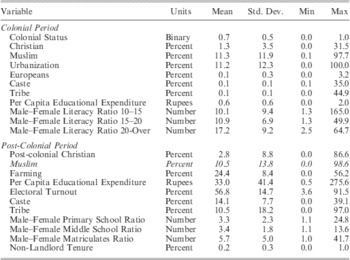
We opted for 1931 data for our key measure of colonial-era missionary influence because the 1931 census was the last comprehensive colonial census: the Second World War limited the scope of the 1941 census operations. The 1931 census represents the best, and the most recent, available measure of Christian missionary influence prior to India's independence in 1947. We present the summary statistics for the two datasets in Table 1.Footnote 127
Summary Statistics

Estimation Approach
Our dataset in the colonial period consists of cross-sectional data from districts with observations over time. To account for unobserved cross-sectional heterogeneity, we employ a panel data method to estimate our models. We use the population-averaged (PA) panel data estimator, also known as the generalized estimation equation (GEE), which allows us to recognize the panel nature of our dataset while eschewing the question of whether or not the cross-sectional effects are correlated with the regressors.
The PA panel data estimator controls for cross-sectional heterogeneity as well as possible effects–regressor correlation by averaging the panel-specific effects across all panels. Since our main interest is not in uncovering the magnitudes of district-specific or subject-specific (SS) effects, this sort of averaging allows us to obtain estimates that reflect average effects across all districts as well as estimates that are consistent. The PA estimator takes account of within-panel, or district, correlation as well as among-panel, or between-district, heterogeneity when estimating a given model.Footnote 128
Our data in the post-colonial period consist of three cross-sectional datasets from 1971, 1981 and 1991. Since our main explanatory variable is time-invariant, and pre-determined before the outcome variable, we employ a cross-sectional ordinary least squares (OLS) estimator with robust standard errors to estimate our models for each period. In particular, we use the Huber–White or heteroskedasticity-consistent (HC) standard errors, which are discussed in several papers including Mackinnon and Halbert.Footnote 129
Colonial Analysis
For our colonial period analysis, we employ a balanced panel dataset with 621 observations, corresponding to 207 districts or cross-sections over four time-periods. In this part of the analysis, we explore the hypothesized links between male and female literacy gaps and additional factors that may impinge upon the outcome variable. We employ a log-linear model in which the logged values of our several measures of gender discrepancies in literacy are regarded as functions of logged values of the combinations of the variables of Christianity; urbanization; Europeans; Islam; caste; tribe; education expenditure; and colonial status.Footnote 130 The model has the form:
 $$llite{{r}_{it}}\, = \,{{\alpha }_i}\, + \,{{x}_{it}}\beta \, + \,{{z}_i}\gamma \, + \,{{{\epsilon}}_{it}},i\, = \,1 \ldots N,t\, = \,1 \ldots T,$$
where the left-hand-side term represents the log of male–female literacy discrepancies, x represents logged values of explanatory variables and z represents time-invariant variables that are logged only if continuous, α,γ and β represent model parameters, ε represents a stochastic term, and the subscripts i and t district and time period respectively.
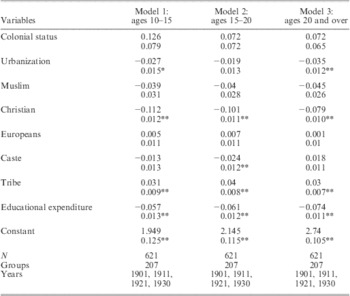
In the colonial literacy Models 1, 2 and 3, the dependent variables are the ratio of literate males to literate females for the 10–15, 15–20, and 20 and over age groups. We lagged our independent variables by a decade such that they correspond to the previous census. Table 2 contains the results. The results that emerge from the three models in Table 2 highlight the importance of Christianity in reducing the literacy gap in all the age groups, even after accounting for the similar role played by educational expenditure and, to a lesser degree, modernization; urbanization is only significant in Models 1 and 3. While a 1 per cent increase in Christianity contributes to an 8 to 11 per cent reduction in this disparity, similar increase in educational expenditure contributes to about 6–7 per cent reduction, and urbanization to 2–4 per cent reduction. The coefficients for Christianity are consistently higher than those for educational expenditure and urbanization. This suggests that in colonial India the variables commonly associated with bridging the gaps in education between men and women, such as modernization or greater educational expenditures, are not as powerful or as consistent in explaining gender gaps in education progression and retention over time as Christianity. In general, the presence of Europeans, the proportion of Muslims and caste do not have a discernible or consistent effect on the measured gender gaps in literacy. By contrast, tribes seem to have a consistently deleterious effect on gender disparity in literacy, aggravating the problem by a statistically significant level of 3–4 per cent. Colonial status has a consistently positive association with gender educational inequalities, though its effect is not always significant.
Colonial Period

Note: The columns show the GEE AR(1) estimates for each variable, with standard errors below. * p < 0.1 per cent, ** p < 0.05 per cent.
In the online appendix Table A1, we replicate these models but without the Kerala districts as an additional robustness check given Kerala's exceptionally high success in female education. We see that the results with regard to our key variable of interest, missionary activity, still hold even when we omit Kerala from the analysis.
Post-Colonial Analysis
In this second stage of the analysis, we establish whether there are colonial-era missionary effects on differences in male and female educational attainment in the post-colonial period. Similar to the colonial period analysis, we employ log-linear models, which we estimate using OLS with robust standard errors. We estimate the model
 $$)(--><$>ledu{{c}_i}\, = \,{{\alpha }_i}\, + \,{{x}_i}\beta \, + \,{{{\epsilon}}_i},\,i\, = \,1 \ldots N.<$><!--$$
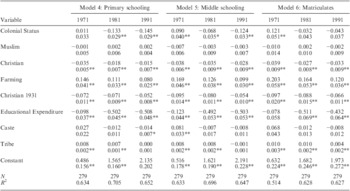
As in the colonial models, α and β are model parameters, ε is random noise, and leduc is the log of the male–female ratios in education attainment measure while x represents the matrix of explanatory variables: our main explanatory variable Christianity in 1931, and the control variables colonial status, Muslim, farming, castes, tribes and educational expenditure. In the post-colonial analysis dataset, there are 279 observations for each cross-section covering three time-periods. A number of colonial districts were divided into several districts during the post-colonial period. Therefore, we have a larger number of observations per time-period in this set of datasets. Although we use data from the 1961, 1971, 1981 and 1991 census decades, we have three periods because the post-colonial Christianity, caste, tribe, farming and educational expenditures have been lagged by a decade. Our education variables cover data for 1971, 1981 and 1991, and the lagged variables cover the census decades 1961, 1971 and 1981. The results are presented in Table 3, Models 4–6.
Post-Colonial Period

Notes: For each model the columns show cross-sectional estimates for three years, with robust standard errors beneath them. Significance: *p < 0.1, **p < 0.05.
The results in the post-colonial models are broadly similar to those found in the colonial period. The effect of colonial era Christianity is still strong in each decade even when other important factors that affect the gender gap are taken into account across all educational levels. This effect is stronger, contributing to 5–10 per cent declines in this gap for every 1 per cent increase in its level, than contemporaneous levels of Christianity that contribute to about 2–4 per cent declines in the gap for every 1 per cent rise. We note that the effect of colonial era Christianity persists even though its effect has been declining with passing time. We also observe that its effect is more pronounced as we go across higher levels of educational attainment. Furthermore, the contribution of colonial era Christianity is still substantial when we consider that the effects of post-colonial educational expenditure and modernization are relatively stronger on reducing the gender educational gap than in the colonial period. The coefficients on both farming and educational expenditure are higher than are those on both measures of Christianity. Scheduled tribes have a largely positive and statistically significant effect on male–female educational divergence, Islam does not have a statistically significant effect across the educational levels and time periods, while caste does not have a consistent or statistically meaningful effect on the outcome variables. We do observe, however, that British territories are more likely to have lower levels of gender inequalities in schooling over time. The coefficient for the colonial status variable is negative and significant in the 1981 and 1991 primary and middle school stage regressions, though it is positive and statistically significant for middle school and matriculation stages in 1971; it is also negative, though not significant, at the matriculate stage regressions in 1981 and 1991. As noted above, the coefficients for the colonial era Christianity variables are slightly higher at the higher educational level. We infer from these results that the positive influence of missionary involvement on gender educational equality becomes more pronounced for higher educational levels at which the ‘wastage’ and slippage into illiteracy begins to occur among females in Indian society. In the online appendix Table A2, we replicate the models without the Kerala districts to demonstrate that the results with regard to colonial missionary activity still hold.
Next, we seek to ascertain the effects of an additional set of variables on gender gaps in education attainment over time. The variables are democracy as measured by district-level voter turnout in state-level elections; and colonial land tenure. The inclusion of these measures is justified on the following grounds. Well-known long-standing theories and cross-national empirical analysis (discussed above) have linked democracy to positive educational outcomes. Scholars have also linked land tenure to education in a recent study of colonialism's long-term effects on post-colonial India's modernization. Because of the complexity of this novel argument, we describe it here at some length. Banerjee and Iyer distinguish between three types of land tenure that British colonial administrators set up in colonial India – the landlord system, the individual cultivator system and the village-based system. The arbitrary power that landlords enjoyed over peasants in landlord areas arguably discouraged public goods provision. Because of the facility of capturing productivity gains from non-landlord areas, the British were also more inclined to invest in infrastructure and public goods in areas under this type of land tenure as compared to those under the landlord system. While not specifically concerned with female education, Banerjee and Iyer link the landlord-based arrangements with generally poor educational provision in post-colonial Indian states.Footnote 131
To create an instrument to measure democracy we gathered State Assembly elections data. In contrast to constituencies of the Lok Sabha, the national parliament, State Assembly constituencies are usually confined within district boundaries (Delimitation of Parliamentary and Assembly Constituencies Order, 1976). As a rule, each district has several constituencies, so we calculated district averages for approximately 4,000 constituencies covering all our districts. Because State Assembly election dates vary for each state, we chose an election period of one to three years that corresponds either to the end or to the start of a decade in which most states had elections. To create an instrument to measure land tenure, we employed Banerjee and Iyer's measure of the proportion of territories with non-landlord systems in each district.Footnote 132
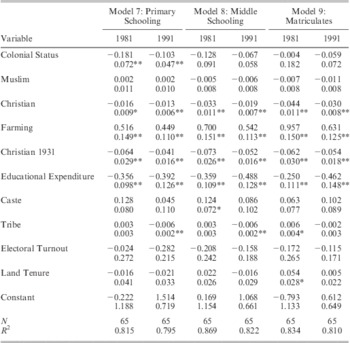
The disadvantage of including the electoral and land tenure variables is that we now have fewer observations to work with. We employed the 1970–90s district-level electoral data since most electoral constituencies are neatly contained within districts in that period. Because the turnout variable has been lagged by a decade, we have two data points in this set of regressions. The education data cover 1981 and 1991, while the electoral variables are for the 1970s and 1980s, respectively. Adding the land tenure data also reduces the number of observations as the data for a number of our districts are missing from the Banerjee and Iyer dataset. Furthermore, Banerjee and Iyer gathered continuous measures of the proportion of non-landlord territories in some districts, while for others (including Kerala), for which precise data were not available, the values of either 1 or 0 were assigned. We also exclude the latter group of observations from the analysis to ensure consistency with the log-linear structure of our data. After all the exclusions, we have sixty-five observations per time group in this set of regressions. The regression results are presented in Table 4, Models 7–9.
Post-Colonial Period, with Electoral Turnout and Land Tenure Variables

Note: Columns show cross−sectional estimates (with robust standard errors beneath) for each variable for two years in each model. Significance: *p < 0.1, **p < 0.05.
In these models, we find that colonial era Christianity still explains a decline in the educational gender gap across all educational levels, even when contemporary Christianity and educational expenditure that work in reducing this gap is taken into account. As in the earlier set of post-colonial period models, educational expenditure has a stronger impact than both measures of Christianity, with colonial era Christianity having a more pronounced effect on this gap than its current counterpart does. Islam, colonial status, caste and tribe have no consistent or statistically significant effects on this gap, while farming has the predicted positive effect on gender inequalities in education. The results also suggest that the level of democracy does not have a statistically discernible effect in reducing the educational gap, while the share of land under non-landlord systems has a positive and statistically significant effect on inequalities in the 1981 regression for matriculates, while being insignificant in other models.
In a further set of regressions performed as an additional robustness check, we include a more limited set of variables because of possible multicollinearity, which may mask the effect of the newly introduced, and other key, variables. Thus, we exclude the post-colonial Christianity and colonial status variables because they may be multicollinear with the colonial Christianity and land tenure variables, respectively. Farming is also excluded as is Islam. We present the results in Appendix Table A3. The general results with respect to our key variable of interest do not change. The land tenure variable does not reduce the educational gap at all levels of schooling while the share of tribes likewise does not have a consistent effect on the outcome variable. Educational expenditure has a significantly negative effect on educational disparities except for the 1981 matriculates, where the effect is not significant. Colonial Christianity is therefore the only variable that has a consistently significant negative effect on gender discrepancies in education. These models demonstrate the robustness of our results with respect to our key variable of interest.
Discussion
Colonial-era Christian missionary activity has had direct and indirect effects on female education in the colonial and post-colonial periods. In what we consider their direct educational effects, Protestant missionaries pioneered co-educational schooling, and introduced new forms of female schooling, for all religious groups; female Christian converts also experienced additional educational effects in terms of literacy retention at a later age due to church practice. Over time, in what could be regarded as indirect effects, missionary efforts led to the broadening of educational provision by a variety of actors – religious groups, native governments, social movements and political entrepreneurs – leading to its greater social acceptability. These actors’ combined lobbying efforts also forced the institutionalization of integrated education for all social groups as government policy, rather than that limited to a narrow range of education providers. Both the social acceptability of female schooling and its institutionalization led to the durability of gender equality in educational access in the post-colonial period.
Our empirical study, while drawing on the religious competition framework, also has implications for the development of the theory, as it helps to specify the mechanisms of strategic adaptation of religious groups to the particular context of a colonial female education marketplace. Religious competition drove educational expansion in Kerala. Protestant entrants into Kerala's religious marketplace faced a handful of established religious monopolies, which, together with native governments, presided over and helped to perpetuate in their practice elaborate systems of gender and caste hierarchies. As religious competition theory would predict, such established monopolies without serious challengers have little incentive to change the status quo: the social welfare of religious adherents usually falls victim to such monopolistic situations.Footnote 133
New entrants to the marketplace are much more sensitive to consumer preferences as they have to work extra hard to capture a share of an already established market. Herein is the fallacy of traditional accounts of missionary involvement in colonies, namely the notion that missionaries imposed alien mores on passive and pliant local populations.Footnote 134 Admittedly, doctrinal matters drove the general outlines of Evangelical policy in India: the social hierarchies and accompanying practices perceived as degrading towards women and other disadvantaged groups were at odds with the missionaries’ egalitarian notions of social welfare. Consumer demand, however, drove missionary strategies much as their doctrinal zeal did. These two factors explain their choice of the female education strategy, rather than that solely catering to native male sensibilities with regard to female education and focusing on the male educational market. Having opted for the former strategy, and faced with the option of concentrating on elite female education or casting their net to include disadvantaged groups, missionaries chose to work in both markets, and tailored their approaches to the respective target audiences. Protestant missionaries were not adverse to courting native elite women, secularizing and otherwise adapting their curricula and methods of instruction to this social stratum. Compared to working with the low castes, this group was easier to teach in that it already had comparatively higher education levels prior to missionary involvement, but it was a more difficult target in so far as it had been less amenable to conversion. Their simultaneous strategies to win converts from amongst much wider social networks representing disadvantaged groups, however, helped undermine the very system which sanctioned education for elite Kerala women only. Though they had been denied the status trappings of higher-caste groups for centuries, those relegated to untouchability were not passive recipients of Evangelical doctrine. Instead, they were keen to adopt the substantive, as well as symbolic, elements of higher status as soon as those options became available. For shanar females, the cloth covering their upper bodies became as much a symbol of status elevation as the opportunity for education.Footnote 135 Whether they became Christian converts or simply recipients of missionary education, these groups signalled to religious monopolies that their allegiance should not be taken for granted. The latter, not hitherto associated with female educational provision, became active contenders for social allegiances in a more vibrant religious marketplace by emulating the policies of new entrants. The social awareness among low caste groups that these various educational initiatives spurred led to the development of native movements from amongst both elite and low status groups. While not specifically concerned with female education, these movements ensured that integrated schooling for all groups in society would become enshrined in government policy, thereby accelerating the ‘catching up’ process of female educational attainment.
Although missionaries spurred competition in education provision for all native groups, conversions had additional effects on active practitioners of Christianity. Regular Bible reading ensured that low-status female converts would have comparatively higher literacy retention rates than female adherents of other faiths in the same social group who tended to lose literacy skills after marriage.Footnote 136
Scholars have attributed Kerala's success in female education to its Christianization prior to colonial-era Protestant involvement; progressive native governments; tradition of matriliny, that is, establishing descent through the female line of the family (we note, limited to the higher castes); communist government; or a vicious caste system, which was ostensibly more conducive to social mobilization for educational change.Footnote 137 Our statistical analysis has demonstrated that missionary involvement has had consistently strong effects on reducing gender educational disparities throughout India even when we exclude Kerala districts from our regressions. While we do not dismiss the importance of Kerala-specific factors contributing to its educational success, both our case study and statistical analysis show that missionary involvement may be a more powerful explanatory factor than those focusing on the peculiarities of that particular state.
We also infer from our results that, while post-colonial missionary involvement is important for female education, colonial-era missionary activity appears to be a stronger predictor of gender education outcomes. The Kerala case study suggests that we could attribute this result to the colonial-era institutionalization of mass schooling. Post-colonial governments in Kerala have had to continue to develop and expand mass schooling because democratic politics made it imperative to do so. In other states, where mass schooling had not developed to such an extent as in Kerala, there would have been less mass pressure for post-colonial educational expansion.
While contributing to religious competition theory, our study is also relevant for the debates on the legacies of colonialism. Contrary to claims of influential cross-national studies about the long-term positive effects of British education policy, such as those of Lipset et al. and Barro, we find no consistent evidence for that claim with respect to gender education parity, particularly at higher levels of schooling.Footnote 138 Instead, our findings dovetail with recent within-nation scholarship that questions the assumption of the beneficial effects of British rule on human capital outcomes in British India.Footnote 139 Although we have not replicated the Banerjee and Iyer study, we have been able to test whether colonial land tenure effects on human capital hold when applied to our variables of interest. We find that they are largely insignificant when missionary influences have been taken into account, while missionary effects are robust to the inclusion of the land tenure variable at all educational levels.Footnote 140 We conjecture that previous research may have appeared to find large effects of British colonialism on education as a result of failing to consider the effects of missionary activities.