1. Introduction
‘It is my hypothesis that the fundamental source of conflict in this new world will not be primarily ideological or primarily economic. The great divisions among humankind and the dominating source of conflict will be cultural . . . The fault lines between civilizations will be the battle lines of the future’ (Huntington, Reference Huntington1993: 22). So began Samuel Huntington in one of the most provocative, cited, debated, and examined assertions in international affairs of the last two decades. Despite the voluminous critical discussion that the ‘clash of civilizations’ thesis has generated, and the civilizational dialogue it has helped to inspire, questions remain about whether there is an empirical basis for claims about the differences between cultures and whether such an approach to world politics, in the face of modernity, is warranted. Huntington's main contention – that strengthened religious identities, revived traditions, and irreconcilable values will define post-Cold War conflict – has yielded a wave of assessments. His notion that such conflicts are built around civilizational identities at ‘the micro level’ through growing cultural affiliation with core states has not.
Our purpose is to address this gap. We ask two questions. First, to what extent do publics show culturally based affinities toward core states? And, second, is religiosity a driving factor behind these affinities, as Huntington suggests, or does nationalism and globalization mitigate its impact? The answers to both are important insofar as affirmative evidence may not only suggest a basis for a civilizational consciousness through the discernment of ‘friend’ and ‘foe’, but may suggest that globalization is having the boomeranging, or ‘culturally resurgent’, effect upon which the clash model rests.
Our focus is on attitudes in what Huntington refers to as the ‘cauldron of civilizations’: the Asian Pacific. A region suffering from undercoverage in other analyses of Huntington's assertions, Asia is home to three in every five of the world's citizens, six of the ten most spoken languages, and seven of the world's nine civilizations (as defined under his framework). The analysis that follows, based on surveys in 28 Asian societies, including Russia and the United States, is therefore well positioned to address the two questions Huntington raises.
2. The debate continues
With a citation count in excess of 10,700 in Google Scholar as of July 2012 (and more than 17,000 if one includes its 1993 precursor in Foreign Affairs), The Clash of Civilizations continues to stimulate debate, particularly in light of the 9/11 attacks and America's incursions in Iraq, Afghanistan, and Pakistan. A full consideration of this vast, interdisciplinary literature – as well as the numerous popular critiques – is well beyond the scope of this paper. Broadly speaking, the scholarly discussion has proceeded on two fronts. The conceptual debate centers on the use of civilizations as units for a post-Cold War framework for world politics. The empirical/evidentiary discussion, which has grown out of and, in turn, shaped the conceptual debate, focuses on Huntington's expectations for conflict – and the evidence yielded by an assortment of quantitative tests.
Simplified, Huntington's theory rests on three assertions. The first is that conflict between states, once predicated on Cold War bipolarity, is giving way to conflict predicated on religious differences. Huntington envisions these as ‘fault line’ encounters that are primarily ‘local wars between local groups with wider (Reference Huntington1996: 268) connections’. The second assertion follows: such ‘wider connections’ are facilitated by core states (e.g., the United States, China) who, in essence, act as representatives of their respective civilizations (e.g., Western, Sinic). Core states are crucial because they are ‘viewed by their members as the principle source . . . of the civilizations culture’ (135) and ‘like older members of a family . . . provide relatives with both support and discipline’ (156). They rarely engage in conflict themselves, but structure a multicivilizational world by dominating member states at the macro-level and serving as beacons at the micro-level that ‘attract those who are culturally similar and repel[ling] those who are culturally different’ (155). Core states are thus central to a civilizations-based politics because, on the ground, they promote and reinforce civilizational identities.
The third assertion is that globalization strengthens the power of core states as loci of civilizational identity because it produces a ‘resurgence’ of tradition and religiosity. Arguing against notions of modernization as a Westernizing or homogenizing force, Huntington contends that it instead
promotes de-Westernization and the resurgence of indigenous cultures in two ways. At the societal level, modernization enhances the economic, military, and political power of the society as a whole and encourages the people of that society to have confidence in their culture and to become culturally assertive. At the individual level, modernization generates feelings of alienation and anomie, as traditional bonds and social relations are broken, and leads to crises of identity to which religion provides an answer (Huntington, Reference Huntington1996: 76).
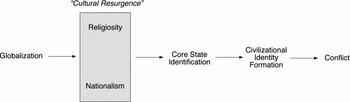
How does globalization strengthen civilizational alignment? ‘In today's world’, Huntington contends, ‘improvements in transportation and communication have produced more frequent, more intense, more symmetrical and more inclusive interactions among people of different civilizations. As a result their civilizational identities become increasingly salient . . . These broader levels of civilizational identity mean deeper consciousness of civilizational differences and of the need to protect what distinguishes “us” from “them”’ (Reference Huntington1996: 129) (Figure 1).
Simplified Huntington Theory of Core State Role in Civilizational Identity Formation

Where an armada of critics have taken exception to Huntington's ‘essentialism’ (see Hall and Jackson, Reference Hall and Jackson2007), categorization scheme, for modeling civilizations as regional über-states and for exaggerating the likelihood of war between ‘the West’, ‘Islam’, and ‘Confucian’ societies (summarized nicely by Fox, Reference Fox2005), his notions about the role of globalization and core states in the formation of a new (or renewed) regional identity have been subject to less scrutiny. Amartya Sen makes the case that ‘the most limiting feature of the civilizational approach . . . [is] the mind-boggling shortcut is taken in trying to understand our sense of identity’ which ‘puts each of us into a little box of a single sense of belonging, to wit, our alleged perception of oneness with our respective “civilization”’ (Reference Sen2008: 6). But this is to merely restate the conventional belief in the social sciences that identities are multifarious, fluid, situational, strategic as well as constructed (e.g., Fearon and Laitin, Reference Fearon and Laitin2000); it does not account for the formation and salience, as has been widely examined in Europe, of transnational political identities rooted in religiosity and the perceived threat of ‘foreign’ cultures (Nelsen et al., Reference Nelsen, Guth and Fraser2001; McLaren, Reference McLaren2002). It may be, as Steven Walt (Reference Walt1997) argues, that ‘the neglect of nationalism’ is instead the ‘Achilles heel of the civilizational paradigm’ as it has often been for Europeanization (e.g., Carey, Reference Carey2002), and, as Henderson and Tucker (Reference Henderson and Tucker2001: 333) contend, ‘the nation, and not the civilization, appears to be the largest identity group to which people consistently swear fealty in the post- Cold War era’. But that, too, remains debatable for, in a number of developing countries, as well as the US, surveys show individuals saying their religious identity is comparable to, or precedes, their national identity (e.g., Pew, 2011; Sinnott (Reference Sinnott and Marsh2006) examines this in Asia). Huntington, in fairness, does not entirely dismiss nationalism, but subordinates it to his independent variable of particular interest, religiosity, contending that the fusion of the two mobilizes civilizational consciousness. Civilizational identities may be underspecified (Senghaas, Reference Senghaas1998) and, as Sen claims, ‘solitarist’ in Huntington's model, but this neither renders them inconceivable (see Hall and Jackson, Reference Hall and Jackson2007) nor incompatible with either the state (e.g., Wendt, Reference Wendt1994) or nationalism (e.g., Duara, Reference Duara2001).
Those who embrace the potential of civilizations as political units, and credit Huntington for raising their profile in international relations, have had little to say about the role of core states, appearing at times to take the formation of civilizational identities for grantedFootnote 1. Katzenstein (Reference Katzenstein and Katzenstein2010: 7) concedes that ‘under specific conditions, political coalitions and intellectual currents can create primordial civilizational categories’ but contends that the dynamic of intercivilizational interaction is one of peaceful exchange, not conflict. This middle-ground position, which credits Huntington but places civilizations as ‘malleable’ ‘weakly institutionalized social orders’ shaped by contemporary ‘technological orders’ reflects two influences: Eisenstadt's (Reference Eisenstadt2001) ideas about ‘modernity as a distinct civilization’ and the empirical strand in the literature where the body of evidence has, in Katzenstein's phrasing, become ‘so damaging [to the primary clash hypothesis] that by now it must be considered to be factually wrong’ (Reference Katzenstein and Katzenstein2010: 8). The predominant finding in several of these studies indeed appears devastating – ‘clashes’ have historically occurred within, rather than between, civilizations (Russett et al., Reference Russett, Oneal and Cox2000; Henderson and Tucker, Reference Henderson and Tucker2001; Henderson, Reference Henderson2005; Gartzke and Gleditsch, Reference Gartzke and Gleditsch2006) and intercivilizational conflict, when it does appear, is less likely to escalate into war (Tusicisny, Reference Tusicisny2004). But other findings are nuanced: modernization itself may be facilitative of conflict (Chiozza, Reference Chiozza2002); states from similar cultures tend to join the same international organizations (Beckfield, Reference Beckfield2008); the West's greater likelihood of engaging in conflict appears due to its tendency to act collectively, like a civilization (Ellis, Reference Ellis2010; Charron, Reference Charron2010); that cross-cultural and religious conflict has generally been on the rise (Fox, Reference Fox2004, Reference Fox2007; Roeder, Reference Roeder2003). Huntington, therefore, may poorly explain the past, but enough evidence has emerged to keep his ideas alive as observers anticipate alignments and conflicts of the future, particularly those that may involve ‘The West’ and ‘Islam’. ‘I still harbor doubts about whether the radical Islamists knocking at the gates of Europe . . . are the bearers of a whole civilization’, initial critic Fouad Ajami (Reference Ajami2008) writes. But ‘clearly, commerce has not delivered us out of history's passions [and] the World Wide Web has not cast aside blood and kin and faith’.
It is reflections like these, along with a persistent media narrative (Seib, Reference Seib2004), that has helped keep the clash discussion alive even as Huntington's third assertion – about globalization-induced resurgence at the micro-level – has remained secondary to the empirical discussion. Exceptional are papers dealing with European and Islamic publics, including a series of analyses based on the World Values Survey. In contrast to the aggregate level studies, the findings are generally sympathetic to Huntington, particularly in demonstrating cohesion among Islamic values and contrasts with the West. Inglehart and Christian Welzel contend that the Huntington-inspired boundaries in their ‘cultural map of the world’ (based on two dimensions of factor scores in the WVS) manifest ‘real’ differences, arguing that ‘societies with a common cultural heritage do fall into common clusters’ (Inglehart and Welzel, Reference Inglehart and Welzel2005: 66, emphasis original) (recalling Huntington's own notion that civilizations are ‘meaningful entities, and while the lines between them are seldom sharp, they are real’)Footnote 2. Inglehart and Pippa Norris find further that Islamic publics show stronger affinities for religious leadership than do Western publics and that cleavages exist on social dimensions, such as gender and sexual equality – what they term the ‘true clash of civilizations’ (Norris and Inglehart, Reference Norris and Inglehart2002; Inglehart and Norris, Reference Inglehart and Norris2003 see also Esmer, Reference Esmer2002). They point out that the cultural differences involve ‘Eros far more than Demos’: once development and socioeconomic diversity are controlled, Islamic publics show stronger support for democratic ideals than those in Western states. But where this poses a challenge to the political aspects of the ‘clash’ hypothesis, it does little to alter Huntington's substantive conclusion: what remains an outlier in the world are the egalitarian and libertarian values of the West. Marsh (Reference Marsh2009), also drawing upon the WVS, finds that the effects of Huntington's civilizational categories on values (relative to the West) are, in fact, larger than those produced by individual level variables.
As the West's core state, perceptions of the United States would presumably be important in defining civilizational identities. Yet, despite several comparative studies after 9/11, few cultural patterns have been revealed in this regard, for the anti-Americanism that emerged after the Iraq invasion was felt at least as deeply in parts of Western Europe as in the Middle East. Chiozza (Reference Chiozza2009) finds, in fact, that foreign views of the US are structured similarly across different cultural zones, although Europeans tend to be more critical of policy where attitudes toward the American people and president combine to shape the impressions of Islamic publics. Studies of foreign opinion toward other core states are scarce, although comparative surveys generally point to intercivilizational heterogeneity (Esmer, Reference Esmer2002; Diez-Nicolas, Reference Diez-Nicolas and Inglehart2003), within ‘Islam’ (e.g., Acevedo, Reference Acevedo2008; Rose, Reference Rose2002; Furia and Lucas, Reference Furia and Lucas2006) as well as ‘Confucian’ societies (Dalton and Ong, Reference Dalton and Ong2005; Kim, Reference Kim2010; Park, Reference Park2011). The question that remains, as far as Huntington is concerned, is whether the presumed core states outside the West are capable of generating similar affinities and enmities as the US and, with particular regard to the theoretical question of civilizational identity, whether such attitudes may be culturally rooted and enduring.
3. Hypotheses
As such, we expect that:
H1 In-civilization (member state) publics will affiliate more strongly with the core state of their civilization than out-civilization publics.
Hence, Western-influenced publics will be more inclined than others in Asia to view the US as a positive influence and Sinic publics will be more inclined than others, ceteris paribus, to view China as a positive influence. Where the lack of a core Islamic state makes affiliation an open question, it would follow that
H1a Citizens in predominantly Islamic states in Asia will identify more closely with Iran and be more inclined to see it as a positive influence than those in Sinic or Western-influenced civilizations.
Where Huntington's emphasis is on religions and their differing values, he makes multiple references in his book to the ‘revitalization of religion’ as a factor that ‘reinforces’ cultural differences and civilizational identities. Extending this, it would seem reasonable to suppose that perceptions of core states, if civilizationally derived, would be influenced by the degree of commitment to one's religion. This is presumably because those most committed to their religion would be more likely to perceive threats to their values and see core states as potential bulwarks capable of preserving the integrity of those values (Ellingsen, Reference Ellingsen2005). Hence, we expect that
H2 As religiosity within given member state publics increases, perceptions of in-civilization core states will improve and perceptions of out-civilization core states, ceteris paribus, will decline.
H3 As nationalism within given member state publics increases, perceptions of in-civilization core states will increase and perceptions of out-civilization core states, ceteris paribus, will decrease.
Finally, to address the expected impact of globalization, we hypothesize that
H4 As exposure to foreign cultures within given member state publics increases, perceptions of in-civilization core states will increase and perceptions of out-civilization core states, ceteris paribus, will decrease.
4. Data and findings
To test these hypotheses, we employ data from the AsiaBarometer, pooled from the project's four waves in 2005 and 2008. In 2005, the predominantly Islamic states of the former Soviet Union (Kazakhstan, Kyrgyzstan, Tajikistan, Turkmenistan, and Uzbekistan) were surveyed along with Afghanistan, Bangladesh, Bhutan, India, Maldives, Mongolia, Nepal, Pakistan, and Sri Lanka. In 2006, Japan, China, and South Korea were included along with Hong Kong, Singapore, Taiwan, and Vietnam. Cambodia, Indonesia, Laos, Malaysia, Philippines, and Thailand were in the 2007 wave, while the 2008 wave again included China, India, and Japan, but expanded to cover Australia, Russia, and the United States.
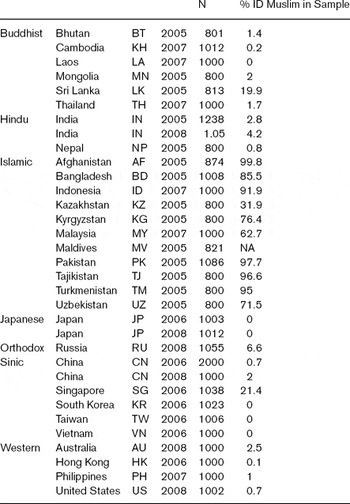
Taken together, the pooled dataset includes the attitudes of 11 predominantly Islamic societies; seven Buddhist societies, five Sinic societies, and four Western societies, along with India and Nepal among predominantly Hindu societies, Russia representing Orthodoxy and Japan – a mixture of seven of Huntington's civilizations (Table 1). This yields a total of 15 intracivilizational and 61 intercivilizational dyads for analysis. The surveys were administered face-to-face in the country's predominant languages, using stratified, multistage random sampling to determine household and respondent eligibility. In some developing countries, the sampling frame was biased toward urban centers and quotas were set to meet the age and gender profile of the country as indicated in its national census.
Country coverage of AsiaBarometer and civilizational grouping, per Huntington (1996 , 26–7)

The value of using the AsiaBarometer to test Huntington's core state assertions lies not only in its wide coverage of Asian publics, but in its offering of appropriate measures (described below), including several that differ from those used in papers based on the WVS. Yet, like the WVS and other large-scale comparative survey projects, the data face limitations in terms of cross-cultural/national measurement equivalence, translation and comprehension (Stegmueller, Reference Stegmueller2011). Minato (Reference Minato2008), in a review, notes further that the delicacy of political questions in the AsiaBarometer may have introduced biases and inconsistencies across contexts, particularly those where respondents live under authoritarian regimes. The reader is thus cautioned that data collected under such circumstances may be susceptible to additional error and that, due to the need to obtain approval from authorities to execute the project in some societies, that all standard political items from the AsiaBarometer questionnaire may not have been asked in all countries. In such instances, where our model could not be tested, countries were dropped after the descriptive analysis. The reader is cautioned further that the single year studies in several countries may have introduced idiosyncratic, cross-sectional effects endemic to the year of data collection. Additional methodological caveats and limitations concerning specific in-country data collection efforts, along with complete fieldwork reports, can be obtained at https://www.asiabarometer.org/en/surveys by clicking on the appropriate survey year.
4.1. Dependent variable
The dependent variable, core state influence, is an item that asks, ‘Do you think the following countries have a good influence or a bad influence on your country?’ It is an appropriate measure for the study because the use of ‘influence’ represents an effort to tap into deeper cultural affinities and economic values that go beyond current events, leaders or diplomatic relationships of-the-moment (though, of course, the item may capture some of these feelings as well). China and the United States were tested in all four waves; Iran in 2005 and 2006. Respondents were asked to assess influence on a 5-point ordinal scale, ranging from ‘bad influence’ to ‘good influence’, with a neutral option ‘neither good nor bad influence’ in the middle.
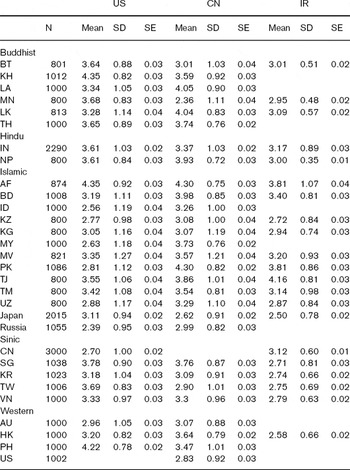
Table 2 displays the descriptives. Attitudes toward US influence vary more widely than those concerning Chinese or Iranian influence. Where Cambodians and Filipinos appear to be among the most favorable toward American power in Asia, Russians have the least favorable impressions. Views among Islamic publics, on the whole, lean toward neutrality; the negative opinions of Malaysians and Indonesians appear to be offset by the positive opinions of Afghans and Tajiks. Chinese view American influence as mostly ‘bad’; Australians and Japanese appear ambivalent. Indians see US power as something generally ‘good’ for India.
Descriptive statistics for the dependent variables, US, Chinese and Iranian influence (5 point re-scale: 1 = ‘Bad’, 5 = ‘Good’), by country and civilization grouping

Chinese influence is viewed most negatively by Mongolians and Japanese; Americans and Taiwanese are also inclined to see it as ‘bad’. Russians and Australians have neutral opinions. Chinese power is, on the whole, perceived more favorably in Islamic Asia than among the other publics of the Sinic civilization, where South Korea and Vietnam retain substantial negative/neutral views. Pakistanis and Afghans are among those who are most consistently positive about Chinese influence.
The positive feelings that emerge in Islamic Asia toward China are not reciprocated – at least as far as Iran is concerned, toward whom the Chinese appear to have neutral impressions. Yet Chinese opinions of Iranian influence are more positive than others in their immediate neighborhood, particularly Hong Kong and Singapore. Iran's power is viewed most favorably, as we expected, among predominantly Islamic publics like Tajikistan and Pakistan. Kazakhs and Uzbekis, at the same time, appear to be more critical.
4.1.1. Core state perceptions: are they zero-sum?
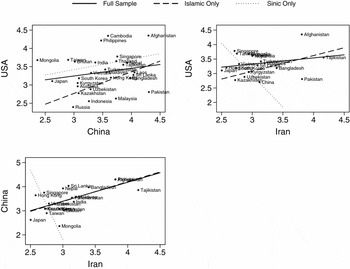
Figure 2 plots the means from Table 2 against one another in an effort to examine whether public perceptions of core states may be related, particularly in a negative way. If Huntington's assumptions about core states have some empirical basis, we would expect to see publics engaged, in a zero-sum fashion – not only identifying with the core state of their civilizations, but viewing competitive core states adversely.
Scatterplots of Country-level Mean Perceptions

In none of these plots does such a pattern emerge. The only one that reaches a standard level of significance is when the perceptions of China are regressed on perceptions of Iran (N = 20, b = 0.78, p < 0.01, α = 0.22, Adj.R 2 = 0.38). When the Asian Islamic states are isolated in the analysis, the amount of variance the simple model predicts in Chinese perceptions increases (N = 9, Adj.R 2 = 0.68).
4.2. Independent variables
There are three independent variables of interest in this analysis. The first, foreign exposure, is a 6-point additive index developed from a battery of items that asks whether:
• A member of [Rs] family or a relative lives in another country.
• [R has] traveled abroad at least three times in the past three years, on holiday or for business purposes.
• [R] has foreign friends in his home country.
• [R] often watch[es] foreign-produced programs on TV.
• [R] often communicate[s] with people in other countries via the internet or email.
• [Rs] job involved contact with organizations or people in other countries.
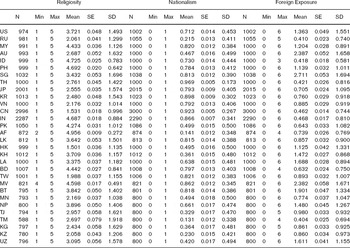
The second, nationalism, is measured by asking whether R can ‘recite the national anthem [of her/his country] by heart’ (0 = no; 1 = yes). The third variable of interest, religiosity, also measures a practice. It asks the respondent ‘How often do you pray or meditate?’ (1 = never; 5 = every day). The country-level descriptives for the independent variables are presented in Appendix Table 1.
4.2.1. Exploring religiosity, nationalism and foreign exposure in the Asian Pacific
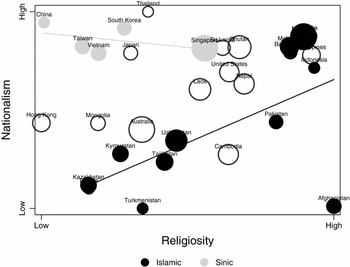
In Figure 3, we plot the means for each of the three variables of interest in a first effort to unravel the interplay of religion, nationalism, and foreign exposure in the Asian Pacific region.
Scatterplot of Nationalism x Religiosity, weighted by Level of Foreign Exposure

Publics in the Sinic civilizational grouping (shown in lighter gray) are generally characterized by low religiosity and high levels of nationalism. China appears to be an outlying case and, as indicated by its small circle, reveals a low level of foreign exposure among its citizens. Generally, each of the countries in the upper left quadrant of the plot, which include Japan and Thailand, have lower levels of foreign exposure, making Singapore stand out for its apparent cosmopolitanism and moderate religiosity. Predominantly Islamic publics (in black) are more diverse. Where residents of Turkmenistan, Kazakhstan, Kyrgyzstan, and Tajikistan, like Russia, exhibit low levels of religious practice or national attachment, those in Maldives, Malaysia, Indonesia, and Bangladesh reveal high levels of both. Afghans appear to be strong worshippers and weak nationalists. Pakistanis lean toward faith over country. Uzbekis lie somewhere in the middle. Like Sinic publics, many Islamic citizens have little interaction with the world. The Singaporean exception for Asian Islam would be Maldives, followed in degree by Uzbekistan and Malaysia.
Figure 3 reveals something further about the publics of core states. Where China and Russia lie at opposite poles of nationalism, but are similarly low in terms of religiosity, Indians are high on both measures. Americans, who appear similar to the more globally engaged Buddhist publics and Singapore on these measures, are notably more nationalistic and religious than their Westernized counterparts in Australia. Filipinos appear to combine strong nationalism with faith, placing them alongside other Southeast Asian Islamic publics, like Indonesians and Malaysians, as well as Indians.
4.3. Model specification
At the individual level, we can specify a model where the probability of citizeni, within a given countryj, will perceive the influence of core statek
 \begin{linenomath}\begin{equation*}
\hbox{Pr(core state influence$_k = m$ | }x_{ij}\, = \, F\mbox{(}\tau _m { - }x\beta {) - }F\mbox{(}\tau _{m - 1} { - }x\beta {)}
\end{equation*}\end{linenomath}
 \begin{linenomath}\begin{equation*}
x{\beta } = {\beta }_{{1}{ij}} \mbox{(civilization grouping)}
\end{equation*}\end{linenomath}
 \begin{linenomath}\begin{equation*}
{\beta }_{{2}{ij}} \hbox{(religiosity)} + {\beta }_{{3} {ij}} \hbox{(nationalism)} + {\beta }_{{4}{ij}} \hbox{(foreign exposure)}
\end{equation*}\end{linenomath}
 \begin{linenomath}\begin{eqnarray*}
x\beta &=& {\beta }_{{1} {ij}} \hbox{(civilization grouping)} + {\beta }_{{2} {ij}} \hbox{(religiosity)} + {\beta }_{{3} {ij}} \hbox{(nationalism)} \\
&&+ \,{\beta }_{{4} {ij}} \hbox{(foreign exposure)} + {\beta }_{{5} {ij}} \hbox{(standard of living)} + {\beta }_{{6} {ij}} \hbox{(education)} \\
&&+\,{\beta }_{{7} {ij}} \hbox{(gender)} + {\beta }_{{8} {ij}} \hbox{(age)} + {\beta }_{{9} {ij}} \hbox{(nationalism*religiosity)} \\
\end{eqnarray*}\end{linenomath}
4.4. Core state affinities: is there a micro-level basis for a civilizational framework?
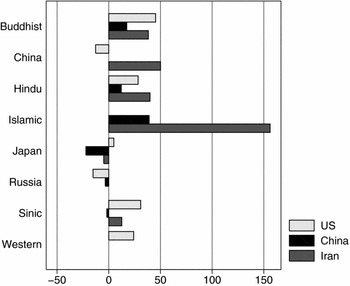
Figure 4 displays the effects of civilization grouping on the dependent variables with the other variables in the model held at their means. The bars represent, ceteris paribus, the odds of having a one standard deviation more positive view of the core state vis-a-vis the reference group (in each case, the reference group selected was identified as the Huntington-defined strongest potential adversary (Reference Huntington1996, 245). Because China appears to be an outlier (and because Chinese respondents represent a disproportionately large slice of the pool), it was separated from the other Sinic countries.
Percent Change in Odds of Seeing Core States as a “Good” Influence, by Civilization \ vis-a-vis the Reference Group (Islamic for the US, Western for China and Iran), with Other Factors Held at Their Means

The results are mixed. On the one hand, citizens of other Westernized societies in Asia are more likely than the reference group (Islamic) to show affinity for the US, but they are outpaced by Buddhist and Sinic countries outside of China. Russians and Chinese are, in fact, less likely than Islamic citizens to view the US as a ‘good’ influence. With regards to Chinese influence, other Sinic societies show no statistically significant difference from the reference group – Westernized societies. Rather, it is residents in predominantly Islamic countries that show the highest probability for admiring Chinese influence – twice as much, relatively speaking, as the next most admiring publics in Buddhist countries. Japanese, rather than Western publics, appear to be least inclined toward seeing Chinese power in a ‘good’ sense.
In the case of Iran, the evidence is supportive. Citizens within the Islamic civilization grouping are 156% more likely to have a (one standard deviation) better view of Iran's influence than those in Westernized Asia. Among the other civilizations tested, Chinese, Hindu, and Buddhist publics are also more inclined than the contrast group to see Iranian influence favorably. Sinic countries are less distinguishable, but the difference still meets a standard level of significance (p < 0.05). As with their views of China, Japanese appear to be significantly less likely than the reference group to view the power of Iran favorably.
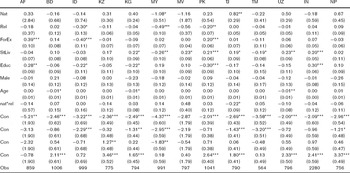
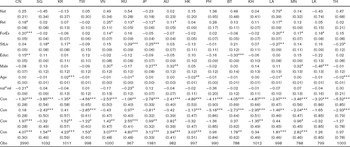
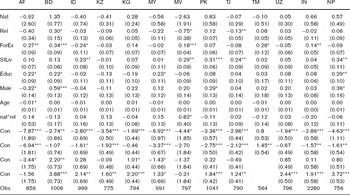
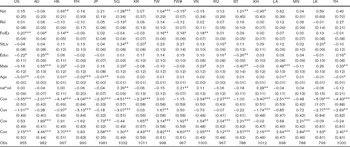
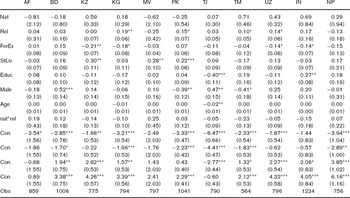
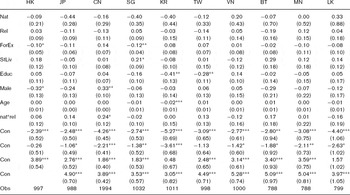
Separate ordered logit models were run in each country using each the three dependent variables. The complete results appear in Appendix Tables 2–7. The remainder of the analysis is devoted first to a general discussion of the variables of interest on each of the three core states, the US, China, and Iran, respectively, which is followed by a summary discussion.
4.5. Explaining core state influence: the United States
4.5.1. The effects of religiosity, nationalism and foreign exposure
Religiosity has complex effects on views of American power in the Asian Pacific. In China and Russia, religion interacts with nationalism. This indicates that the heightened perceptions of American influence generated by religiosity in these countries depresses as levels of nationalism increase. In Japan, religiosity lowers the probability of seeing the US as a ‘good’ influence. In Australia, it increases the same probability – consistent with what we would expect from a predominantly Christian public.
In eight of the 11 states in the Islamic grouping, religiosity has no direct impact on views of US influence. In Indonesia, Malaysia, and Pakistan, the effect is in the expected negative direction. Among Malaysians, nationalism and religiosity appear to mutually depress perceptions of American influence. At the same time, nationalism boosts perceptions of US influence, as witnessed in the cases of Tajikistan and Laos.
Foreign exposure, ceteris paribus, improves perceptions of the United States in several societies across civilizational groupings. In Vietnam, its effect is significant at p < 0.05; in China, Afghanistan, and Pakistan, the z-score of the coefficient reaches a higher standard p < 0.001. Among Indonesians, foreign exposure has a reductive influence.
4.5.2. Controls: standard of living and education
Of the control factors included in our US model, two emerged as important: self-reported standard of living and education. Increases in living standard lead to positive perceptions of American influence among Russians, Singaporeans, and South Koreans as well as among non-Chinese Sinic countries as a whole. Among predominantly Islamic publics, higher standards of living raise attitudes toward the US in Kyrgyzstan, Maldives, Pakistan, Tajikistan, and Uzbekistan. They depress perceptions in Malaysia and Turkmenistan.
The role of education is less consistent. A higher level of education in China increases perceptions of US influence. In several Islamic states – Indonesia, Kyrgyzstan, and Pakistan – the effect of higher education is, ceteris paribus, depressive on such attitudes.
4.6. Explaining core state influence: China
4.6.1. The effects of religiosity, nationalism, and foreign exposure
Religiosity, on the whole, appears to play a small role in shaping impressions of Chinese influence. In Singapore, Tajikistan, and Maldives, the effect is negative, meaning greater religious devotion in those publics is, ceteris paribus, likely to decrease the probability of seeing Chinese power in a positive light. In Bangladesh, however, the effect is positive.
The influence of nationalism is more apparent, appearing to influence views of China primarily in her immediate sphere of influence: Singapore, Taiwan, Hong Kong, and Bhutan. In the case of Singapore, nationalism depresses views of Chinese influence; for the others, the effect is positive.
As with perceptions of American influence, attitudes toward Chinese influence increase in several Asian publics with greater levels of foreign exposure. Noteworthy are the boosts given by cultural interaction in American, Taiwanese, and Vietnamese contexts. Similar patterns are found among Afghans, Bangladeshis, Maldivians, and Turkmens. Indonesians again are an exception, showing lower likelihood of viewing Chinese power as ‘good’ as their exposure to foreign cultures increases.
4.6.2. Controls: standard of living and age
Perceptions of China, as observed in the American model, can be linked to increases in standard of living. This pattern is manifest in Russia, South Korea, Singapore, Sri Lanka, Nepal, Pakistan, and Indonesia.
A generational lens on perceptions of Chinese influence is evident in the data. In the American and Japanese samples, age is negative, indicating that Chinese influence is viewed more negatively as the respondent gets older. Education appears to have mixed influence. It has a reductive impact on the views of Americans, but boosts the views of Russians, Afghans, Bangladeshis, and Malaysians.
4.7. Explaining core state influence: Iran
4.7.1. The effects of religiosity, nationalism and foreign exposure
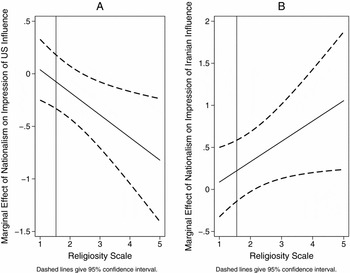
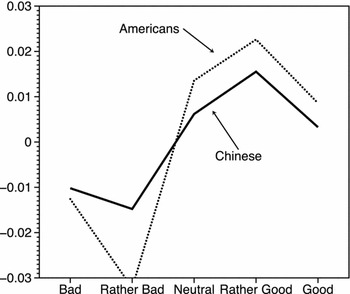
Religiosity, along the lines of our hypotheses, boosts Iranian influence in several Islamic publics, including Kyrgyzstan, Pakistan, Turkmenistan, and Uzbekistan. Recall that in Pakistan we also witness the reductive effect of religiosity on American influence, a pattern that would be anticipated by Huntington. Nationalism plays no role in views of Iran, with one exception, China, where it interacts with religiosity. The sign on the interaction term is positive, producing an effect that is contrary to what is witnessed when US influence is the dependent variable (Figure 5).
Marginal Effect of Nationalism on Chinese Views of the US (A) and Iranian (B) Influence. Graphs plotted using (Boemke (Reference Boehmke2008).)

Where the reputations of the United States and China appear, in large part, to benefit from public exposure to foreign cultures, the impact on Iran is the opposite. As publics in India, Hong Kong, and Singapore, as well as Kazakhstan, Kyrgyzstan, and Uzbekistan, gain in cross-cultural interaction, their perceptions of Iranian influence on their respective countries decline.
4.7.2. Controls: education, living standard and gender
Where education appears to have a reductive impact on views of Iranian influence (South Korea, Taiwan, and Tajikistan), increases in living standard appear to have a positive impact in some Islamic publics (Kazakhstan, Maldives, and Pakistan). An interesting, and unexpected, gender effect is witnessed across several Asian publics. Among Chinese, Bangladeshis, and Tajiks, the effect of being male is positive on impressions of Iranian influence; among the publics of Hong Kong, Pakistan, and Turkmenistan, the effect is negative.
4.8. Summary: assessing the potential for intracivilizational cohesion and intercivilizational clash
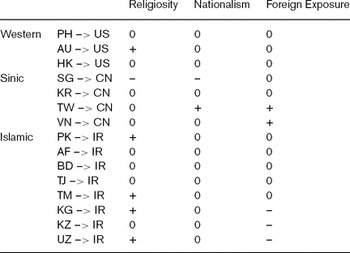
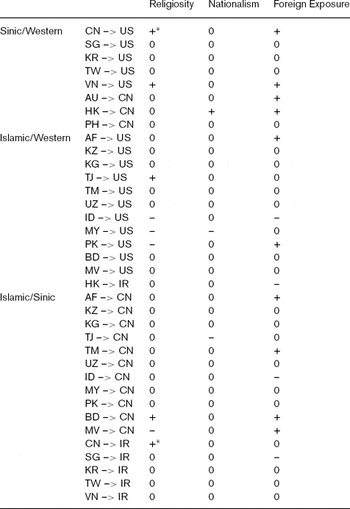
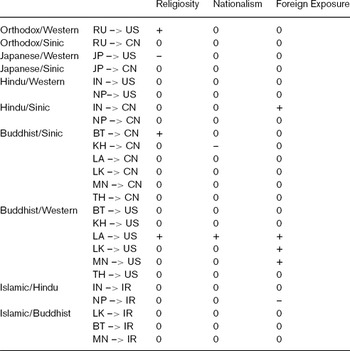
The findings are summarized in Tables 3, 4, and 5. Plus (+) and minus (–) signs represent positive and negative logit coefficients whose z-scores reach a p < 0.05 standard or higher, respectively; zeroes (0) represent those that do not meet this standard.
Summaries from multivariate models: assessing intracivilizational cohesion among Western, Sinic, and Islamic publics

Summaries from multivariate models: assessing intercivilizational clash among Western, Sinic and Islamic Publics

*Effect produced by interaction with nationalism
Summaries from multivariate models: assessing intercivilizational clash among Orthodox, Japanese, Buddhist and Hindu publics.

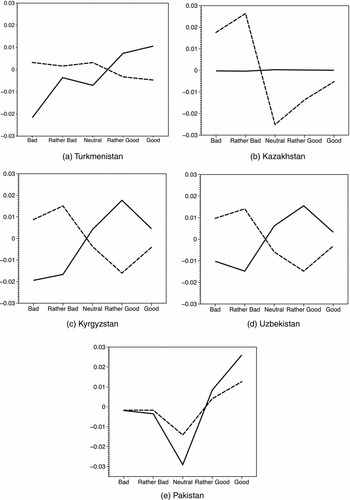
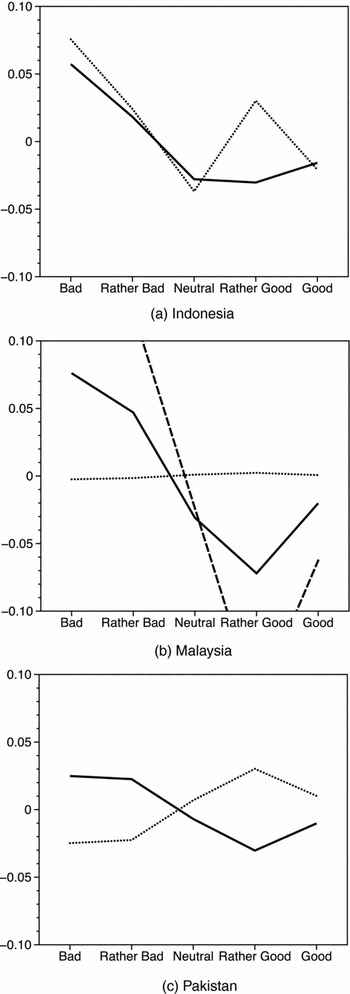
Three points bear restating. First, nationalism plays a limited role in shaping perceptions of the world's hegemons in the region – with the exception of publics within, or in immediate proximity to, China. Second, increased levels of religious practice have the effect of both raising the profile of Iranian influence and lowering the profile of American influence. Religiosity in Turkmenistan, Uzbekistan, and Kyrgyzstan, as displayed in solid lines in Figure 6, reveals positive, statistically significant marginal effects on the ‘rather good’ and ‘good’ response categories in the Iranian model. Conversely, Figure 7 exhibits the positive effects on the two negative categories, ‘rather bad’ and ‘bad’, for the American model among Indonesians (7a) and Malaysians (7b). Pakistan appears to be the better fit for Huntington, where religiosity boosts ‘rather good’ and ‘good’ responses to Iranian influence (6c) and ‘rather bad’ and ‘bad’ responses to American influence (7c).
Marginal Effects of Religiosity (solid lines) and Foreign Exposure (dashed) on Iranian Influence within Central Asian Publics (other variables held at their means)

Marginal Effects of Religiosity (solid lines), Nationalism (dotted) and Foreign Exposure (dashed) on American Influence within Predominantly Islamic Publics (other variables held at their means)

The third point is that foreign exposure (dashed lines) often mitigates the effects of religiosity. With regard to Iran's influence in Turkmenistan, the boost given by religiosity remains the stronger effect of the two; in Kazakhstan, religiosity has no effect. For Uzbekis and Kyrgyz, however, the effect of foreign exposure is essentially the mirror of that offered by religion, boosting ‘bad’ and ‘rather bad’ responses at roughly the same rate that religiosity increases the ‘rather good’ and ‘good’ responses. With regard to American influence in Indonesia and Malaysia, foreign exposure appears to contribute to the negative influence of religiosity and nationalism. But in Pakistan, it boosts ‘rather good’, ‘good’, and ‘neutral’ responses – a counterweight to the effect of religiosity.
Across civilizations, there are publics where foreign exposure lifts Chinese and American influence. For China, as we discussed, statistically significant effects appear among a handful of Islamic publics; comparable findings for the US would be those found in the Buddhist civilizational category. Where the two are at roughly equal public standing, like Afghanistan or Vietnam, the effects of foreign exposure are comparable. In others, like Australia or Laos, one of the hegemons enjoys a greater benefit. Notably, foreign exposure has similar effects on Chinese impressions of US influence and American impressions of Chinese influence (Figure 8).
Comparing the Marginal Effects of Foreign Exposure on Chinese Attitudes toward US Influence (solid) and American Attitudes toward Chinese Influence (dashed)

5. Discussion
One of the key assumptions of the ‘clash of civilizations’ framework revolves around the role of publics and their tendencies to discern ‘us’ from ‘them’ in geopolitical terms. This, according to Huntington, forms the basis of civilizational identities which, in turn, offer a basis for structuring international affairs. Following this logic, we surmised that publics would identify more strongly with the core states of their civilizational grouping and, as such, view the core states of rival civilizations more negatively. We also surmised that religiosity would strengthen those attachments. Globalization, defined here as an individual's everyday exposure to foreign cultures, would strengthen this pattern and, if Huntington's resurgence model were evident across publics, would work in a negative direction and exacerbate impressions of core states of out-civilizations.
What we find in the Asian Pacific context are patterns that are more complex than those suggested by the Huntington model. There is some evidence, at a descriptive level, of divisions between the United States, China, and predominantly Islamic states – primarily among the Indonesian, Malaysian, and Pakistani publics. Some of this can be attributed to religiosity and, to a lesser extent, nationalism, as well as the interaction between the two. Moreover, there is evidence in our analysis of central Asian Islamic public affiliation with Iran as a potential core state. In half of the predominantly Islamic publics we tested, religiosity boosts opinions of Iranian influence. Consistent with some of Huntington's more controversial assertions about an ‘Confucian Islamic connection’, moreover, we find that several of these publics do indeed view China more favorably vis-a-vis the United States. The same goes for Chinese views of Iran. Support for the United States in Australia and Russia can be explained, in part, by increased levels of spiritual commitment, which lends further weight to some of Huntington's assumptions about the evolution of ‘The West’.
At the same time, perceptions of core state influence do not manifest as a zero-sum game. In other words, where publics may identify more strongly with one relative to another, in doing so they do not necessarily perceive out-civilization core states substantively as ‘bad influences’. Some predominantly Islamic publics see both Iran and America, in real terms, as either neutral or good influences; in terms of the United States and China, only Pakistan and Malaysia appear to clearly favor the latter. Taiwan and South Korea edge (or hedge) toward the US. This, combined with the ongoing antagonisms between the Chinese and Japanese publics, calls into question predictions about a cohesive Sinic civilization acting under the banner of Beijing. One of the key barriers would appear, as critics have asserted, to be the role of nationalism. But the effects do not extend much beyond the immediate Chinese sphere in Southeast Asia. Tension over territorial issues in the region since the timing of the surveys, in fact, may be inspiring nationalisms that are wary of growing Chinese power.
The challenge to Huntington, rather, comes with the influence of globalization. Indonesia appears to fit the resurgent response that he predicts, but it is unique. Instead, higher degrees of foreign exposure tend to improve perceptions of foreign state influence in some of the notoriously contentious intercivilizational dyads in the study, notably between Chinese and Americans. Foreign exposure, at the same time, often works against the influence of Iran, particularly in central Asia. Rather than imminent conflict, the evidence presented here suggests greater competition between American and Chinese soft power and development initiatives, while also suggesting the potential for improvement, at the micro-level, in Sino−US relations.
Ultimately, Huntington's expectations about the deterministic influence of religion on identity formation appear to be overstated. To the extent that it may be structured around core state affinities or enmities, a civilizational identity would appear to be susceptible to influences that pull it in conflicting directions. Exposure to imported products, traveling or communicating with others abroad has, in the face of greater religious and nationalist sentiments, the capacity to boost public perceptions of states that, in the Huntington frame, are destined to collide based on cultural or value difference. This does not necessarily lead us to endorse the ‘universal civilization’ thesis that Huntington makes considerable effort to refute, but does suggest that modernity, as Eisenstadt contends, may have its own effect upon the future identities of publics. If comparative politics and international relations should pursue the civilizational paradigm further, Katzenstein's middle-ground view that sees them as ‘weakly institutionalized orders’ appears, at this point, to be the approach that is more empirically plausible. Core states may help to define politics at the macro-level, but, in the face of globalization, their role in defining publics at the micro-level is far less clear.
About the authors
Christian Collet (Ph.D, University of California, Irvine) is Senior Associate Professor at International Christian University, Tokyo, where he teaches courses on public opinion, American and comparative politics. His work has appeared in Perspectives on Politics, The Journal of Politics, Public Opinion Quarterly, Amerasia Journal and Race/Ethnicity: Multidisciplinary Global Contexts and volumes from the University of California Press and Rowman Littlefield. He is the co-editor, with Pei-te Lien, of The Transnational Politics of Asian Americans, published in 2009 by Temple University Press.
Takashi Inoguchi is Professor Emeritus of the University of Tokyo and President of the University of Niigata Prefecture. He specializes in Japanese politics, comparative political behavior, and international relations. He has published numerous books and articles, amongst which are Japanese Politics: An Introduction (Trans Pacific Press, 2005), Political Cultures in Asia and Europe (Routledge, 2006), Citizens and the State (Routledge, 2008), Globalisation, Public Opinion and the State (Routledge, 2008), The Quality of Life in Confucian Asia (Springer, 2010), American Democracy Promotion (Oxford University Press, 2000), Reinventing the Alliance (Palgrave Macmillan, 2003), The Uses of Institutions (Palgrave Macmillan, 2007), Japanese Politics Today (Palgrave Macmillan, 2011), The US–Japan Security Alliance (Palgrave Macmillan, 2011), and Quality of Life in Asia (Springer, forthcoming in 2012). He is Executive Editor of the Japanese Journal of Political Science (Cambridge University Press) and Director of the AsiaBarometer project.
Country-Level Descriptives for Independent Variables of Interest

US Model: Islamic and Hindu Publics

US Model: Sinic, Orthodox, Japanese, Western and Buddhist Publics

China Model: Islamic and Hindu Publics

China Model: Western, Japanese, Sinic, Orthodox and Buddhist Publics

Iran Model: Islamic and Hindu Publics

Iran Model: Western, Japanese, Sinic and Buddhist Publics