A number of recent studies have drawn attention to how the study of religion and religious seeking were intertwined in European and American cultures in the nineteenth and twentieth centuries. Ann Taves, Leigh Schmidt and Hans Kippenberg, for example, have pointed to ways that particularly Protestant anxieties and dilemmas shaped scholarly thinking about categories such as experience and “mysticism.” Scholars have been less interested, however, in the other side of the exchange—less interested, in other words, in how scholarship has reshaped religious belief and practice. The first Americans to study religion scientifically, American psychologists of religion, serve as a particularly useful illustration of how scholarly methods influenced modern ways of believing, but there is still little historical scholarship on the key figures involved. There remain few critical works, for example, on the pioneer psychologists of religion—Edwin Starbuck (1866–1947), George Coe (1862–1951), James Bissett Pratt (1875–1944), and G. Stanley Hall (1844–1924)—and their ways of studying and attempting to reform religion. The notable exception is, of course, the literature on William James, which includes an enormous number of dissertations and monographs, including several important studies examining the Varieties of Religious Experience and James's other efforts to help fashion a science of religion. But even the scholarship on James does not consider how he and others used the sciences to reform religious belief and revitalize American culture. Given the fact that James identified himself as a psychologist, engaged a wide range of neurological, physiological and psychological thinkers in his work, and drew extensively on psychologists like George Coe and Edwin Starbuck, it is remarkable that these contexts have been overlooked. His debt to the psychologist Edwin Starbuck is particularly striking. In his Varieties, he uses or refers to Starbuck's empirical work twenty-six times, he draws from Starbuck's questionnaire data thirty-seven times, and he mentions Starbuck by name a total of forty-six times, which is roughly the equivalent of once in every six pages of text.Footnote 1
Pointing to the ways that scholarship and religious seeking often have been entangled in the history of the study of religion, I argue here that early American psychologists of religion initiated their studies in order to reform concepts of religious experience and make religious belief possible again for themselves and other modern intellectuals. In order to understand precisely how this happened, I turn to the life and work of Edwin Starbuck, a pioneer psychologist of religion whose life illuminates well the preoccupations and struggles of many first-generation American psychologists of religion. Like other psychologists of religion, Starbuck experienced an adolescent conversion that initiated a lifelong interest in the subject. He spent the remainder of his career collecting first-hand accounts of Protestant conversions and arranging and correlating their different dimensions—all because he hoped this work might eliminate local and inessential elements from definitions of (true) religious experience, separate healthy from unhealthy types of religion, and establish a range of legitimate religious thought and action. He was sure that applying scientific methods to the deepest religious experiences—probing and sorting them and studying the “laws” of their growth—would make these deep parts of the self less mysterious. “But to lift [experience] above superstition, to dwell vitally within it, to make it a sure, lasting growing possession of mankind,” Starbuck insisted in his 1898 study of religious experience, “it must have a thousand thought-paths leading into its holy of holies.”Footnote 2 The psychology of religion was Starbuck's “thought-path” to the deep, inner parts of the religious life; and as this science cleared its way to the core of the religious self, it cut away and demolished obscuring superstitions, old theological notions, and narrow conceptions of faith. “A multitude of superstitions and crudities are doomed to fold their tents,” Starbuck rejoiced in a 1902 letter to William James. “People will be living in a new era of religious experience before they know it.”Footnote 3 Starbuck tirelessly promoted the empirical study of religion not just as a new form of knowledge, but as an essential method for fashioning better and healthier ways of thinking about and practicing religion. His life illustrates clearly that scientific studies and methods created new opportunities for religious ways of being in the world.
First-Hand Experiences
Like many other psychologists of religion, Starbuck's interest in religious exper-ience began with a youthful evangelical conversion that he later regarded with dismay, puzzlement, and, occasionally, nostalgia. At first this conversion seemed like a powerful and genuine event; but it was not long before he wondered if social pressures and contagious religious excitements might have produced it. Perhaps the whole episode was contrived and meaningless. “In the heat of the revival at Centre meetings I went through the forms of this public acceptance,” he remembered, “not feeling at the moment the negative implication that my heart had not been on the whole ‘given to the Lord,' during the preceding months.”Footnote 4 Raised in a sober Quaker family, Starbuck had tried hard to approximate the rhythms of evangelical conversion, rhythms that, when they worked, propelled people from a deep conviction of sin to a joyousness that signaled freedom from it. But Starbuck never convinced himself that he was wholly sinful, and the public profession of faith that he mustered was, as a result, half-hearted. Still, there was enough in this experience—enough spiritual relief and emotional power—to make Starbuck wonder about it. Was it possible that such dramatic experiences were authentic or useful in any way? If so, why were these deep, invigorating emotions packaged in such unseemly and unnatural forms, forms such as ecstatic revival behaviors? Would it be possible somehow to separate the vitality and the intensity of these experiences from their unseemly contexts and thus recover something of their spiritual power for modern believers? Starbuck was not the only one interested in such questions. Other early psychologists of religion, such as George Coe and James Leuba, pursued answers to these questions with an intensity that originated in their own puzzling, failed conversions.
When Starbuck enrolled at Harvard Divinity School in 1893 he was still wondering how best to account for evangelical experiences and perhaps recover something of value from them. He later recalled that when he started at Harvard his:
central guiding principle was that [his course of] study must deal primarily with the first-hand religious experience of individuals, not so much with their theories about religion as with their actual experiences. Footnote 5
Theories about religion, he was sure, were “once removed from the vital springs of conduct and valuation”; historical records and sociological statements about religion were “thrice removed, and consist for all we know of only congealed, discoloured, and distorted semblances of real experience. One must,” Starbuck insisted, modifying Emerson, “catch at first hand the feelings of spirituality.”Footnote 6 But how? How might one catch at first hand these unmediated spiritual impulses? What tool could one use? At some point Starbuck decided to investigate these elusive facts in questionnaires that asked for details about “the feelings of divine presence,” “actual feelings of the sense of communion during the ceremony of communion” and, above all, what people experienced during conversion episodes.Footnote 7 He fashioned questions carefully, hoping, he said, to “awaken” his respondents in certain ways, trying to elicit their immediate reactions. He thought that “what came forth spontaneously would be the most vital and essential elements of the experience,” deep inner particulars that were closer to “the operation of life-forces.”Footnote 8 In many ways, this was a typical goal of late nineteenth-century religious liberals: separate the essential inner aspects of religious experience from their less important, outer manifestations. He was the first to use the questionnaire to probe these kinds of religious experiences.Footnote 9
At first, talking to friends and acquaintances about their religious experiences seemed like a good beginning; but in time Starbuck regretted trying to study scientifically the inner lives of associates and fellow graduate students. When he distributed questionnaires to contacts in Cambridge and surrounding areas many thought his surveys were rude and intrusive. (See the very first questionnaire reproduced in figure 1). Although Starbuck intended these questionnaires as ways of understanding and fostering the deepest and most essential parts of the religious self, some saw them as cold, scientific instruments likely to eviscerate, not energize, their spiritual capacities. When Starbuck's mentor William James got a copy of the survey he was full of hesitation. “This is New England,” he warned, and “people here will not reply to an inquisitional document of that sort.”Footnote 10 Starbuck assured James that his plan would work. “I wheedle them; I explain that this is the beginning of a new science in the world—the psychology of religion, and we must have the facts.”Footnote 11 But at least initially, James appeared to be right. Starbuck received several letters of complaint and recrimination. There were a number of people who did not share Starbuck's enthusiasm for this new science, and many more who were positively worried about trying to study empirically the facts of the spiritual life. Was this not just reducing mysterious, spiritual things to natural laws? Even the religious liberal and reformer Thomas Wentworth Higginson complained to James that Starbuck's questionnaire amounted to “moral and spiritual vivisection.” He asked James if his approving signature was a forgery.Footnote 12 Things got worse when Starbuck presented his findings to C. C. Everett's philosophy of religion class. In this setting, which was normally quite collegial, anxious students assaulted him with objections—and one of them, Edward Borncamp, standing erect and with face “white with emotion,” cried “It's all a lie!” And all of this took place at liberal Harvard Divinity School.Footnote 13
“Moral and spiritual vivisection” Starbuck attempted to dissect America's spiritual life with this, his first conversion survey. from Edwin D. Starbuck, “Religion's Use of Me,” 1937. Reprinted with permission of Ayer Company Publishers

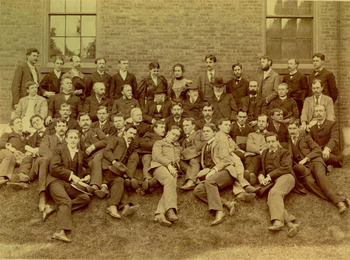
The Harvard Divinity School Class of 1895. Harvard Divinity School, Photograph Collection bMS445, Andover-Harvard Theological Library. Starbuck is the first person in the top row, far left; Anna Diller, his future wife, and one of the first women at HDS, is standing top row, seventh from the left; C. C. Everett sits just in front and to the left of Diller; Edward Borncamp, in a calmer mood, reclines with his hat in the third row, far left.

Eventually Starbuck produced two articles on religious experience that he subsequently included in a book entitled The Psychology of Religion and published in London in 1898. His was the first full-length book by an American psychologist of religion.Footnote 14 Although the book speaks generically about “religion” and “religious experience” it really attempts to measure and account for only one kind of experience—evangelical conversion. Starbuck's personal reasons for focusing on evangelicalism are clear enough; but he also had intellectual reasons for doing so, for he knew enough about the emerging science of religions to see that American evangelicals, with their uncontrollable fits and holy convulsions, manifested those primitive religious elements that European scholars were studying in aboriginal ceremonies. Starbuck regarded American evangelical conversion as a stand-in category for all ecstatic behaviors, calling it “the most dramatic single storm-centre of religious experience,” an event swirling with instincts and primal emotions.Footnote 15 Like European counterparts, Americans intellectuals like Starbuck wondered if these and other odd manifestations of the primitive could somehow be harvested for use in the over-civilized, modern world.
Starbuck found data for his study not in urban America but on the rough-and-tumble frontier—and in the gesticulating shapes, mostly, of American Methodists. His 1898 book is full of rowdy Methodist emotions and testimonials, which he does his best to transform into disembodied statistics. In part one of the book he used different questionnaires. The first yielded 192 responses (120 women; 72 men) from Protestant Christians across the United States, with Methodists in the majority. He supplemented this questionnaire with more focused surveys on conversion and life-cycle stages. These surveys were distributed in three locations: 1) a Women's Christian Temperance Union meeting in California (mostly Methodists), 2) two regiments of soldiers from Iowa and Tennessee, then stationed in San Francisco, and 3) a handful of participants in a Methodist conference in Santa Barbara, California.
Starbuck also used data on ages of conversion from the alumni records of Drew Theological Seminary (again, Methodist). In part one of the book Starbuck identified the emotions that initiated and accompanied conversion, linked conversion styles to different temperamental and biological types, and, challenging a number of other important psychological studies, suggested ways that conversion moments might help young people mature. In part two of the book he identified another model of religious development, the “gradual-growth” model, which seemed more common among intellectuals. Denominations were more evenly represented in this gradual-growth group, and the majority of respondents were college educated.Footnote 16 This fact was not lost on Starbuck or other psychologists of religion. Were educated people less likely to have an evangelical-style conversion?
The striking feature of Starbuck's book is its imposing apparatus of measurement, which Starbuck used essentially to make religious experiences more orderly and comprehensible. There are no less than thirty-two figures in the book—remarkable charts on religious development; graphs correlating conversion with age, gender, body growth, emotion and temperament; tables measuring the frequency of post-conversion anxiety, religious doubt and the intensity of certain beliefs. Starbuck was mapping inner vectors of doubt and depravity, anxiety and ecstasy, taking inventory of mysterious mental things that had confounded him. He found that there were many ways to use empirical methods to bring “a little coherency and constancy into the midst of that which is constantly flowing”—many ways, he said in different contexts, to use science to “make it possible to comprehend new regions in the spiritual life of man.”Footnote 17 Scientific study revealed how spiritual development worked by reducing the astonishing variety of American evangelical experiences, with all of their somatic and emotional variations, to a set of orderly laws and patterns. For Starbuck, this procedure yielded some crucial gains. It had the effect of making the divine force behind religious experiences not a terrifying and unpredictable agent of sudden conversion events but an architect of an orderly universe who might be admired and understood better by plotting his earthly irruptions and manifestations in scientific tables and charts. This was the religious world that Starbuck wanted to live in, a world in which God acted in predictable ways and human beings sensed his immanent presence in nature's laws.
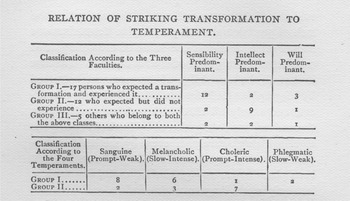
Starbuck's ways of ordering and correlating experiences led to other key spir-itual discoveries. While analyzing the laws and general features of evangelical experiences he and another early psychologist of religion named George Coe, a Methodist who also had failed to experience evangelical conversion, stumbled upon the answer to a question that had long troubled them—why some people wanted and tried to have dramatic conversions but could not. The answer had to do with temperament. Different personality styles predisposed people to one or another kind of religious development. “Where expectation [of conversion] is satisfied” in dramatic experiences, Starbuck explained, “there sensibility is distinctly predominant; but where expectation is disappointed, there intellect is just as distinctly predominant.”Footnote 18 Those who scored high in sensibility (feeling), and those who were more susceptible to social pressures or were introverted, were more likely to experience dramatic conversions. Intellectuals on the other hand, including psychologists, usually were “Intellect Predominant.” Starbuck borrowed a table from Coe's then-unpublished manuscript to illustrate the differences between personality types (fig. 3).
Correlating temperament and susceptibility to evangelical conversion. From George Coe, The Spiritual Life, 1900.

Other surveys confirmed that more educated Americans were less susceptible to evangelical forms of religious instruction. This did not mean, however, that young intellectuals did not go through periods of religious conversion, crisis, or adjustment. Such periods were the sine qua non of adolescence. It merely meant that different people had different ways of navigating developmental milestones in this period. Some proceeded gradually.Footnote 19
Starbuck used categories such as natural/unnatural to structure his data and make a number of normative claims about experience. There was a natural, and thus good and useful, essence to experience; and there were unnatural, and thus bad and harmful, outer behaviors that accompanied religious experiences. Dramatic and sudden evangelical conversion experiences usually were associated with the latter category—they were excessively irrational and potentially harmful—and Starbuck knew personally that they created anxieties and emotional difficulties when foisted inappropriately upon young people. Starbuck advised:
The fatality of impressing the fact of sin and personal unworthiness, of holding out before the adolescent … the horrors of eternal punishment, and of emphasizing unduly the ideal of perfection, instead of stimulating the halting and self-distrustful soul toward wholesome activity—these and numerous other indiscretions which are so frequently indulged in need only be seen to be avoided.Footnote 20
Starbuck could show empirically that excessive emotions stirred up at revivals led to psychological deficiencies, religious morbidity, and immoral behavior. He was seconded by liberal Christian psychologists such as George Cutten, who showed empirically that converts who experienced hot, evangelical experiences were less sophisticated in handling moral questions and less likely to remain believers over the long term.Footnote 21 Such empirical conclusions could be buttressed as well by already-existing certainties about race. Starbuck and many others developed ways to measure and correlate personality dimensions such as credulity and belief and they found these personality traits in abundance in African Americans, Native Americans, and other “primitive” peoples. Starbuck hoped that fewer and fewer people, including especially non-white Americans, would fall for the excessively emotional techniques fabricated by roaming evangelicals.Footnote 22
There was, however, a deep ambivalence in all of Starbuck's work, for although he thought of evangelicalism as an excessive and harmful way of stimulating the religious self, there was no denying that evangelical conversions were energizing and powerful. Starbuck had seen how evangelical experiences helped young people develop powerful religious identities in a very short time. They appeared to catalyze psychological and spiritual growth.
Granting that the highest consciousness is conditioned by the most highly and perfectly organized nervous system; that new ideas imply the functioning of new areas in the nervous system; that the nerve elements that are concerned in spiritual insight are already formed and lying ready to function, if only brought into the right coordination, it is conceivable that during the intense experiences attending conversion, under the heat of the emotional pressure brought to bear, a harmony is struck among these elements which it might have taken months, or even years, to accomplish.Footnote 23
In this passage and in others Starbuck wondered about the emotional power of evangelical conversion and discussed its ways of energizing human emotional and spiritual capacities. Conversion experiences were important, then, as long as they were not excessive and as long as they were understood in wider developmental contexts. The trick was understanding the useful parts of these experiences and separating them from everything else. This was Starbuck's dilemma: How would he and other psychologists recover some of the primitive intensity from phenomena that, at least on the surface, were so deeply unappealing? This was the same dilemma being wrestled with by one of Starbuck's mentors at Harvard, an established philosopher and psychologist also getting interested in empirical studies of religion—William James.
Measuring Faith
At first, James appeared not to have appreciated Starbuck's attempts to count, categorize and measure conversion experiences. When Starbuck began his empirical work, James was chary. The “question-circular method of collecting information had already … reached the proportions of an incipient nuisance,” he remembered telling Starbuck.Footnote 24 He expected Starbuck's questions to add nothing significant to the problems of religious experience, eliciting conventional responses couched in familiar Protestant idioms. But James later admitted that he was mistaken. Respondents testified to a range of interesting awakenings and mystical experiences. Their reports were candid and their language seemed genuine. On a trip to the American west coast James visited Starbuck, then teaching at the newly-founded Stanford University, and wrote Alice that he was reading eagerly Starbuck's questionnaire data. The data surprised him.
Some of them are köstlich [marvelous], and they all give one a splendid feeling of there being such good people in the world. How I have wisht, dear Alice, that you might be reading them aloud to me. I know that you would enjoy them as much as I.Footnote 25
James's letter is reminiscent of another on the same subject written just after his father's death in 1882, in which he playfully told Alice she had “one new function hereafter”—namely:
you must not leave me till I understand a little more of the value and meaning of religion in Father's sense, in the mental life and destiny of man… I as his son (if for no other reason) must help it to its rights in their eyes. And for that reason I must learn to interpret it aright as I have never done, and you must help me.Footnote 26
When James read Starbuck's conversion narratives, this moment appears to have arrived. On subsequent occasions James asked Starbuck for more, and he drew from Starbuck's collection extensively in his Varieties, as I have already noted.Footnote 27 Starbuck's work was a key source for James's book.
Of course, using empirical methods to reform religion was something James had pondered for a number of years. He had been trained in medicine and physiology and in the late 1870s he collaborated with another young psychologist named G. Stanley Hall on a series of arguments for an empirical reform of philosophy, a transformation of philosophy along psychological and physiological lines. They made their argument in a couple of articles in the progressive reformist periodical, The Nation. Their ideas were in line with the ideas of other reforming social scientists. They argued that without induction and empirical methods, philosophy and religious reflection would remain mired in inconclusive, metaphysical speculations. Religion—and Christianity in particular—was in a bad state. Years later, in 1884, James was still wondering “whether there can be any popular religion raised on the ruins of the old Christianity without the presence of … a belief in new physical facts and possibilities. Abstract considerations about the soul and the reality of a moral order will not do in a year what the glimpse into a world of new phenomenal possibilities enveloping those of the present life, afforded by an extension of our insight into the order of nature, would do in an instant.”Footnote 28 But actually using the methods of science to answer specifically religious questions, and thus produce a science of religions, does not seem to have occurred to James until the middle of the 1890s. It was at this time that he encountered new facts collected by psychical researchers, scholars of religion such as E. B. Tylor and Max Müller and psychologists of religion like G. Stanley Hall and Starbuck.Footnote 29
It is not surprising then, that James was intrigued both by Starbuck's raw questionnaire data and how Starbuck sifted and evaluated these data. But why did reading through Starbuck's accounts of religious experience give James hope and that “splendid feeling”? And why did James incorporate Starbuck's data without adornment and in such detail in the Varieties?
The answer has something to do with an ambivalence at the heart of James's work and the work of other psychologists of religion. The more they successfully cast religious phenomena into scientific formulas, the more they complained about being alienated from the deepest and most vital parts of human life. (This was a regular complaint among first-generation social scientists as well, going back to John Stuart Mill.) The psychologist G. Stanley Hall gave voice to this commonly-felt anxiety when he worried that “in our day … the hot life of feelings is remote and decadent. Culture represses, and intellect saps its root. The very word passion is becoming obsolete.”Footnote 30 Hence the appeal of Starbuck's narratives of deep, even primitive religious emotions: These were glimpses into the deepest parts of the self, hot emotions and sensations unmediated by cognition or culture. These emotions were a tonic for enervating, over-civilized lifestyles. And they represented the parts of the self that James, in particular, had trouble accessing.
Although James's yearning for the comforts of faith contributed to his interest in these experiences, this was only part of the reason he wanted to expand his inner life. The inner life, and especially the feelings, registered most accurately our perceptions of the (physical and metaphysical) world—and they determined most powerfully our personal qualities, inclinations and abilities. Starbuck once explained
The mechanism of the affective life consists of all the senses in so far as they respond to stimuli that do not admit of discrete handling, the nerve endings in skin, intestines, blood vessels, glands, muscles and joints, the sympathetic nervous system with all its ramifications, and perhaps, also, structures in the central nervous system corresponding to the ‘association centers.' The affective life thus involves all the organic reactions in vaso-motor response, circulatory and glandular tone, vascular tension and the like, which experimentation is showing to be the immediate and ever present accompaniment of all sensation.Footnote 31
The “feeling life,” Starbuck continued, “draws directly from experience, and not through the mediation of the cognitive processes; that is, it is itself a source of knowledge.”Footnote 32 The immediate bodily feeling was constitutive of every mental act; it was the foundation for thinking, believing, reasoning, and forming opinions. Religious wisdom, then, was “direct and immediate,” and reports of experience should not be “blurred and distorted by an over-degree of rationality.”Footnote 33
Starbuck learned these facts about sensation and perception from James himself, who, when preparing to write his own psychological study of religious experience, worried that the act of doing so might obscure the part of the self that he was most interested in understanding—the “less articulate and more profound part of our nature.”Footnote 34 He gave his Varieties a descriptive quality in order to present the experiences without discussion or philosophizing. He was merely displaying these experiences, hoping, as Starbuck had, that they might elicit emotional responses or somehow give off traces of intensity. For me, James told another psychologist of religion, the divine is “limited to abstract concepts which, as ideals, interest and determine me, but do so but faintly, in comparison with what a feeling of God might effect, if I had one. It is largely a question of intensity, but differences of intensity may make one's whole centre of energy shift.”Footnote 35 Although he could not muster what he called a “living sense of commerce with a God” he knew enough to “envy those who have, for I know that the addition of such a sense would help me immensely.”Footnote 36 The religious experiences Starbuck collected offered him vicarious satisfactions.
James also appears to have been interested in how Starbuck used statistical methods to understand the value of conversions and related phenomena. In his preface to Starbuck's book he commented on this. It was “Dr. Starbuck's express aim to disengage the general from the specific and local in his critical discussion, and to reduce the reports to their most universal psychological value,” James wrote. “It seems to me that here the statistical method has held its own, and that its percentages and averages have proved to possess genuine significance.”Footnote 37 James did not explain what he meant and we are thus left wondering why he thought the “statistical method” was so significant. We also are left wondering why an intellectual so protective of individualism and metaphysical open-endedness was endorsing a scientific program that reduced the “specific and local” to universal patterns. On one level, certainly, his support of this kind of project seems odd.
But at just this moment (1898–1899) James had another, more urgent difficulty to overcome, one that Starbuck's techniques helped him solve. A year or so after Starbuck published his book, James wrote to a friend that the “well-nigh impossible” task he was pondering for his upcoming Gifford lectures was first to defend experience as “the real backbone of the world's religious life—I mean prayer, guidance, and all that sort of thing immediately and privately felt” and, second, “to make the hearer or reader believe, what I myself invincibly do believe, that, although all the special manifestations of religion may have been absurd (I mean its creeds and theories), yet the life of it as a whole is mankind's most important function.”Footnote 38 James and Starbuck thought about this dilemma at the same time: How could religious experiences in general be promoted without authorizing the many particular and absurd manifestations of them?
Starbuck's statistical generalizations (and accompanying tables) solved James's problem perfectly. They sundered religious experiences from their inessential contexts and showed how they functioned generally to adjust people to new life-cycle stages. Starbuck's statistics lifted the “universal psychological value” out of the idiosyncratic questionnaire data. For different reasons, including James's growing impatience with experimental work, he did not ape Starbuck's methods in his book; but he did borrow the categories Starbuck had so carefully described and helped shape, categories like conversion. He also shared with Starbuck a sense that displaying these experiences and sorting through their essential characteristics would help modern believers recover what was essential in religious experiences and ignore the rest.
Religious Feelings and Intuitions
The rest of Starbuck's life is a story about how scientific discourses reshaped not just ideas about religious experience but also how experience was practiced and exchanged in American religious cultures. Of all psychologists of religion, Starbuck made the case most vigorously that religious experiences, once shorn of their unseemly elements, proved that God existed and that belief was psychologically useful and true.
Starbuck did not wait long before turning from scientific studies to arguments that his data revealed new ways of perceiving and believing in God. Soon after publishing his study on conversion experiences he wrote an article that attempted to show that the varied data of religious experience suggested the existence of God. Pointing out that religion was concerned above all with “the affective life” and expressing the common functionalist view that religious feelings, like other feelings and instincts, adjusted human beings to larger realities encompassing them, Starbuck argued that human feeling “gives us as valid an account of external facts and relations, truth and reality, as the cognitive [life].” He reasoned that 1) because religious feelings were universal, and 2) because most other inner dispositions can be relied upon for true knowledge about the world, that therefore 3) religious feelings point to the existence of an objective spiritual reality impinging upon us. Feelings, he argued, were “never purely subjective”; they always pointed to nonsubjective realities outside of the self. Thus, study of the feelings allowed us to probe the edges of a larger universe of relations.Footnote 39 (Starbuck was not alone in wondering about these questions. Many psychologists at the time were concerned with precisely these issues, examining in particular how the physiology of sensation and perception pointed to links between subjective states and outer, objective things.) Starbuck was more inclined than most to transform these kinds of arguments into theistic proofs, perhaps because he himself had experienced a number of mysterious religious experiences and intuitions. His half-hearted evangelical conversion was merely the beginning; later in life he had several other powerful religious “illuminations,” and he never lost that part of his personality that he once called his “ineradicable mysticism.”Footnote 40
As is well known, James had similar suspicions about the existence of a spiritual dimension, but he settled for a tentative assessment of the problem in a section of the Varieties on his “over-beliefs.” In private, however, he encouraged Starbuck. In August 1904 he wrote that “I can see but vaguely just what sort of outer relations our inner organism might respond to, which our feelings and intellect interpret by religious thought.”Footnote 41 When Starbuck's article came out later that year he told Starbuck his thesis “in this article is both important and original, and ought to be worked out in the clearest possible manner” and “as concretely as possible.” It was a difficult argument to make convincingly, James admitted; “the real crux” of it “is when you come to define objectively the ideals to which the feeling reacts. ‘God is a Spirit'—darauf geht es an—on the last available definition of the term Spirit. It may be very abstract.”Footnote 42 The God of scientific believers like Starbuck was abstract indeed; but all other possible gods, including especially those imagined by more conventional American Christians, were accessible only by believing in preposterous doctrines or performing unseemly and irrational worship exercises.
There was a lot at stake in these arguments. Anxious that the Bible's authority had been undermined by both biblical critics and scientific accounts of time and history, American intellectuals turned expectantly to experience as a new, self-certifying foundation for belief. Starbuck insisted that religious experience, shorn of its distortions and excesses, injected life-giving elements into the self. Other believing psychologists made similar arguments. “The cold, half-dying belief of the intellect is often warmed into life by getting into touch with the vital forces of the feeling background, and once so vivified and identified with the deepest currents of one's life, is seldom thereafter subject to doubt or assailable by argument,” the psychologist James Pratt wrote.Footnote 43 The only satisfactory foundation for modern faith was this—religious feeling. The same medicine could heal the skepticism of troubled believers too. Many people of culture and intellectual power, Pratt wrote in another context, describing perfectly his own situation, although “unable to subscribe to any creed or even to worship with any church, yet find springing up within them a stream of inarticulate but genuine religious experience and intuition which is to them the very water of life.”Footnote 44 Pratt had seen Starbuck's data and James's Varieties and was impressed that people who had had religious experiences seemed to be more faithful and certain. Referring to one of the religious (but post-Christian) subjects he dealt with in his own studies, Pratt remembered that this believer, like so many others, insisted that the moment of religious experience itself was “enough to live by.” “It is a part of my being, and has for the rest of my being an importance and a value that are supreme, and that suffices me,” this believer confessed.Footnote 45 The task for psychologists of religion, Pratt thought, was to study and classify all religious data and use that information to help ordinary believers understand religious experiences better and incorporate them in their lives.Footnote 46
There were a number of ways to do this. In popular lectures and articles in religious periodicals, Pratt, Starbuck and others persuaded American believers that psychological studies of experience were refining religiousness and helping people believe in stronger and more healthy ways.
The experience of each and every earnest person is original and genuine, and one that others should share, and one that heightens our conception of what are the possibilities of the spiritual life. It is like the exchange of experiences among trusted friends, or the confessions that people make, or the testimonies that they give in prayer-meeting, except on a larger scale.Footnote 47
Psychological studies of religion produced a new large-scale discursive “prayer-meeting,” a new economy of religious experiences in which personal religious feelings and illuminations were exchanged and discussed. This dramatically changed the nature of experience and how it was disciplined; experience became a discourse shaped less by pastors and Christian symbols and more by statistical generalizations across cultures formulated by psychologists and educators. Believers always shared stories about faith, Starbuck wrote in a popular magazine for pastors, but now this process would lead to an “ability to discriminate among the qualities of spiritual experience.” Comparisons of different religious experiences and their outcomes might reveal which experiences were most functional, useful and healthy. With scientific study “we can know enough to feel that we are not wandering entirely in the dark”; we can “be helpful to the hungering of an inquiring soul”; and we can understand and use different methods to move individuals through processes of religious development.Footnote 48 One method—the older, evangelical way in particular—did not fit everyone; different temperaments called for different methods.
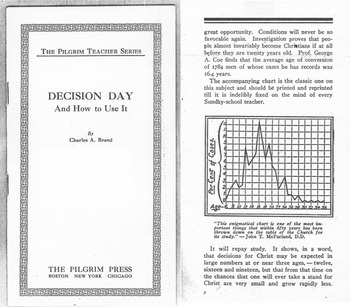
The transformation in American thinking about religious experience that Starbuck and a few others promoted was far-reaching. Many embraced Starbuck's way of thinking about the two types of conversion—sudden and gradual—and a surprising number agreed that gradual, natural ways of nurturing young people's religious feelings were best. Starbuck's charts and graphs of spiritual growth, and the charts and graphs of other psychologists, found their way into a large number of popular devotional manuals. One pamphlet reproduced a chart on conversion ages and informed pastors that psychologists now agreed that there were propitious times to encourage conversion or “Decision Day” (see figure 4).
Pamphlet promoting scientific ways of thinking about religious conversion. From Charles A. Brand, Decision Day and How to Us It, 1908.

It was important to guide adolescent Sunday school children (between the ages of 14–18) in particular; this was the time when “the physical nature and the religious nature are in a strange state of turmoil and incompleteness,” when the young person had a “longing for something higher and better.… Conditions will never be so favorable again.”Footnote 49 Here, psychological insights added urgency to pastoral labors: there was a small window for conversion opportunities. And of course psychological insights also reinforced how important conversion experiences were for overall maturity. Still, while youthful conversions were important, those borrowing from psychological experts agreed that it was never necessary to revert to the “old plan”—to use God's wrath or fearful doctrines to motivate Christians. This might produce a herd of converts but no authentic experiences; and pressuring people in this way also would work “upon the emotions in a way that was not wholesome.”Footnote 50 This was a consistent message in this literature: Do not injure believers (and young believers in particular) by foisting upon them contrived or excessive methods. By the early twentieth century, these ideas dominated religious education among mainline American Protestants.
Conclusion
In the end, Starbuck's empirical studies helped create a believable God for that large group of Americans who found evangelicalism distasteful. Although there was no doubt that evangelical conversions contained essences that were useful and vitalizing, Starbuck knew firsthand that this religious style was unnatural and would have to be reformed or superseded. At a deep level he and other psychologists such as George Coe were unsettled by the evangelical style, which they were able to appreciate only when it was measured and controlled. The transcendent God of American evangelicals, who suddenly irrupted in the self, was disturbing and confounding. Starbuck thought this God was too unpredictable and remote from human needs and aspirations. “Creator gods and absentee deities have never seemed to possess any potency,” Starbuck complained once; those notions and other childish ideas about miracles and healings were fanciful and evanescent. But “the feeling of a Presence has had body and substance” in my life, he wrote, moving me to insight, happiness and a “mighty inwardness.”Footnote 51 (This inwardness, this sense of an inner spiritual dimension in all things, was so powerful that it preserved him from conservative believers and materialistic scientists who detested the mediations of his science of religious experience. There were a number of such critics; Starbuck appears to have ignored many of them.) Starbuck saw a spiritual power or principle operating even in his scientific studies of religion. Late in life he was certain that the psychology of religion had “worked on” him, directing his actions, calling him to its novel affirmations. God worked immanently in the measurements and methods of modern scientific culture.
Perhaps it was only this kind of powerful conviction that could have produced the sweeping religious reforms that, within twenty-five years, completely changed how American Protestants and other believers conceived of and practiced religious experience. Scientific, clinical, and pastoral studies of American religious experiences proliferated at an astonishing pace. Trying to understand this vast output, one reviewer complained in 1937 that few “of my readers can have any idea how large is the number of books and papers which have been written to explain religious phenomena from a psychological viewpoint.”Footnote 52 No one, he said, including himself, could read them all. Many, including especially Starbuck and Coe, had industriously put their new notions into practice, developing dominant religious education associations, fashioning new schemes for religious nurture and creating new Sunday school curricula keyed more to gradual-growth models of faith. Suddenly, lesson plans for Sunday School were specific to age and psychological stage. It is no exaggeration to call this a revolution in how American believers thought about faith. Another observer of the situation noted that in the first decades of the twentieth century, putting the recommendations of Starbuck, Coe and others into practice “eclipsed perhaps every other project of the churches.” “Large numbers of men and women sought specialized training for service in [religious education's] ranks”; new religious specialists helped children believe, adolescents convert, pastors buttress faith and banish disbelief—all with newly-minted scientific methods.Footnote 53 A scientifically-informed pastoral psychology movement blossomed. All of this represented the apogee of Starbuck's project—a project of probing the universal psychological functions of religious experience and bringing into focus its most useful and healthy forms. Although by the interwar period theologians were critiquing and occasionally abandoning this and other liberal religious innovations, in the meantime Starbuck could justifiably look back on his life and rejoice that, for a crucial moment at least, he had in fact delivered on promises to usher in a “new era of religious experience.”