1. INTRODUCTION
The importance of communication in design teams is well recognized (Sonnenwald, Reference Sonnenwald1996; Kleinsmann et al., Reference Kleinsmann, Valkenburg and Buijs2007; Kleinsmann & Valkenburg, Reference Kleinsmann and Valkenburg2008). Although communication can be viewed and conceptualized in different ways (Maier et al., Reference Maier, Eckert and Clarkson2005), in the design research community, communication is generally conceptualized as the exchange of design representations across various communication media, communication tools, and communication channels in distributed and colocated settings (Del Cerro et al., Reference Del Cerro, Lemee, Mar, Wei, Weiman and Wortzell2001; Bucciarelli, Reference Bucciarelli2003; Eckert et al., Reference Eckert, Maier, McMahon, Clarkson and Eckert2005). Beyond satisfying the information needs of communication itself, authors have been increasingly stressing the importance of social learning associated with coincidental communication occurring during the team activity (Brown & Duguid, Reference Brown, Duguid and McLellen1996; Grecu & Brown, Reference Grecu and Brown1998; Bobrow & Whalen, Reference Bobrow and Whalen2002; Wu & Duffy, Reference Wu and Duffy2004).
Social learning refers to learning from social processes (Bandura, Reference Bandura1977), which include direct communication and observation. Social learning is considered particularly important to teamwork because social learning is embedded in the environment and it is as much involuntary as it is goal directed (Marsick & Watkins, Reference Marsick, Watkins, Burgoyne and Reynolds1997). In general, social learning is explained in terms of actions and observations (Tomasello, Reference Tomasello1999; Knobe & Malle, Reference Knobe and Malle2002; Malle, Reference Malle, Hassin, Uleman and Bargh2005). Team members learn about the other members in the team based on the actions of the others, which are often observable (Wallace & Hinsz, Reference Wallace and Hinsz2009). The structure of the team and the available information and communication technologies may support or inhibit opportunities for observations and interactions. For example, a person may directly communicate with another person and learn about her level of expertise with a specific piece of software because they sit in adjacent cubicles and work together on the same project albeit in different roles. Thus, based on this direct communication afforded through spatial adjacency and project team structure, the first person knows to seek the second person's assistance in using the software. In contrast, a third person may not have directly communicated with the second person having the software skills, but he might have observed the second person working while walking by the cubicle and learns through observations that the second person uses that software. Similarly, a fourth person might only have observed (overheard) the discussion between the first person and the second person about the software to learn something about the second person's knowledge of the software, which may be useful if any assistance is needed later on. Those not located in the office would not have the opportunity for this coincidental observation or indirect communication without the assistance of social media. Thus, different modes of social learning associated with direct and indirect communication are possible in design teams, and all these forms of communication provide opportunities for learning about the skills and knowledge of others, which should affect teamwork and team performance (Cohen & Bailey, Reference Cohen and Bailey1997), including task coordination (Cooke et al., Reference Cooke, Salas, Cannon-Bowers and Stout2000, Reference Cooke, Salas, Kiekel, Bell, Salas and Fiore2004).
Design teams require actions and communications that extend beyond the design activity to prosocial aspects of teamwork (Carrizosa & Sheppard, Reference Carrizosa and Sheppard2000; Milne & Leifer, Reference Milne and Leifer2000; Akgun et al., Reference Akgun, Lynn and Yilmaz2006). In the absence of such prosocial characteristics, merely forming a design team consisting of people knowledgeable in their individual domains may not ensure high coordination (Candy & Edmonds, Reference Candy and Edmonds2003). Effective teamwork requires team members to have a well-developed understanding of the team's competence and where (i.e., with whom) competences lay, which has been theorized in terms of the concept of a transactive memory (TM; Wegner, Reference Wegner, Mullen and Goethals1987; Lewis, Reference Lewis2003). TM is a system through which groups collectively encode, store, and retrieve knowledge (Wegner, Reference Wegner, Mullen and Goethals1987; Lewis, Reference Lewis2003; Akgun et al., Reference Akgun, Lynn and Yilmaz2006). TM allows teams to deal with tasks that require multiplicity of competence and knowledge that may not be possible for one individual to develop, manage, and organize, but can be effectively developed, managed, and organized by coordinating the specialized competence and knowledge of the team members and by assigning the right job to the right people.
Simply put, TM mediates efficient teamwork (Moreland et al., Reference Moreland, Argote, Krishnan, Tindale and Heanth1998; Rao & Argote, Reference Rao and Argote2006; Ren et al., Reference Ren, Carley and Argote2006). Communication and social learning act as a mechanism for the formation of TM (Rao & Argote, Reference Rao and Argote2006). The degree to which team members have learned about each other's skills and knowledge is taken as a measure of the completeness or “density” of the TM (Ren et al., Reference Ren, Carley and Argote2006). One benefit of having a complete TM is that fewer communications would be required to coordinate tasks. The team would already know the identity of those knowledgeable in a specific domain. Team members would therefore not have to spend communication cycles finding a knowledgeable person to complete a task or to learn how to complete a task when an expert in the area is available within the organization. Teams that require fewer direct communications between individuals to coordinate task work could be considered to perform more efficiently (Blinn, Reference Blinn1996; Entin & Sarfaty, Reference Entin and Sarfaty1999).
Studies comparing individual learning scenarios to social learning scenarios have established the coordination and TM formation benefits of social learning (Moreland et al., Reference Moreland, Argote, Krishnan, Tindale and Heanth1998; Ren et al., Reference Ren, Carley and Argote2006). However, these studies have considered social learning as a single entity, which limits our understanding of the significance of the constituent learning modes associated with direct and indirect communication. Thus, despite the consensus that various modes of social learning exist and social learning contributes to TM formation and ultimately task coordination, there is little understanding of the differential contributions of the social learning modes to TM formation or task coordination. This research addresses this gap by comparing the differential contributions of different social learning modes associated with direct and indirect communications to TM formation and task coordination.
An improved understanding of the differential effects of the different social learning modes associated with direct and indirect communications on TM formation and task coordination benefits can help design teams reduce the cost of formal training and orientation toward TM formation and improving task coordination (Marsick & Watkins, Reference Marsick, Watkins, Burgoyne and Reynolds1997).
2. RESEARCH APPROACH AND METHOD
Because the aim of the present research is to understand the influence of social learning modes associated with direct and indirect communications on task coordination and TM formation, this research starts from the position that the project team is already staffed with specialists with rich experience in the tasks, processes, and context but who do not have knowledge of what others in the team know. Such an assumption is facilitated by a computational study, which allows isolation and controlled study of experiment parameters that are difficult to isolate in empirical studies (Conte & Gilbert, Reference Conte and Gilbert1995; Jin et al., Reference Jin, Levitt, Christiansen and Kunz1995; Carley & Gasser, Reference Carley, Gasser and Weiss1999; Macy & Willer, Reference Macy and Willer2002; Gilbert, Reference Gilbert2004). Following are the key drivers and advantages of using a computational model for this study:
• In many prior studies on social learning in teams, the foundation of teamwork is the ability of the agents to learn from experience about their tasks, often modeled as information acquisition (Rodan, Reference Rodan2008). Across all these and other similar studies, the consensus is, as put succinctly by Simon (Reference Simon1991, p. 125): “All learning takes place inside individual human heads; an organization learns in only two ways: (a) by the learning of its members, or (b) by ingesting new members who have knowledge the organization didn't previously have.” Rather than modeling cognitively rich agents that improve their own performance through experience, we question the type of experiences that lead to learning and the barriers to those experiences. Specifically, we model the types of social experiences gained through communication about what others know so that the agents can be more efficient at coordinating work.
• In studies with human subjects, it may not be possible to identify or create scenarios such that team members only learn about each other's and the team's competence while their knowledge of the task, process, and context remains constant.
• Constraining how and what the team members (agents in the model) learn through computational simulation ensures that the observed effects are a result of social learning modes and are not biased by learning abilities that may vary from person to person. Factors such as the kinds of assumptions team members make and how those assumptions are influenced by other sociocognitive variables such as trust and reputation may differ from person to person. These factors may diminish or exaggerate the knowledge that agents take away from a social learning experience. The use of a computational model eliminates these factors because social learning and communication opportunities can be consistently implemented as a set of rules.
The computational model has been validated in earlier studies for its usefulness and consistency (Singh et al., in press). Although sociocognitive factors such as trust and contextual factors such as proximity between the agents are likely to affect the veridicality of the reported findings, additional parameters can be modeled in future research to study their effects.
This paper studies the effect of direct and indirect communication on task coordination by considering the fundamental modes of social learning associated with direct and indirect communication; and by conducting simulations with various mediating variables (MVs) that may affect direct and indirect communication, and hence social learning opportunities, in design teams.
3. RESEARCH QUESTIONS AND HYPOTHESES
There are several variables that we believe have a strong influence on opportunities for social learning through communication. The following are the independent variable (IV) and MVs in this study, which we will elaborate upon in the subsequent sections:
IV: Social learning modes (associated with communication opportunities) available to team members
MV1: Team structure, that is, how the team is organized
MV2: Level of member retention, that is, how many team members are retained from one project to another
MV3: Level of busyness, that is, availability of an individual to observe team activities (i.e., learn from indirect communication)
MV4: Task complexity
Although there are numerous forms of social learning, in this model, we consider three fundamental modes of social learning: learning from personal interactions (PI), learning from task observations (TO), and learning from interaction observations (IO). These forms of social learning will be operationalized to model how an individual learns about the competencies of others so that members can better coordinate their activity, which is a key factor that affects the rate at which organizations benefit from their own experience (Argote, Reference Argote2005). The three fundamental modes of social learning are explained below:
1. Personal interaction: Personal interactions are direct communications, and these are the most direct mode of learning. Team members learn by directly interacting with other team members. Personal interactions between team members with respect to a task allow them to know about each other's competence for a given task. For example, if A talks to B about task T1, then both A and B learn about each other's competence with respect to T1.
2. IOs: When a team member has the opportunity to observe interactions between other team members, the member learns about the interacting team members without having to directly communicate with them. For example, if A observes B allocating task T1 to C, then A may learn about the competence of B and C with respect to T1.
3. TOs: A team member may also have the opportunity to observe another team member performing a task without having direct communications. For example, if A observes B performing the task T1, then A learns about B's competence with respect to T1.
In technology-mediated communication, the kinds of indirect and coincidental communication discussed in (b) and (c) can occur on social networking sites and groupware, where members can observe (i.e., read about) each other's activities, messages, and updates.
The relationship between direct and indirect communication and task coordination is mediated by several variables. Team structure determines the opportunities for communication and social learning. Design teams can vary across different dimensions such as size (e.g., large, medium, or small), life span (e.g., project-based temporary teams or long-term teams), location (e.g., distributed or colocated), structure (e.g., flat or hierarchical), and composition (e.g., homogenous or heterogeneous). This study distinguishes design teams with respect to the constraints and opportunities for socialization and communication, primarily categorizing teams with respect to team structure, but taking into consideration the characteristics defined across other dimensions such as location and life span. The theoretical bases for the choice of team structures studied are as follows.
Design teams are often project based (Perkins, Reference Perkins2005), formed from a collection of experts with specialist knowledge. Project-based design teams can take different organizational structures (Laubacher & Malone, Reference Laubacher and Malone2002; Perkins, Reference Perkins2005). The organizational structure of the design teams would create differences in terms of the task allocation and social observation opportunities, which should affect the formation of TM and the ability of the team of experts to coordinate the tasks. The following three types of team structures are differentiated:
Flat teams: Flat teams have no hierarchy and no subdivisions. Such teams are generally used for consultation, taskforce, and design exploration (Katzenbach, Reference Katzenbach1993; Perkins, Reference Perkins2005). In general, such teams allow unconstrained social interactions and observations across all members of the team.
Distributed flat teams: With the increased use of communication technology, collaborative design teams are often distributed across geographies (Moore & Dainty, Reference Moore and Dainty1999; McDonough et al., Reference Mcdonough, Kahn and Barczak2001). Examples of distributed teams can be found in global project teams (McDonough et al., Reference Mcdonough, Kahn and Barczak2001). In such teams, social cliques sometimes develop, such that the team is divided into two to three colocated clusters. Thus, even if the teams are flat for the purpose of task allocation, the opportunities for social learning and indirect communication are skewed due to the physical boundaries (Allen, Reference Allen1977; Fulk & Boyd, Reference Fulk and Boyd1991; Desanctis & Jackson, Reference Desanctis and Jackson1994; McDonough et al., Reference Mcdonough, Kahn and Barczak2001; Kiesler & Cummings, Reference Kiesler, Cummings, Hinds and Kiesler2002; Leinonen et al., Reference Leinonen, Jarvela and Hakkinen2005).
Functional teams: Many design teams are organized into functional subteams (Hackman, Reference Hackman and Lorsch1987; Malone, Reference Malone1987; Grant, Reference Grant1996; Love et al., Reference Love, Gunasekaran and Li1998; Moore & Dainty, Reference Moore and Dainty1999). In such teams, the task is passed to the members from the subteams with relevant domain knowledge. Hierarchy is created in the team as the task is decomposed into subtasks and members are chosen to coordinate those tasks. A team member from each subteam emerges as the group coordinator. This member also coordinates the activities of that group with coordinators from other groups.
Besides the team structure, the project-based nature of design team means team composition, in the sense of having team members with prior experience working together, is a critical consideration (Moore & Dainty, Reference Moore and Dainty1999). It is often considered desirable to retain as many team members as possible from one project to another to take advantage of the social learning and TM achieved from previous projects (Hinds et al., Reference Hinds, Carley, Krackhardt and Wholey2000). However, it may not always be possible to retain the entire team for new projects, and hence, member retention is a critical mediating factor to consider while assessing the role of direct and indirect communications in task coordination.
Finally, in large organizations, individuals are often part of more than one design project, which means their cognitive busyness may divert their attention away from the prosocial activities of the team. The level of busyness determines an individual's availability to attend to the observable data (Gilbert et al., Reference Gilbert, Pelham and Krull1988; Gilbert & Osborne, Reference Gilbert and Osborne1989). Hence, busyness level is another mediating factor that may alter the effects of direct and indirect communications on task coordination.
Based on these three MVs, we can investigate the effects of direct and indirect communication on TM formation and task coordination. Our primary question (Q1) is the following:
Q1: How does the contribution of different social learning modes to TM formation compare across different team structures?
Although the effect of different social learning modes associated with direct and indirect communications on TM formation needs to be established (Q1), it can be argued that the opportunities for TM formation should be highest in flat teams because there are no constraints on direct or indirect communication across the team. Following a similar argument, members of functional teams should have the least opportunity to communicate and learn about each other, in particular, about the team members who are not in their functional group. Therefore, because TM is known to mediate task coordination (Moreland et al., Reference Moreland, Argote, Krishnan, Tindale and Heanth1998; Rao & Argote, Reference Rao and Argote2006), it might be expected that teams with a higher density of TM will show more efficient task coordination. However, despite the expectation that the density of TM formation in functional teams is lowest, it is argued that functional teams will show more efficient task coordination, whereas flat teams will perform the worst. This conjecture is based on the argument that in functional teams, where agents need to coordinate the tasks within smaller and targeted groups, agents need fewer direct and indirect communications to identify the relevant task performers. When agents need to coordinate tasks across the entire team, teams should perform more efficiently if they have no constraints on direct and indirect communications. Following this argument, flat teams should be more efficient in task coordination than are distributed teams. Although the agents need to coordinate the tasks among the same number of agents, that is, the entire team, flat teams provide more opportunities for social learning and indirect communication than distributed teams. This leads to the following hypotheses:
H1a: Task coordination is higher in teams that require direct communications within functional groups.
H1b: Task coordination is highest in functional teams.
Besides the communication opportunities resulting from the team structure, busyness levels and reduction in membership retention should have negative effects on TM formation and task coordination. Busyness reduces the opportunities for learning from social observation (indirect communication). Hence, the negative effects of the reduction in social learning because of higher busyness levels should be higher in flat teams. In flat teams, the contributions of social observations to density of TM formation are expected to be higher compared to distributed flat teams and functional teams. This leads to the following hypotheses:
H2a: The reduction in the density of TM formation with the increase in busyness levels is higher in teams with greater opportunities for communications.
H2b: The reduction in the density of TM formation with increase in busyness levels is highest in flat teams.
The increase in busyness levels should decrease task coordination. Therefore, if task coordination is expected to be highest in functional teams, then the decrease in task coordination with the increase in busyness level should also be highest in functional teams. Following the same argument, the decrease in task coordination with the increase in the busyness level should be higher for flat teams when compared to distributed teams. This leads to the third hypothesis:
H3: The decrease in task coordination with the increase in busyness levels is highest in functional teams.
The pattern of variations in task coordination should similarly be affected with the reduction in team member familiarity. This leads to the fourth hypothesis:
H4: The decrease in task coordination resulting from the reduction in the level of member retention is highest in functional teams.
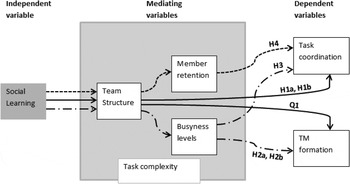
Because the teamwork in this research is discussed in terms of task coordination, it is important to consider the level of task complexity because task complexity would be intuitively expected to influence how much communication is needed to coordinate tasks. Therefore, Q1 and each of the hypotheses are tested across different tasks, differentiated in terms of task complexity, as explained in Section 4.5. Figure 1 shows the relationships between the IVs, MVs, dependent variables, and the hypotheses.
The conceptual framework for the research study. TM, transactive memory; H, hypothesis; Q, question.

4. DESCRIPTION OF THE COMPUTATIONAL MODEL
The computational model is implemented in the Java Agent Development Environment. The agent society consists of team agents, who perform the work, and a client agent, who allocates the task to the team and selects one of the team agents as the team leader. Team agents interact with each other to complete a given project that requires the completion of a set of tasks. For each simulation cycle, a team agent may: perform a task, directly communicate with another agent to assign a task, or observe other agents, which results in indirect communication. Direct communication is implemented as message passing between two agents. Indirect communication is implemented as a notification message to agents from the simulation environment of an observable event, that is, an observable task or an observable interaction between any two agents. The notification message contains details of the observable event, and all the agents that are not busy in a given simulation cycle receive this notification, contingent on the team structure. Thus, opportunities for social learning occur during each simulation cycle. There is one design-related activity in each simulation cycle. This activity is task allocation, refusal to perform a task, or task completion. Agents who are not directly involved in a design-related activity may receive an indirect communication about the design-related activity, contingent on their busyness and the team structure. The key implementation details of the model are briefly described in this section.
4.1. Team structure
The three types of team structures are implemented by defining the task allocation and social observation conditions. In flat teams, there are no constraints on direct and indirect communications across the team. In distributed teams, team members can have direct communication with all other team members, but their ability for indirect communication, that is, observations, is limited to their social groups. Agents in functional teams are constrained to have direct and indirect communications within their own functional groups only, apart from the group coordinator who can directly communicate with the coordinators of other functional groups.
4.2. Agent learning
Rather than modeling cognitively rich agents that improve their own performance through experience, the model implements the types of social experiences, that is, direct and indirect communications that have significant influences on individual learning, and how cumulative individual experience increases individual proficiency when agents have the ability to learn from others (Reagans et al., Reference Reagans, Argote and Brooks2005) about what others know so that the agents can be more efficient at coordinating work (Wegner, Reference Wegner, Mullen and Goethals1987). The model adopts the mechanisms of learning based on actions and observations (Tomasello, Reference Tomasello1999).
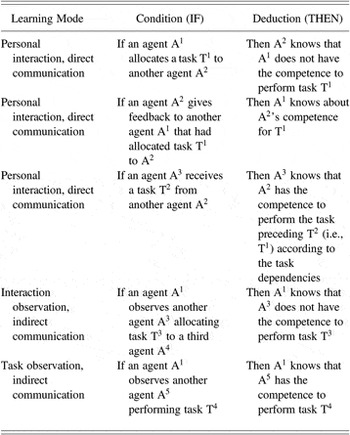
The social learning mode of PI occurs when agents are directly communicating with other agents to perform a design-related task, and the social learning modes of IO and TO occur when agents are not engaged in any design-related task and are instead observing other agents working. Social learning in agents is implemented as rules based on assumptions on the type of knowledge about another agent that could be gained from each mode of social learning (see Table 1). An agent's availability to attend to the observable data is mitigated by the level of busyness (see Section 5.2.3).
Learning assumptions corresponding to learning opportunities

4.3. Simulating TM formation
As agents communicate, they construct their TM. The development of their TM involves learning about the competence of each agent for each of the different tasks the team needs to perform. The competence details for an individual agent are termed the agent competence model (ACM), and collectively, the ACMs within an agent for all other agents form a TM. The TM formed by each agent may be different from the TM of another agent because the agents will have different opportunities for direct and indirect communications.
Competence is measured as the ratio of the number of times an agent successfully provides a solution for a given task to the number of times that task is allocated to the agent. The default value is taken as 1/2 because, unless it is known a priori, there is an equal likelihood that a given agent may or may not have competence in any of the given tasks. Thus, perceived competence tends to move toward either 0 or 1. As an example, at simulation cycle t, agent A1 performs a task T1, which was allocated to it in simulation cycle t – 1. Let an agent A2 be the observer, who at simulation cycle t – 2 had (1/2 as the value against T1 for A1's ACM. Thus, based on the observations in simulation cycles t – 1 and t, the updated value against T1 for A1's ACM will be (2/3), which is an increase in the competence value. In contrast, if in simulation cycle t, A1 shows failure to perform T1, the updated value would be (1/3), which is a decrease in the competence value. Another agent A3 might be busy in simulation cycle t and hence may not be able to update its ACM of A1 because it could not observe the design activity in that simulation cycle.
4.3.1. Implementing TM
The TM is represented as an m × n matrix, where m is the total number of tasks and n is the total number of agents. For example, if there are altogether m tasks to be performed, then the ACM of a team agent A1 will represent A1's competence in each of the m possible tasks. The collection of the ACMs of all n team agents, that is, A1 to An, will form an agent's TM, that is, the TM will have m × n values.
4.3.2. Using the TM for task allocation and handling
To allocate a task, agents directly communicate to the agent having the highest competence for the given task, and if an agent that has received a task has the competence to perform the task, it will. When the simulation starts (at time t = 0), all the agents have the same default value (1/2) for the competence in each task. This assumption can be relaxed if there is prior knowledge about each agent's skills. Given this assumption, agents initially allocate the task to a random agent. Once the agents have gained experience working with each other, there will be differences in known competence of the agents in a given task, gained through both direct and indirect communications. If more than one agent has the highest competence value, the agent allocates the task at random to any one of the agents from this short list.
Agents propose solutions based on their own competence and the range of acceptable solutions for the agent that allocated the task, that is, the task allocator. The task performer looks up in its TM the competence details of the task allocator corresponding to the given task. For the selected solution to be accepted, the solution must also overlap with solutions acceptable to the task allocator. Once the agent has identified a short list of solutions that it can provide and that are also acceptable to the task allocator, it can choose any of the solutions from the short list, provided the chosen solution has not already been proposed in the same project. Because the agent constantly updates the task allocator's ACM as soon as it gets a feedback, the task performer is able to adapt the solution to suit the task allocator. Thus, teams with a well-developed TM are expected to perform faster.
4.4. Measuring TM formation
Density of TM formation is measured as a ratio of the number of TM matrix elements for which the values are different from the initial values by the end of the simulation. At the start of the simulation, because each agent starts with a default value for each element in the matrix, the values in each element will change only if the agent has learned it through direct or indirect communications.
For example, let there be 10 agents in the team and a total of 10 tasks to be performed by the team. In that case, the TM is represented as a 10 × 10 matrix such that there are 100 elements in the TM. When the simulation starts, all the elements have a default competence value = 1/2. As the agents interact with and observe each other and the task, they learn about each other's capabilities in the different tasks and update the values of the corresponding elements in the TM. By the end of the simulation, let us assume that 60 of these values were updated, such that the value of each of these 60 elements is different from 1/2. Thus, the TM formation in this case is 60%.
Each agent maintains a separate TM, which it updates based on its own direct and indirect communications. Therefore, by the end of the simulation, each agent's TM will be different. However, overlap and similarities across the TM of the agents are likely. The overall TM formation for the team is calculated as an average TM formation for each agent in the team. For example, in a team of 10 team agents, if 4 agents have 60% TM formation, 4 agents have 40% TM formation, and 2 agents have 50% TM formation, then the overall TM formation for the team is 50%.
4.5. Modeling tasks
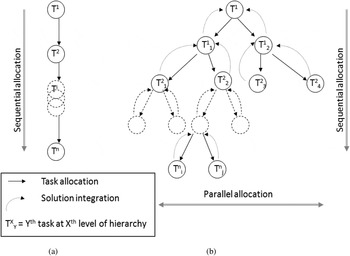
Gero (Reference Gero1990) classifies design tasks as routine and nonroutine, depending on the exploration of the design space. Brown (Reference Brown, Waldron and Waldron1996) suggests another additional dimension for classification of design tasks, namely, parametric/conceptual designs, based on the explication of the attributes that specify the desired design solutions. In this model, two types of parametric design tasks are simulated (simple tasks and complex tasks), such that they are differentiated in terms of the potential values for the attributes that specify the design problem, as shown in Figure 2.
Model task complexity for (a) simple tasks and (b) complex task.

Simple tasks are tasks with unique solutions such that any two agents performing the same task will provide the same solution. All that the agents need to know is “who knows what.” For example, tasks such as drafting and parametric dimensioning of standard structural elements are simple tasks because any two individuals performing the same task will provide the same solution.
For simple tasks, the task handling has sequential hierarchy and dependency (see Fig. 2a). There is a predefined set of tasks, such that one task leads to another. Because the solutions to simple tasks are unique and there are no parallel dependent tasks, the solutions for simple tasks are not subject to any compatibility check. For example, if an agent has completed task T2, the next task to be performed is always T3. Initially, the client allocates the first task on the basis of solutions proposed by agents in the team that express interest in leading the first task. Thereafter, the agents coordinate among themselves to pass on the resulting task to other agents before the set of tasks is complete. If an agent has knowledge in its TM of the competence of a specific agent to complete a task, the agent immediately assigns the task to that agent through direct communication. If the agent has no knowledge in its TM of which agent could complete a task, it randomly chooses an agent and sends a direct communication to inquire if that agent can complete the task. It continues to communicate directly with agents until an agent accepts the task. During each direct communication event, the agent updates its ACM about agents who could and could not complete the task. Each direct communication requires one simulation cycle. Agents that are not involved in the direct communication in that cycle may have the opportunity for observations or indirect communication, contingent on their busyness levels and the team structure. Once the last task is completed, the client is informed of the completion, closing the project simulation.
Complex tasks are tasks for which solutions may vary from person to person depending upon their expertise level are considered complex tasks. These tasks require hierarchical decomposition (see Fig. 2b). These tasks are similar to the complex architectural and engineering design problems that require decomposition according to functions, structures, or (modular) subsystems (Eppinger & Salminen, Reference Eppinger and Salminen2001). For a given task, multiple solutions may exist and an agent working on a task may only find some of the solutions that lie within their competence range, where the competence range of an agent is the range of solutions that an agent can provide or assess for a given task. The competence range is a proxy for the degree of skill for an agent. Two agents assigned the same task may provide different solutions because they may have different competence ranges for the same task. The task performers (agents) need to know the solution space acceptable to the evaluator (some other agent or the client) to prevent providing a solution incompatible to the task allocator. Agents learn about the acceptable solution space of others as they interact and communicate with them. Similarly, the client has a desired range for the overall solutions. The team agents are required to collectively generate a solution that falls within the client's acceptable range. The teamwork involves coordination and evaluation of the subsolutions such that all the subsolutions are compatible.
For the complex tasks, one subtask may branch out into multiple subtasks. Solutions to all the subtasks need to be compatible. Hence, such tasks require solution integration and compatibility check. This may require reallocation of the same tasks to the same or some other agent. The solutions are evaluated at the integration stage, following a top-down approach, that is, the solutions for higher-level tasks are completed first. Initially, the client approves the overall acceptable solution range (e.g., an acceptable solution for T1 in Fig. 2b). The team leader, appointed by the client on the basis of an expression of interest, considers this approved range as the boundary limit when evaluating the solutions for the corresponding subtasks, that is, T11 and T12. Once the team leader approves subtasks provided by other agents, those agents consider the approved solution as a benchmark to reset the acceptable solution range for the solutions to be coordinated at the next lower level, that is, T2x (x = 1, 2, 3, 4). This cycle continues until all the tasks are decomposed into the lowest levels. If the integrated solution exceeds the boundary conditions, the agent evaluating and coordinating the integrated solution, that is, the evaluator, chooses one of the subsolutions to be reworked. For example, if the solutions proposed for T11 and T12, each performed by different agents, do not fit together when evaluated in terms of the solution accepted earlier for T1, then one of the two tasks, T11 or T12, needs rework. This cycle of task evaluation and rework continues until the subsolutions are compatible at each level. The direct communications between agents to coordinate tasks are otherwise identical to the agent communications for simple design problems as are the social learning opportunities and indirect communications when an agent is not performing design work (has no assigned task).
5. SIMULATION DETAILS
5.1. Experiment matrix
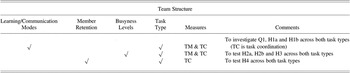
Table 2 shows the experiment matrix. To investigate Q1 and H1, experiments were conducted to ascertain the contributions of different learning modes associated with direct and indirect communications to TM formation across the different team structures. These simulations were conducted with busyness level = 0 and membership retention = 100%. Thereafter, simulations were conducted with varying busyness levels to test hypotheses H2a, H2b, and H3. Simulations with varying levels of member retention were conducted to test H4. All the simulations were conducted with each task type to study the effects of task complexity on the simulation results.
Experiment matrix

Note: TM, transactive memory; TC, task complexity.
5.2. Overview of the simulation
5.2.1. The simulation loop
At the start of the task cycle, the client invites expressions of interest from all the agents. Agents who can perform the “firstTask” propose solutions for the first task and express interest to lead the hierarchical set of tasks for complex tasks. Based on the proposals, the client chooses one of the agents to lead the tasks. Thereafter, the agents communicate with each other to identify experts and coordinate the task allocation and handing as described in Section 4.5.
A single simulation run consists of two simulation rounds: a training round and a test round. In the training round, agents start with default (experimenter-defined) values for the ACM and none of the agents has any TM formed at this stage. A training round is needed to simulate member familiarity, such that some or all agents can be retained in the test round, simulating the level of member retention. Once the training round is completed, the test round is run. All the agents retained from the training round to the test round carry over the TM formed during the training round. Changes to the TM from the training round are used as the basis for TM formation. Measurement of task coordination is based on the results from the test round. For each scenario, the results are based on 60 simulation runs, which was found to give acceptable statistical confidence level (> 99%) in the results using split-half t tests.
5.2.2. Simulating member retention
The level of membership retention is taken as the number of agents retained from the previous project, such that if all the agents are the same in the training round and the test round, the level of membership retention is 100%. If the membership retention is 100%, all the agents retain their TM. If the membership retention is less than 100%, new agents are introduced into the team, such that each new agent acquired in the team replaces an agent that was part of the training round. For example, let there be 10 agents, A1 to A10, who were part of the team in the training round. If the desired membership retention in the test round is 80%, then the new team has 8 agents retained from the training round and 2 new team agents, for example, A3′ and A7′, such that they replace the other 2 agents, A3 and A7, that were not retained from the training round.
Although all new agents (i.e., A3′ and A7′) start with a default TM, the agents retained from the training round (i.e., A1, A2, A4, A5, A6, A8, A9, and A10) reset their ACM of the agents that have been replaced (i.e., A3, A7) while retaining the ACM for the rest of the agents (i.e., A1, A2, A4, A5, A6, A8, A9, and A10). That is, the retained agents retain part of their TM, whereas the other part (i.e., related to A3 and A7), is reset to default values (to be used for ACM of A3′ and A7′).
5.2.3. Modeling busyness levels
Busyness is implemented as the probability that an agent is not able to sense the observable data, that is, does not notice the indirect communication. Observable situations associated with indirect communication include interactions among other agents (IO) and task performance by some other agent (TO). The busyness levels are varied in the training round itself and not in the test round. The effects of busyness on the level of TM formation are measured in the training round. Busyness levels in the training round should effect the task coordination during the corresponding test round. Hence, the mediating effects of busyness levels on task coordination are measured in the test rounds.
6. SIMULATION RESULTS AND DISCUSSION
6.1. Effects of communication
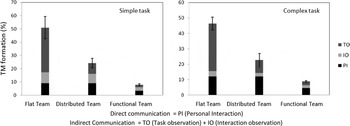
Figure 3 shows the contributions of different social learning modes associated with direct and indirect communications to TM formation across different team structures. Relative contributions of the learning and communication modes are obtained by juxtaposing the results from simulations with the following learning cases:
• PI + IO + TO: All learning modes of social learning are available to the agents.
• PI + IO: None of agents can observe others perform the tasks.
• PI: All agents learn only from personal interactions, that is, only direct communications.
The density of transactive memory formation as a consequence of differing team structures and modes of learning and communications for both simple and complex tasks.

As expected, findings show that TM formation is higher in flat teams, compared to distributed teams and functional teams. These results are consistent with the reported challenges in role clarity, task coordination, and teamwork in distributed work groups (Cramton, Reference Cramton2001; Huckman & Staats, Reference Huckman and Staats2011; Staats, Reference Staats2011). Our findings indicate that, in team environments with greater opportunities for communications, indirect communications play a major role in TM formation. Because flat teams have no subgroups or internal boundaries that obstruct observations, indirect communications contribute more to TM formation than do direct communications.
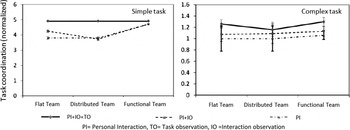
Figure 4 shows the contributions of different learning and communication modes to task coordination across different team structures. The task coordination measures are normalized for this analysis, such that the worst task coordination across all the simulations (maximum number of messages) is considered 1 and higher coordination is shown as increasing. (This normalization is inverse to a standard normalization because the maximum number of messages indicates worst coordination, and hence that is taken as the reference point, i.e., 1.) For each case, the normalized coordination value is obtained by dividing this maximum value by the number of messages in each case. For example, if worst case has 147 messages, and best case has 32 messages, then normalized coordination for the best case is 147/32.
Task coordination as a consequence of differing team structures and modes of learning and communication for both simple and complex tasks.

Simulation results show that teams perform more efficiently when they have opportunities for both direct and indirect communications (PI + IO + TO). Nonetheless, different modes of indirect communications have differential contributions to task coordination. TO contributes more to task coordination than IO. In terms of coordinating simple tasks, the role of indirect communications in improving task coordination is more significant in flat teams. In terms of coordinating complex tasks, there is no noticeable difference in the coordination across the team structures for most cases. However, overall the results indicate that, in general, functional teams perform more efficiently than flat teams, partly supporting hypotheses H1a and H1b.
The results from simulations conducted to investigate Q1, H1a, and H1b suggest that indirect communications, that is, both IO and TO contribute to the density of TM (see Fig. 3) and to the task coordination (see Fig. 4). Across both measures, the contributions of TO are higher than IO. The differences across the learning cases are higher for TM formation than for task coordination, indicating that indirect communications contribute more to TM formation than to task coordination.
We should have expected that an increase in TM formation due to increasing opportunities for indirect communications should be followed by a corresponding increase in task coordination. However, this was not the case, as increasing opportunities for indirect communication had a milder effect on improving task coordination even as TM formation increased. This discrepancy could be explained in terms of what is described as “importance,” a key characteristic of team mental models, a construct related to TM (Badke-Schaub et al., Reference Badke-Schaub, Neumann, Lauche and Mohammed2007). TM is formed as agents develop ACMs of all other agents in the team. However, not all ACMs are equally critical to task coordination. For any agent in the team, it is more important for it to identify and develop ACMs of those agents that it will need to directly communicate and coordinate the tasks with, and it may not matter much to task coordination if the agent is not able to know about the competence and skill levels of the rest of the agents.
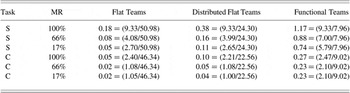
Knowing a priori what will be important in the TM may not always be possible in real-world cases because of the iterative and emergent nature of design and hence the lack of clarity in what (and whose) knowledge could have been important. Therefore, the “efficiency of TM” is introduced as a measure to assess indirectly the formation of an important TM. The efficiency of the formed TM is defined as the ratio of the task coordination to the total amount of TM formed (see Table 3).
Measuring efficiency of transactive memory (task complexity is normalized)

Note: S, simple task; C, complex task; MR, membership retention.
As seen in Table 3, regardless of the experiment scenarios and the variations in member retention or task complexity, functional teams are more efficient in the formation of an important TM. In functional teams, agents primarily communicate with agents within their own task groups, and that is where most of the task coordination is needed. This explains why functional teams are efficient in developing important TM. This also explains why global projects are still successful despite distributed work groups with lower overall density of TM formation. Organizing larger project teams into smaller work groups reduces the task coordination efforts and TM requirements at the team level by splitting the coordination requirements and reinstating the significance of the methodical organizational breakdown structure (Sosa et al., Reference Sosa, Eppinger and Rowles2004).
6.2. Effects of busyness
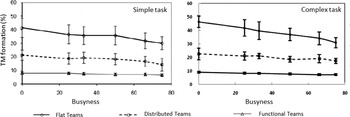
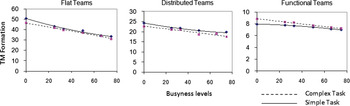
As expected in hypothesis H2a, the reduction in the density of TM formation with the increase in busyness levels is higher in teams with greater opportunities for communications. Simulation results support H2a. Accordingly, the observed negative effects of higher busyness levels on TM formation are highest in flat teams and lowest in functional teams, as shown in Figure 5, supporting H2b. The reduction in TM formation with the increase in busyness levels shows a similar pattern across all team structures regardless of the task type, which is demonstrated in Figure 6.
The effect of team structure and busyness levels on transactive memory (TM) formation for a complex task.

The effect of busyness levels, team structure, and task type on level of transactive memory (TM) formation. [A color version of this figure can be viewed online at http://journal.cambrige.org/aie]

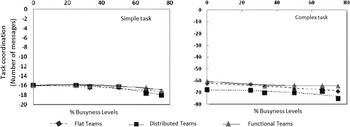
Figure 7 shows the effects of busyness on task coordination across both task types at 100% member retention. In Figure 7 task coordination is represented through negative numbers because coordination is measured in terms of the number of messages (direct communications), such that fewer messages correspond to higher task coordination. In the computational model, the number of messages taken by the team is an indicator of the time taken to complete the task. Teams that require fewer messages complete the task faster. A marginal decrease in task coordination with an increase in busyness levels is observed across all team structures, providing insufficient evidence to support or refute hypothesis H3, that higher busyness levels have greater effects on the task coordination in functional teams.
The effect of team structure, busyness levels, and task type on task coordination, measured as the negative of the number of messages (values closer to zero indicate higher coordination).

The variations across the team structures resulting from higher busyness levels are higher on TM formation than on the task coordination, which is consonant with the earlier conclusion that indirect communications have a greater effect on the density of TM formation as compared to task coordination.
6.3. Effects of membership retention
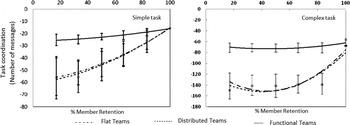
In hypothesis H4, it was expected that the decrease in task coordination resulting from the reduction in the level of member retention is highest in functional teams. Figure 8 shows that the findings reject H4. In absolute terms, the decrease in task coordination resulting from the reduction in membership retention is higher for flat teams and distributed flat teams than that for the functional teams. However, in relative terms, this increase in task coordination caused by the increase in member retention across the different team structures may be comparable. The scope of improvement in the task coordination of functional teams is lower because functional teams show higher efficiency of formed TM, resulting in high task coordination notwithstanding the levels of membership retention or busyness of the team members. In functional teams, even at lower levels of membership retention, which means lower predeveloped TM, the agents' search space for the relevant task experts is narrowed within the corresponding task group rather than the entire team. This smaller search space compared to the flat teams or distributed flat teams inherently reduces the effort in communicating and coordinating the tasks, giving functional teams a greater efficiency in task coordination.
The effect of team familiarity and team structure on task coordination, measured as the negative of the number of messages (lower negative numbers indicate higher task coordination).

The higher scope of increase in task coordination with the increase in member retention in flat teams highlights another important aspect of TM formation. Indirect communications not only allow knowing who knows what but also allow agents to know who does not know what without having to directly communicate and ask around. This allows narrowing of the search space through a process of elimination, which becomes more critical in flat teams than in functional teams. Thus, in a team environment, it may be important not only to identify relevant knowledge sources but also to know which sources to exclude in time-constrained situations. Indirect communications can play an important role in gaining such information.
The findings from simulations with membership retention and team structures are in agreement with the recent findings from Staats (Reference Staats2011), who found that the team familiarity gained under differential conditions (e.g., team structure) have differential effects on task coordination. Staats found variations in the quality of familiarity gained across distributed and colocated team members. The variations can be attributed to the variations in the scope for direct and indirect communications, and hence, the variations in the opportunities for social learning.
In summary, indirect communications contribute more to TM formation than to task coordination. Teams with greater opportunities for communications will show higher improvements in TM formation. Task coordination is faster if the teams are organized as functional teams, whereas TM formation is higher in flat teams. This indicates that although TM mediates task coordination, there is a limit to the value of TM, at which point the importance of the TM becomes critical to task coordination. Organizing teams into functional teams may reduce the need for high levels of TM formation to achieve task coordination.
7. CONCLUSIONS
The findings reported in this paper are applicable to design teams working on tasks where task coordination is the key performance barrier rather than the creativity or novelty of the design outcomes. The simulation results demonstrate the importance of indirect communications in teams toward TM formation, a prerequisite for effective teamwork. The main contribution of this paper is to establish that the different social learning modes associated with direct and indirect communications resulting from different team structures have differential effects on TM formation and task coordination. The paper also establishes the need to distinguish important elements in a TM. An important TM is found to have stronger mediating effects on task coordination as compared to the mediating effects of TM.
These findings suggest that flat teams allow the highest levels of TM formation, wherein the team members have greater access to direct and indirect communications with all other team members. However, higher levels of communication may not necessarily increase team efficiency. Simulation results show that functional teams are most efficient in terms of task coordination, where the direct and indirect communications are primarily limited to the functional group. The efficiency of functional teams is a result of communication that directly contributes to the formation of an important TM. An important TM contains knowledge of competence of those team members whose roles are directly related to the tasks and who must communicate directly to coordinate the tasks with each other. Our results provide further confirmatory evidence of the necessity of aligning organizational communication alongside product functionality and architecture (Sosa et al., Reference Sosa, Eppinger, Pich, Mckendrick and Stout2002, Reference Sosa, Eppinger and Rowles2004). The observed differences in the efficiency of formed TM based on direct and indirect communications are congruent with Gino et al.'s (Reference Gino, Argote, Miron-Spektor and Todorova2010) findings that direct experiences lead to higher task performance, mediated by TM formation. However, it must be noted that Gino et al. (Reference Gino, Argote, Miron-Spektor and Todorova2010) studied the effects of direct and indirect task experiences, not communications, on team creativity and not on task coordination.
Based on the findings, it is recommended that in scenarios where task coordination is critical but team retention is low (or personnel turnover is high) functional teams should be preferred. If the team is likely to be retained for longer term or for multiple future projects, and variations in the task are expected, then flat team structures should be adopted, at least in the norming phase (Tuckman, Reference Tuckman1965). At the same time, for the projects and activities aimed as team-building exercises, team members should have more opportunities for direct and indirect communications, for which colocated flat teams are more suited. In addition, the workload distribution of team members should be managed to ensure sufficient opportunity for them to follow team members' activities. Distributed teams constrained by other factors can reinforce the social interaction and observation opportunities through technological and communication media where all team communications, updates, and activities are available to all the team members, facilitating indirect communications. Therefore, in distributed flat teams, how the team communication is organized and facilitated through social media (Wilson et al., Reference Wilson, Guinan, Parise and Weinberg2011) will play a critical role in TM formation.
To conclude, this paper discusses the effects of direct and indirect communications on task coordination and TM formation resulting from variations in team structure. The reported findings are based on computational studies that simulate scenarios wherein social learning modes associated with direct and indirect communications, team member retention, and cognitive busyness levels are varied along with the team structure. Findings indicate that indirect communications contribute more to TM formation than to task coordination. Flat teams show higher TM formation, whereas functional teams are more efficient in task coordination, suggesting that the role of TM formation in mediating task coordination varies with the team structure. However, the underlying assumptions in the model and the simplifications of the simulation scenarios resulting from controlled parameters need to be considered in interpreting the results. In particular, it is important to note that although literature shows that less communication to achieve the same set of tasks indicates higher task coordination, it is acknowledged that less communication in teams may not be advantageous in the long term (Katz, Reference Katz1982). We need to distinguish between communication to coordinate tasks and communication to learn about each other's competencies so as to form TM. This is an important distinction. When teams need to be efficient, they should be able to achieve task coordination with the least amount of communication (Entin & Sarfaty, Reference Entin and Sarfaty1999). However, in order to ensure that they can continue to be efficient, the team members should continue to communicate about their knowledge and capabilities as much as they can, so that the level of knowledge about roles and capabilities remains high. Indirect communications and flat team structures are particularly important in this team-building and TM formation objective.
Vishal Singh is an Assistant Professor of computer-integrated construction (building information modeling) in the Department of Civil and Structural Engineering at Aalto University. He has multidisciplinary research interests investigating the interaction among products, processes, and people within the design and construction domains. He combines various qualitative and quantitative methods in his research with the aim to develop computational models and tools to support decision making in ill-defined problems, especially in a design and social context.
Andy Dong is the Warren Centre Chair in Engineering Innovation in the Faculty of Engineering and Information Technologies at the University of Sydney. His research is in design-led innovation, where he has made significant methodological contributions in explaining the dynamic formation of design knowledge. For this work in the context of creative teams, he received the Design Studies Prize in 2005 for the most significant journal article in the field. He is currently an Australian Research Council Future Fellow working on predictive analytics to forecast rates of potential progress of engineered products based on their underlying knowledge structure.
John S. Gero is a Research Professor at George Mason University and at the University of North Carolina, Charlotte. He is the author or editor of 50 books and over 600 papers and book chapters in the fields of design science, design computing, artificial intelligence, computer-aided design, design cognition, and cognitive science. He has been a visiting professor of architecture, civil engineering, cognitive science, computer science, design and computation, and mechanical engineering at MIT, University of California–Berkeley, University of California–Los Angeles, Columbia, Carnegie Mellon University, Strathclyde University, Loughborough University, INSA-Lyon and Provence, and EPFL–Lausanne.