An examination of the social uprisings of late colonial Southeast Asia is central to a historical understanding of the region. The Cambridge history of Southeast Asia reports that the ‘period from the mid-nineteenth to early twentieth century in Southeast Asia’ was marked by a ‘multitude of resistance movements, popular rebellions, [and] acts of insubordination’.Footnote 1
This chapter of the Cambridge history was written by Reynaldo Ileto, whose 1979 work, Pasyon and Revolution: Popular movements in the Philippines, 1840–1910, established him as a pre-eminent historian of social movements and peasant uprisings.Footnote 2 Both the argument and methodology of Pasyon and Revolution shaped subsequent scholarship, particularly as it examined the role of lower-class consciousness in revolts and the sources which could be used to reconstruct it. Ileto sought to establish the categories of perception of the Filipino ‘masses’ — peasants and workers — that informed and guided their participation in uprisings throughout the late nineteenth and early twentieth centuries, including the Philippine Revolution against Spain and the Philippine–American War.
An examination of lower-class consciousness will not in itself account for why peasants and workers revolted. To address this requires that explanatory primacy be given to objective historical changes in the economic structure of society, above all the upheaval produced by the incorporation of the colonies into the global capitalist market which was driven by the pace of industrial production. Ileto's quest, however, is a vital one if we are to understand how the peasantry and lower classes more broadly construed their own activities.
What sources can scholars use to reconstruct this consciousness? This was the question which occupied Pasyon and Revolution and was Ileto's great contribution to the field, giving both impetus and form to a good deal of subsequent scholarship throughout the region.Footnote 3 Ileto located pasyon, the publicly sung narrative of the suffering of Christ, and awit, a Tagalog verse form, as the pre-eminent sources for this reconstruction in the Philippines. He approached both sources, however, as texts, in which the basic unit of meaning is the lexeme and allusions are intertextual. I have argued elsewhere that, when examined in the context of their historical performance, these sources prove to be inadequate to the task.Footnote 4 Both pasyon and awit were performed in a shared class space, in which the elite and masses jointly participated and which reinforced existing class hierarchies, and thus neither of these sources can provide access to lower-class conceptions in the nineteenth-century Philippines. Any attempt to extract lower-class perceptions from these cross-class performances would necessarily entail starting with our own preconceptions and imposing them upon our subject; it would presuppose precisely what it was necessary to discover.
Thus, while Ileto's quest for historical sources of lower-class consciousness in the Philippines provided a much-needed impetus to subsequent scholarship, his own findings distorted the very voices which he sought to recover; they also pointed future research in a similar direction. This criticism does not invalidate the quest, it simply means that to address ourselves to lower-class consciousness and perception, we must locate new, class-specific sources, and we must read them with a heightened sensitivity to their historical reception within performance.
Where would attentiveness to performance take us? Among the sources which Ileto touched upon in his work was the legend of Bernardo Carpio, the chained king under the mountain whose imminent escape would spell ruin for the colonial masters. As I document in this article, Ileto subsumed the folk legend to elite verse, and its performance to the printed text, and thus missed the significance of this rich source. If treated as a separate item belonging to a distinct genre, the Carpio legend proves to be a source with which we can begin to reconstruct the consciousness of the lower classes during a time of upheaval. The detailed examination of the Carpio legend and its historical context in this article reveals a set of conceptions of markedly different shape to those depicted by Ileto. Rather than a counter-rational expression of peasant millenarianism, the legend was the ‘hidden transcript’ of subversive historical memory: it celebrated the history of social banditry in the region.
What follows can be read as a case study, demonstrating the rich explanatory effectiveness of an alternative way forward in locating the voices and conceptions of the peasantry and oppressed masses in a period of immense upheaval. Its hermeneutical conception and historical methodology can, I believe, be productively applied to similar problems throughout the region.
Bernardo Carpio, awit
Ileto examined the awit Historia famosa ni Bernardo Carpio in detail. The story of Bernardo Carpio was based upon the sixteenth-century Spanish romances of Lope de Vega, in particular Las mocedades de Bernardo del Carpio and El casamiento en la muerte.Footnote 5 The oldest extant copy of the Historia famosa dates to 1860, and subsequent editions did not alter the text. The more widely available 1919 edition printed by J. Martinez was a verbatim reproduction of the 1860 original. This clearly indicates that there were not multiple versions of the Carpio awit in circulation nor was it a text based upon a pre-existing oral tradition. The Historia famosa is an excellent example of the urbane, sophisticated compositions that came from the school of Huseng Sisiw and Francisco Baltazar in the mid-nineteenth century.Footnote 6
Damiana Eugenio in her work, Awit and corrido,Footnote 7 neatly summarised the Historia famosa. Her summary, which Pasyon and Revolution used almost word for word, separated portions of the awit which should have been treated as a seamless whole, and at the same time collapsed together two distinct works which should have been treated separately. The first portion of the Historia famosa is the narrative, based upon Lope de Vega's Spanish text, which relates Bernardo's struggles both against the treacherous usurper who has betrayed his father, and against the Moros. The second is the conclusion to the awit, which Eugenio treated as a localisation and appendix. Bernardo Carpio, having conquered the Moros, goes off to fight against ‘idolaters’, worshippers of anito or spirits. He sees lightning strike and two mountains colliding against each other and he plunges in between them, with sword drawn, and the mountains close after him. Finally, Eugenio summarised a ‘legend’ which told of how Bernardo Carpio was imprisoned in a cave in San Mateo, but would soon be freed and would liberate the oppressed of the Philippines.
There are two problems with the presentation of the Historia famosa ni Bernardo Carpio in both Eugenio's work and in Pasyon and Revolution. First, they drew a sharp line between the story of Carpio's struggle against the Moros and that of his subsequent struggle against idolatry. The latter section is treated as the localisation of a foreign narrative, the ‘appropriation by the Tagalogs of a Spanish hero’.Footnote 8 Ileto argued that it is ‘curiously reminiscent of Colorum rituals’ (PAR, p. 101). What this analysis ignores is the seamless connection between the two Carpio narratives — that of his struggle against the Moros and of his subsequent struggle against idolaters. They are a single composition, written in the polished and sophisticated style of nineteenth-century urban poetry. That which Eugenio and Ileto treated as a ‘localisation’ was in truth the literary depiction of the extension of Spanish proselytisation to irredentist native beliefs. The colliding mountains, nag-uumpugang bato (lit., ‘colliding rocks’) — two sheer cliff faces separated by a narrow canyon, a comparatively common feature of the Sierra Madre massif's karst topography — are a feature of this belief system. Carpio travels here to fight the anito worshippers. He is not trapped at the end of the awit; rather, he enters the mountains to fight against residual pre-Hispanic beliefs. Eugenio and Ileto considered Carpio to be trapped because they read the awit in light of the separate legend.
The second problem in their treatment of this story was the incorporation of the Carpio legend as the conclusion to the awit. The legend is an item that deserves detailed separate study. It emerged not from urban poets, but from popular culture in opposition to the Historia famosa ni Bernardo Carpio’s conclusion. It was never part of the text of the awit, nor was it ever performed in verse or circulated in written form. Legend is an entirely separate genre from folk poems, and the Historia famosa was never a folk poem — it was an elite textual composition. That Pasyon and Revolution asserted ‘our uncertainty as to whether or not it appeared in the published awit’ (pp. 101–2, n.39) indicates a failure to draw a basic distinction in genre.
Reconstructing perception using the Carpio legend
Ileto's depiction of the Carpio legend as the popular continuation of the Historia famosa was an extension of the elite, textual hermeneutic which he employed in reading the awit. This approach inhibited recognition of the legend as a ‘hidden transcript’ of opposition to the urban elite who produced, and read, the awit.Footnote 9
Like other scholars, Ileto not only conflated awit and legend, but he also combined multiple separate legends and variations of legends into an admixture from which little historical insight can be gained. We must disambiguate and analyse the various sources of the Carpio legend, situate them in their original contexts, and recreate how they would have been performed.
The earliest version of the legend which I have been able to locate tells of an ‘old man in the cave’. Ileto and others treat later fragments of this story as part of the Carpio liberator legend, but it was in fact a separate legend entirely. Gironière's Twenty years in the Philippines is a source to which we shall return in much detail. It contains an appendix written in English in 1853 by the British explorer H. Hamilton Lindsay. In this appendix Lindsay told of his journey with Gironière to the cave of San Mateo and concluded his account by summarising a legend. No previous scholar has drawn attention to this text, so I shall quote it in its entirety:
They have a curious legend respecting the cavern, which has a singular resemblance to the German tale of the ‘Three Brothers,’ in the Hartz Mountains.
An Indian one day entered the cave to catch bats, with the wings of which they compound some sort of medicine. On arriving at the stream of water he saw a venerable old man on the other side, who offered his hand to help him across the stream. The Indian was rather shy of his new acquaintance, and held out the end of his stick, which the old man took, and it instantly turned into charcoal. Upon this the Indian became anxious to return, and thanking the old man for his politeness, told him he did not mean to go any further that day.
The old man then offered him three stones, and, to remove any fear of their burning his fingers, deposited them in the stream. The Indian took them, and retreated as quick as he could, without looking behind him; and, on examining the stones at the mouth of the cave, to his surprise he found them to be three masses of pure gold. The story did not go any further, as to what use he made of his riches. The old Indian who told me this story said it happened long before the arrival of the Spaniards.Footnote 10
Lindsay would have heard this legend through an interpreter. We do not have the actual text of the legend, evidence of the texture of its performance, or the context in which it was traditionally performed. What we have is a legend summary. It is nonetheless quite useful, as it will allow us to separate the various elements which later became identified with the Carpio legend. As Lindsay's account was published seven years before Bernardo Carpio entered Philippine literature in the 1860 Historia famosa, we can safely say that the original San Mateo cave legend had nothing to do with him.
The Carpio liberator legend was first summarised by José Rizal in his second novel, El Filibusterismo, which he published in 1891. The fifth chapter, A cochero's Christmas eve, tells of a calesa driver, a cochero, who has been detained by the guardía civil because he was missing his cedula, the obligatory identification card of Spanish colonialism. As he is driving his passenger Basilio to the town of San Diego, they encounter a Christmas procession. The cochero sees the Three Kings in the procession,
And, observing that the black was wearing a crown and was a king like the other two Spaniards, he naturally thought of the King of the Indios and sighed. ‘Do you know, Señor,’ he asked Basilio respectfully, ‘if the right foot is free by now?’ Basilio repeated the question. ‘The right foot? Whose?’ ‘The King's!’ answered the cochero in a low voice with much mystery. ‘Which King?’ ‘Our King, the King of the Indios … ’ Basilio smiled and shrugged his shoulders. The cochero sighed again. The Indios in the countryside treasure a legend that their king, imprisoned and chained in the cave of San Mateo, will one day come to deliver them from oppression. Every hundred years he breaks one of his chains and he already has his hands and his left foot loose; only the right foot remains chained. This king causes earthquakes and tremors when he struggles or is agitated. He is so strong that one can shake his hand only by holding out a bone, which upon contact with him is reduced to powder. For no explainable reason, the natives call him King Bernardo, perhaps confusing him with Bernardo Carpio. ‘When the right foot is free,’ murmured the cochero, letting out a sigh, ‘I will give him my horses. I will place myself at his service and die for him … He will free us from the civiles.’Footnote 11
Here we find preserved in Rizal's work a legend about an imprisoned liberator in the ‘cave of San Mateo’. Aspects of this legend derive from the ‘Old man in the cave’ legend, namely holding out the bone which upon contact is ‘reduced to powder’, which corresponds to the stick turning to charcoal in Lindsay's version of the legend. We are still dealing with a legend summary, however; we do not have a text of the performance of the legend. Rizal accurately placed the legend on the lips of a member of the lower classes, a cochero, the driver of a horse-drawn calesa.
Claudio Miranda, in a 1911 work on Philippine customs, provides us with additional insight into the legend.
Popular credulity has gone so far as to hope for the liberation of Bernardo del Carpio, one of the fantastic characters of Tagalog legend, imprisoned, according to the imagination of the commoners, between the two enormous rocks of Biaknabató, so that he might exterminate the hunters who defend the Spanish forces. Nothing more is lacking but to free a single foot (paa na lamang ang culang) in order to escape — they assure us — and when he is free, the war will be over, for Bernardo del Carpio can do anything.Footnote 12
Miranda's version of the legend is problematic on several levels. He was at a greater historical remove from the context of the performance of the legend. He refers to Carpio as Bernardo del Carpio, the name used in Lope de Vega's Spanish version; in Philippine folklore he is known simply as Bernardo Carpio, the locative has become a surname.
Miranda places Carpio not at San Mateo, but at Biaknabató, another location famed for its nag-uumpugang bato. It seems unlikely that Miranda is recording a geographical variant of the legend; rather, he is simply erring in his summary. He does, however, provide us with an invaluable fragment of an actual performance of the legend: ‘Paa na lamang ang kulang’ (only the foot is lacking).
A version of the legend recorded in 1917 has Rizal visiting the old man in the cave of San Mateo, who is revealed to be Bernardo Carpio. Rizal extends a bone to Carpio and it crumbles to dust when he touches it. Rizal returns and informs others that Carpio has only one foot still chained.Footnote 13 In a version of the legend documented in 1940, Carpio is no longer chained, but imprisoned by God ‘for his sins’ and is lying among the dead. A bone is extended to him and he crumbles it to dust. He tells his visitor to devoutly say ‘Christum’ to ward off danger, adding that he would soon rise to save the ‘oppressed people’, in keeping with the reasons of Almighty God (PAR, p. 100).
By the time these last two legends were summarised, Bernardo Carpio had become a residual tradition. Idiolect had come to dominate performance. Elements persist: the bone, San Mateo, etc., but the legend was no longer anchored in a community. These later summaries are of dubious value for recreating legend performance at the time of the Philippine revolution.
We thus see a dynamic and evolving legend with multiple variants. Ileto, like all other scholars on this subject, collapsed these variants together as a single narrative. Having conflated these variants, what use does Ileto make of the legend? He connected the legend with the revolutionary leader Andrés Bonifacio, telling of his journey in 1895 to the cave of San Mateo. Bonifacio and his katipunero associates travelled to the cave during Holy Week.Footnote 14 ‘Could it be merely coincidental,’ Ileto asked, ‘… that the group chose the Holy Week of April, from Holy Tuesday to Holy Saturday, to make the climb?’ (PAR, p. 99). His question implies that the Katipunan leaders’ trek should be linked with religious journeys and pilgrimages, and the collection of anting-anting — amulets used to ward off bullets and protect from harm — but Bonifacio and his companions travelled during Holy Week for a more mundane reason, one which any worker in the Philippines would understand. During Holy Week all business shuts down, and this would have been the only opportunity for a group largely composed of salaried and wage labourers to travel together and to do so without raising suspicion.Footnote 15
It does not matter that the leaders of the Katipunan travelled during Holy Week for purely pragmatic reasons and that there was no ‘pilgrimage’ — what is important, according to Ileto, is how the ‘masses’ would have perceived the event. What do we learn in Pasyon and Revolution from the Carpio legend, and Bonifacio's visit to the cave of San Mateo? Sadly, little. According to Ileto, the masses actually believed in the existence of Bernardo Carpio. The masses inhabit ‘a society where King Bernardo Carpio was no less real than the Spanish governor-general’.Footnote 16 Bonifacio, by travelling to the cave, was perceived as identifying with this real king; he was seen as trying to awaken him. Bonifacio thus inspired the devotion of the masses. Ileto treated the legend of Bernardo Carpio as a counter-rational, messianic means of mobilising dissent.
To read legends as embodiments of the actual beliefs of the ‘masses’ unfortunately recapitulates in scholarly guise the preconceptions of the very elite from whom the scholar is attempting to distinguish mass consciousness. One finds this notion of mass credulity in both Rizal's and Miranda's summaries. To treat our subject — the consciousness of workers and peasants — seriously, requires that we find in its content something of greater historical complexity than the age-old allegation of unmitigated superstition. How should we read legend?
Legend as performance
To understand the significance of the Carpio legend we must do more than establish the meanings of the words and sayings it contained. We must seek the effect of the legend's performance in its historical social context.
The performance of a legend, when addressed to a community familiar with it, brings to life an entire body of tradition, and thus to grasp the legend's meaning, we need to recreate the lost context of oral tradition which lurks behind the entexted or summarised utterance. Tradition cannot be reduced to intertextuality; it is the entire nexus of ideas and allusions which a culture creates and upon which it thrives.
Oral traditions generally have a great deal of regional variation. For the legend genre in particular it is the geographical referents, the allusions to place, which most commonly vary as the legend spreads. Timothy Tangherlini summarised the scholarship on the legend genre in his article, ‘It happened not too far from here …’:
Legend, typically, is a short (mono-) episodic, traditional, highly ecotypified, historicized narrative performed in a conversational mode, reflecting on a psychological level a symbolic representation of folk belief and collective experiences and serving as a reaffirmation of commonly held values of the group to whose tradition it belongs.Footnote 17
The ‘high ecotypification’ to which Tangherlini refers is geographic, this is why legends ‘happen not too far from here’. It is thus striking that the summaries of the Carpio legend preserve the geographic specificity of the caves of San Mateo. Why did the Carpio legend resist localisation away from San Mateo? The answer is that San Mateo was indispensable to the legend. Oral performance invokes the large and invisible body of tradition through the use of metonym, a part representing the whole. A particular fragment of tradition is insistently repeated in performance. These repeated fragments serve as integers which, to an audience alive to the body of tradition being invoked, convey meanings far larger than the actual words suggest. When entexted, these awkward repetitions are often smoothed over and erased to match the literary sensibilities of the reading audience.
This metonymic indexicality allows the performer to communicate in a restricted code, one intelligible to others familiar with the code, but seemingly innocuous or nonsensical to those outside it. Thus, the phrase which we found in Miranda's work, ‘paa na lamang ang kulang’ (only the foot is lacking) would have served, for those familiar with it, to refer to the entire Carpio legend and its broader meanings; to outsiders, however, it would seem to be meaningless or simply an example of the superstitious credulity of the masses. There is thus a rupture in meaning when metonymic references are listened to outside of their intended register. By failing to pay heed to the register of performance and to the indexical role of certain elements in the legend, Ileto and Rizal arrived at the idea that the masses sincerely believed in the existence of an actual king.
Legend is the ‘reaffirmation of the commonly held values of the group’; the performance of legend is perlocutionary, it enacts community solidarity. This could be done in the presence of the ruling classes without fear of reprisal. The odd phrase ‘paa na lamang ang kulang’, which Miranda gives us, would have served to invoke the entire Bernardo Carpio legend for those familiar with it, while leaving elite observers mystified.
To those attuned to the register of performance and its metonymic function, each performance of an element of oral tradition serves not to create new meaning, but rather to invoke meaning which is immanent in the tradition. Around which aspects of tradition did the Bernardo Carpio legend strengthen community solidarity? What are the legend's repeated metonymic elements? The pervasiveness of the Carpio legend throughout the Tagalog-speaking provinces and its strong resistance to synchronic ecotypification during the Philippine Revolution both point to the geographic elements of the legend being of central metonymic significance. What body of tradition would reference to San Mateo invoke?
To anticipate results which I shall substantiate in detail: the Carpio legend was not a counter-rational messianic means of mobilising dissent; it was a record of resistance. Through the geographic metonym of San Mateo, the Carpio legend preserved and celebrated the memory of social banditry.
Pamitinan and Tapusi
To make clear how the Carpio legend and San Mateo referred to social banditry, we must make the relationship between two places — Pamitinan and Tapusi — evident. No scholar has yet studied the relationship between these locations and so it will be necessary to go into some detail. Pamitinan is a mountain and is the location of the San Mateo caves; Ileto often referred to this mountain as ‘Tapusi’. Why? What were these two places?
Sixto de los Angeles, the president of the Provincial Board of Health in the province of Rizal, writing on 27 October 1902, analysed the sources of Manila's water supply in the mountains of Montalban. A parenthetical aside in his report is instructive.
The stream flowing toward Montalban is very small near its source but it receives the water from several branches in the various points where the river passes, some of which are larger than the principal stream, the more important being, from its origin, the following: Lumutan (the name comes from the fact that rain falls throughout the year and the trees are always green), Sare or Tapusi (popular name since immemorial times as an inaccessible den of ladrones) Uyungan, Dumiri, Taladoy, Tayabasan, Bunbunan, Astampa, Kal, Kayrupa (where a larger stream enters), Kaykaro, and then the caves, distant about 3 ½ miles from Montalban, at which point the river passes between two mountains, forming the caves. Many people think these caves are the origin of the river, but in fact only one small stream issues from one of the caves. The mountains here form a narrow defile with many large marble stones.Footnote 18
The mountains forming a ‘narrow defile’ are the ‘nag-uumpugang bato’ of the Carpio legend. Montalban and San Mateo were adjacent towns and the caves were occasionally referred to as the caves of Montalban. In this paragraph we see that an important source of Manila's water, the San Mateo River, which rushes through the gorge at the foot of the Pamitinan and Sasocsungan mountains, has its origins in a region named Lumutan and runs through Tapusi, which was ‘since immemorial times an inaccessible den of ladrones’. Ladrones were bandits, widely known as tulisanes. The cave of Bernardo Carpio is in Mount Pamitinan, which is on a spur of the Sierra Madre massif; this spur was referred to as the Mountains of San Mateo. It is the closest encroachment of the Sierra Madre mountains to Manila.Footnote 19
‘Lumutan’ was another name for the Limutan river valley; it is over forty kilometres from San Mateo, and was separated by uncharted mountainous terrain. How then did Tapusi come to be identified with Pamitinan, so that Ileto and other scholars would speak of Bonifacio's ascent of Mt. Tapusi?
Gironière, Dumas, history and fantasy
To address this question we turn to the writings of Paul Proust de Gironière, but these are prickly, problematic sources and their credibility must first be weighed. Of all the travel narratives written in the Philippines in the nineteenth century, Gironière's account was based on the most time spent there, for he lived in the rural Philippines for twenty years from 1819 to 1839, as the owner of a plantation on a Laguna peninsula known as Jalajala. His work is, for example, regarded as an excellent source on the cholera epidemic of 1820 and the massacre of the French residents, who were blamed by Indios for the outbreak.Footnote 20 An examination of the history of the composition of Gironière's memoirs and the association of their publication with Alexandre Dumas's increasingly fantastical writings, however, highlights the need for hermeneutical suspicion.
Gironière claims in the preface to his work that he was inspired to write his own version of events when he read a feuilleton by Dumas in Le Constitutionelle. This feuilleton was subsequently published as Les mille et un fantômes. Dumas's novel was a mélange of material: several lengthy and unconnected narratives, a memoir of one of Dumas's recently deceased friends, and a story entitled Les marriages de pere Olifus. Les marriages told of M. Olifus, who, pursued by his mermaid wife, journeys to Binondo (Manila's Chinatown) and meets a Chinese woman, Vanly Tching, whom he marries. He then travels to Halahala (Jalajala) where he converses with one M. de la Geronnière.Footnote 21
In the late 1840s Gironière had been holding forth in the salons of Nantes, regaling audiences with his tales of adventure in the Philippines and word of his stories reached the intellectually omnivorous Dumas. Stories of banditry were regarded as romantic and were wildly popular in Europe in the mid-nineteenth century,Footnote 22 and Gironière told many bandit stories. Stumbling upon himself as a character in Le Constitutionelle, Gironière wrote to Dumas and offered to sell his own story for publication in Dumas's new journal, Le Mousquetaire.
Europe had just been rocked by the bloody revolutionary struggles and suppression of 1848–49. A marked shift occured in Dumas's writing. An author who previously wrote romanticised yet trenchantly political stories, in historical settings which were but lightly fictionalised, Dumas now wrote a volume of fantasy with ghosts and mermaids and a journey to the exotic Orient. The culmination of this journey into unreality is the encounter with ‘Geronniere’.
The revolutions of 1848–49 saw the rise of realism in art; for Dumas, they marked a flight from reality. His later work was inspired by E.T.A. Hoffmann's Nutcracker. There was nothing innocent in Dumas's literary choice; he dedicated Les milles et un fantômes to the Orléans dynasty. Thus, Dumas made a shift in his writing to fantasy and Gironière's salon fabrications provided some of the content of that fantasy for him. Gironière's work told, for instance, of how he single-handedly stopped a war, visited cannibals and headhunters and ate brains with them, and, above all, how he constantly encountered, captured, and conversed with bandits.
While Gironière was waiting for his stories to be published in Le Mousquetaire,Footnote 23 he tried getting them published elsewhere. He published his adventures as Vingt années in 1853. He revised this slightly and republished it as L'Aventures d'un Breton in 1855, adding an appendix.
This account was the most widely read popular work on the Philippines in the nineteenth century.Footnote 24 Many travellers noted in their own accounts the fictional nature of Gironière's stories; some did so gently, others not so gently.Footnote 25
Gironière and ‘Tapuzi’
We have thus from the outset many reasons to be sceptical of Gironière's writing. That said, Gironière was a plantation owner in rural southern Luzon from 1819 to 1839, a period and a location for which we have few sources, and any accurate material which could be gleaned from his account would thus be unique.Footnote 26 We must, however, approach this material with extreme caution and deep hermeneutical suspicion if we are to recover anything of historical value. In particular, any portion of the text which glorifies Gironière should be discarded as historically unreliable.
Gironière wrote of an excursion to ‘Tapuzi’. He introduced Tapuzi as ‘a place where bandits, when hotly pursued, were enabled to conceal themselves with impunity’.Footnote 27 It was ‘situated in the mountains of Limutan. Limutan is a Tagalog word, signifying “altogether forgotten”.’ Tapuzi, he stated, meant ‘end of the world’.
Gironière claimed that Tapuzi was formed in Limutan by bandits and men who had escaped from the galleys, who now ‘live in liberty, and govern themselves … I have often heard this singular village mentioned, but I had never met anyone who visited it, or could give any positive details relative to it’.
In his story he travels with a guide, a former bandit, up a ravine which was defended from above by stones which could be pushed down upon intruders. An immense block of stone falls in front of them; it is a warning. They are then led by a guide from Tapuzi to a village of sixty thatched huts. He meets with the ‘matanda sa nayon’ (village elder), leader of Tapuzi. When Gironière identifies himself, the old man responds:
It is a long time since I heard you spoken of as an agent of the government for pursuing unfortunate men, but I have heard also that you fulfilled your mission with much kindness, and that often you were their protector, so be welcome.
The ‘Tapuzians’ feed Gironière ‘milled corn and kidney potatoes’. This is an accurate description of a diet which swidden agriculture in the Sierra Madre mountains would have allowed, for while the majority of kaingin — mountain or jungle fields cleared for planting — are used for rice, corn is occasionally grown instead. The old man tells Gironière:
Several years ago … at a period I cannot recollect, some men came to live in Tapuzi. The peace and safety they enjoyed made others imitate their example …
Tapuzi would thus have been populated by waves of remontado migration, a claim which corresponds with our few other sources on the matter. The old man describes the village's socioeconomic structure:
Almost all is in common … he who possesses anything gives to him who has nothing. Almost all our clothing is knitted and woven by our wives; the abaca … from the forest supplies us the thread that is necessary; we do not know what money is, we do not require any. Here there is no ambition; each one is certain of not suffering from hunger. From time to time strangers come to visit us. If they are willing to submit to our laws, they remain with us; they have a fortnight of probation to go through before they decide. Our laws are lenient and indulgent.
Based on this information, Gironière describes Tapuzi as
a real, great phalanstery, composed of brothers, almost all worthy of the name … On the other hand, what an example that was of free man not being able to live without choosing a chief, and bringing one another back to the practice of virtuous actions!
Gironière is editorialising. His reference to phalansteries and thus to Charles Fourier is completely out of place. Hermeneutical suspicion dictates that we must throw out all of his material on the social structure of Tapuzi. The line about not knowing what money is, is particularly suspect; it is likely that the remontado population was actively engaged in trade.
The old man continues. Formerly ‘Tapuzians’ lived ‘like savages’. But the old man had restored Christian practices. ‘I … put my people in mind that they were born Christians.’ He officiated mass, celebrated marriages, and baptised infants. Information in Norman Owen's study of Bicol indicates that remontados would occasionally enter the villages to receive religious services.Footnote 28 We will discard Gironière's claims regarding the old man functioning as the village priest.
Gironière offers to inform the Archbishop of Manila that he might send a priest. The old man declines:
We should certainly be glad to have a minister of the Gospel here, but soon, under his influence, we should be subjected to the Spanish government. It would be requisite for us to have money to pay our contributions. Ambition would creep in among us, and from the freedom we now enjoy, we should gradually sink into a state of slavery, and should no longer be happy.
This seems again to be Gironière editorialising. He also observes that none of the Tapuzian women had ever been out of their village, and had scarcely ever left their huts. This statement is absurd. Prior to Gironière's departure the old man tells him a legend:
At a time when the Tapuzians were without religion, and lived as wild beasts, God punished them. Look at all the part of that mountain quite stripped of vegetation: one night, during a tremendous earthquake, that mountain split in two — one part swallowed up the half of the village that then stood on the place where those enormous rocks are. A few hundred steps further on all would have been destroyed; there would no longer have existed a single person in Tapuzi; but a part of the population was not injured, and came and settled themselves where the village now is. Since then we pray to the Almighty, and live in a manner so as not to deserve so severe a chastisement as that experienced by the wretched victims of that awful night.
We are at many degrees of remove from any original legend that Gironière may have heard. All that we can say to be likely is that there was a legend associated with Tapusi which pertained to a mountain which was split in two. This correlates nicely with the many legends of nag-uumpugang bato. We thus see the legend of the origin of Tapusi associated with the same topographical feature which dominates the Carpio legend of San Mateo. We cannot, however, treat the text of the legend as it is found in Gironière's account seriously; it is a continuation of his editorialising. In the end, we must conclude that all of his conversation with the old man is suspect and should be discarded for purposes of historical reconstruction.
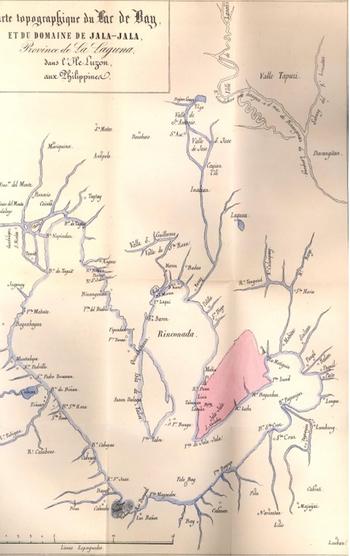
Vingt années was translated by the author and published in the United States in 1854 as Twenty years in the Philippines. The English edition did not include a map. Vingt années, however, did. It is a beautiful, A4-sized fold-out map in the back of the book, and is unique in Philippine cartography (fig. 1).Footnote 29 The map clearly indicates the approximate location of Tapuzi, at considerable remove from San Mateo and Pamitinan, in the Limutan valley. Waterways are marked in blue, Jala-Jala in pink. The waterway which enters Laguna de Bay at Tanay stretches up between Bosoboso and Tapuzi. Valle Tapuzi sits between two rivers which unite to its south and head eastward off the map. These rivers are not printed in blue, but are clear. At the upper left a winding river is labelled Valle de Lanatin, on the upper right, ‘Sabang del Ro. Limutan’. This fork never reaches the top of the page. The river that they unite to form reads ‘Ro. Gaudaboso aue desagua en el mar de Binangonan de Lampong.’ To the right of this river: ‘Darangitan’.
Map of Jala-Jala district, La Laguna province, showing Tapuzi and San Mateo, 1854

This location for Tapuzi/Tapusi is historically accurate. It is borne out by a history of the parishes of the religious province of San Gregorio Magno written in 1865 by the Discalced Franciscan friar Félix de Huerta. A paragraph buried within the 720-page tome states
Limotan
Some eight leagues distant from the mission of San Andres, to the north across an elevated spine of mountains, is the River Limotan and on its banks is a ranchería , which, was gathered by Francisco de Barajas, and made Christian by the signing of a pact on May 6, 1670, and on the next day May 7, in the said year, were baptized the first seven people of the said ranchería. From the year of 1670 to that of 1675 the fervent zeal of the above mentioned Fr. Francisco de Barajas caused many more to join the mission, including the surrounding rancherías named Tapusi, Asbat, Mamoyao, Macalia, Dadanbidig and Maquiriquiri, Bantas, and Binoagan.
This mission grew prosperously until the year 1700, at which time the government had intended to oblige the mission to pay tribute. All fled to the mountains, the mission was completely lost.Footnote 30
Here we see that prior to being an ‘inaccessible den of ladrones’, Tapusi was a ranchería, a small pueblo. It became part of the Spanish mission of San Andres, in the ‘Limotan’ river valley, but the residents fled to the mountains as remontados in 1700 when forced to pay tribute. Gironière's geography is accurate.
Gironière's account, pared back to its core of plausible historical details, reveals a community of remontados, built up by waves of migration, engaged in subsistence corn agriculture, located in the Limutan river valley, with an origin legend based on the same topographical feature as the Bernardo Carpio legend: nag-uumpugang bato.
And what of the cave of San Mateo?
Connecting Pamitinan and Tapusi: Remontado migration
Bonifacio's trek to San Mateo could be situated within a history of ‘pilgrimage’, but it would be a very different history from that suggested by Pasyon and Revolution. There was an established tradition of European tourists travelling to the cave of San Mateo in the nineteenth century.
In a separate section of his book, Gironière writes of travelling to see the cave of San Mateo. He tells of going between two ‘monster mountains … equally alike and similar in height’.Footnote 31 His story goes into great detail of the spelunking which he and Hamilton Lindsay undertook, through subterranean chambers and between enormous stalactites. He does not mention Tapuzi in the context of the cave of San Mateo, nor does he mention San Mateo in his journey to Tapuzi, for at the time of his explorations the conflation of the two locations had not yet occurred.
Surveying the accounts written by foreigners visiting Luzon in the nineteenth century, we almost always find a reference or two to the caves of San Mateo. It was a popular destination among the more bold adventurers to visit Manila.Footnote 32
For tourists what they visited was no more than the cave of San Mateo; for Bonifacio, the mountain and the cave ‘of Bernardo Carpio’ were named Pamitinan. Julio Nakpil, one of Bonifacio's commanders and a famed composer, was stationed along with Emilio Jacinto in the mountains of San Mateo, where he fought under the nom de guerre of J. Giliw. In his handwritten manuscript, Apuntes para la historia de la Revolución Filipina de Teodoro M. Kalaw, Nakpil wrote of how Bonifacio was fleeing from Aguinaldo in Cavite to San Mateo when he was arrested and executed. Bonifacio's widow, Gregoria de Jesus, was able to escape and reached the San Mateo mountains, joining Nakpil and commanding troops there. She and Nakpil married a year-and-a-half later. Within a month of Bonifacio's execution, Nakpil composed a dance entitled Pamitinan, which he dedicated to the remontados.Footnote 33 This was the tradition which Bonifacio's Katipunan identified with Pamitinan, the history of resistance to Spanish rule, and not a mythical Tagalog king.
Despite the remarkable differences and great distance between the two places, Pamitinan can be associated with Tapusi both historically and geographically. What were these historical and geographical connections?
First, some of the Tapusi remontados came from San Mateo. Nakpil wrote of the remontados from this region, as did Rizal, who referred to ‘los remontados de San Mateo’ in El Filibusterismo.Footnote 34 The US colonial government in the Philippines conducted a census in 1903. In a brief glossary, the census defined ‘nomads’ or ‘remontados’: ‘This term refers to a group of wild Tagálog people, who tradition says ran away from the town of San Mateo, and whose descendants to-day roam the mountains back of Montalbán in association with the Negrito.’Footnote 35
Linguistic evidence likewise suggests that remontado migration connected Tapusi in the Limutan river valley with Pamitinan. In the 1970s Teodoro Llamzon discovered a new language in Daraitan in the mountainous upstream of Tanay, in Rizal province. This was exactly where Gironière located Tapuzi, although he spelled the region ‘Darangitan’. Llamzon designated the language Sinauna (original or ancient), as he considered it represented an ancient strand of Tagalog; the native speakers called their language Tagarug. In the Ethnologue listing of world languages it is classified as Remontado Agta. Agta is a language of the Negrito people of the Sierra Madre and the population of Sinauna speakers is supposed to be descended from intermarried remontado and Negrito populations.Footnote 36 Sinauna has now been identified as an important transitional form between Tagalog and Bikolano, and is mutually unintelligible with Tagalog.Footnote 37
In Southeast Asian linguistics, the pepet vowel is the indifferent vowel; it is akin to schwa. Pepet is the Javanese word for this vowel. Carlos Conant, in his dissertation of 1913, examined the ways in which this vowel was differentiated in various Philippine languages, e.g. atəp (roof), becomes atep, atip, atap, and atup.Footnote 38 Llamzon revisited this thesis and examined the role of dialects in this law. He found that the pepet vowel had not disappeared from most of the languages that Conant claimed had lost it. Conant overlooked the retention of the pepet vowel because he had failed to examine dialects.Footnote 39
For our present purposes, this line in Llamzon's work is important: ‘For the Puray dialect, which is geographically located at the back of the Montalban Dam, the regular reflex seems to be ə.’ Some brief samples of the dialect follow: ipa, dakip, ngipin, pusod, talong, dikit, dinggin, all of which indicate a retained pepet vowel.Footnote 40 Puray is a river slightly beyond Pamitinan; it is a tributary of the San Mateo River.Footnote 41 Thus, in the region of Pamitinan, a Tagalog dialect was spoken which retained the pepet vowel.
That the Limutan river valley was spelled ‘Lumutan’ in de los Angeles's report on Manila's water supply was not an error in transcription; rather, it reflected the ambiguity of the pepet vowel which was retained in both Puray Tagalog and Sinauna. It seems likely that the original semantic significance of the place name was lumutan (verdant, lush green, mossy). The pepet vowel in the penultimate syllable of a non-enclitic morpheme reflects to i,Footnote 42 and thus L/*e/mut came to be L/i/mut, and the verdant, forgotten.
The Governor of the Province of Rizal wrote on 8 July 1908 in his report to the Governor General of the Philippines,
There are several nomad families in the mountains of Tanay called Dagat-dagatan, Lanay, Panusugunan, and others; in the mountains of Antipolo called Uyungan, Sare, and Lumutan, and others bordering on the barrio of Boso-boso; in the woods and sitios in the jurisdiction of San Mateo and on the Garay River called Pinauran, Cabooan, Lucutan malaqui. These families are estimated to number 1,000 individuals, it being worthy of note that these people come down to the settlements to sell rattan, gugu, wax, bees’ honey, and resin in small quantities.Footnote 43
Lumutan is here adjacent to Sare, which was another name for Tapusi, according to de los Angeles. The remontado population according to this report ranged from San Mateo to Lumutan and engaged in trade with the settlements. What Ed. C. De Jesus wrote of the remontados of Cagayan applied to those in Tapusi as well:
Whatever their original motives for reverting to their old way of life, the remontados quickly found additional reasons for remaining in the mountains and outside of Spanish control. Contacts among both the Christian towns and the pagan tribes made them the ideal middlemen for the trade between the two groups.Footnote 44
The isolationist hypothesis in anthropology has now been discarded; it asserted that hunter-gatherer tribal groups had been living without contact with lowland agricultural populations for centuries, even millennia, and had evolved in linguistic and cultural isolation. It is now apparent that Negrito populations in the Philippines established contact and trade with the Austronesians upon the latter's arrival in the Philippines. Trade contact was frequent; the Negritos provided forest products in exchange for agricultural goods. It was trade with Austronesian agriculture which enabled the Negritos to begin settling the jungles and forests of Luzon, which could not provide ‘sufficient lipids to supply the nutritional needs of humans in the absence of wild plant starches’.Footnote 45 The frequent trade was facilitated by the creation of a pidgin, whose core words were derived from the status language, which in this case would have been of Austronesian origin. The pidgin was creolised, and then underwent a lengthy period of de-creolisation, as the Negrito creole language adapted to the morphology and syntax of the status language. Thus, the Negritos of the Philippines all speak languages with Austronesian structure and vocabulary. They retain, however, a substrate of non-Austronesian lexemes.Footnote 46
With the arrival of the Spaniards, the trade of upstream forest products for agricultural goods withered, as the Negrito populations were isolated from the downstream rice growers.Footnote 47 The remontados, fleeing the Spanish ambit to avoid the onerous impositions of colonialism, became a liminal population which facilitated the resumption of trade between upstream and downstream. In contrast to Gironière's isolated ‘great phalanstery’, whose female population had never been out of the community, the remontados of Tapusi would have been intensely mobile. They were a population engaged in trade throughout the Southern Sierra Madre, ranging from Tanay to San Mateo. They would have carried on trade with both lowland Tagalogs and with the Umiray Dumaget Negritos. Sinauna would have been the language spoken by the rancherías of the mission of San Andres. When the mission was abandoned in 1700, these Sinauna speakers became known as remontados. To engage in trade it was necessary for them also to speak Tagalog, with which Sinauna is mutually unintelligible. This trade Tagalog of the Sinauna remontados was, it seems likely, the source of the Puray pepet vowel, which is unique among Tagalog dialects and corresponds nicely to the Sinauna language.
The remontados of San Mateo would have passed between the nag-uumpugang bato of Sasocsungan and Pamitinan as they progressed up the San Mateo River to Tapusi. Linguistic and historical data both establish this connection. Bonifacio and his companions were familiar with the history and legacy of Pamitinan, the history of the remontados. The Carpio legend was the folk memory of this flight. The resistance associated with San Mateo did not consist solely of flight, however.
Tulisanes: San Mateo and banditry
Colonial authorities labelled the long-standing tradition of resistance at San Mateo ‘banditry’, and the inhabitants of the region, tulisanes. Telesforo Canseco, the overseer of the Dominican hacienda in Naic, Cavite, wrote of
the bandits (tulisanes) of San Mateo with long beards whom we have called tulisan pulpul, are men who are dedicated to robbing and committing crimes and have taken to the mountains (remontarse) and have lived for many years in the mountains of San Mateo, where even the Spanish have not been able to reach them.Footnote 48
Noceda and Sanlucar in their 1860 Vocabulario de la lengua Tagala defined ‘tulisan’ as ‘malhechor, salteador; de tulis, agudo’/evil-doer, highwayman; from tulis, sharp.Footnote 49 The etymon of ‘tulisan’ is tulis, to sharpen. Tulis is an Austronesian root which developed into the Malay tulisan, writing,Footnote 50 a significance related to the sharpened implement which was used for scratching letters into the leaves of the lontar palm.Footnote 51 Tulis thus had pluripotent significance, waiting to be sharpened into one or the other of at least two possible meanings. As the Spaniards supplanted and destroyed Philippine writing systems, the highly literate native populations were driven to orality; tulis came to mean banditry.Footnote 52
Eric Hobsbawm, in his work Bandits, writes that social bandits,
are peasant outlaws whom the lord and state regard as criminals, but who remain within peasant society, and are considered by their people as heroes, as champions, avengers, fighters for justice, perhaps even leaders of liberation, and in any case as men to be admired, helped and supported.Footnote 53
This description aptly matches the phenomenon of tulisanes in the Philippines. On the subject of tulisanes, Henry Ellis wrote,
Brigandage still exists in Luzon to a considerable extent, armed bands of Tulisanies [sic] (hill robbers) patrolling the country levying contributions and plundering with seldom much effectual molestation from the authorities, carrying their depredation in quite an organized form into the suburbs of Manila itself …
A party of soldiers, under the command of Lieutenant Enciso, in the gray of the morning of the 25th July, managed to surprise a famous brigand leader of the name of Jiminez, who with a part of his band was caught napping in a house in the neighborhood of the cave of San Mateo …
The chief (Jiminez), although in figure an exceedingly slight, small man, had through the daring and determination of his character long held a most perfect sway and control not only over his own particular band but more or less over all the ‘gentlemen of the craft’ in that part of the country, and, it was said, had frequently used his restraining power for good, punishing severely among his followers acts of wanton outrage and restraining them from unnecessary violence and bloodshed. He carried on a black-mail system, levying contributions principally on the rich, and was not only respected but rather a favourite among the poorer villagers, going amongst them in perfect immunity.Footnote 54
San Mateo, and Mount Pamitinan in particular, the closest intrusion of the Sierra Madre massif into Spanish Manila, was the epicentre of tulisan activity in popular consciousness.
This tradition of resistance was precisely what the Carpio legend invoked. For Ileto to state that the masses live in ‘a society where King Bernardo Carpio was no less real than the Spanish governor-general’ is to fail completely to understand the function of legend. The geographical specificity of the legend, the insistence upon San Mateo as the location of Bernardo Carpio, served as a metonym for social banditry and resistance to the ruling class.
Conflating Pamitinan and Tapusi: Elite error
How then did Tapusi become not merely associated but actually conflated with Pamitinan and the cave of Bernardo Carpio, if it is a geographically distinct location? Santiago Alvarez, when speaking of Bonifacio's intention to assault Manila from San Mateo refers to Bonifacio's hiding place in the mountains of San Mateo as ‘Tapusi’.Footnote 55 Alvarez was a mestizo landowner from Cavite, whose alliance with Bonifacio in opposition to Aguinaldo reflected the continuation of a long-standing regional rivalry between two ruling class factions. His account is important for understanding the events in Cavite leading up to Bonifacio's arrest and execution. The greater the remove of an event or person from Alvarez's class and geographical ambit, however, the more tenuous are the facts which he records on the subject. Thus, when Alvarez writes of Maestrong Sebio, a charismatic leader from Bulacan, he misidentifies him as Eusebio Viola, a wealthy mestizo landowner, when Maestrong Sebio was in truth Eusebio Roque, a local schoolteacher.Footnote 56 Another wealthy Caviteño, Carlos Ronquillo, also conflated Tapusi with Pamitinan in his 1898 account of the Revolution, but there is more involved in his account than simple error.
Fray Mariano Gil, a Spanish priest, revealed the existence of the Katipunan to the colonial authorities after hearing the confession of the wife of one of its members. In his report he stated that the Katipunan was amassing weapons at ‘Tapusi’, which in the report was neither a mountain nor geographically specific but a fabled place of resistance. The Spanish authorities’ response was not to rush to San Mateo, but to hunt for Bonifacio and his companions in Tondo. Gil's testimony is not evidence for the conflation of Pamitinan and Tapusi, but rather for a hazy fear of Tapusi in the minds of the colonial and religious authorities.
Pedro Paterno, writing his self-aggrandising memoirs on his role in mediating the pact of Biaknabató, stated, ‘I climbed mount Tapusi, with its famous cave, eternal refuge of tulisanes and afterwards lair of General Luciano San Miguel, who afterwards died gloriously at Pugad-Babuy under the fire of American cannons.’Footnote 57 Thus, in 1910 Paterno identified Tapusi with Pamitinan. It is worth pointing out that Paterno, the extremely wealthy and laughably pretentious Bulakeño, could not speak passable Tagalog and was carried in a hammock from Manila to Biaknabato and back again. He never went anywhere near Pamitinan, and he certainly did not ‘climb’ anything.Footnote 58
The conflation of Pamitinan and Tapusi occurred among outsiders, those excluded by class from the sociolinguistic register of the peasantry and by spatial and temporal remove from the actual geographical specificity of Pamitinan. Tapusi and Pamitinan were connected, in history and in legend. They were not, however, the same.
On the basis of these conflations, Ileto goes on to identify ‘Mount Tapusi’ with Mount Meru, a centre of power in Southeast Asian conception.Footnote 59 This misses the point entirely. Tapusi was not a mountain, it was not in San Mateo, it had no cave; the idea of Bonifacio's journey being a ritual ascent of Tapusi makes no sense in light of historical evidence.Footnote 60
San Mateo: Central to Bonifacio's military strategy
Bonifacio's journey to the cave of San Mateo did place him within a nexus of signification. Bonifacio was aware that this was known as the cave of Bernardo Carpio, but he was not awakening a sleeping king, nor was he manipulating peasant belief. He was participating in a long-standing history of revolt, for we find that there is continuity between social banditry and Bonifacio. It is not a continuity of idiom or ideology, however. Bonifacio journeyed to the cave of San Mateo because he was both continuing and qualititatively developing the history of mass resistance of the late nineteenth century.
Based on an awareness of its history, Bonifacio recognised the tactical significance of San Mateo's geography and used it to the advantage of the Katipunan at the beginning of the Revolution.
In Pasyon and Revolution we read, ‘Bonifacio himself, as Carlos Ronquillo reports, told his followers that their legendary king Bernardo would descend from Mount Tapusi to aid the Katipunan rebels’ (p. 111). The source for this claim is Ronquillo's manuscript, Ilang Talata tungkol sa Paghihimagsik ng 1896–97; there is no page number given.
In responding to Milagros Guerrero's critique of his work, Ileto stated
In 1897, Carlos Ronquillo, the personal Secretary of Emilio Aguinaldo, in his ‘history’ of the Katipunan uprising castigated Bonifacio for raising false hopes that an army would descend from Mount Tapusi ‘to lead his whole army.’ ‘This plain falsehood,’ writes Ronquillo, ‘was a deception or morale booster (pangpalakas loób) perpetrated by Bonifacio; because at the appointed hour neither men nor arms arrived from Tapusi. Up to now we do not know where this mountain is.’Footnote 61
Ileto used this passage in three separate essays. In each case he cited pages six and twenty-one of Ronquillo's unpublished manuscript. In his response to Guerrero, Ileto dropped his prior reference to Bernardo Carpio. In Carpio's stead we find Bonifacio's promise that ‘an army’ would lead the ‘whole army’. Not one of the four citations provided the Tagalog original, aside from the phrase ‘pangpalakas loób’.
In Ileto's later articles, Ronquillo served as the example of ‘the nationalist ‘historian’ … a believer in enlightened liberalism’. He stated that Ronquillo
already decried this “dark underside” of Bonifacio's mentality, adding it to the litany of faults that he felt justified Bonifacio's execution at the hands of Aguinaldo and the Cavite elite. Hopefully, historians today will not participate in this bloody execution by insisting upon a singular, reductionist reading of the text that comprises our national hero.Footnote 62
Ileto was not questioning the historical accuracy of Ronquillo's statement; he was rather asking that we consider how the ‘masses’ would have perceived Bonifacio's claim that Bernardo Carpio, or an army, would descend from Mount Tapusi. Ronquillo was thus a representative of bad ‘reductionist’ historiography; to read history in this fashion was to participate in the murder of Bonifacio.
In 1996, the University of the Philippines press published an excellent edition of Ronquillo's manuscript, thoroughly edited and annotated by Isagani Medina.Footnote 63 Ileto appears to have been paraphrasing a passage and a footnote from the manuscript. Nowhere is there anything close to an exact quotation. The first passage reads
Because it had been agreed upon, we stopped and waited for the army of Bonifacio that would be coming from Mount Tapusi and were to be firing and would lead the entire army; however, from the agreed upon time to until daybreak it did not arrive.Footnote 64
Ronquillo footnoted Tapusi thus
This statement by Bonifacio was a tremendous lie because neither people nor arms were at Tapusi and even he himself did not arrive there. This was just a cruel deception of the people!Footnote 65
The statement ‘up to now we do not know where this mountain is’ and the parenthetical untranslated phrase, ‘pangpalakas loób’, are both absent from Ronquillo's manuscript. Bernardo Carpio is missing as well. This was not the statement of someone who is detecting the ‘dark underside’ of Bonifacio's mentality; this was an accusation of poor military leadership and deception. Bonifacio promised troops and he failed to deliver. This was Ronquillo's accusation. It is also, ironically, a ‘cruel deception’.
Zeus Salazar, in his Agosto 29–30, 1896: Ang Pagsalakay ni Bonifacio sa Maynila, examined in detail the claim that ‘Bonifacio's plan to attack Manila subsequent to the discovery of the Katipunan was never really carried out.’ This planned assault on Manila, ‘traditional historians’ believed ‘was replaced instead with an attack on San Juan del Monte’, a much smaller, less coordinated undertaking.Footnote 66 Salazar's examination of the dispatches made by the English, German and French consuls in Manila, in conjunction with the existing historical evidence, convincingly demonstrated that the planned assault did, in fact, occur.
Bonifacio had planned a three-pronged assault on Manila — from the north, Caloocan, Balintawak and surroundings; from the south, Cavite; and from the east, from the mountains of San Mateo. On the night of August 29, the assault was initiated by Bonifacio's forces from San Mateo, the troops in the north likewise attacked. Cavite did not respond to Bonifacio's orders. Numerous justifications for this failure to follow orders were given in memoirs and subsequent accounts: the orders did not apply to all Katipunan balangays (local chapters), there was no signal given, the Katipunan lacked the necessary arms.Footnote 67 No excuse is quite as dramatic — or as dishonest — as Ronquillo's bald-faced assertion that ‘Bonifacio's forces never came down from Tapusi’. Ronquillo was certainly attempting to justify the execution of Bonifacio, but not because Bonifacio was part of some irrational, dark ‘underside’ of Philippine society. When Ronquillo wrote his memoirs, Bonifacio was dead. By calling Bonifacio a liar and a poor leader, Ronquillo was not merely justifying his execution; he was covering over the perfidy of the Cavite elite.
Not only did San Mateo and Pamitinan figure prominently in the initial assault on Manila, they remained a vital centre for operations under the leadership of Bonifacio and his fellow katipuneros. Numerous sources attest to this.
Mariano Ponce, writing on 6 May 1897 from exile in Hong Kong to Ferdinand Blumentritt, gave notes on details of the revolutionary effort culled from various letters he had received, in particular a letter from a ‘rebel camp at Baling-Cupang (San Miguel de Mayumo)’. He writes
In Pamitinan, in the jurisdiction of Montalban and a half kilometer from it (province of Manila), is one of the best defended Tagalog encampments. Columns proceeded from Manila, Mariquina, Pasig and San Mateo intending to attack it on the 7th and 9th of April; but seeing the situation and defenses of the camp, they retreated a great distance without firing a single shot.Footnote 68
Pamitinan was prepared for combat and served as a successful base for the Katipunan under Bonifacio's leadership; it continued to serve as a base of armed struggle long after his death.
Conclusion
Latent within the Carpio legend is the folk memory and celebration of social banditry under late Spanish colonialism. It was a moment within the vast totality of peasant and lower-class discourse which was conducted in registers designed to occlude these discourses from elite perception and interference. A superficial examination of the legend finds only superstition and all the old aristocratic stereotypes about peasant thought.
The quest launched by Ileto to locate lower-class discourses and categories of thought was a valuable one, but it has been largely carried out with an elite, textual hermeneutic that has failed to situate the reception of the texts examined within their historically determined acts of performance.
A careful examination of these lower-class discourses reveals that they contain a deep-seated historicity; they are also complex and contradictory, in keeping with the developing social consciousness which produced them. To begin to piece together this consciousness from the extant source material will require a heightened sensitivity to each text's historical specificity and to the significance endowed upon it in its performance.
Ileto's reading of pasyon and awit established a continuity of comparatively unaltered, religiously construed mass consciousness, stretched between 1840 and 1910, as the groundwork of social upheaval. My examination suggests precisely the opposite: it is in fact the transformations in consciousness — as the long-lagging conceptions of the masses catch up to objective circumstances with startling speed — that are fundamental to understanding the Philippine Revolution. Social banditry, while significant, was but a preliminary waystation in this process.
The implications of this conclusion are both profound and wide-ranging, embracing the progress of revolutionary struggles and the function of leadership. The question of Bonifacio and the Katipunan, one of the thornier ones in Philippine history — fraught with questions about class relations, sources and their reliability, and the perceptions of the masses — can serve as an example of these implications.
Objective historical shifts and economic crisis propel toward revolutionary struggle, but they do not determine its course. The rise and fall in rice prices, for example, plays a far smaller role in the progress of a revolution than the rapidly developing consciousness of the masses in motion. Here revolutionary leadership, which is but the most conscious expression of the objective tendency of the emerging movement, proves vital. The success of any revolutionary leadership depends on the extent to which it aptly articulates these objective interests which the masses coming into struggle but yet vaguely perceive. To understand the role of Bonifacio and the Katipunan, we must thus begin not with biography, but with the systematic reconstruction of the alterations in mass consciousness over the course of the 1890s.
The Carpio legend gives us insight into a historical baseline of consciousness from which the revolutionary struggle of the masses moved. A reconstruction of the Philippine Revolution, far richer than those yet written, will require comparable work using similar sources to uncover moments within the developing trend of mass thought. On this foundation, and on it alone, can the question of Bonifacio and that of revolutionary leadership be productively revisited.