Introduction
In June 2015, a nomination dossier entitled “Delhi’s Imperial Capital Cities,” combining the two imperial capitals of Shahjahanabad and New Delhi, was proposed for the World Heritage List; this was the only nomination submitted by India that year.Footnote 1 Discussion of the dossier was scheduled for the thirty-ninth session of the World Heritage Committee meeting, held in Bonn, Germany. Notably, India was also serving as a member of the World Heritage Committee (2011–15), the most powerful decision-making group within the organization. India thus had considerable influence over the proceedings, further evidenced by its long history of vocal participation and of garnering successful outcomes in the committee.Footnote 2 The Indian National Trust for Art and Cultural Heritage (INTACH) had first initiated and then methodically prepared the dossier over several years, working with and between various state, national, and international bodies. During those preparations, senior members of the International Council on Monuments and Sites (ICOMOS) had provided feedback and considerable direction to the shape the dossier would take, including the central idea of concentrating on the two imperial capitals, one Mughal, the other British. Taken together, these circumstances all indicated that a positive outcome was assured.
In the final stages of the ICOMOS evaluation, however, just before the Bonn meeting in late June, the nomination was withdrawn by the Indian Ministry of External Affairs. This dramatic turn of events, particularly in the face of an almost certain World Heritage List inscription, occurred without consulting the National Capital Territory of Delhi. Specifically, such a withdrawal necessitated the Ministry of External Affairs to bypass not only the federal rights of the Delhi government but also the Ministry of Culture, which had approved the dossier. The decision came as a surprise to the state government, which had borne the extensive costs of preparing the dossier over several years as well as to other World Heritage observers. Questions were asked in the Rajya Sabha (Upper House of Parliament) about the reasons for the retraction and the total expenditure of producing the dossier over 10 years, plus what “corrective measures” the government would take in future.Footnote 3 The United Nations Educational, Scientific and Cultural Organization’s (UNESCO) official website simply stated that the “nomination was withdrawn at the request of the State Party.” A further corrigendum stated that it “has been postponed for consideration of the World Heritage Committee to a later date.”Footnote 4
Examining in micro-detail the course of one very complex dossier reveals not only the politics of nomination practices but also the broader issues of urban conservation, international institutions, neoliberal politics, and colonial histories in India today. Indeed, the dossier was originally assembled during Manmohan Singh’s government (the United Progressive Alliance) but then withdrawn under Narendra Modi’s government (the Bharatiya Janata Party [BJP]). Apart from his well-documented attachments to the right-wing Rashtriya Swayamsevak Sangh (RSS) and Hindutva ideology,Footnote 5 Modi’s term has been characterized by neoliberal experiments to promote urban heritage, while encouraging economic growth and modernization and simultaneously re-engineering (or erasing) the post-independence monumental legacy in cities such as Delhi. And while such attitudes are not without precedent in Indian political history, they have been dramatically accelerated and amplified under the current government. Throughout this article, I argue that the fate of the Delhi dossier, and, indeed, of Delhi itself, reveals current political attitudes toward past empires, entwined histories, and religious inclusion that will have enduring implications.
To trace these emerging developments, I have embarked on a long-term project to document how monumental regimes of research and preservation are conducted within and between various state and civic agencies. Efforts to preserve the considerable vestiges of India’s monumental past are further complicated by the legacies of colonial occupation and the onerous bureaucratic systems that linger, the dramatic growth in urban populations, the density of historic sites in urban settings, and the pressures on heritage sites as well as by a certain disjunction between ancient histories and modern populations. The current article builds upon my long-term study of UNESCO’s World Heritage.Footnote 6 I draw on discussions with officials and employees at UNESCO’s India and Paris offices, government departments tasked with urban administration and heritage protection like the Delhi Development Authority, the Archaeological Survey of India (ASI), INTACH, non-governmental organizations (NGOs) and heritage foundations including the Aga Khan Trust for Culture, and conservation consultancies as well as with individual diplomats, politicians, academics, architects, and activists.
A timeline of two cities …
In 2012, “Delhi – A Heritage City” was submitted to UNESCO’s Tentative List, where it still remains. This dossier focused upon Delhi’s surviving historic urban-scape as comprised by four precincts: Mehrauli, Nizamuddin, Shahjahanabad, and New Delhi. Notably, the original vision extended beyond the two imperial capitals, and emphasis was placed upon the “diverse historical, cultural and environmental exigencies” that have created “the city that is today recognized globally as the capital of an important developing nation.”Footnote 7 The dossier stated unequivocally that “Delhi is a living city. It accommodates the remains of over a thousand years of building in different states of preservation.” And it claimed to incorporate Sufi traditions, the Urdu language, and other forms of intangible heritage that persist in the heritage precincts of Mehrauli and Nizamuddin.
By July 2013, the original Delhi dossier had been reframed, reimagined, and telescoped down to just two components, as I was repeatedly told by those assembling the nomination, at the behest and advice of UNESCO’s Advisory Body representatives. Seemingly beyond their official remit, senior ICOMOS evaluators persuaded Indian experts to concentrate solely upon the British and Mughal empires, possibly reinforcing their Eurocentric bias, which is well established in the World Heritage arena.Footnote 8 It has been documented that nominations from developing nations have had a better chance of inscription if they propose colonial-era sites and structures rather than indigenous ones. This typically ensured support from their former colonizers too, as my colleagues and I have quantitatively demonstrated.Footnote 9 The newly crafted 300-page nomination comprised Shahjahanabad, built as the new capital of the Mughal Empire for Emperor Shahjahan in the mid-seventeenth century (1638–48), and New Delhi, the new British colonial capital (1912–31), designed by Sir Edward Lutyens and built adjacent to the Mughal city.
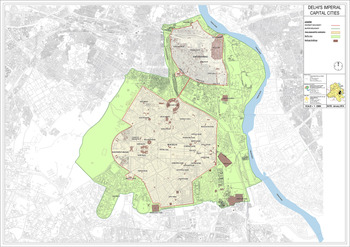
India argued that both are outstanding examples of imperial town planning, both continue to function as iconic precincts in the capital, and both symbolize the city’s extraordinary historic antecedents.Footnote 10 The two cities were nominated under criterion (iv), which pertains to outstanding buildings, architecture, and ensembles that illustrate significant stages in human history. India thus argued that Delhi is an outstanding example of imperial planning traditions, illustrating two notable stages in the history of the Indian subcontinent: the peak of the Mughal Empire and apogee of the British Raj. The dossier contended that each of the two cities displayed unique urban morphologies that are a synthesis of strong town planning principles (see Figure 1).
Nomination Area and Buffer Zone, Delhi’s Imperial Capital Cities (courtesy of “Delhi’s Imperial Capital Cities,” Nomination to UNESCO’s List of World Heritage Cities, January 2014, prepared by INTACH, Delhi Chapter; supported by Government of National Capital Territory of Delhi, submitted by Archaeological Survey of India, Ministry of Culture, Government of India).

There was perhaps another empire in play too. Here I want to underline that, from a procedural perspective, senior ICOMOS advisors participating in World Heritage nominations have sometimes functioned as both consultants and adjudicators, leading to imputed “conflicts of interest” by some States Parties. This practice was frequently cited as “mission creep” in World Heritage Committee meetings. China recently chided ICOMOS, requesting that it “stick to the principle of transparency, impartiality and professionalism. Firstly, we believe it is important to ensure the impartiality and its recommendation by not being a player and a referee at the same time.”Footnote 11 It is ironic, then, that by 2014 ICOMOS evaluators had circled back to India to request “a clearer understanding of the logic behind joining these two distinctly different areas within one nomination. It would also appreciate knowing whether any consideration had been given to nominating these two areas separately, with Shahjahanabad linked to the already inscribed Red Fort.”Footnote 12 The request proved frustratingly contradictory for the State Party in light of the previous direction provided by senior ICOMOS representatives and underscores the dilemma of “paternal” interference and deeper managerial flaws in the World Heritage system.
The newly fashioned Delhi dossier was framed around the two capital cities, which were built about 300 years apart and represent the high points of Mughal and British colonial town planning and architecture. What was lost in this new iteration were the linkages to other historic settlements that play a significant role in Delhi’s urban history and fabric, specifically Mehrauli and Nizamuddin. This is noteworthy since local politicians, conservation professionals, and heritage activists have long promoted the heritage of Old Delhi as a driver for financial development and cultural recognition. In curating a significantly reduced dossier, ICOMOS representatives were undoubtedly “helping” India to create a coherent narrative – two empires, two international epochs – and thereby reducing potential critique about the lack of linkages between locales, complex narratives, and problems with particular sites. As one INTACH expert quipped, “UNESCO is a game … and India is bending the rules of the game to our benefit.” But, alternatively, one might also argue that UNESCO’s procedures are a game and ICOMOS is similarly playing to suit itself, manufacturing the kinds of dossiers that it wants to evaluate. Given the years of voluble critique and resistance directed toward ICOMOS, much of which my colleagues and I have analyzed,Footnote 13 plus the behind-the-scenes machinations and the types of power enacted with States Parties, I still find these practices revealing.
In discussions with numerous actors involved with UNESCO, INTACH, ASI, and the government of India, as well as those in the heritage and conservation fields, two key issues emerged as reasons for the dossier’s withdrawal. The first was the notion of built heritage as an impediment to development – that the past was indeed a burden that the capital could no longer sustain. Second was the historical overburden – that both the Mughals and the British had invaded India and occupied it and that their legacies should not be enshrined on the World Heritage List. Rather, these were historical shackles that should be thrown off. More specifically, it was the Mughal layer of history that was most often challenged in these discussions, eliciting not only vitriolic sentiments about the patrimonial past but also antipathy toward people in the present. And the two issues are deeply and historically interlinked. As Anand Vivek Taneja reminds us, the desire for development has long been sutured to issues with Islam, exemplified by Jawaharlal Nehru’s comment to his education minister Maulana Azad: “[H]alf of Delhi is graveyards and mosques. Our schemes will fail if we don’t have room to build.”Footnote 14
The curse of heritage
As soon as a site is listed, it “becomes a curse,” explained one senior ASI official charged with managing a World Heritage property. Exasperated, he disputed whether anyone in India wanted such labels, in his experience because the label prevented building and that impacts “not only hotels, but hospitals.” Furthermore, the needs of the living are frequently impinged upon, without any tangible benefits as recompense. He described how local people were often moved out of their homes and their traditional crafts subsequently relocated to other cities so that the UNESCO status was inexorably changing the social fabric of Indian life. Rather than enhancing lives and livelihoods, the World Heritage designation was hindering it: all the so-called “help,” he purported, just created new pressures for residents. In the case of Delhi, the unequal burdens of heritage would have been disproportionately felt by the poor residents of Shahjahanabad as opposed to the political and social elite of Lutyens’ Delhi. The Lutyens Bungalow Zone (LBZ) literally constituted the seat of India’s colonial and postcolonial government, an enclave today reserved for members of parliament, government ministers, generals, and the like. The heritage curse, it seemed, was further swept up in expansive political currents that equated development with nationalism.
One of the major reasons for the Delhi dossier’s withdrawal, cited throughout my interviews, reported in the media, and discussed in government circles, was that a World Heritage listing would hamper development in Delhi. A senior expert involved in the nomination revealed how the Ministry of Urban Development had expressed its concerns about a World Heritage listing. Yet only 2 percent of the total area of Delhi was being nominated. That meant that some 98 percent was free for development; however, government officials were not persuaded.Footnote 15 In 2014, ICOMOS asked India to provide more information on the LBZ, specifically to “clarify the implications for the built fabric of the bungalows of the 1988 order from Prime Minister’s secretariat prohibiting any new development” and to square this with the news of “possible plans for dismantling some 500 bungalows which were reported on the newspaper ‘Business Standard’ on 22nd July 2014.”Footnote 16 India responded in a 44-page document and proposed the following:
[T]hree ideals that mutually reinforce each other – first, to bring about a shift in the way the architectural heritage was treated, from the narrow concerns of protection to the broader objectives of conservation; second, to align the conservation of architectural heritage with the imperatives of urban design and thereby look beyond the monument to create a more livable city; and third, to relate these initiatives with new strategies of sustainable tourism and thus make conservation an economically viable proposition.Footnote 17
Despite the rhetoric, the LBZ has been progressively chipped away, from 28.73 square kilometers in 2003 to just 23.60 square kilometers in 2015 when the UNESCO dossier was submitted. The 2015 report on boundaries and development recommended to “maintain the skyline, ensure that buildings do not cross the existing tree height, the overall garden city urban landscape character and ambience.” According to conservation experts, the government has since considered altering the laws to construct high-rise buildings in the LBZ. This entails redrawing the boundaries of the LBZ, one of the two historic precincts identified for inscription. Any initiative to develop this protected historic zone is driven by prime real estate speculation in the leafy enclaves with their white-washed “bungalows” that are really mansions. The zone, after all, is home to some of the most expensive residential and commercial real estate in the world, standing in stark contrast to the relative poverty experienced in so much of India.Footnote 18 But such redrawing and redevelopment also seeks to undermine the British colonial heritage represented therein. The latter is cathected with the abhorrence of historical occupation, most recently under the British, but most viscerally with the Mughal Empire, which is increasingly seen not as part of India’s multicultural history but, rather, as an aberration to be shunned.
In the case of Delhi, many people with whom I spoke, from UNESCO employees to INTACH representatives and heritage consultants, sought to blame the government bureaucracy for the dossier’s fate, with “too many departments that often have overlapping mandates.” ICOMOS in their 2013 appraisal averred that “just the list of agencies is daunting and the text of the Management Plan does not inspire confidence.”Footnote 19 The capital’s famed “multiplicity of agencies” ensures that no single agency holds comprehensive data about land ownership. Moreover, as Khandekar claims, the myriad decisions about Delhi’s historic landscape are being taken by those in the Union Ministry of Urban Development, who have little or no connection with the city.Footnote 20
The rhetoric of development is powerful and multivalent: in economic terms, it captures the propensity for lucrative property development in Delhi, but it also gestures to advancing social capital. The central government’s decision to withdraw the Delhi dossier, I was told back in 2015, reflects a broader reluctance to showcase historic cities since this might give the “wrong” impression of modern India: this attitude underpinned a proposal to renew the historic precinct of Shahjahanabad in the zonal plan prepared by the Delhi Development Authority. Therefore, when Shahjahanabad was identified as one of the two historic precincts for the World Heritage nomination, it faced stiff resistance from government decision makers, including urban planners, who sought to transform it into a “modern city.” The trope of the “world class” city is rife within Indian urban development and heritage circles, encompassing everything from Delhi’s Commonwealth Games bid in 2010 to the current Adopt-a-Heritage scheme at the Red Fort World Heritage site.Footnote 21 India’s experiment with bureaucratized preservation was publicly tested during the controversial lead-up to its hosting of the 2010 Commonwealth Games. In the last minute scramble to develop “world-class” infrastructure for the games, the government discovered that much of its planned transformation violated its own laws on nationally protected monuments. The issue was brought before the Delhi High Court as many illegal constructions were within the 100-meter exclusion zone, including those in the vicinity of Qutub Minar, Humayun’s Tomb, and Salimgarh Fort.Footnote 22 Requiring a legal sleight of hand, a newly drafted ordinance expediently regularized these constructions and enabled reconstruction work within the prohibited zone.
The notion of the world-class city is the global index, specifically in aesthetic terms, to which Indian planners, politicians, and citizens aspire.Footnote 23 The drive for global competitiveness began with the liberalization reforms and market triumphalism of the 1990s, and, as Veronique Dupont argues, this image building has had negative consequences, especially for the poor, through spatial cleansing of slums and other alleged undesirable elements.Footnote 24 Predictably, the imposition of this new economic model with its concomitant urban aesthetics has further fueled socio-spatial polarization in Delhi. From the colonial period onwards, a particular way of seeing has prevailed, Asher Ghertner argues, guiding the eye to identify “the slum” as illegal or the shopping mall as modernity, an “aesthetic engagement with mutually recognizable visual markers of order and disorder.”Footnote 25 Perceived inefficiencies and encumbrances of the more socialist, post-independence planned city have also been cast aside. Paradoxically, both preservationist and development-oriented strategies can be embraced, Amita Baviskar notes, under the singular rubric of the “global city.” The concept variously assembles “state agencies, corporate capital and bourgeois citizens, who use it to authorise and endorse political action across a variety of scales.”Footnote 26 Such an ambitious (and ambiguous) clarion call is often underwritten by rather more dubious social and economic values.
The central government seeks to make Delhi a world-class tourist destination not only by fabricating modernity but also by leveraging the city’s historic assets.Footnote 27 All evidence suggests that a World Heritage title would have manifestly increased tourism to the capital. Moreover, in January 2015, the central government announced that it would support “holistic development of heritage cities” through a scheme called the Heritage City Development and Augmentation Yojana. This scheme aimed to “preserve and revitalise the soul of the heritage city to reflect the city’s unique character by encouraging an aesthetically appealing, accessible, informative and secured environment.”Footnote 28 This finds further resonance with UNESCO’s World Heritage Cities Programme, in which India is an aspirational participant.Footnote 29 But by 21 May 2015, the central government had withdrawn the “Delhi’s Imperial Capital Cities” nomination.
The transformation of the city following an international model of modernization has continued unabated, with multiple layers of urban heritage suffering collateral damage. One high-profile example was the 2017 demolition of the iconic Hall of Nations at Pragati Maidan. The Delhi High Court had dismissed a plea by INTACH to halt the destruction. Conservation insiders saw this as an ominous sign of things to come. However, several experts I talked with admitted that INTACH’s response had been muted; they had wanted to be more vocal but were in the invidious position of relying on government funds for conservation. The erasure of a highly symbolic, post-independence structure did indeed set in motion a chain of events involving the real estate lobby, in tandem with politicians and bureaucrats.Footnote 30 This is also what makes Delhi such a compelling case study, the conjunction of structural factors – the overriding power of the state and the decisive intervention of the courts in urban affairs.Footnote 31 However, the inherent complexity may go some way to explaining why Delhi has been dubbed by some commentators “the city that nobody loves.”Footnote 32
The concerns of INTACH experts like A. G. Krishna Menon were indeed prescient. In September 2019, Prime Minister Modi announced plans to construct a new parliament and redesign the historic Rajpath or Central Vista, designed by Edward Lutyens. In 2020, the COVID-19 pandemic provided a major distraction from politics in India as elsewhere, enabling the government’s plans for the redevelopment to be approved by the high court of India without consultation or due process. The call for bids requested a new master plan “that represents the values and aspirations of a New India – Good Governance, Efficiency, Transparency, Accountability and Equity and is rooted in the Indian Culture and social milieu.”Footnote 33 Yet, according to Menon, the proposed redevelopment will see the Central Vista “dominated by a phalanx of multistoried government office buildings for accommodating the staff of the Indian government, but will retain the lawns, trees and water channels the colonial government built. This enormously popular, and democratic public space will be turned into a gated security area.”Footnote 34 Modi’s plans have attracted the scorn of architects and activists alike, evidenced by a widely circulated satirical cartoon attacking the project’s exorbitant costs borne by taxpayers, its vast carbon footprint, the destruction of heritage buildings, and so on.Footnote 35 Menon calls the plan Machiavellian in its brilliance, its completion slated to mark the one hundredth anniversary of the right-wing, nationalist, and paramilitary organization the RSS. Others in the Indian press have likened the plan to examples of fascist architecture and ideology from Berlin to Baku.
Architect Bimal Patel was hired for the project, which was to cost more than 20,000 crore rupees (US $2.6 billion). Patel has been widely criticized for cementing over the banks of the Sabarmati River in the city of Ahmedabad and similar concretization, road-building, temple demolition, and redevelopment schemes in Varanasi.Footnote 36 It is not simply the erasure of Lutyens’ Delhi – the legacy of its history and architecture – that has raised concern but also the dismantling of Nehru’s legacy of a secular India. Decrying this as a “war of symbols” orchestrated to end the Nehruvian era, Shiv Visvanathan claims that “the capital had to be emptied symbolically. Delhi was considered outside, a travesty of history, a colonial remnant located endemically in the dynasty. It was white, colonial and English-speaking. It had no sense of locality.” The irony, however, is that Lutyens’ Delhi has remained precisely and exclusively the enclave for postcolonial governmental elites (widely regarded as India’s snobbiest neighborhood).Footnote 37 Yet the BJP’s rhetoric is that the Nehruvian vision has become an extension of colonialism, a distortion that was appropriated by outsiders: here, we might consider the international community in the guise of bodies like UNESCO.Footnote 38 World Heritage recognition would have enshrined this now reviled history. As Ashis Ray perceptively suggests,
Modi was probably advised that his clandestine design may not fructify if India’s representation to UNESCO was accepted or remained on the table. To obtain or seek heritage status and concurrently tamper with the site would have constituted a brazen breach of India’s sovereign commitment, notwithstanding demolition of the listed buildings not being on the anvil.Footnote 39
But these dramatic events point to a wider, more mundane malaise that I sensed in the corridors of INTACH’s Delhi headquarters. “There is no sense of urban heritage in India,” one expert complained. Rather, there is ignorance: an example he gave was the recent cutting down of trees in the city that had sparked outrage.Footnote 40 Delhi is “the only planned city between the wars, a garden city,” he continued. But the dossier’s withdrawal was also entwined with development and changing the bylaws. The ASI’s Law of 2010 was similarly being amended, specifically the boundary demarcation limits around sites, which were also being framed as anti-development. “It’s a political issue, not a technical one,” I was told; “law is abstract,” and so it was not coming from a “felt need” in India, unlike Britain, for example. Such a comparison reveals the persistence of imperial ambitions in India, where heritage regimes still, ironically in light of the foregoing, genuflect to Britain.
“But they made us their slaves”
In the writing of poets, novelists, and historians, coupled with the framings of heritage agencies, tourist campaigns, and itineraries of guides, Shahjahanabad has come to materialize the rise and fall of the Mughal Empire. Relatedly, Lutyens’ Delhi is narrated as the grandiose architectural folly of a declining British Empire.Footnote 41 Ignoring the fact that the uses and meanings attached to the material vestiges of the past change over time, both “cities within the city” are negatively inflected for today’s political decision makers. This propensity to view India’s past as discrete and disconnected epochs reminded me of John Stuart Mill’s famous linear tripartite categorization of Indian history: divided into Ancient (Hindu), Medieval (Muslim), and Modern (British). Mobilizing such categories, the nineteenth-century architectural historian James Fergusson argued that the material vestiges of India’s expansive past could be read as a “great stone book.”Footnote 42 Indeed, when colonial powers established the Archaeological Survey of India, they divided their official jurisdiction between “Hindu and Buddhist” and “Muhammadan and British,” the former being an archaeological issue, the latter one of monumental conservation.Footnote 43 Taken together, these two cities have come to stand for the imputed occupation and oppression of an imagined historically continuous and coherent polity or Hindu Rashtra, along with the imposition of foreign empires, populations, religions, and monuments. In conversation with various government officials seeking an explanation for the withdrawn dossier, many would look at me with consternation, and one bureaucrat retorted: “[B]ut they made us their slaves.”
This prejudicial perspective was reinforced during my meetings over the years with INTACH representatives. Kishor, a senior figure in the organization, explained that despite the official line – that the decision was pegged to development and the desire to construct a high-rise office block – this was not the underlying reason for the dossier’s withdrawal. He revealed that those at the highest levels of government claimed that “it’s not our heritage,” either the Muslim or the colonial cities of Delhi: Shahjahanabad presented a problem, as did Lutyens’ Delhi, maybe even more so. Kishor had been similarly told by a high-ranking government official, vehemently against the nomination, that “we were once slaves.” The problem is that Delhi is a city of Islamic heritage that is at odds with the majoritarian ideology of the BJP government. An experienced consultant with ties to ICOMOS, UNESCO, and the World Monuments Fund ventured that the decision to withdraw was an objection to Islamic heritage in tandem with development pressures. Hindutva and development have also been sutured together under Modi. Indeed, the two objections have been conflated, whereby Muslims have been reconfigured under the BJP as obstacles to development, a drain on resources, and an alien, socially divisive element that erodes cultural cohesion. Put simply, “a non-modern and unassimilable remnant of the past.”Footnote 44 The fate of the Delhi dossier, in her view, was rife not only with politics but also with corruption and lack of coordination. Another colleague involved in preparing the Delhi dossier thought it was simply about business and that the file would not be resubmitted to UNESCO. In this regard, she has been proven right.
It is instructive to examine how India has recently positioned or bypassed other sites that showcase Islamic heritage. In 2017, the Historic City of Ahmedabad in Gujarat was inscribed on the World Heritage List, with little political support from the central government.Footnote 45 Founded in the fifteenth century and considered by many to be an Islamic city, Ahmedabad had a dossier that stressed its multi-religious character; it is also the city most closely associated with Narendra Modi. In 2002, Ahmedabad witnessed inter-communal violence and a pogrom against Muslims while Modi was chief minister, earning him international condemnation.Footnote 46 States Parties at the World Heritage Committee session in Krakow spoke passionately in support of Ahmedabad not for its urban planning but, rather, as the birthplace of Gandhi and Indian independence and religious pluralism, relegating its Muslim founding and subsequent persecutions to history. Then, in 2019, the central government chose to nominate the so-called Glorious Kakatiya Temples and Gateways for World Heritage inscription.Footnote 47 This bypassed the Monuments and Forts of the Deccan Sultanate,Footnote 48 selecting another, already over-represented Hindu temple complex for listing over some four large groupings of Islamic sites and monuments across the states of Karnataka, Telangana, and Andhra Pradesh. The Deccan dossier, comprising three volumes of rigorous documentation, which were probably one of the most impressive this author has viewed, was prepared by the Indian Heritage Cities Network for the government of Karnataka in conjunction with the Aga Khan Trust for Culture and Heritage Telangana. Since a decision on the Kakatiya Temples has not yet been taken, the Deccan Sultanate sites may be considered for future nomination. However, the COVID-19 pandemic delayed the annual World Heritage Committee meetings, and the future of the Deccan dossier remains uncertain.
A sobering pattern began to emerge during my fieldwork. Those architects, conservators, consultants, and other heritage workers involved in supporting Islamic site initiatives and Muslim intangible heritage were worn down, disappointed, and dispirited. They increasingly struggled under the BJP; some complained that their donors had withdrawn funds under state pressure and that government agencies like the ASI were not forthcoming, while others faced legal challenges over their projects, were taken to court, and encountered other threats. Typical amongst them was Prakash, a Delhi architect working in Shahjahanabad since 2005 on conservation projects around Chandni Chowk and the Jama Masjid. The Municipal Corporation of Delhi had asked him to develop heritage zones, and the decision was backed by the Delhi High Court. Sitting in a teahouse in the incongruously named Essex Farms (another nod to Delhi’s “world-class” pretentions), Prakash explained how heritage projects must be community driven; he had focused on craft production, food sellers, and the epic storytellers of Shahjahanabad. Yet these projects had largely stalled, he had not been paid, and he was losing money, but he remained resolute. I have met many professionals who express similar sentiments, who are principled and determined, but now accept that their work might never come to fruition; the same was true for those specialists who compiled the Delhi dossier. As our meeting drew to a close, Prakash admitted to me, “if this was a temple, not a mosque, maybe it would have happened in two years.” It echoed something I had been told by a famous Indian historian and preservation activist during a heritage walk: “If you want to preserve something, turn it into a temple!”
Over the past few years, I have noted how expressing anti-Muslim sentiments in regard to heritage conservation and promotion has become more prevalent, with professional people feeling increasingly comfortable in airing prejudicial views with impunity. Bolstered by BJP rhetoric and the Supreme Court decision over Ayodhya,Footnote 49 it is not only government-appointed bureaucrats but also functionaries in heritage agencies and NGOs who feel emboldened to speak out. In one particularly uncomfortable discussion, an executive officer lectured me about the dangers of certain religions and their propensity for violence, arguing that “Islam is the newest religion” and therefore had “to prove itself” by being “more militant.” His own organization, ironically, is highly regarded for conserving Islamic and other minority heritage and enjoys an excellent reputation. And, in that sense, his sentiments betray the wider paradox of desiring the materiality of the Mughal past yet disavowing those who created it as well as India’s Muslim citizens today. Perhaps, encountering me as a Western academic, he imagined that I would empathize with the contrary incivility of loving and loathing. These uncomfortable discussions became more commonplace, whether in Lutyens’ Delhi or the Ellora Caves in Maharashtra, typically devolving into who built what monument, who destroyed it, who has desecrated it, and so on. During my time in Delhi, I found conversations about “those people” becoming more frequent.Footnote 50 Moreover, they were often couched in vague terms like “multicultural” to describe sites with different historical layers that included Muslims (Indo-Islamic is another portmanteau term) but specifically eliding their contributions.Footnote 51 That too had crept into the vocabulary.
Postcolonial publics in India, following Sharika Thiranagama, have been “built upon forms of exclusion, segregation, and differential participation” that have devolved into displays of community difference rather than national unity.Footnote 52 And as Thomas Hansen reminds us, these thriving vernacular publics have “enabled a new and intensified sense of intimacy and hurt that in turn have facilitated the rise of a popular politics of passion and action.”Footnote 53 History and heritage, rather than being collaterally implicated, are increasingly on the frontline. Accommodating the vociferous demands of Hindu nationalists to erase the reminders of India’s Muslim past, the BJP government has sought to reclaim and rename towns, streets, airports, and railway stations across the country.Footnote 54 In 2018, the successful campaign to rename Allahabad was led by the Hindu priest, activist, and founder of a militant Hindu youth group, Ajay Mohan Bisht (alias Yogi Adityanath). He is currently chief minister of Uttar Pradesh, India’s most populous northern state. As part of a “saffronization” movement, Bisht asserts publicly that the identity, history, and traditions of India must be salvaged from the taint of alien, Muslim invaders.Footnote 55 This divisive process is well underway in cities like Hyderabad, where Muslim heritage is being purged in the name of development. Anti-minority rhetoric is being normalized, coupled with growing ethno-religious exclusivism and practices of marginalization.Footnote 56 Under the banner of cultural nationalism, inscribing Islam as Indian World Heritage will be near impossible.
Concluding thoughts
In those oft-quoted opening lines that Charles Dickens wrote, “it was the best of times, it was the worst of times, it was the age of wisdom, it was the age of foolishness, it was the epoch of belief, it was the epoch of incredulity.”Footnote 57 A Tale of Two Cities remains eerily germane for our own times and captures the political machinations unfolding in India and elsewhere: economic and political unrest and large-scale mob violence, in an era marked by duality, revolution, and resurrection. Similarly, it recalls the history of Shahjahanabad, a city that was sacked twice since its founding: once in 1748 by Nadir Shah and then by the British colonial army in the aftermath of the uprisings of 1857. In the wake of partition in 1947, Shahjahanabad bore witness to cataclysmic events that transformed its historic character and, indeed, were part of the reconfiguration of a new nation; however, as the UNESCO dossier acknowledged, the city’s morphology has remained remarkably resilient.Footnote 58 The initial desire to nominate Shahjahanabad under Delhi’s Imperial Capital Cities and its subsequent retraction reveal a series of ruptures – from the romance of Urdu and the ruin-scape of medieval monuments to the disavowal of the Muslims in India today. Taneja viscerally describes the necrophiliac attachment rendered by the postcolonial Indian state, which is only able to care about such monuments to the Muslim past when they are dead.Footnote 59 In a different and less volatile vein, the British colonial love affair still lingers not only within the academy and conservation architecture but also in the everyday embrace and privilege of Lutyens’ Delhi.
Yet there are more generalized challenges for India in securing UNESCO recognition, ones that gesture to other forms of cultural imperialism and enduring Eurocentrism. A. G. Krishna Menon has written that World Heritage guidelines should be modified to ensure that they are more culturally inclusive to accommodate the living heritage cities of India and South Asia. This entails contesting the expectations of integrity and authenticity as defined in the operational guidelines. These parameters are also challenged by the deep structure of Indian cultural beliefs. Menon provides the example of jeeranodhara, an indigenous concept that recognizes the natural life cycle of buildings, that they can be restored and rebuilt to retain their use and meaning over time.Footnote 60 Other scholars like Ray advocate jettisoning the colonial monument-centered approach altogether, arguing that it is more culturally appropriate to consider heritage within more expansive cultural landscapes.Footnote 61 During India’s term on the World Heritage Committee (2011–15), delegates pushed for the centrality of local knowledge and cultural understandings in site listing; they emphasized vernacular and living heritage and tendered a robust critique of Western expertise. India’s role on the committee underscored the mounting tension toward UNESCO’s mission and purpose that was generally felt by many emerging nations and instead advocated for cultural specificity in the heritage sphere that would also allow for economic development.
All that being said, Indian conservation still looks predominantly to the West to rationalize its practices, underpinned by historical circumstances and a residual colonial ethos. This is not surprising considering the British imperial origins of the profession in India and the subsequent training partnerships between India and the United Kingdom. Hence, Menon argues that the objectives of conserving architectural heritage in India still face West, as the interventions from ICOMOS experts and the trajectory of the Delhi dossier reveal. Even after independence, the colonial conservation ideology was simply overlaid and reinforced by the authority and guidelines of international European-led agencies like UNESCO. I suggest that the fate of the Delhi dossier reveals many such contradictions, shortfalls, and socio-historic tensions as they have unfolded on an international stage, including, among other issues, the initial desires that first animated the dossier with its focus on imperial planning, the subsequent retractions that were suggested to India by ICOMOS, followed by the current remaking of Delhi in the wake of the dossier’s withdrawal in 2015. These decisions and their collateral effects force us to reckon with the dossier as artifact not only with respect to heritage aspirations but also in regard to desires for power over urban futures and governance thereof.
There are obviously quite specific implications that follow from the fallout of the Delhi dossier, anchored to this particular moment in time and rooted in BJP politics and governance, their neoliberal experiments, social engineering, and attitudes to the nation’s history and heritage. First, there is a bifurcated approach whereby the central government seeks to promote urban heritage preservation and showcase its privatization schemes like Adopt-a-Heritage while similarly encouraging urban development and economic growth in Delhi. These two seemingly opposing strategies have been incongruously aligned in striving to achieve “world-class city” status. Monumental conservation gestures to international indexes of modernity and good governance, while development operates on the domestic front to stimulate the economy, generate employment, boost real estate, and incentivize voters. But, in this desire to be a global city – indeed, a heritage city – the eventual choice (even one guided by ICOMOS) of a Mughal and British capital have complicated and confounded the political will of Modi’s BJP government. Essentially, the dossier’s withdrawal hinged on escalating tensions over contemporary perceptions of imperial occupation and “foreign” empires at a time when Hindutva politics seek to portray India as a largely, and continuously, Hindu Rashtra. The perceived aberrations of Muslim occupation followed by British rule inevitably strain such mythopoesis. Inscribing Delhi would have undoubtedly forestalled plans for redeveloping the Central Vista or Rajpath, an allied ambition of Modi’s government, which further reengineers and removes the traces of Nehru’s vision for a plural, post-independence India.
While academics always say that heritage is political, there are degrees of difference and scale in a context such as India: Ayodhya provides a salient illustration. Everyday, heritage politics are magnified and crosscut by the conflicting fault lines of religion, caste, class, and gender, which can easily erupt into violence. But things also matter here, intensely, and sites hold meanings and attachments that are difficult to encapsulate in the formulaic design of a World Heritage dossier or “manage” by following Eurocentric practices embedded in the UNESCO regime. Finally, while many of us have researched the political, economic, and social stakes involved in nominating and inscribing places for sovereign nations, few of us have considered what it means to actively retract a file, to renounce the centrality of certain histories and, indeed, peoples in a political climate where disavowals and erasures are increasingly tethered to the business of heritage.
Acknowledgements
I am extremely grateful to the many experts, scholars, and friends who have been constantly generous with their time, ideas, and contacts, including Milan Chauley, Ajay Dandekar, Sonali Ghosh, Sudeshna Guha, Divay Gupta, Junhi Han, Smriti Haricharan, Shikha Jain, Renu Khosla, Ragiv Kumar, Swapna Liddle, Vikas Maloo, A. G. Krishna Menon, Jaya Menon, Ratish Nanda, Rohini Pande, V. N. Prabhakar, Himanshu Prabha Ray, Debdutta Ray, Janwij Sharma, Kavita Singh, Utsavi Singh, Vasant Swarnkar, and Supriya Varma. My research was supported by Vandana Sinha and colleagues at the American Institute of Indian Studies. People who read the text and greatly improved it include Annalisa Bolin, Kecia Fong, Shikha Jain, Claudia Liuzza, A. G. Krishna Menon, Jaya Menon, and Supriya Varma. Mudit Trivedi and Anand Vivek Taneja deserve special praise for their patient reading of the text and thoughtful insights into the issues. Finally, I am indebted to Alex Bauer and two anonymous reviewers for their helpful comments. Part of this fieldwork was funded by a UPS Endowment Fund award from Stanford University.