Introduction
Sikkim is one of the north-eastern states of India harbouring impressive maize diversity including some unique maize landraces like ‘Sikkim Primitive’ (SP). Maize genetic resources of Sikkim have been mentioned in various studies with special mention of ‘Sikkim Primitives’ (Karuppaiyan and Avasthe, Reference Karuppaiyan and Avasthe2006; Prasanna et al., Reference Prasanna, Sharma, Wasala, Singode, Kumar, Guleria, Sekhar, Karuppaiyan, Srinivasan and Gupta2009; Prasanna, Reference Prasanna2010; Sharma et al., Reference Sharma, Prasanna and Ramesh2010; Singode and Prasanna, Reference Singode and Prasanna2010). ‘SP’ maize locally known as ‘murali makkai’ is a prolific landrace (5–6 cobs/plant) with small grains having an excellent popping ability (95%) and distinct features due to its resemblance to wild corn (Dhawan, Reference Dhawan1964). This landrace has a history of around 10,000 years and is a source of prolificacy, pest resistance and drought tolerance due to its survival under unfavourable conditions (Mani et al., Reference Mani, Joshi and Koranne1987). The status of this landrace has reached near extinction level due to neglected conservation efforts in-situ (on-farm conservation). This makes it imperative to initiate conservation efforts along with proper characterization and documentation. As per our study, no report on its characterization based on distinctness, uniformity and stability (DUS) traits is available as on date and also few studies have been carried out on molecular characterization of SPs (Sharma et al., Reference Sharma, Prasanna and Ramesh2010). Descriptions made earlier on SP (Dhawan, Reference Dhawan1964; Singh, Reference Singh1977) have several drawbacks as such studies have not been carried out in their area of adaptation i.e. northeast hill region where it shows full expression of distinct traits and the published studies are too old for utilizing them as reference. Data on morphological descriptors of germplasm are an essential pre-requisite for crop improvement programmes to have knowledge on the distinct traits. Furthermore, germplasm characterization facilitates in registration of farmers' varieties and for long-term storage in National Seed Repository.
Experimental material
Seeds of murali makkai were collected from farmers' field at Gyathang village of lower Dzongu in the north district of Sikkim (known to be the home of SP) located at an altitude of 1728 m amsl (27°47′30″N and 88°49′68″E). The collected sample was tested in research trials conducted during the spring season of 2018 and 2019 at Organic Experimental Research Farm of ICAR Research Complex for NEH Region, Sikkim Centre, Tadong, Sikkim located at an altitude of 1320 m amsl. The experimental plot consisted of 20 rows of 5 m length sown at a planting geometry of 60 × 20 cm2. Data were recorded for 31 characters as per guidelines for the conduct of test for DUS on maize (http://www.plantauthority.gov.in/pdf/GMaize.pdf) at various crop stages. The crop was raised under recommended organic package of practices. For molecular characterization total genomic DNA from the samples was extracted following the modified cetyltrimethylammonium bromide procedure (Doyle and Doyle, Reference Doyle and Doyle1990). Twenty two simple-sequence repeat (SSR) markers were employed for molecular characterization of the maize landrace along with five other maize samples which comprised of four improved open pollinated varieties (OPVs). Sequence information of different SSR primers was retrieved from on-line resource maize GDB (http://www.maizegdb.org). Polymerase chain reactions (PCRs) for amplification were carried out with a 10 μl reaction volume with approximately 30 ng of genomic DNA and separated on 3% agarose gel. DNA ladder of 100 bp was run as a reference for determining amplicon size. Polymorphism information content was carried out using Microsoft Excel (online Supplementary Table S1).
Results and discussion
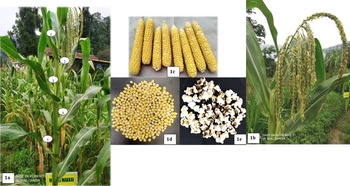
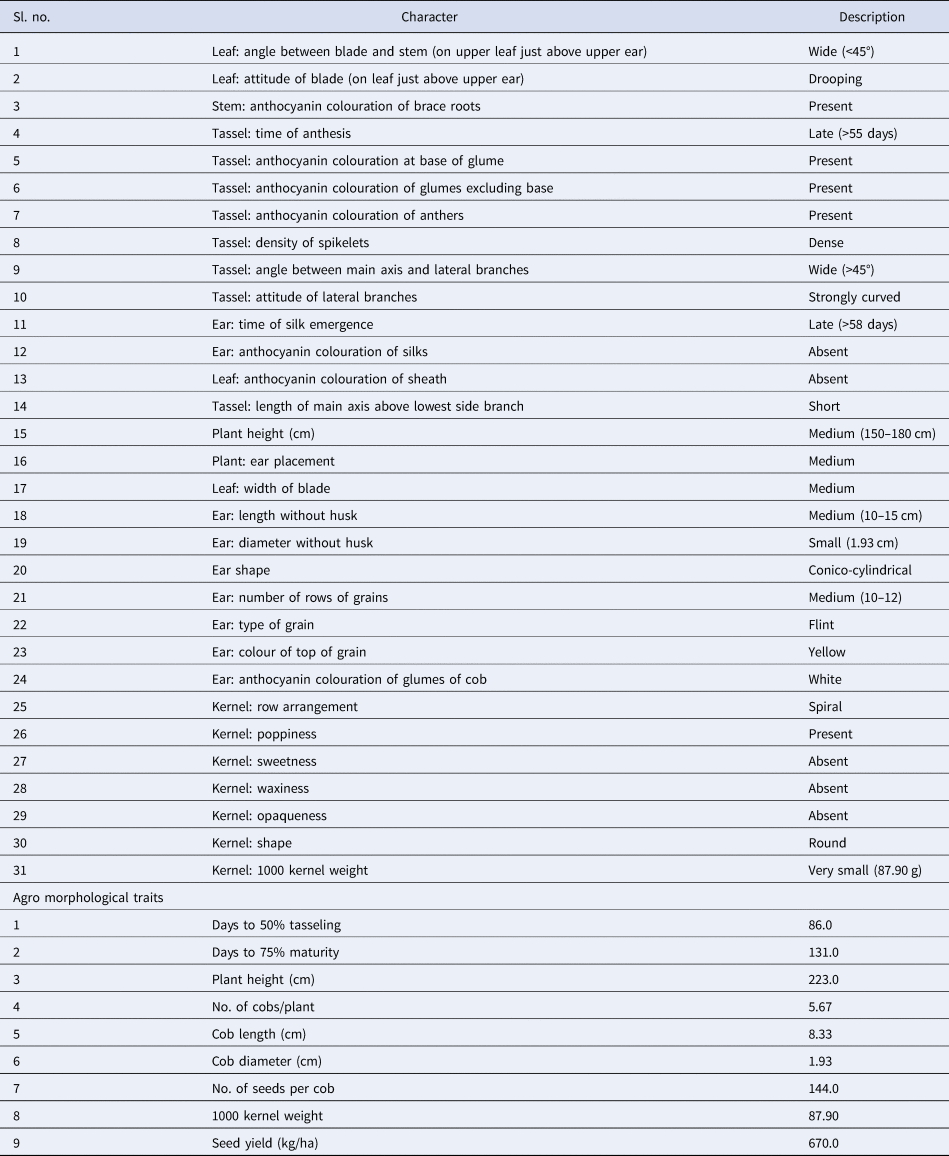
Murali makkai lacks formal crop improvement intervention and has evolved over time adapting to the peculiar hilly conditions of Sikkim. The presence of small-sized cobs with small-sized seeds and prolific habit (5–6 cobs) resemble wild corn (Fig. 1). Data recorded following DUS guidelines revealed distinct traits (Table 1). Tassel showed drooping and strongly curved attitude of lateral branches. Ears were medium in length (10–15 cm) with small diameter (1.93 cm), conico-cylindrical with round flint type grains arranged in a spiral row fashion. Kernels were small with low test weight (87.90 g) and showed excellent popping capacity (>95%). Plants were tall (223.0 cm) and late in maturity (131–135 days). Plants exhibited prolificacy with an average of 5–6 cobs per plant with a mean cob length of 8.33 cm. A mean grain yield of 670 kg/ha was recorded in test plots. PCR amplification with SSR markers amplified a total of 22 amplicons in murali makkai ranging from 100 to 800 bp (online Supplementary Table S2). Primers bnlg1083, umc1353, umc1128, bnlg1017, bnlg2077, umc2298 and umc2373 amplified unique amplicons in murali makkai. SP maize has been reported to be evolved from a common ancestor and similarity with that of pre-chaplote, pre-Nal-Tal and prehistoric corn of Mangelsdorf has been established (Sachan and Sarkar, Reference Sachan and Sarkar1982, Reference Sachan and Sarkar1986). Prolificacy with multiple ears developing from each node is desirable trait for baby corn breeding. A significant study by Prakash et al. (Reference Prakash Nitish, Zunjare, Muthusamy, Chand, Kamboj, Bhat and Hossain2019) on genetic dissection of this landrace revealed quantitative inheritance of prolificacy with non-allelic duplicate epistasis interaction. The same authors reported a novel major Quantitative trait loci (QTL) ‘qProl-SP-8.05’ conferring prolificacy contributing 31.7% phenotypic variation for the trait utilizing prolific inbred line (Prakash et al., Reference Prakash Nitish, Zunjare, Muthusamy, Rai, Kumar, Guleria, Bhatt, Choudhary, Chand, Jaiswal, Bhat and Hossain2021). One of the limitations of utilizing this landrace in maize breeding programme is poor expression of the distinct traits outside the northeastern region (Sharma et al., Reference Sharma, Prasanna and Ramesh2010). Conservation of SP on-farm is a potent strategy where its custodian communities shall be promoted to conserve and expand area under its cultivation through institutional support. In spite of its relatively low yield as compared to other high yielding pop corn hybrids or OPVs, unique trait of prolificacy and adaptation to low input conditions makes it a valuable genetic resource. Considering the current scenario, conservation by use seems to be best strategy for sustainable use of this maize landrace by utilizing it in development of inbred lines, prolific gene pools and population improvement programmes focusing on prolificacy. SSR markers bnlg1083, umc1353, umc1128, bnlg1017, bnlg2077, umc2298 and umc2373 with unique amplicons shared with three other maize populations can be utilized for fingerprinting studies of this landrace. Seed samples of murali makkai have been submitted to ICAR-National Bureau of Plant Genetic Resources, New Delhi for long-term storage for further utilization in maize improvement programmes.
(a) Murali makkai with five cobs, (b) tassel attitude, (c) cobs, (d) unpopped kernels and (e) popped kernels.

DUS and agro-morphological traits of murali makkai

Supplementary material
The supplementary material for this article can be found at https://doi.org/10.1017/S1479262122000065
Acknowledgements
The authors express deep sense of gratitude to the farmers of Sikkim for providing the maize samples. The authors sincerely thank The Director, ICAR Research Complex for NEH Region, Umiam, Meghalaya for providing necessary facilities for carrying out the study.