





Impact statement
By revealing the systemic structures that hinder the advancement of biodesign, this study provides a foundation for developing coordinated, practice-enabling infrastructures and tools that can strengthen the field’s advancement across academia, individual designers, design agencies and industry. Its systems-oriented insights support more effective integration of regenerative, life-centred design approaches, contributing to the broader transition towards a more sustainable and circular economy.
Introduction
As the global need to shift towards sustainability increases, design practices in Industrial Design Engineering Technology need to evolve beyond traditional, techno- or human-centred approaches, as acknowledged in multiple design fields, that is, ecodesign, biomimicry, biodesign, etc. (Ceschin and Gaziulusoy Reference Ceschin and Gaziulusoy2016). This article is specifically focused on the field of biodesign and how it is concurrently enacted as a design field within Industrial Design Engineering Technology. Biodesign, although rising, is today still little implemented by industrial design engineers in their projects. Even though many initiatives are out there, and still being developed, its advancement seems to remain obstructed in some way or another. Hence, this study sets-out to analyse pioneer biodesign experts’ experience to learn if there are deeper systemic structural explanations to be found for this obstruction. This is addressed by extensively interviewing 21 pioneer biodesign experts (n = 21) to ask why and how they already engage with biological elements in their design projects. More specifically what challenges and opportunities, as well as what obstacles/barriers & advantages/enablers they experience. The interview transcriptions are subsequently qualitatively analysed, applying the QUAGOL protocol, through a coding process. The codes specific to the challenges and opportunities, and obstacles/barriers & advantages/enablers are used to identify a system of biodesign and its underlying systemic structures that might hinder its advancement in Industrial Design Engineering Technology. Creating this initial understanding of the hindering systemic structures might enable future work to use this knowledge of these identified systemic structures to pinpoint leverage points through which biodesign can be meaningfully advanced.
Theoretical foundations
This section will address the growing foundations of the biodesign field, the recognition of multi-species agency in design, the changing role of designers and a systems thinking approach employed to deal with the complexity – such as biodesign implementation in Industrial Design Engineering Technology.
The biodesign field
In this study, the argument advanced by Thomsen and Tamke (Reference Thomsen and Tamke2022) – that learning from nature alone is insufficient to achieve a genuine transition towards circular and regenerative systems – is explicitly adopted (Thomsen and Tamke Reference Thomsen and Tamke2022). Biodesign is therefore positioned not as an evolution of biomimicry that merely translates biological inspiration into existing industrial paradigms, nor as the commodification of natural resources, but as a design approach that actively collaborates with (once-)living biological systems. Rather than treating nature as a passive reference or extractable input, biodesign engages ecosystems as co-creative partners that sustain both human and non-human life (Kopnina Reference Kopnina2017; Shiva Reference Shiva2000). In this sense, it operates “beyond biomimicry,” as articulated by Myers (Reference Myers2018a), by embedding design practice within ecological processes rather than abstracting from them (Myers Reference Myers2018a).
The ethos of biodesign resonates with what has been described as “organic design”: an approach that involves “watching objects grow” and “letting nature, the best among all engineers and architects, run its course” (Antonelli Reference Antonelli2018, p. 7; Birch et al. Reference Birch, Bridgens, Zhang and Dade-Robertson2024). Within this study, biodesign is defined following the formulation proposed by Biofabricate as “Designing of, with, and for biology” (Antonelli Reference Antonelli2018; Birch et al. Reference Birch, Bridgens, Zhang and Dade-Robertson2024; Lee et al. Reference Lee, Congdon, Parker and Borst2020, p. 10). This concise definition captures the breadth of biodesign practice and foregrounds the varying roles that biology can assume within design processes.
Biodesign is not confined to a single industry but is increasingly applied across architecture, construction, cosmetics, fashion, fragrance, colouring, automotive design and other industries (Myers Reference Myers2018b). Across these domains, a defining characteristic is the integration of (once-)living organisms as active participants in design processes (Ginsberg and Chieza Reference Ginsberg and Chieza2018). Oxman (Reference Oxman2016) observes that contemporary design is increasingly incorporating biological processes not merely as sources of inspiration, but as contributors to utility and behavioural transformation (Oxman Reference Oxman2016). Yet, such integration introduces significant challenges for Industrial Design Engineering Technology. Biological systems are characterised by heightened variability, unpredictability and uncertainty, which often conflict with conventional expectations of control, standardisation and repeatability.
Although biodesign moves beyond conventional biomimicry, it still draws upon core biomimetic principles as methodological and evaluative foundations. In aligning with Life’s Principles and foundational biomimetics concepts, biodesign reframes design as life-centred rather than exclusively human-centred, applying biological forms, processes and ecosystem logics to address complex challenges (Stevens et al. Reference Stevens, Fehler, Bidwell, Singhal and Baumeister2022). Within material economies, biodesign contributes to regenerative practices in the Circular Economy (Cotsaftis et al. Reference Cotsaftis, Williams, Chyon, Sadar, Va Pesaran, Wines and Naarden2023). As du Plessis (Reference du Plessis2012) argues, regenerative paradigms emphasise co-creative partnerships with nature grounded in adaptation, resilience and regeneration (du Plessis Reference du Plessis2012). Biodesign thus mediates between material systems, living processes and socio-ecological contexts, positioning itself as an enabler of the regenerative transformation.
Rise of agency
The emergence of biodesign is closely linked to broader debates surrounding the Anthropocene – an epoch defined by the dominant influence of human activity on planetary systems (Crutzen Reference Crutzen2002, Reference Crutzen2022). As critiques of anthropocentrism have intensified, alternative framings such as bio- or symbiocentrism have been proposed, repositioning humanity as an integral participant within ecological systems rather than as an external controller (Albrecht and Van Horn Reference Albrecht and Van Horn2016; Pollini and Rognoli Reference Pollini and Rognoli2024). This shift carries profound implications for design.
Design has traditionally been described as a “human tradition of inquiry and action” concerned with intentionally creating preferred situations, the “ultimate particular” (Nelson and Stolterman Reference Nelson and Stolterman2014, pp. 1, 31). Implicit in this framing is the assumption that agency resides solely within human actors. The rise of More-Than-Human (MTH) thinking challenges this assumption. First articulated by Abram (Reference Abram1996), the MTH perspective decentres humanity and recognises ecosystems, plants, fungi, animals, soils, atmospheres and technological artefacts as active participants in design processes (Abram Reference Abram1996). Conventional paradigms often treated these entities as passive resources to be extracted, optimised or controlled – a reflection of a mechanistic worldview that separates humans from ecological systems (Cole Reference Cole2012; Pataranutaporn et al. Reference Pataranutaporn, Vujic, Kong, Maes and Sra2020). In contrast, MTH perspectives emphasise interdependence, recognising that agency is distributed across interconnected actors.
Agency, understood as the capacity to meaningfully influence outcomes, thus extends beyond human stakeholders. In biodesign, this expansion manifests as non-human biological agency: the active contribution of (once-)living organisms or biological materials to design processes. More-Than-Human Design has emerged as a field that intentionally creates space for such non-human agency to influence outcomes in mutually beneficial ways (Karana et al. Reference Karana, McQuillan, Rognoli and Giaccardi2023; Kim Reference Kim2021; Wakkary Reference Wakkary2021).
Theoretical grounding for MTH agency in biodesign is further articulated by Gough and colleagues, who draw from Human–Computer Interaction (HCI) to propose living computational systems (Gough et al. Reference Gough, Pschetz, Ahmadpour, Hepburn, Cooper, Ramirez-Figueroa and Catts2020, Reference Gough, Forman, Pataranutaporn, Hepburn, Ramirez-Figueroa, Cooper, Vujic, Kong, Kim, Maes, Ishii, Sra and Ahmadpour2021a, Reference Gough, Yoo, Tomitsch and Ahmadpour2021b). Rather than relying solely on digital computation, these approaches recognise biological organisms as contributors of bioaffordances – organism-specific capacities for action and interaction (Gough et al. Reference Gough, Yoo, Tomitsch and Ahmadpour2021b). Building on Gibson’s (Reference Gibson1977) concept of affordances and its adaptation by Norman (Reference Norman1988) to Industrial Design (Gibson Reference Gibson1977; Norman Reference Norman1988), bioaffordances describe the action possibilities offered by non-human biological agents. From this perspective, biodesign emerges as the application of bioaffordances, enabling symbiotic collaboration between biological and design entities (Gough et al. Reference Gough, Yoo, Tomitsch and Ahmadpour2021b).
The integration of MTH agency inevitably raises ethical considerations. Armstrong (Reference Armstrong2022) emphasises that when living agents are engaged in design processes, they must be appropriately supported, calling on designers to “step inside the skin” of the entities they work with (Armstrong Reference Armstrong2022, p. 5). Her principles advocate recognising microbes as foundational architects of the biosphere, shifting designers’ roles from sole authors to facilitators within multi-species collectives, fostering metabolic enlivening rather than extractive optimisation and integrating diverse knowledge systems beyond modern science (Armstrong Reference Armstrong2022). These principles foreground reciprocity, stewardship and dialogue with biological systems.
Taken together, the rise of expanded agency in biodesign is characterised by: explicit acknowledgement of agency beyond the human, commitment to reciprocity and stewardship, alignment of MTH lifecycles with product and system lifecycles and engagement with local ecologies through iterative, open-ended practices that embrace variability, unpredictability and uncertainty. In doing so, biodesign spans from translating nature into industrial forms to co-producing value with (once-)living ecosystems (Pollini and Rognoli Reference Pollini and Rognoli2024).
Changing role of designers
As agency expands beyond the human, the role of the designer undergoes a profound transformation too. Designers have shifted from being mere material applicators – selecting and specifying predefined materials – to material collaborators/orchestrators who coordinate complex material systems that include living and once-living entities (Gough et al. Reference Gough, Pschetz, Ahmadpour, Hepburn, Cooper, Ramirez-Figueroa and Catts2020; Vuylsteke et al. Reference Vuylsteke, Detand and Ostuzzi2023). This shift reflects an increasing engagement with processes of growth, transformation, decay and regeneration across extended temporal scales (Camere and Karana Reference Camere and Karana2018; Välk et al. Reference Välk, Chen, Dieckmann and Mougenot2023).
Recognising non-human biological agencies as stakeholders fundamentally alters the design landscape. Designers must navigate intricate networks of interdependent actors, increasing systemic complexity and requiring nuanced understanding of dynamic interactions between human and non-human agents (Camere and Karana Reference Camere and Karana2018; Dade-Robertson and Zhang Reference Dade-Robertson and Zhang2024; Karana et al. Reference Karana, McQuillan, Rognoli and Giaccardi2023). Agency no longer resides solely in human intention nor in autonomous biological processes, but emerges through their relational entanglement (Gough et al. Reference Gough, Forman, Pataranutaporn, Hepburn, Ramirez-Figueroa, Cooper, Vujic, Kong, Kim, Maes, Ishii, Sra and Ahmadpour2021a; Karana et al. Reference Karana, McQuillan, Rognoli and Giaccardi2023; Oxman Reference Oxman2016).
This shift challenges the conventional pursuit of control, predictability and optimisation. Instead, designers are called to cultivate acceptance of open-endedness and uncertainty, embracing the variability inherent in ecological systems (Karana et al. Reference Karana, McQuillan, Rognoli and Giaccardi2023; Kim Reference Kim2021; Ostuzzi Reference Ostuzzi2017). The designer’s role becomes less about prescribing fixed outcomes and more about initiating conditions for interactions to unfold (Dubberly and Pangaro Reference Dubberly and Pangaro2015; Myers Reference Myers2018a).
To engage meaningfully with MTH agents, designers must adopt transdisciplinary approaches, integrating knowledge from biology, biotechnology, biochemistry, ecology, botany and related life sciences (Bandoni et al. Reference Bandoni, Almendra and Forman2022; Camere and Karana Reference Camere and Karana2018; Chen et al. Reference Chen, Cai, Jiang, Long, Sun, Childs and Zuo2023; Kääriäinen et al. Reference Kääriäinen, Tervinen, Vuorinen and Riutta2020; Myers Reference Myers2018c; Pollini and Rognoli Reference Pollini and Rognoli2024). In this expanded role, designers move from controlling matter to co-evolving with (once-)living systems.
This transformation – from human-centred problem solver to systems initiator and orchestrator within multi-species collectives – forms a critical theoretical foundation for understanding biodesign. It situates design not as an external force imposed upon nature, but as a relational practice embedded within living ecologies.
System-oriented perspectives and systemic design
As is illustrated with the broad and ever-emerging academic and industrial discourse in biodesign, its complexity is rising with the increased understanding. In order to address this complexity of the field and its practice in Industrial Design Engineering Technology, approaches are employed that are specifically well suited to handle this wicked context (Vandenbroeck Reference Vandenbroeck2012).
Therefore, this study aligns with and extends prior research that recommends systems thinking and systemic design to handle complexity (Vandenbroeck Reference Vandenbroeck2012). Dubberly and Pangaro (Reference Dubberly and Pangaro2023), for instance, recently present multiple recommendations for scholars working with systems, supported by practical examples (Dubberly and Pangaro Reference Dubberly and Pangaro2023). Similarly, Dumon and Ostuzzi (Reference Dumon and Ostuzzi2021) reports the use of systemic design in design education through practice-based assignments, providing empirical evidence of systemic design being integrated into academic curricula and offering a robust platform that resonates with such recommendations (Dumon and Ostuzzi Reference Dumon and Ostuzzi2021). Wiek et al. (Reference Wiek, Withycombe and Redman2011) further argues that systems thinking and systemic interventions are among the key competencies in sustainability (Wiek et al. Reference Wiek, Withycombe and Redman2011). McMahon and Hadfield (Reference McMahon and Hadfield2007) likewise advocate systems thinking as a pathway towards sustainable design solutions by proposing a taxonomy for systemic design and testing their assumptions with professional designers, challenging them to think in systems when addressing a given problem (McMahon and Hadfield Reference McMahon and Hadfield2007).
Across these contributions, a core lesson emerges that motivates this study: through systemic design – spanning across design fields – designers can push projects beyond symptomatic solutions that remain confined to isolated products and instead intervene in the interconnected conditions that shape practice and its outcomes.
Furthermore, does the Law of Requisite Variety in Cybernetics tell us that “only variety can destroy variety” (Ashby Reference Ashby1956, p. 207). Following this law, two strategies arise to address the increased experienced variability, unpredictability and uncertainty when biodesigning: (1) reducing the variety of the system to be controlled by simplifying it, something that we have done by refraining from biodesign principles over the last decades, (2) increasing the variety of the designer (controller) rather than reducing the variety of the system, thereby increasing the adaptive capacity of the designer through a meaningful support system. Of course, before this second strategy can be implemented we need to identify what hinders advancement to date.
Ultimately, this study is guided by the following research question: “What systemic structures hinder advancement of biodesign?.”
Methodology
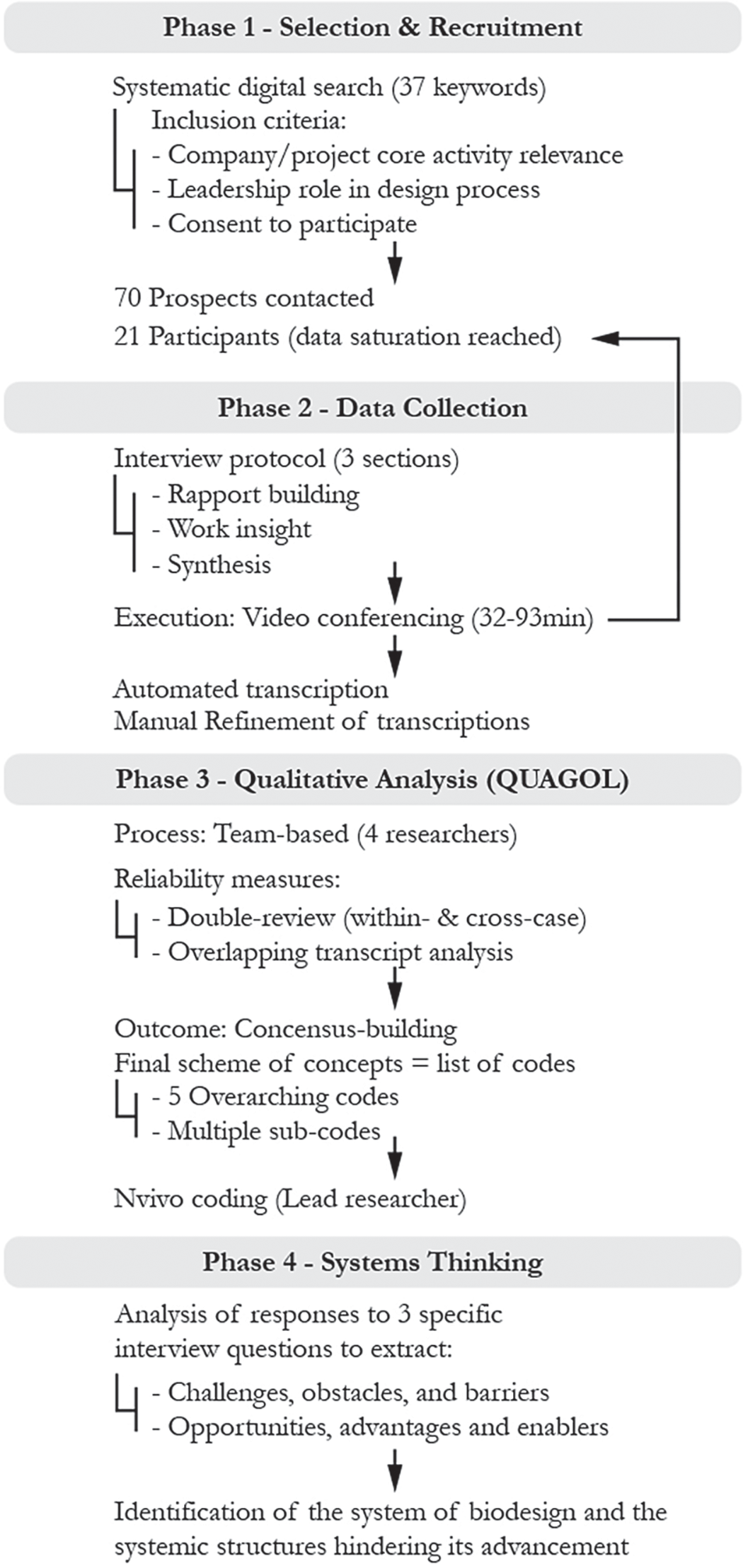
In order to answer this study’s research question, pioneering biodesign experts were interviewed. The data obtained is very extensive, to the extent that in total three studies evolved from this large dataset alone. Each using the data obtained from: (1) responses of a specific set of questions within these interviews, (2) different angles of reconfiguring this qualitative data. This paper will report on one of these studies, focused on a specific set of questions. Figure 1 illustrates the complete methodological process for this study.
Methodological process overview.

Phase 1 – Participant selection and recruitment
A systematic digital search (using Google search engine and LinkedIn post search) was conducted to identify projects and organisations operating within the field of biodesign. To ensure the relevance of the sample, three inclusion criteria were applied:
-
1. The core activity of the project or company engages with biodesign, verified by the presence of multiple key descriptors – as illustrated in the Biodesign Model – on their digital platforms (bioart, bioeconomy, bioassembly, biobased, biobased economy, biocomposite, biodegradable, bioderived, biodesign, biofabrication, biogenic, bioinspired, biological, biomanufacturing, biomass, biomaterial, biomimicry, biophilia, bioplastic, bioreceptivity, biorefinery, biosynthesis, biosynthetic, biotic, bodily material, compostable, ecosystem, green economy, growing design, marine degradable, material ecology, microorganism, natural, organic, regenerative design, renewable material, synthetic biology), which were studied in a prior study on terminology (Vuylsteke et al. Reference Vuylsteke, Detand and Ostuzzi2023);
-
2. The prospective participant had to hold an active or leadership role in the biodesign process; and
-
3. A willingness to participate in the study.
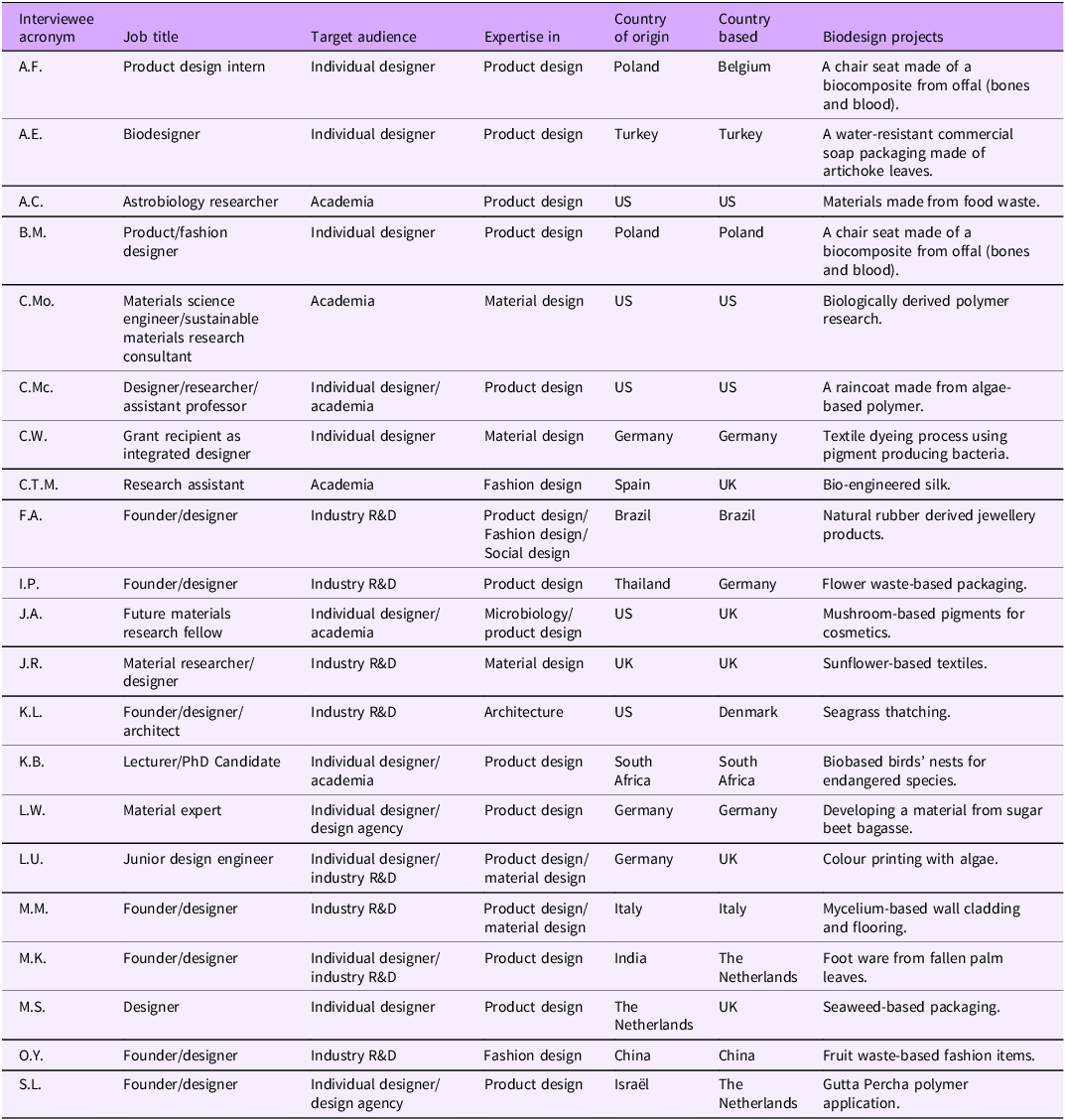
70 candidates were identified and contacted to participate. Recruitment continued until data saturation was reached, defined as the point at which no new themes or insights emerged in subsequent interviews. The final sample – constituting 21 expert participants (n = 21) – was deemed sufficient given the depth of the interviews and the strong thematic convergence observed across the data, which indicated that significant and diverse insights could be derived from participants’ reported experiences. Table 1 provides an overview of these biodesign expert participants, highlighting a diverse range of professional backgrounds and geographical locations.
Overview of biodesign expert participants

Table 1. Long description
Tabular overview of the 21 biodesign expert participants and their professional, and geographical background information. The columns contain information about the interviewee acronym, job title, target audience they belong to, expertise, country of origin, country based, and biodesign projects they worked on.
To ensure relevance across the contexts in which biodesign is enacted, the studies defined and targeted four distinct audience groups that biodesign on different scales and with different purposes: academia, individual designers, design agencies and industry with R&D departments.
-
• Academia is defined here as the collective world of higher education, research and scholarship, encompassing professors, researchers and students who are dedicated to the pursuit and preservation of knowledge in Industrial Design Engineering Technology.
-
• Individual designers are defined as freelance professionals who are self-employed and work in service of a larger company or project.
-
• Design agencies are defined as collectives or teams of designers with specific specialisations working in service of larger companies or projects.
-
• Industry with R&D departments is defined as companies that have specialised departments of designers, architects, engineers and/or bioengineers who pursue novelty within the company’s niche.
These four target audiences were also made explicit in the tabular overview of the biodesign expert participants. Some participants were attributed to multiple target audiences. Of all participants, 28% were involved in academia, 57% as individual designers, 10% in design agencies and 38% in industry with R&D departments.
Phase 2 – data collection
An interview protocol was established and validated (https://doi.org/10.6084/m9.figshare.26206817) (Vuylsteke et al. Reference Vuylsteke, Ostuzzi and Detand2022a), consisting of three distinct phases:
-
1. 4 opening questions to establish rapport;
-
2. 10 questions providing insight into the participants’ specific work; and
-
3. 10 closing questions designed to broaden the scope of the discussion and facilitate a synthesis of the interview.
All interviews were conducted in English by the lead researcher via video conferencing (using MS Teams), with durations ranging from 32 to 93 minutes. Audio recordings were transcribed automatically and subsequently refined manually to ensure accuracy.
Phase 3 – qualitative data analysis
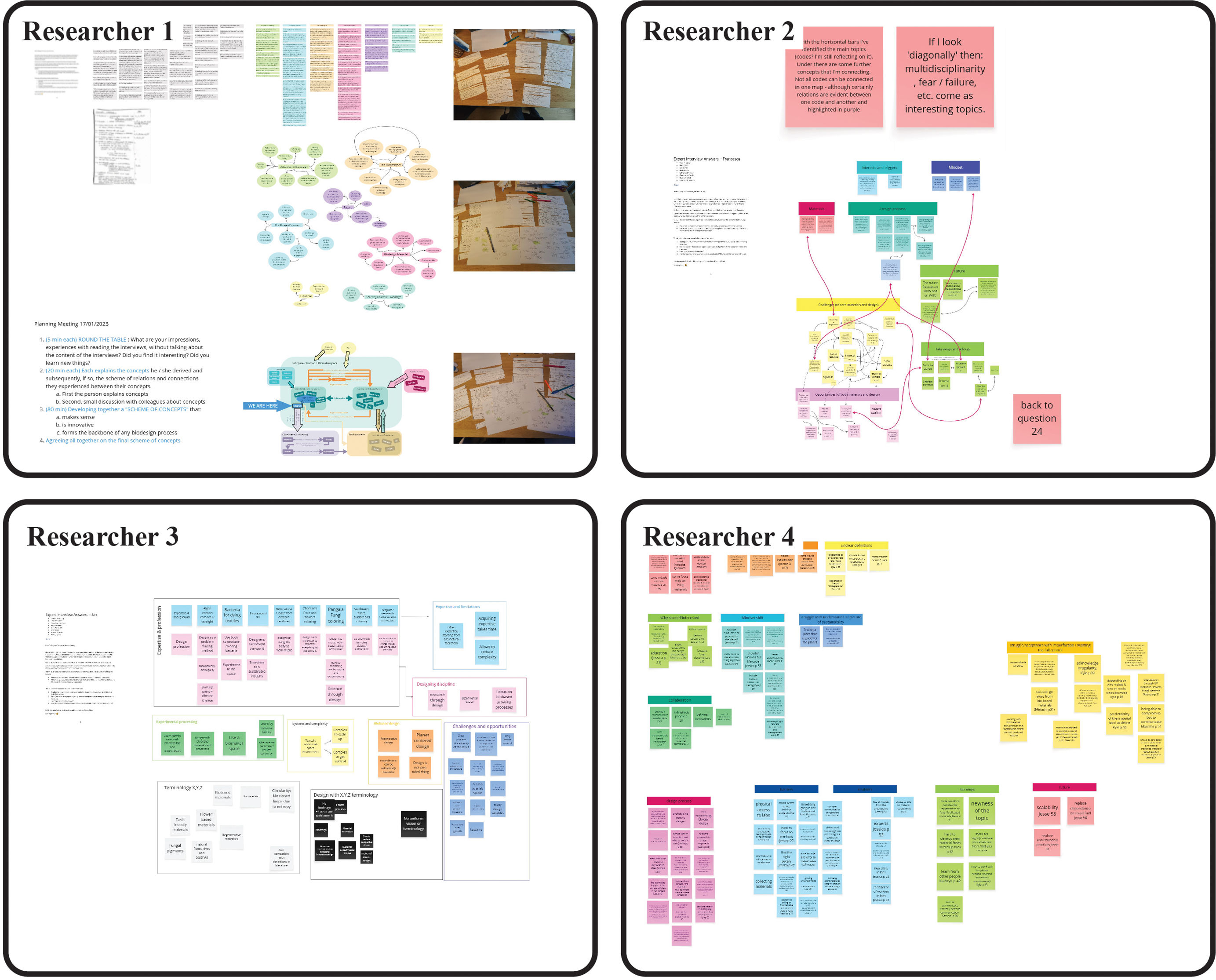
The study employed the Qualitative Analysis Guide of Leuven (QUAGOL) methodology to ensure a rigorous and transparent interpretive process (Dierckx de Casterle et al. Reference Dierckx de Casterle, Gastmans, Bryon and Denier2012). The method entails a, preparatory phase followed by an actual coding phase. In the preparatory phase, all transcripts were subjected to thorough re-reading. Reliability was supported through two specific measures: first, each interview was randomly assigned and reviewed by at least two researchers to ensure overlap and verify consistency in interpretation; and second all researchers reviewed the interview once within-case (interview by interview) and once cross-case (question by question) to mitigate order bias. Each researcher produced narrative interview reports that captured the participant’s storyline and key meaning and created a conceptual interview scheme containing preliminary concepts and their relationships (Figure 2).
Narrative interview reports as conceptual interview schemes of concepts of the four researchers (access to original file through https://doi.org/10.6084/m9.figshare.26206883).

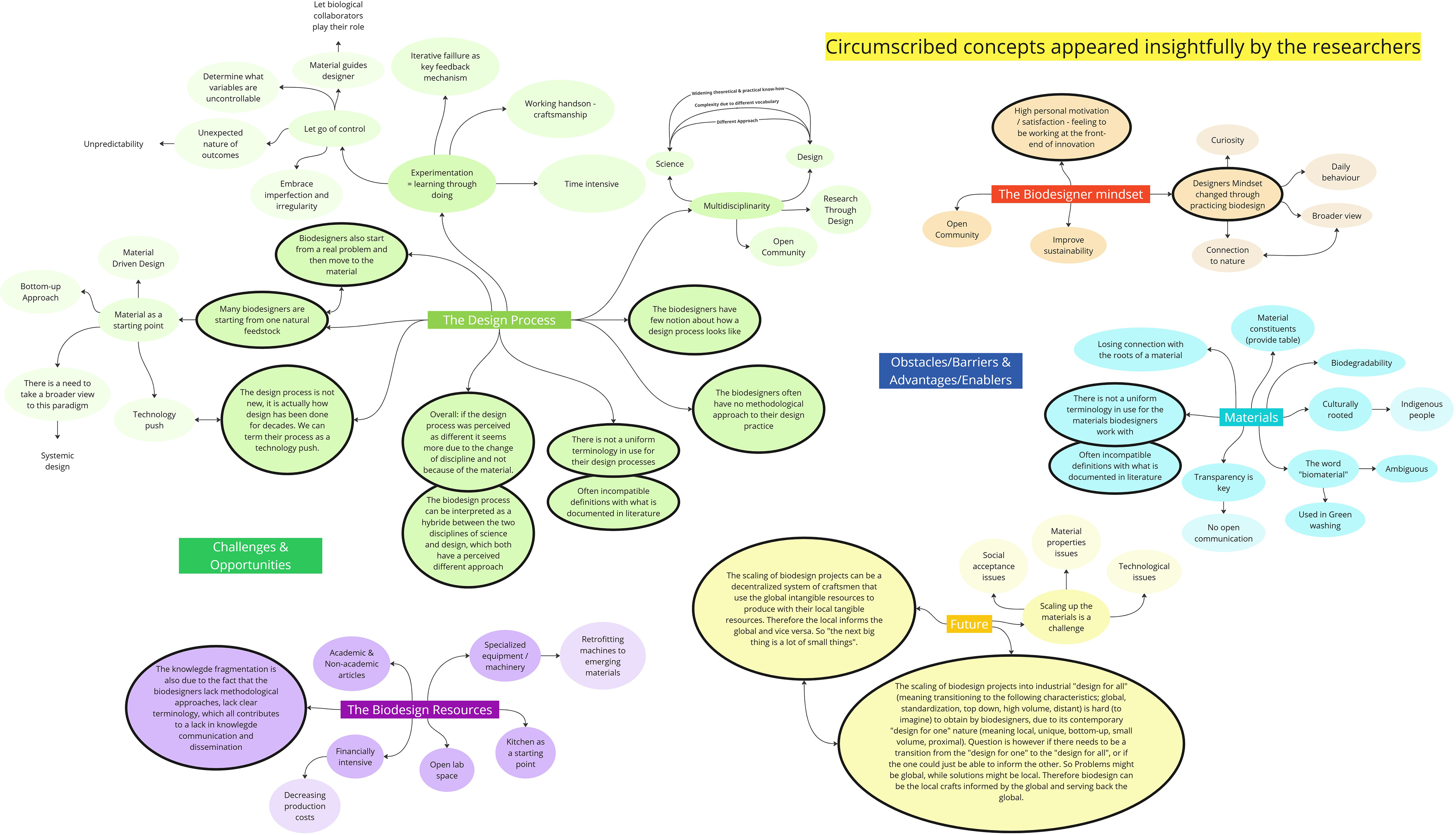
The team subsequently compared and synthesised individual schemes, resulting in a joint conceptual scheme that established seven overarching codes and associated subcodes (Figure 3) (Vuylsteke et al. Reference Vuylsteke, Ostuzzi and Detand2022b).
Joint scheme of concepts through consensus building amongst the four researchers, resulting as the preliminary codebook (access to original file through https://doi.org/10.6084/m9.figshare.26206883).

The actual coding phase was supported by NVivo software (Lumivero 2022). The seven overarching codes and their respective subcodes were imported as a preliminary codebook. The relevant interview fragments were linked to the appropriate codes, introducing emergent subcodes where novel commonalities appeared, and concepts were analysed in detail.
This study adopted a systems-oriented research approach in order to analyse the response specific for the following three interview questions:
-
• What are the challenges and opportunities of biological elements and its accompanying design practice?
-
• Which obstacles or barriers do you encounter in your design process when designing with biological elements?
-
• Which advantages or enablers do you identify when designing with biological elements?
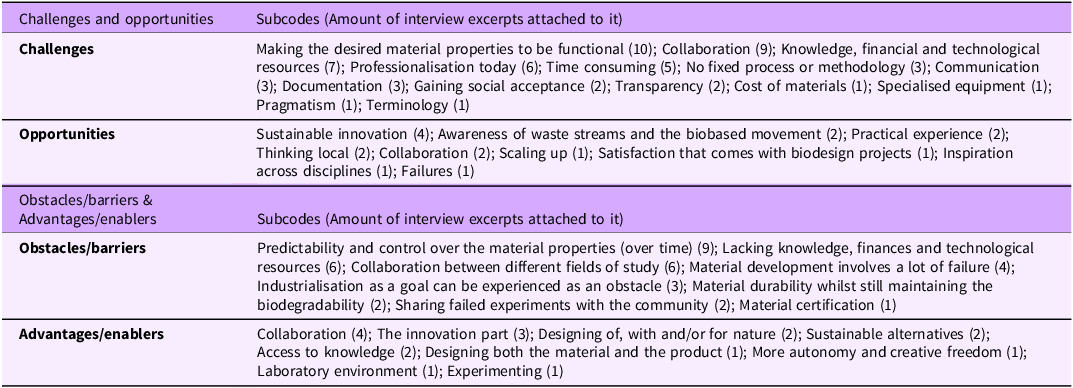
From the responses of these three questions, the challenges, obstacles and barriers, as well as the opportunities, advantages and enablers were coded together with interview excerpts for empirical grounding under the overarching codes Challenges and Opportunities and Obstacles/Barriers & Advantages/Enablers. In this way, this study specifically focused on two of the seven overarching codes. Table 2 holds the subcodes for which each has one or multiple interview excerpts attached to it, ranked from most to least attached excerpts.
The subcodes identified for the overarching codes Challenges and opportunities and obstacles/barriers & advantages/enablers after qualitative analysis of the expert interviews

Table 2 Long description
A table categorizing subcodes for challenges, opportunities, obstacles, and advantages in expert interviews. The table has two main sections: Challenges and opportunities, and Obstacles/barriers & Advantages/enablers. Each section lists subcodes with the amount of interview excerpts attached to it. Challenges include Making the desired material properties to be functional (10), Collaboration (9), Knowledge, financial and technological resources (7), Professionalisation today (6), Time consuming (5), No fixed process or methodology (3), Communication (3), Documentation (3), Gaining social acceptance (2), Transparency (2), Cost of materials (1), Specialised equipment (1), and Pragmatism (1). Opportunities include Sustainable innovation (4), Awareness of waste streams and the biobased movement (2), Practical experience (2), Thinking local (2), Collaboration (2), Scaling up (1), Satisfaction that comes with biodesign projects (1), Inspiration across disciplines (1), and Failures (1). Obstacles/barriers include Predictability and control over the material properties (over time) (9), Lacking knowledge, finances and technological resources (6), Collaboration between different fields of study (6), Material development involves a lot of failure (4), Industrialisation as a goal can be experienced as an obstacle (3), Material durability whilst still maintaining the biodegradability (2), Sharing failed experiments with the community (2), and Material certification (1). Advantages/enablers include Collaboration (4), The innovation part (3), Designing of, with and/or for nature (2), Sustainable alternatives (2), Access to knowledge (2), Designing both the material and the product (1), More autonomy and creative freedom (1), Laboratory environment (1), and Experimenting (1).
Phase 4 – systems thinking
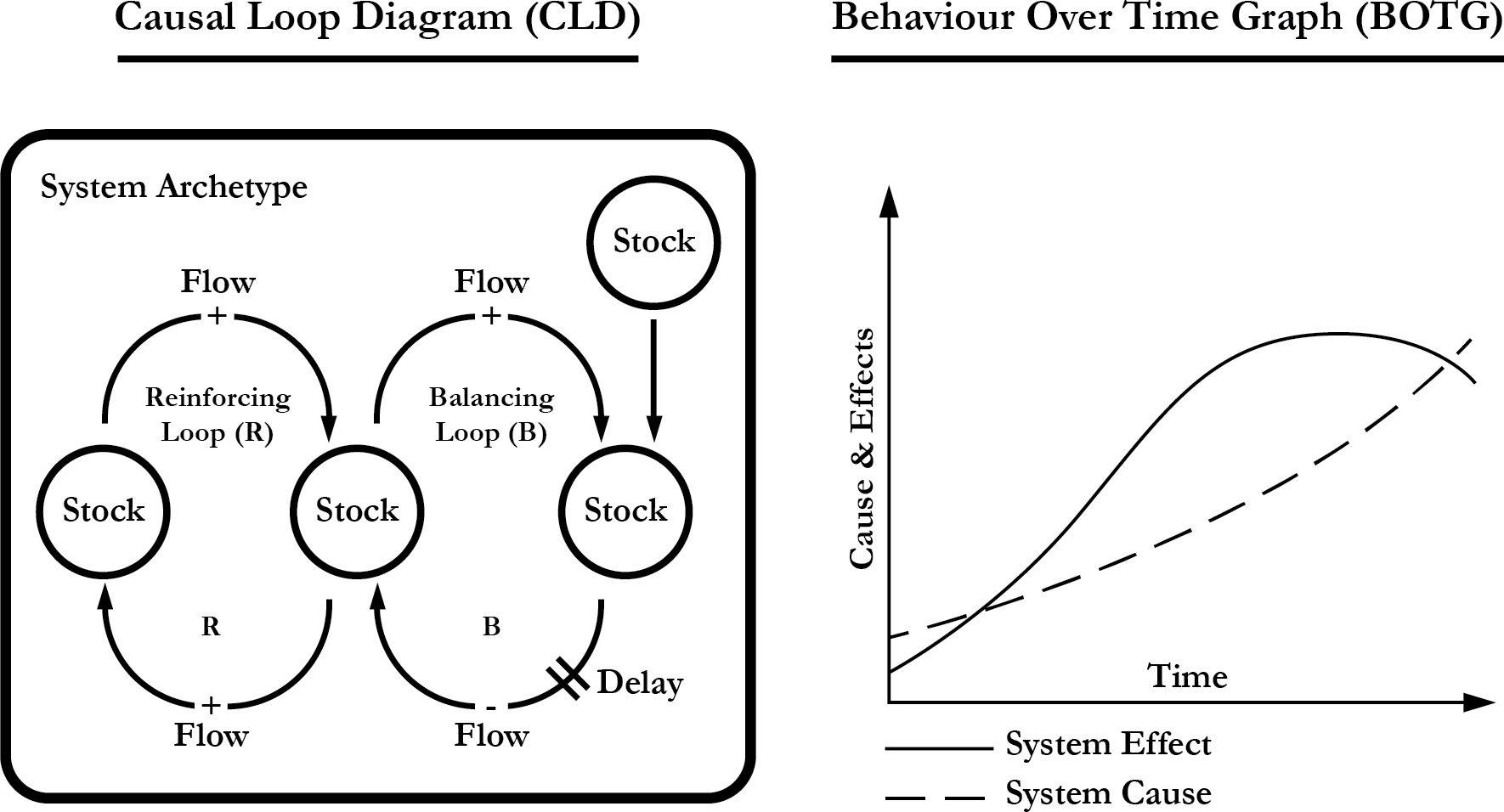
Through the interview excerpts attached to the codes, logical patterns emerged as systemic structures. Accordingly, these codes became either the stock or the flow elements of the system of biodesign which was represented through use of a Causal Loop Diagram (CLD) (Forrester Reference Forrester1997; Senge Reference Senge1990). In systems thinking – especially in its visual representations with CLDs – stock are the elements that can be added or subtracted from a system over time, while the flow are the actions of processes that increase or decrease (transform) this stock in a system represented by arrows.
The opportunities, advantages and enablers were representing the current biodesign systemic structures (= current state of stock and flow), while the challenges, obstacles and barriers were the hindering systemic structures (= root causes to advancement of the field). In this way a contemporary system of biodesign was identified with its hindering systemic structures. Some of the systemic structures that emerged, aligned with recognisable System Archetypes which describe common patterns in complex systems (Braun Reference Braun2002). In this way the hindering structures could be explained through these known archetypes and their established Behaviour Over time plotted in a Graph (BOTG) (Braun Reference Braun2002).
Thus, through Causal Loop Diagrams (= containing stock and flow), System Archetypes (= recognisable patterns) and Behaviour Over Time Graphs (= behavioural cause and effect diagrams plotted over time) the system of biodesign was identified and analysed to highlight the current systemic structures that might hinder the advancement of biodesign in Industrial Design Engineering Technology contexts (Figure 4).
System CLD, Archetype, and BOTG demonstration.

Validation of these CLDs, BOTGs has happened by two systems thinking expert researchers.
Results
For the advancement of the biodesign field, it is of interest to understand how its design practice is enacted – such as the use of supporting design tools, the integration of different disciplines, the involvement of different design agencies (human and more-than-human) and other enabling conditions.
Systemic understanding of biodesign
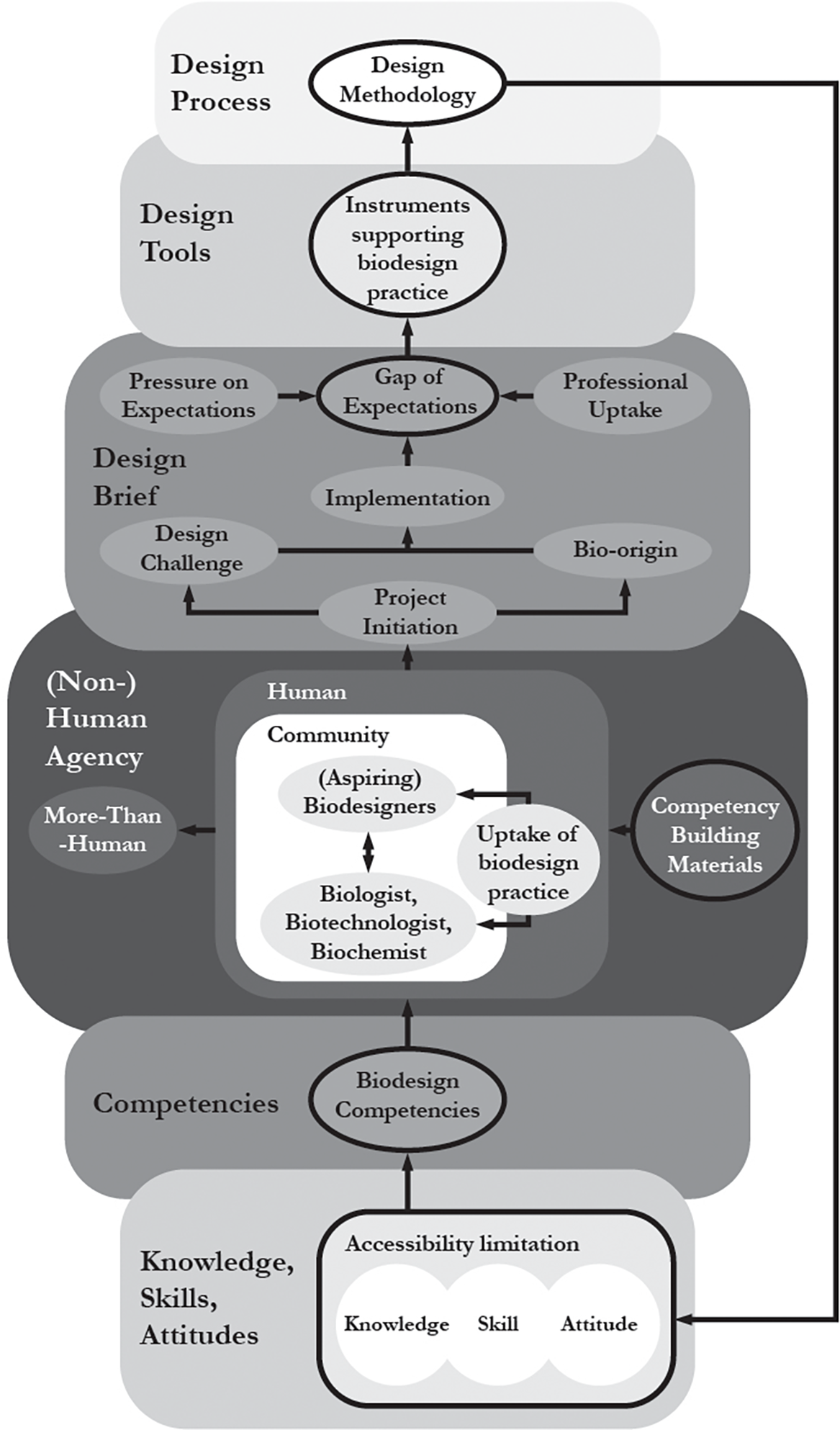
As explained in the research method, this understanding is created through a system-oriented research approach. In line with systems thinking, this study explicitly adopts the premise that systems can be described on multiple system depths of which the systemic structures are most fundamental – see Iceberg Model (Kambiz E. and Cavana Reference Kambiz E and Cavana2007; Kim Reference Kim1992, Reference Kim1999; Senge Reference Senge1990). Accordingly, a simplified representation of the system of biodesign is presented in the accompanying Figure 5, which visualises the biodesign system and its diverse system depths as conceptualised in this research.
Simplified representation of the system of biodesign (access the detailed system of biodesign through (https://doi.org/10.6084/m9.figshare.31429523).

Within this simplified representation, the designer is positioned centrally at the system depth of (Non-)Human Agency, reflecting how biodesign unfolds through interaction between human agencies and more-than-human agencies. On a deeper system depth, design practicing human agencies are understood to operate through Competency subsystems, which in turn are constructed through underlying subsystems of Knowledge, Skills and Attitudes. Moving to the other deeper side from the agency level, the Design Brief functions as a system depth that informs design agencies of either a design challenge or the opportunity to work with biological elements. Even deeper, the enabling system for the design brief provides Design Tools, which support and operationalise the Design Process system level. Importantly, the system boundaries presented in this study are drawn from a design field enabling perspective, meaning that the system stock & flow acknowledged through evidence-based qualitative analysis – and the system depths identified – are bounded by the perspective of what enables or constrains biodesign.
Systemic structures that hinder advancement of biodesign
The qualitative systemic analysis (as explained in the Methodology) revealed several systemic structures (in Figure 5 represented by black stroked system stock) that might hinder advancement from early curiosity to sustained biodesign advancement. These systemic structures are grounded in the expert interview data through: (1) expert interviews description of concepts database (https://doi.org/10.6084/m9.figshare.26206910) (Vuylsteke et al. Reference Vuylsteke, Ostuzzi, Detand and Dumon2024), (2) figure of the detailed system of biodesign and its empirically grounded evidence of interview excerpts (https://doi.org/10.6084/m9.figshare.31429523) (Vuylsteke et al. Reference Vuylsteke, Ostuzzi and Detand2026). Each deeper systemic structure is described in detail and represented in a figure (Figures 6–9) using Causal Loop Diagrams (CLDs), System Archetypes, Behaviour Over Time Graphs (BOTGs) and empirical evidence through interview excerpts that point this out.
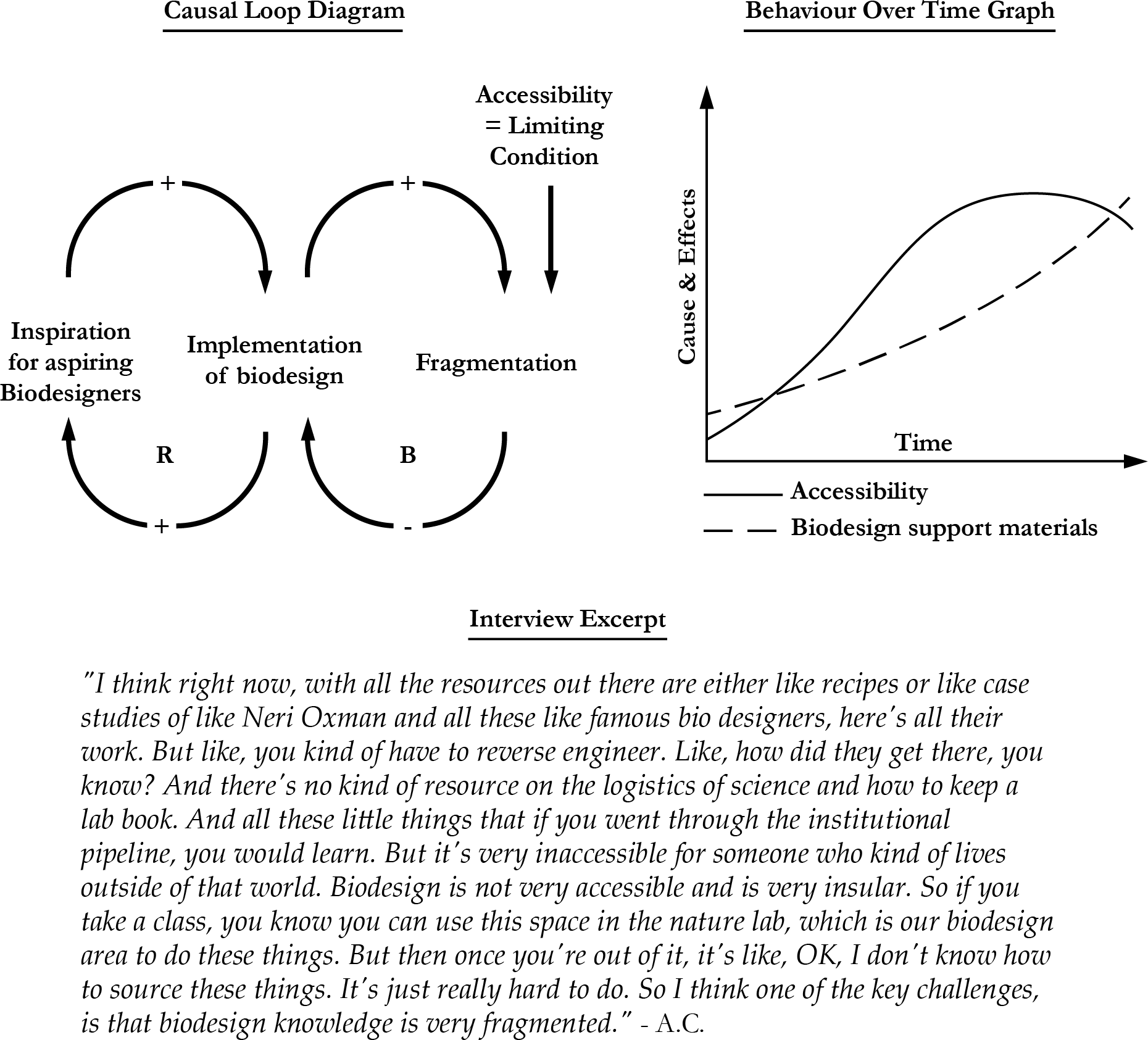
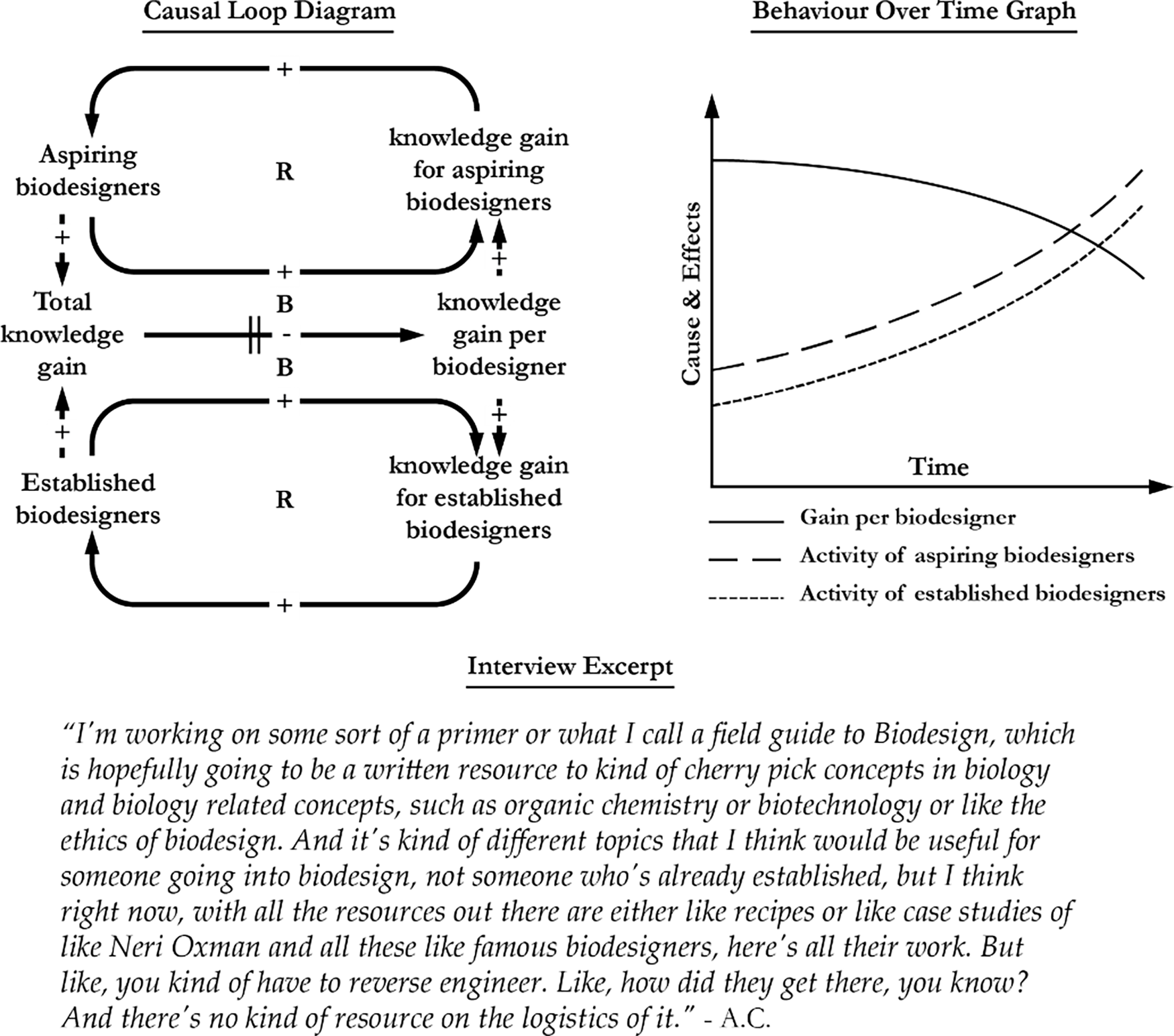
Causal loop diagram, behaviour over time graph and expert interview excerpt of systemic structure 1 – limits to growth – accessibility.

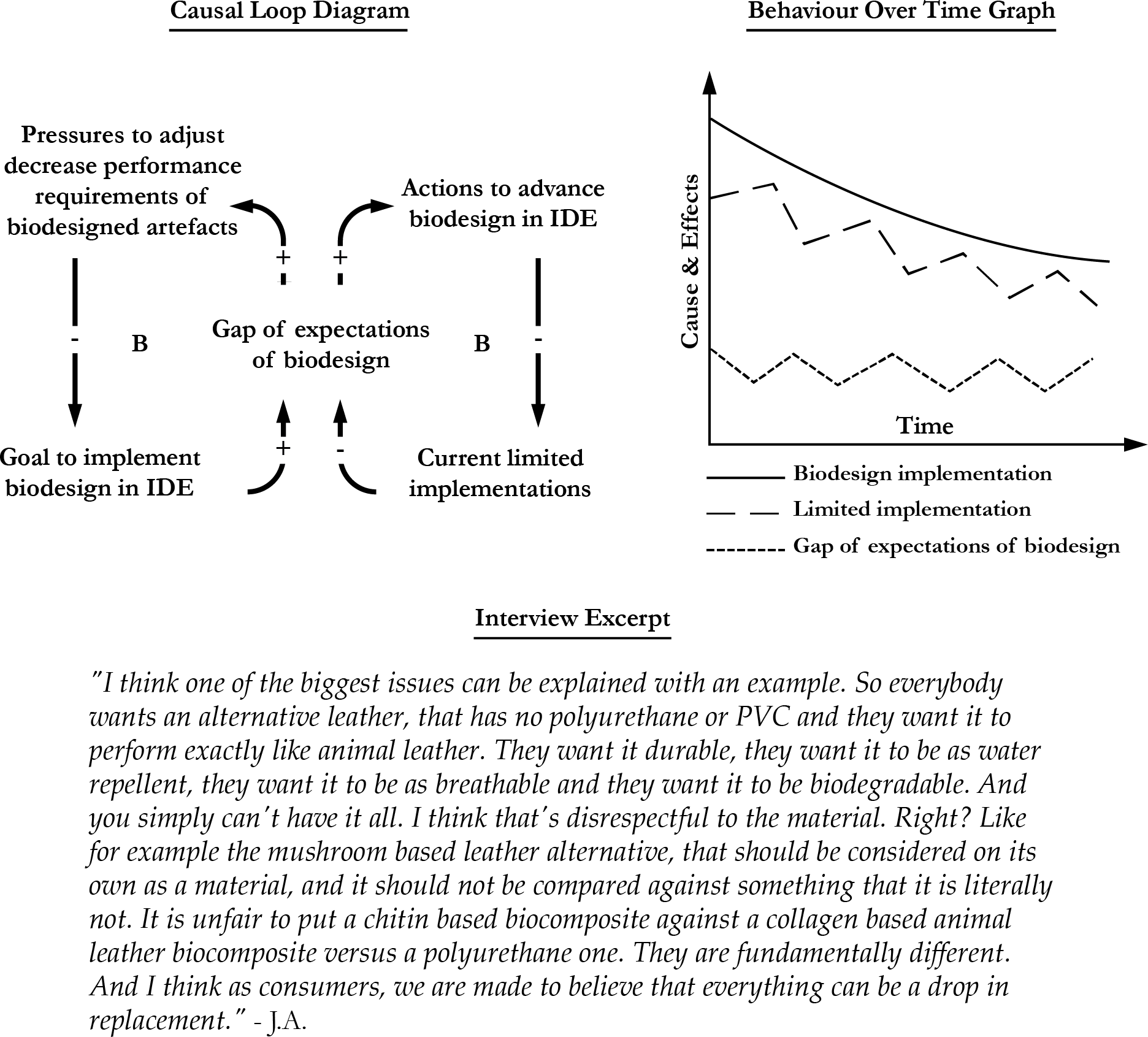
Causal loop diagram, behaviour over time graph and expert interview excerpt of systemic structure 2 – eroding goals – expectations of biodesign projects.

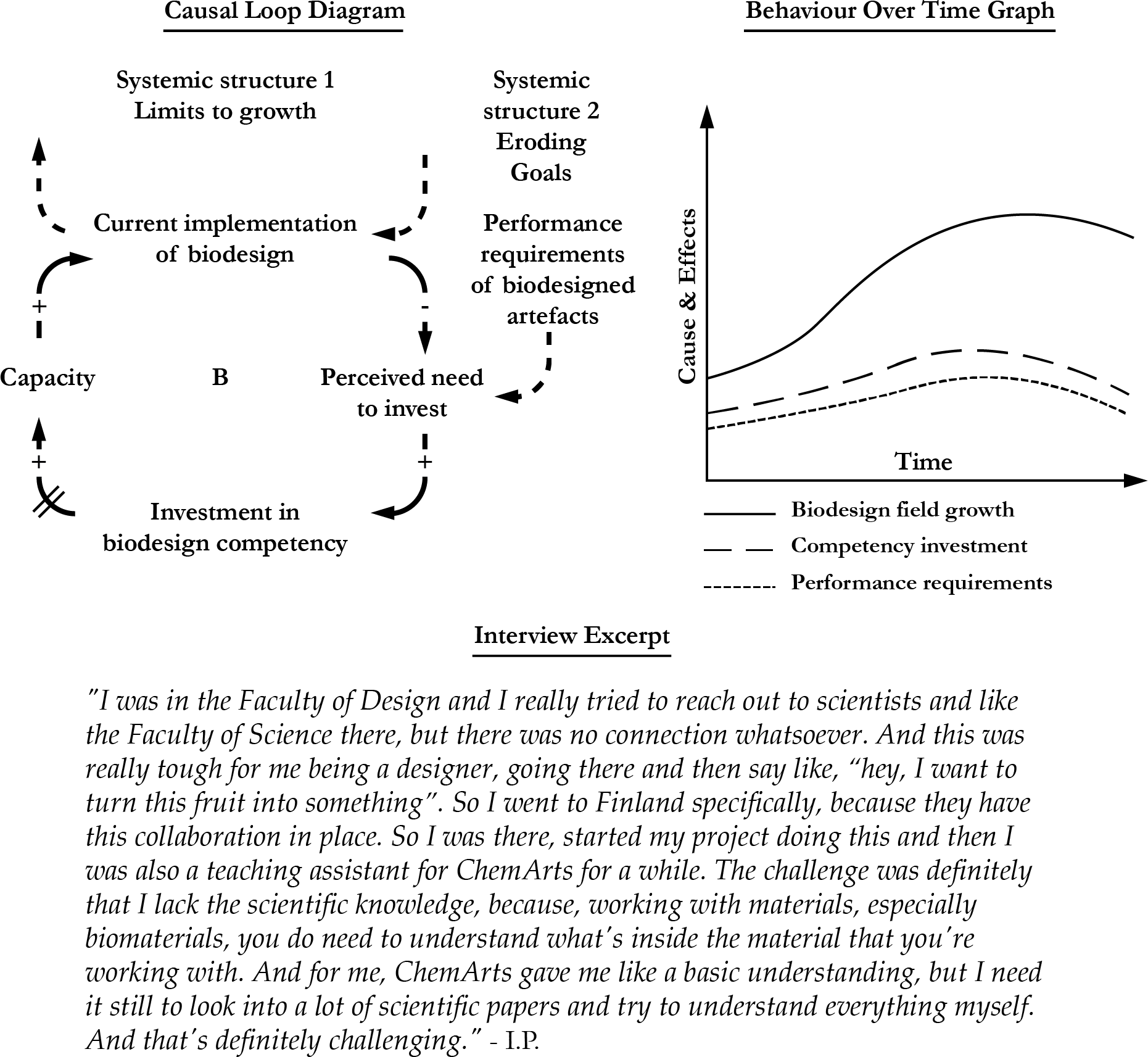
Causal loop diagram, behaviour over time graph and expert interview excerpt of systemic structure 3 – growth and underinvestment – invest in biodesign competencies.

Causal loop diagram, behaviour over time graph and expert interview excerpt of systemic structure 4 – tragedy of the commons – knowledge restrictions in biodesign.

Systemic structure 1 – limits to growth – accessibility
A first systemic structure (Figure 6) can be described as limits to growth (Braun Reference Braun2002). As knowledge, skills and attitudes gained from successful demonstrators of biodesign practice increase, demand for a design process and competency building grows as well, reinforcing further growth. However, when diverse design methodologies and knowledge, skills and attitudes are created from many diverse directions without a systemic understanding, these resources increasingly fragment into an unstructured overload of information. This reduces accessibility over time, particularly for starting biodesigners who lack the experience to navigate dispersed, inconsistent or incompatible field supporting materials. Because this fragmentation and reduced accessibility occur at the deepest system depths – knowledge, skills and attitudes and design process – it becomes a foundational limiting condition that constrains advancement across multiple other systemic levels (Competency, Design Tools, Design Brief, [Non-]human agency). In other words, a weakness experienced at one of the deepest system depths propagates outwards, limiting the capacity of the overall system to reliably build proficiency and advance the biodesign field. As expressed by interviewee A.C. in the below interview excerpt, the experienced fragmentation, the inaccessibility and the insular nature of biodesign related resources today is a limiting condition of aspiring biodesigners to implement this design field in their projects, hence potentially limiting the growth of the overall design field.
Systemic structure 2 – eroding goals – expectations of biodesign projects
A second systemic structure (Figure 7) can be described as eroding goals (Braun Reference Braun2002). There are pressures in the design brief to deliver on successful biodesign projects that meet standards, expectations and certification (which are some performance requirements of biodesigned artefacts). Think for example of functionalising desired material properties, matching the product lifespan with the material lifespan, social acceptance or upscaling. These pressures become especially urgent because clients today often demand biodesign outcomes mostly as drop-in replacements that perform as well as pre-existing products. Under these conditions, pressure builds to decrease standards, expectations and certification thresholds for biodesigned solutions, rather than investing on the long-term in foundations (like design methodology or competency building) to meet existing expectations. This dynamic risks normalising reduced ambitions and weakened evaluation criteria over time, thereby undermining the very goals that would otherwise drive the uptake and advancement of biodesign in Industrial Design Engineering Technology. As interviewee J.A. pointed out, it is unrealistic and unjust to the identity of the biodesigned artefact that people demand products which can replace their predecessors on a one-to-one basis (drop-in replacements) and perform just as well; this results in lowering the standards for such biodesigned artefacts. True advancement of the biodesign field therefore requires investing in itself, rather than devaluing biodesign by measuring it against the rigid metrics of the past.
Systemic structure 3 – growth and underinvestment – invest in biodesign competencies
A third systemic structure (Figure 8) can be described as growth and underinvestment (Braun Reference Braun2002). Within the current system, there is underinvestment in biodesign competency building, driven by a limiting factor located in the Design Process system depth: the accessibility to knowledge, skills and attitudes of biodesign (systemic structure 1). This limiting factor contributes to a drift in the Design Brief system depth, where standards, expectations and/or certification requirements for biodesigned artefacts decrease over time (systemic structure 2). The combination of rising interest and insufficient investment in competency building creates a compounding dynamic over time (delayed, see || in the archetype): growth in attention to biodesign does not translate into growth in proficiency and implementation, and the system compensates by adjusting targets downwards rather than strengthening its underlying capacity. As interviewee I.P. noted, rather than compromising on performance, the interviewee refocused on acquiring the biodesign competencies (specific knowledge, skills and attitudes) necessary to navigate and master the field’s underlying processes. In this way, this interviewee sought the right working environment that provided it with the resources to enhance its biodesign competencies and reach its desired results.
Systemic structure 4 – tragedy of the commons – knowledge restrictions in biodesign
A fourth systemic structure (Figure 9) can be described as a tragedy of the commons (Braun Reference Braun2002). Field support in biodesign are currently fragmented across diverse tools, platforms and formats, often generated by pilot projects and pioneers themselves and are frequently fenced off to protect their knowledge gains and insights, their creations and even their development processes (agency level). Thereby limiting reproduction, scaling and the broader uptake of the field – reinforcing the limits-to-growth dynamic (systemic structure 1). At the same time, pioneers’ successes inspire new aspiring biodesigners to engage with the field, increasing demand for accessible field support. Yet as long as the commons remains protected and fragmented, further growth is constrained; this may reduce investments and resources and ultimately minimise, limit or even destruct efforts to maintain the commons and long-term investments – here understood as the sustained creation of new design methodologies, competency building, tools, etc. in biodesign. As expressed by interviewee A.C. there is a need for a more organised body of knowledge about biodesign, as currently it seems designers are forced to reverse-engineer finished projects just to understand how they work.
Discussion
Insights
A key insight of this study is the suggestions to move from isolated, well-intentioned biodesign support efforts towards an integrated and complementary support system for biodesign. Rather than treating models, tools, workshops, educational initiatives or platforms and many more as stand-alone solutions, systems thinking may allow to conceptualise biodesign as an interconnected system consisting of multiple system depths, interacting over time. This perspective made it possible to shift the focus from the effectiveness of individual interventions towards the behaviour of the overall systemic structures that hinder the field’s advancement. In doing so, the study responds directly to the wicked nature of biodesign, for which no single intervention can suffice and where effectiveness depends on the designers employing it.
Systemic design of interventions
From this systems-oriented perspective developed in this study, the identified hindering systemic structures can be addressed through two distinct approaches that co-exist.
-
• One approach is to divide the problem into smaller problems at deeper system depths, for instance by enabling each biodesigner to build their own design processes and competency materials (e.g., journaling progression protocol, IP control, local lab building, etc.). While this may increase local capability, it also risks producing an even more fragmented and scattered system of isolated, localised biodesign initiatives. Therefore a second approach goes in tandem.
-
• This second approach is to integrate such biodesign supporting tools into a system of interventions at system depths proportional with the size of the actual hindering systemic structure: for example, a field enabling system with tools that provide methodological guidance and empowers existing and aspiring biodesigners to take up biodesign principles within their Industrial Design Engineering Technology projects.
Given these two approaches, interventions can be designed which divide the wicked problem into smaller ones, but at the same time integrate the proposed solutions in an overarching, adaptive structure that is proportionate to the biodesign system it addresses (Kauffman Jr. Reference Kauffman1980). Some promising potential interventions that may support advancement of biodesign across its multiple system depths are here proposed, but it is suggested that future research must not be limited to these alone:
-
• Systemic Structure 1 – Limits to growth – Accessibility: Located on the deepest system depth and propagating through all other depths, is the accessibility to knowledge and competency building. Therefore, a methodological structuring of the design process, combined with a reference point for competency building in biodesign hold promising potential to advance the field. This has also been acknowledged by the open call in Research Directions: Biotechnology Design, where leading scholars asked “How do we grow a biodesigner?” – inviting contributions to define the field’s education and practice (Vijayakumar et al. Reference Vijayakumar, Cogdell, Correa, Dade-Robertson, Danies, Edens, Forlano, George, Grushkin, Holbert, Hoover, Jalkh, Kisielewski, Obregon, Pirone, Polli, Scarpelli, Stukes, Ward, Wintermute, Balangue and Walker2024). By mapping how pioneering biodesigners articulated and structured their practices – as acknowledged by peer researchers, that is, Jang et al., this study and future work may better understand the leverage points at which to potentially meaningfully intervene (Jang et al. Reference Jang, Kwon, Song and Choi2024).
-
• Systemic Structure 2 – Eroding goals – Expectations of biodesign projects: This archetype described how the increasing pressure to rapidly deliver high-performance, drop-in replacements using biological elements can lead to a lowering of standards and expectations of biodesign projects. Instead of investing in the long-term development required for successful biodesign, practitioners may resort to superficial, symptomatic solutions. To counter this tendency, the proposed methodological structuring of the design process can be translated into a series of practically applicable and accessible interventions. These interventions may for example include a guiding card set that informs, inspires and/or activates users or a digital platform with inspiring examples that also hosts other essential biodesign related information, etc. Most importantly, while such interventions would operate individually at the system depth of tools, their collective integration may potentially form a toolkit, which functions at the system depth of design brief. Such toolkit may therefore enable designers to formulate new biodesign opportunities and challenges to be solved, explore biological elements and structure their design processes more effectively. Respectively, scholars indirectly noted that such system of interventions (toolkit) may support an ongoing transition from fragmented initiatives of biodesign (Bandoni et al. Reference Bandoni, Almendra and Forman2022; Chen et al. Reference Chen, Cai, Jiang, Long, Sun, Childs and Zuo2023; Gough et al. Reference Gough, Yoo, Tomitsch and Ahmadpour2021b) towards a more coherent conceptual consolidation (Dade-Robertson and Zhang Reference Dade-Robertson and Zhang2024).
-
• Systemic Structure 3 – Growth and underinvestment – Invest in biodesign competencies: When increasing interest in biodesign does not translate into sustained investment in competency building. As a consequence of the previously described limits to growth and eroding goals, expectations and performance standards may gradually decline. To address this systemic structure, the previously introduced competency reference point for biodesign may help. This may even serve a dual purpose. On the one hand, it provides guidance for the development of future educational programmes that aim to train biodesign practitioners. On the other hand, it functions as a reflective tool that allows companies and designers to assess their own progression in biodesign competency development. Today already, a growing number of institutions are incorporating biodesign into various design-related curricula, which demonstrates a growing interest in competency building in this field of design (Strobel do Nascimento and Heemann Reference Strobel do Nascimento and Heemann2023).
-
• Systemic Structure 4 – Tragedy of the commons – Knowledge restrictions in biodesign: The tendency of pioneers to gatekeep intellectual gains for competitive advantage presents a barrier to the advancement of biodesign. This behaviour, while understandable, restricts the shared methodologies essential for innovation. Mitigating this requires a dual approach: the deployment of knowledge-dissemination events – such as seminars or workshops – and the adoption of open-science and open-source practices to facilitate the common field knowledge. To date, broader perspectives in design and innovation research therefore emphasise that complex practices are not solely shaped by individual initiatives, but also by the infrastructures and ecosystems within which they are embedded (Ihls and Pollini Reference Ihls and Pollini2025).
Limitations
Six limitations of this study are here listed. (1) The selected experts – however representing all intended target audiences - may still not fully represent the current scope of biodesign professionals (i.e. excluding people of the life-sciences). (2) Interviews were in English, which was not the native language for most participants, possibly limiting the depth of discussion. (3) While four researchers conducted the qualitative analysis, the final coding was done by only one researcher. (4) the systemic representation - including the system depths, stock & flow - is purely constructed through the viewpoint of biodesign. (5) The systemic structures hindering the advancement of biodesign, expressed as archetypes that are empirically grounded through the expert interview data, may still not capture all patterns. (6) The CLDs and BOTGs have only been validated by two systems thinking experts.
Conclusion
This study set out to address the research question: “What systemic structures hinder advancement of biodesign?.” Drawing on extensive interviews with 21 pioneering biodesign experts (n = 21) and qualitatively analysing their experiences through a systems-oriented perspective, the study demonstrates that the limited uptake of biodesign within Industrial Design Engineering Technology cannot be reduced to isolated practical barriers. Rather, it is rooted in deeper systemic structures that unfold across multiple nested system depths – from knowledge, skills and attitudes, to competencies, (non-)human agency, design briefs, tools and processes.
Four recurring system archetypes were identified as particularly constraining. (1) First, a limits-to-growth systemic structure reveals how fragmentation of methodologies and competency-building reduces accessibility, particularly for emerging practitioners. When foundational knowledge structures are dispersed and unaligned, progression across deeper system levels is restricted. (2) Second, an eroding-goals systemic structure highlights how pressures to meet conventional performance standards, certification schemes and market expectations can gradually lower ambitions for biodesign projects, normalising compromised objectives instead of strengthening underlying biodesign capacities. (3) Third, a growth-and-underinvestment systemic structure shows how increasing attention to biodesign is not matched by proportional investment in competency development, resulting in rising interest without corresponding growth in proficiency. (4) Final and fourth, a tragedy-of-the-commons systemic structure exposes how fragmented and often protected practice-support tools limit collective learning, scaling and consolidation of the field, despite growing demand for shared infrastructures.
Together, these systemic structures reveal that the obstruction of biodesign is not primarily a matter of individual resistance or technical infeasibility, but of systemic nature. Biodesign currently operates within a support system that remains fragmented, unevenly resourced and structurally underdeveloped. The field’s complexity – shaped by multi-species agency, transdisciplinary collaboration, ethical considerations and heightened variability – demands more than isolated interventions. It requires coordinated systemic design of practice-enabling infrastructures, that is, methodological process structuring, competency reference points, applicable supportive tools, etc.
A key contribution of this study is therefore methodological: by applying systems thinking to the biodesign field, it shifts the discussion from evaluating individual tools or initiatives towards understanding the behaviour of the overall system. This perspective makes visible reinforcing and balancing feedback loops, delays and unintended consequences that would otherwise remain obscured. In doing so, it responds directly to the wicked and systemic nature of biodesign implementation in Industrial Design Engineering Technology.
Two broad strategic directions emerge. One is to decentralise and localise solutions, enabling individual practitioners to construct their own competency trajectories and processes. While this may strengthen local capacity, it risks further fragmentation. The alternative that must co-exist with the first approach is to intervene at deeper system depths through the development of integrated, practice-enabling systems that align methodologies, competency-building, tools and evaluation criteria. Such systemic interventions are more proportionate to the scale of the identified systemic structures and more likely to generate cumulative, long-term impact.
Data availability statement
The data that support the findings of this study are openly available in Figshare at:
-
• https://doi.org/10.6084/m9.figshare.26206817, (Vuylsteke et al. Reference Vuylsteke, Ostuzzi and Detand2022a).
-
• https://doi.org/10.6084/m9.figshare.26206883, (Vuylsteke et al. Reference Vuylsteke, Ostuzzi and Detand2022b).
-
• https://doi.org/10.6084/m9.figshare.26206910, (Vuylsteke et al. Reference Vuylsteke, Ostuzzi, Detand and Dumon2024).
-
• https://doi.org/10.6084/m9.figshare.31429523, (Vuylsteke et al. Reference Vuylsteke, Ostuzzi and Detand2026).
Acknowledgements
We are grateful for the professional biodesign practitioners who have participated in this study and for sharing their invaluable insights.
Author contributions
Conceptualisation: Bert Vuylsteke; Francesca Ostuzzi, Jan Detand. Methodology: Bert Vuylsteke. Data curation: Bert Vuylsteke. Data visualisation: Bert Vuylsteke. Writing original draft: Bert Vuylsteke. All authors approved the final submitted draft.
Financial support
This research was supported by grants from the Interreg North Sea Region Building Based on Bio-Based project under Grant Call 3C (FA); and Vlaio Circular Living Lab Hemp+ project under Grant VNS.2022.0142.
Competing interests
None.
Ethical standards
This research was conducted in accordance with the principles embodied in the Declaration of Helsinki and in accordance with local statutory requirements. Written informed consent has been collected from all participating designers. All participants approved for their results and abbreviated names to be included in this article. The Chair of the University Faculty’s Ethics Review Committee informed that, in compliance with the general ethics protocol, this research was conducted under the conditions of the Faculty’s ethics waiver programme and is therefore not subject to mandatory additional review by the Ethics Review Committee.

 Open access

