Hurricane Sandy hit New Jersey on October 29, 2012, leaving 650,000 homes damaged or destroyed and 8.5 million without power. The stress of living through a natural disaster includes fear for one’s safety and distress from disruptions in basic needs including power, water, and healthy food, which can lead to difficulty in managing chronic illnesses. Older adults with chronic illness and disabilities are particularly vulnerable to poor physical and mental health outcomes after a natural disaster.Reference Heid, Christman and Pruchno 1 Despite their known vulnerability, little research evidence exists regarding older adults’ health care utilization during the year after a natural disaster.
Of the few studies that described older adults’ health experiences after a disaster, most focused on psychological outcomes. The prevalence of severe post-disaster psychological disorders is low. Post-hurricane prevalence of post-traumatic stress disorder for those who were present and experienced extreme fear from the 2004 Florida hurricanes season was 1.4%.Reference Acierno, Ruggiero and Galea 2 However, general reports of psychological distress are commonly reported after a natural disaster. Nearly half of persons exposed to the Florida hurricanes reported they experienced significant fear of injury or death from the hurricanes 8 months after the storms.Reference Acierno, Ruggiero and Galea 2 A study of older adults exposed to Hurricane Ike reported that a quarter of respondents had unmet psychological needs in the months following the disaster.Reference Pietrzak, Southwick, Tracy, Galea and Norris 3 Prior studies have not determined whether of older adults’ reports of fear and distress from a disaster are prognostic of their future health care utilization.
Andersen’s behavioral model of health care utilization provides a framework for determining whether reports of disaster-related stress are associated with increases in post-disaster utilization in the context of factors that predispose, enable and create need for health care utilization.Reference Andersen and Newman 4 Older age and female gender are among the most robust predisposing predictors of future hospital and emergency department (ED) utilization among older adults.Reference Crane, Tung and Hanson 5 Marital status, an enabling characteristic, is associated with reduced ED utilization among older adults.Reference Walsh, Currier, Shah and Firedman 6 Among variables that predict need for utilization, prior utilization is more prognostic of future utilization than co-morbid illnesses.Reference Crane, Tung and Hanson 5
The purpose of this study was to determine whether older adults’ self-reports of distress and fear from Hurricane Sandy were predictive of hospital, ED or outpatient utilization the year after the disaster, controlling for individual predisposing, enabling, and need characteristics associated with health care utilization. The findings will inform planning for older adults’ health care utilization after natural disasters.
Methods
Participants
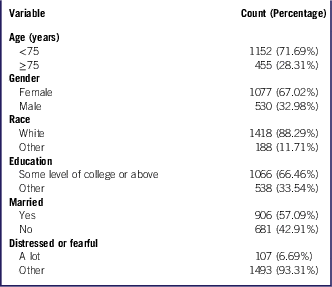
Respondents were from the ORANJ BOWL Study, a representative sample of adults aged 50-74 in New Jersey recruited between 2006 and 2008 through random-digit dialing. The goal of the ORANJ BOWL longitudinal panel study is to determine how personal and environmental characteristics influence successful aging. We identified 2942 original ORANJ BOWL respondents who were age 65 or older in January 2012. To link 2012-2013 Medicare data with post-hurricane survey data, 3 pieces of personally identifiable information (PII) and the respondents’ study identifier were securely sent to analysts at the Center for Medicare and Medicaid Services (CMS) to conduct probability matching of respondents’ PII to their Medicare data. CMS found matches for 85% (2488) of the 2942 respondents for which we requested Medicare data. Medicare claims data were merged with de-identified ORANJ BOWL survey data via a CMS generated crosswalk between encrypted Medicare beneficiary numbers and the respondents’ study identifier. This study included data from the fourth wave of ORANJ BOWL data collection. The fourth wave occurred between July 2013 and July 2015 and contained information about respondents’ experiences of Hurricane Sandy. Among the 2488 respondents with matched Medicare data, 95 (3.8%) were deceased and 786 (31.5%) did not complete the fourth survey, resulting in an analytic sample of 1607 (64.6%) respondents. Collectively, the final analytic sample was predominately female (67%), younger than 75 (72%), white (88%), had some college education (66%), and were married (57%) (Table 1).
Dependent Variables
The outcome variables were calculated from Medicare claims data and included time to hospital admissions, number of outpatient visits, and number of ED admissions. We calculated cumulative utilization at 3 months and at 1 year after Hurricane Sandy. Revenue center codes 0450-0459, 0981 were used to identify ED admissions from inpatient and outpatient Medicare claims files.
Independent Variable
During the follow-up survey respondents were asked, “Were you distressed or fearful during Hurricane Sandy?” The response options were no, a little, and a lot. Responses were recoded to a lot versus little to no fear and distress.
Covariates
Predisposing demographic characteristics included age, gender, and race. Enabling characteristics included education and marital status. Age was coded as below 75 or 75+. Education was coded as high school or less versus some level of college or above. Race was coded as white or other. Marital status was coded as married versus other. These variables were from ORANJ BOWL survey data. Separately, for each type of utilization (hospital, ED, or outpatient) the number of Medicare claims between January 1, 2012 and October 1, 2012 were calculated and included as covariates to control for need for health care utilization before Hurricane Sandy.
Statistical Analyses
The Anderson-Gill extension of the Cox proportional Hazard model was used to compute the association between being distressed or fearful and time to hospital admissions. The negative binomial count model was used to determine the association between being distressed or fearful and the number of outpatient visits and the number of ED admissions after Hurricane Sandy. Bivariate analyses were conducted to examine the associations between being distressed or fearful and each of the predisposing, enabling, and need covariates. Variables with an association with a P-value of 0.2 or less were included in the model for adjustment. Backward elimination was used to select the final model. All the analyses were performed using SAS 9.3.
The Institutional Review Boards of both Virginia Tech and Rowan University approved this research.
Results
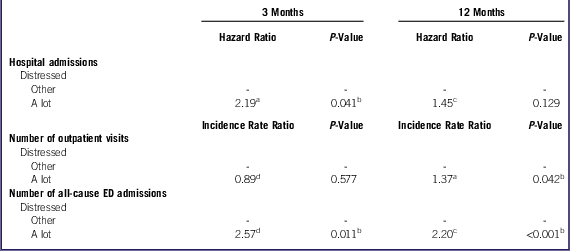
Nearly 7% (107 respondents) reported experiencing a lot versus little to no fear and distress during Hurricane Sandy. Characteristics associated with distress and fear include older age (P=0.070), female gender (P<0.001), and marital status (P=0.015). Prior utilization was associated with subsequent health care for each outcome (P<0.001) and included in each model. Table 2 shows that compared to respondents who experienced no or a little distress or fear during the hurricane, those who experienced “a lot” had a higher probability of hospitalization within 3 months. The adjusted hazard ratio (HR) for a lot versus little to no distress was 2.19 (95% CI: 1.03-4.63) after adjusting for age (P=0.16) and prior utilization (P=0.004) at 3 months. However, the probability of hospitalization at 12 months was not significantly higher for those who experienced a lot versus little to no fear and distress (HR: 1.45, 95% CI: 0.90-2.35). Table 2 also shows that those who reported a lot versus little to no distress had significantly more outpatient visits 12 months after the hurricane. The incidence ratio (IR) for number of outpatient visits was 1.37 (95% CI: 1.02-1.87) after adjusting for age (P=0.197) and prior utilization (P<0.001). Those who experienced a lot of versus little to no distress or fear from Hurricane Sandy also had significantly more all-cause ED visits at 3 months (IR: 2.57, 95% CI: 1.21-5.35) after adjusting for age (P=0.477), marital status (P=0.302), and prior utilization (P=0.006). Those who experienced a lot versus little to no distress had significantly more ED visits through 12 months after the hurricane (IR: 2.20, 95% CI: 1.44-3.37) after adjusting for age (P=0.077), gender (P=0.051), marital status (P=0.014), and prior utilization (P<0.001) (Table 2).
Sample Characteristics

Adjusted Hazard Ratios Computed by the Anderson-Gill Model and Adjusted Incidence Rate Ratios Computed by the Negative Binomial Count Model at 3 and 12 Months

Abbreviation: ED, emergency department.
a Estimate adjusted for age and prior utilization.
b P-value<0.05.
c Estimate adjusted for age, gender, marital status and prior utilization.
d Estimate adjusted for age, marital status and prior utilization.
Discussion
Compared to older adults who experienced a little or no distress, those who experienced a lot of fear or distress from Hurricane Sandy had higher cumulative ED and outpatient visits in the subsequent year as well as higher ED and hospital admissions soon after the disaster. Disaster preparedness includes assuring adequate capacity for needed health care services, but recommendations regarding how long providers should expect higher rates of health care utilization are rarely articulated. Findings from this study indicate that increases in ED and primary care utilization continue for at least a year for older adults who experience disaster-related distress.
Self-reported assessments of health status or health needs have proven prognostic validity. For example, single-item measures of self-rated health or unmet need for medical care are associated with higher rates of hospitalization.Reference Kennedy, Kasl and Voccarino 7 , Reference DePalma, Xu and Covinsky 8 Conceptually, single-item assessments provide a quick assessment of an individual’s collective appraisal of their health status. Such appraisals may help clinicians in determining patients’ need for more formal clinical assessments and their risk for poor health outcomes in the future. We found that a single question about experiencing fear or distress from a hurricane is predictive of ED and outpatient utilization through a year after the disaster. Although studies of health care utilization after a disaster are rare, we found support for our findings from a small study of rural clinic patients whose reports of psychological distress were predictive of higher number of clinic visits in the subsequent year.Reference Polusny, Ries and Schultz 9
A limitation to our study is loss to follow-up by the fourth wave of ORANJ BOWL data collection. Although the dropout rate is lower than some longitudinal national health studies,Reference Radler and Ryff 10 the final sample of older adults was younger, more likely to be married, and highly educated. These characteristics are associated with reduced risk for health care utilization and potentially reduced the observed effect sizes. In addition, it is likely that those who completed the fourth wave of data collection were less geographically mobile and less likely to change phone numbers than the general population. Thus, despite using random-digit dialing to derive the sample, it is unlikely that the sample for this analytic study is representative of the entire population of older New Jersey residents.
Some of the survey data were collected as long as 2 years after the hurricane. That delay may have changed perceptions about the level of fear and distress respondents experienced during the hurricane. For example, those who experienced higher health care utilization after the hurricane may have developed inflated estimates of their level of fear and distress during the hurricane. The delay in querying respondents about their experiences during the hurricane limits our understanding of the mechanism by which reports of fear and distress are associated with future health care utilization. Future research with population-based samples is needed to provide better estimates of the impact of disaster-related psychological distress on health care resources. Nearly 350,000 older adults live in New Jersey, and if future studies confirm that nearly 7% of the population has a 2-fold increase in ED use due to disaster-related psychological distress, this may inform resource planning for already crowded emergency departments. Despite these limitations, our findings indicate that a single-item screen for disaster-related fear or distress may help identify individuals who have increased health care needs after a disaster.
Anticipated increases in the frequency and severity of hurricanes combined with the growth in numbers of vulnerable older adults reveal the importance of increased understanding of older adults’ health care needs after a disaster and preparedness for those needs. Preparedness should reach beyond health care facilities and include local area agencies on aging to coordinate needed health services for older adults. The results from this study provide evidence that planning for older adults’ disaster-related health care utilization should extend beyond acute health care needs to address longer-term health sequelae of disaster-related psychological distress.
Funding
Funding for this study was provided by UMDNJ-SOM, the Rockefeller Foundation the Assistant Secretary for Preparedness & Response HITEP130008-01-00 and the National Institute on Aging R01 AG046463.