Cardiac transplantation may represent a treatment option for patients with functionally univentricular hearts who have failing staged palliation. In an effort to examine outcomes of rescue cardiac transplantation for failing staged palliation, we compare the results of primary cardiac transplantation for hypoplastic left heart syndrome to the results of rescue cardiac transplantation for failing staged palliation or repair of hypoplastic left heart syndrome.
The initial surgical approach to neonates with hypoplastic left heart syndrome, be it staged reconstruction or cardiac transplantation, has been a hotly debated issue, with diametrically opposed schools of thought.1–6 Today, with further experience, technical advances, and dramatically improved outcomes, there seems to be an emerging complementary role for both options, favouring staged reconstruction in the majority of circumstances.
Orthotopic cardiac transplantation is considered a rescue option for children with failing staged palliation or repair of hypoplastic left heart syndrome. Although the majority of patients with hypoplastic left heart syndrome treated with surgery now undergo staged palliation, a subset of these children will at some point fail, and become candidates for rescue transplantation.
In the second half of the 1990s, The Congenital Heart Institute of Florida utilized primary cardiac transplantation and staged palliation on an equal basis. We have now evolved to the more selective utilization of cardiac transplantation, and the majority of our patients are now treated with a primary strategy of staged palliation. Since 2000, in our programme, 100 infants have undergone the initial stage of palliation, with survival at 30 days of 84%.
In this report, we will present our contemporary strategy for management, and outcomes, for children undergoing cardiac transplantation for hypoplastic left heart syndrome at The Congenital Heart Institute of Florida at our All Children's Hospital campus in Saint Petersburg, Florida. We will compare the results of primary cardiac transplantation for hypoplastic left heart syndrome to the results of rescue cardiac transplantation for failing staged palliation or repair of hypoplastic left heart syndrome.
Materials and methods
Patients
Our cardiac transplantation programme for children performed the first transplant on May 21, 1995. We review here all of our cases of cardiac transplantation up until January 1, 2005. This cohort represents 68 consecutive children, with 31 having hypoplastic left heart syndrome, 20 cardiomyopathy, and 17 post-operative complex congenital heart disease. Out of 68 recipients, 9 (13.24%) were neonates, and 46 (67.65%) were infants. The median age of the total population at the time of transplantation was 118.5 days.
Of the 31 patients with hypoplastic left heart syndrome, 23 underwent primary transplantation, and 8 underwent rescue transplantation from failing staged palliation in 7, or attempted biventricular repair in 1. Of the 7 patients who had failing staged palliation, three had undergone only the Norwood Stage 1 operation, 2 had undergone a Norwood Stage 1 operation and a Glenn superior cavopulmonary anastomosis and two had undergone a Norwood Stage 1 operation, a Glenn superior cavopulmonary anastomosis, and a completion Fontan operation.
Operative technique
Our approach involves bicaval cannulation and anastamoses with continuous low flow bypass and short periods of circulatory arrest or continuous low flow antegrade cerebral perfusion for reconstruction of the aortic arch in those with hypoplastic left heart syndrome. Bicaval implantation is used, with reconstruction of the superior caval vein with a spatulated sliding cavoplasty to prevent narrowing. Initial reperfusion of the donor heart utilizes glutamate and aspartate substrate enriched white blood cell filtered cardioplegia. Mechanical circulatory support is used when necessary as a bridge to transplantation, and to support marginal donor hearts.
Immunosuppression and surveillance
Our standard immunosuppression protocol is induction immunosuppressive therapy with pulse steroids for 4 days, gamma globulin, and polyclonal rabbit Antithymocyte globulin. Initial immunosuppression is consists of a calcineurin inhibitor (Cyclosporine A or Tacrolimus [Prograf]), an anti-proliferative agent (either azathioprine [Imuran] or mycophenolic acid mofetil [CellCept] to target levels of 2–4), and a short weaning course of oral steroids over one to two weeks.
Immunosuppression was modified in patients with elevated panel reactive antibody greater than ten percent as follows:7 preoperative intravenous immunoglobulin was given weekly and/or preoperative cyclophosphamide (Cytoxan) or mycophenolic acid mofetil was given daily from the time of listing until the time of transplantation. Preoperative and postoperative (up to 5 days) exchange transfusions (infants) or plasmapheresis (children) was utilized. Also, in patients with elevated panel reactive antibody, cyclophosphamide (Cytoxan) (1 milligram per kilogram per day) was the initial anti-proliferative agent with conversion to mycophenolic acid mofetil when oral intake was established.
Rejection surveillance is conducted by echocardiography and echocardiographically-directed endomyocardial biopsy, as previously described by our group and others.8–12 Echocardiographic surveillance of systolic and diastolic function predicts biopsy abnormalities and decreases the number of cardiac catheterizations. Biopsy is performed when the echocardiogram is suspicious for rejection. Rejection is defined as intensification of immunosuppression associated with an abnormal biopsy (greater than the International Society of Heart and Lung Transplantation grade 2) and/or new-onset hemodynamic abnormalities confirmed by echocardiography. No prospective cross-matching has been done in our programme.
Database and statistics
A registry and database (a component of the CardioAccess International Clinical Outcomes Database: Comprehensive Cardiovascular and Thoracic Module, CardioAccess Inc., Saint Petersburg, Florida and Fort Lauderdale, Florida: http://www.cardioaccess.com) has been prospectively maintained on all patients and has been utilized for data collection and analysis. Informed consent was obtained in all cases.
Statistical comparisons between those undergoing primary versus rescue transplantation are made utilizing either the Fischer's Exact test when comparing mortality data, or the Oneway Analysis of Variance when comparing the remainder of the data. The statistical analysis was performed utilizing JMP, The Statistical Discovery Software (produced by SAS Institute, Inc.). A p value of less than 0.05 is considered to be significant.
Results
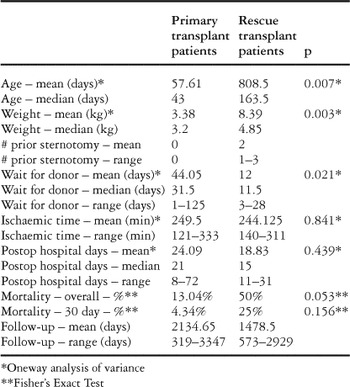
Table 1 presents comparative clinical data and results for those patients undergoing primary as opposed to rescue transplantation. Patients with hypoplastic left heart syndrome treated with primary cardiac transplantation were younger (p equals 0.007), weighed less (p equals 0.003), and waited longer for an appropriate donor heart (p equals 0.021) than those treated with transplantation as a rescue from prior surgery. Those requiring rescue had more prior median sternotomies. No significant difference exists between the patients in terms of ischaemic time or post-transplant length of hospital stay. Survival at 30 days, (p equals 0.156), and overall survival (p equals 0.053), was better in the group treated with primary transplantation, although these differences were not statistically significant when a p value of less than 0.05 is considered to be significant. Even with the small size of the group requiring rescue transplantation, the trends are obvious when examining the Kaplan-Meier survival curves in Figures 1 and 2, and are reinforced by the logrank test for the Kaplan-Meier curve in Figure 2.
Table 1. Clinical and outcome data.


Figure 1. Of the 31 patients with hypoplastic left heart syndrome, 23 underwent primary transplantation, and 8 were transplanted as a rescue from failing staged palliation (7) or biventricular repair (1). This graph shows Kaplan-Meier survival curves for the total population of 68 children undergoing transplantation, those having primary transplantation, and those requiring rescue transplantation.

Figure 2. Of the 31 patients with hypoplastic left heart syndrome, 23 underwent primary transplantation, and 8 were transplanted as a rescue from failing staged palliation (7) or biventricular repair (1). This graph shows Kaplan-Meier survival curves with 95% confidence intervals for the two groups.
In those undergoing primary transplantation, no patients had elevated panel reactive antibody greater than 10%. In those requiring rescue, 4 out of 8 patients had panel reactive antibody greater than 10%. In these latter patients, 3 or 4 with high panel reactive antibody died, while only one of the four with non-elevated panel reactive antibody died.
Of those undergoing rescue transplantation, 2 died early, one from brain injury and eventual brain death after pre-transplant support with extracorporeal membrane oxygenation for 5 days, this patient dying on the ninth day after transplantation, and a second child with primary graft failure supported postoperatively with extracorporeal membrane oxygenation and listed for a second heart who died on the 13th day after transplantation. The two patients dying late after rescue transplantation were secondary to pulmonary venous stenosis 628 days later, and secondary to an unclassified T cell immunodeficiency and subsequent fungal pneumonia 727 days later.
In Figure 1, we show Kaplan-Meier survival curves for the total population, those undergoing primary transplantation for hypoplastic left heart, and those requiring rescue transplantation. Figure 2 shows Kaplan-Meier survival curves with 95% confidence intervals for those undergoing primary as opposed to rescue transplantation.
Discussion
Because of the pioneering work of Bailey and his team at Loma Linda University Medical Center, in the 1980s, cardiac transplantation emerged as a primary therapy for hypoplastic left heart syndrome.3, 4 Although faced with multiple medical, ethical, and political challenges, the team at Loma Linda persevered and developed neonatal cardiac transplantation, resulting in previously unprecedented survival of children with hypoplastic left heart syndrome. Survival of 85% at 5 years, associated with near normal growth and development, was reported and subsequently reproduced by others. Furthermore, neonatal transplantation seems to provide a survival advantage in comparison to patients undergoing transplantation at an older age. Unfortunately, lack of donor organs represents a major impediment to the use of replacement therapy as primary therapy. Furthermore, the initially held hope of freedom from graft arteriopathy is no longer valid, since as many as 10 to 15% of patients are showing signs of significant coronary arterial lesions. Nevertheless, transplantation continues to play a valuable role in patients with hypoplastic left heart syndrome when used selectively as primary therapy. Neonates with hypoplastic left heart syndrome and a poorly functioning ventricle or valvar insufficiency, or both, may well be better served with primary replacement therapy. Transplantation is also beneficial when used as a rescue option for failing surgical treatment of hypoplastic left heart syndrome.
Also in the 1980s, staged palliation as treatment for hypoplastic left heart syndrome evolved secondary to the pioneering work of Norwood and others.5, 6, 13 In the current era, staged reconstruction continues to demonstrate improved survival over the short and intermediate terms.14–16 Staged reconstruction is now considered to be the best primary treatment for the majority of patients with hypoplastic left heart syndrome. Large centres, previously committed to primary replacement therapy, now only transplant approximately one-tenth of their patients.17, 18 The ongoing refinement in surgical technique continues.19, 20 Determinations of optimal shunting, as well as trials with newer materials for arch reconstruction with less reactivity, are current areas of interest. Perhaps the most profound reason for improved survival in recent years has been the understanding and application of medical management of patients with functionally single ventricles in the perioperative period.21, 22 Nevertheless, significant problematic issues including deteriorating ventricular and valvar function, difficult arrhythmias and morbidities such as protein losing enteropathy continue to plague many of these patients. Many of these late problems associated with staged palliation will require treatment with further surgical interventions including cardiac transplantation. Thus, for some patients, staged palliation includes not only the initial three stages of the Norwood procedure followed by Glenn and Fontan procedures, but a fourth stage, that of cardiac transplantation.1
Previous studies have suggested that the best surgical results for hypoplastic left heart syndrome are obtained in centres committed to either cardiac transplantation or staged palliation.2 We feel that this generalization does not apply to the modern era because it is possible to offer both cardiac transplantation and staged palliation in a single mature programme, and obtain excellent results with both strategies.1 Once a programme progresses through the learning curve, excellent results may be achieved simultaneously with selective utilization of both staged palliation and cardiac transplantation. Although the time to progress through the programmatic learning curve may be shortened by committing only to one strategy, it is possible for a single mature programme to achieve excellent outcome employing both strategies.
At The Congenital Heart Institute of Florida, the largest congenital heart surgery programme in Florida, we selectively offer three treatment options for patients with hypoplastic left heart syndrome. The majority of our patients with hypoplastic left heart syndrome are treated with Norwood staged palliation or cardiac transplantation, with most patients undergoing Norwood staged palliation and second most commonly cardiac transplantation. A smaller select group, including patients with hypoplasia of the left heart in the absence of intrinsic valvar stenosis (also known as hypoplastic left heart complex), critical aortic stenosis with left ventricular hypoplasia, and aortic atresia with ventricular septal defect, is managed with biventricular repair. In the second half of the 1990s, our programme used primary cardiac transplantation and Norwood staged palliation on an equal basis. We have now evolved to the more selective utilization of cardiac transplantation. Although the majority of our patients are now treated with a primary strategy of staged palliation, we employ cardiac transplantation as treatment for hypoplastic left heart syndrome in the setting of family preference, significant ventricular dysfunction, severe atrioventricular or ventriculo-arterial valvar regurgitation, and in patients with failing staged palliation at any point in the process of staged palliation.1, 7 Thus, in our programme at The Congenital Heart Institute of Florida, transplantation continues to play a valuable role in patients with hypoplastic left heart syndrome. It is used selectively as primary therapy in neonates with a poorly functioning ventricle or valvar insufficiency, or both, and is employed as a rescue option for failing surgical treatment of hypoplastic left heart syndrome. We have employed cardiac transplantation as a rescue option in both patients from our own programme and in patients undergoing staged palliation elsewhere.
Children undergoing cardiac transplantation as a rescue from failing staged palliation or biventricular repair appear to be at higher risk than those treated with primary transplantation. The aetiology of this increased risk appears to be multifactorial. The patients requiring rescue were older, had undergone more prior surgical procedures, and were more prone to manifest evidence of immunosensitization. The older age in and of itself may be associated with less immune tolerance, and the multiple prior operations may increase surgical risk. Several prior publications have discussed many of these challenges.23–25 Often times, the patients requiring rescue have undergone multiple prior sternotomies, making the surgical dissection time consuming and tedious. In addition, creative surgical strategies are often necessary to reconstruct the pulmonary arteries and other abnormal cardiac connections. Then, postoperative haemostasis also becomes challenging, and requires a team approach employing both patience and persistence. The subset of patients who have immumologic pre-sensitization and elevated panel reactive antibody appear to be at especially high risk.
Our previously published data shows that, despite aggressive immunosuppression, children with elevated panel reactive antibody are high-risk candidates for cardiac transplantation.7 Several reasons explain why children may have elevated panel reactive antibody, and why more children may have elevated panel reactive antibody in the future. Common risk factors, and predisposing factors for elevated panel reactive antibody in children, include previous blood transfusions, previous exposure to allograft material,26–30 and previous transplantations. Patients undergoing transplantation after prior surgery for hypoplastic left heart syndrome may possess any or all of these risk factors. Furthermore, the increasing use of mechanical circulatory support with its commonly associated transfusion requirement ensures that the leucocyte-induced HLA antibodies and positive prospective crossmatches will become more common.31 Also, as the population of children undergoing transplantation matures, more and more will require re-transplantation. As immunosuppression options improve, outcomes for transplantation of critically ill children with terminal heart failure but elevated panel reactive antibody are also likely to improve. Nevertheless, the higher risks warrant careful informed consent discussions with recipients and their families. The aetiology of this elevated risk in immunosensitized patients is in all likelihood also multifactorial, because in addition to elevated panel reactive antibody, these patients are also older and have undergone more prior surgical procedures.7 Again, the older age may be associated with less immune tolerance and the multiple prior operations may increase surgical risk. Still, it is clear that the subgroup of children with elevated panel reactive antibody remain at higher risk than those with non-elevated panel reactive antibody.7
Unfortunately, transplantation, as rescue therapy for patients with the failing Fontan circulation is associated with significant mortality,24 leading some authors to recommend transplantation as an alternative only in patients deemed to be at very high risk.32, 33
Patients undergoing staged palliation also appear to be at higher risk for cardiac transplantation after one or more stages of their palliation than prior to these surgical interventions. Thus, although patients and families can be offered transplantation as a rescue option during the course of failing staged palliation, they should be aware from the beginning that this option will carry a higher risk than primary cardiac transplantation. Furthermore, given the extreme shortage of donors for children, an overall survival of only 50% in those undergoing rescue can lead to some ethical questions about optimal use of donor organs.
Multiple authors have already compared and debated outcomes of primary cardiac transplantation compared to staged palliation as treatment for hypoplastic left heart syndrome.1, 2, 17, 34, 35 The purpose of our review is not to revisit these previously studied comparisons. Instead, our purpose is to compare the outcomes in children with hypoplastic left heart syndrome treated with either primary transplantation versus those requiring rescue transplantation after prior surgery.
Our comparison of these groups of children reveals that overall survival after transplantation appears to be worse for those undergoing rescue. Still, it must be understood that cardiac transplantation represents the only treatment option offering potential long term survival for these challenging patients. Clearly, more follow-up of this group of patients is needed to assess true long-term outcomes, and further study is necessary to improve treatment of pre-sensitized patients. Cardiac transplantation can offer children with functionally univentricular hearts and end-stage heart failure after prior surgery their only chance of survival. This subgroup of patients, nevertheless, remains at high risk despite advances in operative technique and immunosuppression.
Acknowledgements
We acknowledge the contributions of Jay Gould, (GouldJ@allkids.org) who performed the statistical analysis. We also acknowledge the contributions of Tina Merola, the Research Coordinator and Database Manager for Cardiac Surgical Associates and The Congenital Heart Institute of Florida.
Disclosure
Jeffrey P. Jacobs is the medical advisor for CardioAccess, Inc.