Few initiatives have trained minority communities in emergency preparedness planning, especially for mental health issues.Reference Andrulis, Siddiqui and Gantner1 Yet, unmet post-disaster mental health (PDMH) needs can lead to posttraumatic pathologies.Reference Davidson and McFarlane2 People most likely to be in need of PDMH interventions are those with a history of mental illness, those with few social resources and supports, and those experiencing the greatest trauma, loss, and displacement such as individuals in economically distressed areas.3-Reference Peacock, Morrow and Gladwin5 Hurricanes Floyd, Katrina, and Rita exposed how the lack of local provider preparedness and community-level capacities to address PDMH can differentially impact poor and predominantly black com-munities.Reference Cross6-Reference Honore11 An estimated $7 million was spent on providing mental health services to Hurricane Katrina victims even though only 1.6% of individuals identifying a need of assistance were actually receiving it one year later.Reference Cross6, 7 A recent report indicates that five years later, 37% of affected children seeking mental health care were diagnosed with depression, anxiety, or other behavioral disorders.Reference Abramson, Park and Redlener8
The World Health Organization (WHO) and the National Institute of Mental Health (NIMH) recommend appropriate psychological and social interventions according to the stages of disasters.9, 10 The preparation stage is when resource coordination and training should take place. The acute phase is when psychological interventions focus on responses to urgent psychiatric needs and reassurance for those with symptoms of emotional distress. Social interventions should focus on elements such as the reliable flow of credible information, responding to safety and physical needs of survivors, re-establishing normative cultural and religious events, and disseminating reassuring public educational messages concerning normal stress reactions and expectations of normal recovery. Finally, the reconsolidation phase is when a variety of evidence-based therapeutic interventions are needed for individuals with continued symptoms. Social interventions at this stage involve organized outreach and psychoeducation for those who are experiencing persistent symptoms or exacerbated mental health conditions.9
There have been significant challenges to providing evidence-based local, and easily accessible, mental health services in the immediate aftermath of disasters.Reference Ritchie, Watson and Friedman12 External organizations providing PDMH traditionally used vertical models rather than competency building models.Reference James13 First-contact care was provided by specialized mental health providers who were separate from local general health care services, overtaxed during disaster aftermath periods, and comparatively less available than other health services. Delays in reaching disaster affected areas of these top-down PDMH responses hindered the effectiveness and efficiency of services in areas with little preexisting disaster mental health capacity.Reference Kutcher, Chehil, Cash and Millar14
It is now recognized that PDMH interventions must be integrated into existing health systems to meet the surge in need for mental health.Reference van Ommeren, Saxena and Saraceno15-Reference Everly, Barnett, Sperry and Links17 In addition, growing evidence indicates that PDMH services should be contextualized to meet the needs of local populations, and can be delivered by appropriately trained nonmental health providers.9, Reference van Ommeren, Saxena and Saraceno15, Reference Rose, Bisson and Churchill18-20 This has led to the development of training for public health workers, nurses, and nonmental health clinical providers who are better positioned for the delivery of contextually appropriate and sustainable PDMH care.Reference James13, Reference Parker, Barnett, Everly and Links21-Reference Young, Ruzek and Wong23
It has been postulated that if preexisting social capital is established, then the degree of postdisaster individual and collective level recovery will be mitigated.Reference Kawachi and Subramanian24 Mental health preparedness training of community insiders can increase social capital in underserved minority populations.25 Community-based organization (CBO) leaders are now recognized as a critical resource in disaster mitigation and preparedness planning.Reference Lichterman26-Reference Schoch-Spana, Franco, Nuzzo and Usenza29 They can bring an understanding of local views and religious beliefs, be an appropriate adjunct to service provision, and be trained to deliver psychological first aid (PFA), especially for communities of color where high levels of suspicion and distrust of mental health institutions prevail.Reference Sussman, Robins and Earls30, Reference Whaley and Geller31 The availability of trained, trusted, CBO leaders can significantly enhance access to and retention of PDMH treatment.Reference Cohen32, Reference Rao33 Community leaders also play important roles in re-establishing community norms and social networks, accelerating recovery.Reference Summerfield34-Reference Somasundaram and van de Put36
Clinical providers and CBO leaders working in disadvantaged black communities remain unprepared to deal with first contact mental health care needs. Most curricula and resource guides integrating evidence-based mental health practice into disaster response are designed to train hospital, public health, and first-responder audiences.37-Reference Thorne, Oliver, Al-Ibrahim, Gucer and McDiarmid40 Curricula developed and tested through research centers have shown promise, yet they focus on faith-based organizations, which may not always offer low stigma conditions for addressing co-existing health problems in black communities.Reference McCabe, Lating and Everly41, Reference McCabe, Mosley and Gwon42 In addition, PDMH preparedness in black communities is often packaged under training for response in “vulnerable groups,” as based on the geography of poverty, without acknowledging influences such as systematic racism on mental health or the legacy of survival specific to black experiences within communities.Reference James13, Reference Young, Ruzek and Wong23
Our goal was to build local capacity for responding to the needs of black communities in the immediate aftermath of natural disasters by empowering both clinical providers and CBO leaders in black communities with the knowledge and skills that they need to collaboratively plan for and deliver culturally responsive and timely PDMH interventions. This report describes a NIMH-funded Phase I study to develop materials and test the feasibility of adapting training processes in a hurricane-prone community in eastern North Carolina.
TRAINING DESCRIPTION
We adapted an evidence-based model that calls for training a core team of mental health providers that in turn trains local clinical providers.Reference Kutcher and Chehil43 Our adaptation involved (1) developing and tailoring a curriculum for addressing PDMH in black communities and (2) building on the theory of diffusion of innovation and extending second-stage training to black CBO leaders.Reference Rogers44 The curriculum includes a core competency manual with front matter, topic content, and cooperative learning exercises; Web-based exercises; a trainer's manual; and separate sets of modules for clinical providers and CBO leaders with corresponding process and outcome assessment forms. The modules extend recommended core disaster mental health training competencies by covering how the local black population labels and communicates distress, understands the causes of mental health problems, perceives the provision of mental health care, and uses and responds to mental health interventions. Cooperative learning activities involving stakeholder engagement and input on vignettes, video clips, and cooperative exercises relevant to the black experience are innovative features of the training. In addition, a framework is provided for taking additional steps in partnering and planning among those who have been trained as well as across emergency response planning entities. The collaborative training fosters community self-reliance from an asset-based approach, which defies the images of black communities as helpless victims, duly recognizing the value of their contributions and expertise.Reference Kutcher and Chehil43
METHODS
Training Curriculum Development
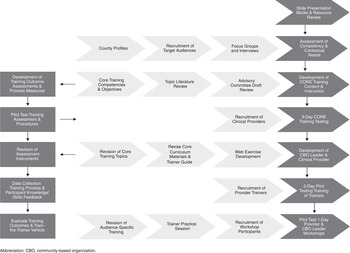
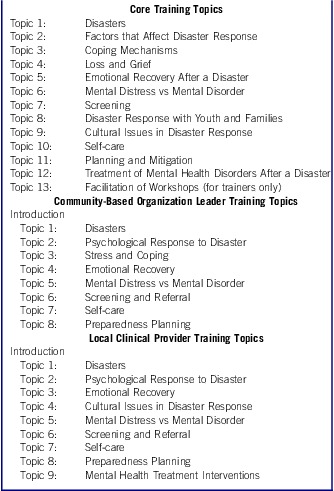
The training curriculum was developed iteratively, with revisions being made according to formative information gathered and the output of each stage of design (Figure 1). This development process ensured that the training was evidence based, informed by successful models from other locations, contextually relevant, understood and supported by community local audiences, and evaluable. As a first step, we undertook a comprehensive and critical review of existing training materials and resources.7, Reference DeWolfe45-Reference Calhoun, Rowney, Eng and Hoffman50 Relevant resources were used in conjunction with training needs assessment results to establish the learning objectives of the training materials (Table 1). Results from four focus groups and two in-depth interviews with 13 CBO leaders and seven clinical providers performed in Lenoir County, North Carolina, helped us identify (1) the priority topics to be covered in the core curriculum; (2) specific topics to cover for each target audience; and (3) how to tailor the format and logistics of implementation.Reference Laborde, Brannock and Parrish51 Next, we formulated training competency knowledge and skills outcomes for each identified topic. The topic competencies were mapped to competencies covered in a slide presentation provided by mental health experts who had developed the train-the-trainer (TTT) model for technical assistance to developing countries.Reference Kutcher and Chehil43, Reference Everly, Beaton, Pfefferbaum and Parker52 Detailed outlines of training topics and competencies guided the elaboration of each topic by content experts on our team (two social workers, a psychologist, a health educator, and a mental health epidemiologist), based on literature review and experience. African American team members assisted in tailoring each topic content according to the language, persons, metaphors, content, concepts, goals, methods, and context dimensions recommended by Bernal etal.Reference Bernal, Bonilla and Bellido53 A curriculum designer and the project director (D. J.L.) integrated the content with illustrative video clips and photographs and developed group exercises and a trainer's guide.
Iterative Development of Disaster Mental Health Training Materials.

Topics Selected for Postdisaster Mental Health Training for Black CommunitiesFootnote a

a HERMES, LLC, Wilmington, North Carolina; 2008-2010.
The final draft core training materials were designed to be implemented over a three-day workshop, and included specific learning objectives, background content on each topic, cooperative learning activities, and job aids for each of 12 modules. We contextualized the vignettes and exercises for black communities in eastern North Carolina by creating scenarios consistent with the local culture and offering psychological first aid (PFA) techniques that could be customized according to the traditions of extended black family support systems.Reference Rosenfeld, Caye and Ayalon54 The trainer guide included a description of the training, preparation, trainer's role and responsibilities, tips for ensuring supportive cooperative learning, logistics, a proposed schedule, and annotated content.
An advisory committee composed of a clinical psychologist from the state Disaster Response Network (DRN), the director of the state division of mental health, the coordinator of the state disaster preparedness and response, and an academic social worker with extensive experience in PDMH training reviewed the core curriculum. The committee made several useful suggestions, including (1) mental disorders and corresponding therapies should be presented only to licensed clinical providers; (2) these clinical topics could be presented in a separate module; and (3) a three-day workshop was too long. Our team discussed this option with experts who had developed the training model from which we adapted our curriculum. We decided to keep the section on mental health treatment (which was restricted to training of physician providers and designed to be facilitated by a licensed psychiatrist trainer) while cognitive-based stress-reduction techniques could be taught to all clinical providers.Reference Hawley, Hawley, St Romain and Ablah55, Reference Ruzek, Walser and Naugle56 The core workshop was shortened to two and a half days.
Recruitment Strategy
We created profiles for 15 of the 24 rural and coastal NC counties with the highest black populations and high indices of poverty. The profiles included demographic and mental health statistics, existing mental health networks, and key points of contact. Lenoir County, North Carolina, was chosen as representative of regional vulnerable areas because of its proportion of black residents living in poverty, history of postdisaster hardships, and lack of access to mental health services and infrastructure. We used a combination of targeted and network sampling to recruit participants meeting eligibility criteria.
For the CBO leaders, the eligibility criteria were as follows:
• Eighteen years of age or older
• Embedded and respected in their communities
• Able to act as a cultural translator
• In a position to deliver PDMH information to the community
For the clinical providers, the criteria were as follows:
• At least two years of active experience
• Physician, nurse, nurse practitioner, or clinical psychologist or social worker
• Have tailored their services to the diversity of the local black community
• In a position to deliver PDMH information to the community
We created an initial contact list from the county profile information and our team's public health and community linkages.Reference Onwuegbuzie and Collins57 Individuals on the list were called to determine their eligibility and interest in the project and asked to recommend peers. We also presented our project and distributed information packets and flyers at the County Health Alliance monthly meeting. Focus group and interview participants received $150 and $100 incentives, respectively. Workshop participants received incentives of $200 per day of training and paid travel expenses. In addition, participants were served meals and refreshments and were allowed to keep the training materials. Focus groups and workshops were conducted at the local business development center, community health center, and hotel conference rooms. All study procedures were in accordance with ethical standards and approved by the North Carolina Central University Institutional Review Board.
Core Curriculum Usability Testing
In addition to meeting the clinical provider eligibility criteria, the core training participants were required to have a knowledge base in mental health (licensed psychiatrist, psychologist, psychiatric nurse, or social worker). Each participant agreed to provide input and assistance in tailoring the workshops for target audiences. Considerable effort was spent on telephone and e-mail outreach to engage mental health. Nine of 16 interested providers who were available on mutually agreeable dates were registered to attend; 5 participated in at least one day, and 3 completed the entire the two and one-half day core workshop. Members of the study team facilitated workshop sections according to their expertise (psychological first aid, cultural competence, mental health emergency services, and planning). One of the psychiatrists who developed the original slide presentation and conducts training internationally facilitated the therapeutic interventions module and demonstrated cognitive-based intervention techniques.
Revision of Core Curriculum
We collected process data and topic evaluations and conducted postworkshop debriefing discussions with participants and facilitators. These usability data and feedback from our advisory committee were analyzed and used to remap topic areas to priority competencies. The core curriculum components and procedures were reduced to fit a two-day TTT workshop.
Community Leader and Clinical Provider Trainer-Led Workshops
Formative data from the core curriculum usability testing were triangulated with results of the clinical provider and CBO leader training needs assessment data. After reaching consensus on the most relevant topics and the depth of content that needed to be covered, several adjustments were made to redesign the training to fit a one-day workshop. First, to better accommodate the majority nonphysician clinical provider audience, the therapeutic intervention topics were reserved for later development of a Web-based module. Second, the sections covering youth PDMH and community planning were condensed considerably. Finally, the demonstration and usability testing of the Web-based planning was excluded from the workshops, and participants were invited and scheduled to test it remotely after the workshop. The curriculum designers integrated core curriculum materials into separate sets of CBO leader and clinical provider topic modules and crafted corresponding module content, cooperative learning exercises, training aids, and trainer guides.
The CBO leader modules had more emphasis on background and communicating about mental health reactions, facilitating referral, and PFA methods. The screening section focused on cultural ways to address stigma and educate survivors on stress, coping, and assistance in accessing mental health services. The clinical provider modules had more emphasis on developing cultural competence, case referral and follow-up, cognitive-based approaches, and acute episode psychotherapy. Both sets of modules were further tailored with local illustrative vignettes and film clips to highlight cultural aspects of disasters in black communities and a list of resources.
Web-Based Exercise
The “Community Planning for PDMH” module was adapted to three synchronous collaborative e-learning exercises: brain-storming, developing a list of community resources, and mapping. One of the authors and an instructional designer worked with consultants who developed a Web portal that provides access to a narrated module and integrates collaboration tool software (Vyew) that functions as a whiteboard. The exercises demonstrated how to use the virtual whiteboard and place sticky notes to brainstorm ideas, upload and save planning documents, and communicate using a chat room. In the future, a mapping tool would allow for the use of overlays to map local community resources and needs.
Training of Trainers
Mental health providers who could not participate in usability testing of the core training workshops due to scheduling conflicts and new referrals from their networks were invited to participate in the revised two-day TTT workshop. Once again, rounds of e-mails and telephone calls were required to schedule six participants. Of five mental health providers who attended this workshop, three were also available to attend a one-day follow-up facilitator training session. During the follow-up session, participants reviewed the curriculum and identified differences between the clinical provider and the CBO leader modules, tailoring and leading cooperative exercises and logistics. Trainers agreed on follow-up communications and module facilitation assignments according to where they felt they had strongest competencies.
Trainer-Led Workshops
Using the extended network recruitment strategy, we identified and scheduled 13 CBO leaders and 10 clinical providers for trainer-led, one-day workshops. Teams of two local trainers were assisted with logistics and leading the workshops by study team members.
Web-Based Training Workshop
Participants from trainer-led workshops were invited to evaluate the Web-based format of the community planning module; seven accepted. The purpose of the online exercise was to provide a forum through which community leaders and providers could reduce the meeting demands of collaboratively planning a community disaster mental health mitigation partnership and strategy.
Data Collection
Participant profiles
Upon signing an informed consent, each participant completed a profile form querying demographics, reasons for participation, and prior experience in PDMH and preparedness training.
Observation
At least one study team member documented training fidelity, participant engagement, flow of interaction, communication, and problems using a standardized observation form.
Post-test
Participants completed posttests with 21 multiple-choice items to measure their knowledge of PDMH issues related to workshop learning objectives.
Evaluation forms
Participants also completed a 30-item evaluation form, ranking how well the training met each learning objective from 1 (not met at all) to 5 (very well met); the usefulness of the content and format from 1 (not very useful) to 5 (very useful); how much they learned from each of the exercises/learning activities from 1 (nothing) to 4 (a lot); and how relevant these were to the black community from 1 (not at all) to 4 (very).
Feedback discussions
Participants were engaged in debriefing by a health educator using a discussion guide that elicited their overall reactions to the training, exercises, and format, as well as suggestions for improvement. The moderator took notes, and the discussions were audiotaped. Facilitators were also debriefed by one of the investigators after each workshop.
Data Analysis
Quantitative data were entered, stored, and managed in a spreadsheet and imported into SAS, version 8.2, for analysis. Simple summary statistics were used to examine the participant characteristics and responses for the workshop posttests and evaluations. Due to small sample size and the formative nature of this study, we did not calculate any index of internal consistency of our instruments but noted how to improve their construct validity. Participant knowledge scores were calculated as the percent of correct posttest items, and mean group scores were compared using the two-group t test. The modal distributions of perceived training effectiveness for meeting each learning objective were examined for each group of participants. Likert ratings were dichotomized into positive (very useful or useful) vs neutral or negative (somewhat not useful and not useful) to compare the percent of positive ratings for different dimensions of the training.
Thematic analysis of audio- and videotaped transcripts was performed using qualitative data analysis software (NVivo) by two investigators and then discussed in meetings. Notes taken during the debriefing of facilitators and training observations were examined to assess the implementation challenges and lessons learned. Triangulation of the quantitative and qualitative data was used to arrive at an overall assessment of the processes and cultural adaptation of the training.
RESULTS
Participant Profiles
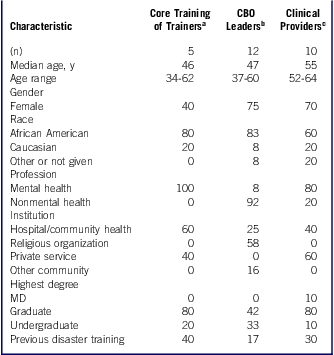
Twenty-eight CBO leaders and clinical providers participated in training sessions (Table 2). The majority were black (79%), women (67%), and middle aged (range 34 to 64 years). Clinical providers were slightly older than other groups and predominantly nonphysicians with degrees in clinical psychology or social work. Most of the trainers worked at health centers, while most of the clinical providers in the trainer-led workshop worked in local private practices. The CBO leaders included individuals who were active in community centers, outreach programs, churches, and hospitals. Only two clinical providers reported previous training in disaster response, one in crisis response. Likewise, only two CBO leaders reported previous training in community support during emergencies.
Characteristics of Disaster Mental Health Training Participants, North Carolina 2009-2010
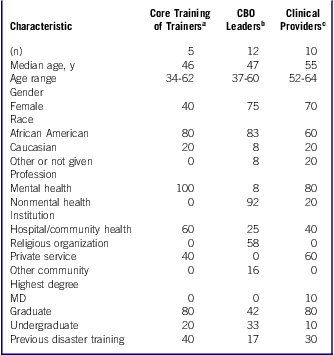
Abbreviation: CBO, community-based organization.
aParticipants were mental health providers who were trained using the core training curriculum and led the training of local clinical providers and CBO leaders.
bParticipants attended 1-d community leader workshops led by mental health providers who were trained using the core training curriculum.
cParticipants attended a 1-d clinical provider workshop led by mental health providers who were trained using the core training curriculum.
Posttest Results
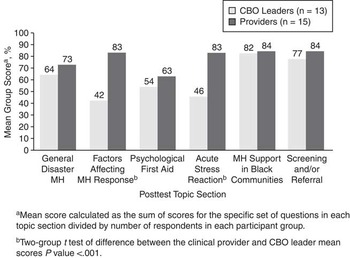
The majority of participants (>50%) correctly answered 17 of the 20 core competency items on the posttest (overall mean score 71%, s = 12.7%). All participants correctly answered items measuring their understanding of factors affecting disaster-related reactions and emotional regulation (100%), the types of people not in need of PDMH monitoring (96%), and postdisaster support for youth and family (93%). Less than half of all participants identified the disaster phase during which PTSD is usually diagnosed (43%) or PFA is used (21%). The latter item was omitted from the test score based on our observation that PFA skills were not clearly presented according to the phases of disasters. While all core providers correctly identified the characteristics of Mundane Extreme Environmental Stress (MEES),Reference Andrulis, Siddiqui and Gantner1 few of the trainer-led workshop participants correctly answered this question (CBO leader 0%, clinical providers 30%). Mean posttest scores were not significantly different for clinical providers in the core training and trainer-led workshops (81% and 79%); therefore, we combined their results (n = 15) for subsequent comparisons with the CBO leaders scores (n = 13). This combined group is hitherto referred to as “providers.” The mean posttest score for the CBO leaders was lower than the mean score of the providers (80%, s = 7.3% vs 61%, s = 8.8%; P < .001). Examining mean group scores according to topic sections revealed two areas for which group score differences between CBO leader and provider were statistically significant (Figure 2). CBO leader scores were lower on three of four mental health risk items. In the acute stress response section, none of the CBO leaders selected the correct definition of mental health disorders, whereas 93% of providers selected the correct definition.
Distribution of Provider- and Community-Based Organization (CBO) Leader Participant Mean Group Scores on Disaster Mental Health (MH) Training Posttest Topic Sections.

Evaluation Results
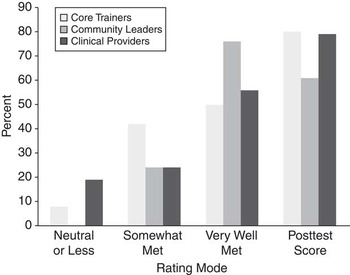
On the evaluation forms, participants indicated the training as having “somewhat met” or “very well met” the majority of learning objectives. The highest consensus among participants (>90% indicated “somewhat met” or “very well met”) was for distinguishing between mental distress and mental disorder, explaining the influence of culture in survivors’ responses to disaster, the importance of cultural competence and cultural humility, and identifying how disasters can affect responders and the ABCs of self-care for responders. Although providers had higher posttest scores, a higher percentage of CBO leaders rated the learning objectives as having been very well met (Figure 3). The objectives that received “neutral” or “somewhat not met” ratings related to the community planning. This was the last module of the day that had been shortened from a four-hour to a 40-minute session.
Mode Distribution for Ratings of Training Effectiveness in Meeting Learning Objectives and Mean Posttest Scores by Participant Group (North Carolina 2010).

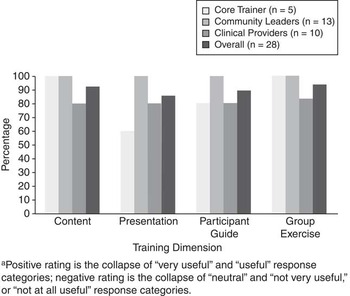
Overall 90% of ratings on the usefulness of the content, presentation, materials, and exercises were positive, with the majority of participants rating the dimensions of training as “very useful” (Figure 4). Likewise, 97% of participants rated the content and exercises as being relevant to the black community (75% strongly agreed) and that they had learned a lot from the exercises (92%), especially the exercises on cultural perspectives (97%).
Percent of Positive Ratings of Usefulness for Different Dimensions of Disaster Mental Health Training by Participant Group and Overall (2010 North Carolina).a

Debriefing Discussions and Observations
During the postworkshop debriefing discussions, all participants indicated that they had benefited from participating in the workshops and would welcome more in-depth coverage of certain topics. Community leaders were interested in learning more about coordination, holistic approaches to mental problems requiring multiple resources, and ways of accessing professional clinical support. Clinical providers involved in social work and counseling were interested in more tools for networking with community organizations and cultural competence, while physicians suggested more in-depth content on screening and pediatric disaster mental health skills. The clinical provider trainer-led workshop was not as well received, with comments on the lack of facilitator knowledge of the content and skills for fixing technical problems.
Our observations and videotapings confirmed that participants were engaged in the exercises and discussions. Trainer debriefings and notes indicated that the amount of material to be covered was extensive. The agenda was found to be helpful for guiding trainers in allocating time for each topic, but there were times when lively discussions had to be abbreviated to transition to the next section. Training fidelity was affected by the level of trainer preparation, readiness, and familiarity with the material. One of the three trainers facilitated in all workshops, allowing us to observe within trainer fidelity of the delivery of their topics across audiences.
Usability Testing of Web-Based Training
Two clinical providers and five CBO leaders tested the usability of the Web-based version of the community disaster mental health planning module. This testing involved remotely accessing the online narrated courseware and then logging on to the whiteboard for a demonstration on how to use the software for collaborative planning by telephone. All participants rated the Web-based module as either “useful” or “very useful.” The clinical providers and one CBO leader who had experience with online courseware indicated that the level and pace of instruction were “about right.” Clinical providers felt that their knowledge gains were due to both the courseware and workshop session and that e-learning would be a viable option for enhancing but not replacing the workshop session. Although they also indicated that a Web-based format would be “valuable” or “of great value,” three of the five CBO leaders felt that their knowledge gains were due solely to the workshop. Their major concern was that relying on Web-based training would limit participation of vital community partners.
COMMENT
According to the US Department of Health and Human Services, the cotraining of community health providers and community leaders responds to the appeal of many federal agencies for translation of evidence-based practices and development of culturally competent mental health interventions.Reference Kutcher, Chehil, Cash and Millar14, 58 High evaluation ratings indicate that our course materials, videos, cooperative learning exercises, and case scenarios were culturally relevant and acknowledge preexisting dynamics that contribute to disaster consequences in communities of color. We also observed high ratings of participants’ perceived training effectiveness in meeting the training objectives. Nearly all participants achieved high posttest scores on items related to cultural competence in mental health disaster response, survivor stress reactions, and referral to mental health services. The TTT model has been increasingly used in medical and emergency service preparedness education.Reference Thorne, Oliver, Al-Ibrahim, Gucer and McDiarmid40, Reference Cross, Cerulli, Richards, He and Herrmann59 The CBO leader preference for interactive, face-to-face discussions of engaging case scenarios and video clips was expected. These results support our premise that extending the model to black CBO leaders hinges on contextualization based on needs assessment, collaborative learning, and using local messengers.
Our study also highlights the ongoing challenges in engaging the target audiences. Clinicians were the most difficult to recruit and schedule, even though we provided generous incentives and held workshops on weekends. We plan to improve recruitment efficiency according to suggestions from our participants (eg, using professional venues with more authority to recruit members by mandating training and/or providing continuing education credits and working with campus-community partnerships). More outreach is needed to raise community awareness and interest in disaster-related and general mental issues prior to recruitment. Our highest recruitment efficiency was in the second and third waves of training, once potential participants learned about the study from usability test participants.
The variability in trainer preparation affected the quality and fidelity of the training. Evaluations and posttests were the highest for topic areas facilitated by the best prepared trainer who also had the longest professional experience and history of community involvement. This finding underscores the need to identify dedicated and available trainers, and provide trainers with more rigorous preparation and incentives such as certification linked to measures of fidelity and performance. However, the extent of trainer support and feedback that can be provided will likely depend on the availability of additional local resources.
Although usability test participants and the advisory committee recommended reducing the workshop schedule to ensure participation, our observations and workshop feedback indicated that either multiday workshops or multiple one-day workshops are needed to adequately cover the training competencies identified in the needs assessment. Delays due to technical difficulties with audiovisual equipment and in accessing the Internet arose during both the workshop and the Web-based training, reinforcing the importance of ensuring that technical support is available and that technologies work in community venues.
The Web-based modules offer flexibility and reduce costs but should be reserved for specific groups, continuing medical education testing, and continuing trainer support. However, the most valued aspect of the training was the understanding gained through face-to-face cooperative learning experiences. In addition, a shortcoming of the few resources targeting minority preparation has been that they are primarily available through Web sites, and many black communities in rural areas still have limited internet access.Footnote 1
There was a lack of correspondence between the level of understanding of the competencies displayed by CBO leaders during the workshops and their scores on corresponding posttest items. This finding informed us of what needs to be conveyed more clearly and emphasized by the trainers. It also may reflect clinical provider advantage of being more familiar with some of mental health terminology and greater test-taking experience with the types of items on the posttest (eg, reverse category). Although it is standard practice to use identical items to measure and compare knowledge gains in participants from a wide range of backgrounds, the competencies we want to confer go beyond terminology. For example, when participants were introduced to the concept of MEES, the CBO leaders discussed local examples and gave valuable input on how the lifelong accumulation of racial stressors affect them and their community. Their visceral understanding of the professionally coined MEES was far more relevant to mastering culturally appropriate PSA competencies than their correct answer. Although we are certain to revise our assessment tools based on our findings, it is not feasible to conduct cognitive and pilot testing of questionnaires for each training site. One alternative is to rely on mixed-method evaluation of competencies such as follow-up case studies of participants having the opportunity to apply their knowledge and skills in their community. The planning module includes assessment of local response capacities that can be benchmarked and monitored, allowing for some measure of training effectiveness in the response that can be activated during emergency situations.
CONCLUSION
This feasibility study provides valuable information on how to improve the PDMH curriculum and procedures. We have identified evidence-based training components and procedures that are acceptable and feasible and resulted in self-reported increased knowledge and improved self-efficacy among participants who can contribute to black community mental health preparedness and planning.
Our training tools and approach hold promise for filling an important void in population-specific, PDMH training due to several novel features. They integrate predisaster mental health needs and use vignettes and cultural touch tones specifically relevant to the local black community. Education on the use of PFA for decreasing hyperarousal among disaster survivors and effective self-strategies is extended to trusted messengers in the community. The training outlines steps in collaborative PDMH planning and improves intersectional awareness. Thus, community insiders can more effectively connect disaster survivors who experience problematic emotional responses or other mental health problems to local providers who can be activated in the immediate aftermath of a disaster. The training raises cultural awareness and dispels the damaging and stigmatizing images of helpless black communities by recognizing the important contributions and potential of targeted communities in disaster mental health response. This repositioning of disaster mental health planning integrates local knowledge of social ecology for mitigating the individual and collective trauma of disasters. Last, the training and collaborative planning warrant further testing of adaptability, effectiveness, and sustain-ability. Findings from this study will be used to refine assessment tools and benchmarking in the evaluation of a larger study across multiple black community settings and similar efforts to disseminate disaster mental health competencies.
Disclosure
The project described was supported by Grant Number 5R43MH080520 from the National Institute of Mental Health. The content is solely the responsibility of the authors and does not necessarily represent the official views of the National Institute of Mental Health or the National Institutes of Health.
Acknowledgments
Sonia Chehil, MD, and Stanley Kutcher, MD, shared their model presentation and significant contributions during the early development of the curriculum. Kristen Brannock, MPH, and Sara Hutchinson, MS, provided research assistance, and LaVerne Reid, PhD; Michael Moseley, MS; Joanna Forester, MSW; Alfiee Breland Noble, PhD; and Tab Ballis, MSW; provided assistance and input during implementation. A number of community leaders and clinical providers in Lenoir County, North Carolina, contributed their time and constructive feedback on the materials and processes that were tested.
Published online: June 29, 2012. doi:10.1001/dmp.2012.15