The inclusion of women in the official decision-making institutions of the United States contributes to the legitimacy of those institutions (Darcy, Welch, and Clark Reference Darcy, Welch and Clark1994), and when it comes to electing women to national office in the United States, we now look to evidence that “when women run, women win” (Darcy, Welch, and Clark Reference Darcy, Welch and Clark1994; Burrell Reference Burrell1990; Burrell Reference Burrell1994; Burrell Reference Burrell, Carroll and Fox2006; Schlozman and Uhlaner Reference Schlozman and Uhlaner1986; for opposing perspectives, see Lawless and Pearson Reference Lawless and Pearson2008; Sanbonmatsu Reference Sanbonmatsu2006a; Sanbonmatsu Reference Sanbonmatsu2006b; Niven Reference Niven2006). The difficulty of electing women to Congress in the United States has been attributed to such sources as gender stereotyping on the part of voters as well as party leaders, political systems and structures that favor incumbents, a lack of viable female candidates, and fundraising challenges. In this article, we investigate the impact of EMILY's List (hereafter EList) on women's success in elections because it is the standard bearer of women's PACs and is commonly cited as crucial to Democratic women's electoral victory (Burrell Reference Burrell, Lovenduski and Norris1993; Burrell Reference Burrell1994; Burrell Reference Burrell, Carroll and Fox2006; Schlozman and Uhlaner Reference Schlozman and Uhlaner1986; Sanbonmatsu Reference Sanbonmatsu2006b).
It has been suggested that EList represents more than the typical PAC. Electing women requires funds, but it also requires recruitment of candidates, advocacy, and candidate training to overcome the challenges listed previously (Lawless and Fox Reference Lawless and Fox2005; Burrell Reference Burrell, Carroll and Fox2006). EList has championed these services and become the premier women's PAC as a result. Our research question is a simple one in light of the complexities of electing women in the United States: Does an endorsement by EList provide an essential catalyst for the electoral success of pro-choice, Democratic women in the United States? That is, does an endorsement by EList predict electoral success? Alternatively, it could be the case that EList selects would-be winners for endorsement. In other words, the organization selects candidates that are likely to succeed with or without its endorsement. As cited by Day and Hadley (Reference Day and Hadley2005), the literature on women's PACs as organizations is extensive, but there are few studies that empirically examine the impact of women's PACs on women's actual electoral success. This article contributes to just such a gap in the literature and specifically addresses the puzzle identified in the title.
WOMEN'S PACS AND EMILY'S LIST
Sanbonmatsu suggests that “[the] relationships among funds, qualifications, and elections merit further investigation” (Reference Sanbonmatsu2006b, 200). An endorsement by EList is certainly about funds, but it is also something of a proxy for qualifications, since the organization determines who it will endorse based on “viability”—the candidate's experience, her existing network of supporters, access to money, and an existing campaign organization (Day and Hadley Reference Day and Hadley2005, 25). In this article, we attempt to identify the relationship between endorsement by EList and electoral success using propensity score matching, which is explained in more detail in the following sections. The present puzzle in the literature regarding EList's impact is whether the endorsement is essential to pro-choice, Democratic women's electoral success, or whether EList merely picks the winners. It may also be that EList's impact was significant in the 1980s and early 1990s but is now waning in importance, given that the Democratic party is now less likely to overlook viable women candidates than it was in the past. To date, none of these notions have been backed by empirical investigation. As an introduction to why EList would be so essential in the first place, it is important to briefly provide background information on women's PACs.
Women's PACs are unique in that they are founded by women and focus almost exclusively on electing women to Congress and a range of state offices. “EMILY” stands for “Early Money Is Like Yeast” (it makes the dough rise) and was founded in 1985, when women held only 5% of congressional seats (Day and Hadley Reference Day and Hadley2005). The founders of EList had played active roles in women's PACs in the 1970s but felt that the bipartisan nature of these organizations was inhibiting women's electoral success. By 1992, EList had achieved considerable notoriety by helping elect 24 Democratic, pro-choice women to Congress and boasting 23,000 members on its list.Footnote 1
Other women's PACs emerged as partisan or ideological counters to EList (e.g., the WISH List and the Susan B. Anthony List), although none have achieved the same level of success as EMILY (Burrell Reference Burrell, Carroll and Fox2006, 155). Women's PACs run the ideological spectrum and are as varied in their objectives as are female citizens, activists, and candidates (Day and Hadley Reference Day and Hadley2005, 1–2; see also Burrell Reference Burrell, Lovenduski and Norris1993; Burrell Reference Burrell, Carroll and Fox2006; Hartmann Reference Hartmann1989).
The early moneyFootnote 2 that EList provides is largely in the form of bundled checks that come from its network of members (Pimlott Reference Pimlott2007, 8). Because EList can collect contributions from its members and forward them to the candidates, official reports of what the PAC gives to an individual candidate may underestimate the actual financial impact (Day and Hadley Reference Day and Hadley2005, 5–6; Burrell Reference Burrell, Carroll and Fox2006, 156–57). EList members are prompted to send checks via press releases, e-mails, or postal mailings announcing that a particular candidate has been endorsed. As a result of this “early money” strategy, as well as its leverage of the power of its membership, EList “has been able to provide its endorsed candidates with hard contributions that far exceed the limits afforded to PACs” (Pimlott Reference Pimlott2007, 6). Additionally, EList is the largest and wealthiest of the women's PACs. It is not just wealthy in comparison to other women's PACs—its total contributions to candidates stand at or near the top of all PACs (Day and Hadley Reference Day and Hadley2005, 24; Burrell Reference Burrell, Carroll and Fox2006). For example, in 2006, EList's total receipts were $34,118,930, and in 2008, the total receipts were $35,232,112.Footnote 3
In its first four election cycles (1986–1992), EList focused on raising money and contributing to candidates. Beginning with its success in 1992, it evolved as an organization and expanded to also conduct campaign-related research; train candidates and campaign staff; identify and contact voters; and conduct surveys, focus groups, and advocacy campaigns (Day and Hadley Reference Day and Hadley2005, 27; Pimlott Reference Pimlott2006, 64–81). Despite the expanded role of the PAC and the complexities of electing women to Congress, EList continues to assert that supporting women in primaries by providing them with early money is essential to electoral success. In her empirical examination of the impact of EList on elections between 2000 and 2006, Pimlott (Reference Pimlott2007) found a significant positive relationship between EList endorsement and primary victory. She observes that “EMILY's List candidates are more likely to win their primaries than candidates not endorsed by EMILY's List,” but also notes that other factors such as incumbent/challenger status, total money raised, and the political atmosphere of the district or state are likely to be critically important (9).
EList has championed recruitment, nomination, and financial support to expand the role of the typical PAC and has not taken for granted that female Democratic candidates will win if they run. Sanbonmatsu (Reference Sanbonmatsu2006b) found that organization outside of the Democratic party has advantages for women, particularly in cases in which the party is less likely to select women as candidates. In fact, women's PACs such as Hope Chest in Ohio and Lillian's List in North Carolina “were modeled self-consciously after EMILY's List” in an effort to elect women outside of state Democratic party support (194). Since the party organizations are a patchwork among the states, it cannot be assumed that female Democratic candidates will receive party support, despite research that suggests the party is improving their support of women candidates (Burrell Reference Burrell1994; see also Sanbonmatsu Reference Sanbonmatsu2002, Reference Sanbonmatsu2006a; Niven Reference Niven2006; Duerst-Lahti Reference Duerst-Lahti, Thomas and Wilcox1998).
Party leaders ought to be interested in finding the strongest candidate when the two parties are competitive in the particular district or state, and the office itself should likewise have an impact on the extent to which party leaders are selective among a pool of candidates (Aldrich Reference Aldrich1995; Aldrich Reference Aldrich2000). Sanbonmatsu (Reference Sanbonmatsu2006b) observes that, in the past, voters have been more supportive of women as candidates than have party leaders (see also Niven Reference Niven2006). Changing attitudes over time may reflect the changing role of the party with regard to the recruitment and election of women. The notion that EList has become somewhat of a party adjunct in recent years (Pimlott Reference Pimlott2007, 1) seems to fit with research suggesting that women's political groups that ally themselves with the Democratic party are much stronger partisans than organizations that endorse Republican women (Cooperman Reference Cooperman2001) and thus able to wield more influence in the context of an election.
One of the recurring questions regarding ideological PACs such as EList is how the endorsements are decided. Aside from the requirement that the candidate be a pro-choice, Democratic woman, EList determines the viability of a candidate based on her experience, existing network of supporters, access to some money, and existing campaign organization (Day and Hadley Reference Day and Hadley2005, 25; Pimlott Reference Pimlott2007). In other words, EList does not endorse candidates who are starting from scratch. This strategy may provide a framework with which to view EList endorsees and their likely electoral success, but it also begs the question of the role actually played by EList in the electoral success of the candidates it selects. Day and Hadley's (Reference Day and Hadley2005) assessment of EList suggests that it does not merely pick the winners, but also makes their success possible by identifying and contacting donors and voters, and providing research and advocacy on behalf of women as candidates. This assertion has not been tested, however. In short, there appears to be a problem of causal inference regarding endorsements predicting electoral success or likely winners receiving endorsements. The role of EList and other women's PACs could be better understood with further empirical investigation.
HYPOTHESES AND DATA
Does an endorsement by EList predict electoral success? Previous empirical studies have tested for a linear relationship with traditional controls. The most well-established variable predicting electoral success is incumbency (Mayhew Reference Mayhew1974). Incumbency has been a barrier to women achieving widespread electoral success (Duerst-Lahti Reference Duerst-Lahti, Thomas and Wilcox1998), and because of this structural barrier, open seats are also of particular interest to women candidates (Sanbonmatsu Reference Sanbonmatsu2006b). In addition to incumbency, other traditional covariates have included the amount of money raised, candidate gender, the political ideology of the district, and political culture, typically controlled for as percent voting Democratic in either the district or the state for the last presidential election. The particular year may also have an impact on women's electoral success (Burrell Reference Burrell, Lovenduski and Norris1993; Burrell Reference Burrell1994; Delli Carpini and Fuchs Reference Delli Carpini and Fuchs1993; Lawless Reference Lawless2004) so the year of the election has been a traditional covariate as well.
Although these are the typical controls that would be considered in empirical studies examining the impact of PACs on election outcomes, our research question requires us to leverage on causality, and, therefore, a traditional linear model is insufficient. In the following section, we present a propensity score–matching model to test our research question. Propensity matching reproduces an experimental condition in which no controls are needed because cases are matched based on the predictive condition or independent variable(s) instead of randomizing the experimental condition or independent variable(s).Footnote 4
METHODS
The direction of causality between winning the general election and an EList endorsement is not clear. It is possible that an EList endorsement helps candidates to win, but it is equally conceivable that EList is more likely to endorse probable winners. Thus, endorsement could appear as predictive of electoral victory in any quantitative associational analysis in which electoral victory is the dependent variable and endorsement is the independent variable, when in reality, the direction of causation is, at best, assumed. One of the problems of causal inference is how to estimate the treatment effects in observational studies (McDermott Reference McDermott2002). In other words, without a controlled situation that allows for the systematic assessment of the impact of treatment (endorsement) on outcome (electoral success), we are stuck with seemingly inadequate methods. The ideal situation to test this causal relationship would be a full experimental design with randomly selected candidates and the requirement that EList endorse our randomly selected candidates. Since we cannot force EList to act according to our methodological wishes, we must resort to analyzing observational data on past races.
The dataset used in this analysis was compiled by the authors to include all female, pro-choice, Democratic candidates (because EList does not endorse male, pro-life, Republican candidates) from 1996 to 2008 who engaged in a contested general election race for the U.S. House.Footnote 5 Noncontested races were eliminated from the sample. Election and candidate data were gathered from the Center for American Women and Politics (http://www.cawp.rutgers.edu), EMILY's List (http://www.emilyslist.org), and the appropriate volumes of the Almanac of American Politics.Footnote 6 Fundraising data were gathered from the Center for Responsible Politics (http://www.opensecrets.org) and the Federal Election Commission (http://www.fec.gov).
The dataset provided us with two potential comparison groups—candidates who were endorsed by EList and candidates who were not endorsed. Although we could compare the two groups post hoc, the results of any such a comparison could be dismissed on the basis of biased case selection. As a result, we chose to use the method of propensity score matching, because it takes steps to overcome this problem. Propensity score matching involves pairing treatment and comparison cases based on their similarity in regards to their observable characteristics (i.e., some of the traditional covariates mentioned above). One of the reasons that we opted to use propensity score–matching methods to examine our research question is because the dimensionality of our observable characteristics is high—in other words, we have quite a few covariates. It would be difficult to discern the dimensions along which to match cases and what weighting scheme to adopt if we used traditional methods.
Propensity score matching allows us to test the propensity of endorsement and narrowly confines the range of this propensity in the analysis so that we can evaluate the relationship between endorsement and electoral success. This approach allows us to include cases in our sample that are very similar to each other based on our predictors of endorsement. The only difference between the matched cases is that some were, in fact, endorsed by EList and some were not.Footnote 7 Assuming we have selected strong predictors, this method limits the problem of detecting a relationship that stems from incorrect assumptions about causal direction. The propensity score—the probability of receiving the treatment (endorsement) conditional on covariates—reduces the dimensionality problem of our data and provides us with better leverage to discover the relationship between EList endorsement and electoral success.
MODELS
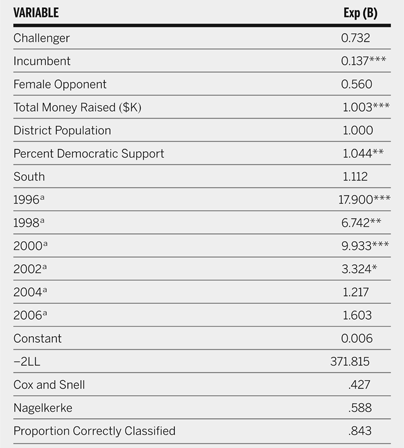
Using propensity score matching requires us to engage in a three-step modeling process. The first step is to run a logistic regression with endorsement as the dependent variable and the following independent variables (representing all our available data): incumbency (2 variables: challenger and incumbent, with open seat as the reference), gender of the opponent in the general election, total money raised by the candidate, population of the candidate's district, and ideology of the district (operationalized by the percentage of the vote received by the Democratic presidential candidate in the previous presidential election). We also controlled for the election year through dummy variables, and our reference category was 2008. This model produces predicted group membership (endorsed or not) for each candidate and provides us with the probability of group membership (the probability of endorsement).
Table 1 shows the results of the model for predicting the probability of endorsement. It appears that the propensity of endorsement is related to the amount of money a candidate previously raises, the partisan composition of the district, and the election year. The propensity of endorsement increases with the amount of money raised; it is the highest for open seats and lowest for incumbents. Furthermore—and as expected, given the mission of the organization—the more Democratic a district is, the higher the propensity of endorsement. It also appears that the propensity of an EList endorsement decreases over time. The candidates in our sample who ran in elections from 1996 to 2002 were more likely to receive an endorsement than candidates in subsequent election years. The highest likelihood of endorsement occurred in 1996. This finding is consistent with what is known about the evolution of the organization. The organization went through significant changes in the mid- to late 1990s, including the creation of several new programs that greatly expanded the services provided to candidates. Part of this transformation included EList's increased focus on a more strategic endorsement process, leading to fewer candidates overall being endorsed each year; however, those candidates receiving endorsements were identified by EList as strategic recipients in targeted races.
Predicting the Probability of Endorsement

Note. N = 504.
* p < .05,
** p < .01,
*** p < .001
Because the model is an acceptable fit, we can trust its predicted probabilities for propensity matching purposes. We can now use these probabilities to divide cases into quartiles for final analysis and testing of our research question. We selected quartiles because of the relatively small sample size (quintiles or larger splits are more commonly used). The second step of our analysis involved separating our original cases into subsamples based on the predicted probabilities produced above. The first subsample (first quartile) is composed of the candidates with the lowest probabilities of endorsement (0%–25%). This group contained 285 candidates, 28 of whom were endorsed by EList. The second subsample is the second quartile (25%–50%). This group contained 70 candidates, and 29 were endorsed by EList. The third quartile (50%–75%) contained 49 candidates, 37 of whom were endorsed by EList. The fourth quartile (75%–100%), comprising candidates with the highest propensity of endorsement, contained 100 candidates, 86 of whom were endorsed by EList. Assuming no mistakes were made in the variable selection process, these quartiles contained candidates who did not differ on relevant characteristics that predict electoral success other than EList endorsement. For this reason, the cases within each quartile can be treated as if they were randomly selected to be endorsed or not—just as if we had experimental data.
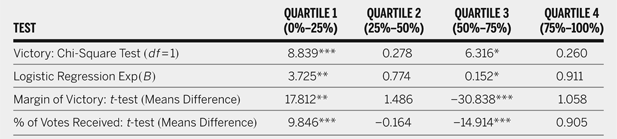
To complete our final step in testing the relationship between EList endorsement and electoral success, we set up three bivariate models for each quartile. The first model was a logistic regression in which electoral success was predicted by the single dichotomous independent variable (endorsement). The logistic regression model estimation included a simple chi-square test of the 2 × 2 table reported along with the exponents of the endorsement coefficients. To examine the impact of an EList endorsement on the margin of victory, we set up a two-sample t-test to explore the differences between the endorsed candidates endorsed and the nonendorsed candidates. The same test was also conducted to examine the relationship between an EList endorsement and the percentage of votes received. Results of these analyses are presented in the following section.
RESULTS
The research question driving our analysis concerned the relationship between an EList endorsement and a candidate's electoral success. The results of our analysis further highlight the need to examine these complex relationships with new methods such as propensity score matching. According to our analyses, an EList endorsement helps candidates who are not likely endorsees (e.g., incumbents, candidates with less money, candidates in more conservative states), hurts candidates for whom propensity of endorsement is not clear, and has absolutely no impact for candidates for whom endorsement is expected. For unlikely cases (candidates with a 0% to 25% chance of endorsement according to propensity score–matching), an EList endorsement almost quadruples the likelihood of electoral success and leads to an 18% increase in the margin of victory and a 10% increase in the percentage of votes received. For cases in which the propensity of endorsement is ambiguous to moderately high, however, an endorsement by EList decreases the likelihood of electoral success by about 15% (one-sixth). This also means a 31% loss in the margin of victory and a 15% loss in percentage of votes received. For the second quartile (unlikely to ambiguous endorsement) and fourth quartile (high likelihood of endorsement), there is no significant relationship between endorsement and electoral success. The estimated effects are negligible. Traditionally, these results within the quartiles would be combined into one final result. Our positive and negative (and two insignificant) effects would obviously not yield a significant overall relationship. Within the quartiles, however, the results are enlightening (see table 2).
The Impact of Endorsement on Victory, Margin of Victory, and Percentage of Votes Received

Note. Quartile 1, n = 285; Quartile 2, n = 70; Quartile 3, n = 49; Quartile 4, n = 100.
* p < .05,
** p < .01,
*** p < .001
According to our analysis, an EList endorsement helps candidates who are not likely endorsees (e.g., incumbents, candidates with less money, candidates in more conservative states), hurts candidates for whom propensity of endorsement is not clear, and has absolutely no impact for candidates for whom endorsement is expected. In the case of the fourth quartile—candidates with the highest propensity of endorsement—there are high numbers of candidates actually endorsed (86 endorsements out of 100 candidates), as predicted, but the endorsement does not have a critical impact for those candidates, because they are likely to do very well anyway, according to the traditional predictors of electoral success.
DISCUSSION
Stories regarding the importance of an EList endorsement for female Democratic candidates abound. For example, in 1998, Jan Schakowsky captured an EList endorsement and won her race for Illinois' 9th congressional district after approaching all the female law partners in Chicago for support; she received 57% of her campaign funds from this “untapped constituency” (Burrell Reference Burrell, Carroll and Fox2006, 154). Another fourth-quartile candidate, Allyson Schwartz from Pennsylvania's 13th congressional district, was endorsed by EList in 2004 and 2006. In 2004, the EList endorsement and donations “helped Schwartz lead all primary candidates in fundraising by October 2003, a [full] year before the general election. EMILY's List reported providing over $175,000 in expenditures on her behalf in the primary as well as sending its ‘Women Vote’ grassroots turnout operation into her district” (Burrell Reference Burrell, Carroll and Fox2006, 143). The organization did not endorse Schwartz in 2008, likely because of the fact that her seat was deemed safe in that particular year.
Another example of an EList candidate in the fourth quartile is Loretta Sanchez from California's 46th congressional district. Sanchez was a little-known challenger in 1996 running against a well-known incumbent. By working under the radar and employing unorthodox communicative tactics and a relentless grassroots effort to win over her district, which had been shifting demographically, Sanchez gained the attention of party leaders and organizations (Burton and Shea Reference Burton and Shea2002, 100–01). Before the primary, EList endorsed Sanchez, who was polling neck-and-neck with her opponent, and she went on to win her race. EList endorsed her again in 1998 and 2000, and Sanchez emerged victorious each time. In 2002, the organization endorsed her sister, Linda Sanchez, providing her with more than $100,000 in donations from the PAC and bundled money from its members. Linda Sanchez won her race for California's 39th congressional district, and Loretta and Linda became the first sisters to simultaneously serve in the U.S. Congress.
Anomalies in the fourth quartile—candidates not endorsed by EList who nevertheless share many of the characteristics of the candidates cited previously—offer a wealth of unmined data and narratives for future studies. In 2000, for example, Martha Folsom in Alabama's 4th and Lois Capps in California's 22nd congressional districts were not endorsed by EList. Folsom lost her race, but Capps won. Another fourth-quartile candidate, Linda Ketner, running in South Carolina's 1st congressional district, was not endorsed by EList and lost in the general election.
Despite the claim by EList that they select candidates with money and an organization in place, there appear to be a number of endorsees chosen by EList who deviate from this claim. According to our analysis, these candidates are the group that is truly helped most by an EList endorsement. For unlikely cases, an EList endorsement almost quadruples the likelihood of electoral success and leads to an 18% increase in the margin of victory and a 10% increase in the percent of votes received. For example, in 2008, Carol Shea-Porter, running in New Hampshire's 1st district, and Carolyn Cheeks Kilpatrick, running in Michigan's 13th district, fell within our first-quartile grouping. Both were endorsed by EList and both won in the general election. There are other low propensity cases in which EList opted not to endorse a candidate for what seem like obvious reasons. For example, in 2006, Maxine Maul made an unsuccessful run in Nebraska's Republican-leaning 1st congressional district.
Our study clearly does not provide the definitive explanation of the relationship between an EList endorsement and electoral success. However, we introduce and use a nuanced method to examine the impact of EList on the electoral success of female Democratic candidates. In so doing, we draw attention to several key factors that must be taken into account by scholars unraveling this puzzle: namely, the importance of more contextual variables and the need to include a variable capturing the timing associated with any EList endorsement. It may be important to include the factor of how EList supported particular candidates: did EList run attack ads, provide a “get out the vote” drive, or just give money? Other contextual variables such as the candidate's previous margin of victory (if he or she is an incumbent) and his or her seniority in the House (again, for an incumbent), as well as the presence of party endorsement, could be illuminating. For purposes of simplicity in running the model, we did not attempt to define and measure party endorsement or legislative experience, but we do acknowledge that such variables may be of importance for a full understanding of when, where, and how EList makes a difference.
The ambiguous propensity cases may contain the most fertile ground for future studies. It is not immediately clear why an EList endorsement would have no effect or even hurt endorsees, unless an endorsement somehow provides an impetus to mobilize the opposition. It may be that an EList endorsement benefits some candidates in some districts and can be the kiss of death for others by creating the perception of an overtly feminist image for the candidate. What is not clear is the extent to which EList understands this image or uses its endorsement and support in different ways depending on the context of the election. Author interviews with EList staff indicate that EList endorses candidates in a strategic manner, which has become even more true as the organization has grown in influence and the field of female, Democratic, pro-choice candidates has broadened.
We believe that our analysis provides insight into the EList strategy for choosing endorsees as well as sets the stage for further empirical tests of when endorsements by EList—or PACs more generally—predict electoral success for women. Our study also sets the stage for more nuanced contextual understandings of the candidates and their races. As Alice Eagly and Linda Carli note, “Women are still excluded [from leadership positions] more frequently than men, but the processes underlying this result are varied and not necessarily as obvious as they were in the past” (Reference Eagly and Carli2008, 7). Empirical approaches to when, where, and how women win must take into account the well-tested assumptions about what variables predict electoral success, as well as considering more nuanced approaches, such as the one presented here.