Introduction
The elderly represent the fastest growing segment of the population (Statistics Sweden, 2010). The number of individuals aged 95 years and older in Sweden is expected to increase by 165% between 2010 and 2050, while the corresponding increase for the entire population is estimated at 14% (Statistics Sweden, 2010). The changing population structure will pose challenges for the health care. The inter-individual variations in health status increase with age and individuals surviving beyond 90 years of age represent a unique population (Nelson and Dannefer, Reference Nelson and Dannefer1992; Engberg et al., Reference Engberg, Oksuzyan, Jeune, Vaupel and Christensen2009). Extrapolation of knowledge concerning younger elderly to this very old age group can therefore be problematic. In light of the demographic changes, epidemiological research focusing on this population is warranted.
Drug use among the elderly is extensive and psychotropic drugs are one of the most common drug types among the elderly (Linden et al., Reference Linden, Bar and Helmchen2004). However, depression and anxiety disorders are often undertreated among the elderly (Bergdahl et al., Reference Bergdahl2005; Strothers et al., Reference Strothers, Rust, Minor, Fresh, Druss and Satcher2005; Bryant et al. Reference Bryant, Jackson and Ames2008). A substantial part of the suboptimal drug use among the elderly concerns psychotropic drugs and this drug group is therefore of particular interest (Bergdahl et al., Reference Bergdahl2005; Fialova et al., Reference Fialova2005; Strothers et al., Reference Strothers, Rust, Minor, Fresh, Druss and Satcher2005; Bryant et al., Reference Bryant, Jackson and Ames2008). The elderly have an increased vulnerability to drugs due to age-related physiological changes (Mangoni and Jackson, Reference Mangoni and Jackson2004). The sensitivity for psychotropic drugs such as tricyclic antidepressants, which have anticholinergic effects, and benzodiazepines is increased among the elderly (Mangoni and Jackson, Reference Mangoni and Jackson2004). Use of such drugs increases the risk for fatigue, agitation, confusion and delirium, especially among individuals with dementia (Rudolph et al., Reference Rudolph, Salow, Angelini and McGlinchey2008), and these drugs are thus considered potentially inappropriate among the elderly (National Board of Health and Welfare, 2004).
Knowledge about patterns of drug use among individuals aged 90 years and older is limited. This population is often under-represented in pharmacoepidemiological studies of the elderly and results are rarely presented specifically for this age group. Also, study samples are seldom population-based and tend to focus on selected populations, such as nursing home residents. Population-based research on patterns of drug use in this very old and growing population group is thus warranted. The aim of this study was to assess the use of psychotropic drugs in relation to mental disorders and institutionalization among 95-year-olds and to identify use of potentially inappropriate psychotropic drugs.
Methods
Study participants
The Gothenburg 95+ Study is a population-based study of individuals aged 95 years and older in Gothenburg, Sweden. From 1996 to 1998, 589 95-year-olds born between 1 July 1901 and 31 December 1903 were identified via the Swedish population register and invited to participate. Among these, 47 died before the investigation, 18 could not be traced and three were excluded due to insufficient knowledge of the Swedish language. The response rate among the remaining 521 was 65%, of whom 338 (263 women, 75 men) agreed to participate. The sample included individuals living in community settings as well as in nursing homes. Respondents and non-respondents were similar regarding 3-year mortality and marital status. However, the response rate was higher among men than among women (81% vs. 61%; Fisher's exact test p < 0.001). The study was approved by the ethics board at the University of Gothenburg. Written informed consent was obtained from all participants without dementia and from a close relative for those with dementia.
Psychotropic drugs
Information on regular and as-needed drug use was collected from multi-dose drug dispensing lists (a list of drugs delivered to individuals every second week). When such lists were unavailable, information on drug use was collected during home/nursing home visits. Participants were asked to show the interviewer the drugs they used. A participant was classified as a user of the drug if use was documented by either source. Information on duration of drug use or dosage regimen was not available. Psychotropic drugs were classified according to the Anatomical Therapeutic Chemical (ATC) classification system (WHO Collaborating Centre for Drug Statistics Methodology, 2009).
Potentially inappropriate psychotropic drugs were classified according to criteria developed by the Swedish National Board of Health and Welfare (National Board of Health and Welfare, 2004). The criteria are based on internationally published explicit criteria, expert opinions and Swedish guidelines and recommendations. Potentially inappropriate psychotropics include long-acting benzodiazepines (flunitrazepam, nitrazepam, and diazepam), psychotropics with anticholinergic effects (chlorpromazine, levomepromazine, prochlorperazine, chlorprotixene, hydroxyzine, clomipramine, trimipramine, amitriptyline, nortriptyline and maprotiline), the hypnotic drugs propiomazine and triazolam, and the use of two or more benzodiazepines, two or more psychotropics in the same class and two or more psychotropics with anticholinergic effects.
Assessment of mental disorders
The psychiatric examinations were performed in 1996–1998 during home/nursing home visits by trained psychiatrists. The Comprehensive Psychopathological Rating Scale (CPRS) (Asberg et al., Reference Asberg, Montgomery, Perris and Sedvall1978) and a battery of cognitive tests were used (Börjesson-Hanson et al., Reference Börjesson-Hanson, Waern, Östling, Gustafson and Skoog2011). Dementia was diagnosed according to the Diagnostic and Statistical Manual of Mental Disorders, third edition, revised (DSM-III-R; American Psychiatric Association, 1987) using information from examinations and close informants. The close informant interviews were conducted for 283 participants (84%; 90% of those with dementia and 77% of those without dementia) on average 9 months after the psychiatric examination. This information was primarily used to assess the subtype of dementia, which is not addressed in this paper. Multiple data sources were used to diagnose cases, and all data were assessed by an expert clinician (AB-H). A panel of geriatric psychiatrists then reviewed the data and diagnostic consensus was reached. Results regarding dementia diagnoses have been published previously (Börjesson-Hanson et al., Reference Börjesson-Hanson, Edin, Gislason and Skoog2004). According to the diagnostic hierarchy in DSM-III-R, depressive, anxiety and psychotic disorders were diagnosed among participants who did not fulfill criteria for dementia (American Psychiatric Association, 1987). Minor modifications were applied due to the lack of information on symptom duration in this cross-sectional study. The diagnostic work was finalized during 2007 and the findings were published recently (Börjesson-Hanson et al., Reference Börjesson-Hanson, Waern, Östling, Gustafson and Skoog2011). Psychotropic drug use in relation to psychotic disorders has been presented previously and will not be described here (Ostling et al., Reference Ostling, Borjesson-Hanson and Skoog2007).
Statistical methods
Psychotropic drug use in relation to mental disorders and institutionalization was assessed. 95% binomial proportion confidence intervals (CI) were calculated for proportions. P-values for comparisons between proportions were calculated with two-tailed Fisher's exact test. A multiple logistic regression analysis was performed to analyze the associations between psychotropic drug use and dementia, institutionalization and sex. The results were presented as adjusted odds ratios (OR) and 95% CI. The statistical significance level was 5%. Stata 10.0 statistical software (StataCorp, TX, USA) was used for statistical analyses.
Results
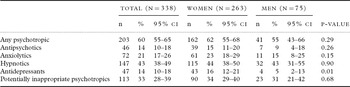
The prevalence of psychotropic drug use among the 95-year-olds is presented in Table 1. Forty participants used two psychotropics (12%; 95% CI 9–16%) and 41 (12%; 95% CI 9–16%) used three or more psychotropics. Hypnotic drugs were most common, followed by anxiolytics. Among the participants using antipsychotics, the conventional antipsychotics were most common, used by 96% (95% CI 92–100%; n/N = 44/46). The majority of participants with anxiolytic drugs used oxazepam (72%; 95% CI 60–82%; n/N = 52/72). Among the hypnotics, the long-acting benzodiazepine flunitrazepam was used by 31% (95% CI 23–39%; n/N = 45/147) and the short-acting z-hypnotics (zopiclone, zolpidem, zaleplon) were used by 37% (95% CI 30–46%; n/N = 55/147). The majority of participants with antidepressants used the new generation antidepressants (89%; 95% CI 77–96%; n/N = 42/47), and tricyclic antidepressants were used by 11% (95% CI 4–23%; n/N = 5/47). Women were more likely than men to use antidepressants. The most common type of potentially inappropriate psychotropic was long-acting benzodiazepines (21%; 95% CI 17–26%; n = 71). Psychotropics with anticholinergic effects were used by 7% (95% CI 4–10%; n = 23).
Psychotropic drug use among 95-year-olds (N = 338).

95% CI = 95% binomial proportion confidence intervals; p-values for differences between women and men calculated with Fisher's exact test
Psychotropic drugs and dementia
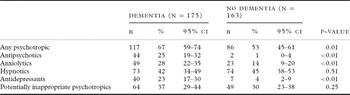
Participants with dementia were more likely to use antipsychotics, anxiolytics and antidepressants compared to those without dementia (Table 2). Use of hypnotics did not differ by dementia status. Long-acting benzodiazepines were used by 17% (95% CI 12–24%; n/N = 30/175) of the participants with dementia and by 25% (95% CI 19–33%; n/N = 41/163) of those without (p = 0.07). Psychotropics with anticholinergic effects were more common among those with than among those without dementia; 12% (95% CI 8–18%; n/N = 21/175) vs. 1% (95% CI 0–4%; n/N = 2/163); p < 0.001.
Psychotropic drug use in relation to dementia among 95-year-olds (N = 338).

95% CI = 95% binomial proportion confidence intervals; p-values for differences between individuals with and without dementia calculated with Fisher's exact test
Psychotropic drugs and institutionalization
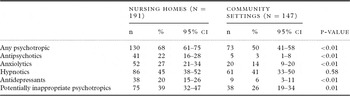
Antipsychotics, anxiolytics and antidepressants were more common among nursing home residents than among those living in community settings (Table 3). Psychotropics with anticholinergic effects were used by 11% (95% CI 7–16%; n/N = 21/191) of the nursing home residents and by 1% (95% CI 0–5%; n/N = 2/147) of the participants in community settings (p < 0.001).
Psychotropic drug use in relation to institutionalization among 95-year-olds (N = 338).

95% CI = 95% binomial proportion confidence intervals; p-values for differences between participants living in nursing homes and in community settings calculated with Fisher's exact test
In the adjusted logistic regression analysis, psychotropic drug use was associated with living in a nursing home (OR 1.9; 95% CI 1.1–3.3%), but not with dementia (OR 1.2; 95% CI 0.7–2.1%) or female sex (OR 1.1; 95% CI 0.7–1.9%).
Psychotropic drugs in depressive and anxiety disorders
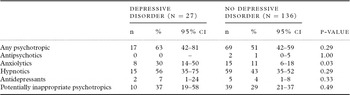
Less than one-tenth of participants without dementia who had a depressive disorder used antidepressants, while hypnotics were used by more than half and anxiolytics by one-third (Table 4). As previously reported, 14 of the 163 participants without dementia fulfilled the criteria for an anxiety disorder (9%; 95% CI 5–14%) (Börjesson-Hanson et al., Reference Börjesson-Hanson, Waern, Östling, Gustafson and Skoog2011). Two of these used antidepressants (14%; 95% CI 2–43%), four used anxiolytics (29%; 95% CI 8–58%) and seven used hypnotics (50%; 95% CI 23–77%).
Prevalence of psychotropic drug use in relation to depressive disorder among 95-year-olds without dementia (N = 163)

95% CI = 95% binomial proportion confidence intervals; p-values for differences between individuals with and without depressive disorders calculated with Fisher's exact test
Discussion
Use of psychotropic drugs, especially hypnotics, was common among 95-year-olds in this Swedish population-based sample. Ten percent used three or more psychotropic drugs. Specific pharmacological treatment for mental disorders was rare and potentially inappropriate psychotropics were observed in one-third.
The prevalence of psychotropic drug use among the 95-year olds with dementia (67%) was higher than the corresponding prevalence observed among individuals aged 90 years and older (45%) (Forsell and Winblad, Reference Forsell and Winblad1997), as well as among 85-year-olds (56%) (Skoog et al., Reference Skoog, Nilsson, Landahl and Steen1993) and among individuals aged 81 years and older (52%) (Giron et al., Reference Giron, Forsell, Bernsten, Thorslund, Winblad and Fastbom2001a). Among the 95-year-olds, psychotropic drug use was more common among participants with dementia than among those without dementia, and among participants living in nursing homes than among those in community settings. The majority (85%) of the 95-year-olds with dementia lived in nursing homes (Börjesson-Hanson et al., Reference Börjesson-Hanson, Edin, Gislason and Skoog2004), and the adjusted analysis revealed that nursing home residents were more likely to use psychotropic drugs than participants in community settings, irrespective of dementia status. Research on psychotropic drug use in relation to institutionalization in this very old population group is limited, but previous Swedish studies focusing on somewhat younger populations have also found that psychotropic drug use is more common in nursing homes than in community settings (71–74 vs. 36–37%) (Skoog et al., Reference Skoog, Nilsson, Landahl and Steen1993; Giron et al., Reference Giron, Forsell, Bernsten, Thorslund, Winblad and Fastbom2001a). This pattern might be related to an increased morbidity among individuals living in nursing homes or the use of psychotropic drugs to compensate for lack of staff (Schmidt et al., Reference Schmidt, Claesson, Westerholm and Svarstad1998).
A quarter of the 95-year-olds with dementia used antipsychotics, compared to only 1% of those without dementia. This pattern has also been observed in previous research (Forsell and Winblad, Reference Forsell and Winblad1997; Linden et al., Reference Linden, Bar and Helmchen2004). Antipsychotics are commonly used for behavioral and psychological symptoms of dementia, such as aggression, although they may increase the risk for cerebrovascular events and mortality (Gill et al., Reference Gill2007; Sacchetti et al., Reference Sacchetti, Turrina and Valsecchi2010). Previous research indicates that over half of the antipsychotics used in nursing homes are not prescribed according to guidelines, for example without an appropriate indication (Briesacher et al., Reference Briesacher2005). Thus, efforts to improve the use of antipsychotics among the elderly are warranted. The majority (96%) of the 95-year-olds taking antipsychotics used conventional antipsychotics. According to the Swedish Prescribed Drug Register at the National Board of Health and Welfare (established in 2005), atypical antipsychotics were used by 80% of the 95-year-olds in Gothenburg who used antipsychotics in 2006. A trend towards the use of atypical antipsychotics has also been observed in previous research, but their safety advantage over conventional antipsychotics has been questioned (Rapoport et al., Reference Rapoport, Mamdani, Shulman, Herrmann and Rochon2005; Trifiro et al., Reference Trifiro, Spina and Gambassi2009).
One-third of the 95-years olds used at least one potentially inappropriate psychotropic. Drugs with anticholinergic effects should be avoided among individuals with dementia since they increase the risk for adverse effects on cognitive function (Rudolph et al., Reference Rudolph, Salow, Angelini and McGlinchey2008). Nevertheless, psychotropics with anticholinergic effects were more common among participants with dementia than among those without. This pattern has also been observed in an earlier Swedish study which included individuals aged 81 years and over (Giron et al., Reference Giron, Wang, Bernsten, Thorslund, Winblad and Fastbom2001b). Since safer drugs with similar effects are available (National Board of Health and Welfare, 2004), the findings suggest a need for improvement.
About half of the 95-year-olds used hypnotics, and the use of hypnotics was at a similar level in all subgroups. The prevalence of hypnotic drug use is higher than in a previous study on individuals aged 90 years and older (31%) (Forsell and Winblad, Reference Forsell and Winblad1997), although that study did not include drugs used as-needed. The prevalence is also higher than in somewhat younger elderly populations (23–26%) (Skoog et al., Reference Skoog, Nilsson, Landahl and Steen1993; Giron et al., Reference Giron, Forsell, Bernsten, Thorslund, Winblad and Fastbom2001a). Although sleep disorders were not diagnosed in the current study, others have reported that two-thirds of individuals aged 90 years and older who use hypnotics on a regular basis do not report sleep disturbances (Forsell and Winblad, Reference Forsell and Winblad1997). However, it is possible that sleep disturbances were not reported if this problem was alleviated by hypnotics.
The long-acting benzodiazepine flunitrazepam and the z-hypnotics were each used by one-third of the 95-year-olds with hypnotics. According to the Swedish Prescribed Drug Register, z-hypnotics were used by 82% of the 95-year-olds with hypnotics in Gothenburg in 2006. Previous research has also suggested a trend towards the use of short-acting instead of long-acting hypnotics (Tu et al., Reference Tu, Mamdani, Hux and Tu2001).
During the 1990s, use of antidepressants among the elderly increased dramatically, largely due to the introduction of the new generation antidepressants (Carlsten et al., Reference Carlsten, Waern, Ekedahl and Ranstam2001; Sambamoorthi et al., Reference Sambamoorthi, Olfson, Walkup and Crystal2003). Compared to the tricyclic antidepressants, the new generation antidepressants are associated with an improved tolerability in the elderly (Wilson and Mottram, Reference Wilson and Mottram2004). Before the new generation antidepressants had been introduced, antidepressants were used by 14% in a sample of 85-year-olds (Skoog et al., Reference Skoog, Nilsson, Landahl and Steen1993). This is similar to the prevalence observed among the 95-year-olds in this study (14%), where the majority (90%) used the new generation antidepressants. A similar proportion (91%) of 95-year-olds taking antidepressants in Gothenburg in 2006 used the new generation antidepressants, according to the Swedish Prescribed Drug Register. In a Swedish study on individuals aged 85 years and older, performed a few years after the Gothenburg 95+ Study, the prevalence of antidepressant use was 23% (Bergdahl et al., Reference Bergdahl2005). It is likely that the prevalence of antidepressant use in this age group has increased since the 95-year-olds in the Gothenburg 95+ Study were examined.
The overall prevalence of psychotropic drug use among the 95-year-olds diagnosed with depressive disorder (63%) is similar to the prevalence observed among 85-year-olds (60%) (Skoog et al., Reference Skoog, Nilsson, Landahl and Steen1993). Less than 10% of 95-year-olds who fulfilled criteria for a depressive disorder used antidepressants; by contrast, use of hypnotics and anxiolytics was considerably more common. Similar patterns have been found in previous studies (Skoog et al., Reference Skoog, Nilsson, Landahl and Steen1993; Forsell and Winblad, Reference Forsell and Winblad1997; Bergdahl et al., Reference Bergdahl2005). Sleep disturbances and symptoms of anxiety are common symptoms of depression. Symptomatic treatment may have contributed to the high use of anxiolytics and hypnotics, which indicates a need for improvement in the diagnostics and treatment of depressive disorders among the very old. Individuals with previous depression would not fulfill criteria for depressive disorder in the current study, but might have been prescribed long-term treatment with antidepressants to reduce the risk of new episodes. This might partly explain the use of antidepressants among those without a diagnosis of a depressive disorder.
Strengths and limitations
The major strength of this study is its focus on psychotropic drug use in a population-based sample of very old individuals living in nursing homes or community settings, who were examined for mental disorders. The response rate of 65% is a limitation, but can be considered satisfactory given the high age of the sample. Further, information on drug use was primarily derived from multi-dose drug dispensing lists, which are issued every second week and would thus be representative of the drugs currently used by the individual.
Research on psychotropic drug use in this very old population is rare, which emphasizes the importance of this study. The prevalence of psychotropic drug use in this sample was higher than in somewhat younger samples (Skoog et al., Reference Skoog, Nilsson, Landahl and Steen1993; Giron et al., Reference Giron, Forsell, Bernsten, Thorslund, Winblad and Fastbom2001a). The prevalence was also higher than among individuals aged 90 years and older in nursing homes and community settings in Stockholm, Sweden (Forsell and Winblad, Reference Forsell and Winblad1997). However, while the prevalence of dementia in that study (47%) was similar to that among the 95-year-olds, a lower proportion lived in nursing homes (26%) and drugs used as-needed were not included. Further, Gothenburg traditionally has a higher use of psychotropic drugs compared to Stockholm. This should be acknowledged in relation to the external validity.
There are also some limitations. First, although the number of participants in this study is relatively high compared to previous studies of this age group, numbers in some subgroups are small with statistical uncertainty as a result. Second, the examinations were performed in the period 1996–1998 and prescribing patterns may have changed since then. However, at least in some psychotropic drug classes (e.g. antidepressants) the pattern of psychotropic drug use was similar ten years later, according to the Swedish Prescribed Drug Register. The prevalence rates were not compared due to the methodological differences between the two data sources. Third, the cross-sectional design and the lack of comprehensive information on duration of drug use and dosage regimen may limit the interpretation of the results. Fourth, according to the DSM-III-R criteria, no other mental disorders were diagnosed among participants with dementia, which decreases the population at risk for being diagnosed with, for example, depressive disorder. However, it increases the reliability since these other diagnoses are based mainly on self-reported information, which can be difficult to collect among individuals with cognitive impairment. Finally, neither indication nor dosage regimen is considered in the classification of drugs as potentially inappropriate, and potentially inappropriate drugs may have been appropriately prescribed in some cases.
In conclusion, the high prevalence of psychotropic drug use and the nonspecific nature of these treatments among 95-year-olds indicate a need for improvement in prescribing patterns.
Conflict of interest
None.
Description of authors' roles
EL, AC, IS, MW and AB-H designed the study. IS and AB-H collected the data. EL and MP performed the statistical analyses. EL wrote the paper, with the assistance of all other authors.
Acknowledgments
This work has been supported by the Swedish Research Council, the Swedish Council for Working Life and Social Research, the Alzheimer's Association USA, Hjalmar Svensson Foundation, Bror Gadelius Foundation, Stiftelsen Gamla Tjänarinnor, Stiftelsen Söderström-Königska Sjukhemmet, and the National Corporation of Swedish Pharmacies (Apoteket AB).