Intravenous vasoactive drugs are administered in the critical care setting to maintain the cardiovascular function of patients by continuous intravenous infusion. Syringe pumps for vasoactive infusions are effective automatic delivery devices and have the advantages of small size and weight, portability, and low cost. However, limited syringe capacity necessitates the use of high drug concentrations, especially in the paediatric and neonatal intensive care setting. The combination of these high concentrations, small delivery volumes, and the requirement for infusion interruption for syringe changes may result in the potential inconsistent rate of delivery and may result in significant haemodynamic effects.Reference Lonnqvist and Lofqvist 1 – Reference Van Der Eijk, Van Rens and Dankelman 3 It has long been observed by critical care providers that haemodynamically unstable patients experience potentially hazardous changes in vital signs related to the exchange of depleted syringes to full, fresh vasoactive medication syringes.
There are a few protocols that address the practice of vasoactive medication syringe exchange in paediatric critical care settings. A study of the impact of the standardisation of changeover of vasoactive drug infusion pumps in adults found that of all the adverse incidents evaluated systolic blood pressure variations were the most frequent, and were usually related to the changeover or exchange of vasoactive infusion syringes.Reference Lovich, Wakim and Wei 4 – Reference Leff and Roberts 6 Studies reported in the nursing literature attempted to identify a practical and safe protocol of syringe changeover, but did not quantify haemodynamic changes related to those exchanges.Reference Arino, Barrington and Morrison 7 , Reference Trim and Roe 8 Although the mechanical idiosyncrasies and optimal operation of the device have been described,Reference Klem, Farrington and Leff 9 , Reference Rooke and Bowdle 10 as well as the detrimental effect of overstimulation with adrenergic agents,Reference Dünser and Hasibeder 11 there has been little research conducted to truly quantify the effects of an epinephrine syringe pump changeover on haemodynamic variables including systolic blood pressure and heart rate in paediatric cardiac patients to consistently gauge its incidence and therefore provide a baseline measurement for future interventions.
The purpose of this study is to determine the correlation between changes in haemodynamic variables and syringe exchanges of epinephrine in a paediatric cardiovascular ICU. Further, we intend to quantify the magnitude of the change in haemodynamic variables. Supplemental analysis includes analysis related to variation of vital signs and syringe exchange events temporally related to time of day.
Material and methods
This study was conducted under an Institutional Review Board protocol approved by Baylor College of Medicine, and the need for written consent was waived. Syringe exchange records were obtained for all patients who received continuous epinephrine infusions while admitted to the cardiovascular ICU of Texas Children’s Hospital between 1 January, 2013 and 30 June, 2015, regardless of age or diagnosis. Syringe exchanges that did not include initiation, a dose, or flow change were included in the analysis. A regulated practice for the exchange of epinephrine syringes every 24 hours, as well as depleted syringes, was followed by nursing staff during the study period. This usual practice included a second syringe pump actively running at prescribed rate and dose while not attached to the patient. The patient tubing from the initial near-empty syringe was quickly attached to the replacement syringe at the pump level. The patient did not receive double infusion at any point per usual practice. Vital signs were measured using standard ICU bedside monitors (GE B850). The Sickbay platform (Medical Informatics Corp, Houston, Texas, United States of America) was used to continuously capture data from all the bedside patient monitors in the unit over the course of the study. Captured vital signs included heart rate, respiratory rate, systolic blood pressure, and oxygen saturation. All vital signs were sampled at 0.5 Hz and stored on the Sickbay system located in the data centre of the institution. Data analysis was completed using Matlab (The Mathworks, Natick, Massachusetts, United States of America).
Institutional practice and policy in this ICU dictate that the inotropic or vasopressor medication syringe exchanges be a singular event away from other usual care. Furthermore, allowing a syringe to run dry before exchange would be a reportable safety event in our ICU and would be a rare occurrence. There was no documentation of such an event in the safety reporting structure during the time period of the study. Vital-sign analysis was limited to heart rate and systolic blood pressure, as these vital signs were considered to be the most sensitive to the administration of epinephrine. The patient’s haemodynamic data are examined in Sickbay – continuous data collected from the bedside monitors – for 60 minutes before the documented syringe exchange, 15 minutes directly after syringe exchange, and then an additional 60 minutes providing 135 minutes of data for each syringe exchange event. The 15-minute envelope around recorded time of exchange allows for consistency in the electronic medical record documentation of which nursing policy dictates no further allowance. Otherwise, the 60-minute time periods were arbitrarily chosen.
As haemodynamic perturbations can occur spontaneously, we compare the baseline frequency of such perturbations obtained from control data in the study cohort with the rate observed in the time period adjacent to the syringe exchange events. A corresponding control data set was identified for each syringe exchange event and consisted of 60 minutes of measurements recorded at least 6 hours before the exchange event and at least 1 hour away from any medication administration. Both control and study data did not include those from the operative suite or the few hours after discharge from the OR during active titration of medications. The difference in haemodynamics observed in the control and study data were then quantified, with each subject serving as their own control. Further analysis included temporal relation of epinephrine syringe exchanges to unit staff shift changes and defined as day shift, 7 AM–6:59 PM, and night shift, 7 PM–6:59 AM.
Non-physiologic changes in systolic blood pressure – that is due to the flushing of arterial lines – were filtered out before data analysis. A mathematical algorithm was developed to identify haemodynamic perturbations, defined as significant prolonged changes in vital-sign measurements. The algorithm started by breaking the data into small, consecutive time intervals. For each interval, the data were split into two equal halves and the norm of each half was calculated. The difference between the two norms was then divided by the standard deviation of the vital sign – measured across the entire study cohort. This analysis was repeated with increasingly wider time intervals, ranging from 60 seconds to 1800 seconds in increments of 60 seconds.
Once all the calculations were complete, the largest, positive and negative, perturbations at each time step were identified. Heart-rate perturbations less than 13 beats per minute and systolic blood pressure perturbations less than 7 mmHg were considered insignificant and were removed from the analysis. These thresholds were chosen to be half of the measured standard deviation for each vital sign. In addition, a minimum time difference between two perturbations was enforced to prevent perturbations from overlapping in time and/or being counted multiple times. The minimum time difference between two adjacent perturbations was chosen to be the larger of their individual durations. If the time between the two perturbations was smaller than this value, then the perturbation with the larger magnitude was included in the analysis, whereas the other perturbation was not considered.
After all the significant haemodynamic perturbations were identified, a linear model was fit to the associated data. The best fit model parameters of magnitude (height) and duration (length of time) were recorded in addition to the time offset from the syringe exchange event. Student’s two-sample t-test was used to establish statistical significance between measurements made on control and study data. The t-test was applied to the means of the observed frequency of perturbations in the study and control data.
Results
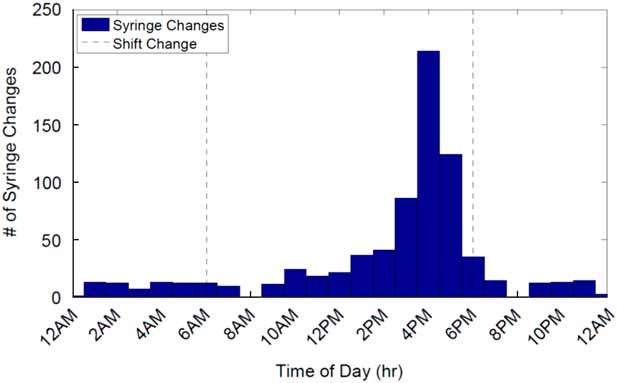
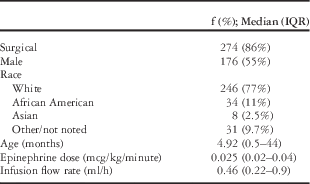
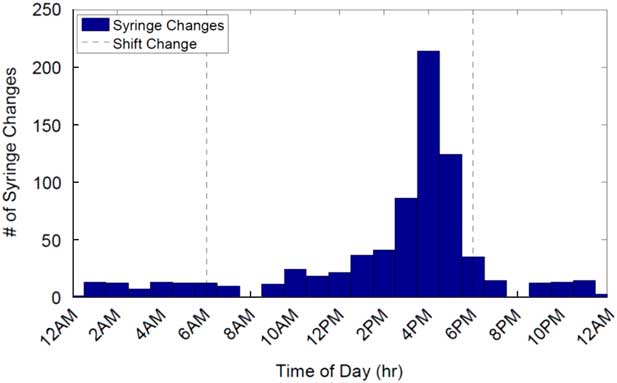
A total of 1042 epinephrine syringe exchange events from 319 patients were recorded and analysed in the study period. Of the total syringe exchange events, 850 (81.6%) contained continuous and uncorrupted data, which were sufficient for analysis. In the pilot study set, 274 patients (86%) were post-surgical, 55% were male with a median age of 4.9 months [interquartile range (IQR) 0.5–44)] with a median dose of 0.03 mcg/kg/minute (IQR 0.02–0.04) at a median infusion flow rate 0.46 ml/h (IQR (0.22–0.9); Table 1. Of these 850 events, 744 (88%) showed significant changes in vital signs as indicated by our algorithm. Of these 744 events, 614 (83%) occurred during the day shift and 130 (18%) occurred during the night shift, with the most common time for a syringe exchange event being 4 PM (Fig 1). Control data were found for 294 syringe exchange events.
Histogram of the time of day when syringe exchange events occurred.
Characteristics of 319 patients.

A total of 2953 significant perturbations in systolic blood pressure and 1747 perturbations in heart rate were identified across all syringe exchange events in the study data set. In the control data set, 731 significant perturbations in systolic blood pressure and 1160 perturbations in heart rate were identified. Of the systolic blood pressure perturbations found in the study data set, 1104 (37%) occurred in the 60 minutes before syringe change, whereas 1849 (63%) occurred in the 75 minutes after the syringe exchange. Of the heart-rate perturbations found in the study data set, 409 (35%) occurred in the 60 minutes before syringe change, whereas 751 (65%) occurred within the 75 minutes after the syringe exchange.
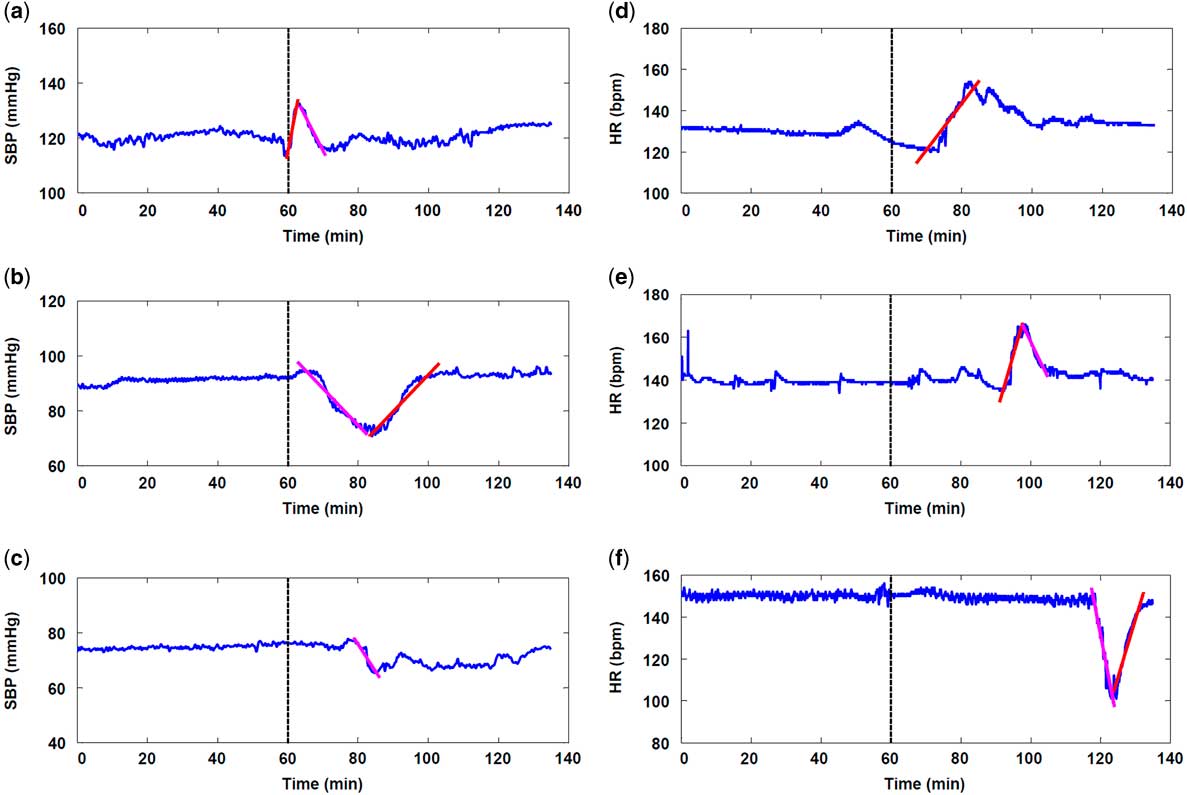
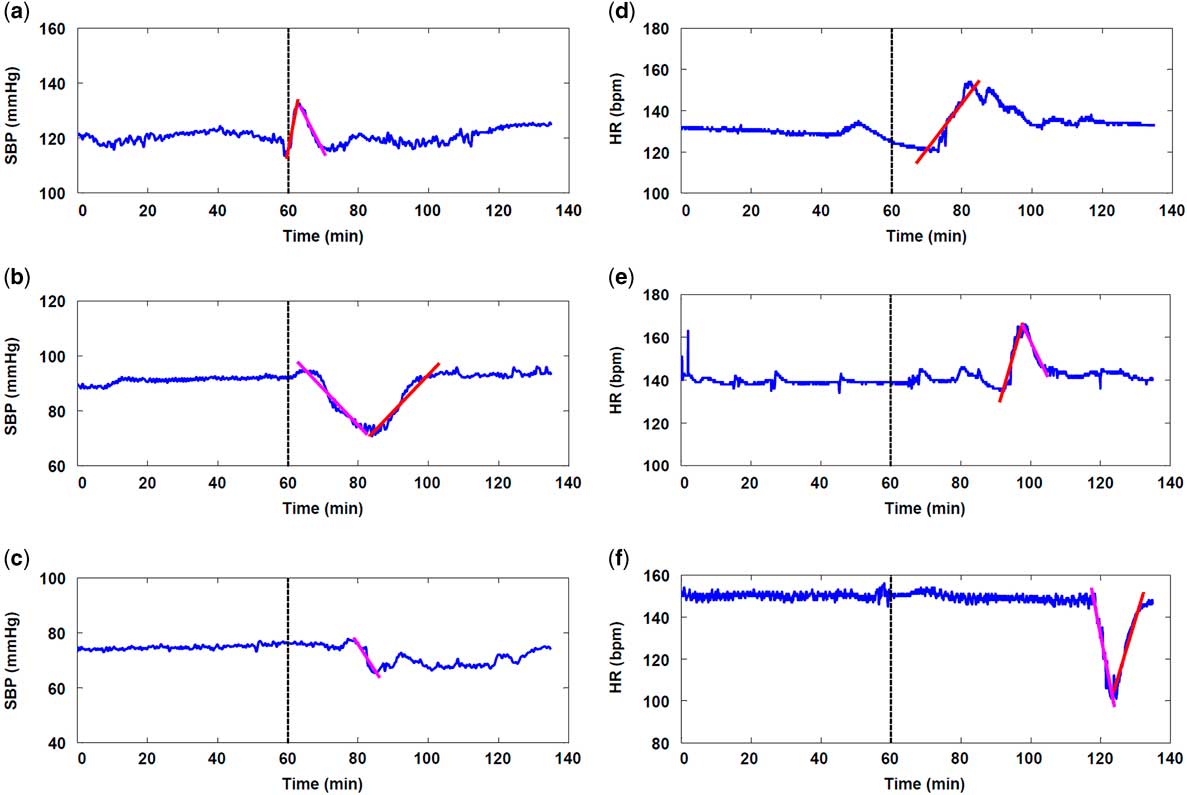
Examples of vital-sign perturbations in systolic blood pressure and heart rate can be seen in Figure 2. Several common vital-sign patterns were observed around exchange events for both systolic blood pressure and heart rate: a temporary increase and subsequent recovery to baseline, a temporary drop and subsequent recovery, or a sustained plateau. The best fit models for both negative and positive vital-sign perturbations have been superimposed over the measured data to illustrate how events were quantitatively characterised.
Examples of haemodynamic perturbations found in close proximity to syringe exchange events. ( a ) A spike in systolic blood pressure (SBP), which recovers to baseline. ( b ) A drop in systolic blood pressure, which recovers to baseline. ( c ) A drop in systolic blood pressure, which does not recover to baseline. ( d ) A spike in heart rate (HR), which does not recover to baseline. ( e ) A spike in HR, which recovers to baseline. ( f ) A drop in HR, which recovers to baseline. Dashed line denotes the documented time of a syringe exchange event, red lines denote positive perturbations, and pink lines denote negative perturbations as determined by our algorithm.
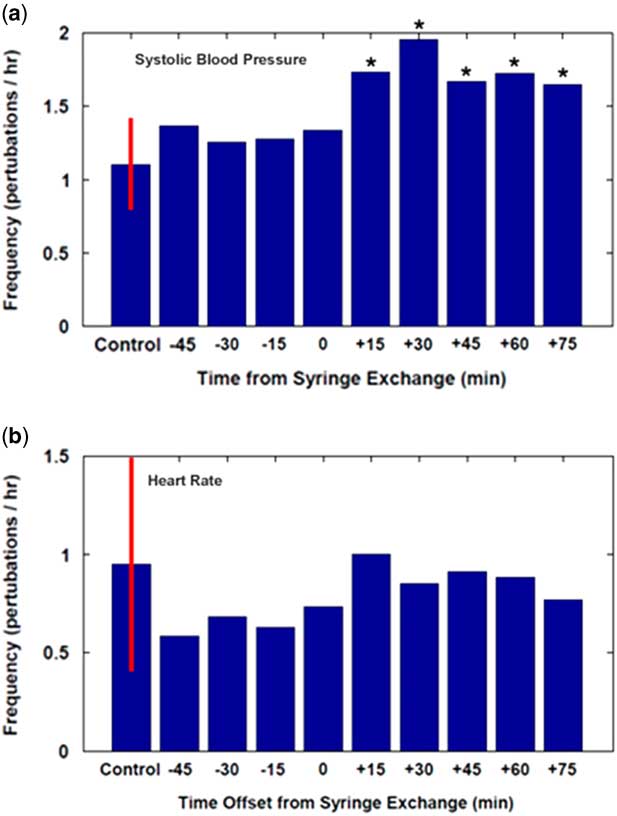
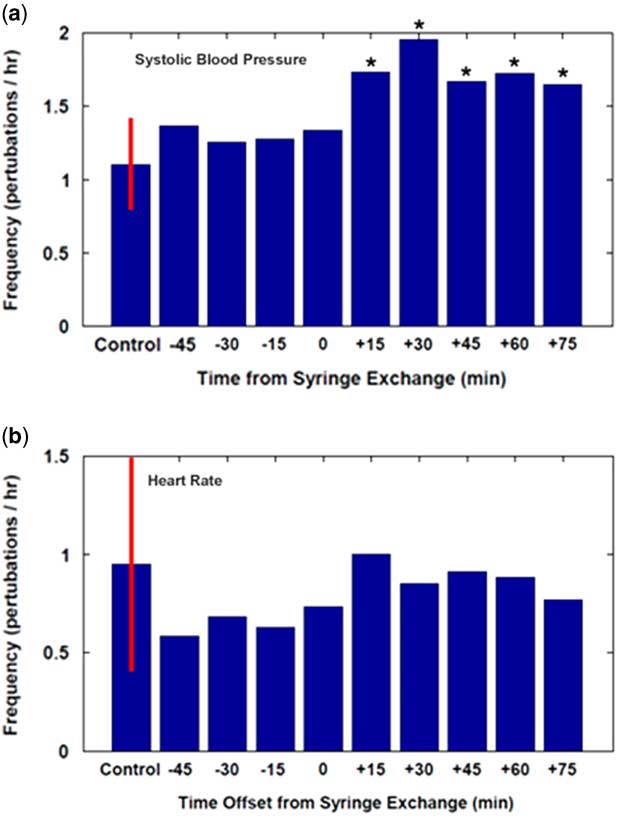
The relationship between syringe exchange events and the timing of haemodynamic perturbations can be seen in Figure 3. Control data indicate that the mean rate, or frequency, of systolic blood pressure perturbations for this cohort is 1.11±0.10 per hour. Although this rate is slightly elevated in the time period leading up to syringe exchange events (1.30±0.05 per hour), it was not found to be statistically different from control data. However, in the 75 minutes after the syringe exchange event, the frequency of systolic blood pressure perturbations was found to increase by 58% to 1.75±0.12 per hour, which was found to be a statistically significant change (p<0.001). A similar frequency of heart-rate perturbations was found; however, no significant difference was found between control and study data.
Frequency of haemodynamic perturbations as a function of time from the start of a syringe exchange event. ( a ) The observed frequency of perturbations in systolic blood pressure. ( b ) The observed frequency of perturbations in heart rate. Bins consist of data within the previous 15 minutes. Error bar on the control data is 3σ. Asterisks denote statistically significant change (p<0.001) compared with control data.
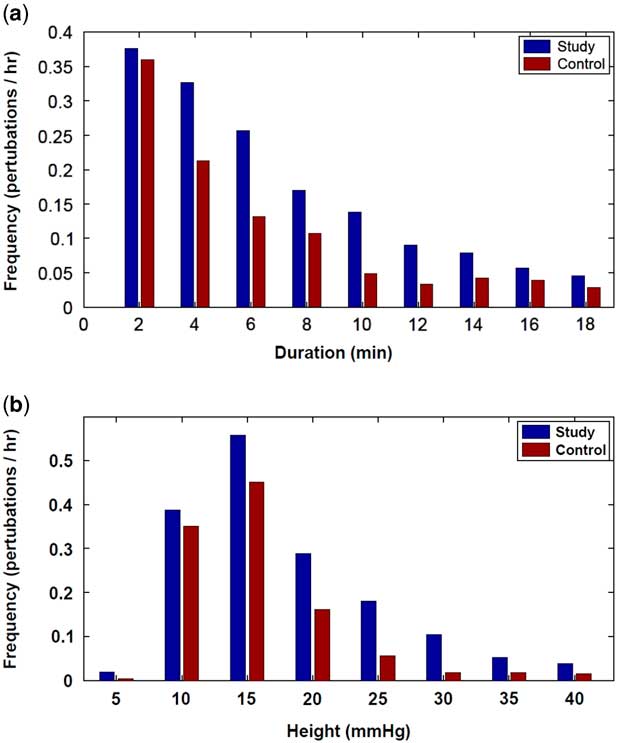
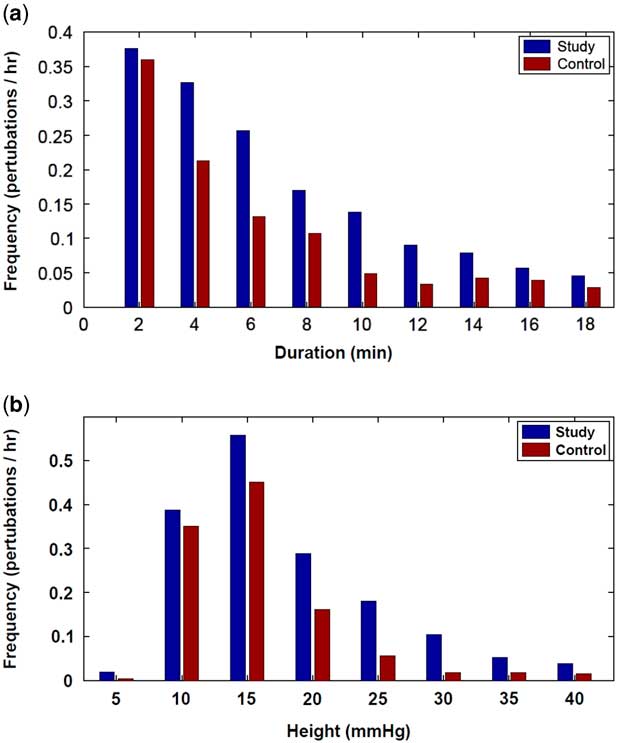
The magnitude and duration of each haemodynamic perturbation was characterised for both the control and study data after the syringe exchange event (Fig 4). Only systolic blood pressure perturbations were characterised because perturbations of heart rate were shown to be no different from control data (Fig 3). Haemodynamic perturbations of systolic blood pressure immediately after syringe exchange events were found to be both larger and longer compared with those found in the control data (p-value<0.001 for both cases).
Characterisations of the observed frequency of haemodynamic perturbations in systolic blood pressure in the 75 minutes after a syringe exchange event (red) compared with control data (blue) as a function of their duration (top) and magnitude (bottom). The magnitude (i.e. height) of the perturbation is the change in the systolic pressure that was observed from baseline to peak, as illustrated in Figure 2a.
Discussion
With the novel approach to analyse an enormous amount of haemodynamic data including millions of beat-to-beat systolic blood pressures surrounding recorded syringe exchange events in a paediatric cardiovascular ICU, we can correlate haemodynamic changes with medication records. We report the ability to analyse the haemodynamic effects of changing depleted syringes of a vasoactive medication as an example of that correlation. Our results indicate that a substantial number of epinephrine syringe changes lead to haemodynamic perturbations. The reported perturbations in haemodynamics surrounding epinephrine syringe exchange are hypothesis generating, and it is important to investigate them as we believe they could have deleterious effects on fragile paediatric cardiac patients receiving vasoactive infusion. Depleted syringes of vasoactive medications such as epinephrine need to be replaced in a timely efficient manner without interruption in those patients with tenuous haemodynamics. The adult intensive care literature has reported that when critically ill adults were monitored for untoward events surrounding infusion of vasoactive medications, major iatrogenic complications were frequent, associated with increased morbidity and mortality rates.Reference Giraud, Dhainaut and Vaxelaire 12 Most of the discussion in the critical care literature has been centred around best delivery methods and optimal equipment to avoid untoward medication errors.Reference Neff, Fischer and Fehr 13 , Reference Larsen, Parker and Cash 14 There is, however, very little discussion about vasoactive medication syringe exchange events and the effect to the patient’s vital signs in the literature to date, yet many intensive care practitioners have experienced the storm that can develop following such syringe exchanges. These storms have the potential to be most severe in the tenuous paediatric cardiac patient secondary to infusion rates, medication concentrations, and body/tubing ratios.
Nearly 88% of syringe events recorded had systolic blood pressure changes correlating within the measured window of 135 minutes of exchange. It has been proposed by Bartels et al that current medication continuous infusion techniques in the paediatric ICU setting can result in significant, so far unrecognised, delays in delivery of intended medication doses.Reference Larsen, Parker and Cash 14 This could be related to equipment or programming in relation to total flow rate, the priming of the infusion system, and the dead volume in the tubing. Contribution of the start-up performance of the syringe infusion delivery may lead to delays or premature bolus in prescribed rates of medication delivery. It could be supposed that hypertensive responses represent an incremental bolus dose of concentrated epinephrine received, and oppositely there was an interruption in infusion for the hypotensive response. Critical care medicine can include a natural variation of bedside care provider presence and interaction with the patient, which could possibly add haemodynamic effects from fear and anxiety. However, the aim of this study was to identify associations between epinephrine syringe exchanges and haemodynamic instability and thus cannot establish causality. Any outcomes, including cardiac arrest, are generally multifactorial and we believe would be better addressed in additional studies that include temporally related syringe exchange events as a variable along with other patient-care-related factors. The results presented in our study reveal high likelihood of instability, which may be a correlation to untoward consequences, and increased awareness is necessary to evaluate the cause.
The haemodynamic change associated with epinephrine syringe exchange identified in this study can be used as a metric to drive quality improvement with heightened awareness and standardised multidisciplinary protocols including pharmacy and nursing. To improve patient safety in our ICUs, preventive measures should be targeted primarily on the most severely ill patients. Increased awareness around medication exchange events may prevent unplanned, untoward iatrogenesis. The emerging high-throughput technology described in this study may uncover subacute clinical changes heralding more clinical importance than previously recognised. For example, Vu et al found that in a fragile single-ventricle population in the cardiovascular ICU, conventional monitoring of changes in ST segments did not raise alarm; however, mathematical modelling identified a temporal association between ST segment changes and subsequent cardiac decompensation.Reference Vu, Rusin and Penny 15 Multiple subacute perturbations in haemodynamics may add to more clinical significance. The results in this study point to heightened awareness to epinephrine syringe exchange events as potentially dangerous events in the ICU, and best practice requires definition with emphasis for careful equipment setup and proper use of syringe pumps to avoid unintended drug administration or delay in drug administration. Although nursing protocols have been defined, we speculate that any potential inconsistencies in bedside practice including delay in syringe replacement or pump programming/malfunction could lead to haemodynamic instability and systematic practice alterations may be required. The mathematical algorithm used in this study can be used to measure improvement after such systematic changes are instituted – that is, decreased frequency of haemodynamic perturbation. The mathematical model used to identify haemodynamic changes related to infusions can also be used after new device purchases or institutional operational changes to monitor effects at the patient level. The finding that the majority of syringe exchange events happen at a certain time of day (4 PM in this cohort) could lead to planned quality protocol and observational analysis of practice in a practical, multidisciplinary manner. More broadly, the algorithm can be used to measure haemodynamic changes occurring with other medications administered or around other potentially dangerous infusions including blood transfusion administration.
The purpose of this study was to determine the correlation between changes in haemodynamic variables and epinephrine syringe exchanges in a paediatric cardiovascular ICU and to quantify the magnitude of those changes by means of a novel mathematical algorithm. A limitation of this study is the lack of evaluation of interventions for those haemodynamic perturbations. Additionally, further interpretation is limited by a lack of subgroup analysis by diagnosis or surgical procedure. Future research efforts may define more at-risk populations within the cardiovascular ICU including neonatal or single-ventricle patients.
In conclusion, with a novel mathematical model analysing beat-to-beat parameters, a correlation can be found with epinephrine syringe exchanges and haemodynamic perturbations, specifically systolic blood pressure changes. Further investigation is required for clinical correlation.
Acknowledgements
None.
Financial Support
This research received no specific grant from any funding agency, commercial or not-for-profit sectors.
Conflicts of Interest
None.
Ethical Standards
The authors assert that all procedures contributing to this work comply with the ethical standards and has been approved by the Institutional Review Board for Baylor College of Medicine and Affiliated Hospitals (IRB) under a protocol number H-40094. Complete IRB protocol can be made available upon request. The authors assert that all procedures contributing to this work comply with the ethical standards of the relevant national guidelines on human experimentation as dictated by the National Institutes of Health and with the Helsinki Declaration of 1975, as revised in 2008. All authors are up to date with Collaborative Institutional Training Initiative (CITI) as required at this institution for clinical research.