This study evaluated cigarette smoking over seven waves of national data from community samples on symptom management using a cohort of youth diagnosed with early onset schizophrenia (EOS) and comorbid depression and anxiety. Youth with EOS are a rare population with complex and global problems that affect all levels of functioning, including evidencing more social and educational problems during their lifetime compared to those with later onset schizophrenia (Driver, Gogtay, & Rapoport, Reference Driver, Gogtay and Rapoport2013; Meier et al., Reference Meier, Caspi, Reichenberg, Keefe, Fisher, Harrington, Houts, Poulton and Moffitt2014; Vourdas, Pipe, Corrigall, & Frangou, Reference Vourdas, Pipe, Corrigall and Frangou2003). There are almost no reliable studies on the prevalence of EOS, and the Centers for Disease Control in 2012 acknowledged that there are few existing surveillance systems that track childhood-onset schizophrenia (CDC, 2012). Even more limited is the research on youth with schizophrenia in community samples. There have been some recent studies on comorbid anxiety and depressive symptoms as prodromal to EOS (Braga, Reynolds, & Siris, Reference Braga, Reynolds and Siris2013; Gawęda, Holas, & Kokoszka, Reference Gawęda, Holas and Kokoszka2013; McRenolds, Mehta, & Nasrallah, Reference McRenolds, Mehta and Nasrallah2013; Opler, Hwang, & Opler, Reference Opler, Hwang and Opler2013; Schimmelmann, Conus, Cotton, McGorry, & Lambert, Reference Schimmelmann, Conus, Cotton, McGorry and Lambert2007; Young et al., Reference Young, Pfaff, Lewandowski, Ravichandran, Cohen and Öngür2013). In particular, some research shows a progressive patterns of social withdrawal consistent with social phobia and obsessive compulsive behaviours (Braga et al.; Matheson et al., Reference Matheson, Vijayan, Dickson, Shepherd, Carr and Laurens2013). Other studies suggest that youth with anxiety disorders and attention deficit hyperactivity disorder are more likely to present with patterns of chronic and severe levels of disruptive behaviours and mood disorders consistent with a psychotic presentation (Biederman et al., Reference Biederman, Faraone, Wozniak, Mick, Kwon and Aleardi2004; Hammerness et al., Reference Hammerness, Harpold, Petty, Menard, Zar-Kessler and Biederman2008).
Cigarette Smoking
Coping with psychotic symptoms is difficult regardless of age. Tobacco use is more prevalent in those with schizophrenia than in the general population (Kotov, Guey, Bromet, & Schwartz, Reference Kotov, Guey, Bromet and Schwartz2010; Winterer, Reference Winterer2010). A recent longitudinal study followed patients with an initial hospitalisation for psychosis and reported that 52% were current smokers and 69% were lifetime smokers (Kotov et al., Reference Kotov, Guey, Bromet and Schwartz2010). This study is one of the few longitudinal studies that included adolescents with schizophrenia and found that 65.4% of the 15- to 18-year-olds were smokers at admission and remained smokers over time. High rates of smoking appear to be prevalent in adolescents with other psychiatric symptoms, as evidenced in youth with depressive disorders (Moylan et al., Reference Moylan, Gustavson, Karevold, Overland, Jacka, Pasco and Berk2013; Zubrick, Lawrence, Mitrou, Christensen, & Taylor, Reference Zubrick, Lawrence, Mitrou, Christensen and Taylor2012) and anxiety disorders (Audrain-McGovern, Rodriguez, & Kassel, Reference Audrain-McGovern, Rodriguez and Kassel2009; McKenzie, Olsson, Jorm, Romaniuk, & Patton, Reference McKenzie, Olsson, Jorm, Romaniuk and Patton2010).
Research is limited on why people with psychotic disorders start smoking, smoke more than the population at large, and continue to smoke despite known consequences (Hahn et al., Reference Hahn, Harvey, Concheiro-Guisan, Huestis, Holcomb and Gold2013; Morisano, Wing, Sacco, Arenovich, & George, Reference Morisano, Wing, Sacco, Arenovich and George2013). Patients indicate they smoke, in part, to manage psychotic symptoms (Tidey & Rohsenow, Reference Tidey and Rohsenow2009), to reduce cognitive deficits, and to increase the ability to cope with symptoms (Goff, Henderson, & Amico, Reference Goff, Henderson and Amico1992; Jacobsen et al., Reference Jacobsen, D'Souza, Mencl, Pugh, Skudlarski and Krystal2004; Smith, Singh, Infante, Khandat, & Kloos, Reference Smith, Singh, Infante, Khandat and Kloos2002; Vancampfort et al., Reference Vancampfort, Probst, Scheewe, De Herdt, Sweers, Knapen and De Hert2012; Wehring et al., Reference Wehring, Liu, McMahon, Mackowick, Love, Dixon and Kelly2012; Ziedonis, Kosten, Glazer, & Frances, Reference Ziedonis, Kosten, Glazer and Frances1994). Some studies suggest patients smoke to diminish the adverse effects of neuroleptics (Sandyk, Reference Sandyk1993; Thirugnanasambandam et al., Reference Thirugnanasambandam, Grundey, Adam, Drees, Skwirba, Lang, Paulus and Nitsche2011), a premise supported by studies that report that smoking normalises abnormal brain neurochemistry and thereby creates a greater sense of cognitive normalcy (D'Souza & Markou, Reference D'Souza and Markou2012).
The presence of anxiety and depression in those with schizophrenia (Martin, Allan, Fleming, & Atkinson, Reference Martin, Allan, Fleming and Atkinson2008; Ziedonis et al., Reference Ziedonis, Kosten, Glazer and Frances1994) may reinforce heavier smoking as a coping strategy. Anxiety, in particular, has been identified as a key component in the maintenance of persecutory delusions in those with psychotic disorders (Freeman, Garety, & Kuipers, Reference Freeman, Garety and Kuipers2001). However, there is little research on the impact of smoking on clinical levels of anxiety and depression among adults with schizophrenia, and it is virtually absent in youth with EOS (Martin et al., Reference Martin, Allan, Fleming and Atkinson2008; Ziedonis et al., Reference Ziedonis, Kosten, Glazer and Frances1994).
This study examines the effects of smoking on stabilisation of anxiety and depression symptoms with a subsample of youth with early onset schizophrenia who were evaluated longitudinally over a potential of seven data points at 6-month intervals. It was hypothesised that those who smoked, based on the Substance Use Survey, Revised (SUS-R) scores, would have less fluctuation in their Reynolds Adolescent Depression Scale (RADS) scores and Revised Children's Manifest Anxiety Scale (RCMAS) scores than those who did not smoke.
Method
Data Source and Subject Selection
Secondary data from the 1998–2006 national evaluation of Phases II, III, and IV of the Comprehensive Community Mental Health Services for Children and Their Families Program (the CMHS Program) were used. The national evaluation consisted of a cross-sectional descriptive (intake) study and a longitudinal outcome study in which a subset of youth were assessed six times at half-year intervals for a total of seven possible assessments. The CMHS program and its evaluation were funded by the Child, Adolescent and Family Branch of the Center for Mental Health Services and Substance Abuse and Mental Health Services Administration (SAMHSA/Center for Mental Health Services) from 1998 to 2006. The national evaluation database has been managed by Macro International Incorporated (ICF Macro).
The sample consisted of youth who had received a diagnosis of schizophrenia, schizophreniform disorder, schizoaffective (DSM/ICD codes 295.**), delusional disorder (DSM/ICD codes 297.**), or psychotic disorder (DSM/ICD codes 298.**) at intake or during the longitudinal outcome study and who were at least 11 years of age at intake or attained that age during the outcome study. The evaluation design precluded administering self-report measures on depression and anxiety to youth less than 11 years of age.
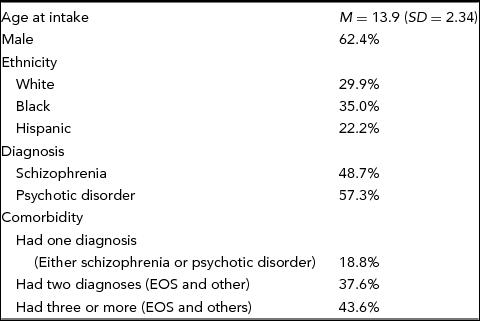
A total of 117 youth met the selection criteria and were included in this study. Table 1 reports their demographic characteristics.
Characteristics of Subjects in Study (N = 117)

Research Variables
Cigarette use during the previous 6 months
The youth self-report item ‘Have you ever used cigarettes in the past 6 months?’ from SUS-R was used. The SUS-R was designed for the CMHS Program to collect information on the prevalence of substance use. At each interview, the SUS-R queried youth about use of cigarettes during the past 6 months. Youth's response was either yes or no. An examination of the resulting smoking patterns revealed that 34 youth acknowledged cigarette use at one or more interviews and that 83 youth denied cigarette use at every interview. Given the sample size and interest in maximising power for the planned analyses, cigarette use was treated as a time-constant variable assessing reported use at any wave versus no reported use at every wave.
Depression
At each interview, the RADS was administered. The total raw scores ranged from 30 to 120. Higher scores indicate higher level of depression. A level of 61 or above in t scores suggested the need for a further extensive evaluation associated with clinical depression. Total t scores were used to examine youth's depression in the analyses. ICF Macro transformed the total raw scores to t scores.
Anxiety
At each interview, the RCMAS was administered. The total raw score ranged from 0 to 28. Higher scores indicate a higher level of anxiety. A level of 69 or above in t scores suggested the need for a further extensive evaluation associated with clinical anxiety. Total t scores were used to examine youth's anxiety in the analyses. ICF Macro transformed the total raw scores to t scores.
Missing Data
There were missing data, most commonly because of missing the collection window or ageing out (over 21 years). The percentage of youth completing a specific interview declined from 86% at baseline to 25% at wave 7. The number of completed interviews ranged from one to seven, with about 13% of youth completing a given number of interviews (range: 9–20%). Altogether, 435 complete interviews were available. Comparisons among (a) youth with any missing data for both waves 1–4 and waves 5–7 (n = 67), (b) youth with any missing data for waves 5–7 only (n = 29), and (c) youth with no missing data or any missing data for waves 1–4 only (n = 17 and n = 4, respectively) revealed that gender but not age, white ethnicity, number of diagnoses, any cigarette use, or baseline depression or anxiety scores were related to the missing data pattern. Larger percentages of male youth than female youth had missing data for waves 5–7 only (27% vs. 20%) and for both waves 1–4 and 5–7 (64% vs. 49%). However, gender was not associated with either baseline depression or anxiety. Although the power is small, the pattern of results indicates that the differential attrition of male youth did not differentially affect either depression or anxiety scores.
Analytic Approach
Mixed models were implemented using SPSS 23.0 to examine the relationships between smoking cigarettes and the stability of depression and anxiety over the 3 years (seven waves) of the longitudinal outcome data. Mixed models allowed for the use of all of the available data to model individual variations over time and trends both within and between person variables (Singer & Willet, Reference Singer and Willett2003). Univariate statistics were computed first to identify trends in means, variances, skewness, and kurtosis. Linear, quadratic, and cubic polynomial curves were then fit to the longitudinal means, indexed as years, since the baseline interview. This allowed for identifying the growth pattern. A cubic polynomial became the starting point for the unconditional models because it yielded the best fit for both depression and anxiety. Using a cubic polynomial model, only the intercept and linear slope terms had significant variance values for both dependent variables. Demographic and background variables were then tested individually as potential predictors of the intercept or linear slope variances, and those variables with significant regression coefficients for either term were retained. The demographic and background variables tested included age, gender, race, comorbidity, diagnosis, trauma, and poverty. However, none of those variables were found to have significant regression coefficients. Therefore, cigarette use was the only predictor of intercept and linear slope variability in the final model. Examination of over-time plots of predicted and observed values by cigarette use revealed that cigarette-using youth had different depression and anxiety profiles than did non-cigarette using youth. To model these differences, interactions between cigarette use and quadratic and cubic time terms were investigated and found to be significant for both variables and supported the hypothesis that smoking may stabilise both anxiety and depression symptoms. The fit of the final model was evaluated by plots of residuals.
Results
Cigarette Use
Of the 117 youth who responded on the self-report with cigarette use data, 19 youth (16.2%) reported smoking at every interview, and 15 youth (12.8%) reported smoking at some but not all interviews they attended (range: 20–71% of interviews). The remaining youth (n = 83, 70.9%) denied smoking at every interview they attended. Since not every youth was interviewed at every wave, the percentage of the interviewed youth who reported smoking varied from 10.0% to 24.6% in each wave.
Depression
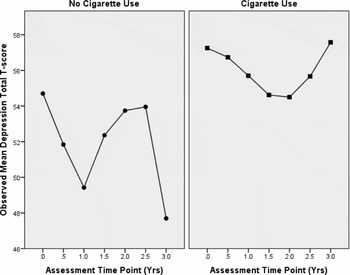
The mean Depression score ranged from 50.00 (SD = 11.25) to 55.50 (SD = 9.98) across the seven waves. Skewness values ranged from -0.17 to 0.63 and kurtosis values ranged from -0.72 to 0.25, with most waves having a positive skewness and a negative kurtosis. As is evident in Figure 1, the shape of the depression score means over time differed markedly between smokers and non-smokers. Smokers’ mean scores had a roughly level, bowl-shaped, quadratic (time squared) curve shape while non-smokers’ mean scores had a down-trending, cubic (time cubed) curve shape. Smokers had a higher mean score at each wave and a higher, but not significantly so, overall mean score than non-smokers (M = 56.04, SD = 11.04 vs. M = 52.21, SD = 11.01; d = 0.35). The over-time range of mean scores for smokers, expressed as a d effect size, was nearly one third that of non-smokers.
Observed depression scores of cigarette users and non-users at follow-up assessment time points.

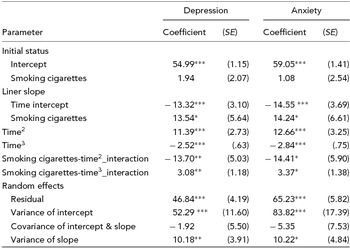
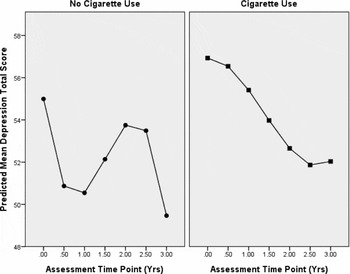
The striking differences between the mean depression score profiles for smokers and non-smokers necessitated a non-linear mixed model, the result of which is reported in Table 2 and in Figure 2. The significant linear slope, time squared, and time cubed terms capture the trend and fluctuations in depression scores for non-smokers. The significant smoking by time-squared and by time-cubed interaction terms and the significant smoking effect on the linear slope do the same for smokers. The effect of smoking on initial status, that is, the predicted baseline value, indicates that smokers had a higher score than did non-smokers, although the effect was not significant. Comparing Figure 2 (predicted means) with Figure 1 (observed means) shows that the final model accurately captures the trajectories of the two groups of youth.
Results of Mixed Model Analysis of Smoking on Depression, Anxiety (N = 117)

Note: *p < .05; **p < .01; ***p < .001
Predicted depression scores of cigarette users and non-users at follow-up assessment time points.

Anxiety
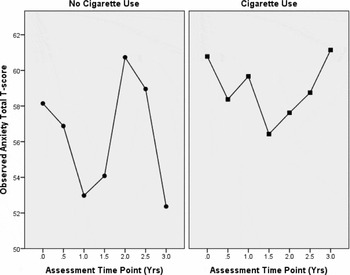
The average anxiety score in each data wave ranged from 54.48 (SD = 15.51) to 59.74 (SD = 11.63). Skewness values ranged from -0.44 to 0.20 and kurtosis values ranged from -1.21 to 0.68. Most waves displayed a negative skewness and a negative kurtosis. As Figure 3 shows, smokers and non-smokers again had markedly different mean score profiles. Although both profiles were slightly down-trending, the profile for smokers had a deeper but rougher quadratic curve shape while the profile for non-smokers had a smoother cubic curve shape. Smokers had a higher, but not significantly so, overall mean score than non-smokers (M = 58.94, SD = 11.64 versus M = 56.33, SD = 13.24; d = 0.20). Smokers’ scores had a smaller range (about three fifths as large in d effect size) that fell nearly completely within the range of non-smokers’ scores.
Observed anxiety scores of cigarette users and non-users at follow-up assessment time points.

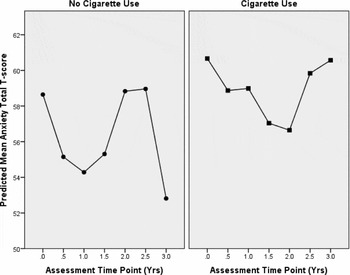
Table 2 and in Figure 4 present the results of the non-linear mixed model. The time-squared and time-cubed terms, as well as their interactions with smoking, the linear slope term and the term for the effect of smoking on the linear slope were all significant and functioned as in the depression model. Smokers had a higher predicted baseline score than non-smokers, but the difference was not significant. Comparing Figure 4 (predicted means) with Figure 3 (observed means) shows that the final model accurately captures the trajectories of the two groups of youth.
Predicted anxiety scores of cigarette users and non-users at follow-up assessment.

Discussion
This study is unique in that it is based on longitudinal, community-based national data of youth with EOS receiving treatment through community mental health services. It examined the effects of tobacco use on both depression and anxiety symptoms. Data on smoking were captured only on those 11 years and older and, therefore, do not include data on those younger than 11 who also might smoke. Even so, the prevalence of cigarette smoking by subjects (29%) in this study is reason for concern, given that the average age was 13.9 years (SD = 2.34) and was higher than national trends at the time for smoking among adolescents. According to the National Institutes on Drug Abuse's Monitoring the Future studies in 2006 (National Institute on Drug Abuse, 2014), approximately 10% of 8th-graders (close age match to the mean age of this sample) were current smokers and about 22% of 12th-graders were current smokers.
The findings from this study suggest that youth with EOS largely continued to report smoking once they started and tended to have less variance in symptoms if they smoked. Over half of those youth who reported smoking (19 out of 34) did so consistently at each data point during the prior 6 months while the remainder did so intermittently. Although smoking did not predict either depression or anxiety as a main effect, it did interact with time to predict more stable levels of both depression and anxiety across waves. Youth who smoked cigarettes had higher levels of anxiety and depression in most of the study time points but with less fluctuation in the pattern.
It is worth noting that the rates of smoking appear consistent with reported early adoption and high rates of smoking seen in adults with schizophrenia (Kotov et al., Reference Kotov, Guey, Bromet and Schwartz2010; Winterer, Reference Winterer2010). Also, many research findings indicated that adults with the disorder adopted smoking as a means of managing symptoms of schizophrenia and comorbid mental health disorders, as well as managing the side effects of medications (Jacobsen et al., Reference Jacobsen, D'Souza, Mencl, Pugh, Skudlarski and Krystal2004; Smith et al., Reference Smith, Singh, Infante, Khandat and Kloos2002; Tidey & Rohsenow, Reference Tidey and Rohsenow2009; Vancampfort et al., Reference Vancampfort, Probst, Scheewe, De Herdt, Sweers, Knapen and De Hert2012; Wehring et al., Reference Wehring, Liu, McMahon, Mackowick, Love, Dixon and Kelly2012; Wing, Wass, Soh, & George, Reference Wing, Wass, Soh and George2012; Ziedonis et al., Reference Ziedonis, Kosten, Glazer and Frances1994). A tentative research assumption deriving from adults’ behaviours is that youth might use cigarettes for the same reason as adults. However, given the fact of insufficient information on youth's psychiatric medication in the data, further research is needed for validation of association of cigarette consumption and side effects of psychiatric medications.
While these data provided rates of smoking in youth with EOS diagnosis, unfortunately they do not provide access to key information about whether any of the subjects were medicated with antipsychotics or other psychotropic medications, how often they smoked between data points, or how much they smoked. Even so, these preliminary findings suggest that smoking appears to help manage symptoms of both anxiety and depression, as evidenced by less fluctuation in those symptoms over time. This, in turn, suggests the potential for self-medicating behaviours with tobacco use. The findings of this study are consistent with the recent comprehensive review of the empirical literature on smoking and comorbid mental illness by Leventhal and Zvolensky (Reference Leventhal and Zvolensky2015). They found that smoking was used to self-medicate depression and anxiety symptoms by adults and young adults; that those with more severe anxiety and depressive symptoms were heavier smokers; and finally, those with anxiety and depression were less likely to successfully quit smoking. Because of the scarcity of literature in this area, this study supports the need for additional research on EOS and smoking to better understand the interaction of tobacco use with anxiety and depression among these youth.
Relevant Issues: Strengths, Limitations, and Implications
This study benefitted from a relatively large national community-based sample size, given the rarity of EOS, and supports the benefits of a longitudinal study (Lane, Wehby, Little, & Cooley, Reference Lane, Wehby, Little and Cooley2005). It provided a preliminary exploration of the impact of cigarette smoking on depression and anxiety symptoms in those with EOS. As such, these findings provide, at best, a tantalising starting point for future research and should not be generalised to youth with EOS who did not receive services from a CMHS Program.
Although the rarity of EOS makes the sample size of 117 significant, the limitations of the consequent low statistical power must be acknowledged. Rather than providing high power tests of even medium effect size hypotheses, this sample can suggest possible directions for future, larger studies. Irrespective of the likely multiple causes, the frequency of missing data was considerably higher than desirable, although perhaps not unexpected given the characteristics of the sample and the study implementation. Although males had higher levels of missing data, neither depression nor anxiety scores were associated with this variable. Thus, the differential attrition would cause minimal bias. Measured demographic and substantive variables, such as number of diagnoses, were examined for their association with anxiety and depression symptoms over the seven waves, but no relationships were found. Although limited by the available power, the conclusions and inferences made from this study can be useful in identifying the impact of smoking levels on depression and anxiety.
Additionally, there are important limitations in this study beyond sample size that must be considered. The first concerns the diagnosis. Youth diagnosed with EOS should not alone be considered definitive proof of EOS. While youth's diagnoses were consistent across waves, the measures used did not capture psychosis-specific symptoms or use of medications. In recent years, there have been concerns raised that children are being diagnosed with psychotic disorders without meeting even the most minimal levels of symptoms, and treated with antipsychotics for non-psychotic conditions, leading to inflated assumptions about rates of EOS. This position was reinforced by Olfson, Blanco, Liu, Moreno, and Laje (Reference Olfson, Blanco, Liu, Moreno and Laje2006) who noted a sharp increase in physicians prescribing second-generation antipsychotic medications for disruptive behaviours associated with mood disorders and other behavioural problems. While these data provided a national multiwave sample, it is important to note that these data were collected as part of a globally focused study on youth with severe emotional disturbances and only incidentally on those with EOS.
The lack of information on levels and types of medications prescribed to youth in the sample constitute an important limitation as current research suggests that those on antipsychotic medications generally smoke at higher rates, and that smoking in this population may be both part of a spectrum of self-medication behaviours used to manage psychotic symptoms and a means of limiting the side effects of antipsychotics (George et al., Reference George, Ziedonis, Feingold, Pepper, Satterburg, Winkel and Kosten2000; Meszaros et al., Reference Meszaros, Dimmock, Ploutz-Snyder, Abdul-Malak, Leontieva, Canfield and Batki2011). Equally problematic was the fact that it was not possible to determine the daily ‘dosage’ of cigarette consumption. Therefore, it was not possible to fully understand the role smoking played in self-medicating and stabilisation of anxiety and depression symptoms. However, smoking is known to improve the subjective sense of cognitive functioning among adult patients with schizophrenia, especially those on antipsychotics (Smith et al., Reference Smith, Singh, Infante, Khandat and Kloos2002). It is possible that smoking may have provided the same cognitive benefits to these youth. While this is a tempting line of inquiry, these data do not provide sufficient information about either how much they smoked or whether or not these youth were on antipsychotic medications.
Additionally, the lack of data on changes in psychotic symptoms over time limited the ability to assess the effects of smoking independently on psychotic symptoms and on levels of depression or anxiety in the context of fluctuation or stability over time. In future studies, data on fluctuations in psychotic symptoms against both anxiety and depression could provide a richer understanding of the role of smoking on the side effects of medication, including first- and second-generation antipsychotics, as well as antidepressants and antianxiety medications in youth with EOS who smoke.
Implications for Practice
Findings from this study suggest that evaluating youth with EOS for tobacco use is important for practitioners in general, but especially in school-age youth, because of the disciplinary consequences they face for smoking on school grounds. Both the literature and the findings from this study indicate that youth with EOS are more likely to smoke early and to continue smoking once they start because it appears to help with mood regulation. School counsellors need to understand how self-expectancies relate to smoking to manage the state of depression and anxiety. The school counsellors cannot rule out the possibility that youth might manage the side effects of medications which, in turn, might further reinforce smoking. Those same self-expectancies probably endorse smoking as a means to manage hallucinations and delusions, particularly in the presence of concurrent feelings of anxiety and depression.
School social workers or counsellors should assess whether these youth manage affective symptoms by smoking and then work with them to develop alternative strategies that are more health promoting. To that end, school counsellors and social workers might join the family in a consultation with prescribers to consider the means of mood regulation and symptom management. Using a client-centred approach, school counsellors and prescribers can incorporate methods of tracking depressive and anxiety symptoms as well as medication side effects, in order to develop coordinated interventions as part of the treatment protocols. With those who smoke, these strategies can incorporate ways to delimit or eliminate smoking (Hahn et al., Reference Hahn, Harvey, Concheiro-Guisan, Huestis, Holcomb and Gold2013; Lasser et al., Reference Lasser, Boyd, Woolhandler, Himmelstein, McCormick and Bor2000; Kotov et al., Reference Kotov, Guey, Bromet and Schwartz2010).
When working with school personnel such as teachers and administrators, counsellors should be providing education about how having EOS contributes to disruptive classroom behaviours, struggles with mastering content, and increased anxiety and depression. As part of a client-centred planning process, counsellors can include teacher and staff input about expectations in order to develop appropriate accommodations that can be incorporated into possible educational plans to reduce stress and reactivity this population experiences while in school. While it is challenging to address the issue of smoking in schools with rigid and appropriate no-smoking policies, it is helpful to ensure that teachers and administrators understand the effect smoking has on symptom management and mood regulation. Once plans to stop or delimit smoking have been developed with the youth and his or her family, implementation should be included in the school's educational plans for these youth. They then can coordinate therapeutic approaches with prescribers, clinicians, teachers, guidance counsellors, and other school personnel who proactively help these youth manage symptoms and promote healthier behaviours.
Schizophrenia, especially in children, is a complex disorder requiring creative approaches to foster symptom management and success. Social work, with its emphasis on coordinating across systems and intervening in systems as well as families, is critical to ensure that these youth receive comprehensive psychosocial assessments toward developing strength-based interventions across both formal and informal networks.
Disclaimer
The views expressed in this publication do not necessarily reflect the official policies of the Department of Health and Human Services, nor does mention of trade names, commercial practices, or organisations imply endorsement by the U.S. Government.
Conflict of Interest Statement
The authors declare that they have no conflict of interest.