Introduction
Since the advent of Next Generation Sequencing in the early 2000s, there has been a meteoric rise in microbiome research. That research has yielded incredible insights into the ecology of microorganisms across a range of environments, but a substantial amount of work has focused specifically on host-associated microbiomes. The host-associated microbiomes of myriad organisms have been described, particularly those of humans (Gilbert et al. Reference Gilbert, Blaser, Caporaso, Jansson, Lynch and Knight2018; The Human Microbiome Project Consortium 2012) and of animals that vector diseases like mosquitoes (Coon et al. Reference Coon, Hegde and Hughes2022; Griffin et al. Reference Griffin, Weber, Seabourn, Waianuhea and Medeiros2023). However, many organisms such as endoparasites, have received far less attention, which is surprising given their importance to human and wildlife health. In 2017, the Parasite Microbiome Project (PMP) was proposed to fill important knowledge gaps regarding parasite-microbe interactions and parasite-associated microbiomes (Dheilly et al. Reference Dheilly, Bolnick, Bordenstein, Brindley, Figuères, Holmes, Martínez Martínez, Phillips, Poulin and Rosario2017). Several major challenges in parasite-associated microbiome research have been identified (Dheilly et al. Reference Dheilly, Martínez Martínez, Rosario, Brindley, Fichorova, Kaye, Kohl, Knoll, Lukeš, Perkins, Poulin, Schriml and Thompson2019; Salloum et al. Reference Salloum, Jorge, Dheilly and Poulin2023), and addressing those challenges are important to improving our understanding of parasite biology and evolution. A crucial first step in fulfilling the goals of the PMP is to establish a robust characterization of the microbiomes of different parasite species.
Helminths are an important group of endoparasites ripe for parasite-associated microbiome research. They are taxonomically diverse, spanning four phyla: Acanthocephala, Annelida (leeches), Nematoda, and Platyhelminthes (Hugot, Baujard and Morand Reference Hugot, Baujard and Morand2001; Sepulveda and Kinsella Reference Sepulveda and Kinsella2013), with approximately 21,000 species known to parasitize vertebrates (Hugot, Baujard and Morand Reference Hugot, Baujard and Morand2001). Helminths have evolved several different strategies of transmission, including host ingestion of eggs or larvae and penetration of host cutaneous tissues. Once inside the host, helminths develop and reproduce in a variety of tissues; however, the tissues used vary across parasite species. Those complex transmission strategies and host interactions are likely to affect how helminths encounter and acquire potential symbionts.
A substantial portion of an animal’s microbiome is environmentally derived (Heidrich et al. Reference Heidrich, Valles-Colomer and Segata2025; Seabourn et al. Reference Seabourn, Weber, Spafford and Medeiros2023), and for many helminths, this could be highly dependent on the ecology of their host. There is evidence that helminth-associated microbiomes will vary in their composition because of geographic distance (Jorge et al. Reference Jorge, Dheilly, Froissard, Wainwright and Poulin2022), even when helminth and host species are the same – a common phenomenon that has been observed in many other organisms (Clayton et al. Reference Clayton, Vangay, Huang, Ward, Hillmann, Al-Ghalith, Travis, Long, Tuan, Minh and Cabana2016; Frankel-Bricker et al. Reference Frankel-Bricker, Song, Benner and Schaack2020; Medeiros et al. 2022). Furthermore, habitat quality may also impact gastrointestinal helminth microbiomes. For example, environmental microbiomes extrinsic to the host are impacted by pollution, especially in aquatic systems (Muhie et al. Reference Muhie, Gautam, Mylroie, Sowe, Campbell, Perkins, Hammamieh and Garcia-Reyero2025), which alters the microbiome of aquatic organisms (Bharti et al. Reference Bharti, Nagar and Negi2023; Xue et al. Reference Xue, Jia, Yue, Guan, Zhu and Wang2021).
In this study, we characterize the microbiome of Dujardinascaris helicina (Nematoda: Ascarididae), a gastrointestinal helminth that parasitizes crocodiles. Little is known about the ecology of D. helicina, and little is known about its microbiome. We isolated D. helicina from the guts of the American crocodile, Crocodylus acutus, from two separate locations across Belize – Caye Caulker and Ladyville. Those locations were chosen because of the variation in the levels of human impact at each site. Caye Caulker experiences very low levels of human activity, and Ladyville experiences high levels of human activity. We hypothesized that D. helicina microbiomes would differ in composition across the two locations.
Materials and methods
Study sites
Sampling was conducted between 2013 and 2015 from two principal study sites: Caye Caulker and Ladyville, Belize. Caye Caulker is an offshore island. A channel separates the less developed northern portion of the island, which is characterized by mixed mangrove scrub along the coast, deciduous broad-leaved lowland shrubland, herbaceous swamp, and tropical littoral forest, from the more developed southern portion, which consists of reduced mangroves and littoral forest. Habitats across the island remain relatively natural but with sporadic settlements along southern regions. Sampling from Caye Caulker also consisted of two locations: from mangroves near the northern coastline (17.77183° N, 88.02962° W) and from an inland lagoon near the southern coastline (17.73278° N, 88.03077° W). The second site, Ladyville, was from a small channel running inland from the mainland coast near Belize City (17.55442° N, 88.27878° W). Belize City is the country’s largest and most populous city, where urban expansion has cleared most of the natural mangrove, coastal wetlands, and riverine habitats to be replaced with urban infrastructure.
Parasite collection
A total of 40 nematodes were collected from wild American crocodiles (Crocodylus acutus) sampled from Caye Caulker (n = 20; 1 crocodile) and Ladyville (n = 20; 1 crocodile), Belize. Crocodiles were captured live, either by hand or with catchpole snares. Nematodes were collected from adult crocodiles using non-lethal stomach flushing protocols following techniques described by Rice et al. (Reference Rice, Ross, Finger and Owen2005). Once collected, the nematodes were cleaned in distilled water, stunned with boiling water, and placed into labeled glass vials of 70% ethanol stored at a –4°C prior to being sent to the University of Hawaii for subsequent identification and DNA extraction. Nematodes were examined using light microscopy and identified as ascarid species, Dujardinascaris helicina (Molin Reference Molin1860), using a key of morphological characteristics (Moravec Reference Moravec2001). Prior to DNA extraction, nematodes were surface sterilized with two washes in 3% bleach for 5 minutes followed by two washes in sterile 1X PBS. Whole worms used for microbiome sequencing.
DNA extraction and library preparation
DNA was extracted using a NucleoMag Tissue kit following the manufacturer’s protocol. The bacterial library preparation was done using a modified version of the Earth Microbiome Project 16S V4 protocol targeting the V4 region of bacterial 16S rRNA using 515F and 806R primers from the Earth Microbiome Project (Caporaso et al. Reference Caporaso, Lauber, Walters, Berg-Lyons, Lozupone, Turnbaugh, Fierer and Knight2011). The library was checked for quality and quantity using a Bioanalyzer High Sensitivity chip (Agilent Technologies) and sequenced by the Advanced Studies in Genomics, Proteomics, and Bioinformatics core facility at the University of Hawai‘i at Mānoa using Illumina MiSeq PE300 with a MiSeq Reagent Kit v3.
Bioinformatics
Bioinformatic analysis was performed using the MetaFlow|mics pipeline for microbiome marker data (Arisdakessian et al. Reference Arisdakessian, Cleveland and Belcaid2020). Reads were truncated at position 220 (190 for the reverse read) and were discarded if they contained at least one base below quality 20 (minimum quality to assign nucleotide identity with <1% error) or a number of expected errors above 3. Two amplicon sequence variants (ASVs) were merged if all the three following conditions were satisfied: i) they co-occur in every sample, ii) one of the two ASVs has a lower relative abundance than the other in every sample, and iii) they share a sequence similarity of at least 99%. MetaFlow|mics wraps functionality from DADA2 to assign taxonomy. All singletons (ASVs with reads in only one sample) and ASVs with no annotation at the kingdom level were removed. After quality control, sequencing resulted in 7.39 million 16S reads. Further ASV processing was performed by merging the abundance data, taxonomic data, and sample data using the Phyloseq package (McMurdie and Holmes Reference McMurdie and Holmes2013) in R. 16S ASVs were included in the final analysis only if they appeared more than once in 99.0 % of total samples.
Statistical analyses
To compare microbiomes, β-diversity was compared among individual nematodes isolated from crocodiles from two distinct locations. To assess β-diversity, changes in the composition of the bacteriome (measured as the relative abundance of ASVs) in response to the crocodile environment (Caye Caulker and Ladyville) were tested statistically with a generalized linear mixed model (GLMM), using the R package glmmTMB (Brooks et al. 2017), assuming a negative binomial error distribution similar to the approach detailed by Sweeny et al. (2023). All models included i) a fixed effect of the offset of the log sum of total reads, ii) a fixed effect of sampling location, and iii) a random effect of ASV. Model selection was performed using the Akaike information criterion (AIC) method. We further explored which specific taxa are changing across habitats by using the conditional modes of random effect estimates similar to the approach used in Sweeny et al. (2023).
Results
Bioinformatics
A total of 624 ASVs were included in the statistical analyses. Of those 624 ASVs, 87.33% belonged to four phyla including Actinobacteriota (11.22 %), Bacteroidetes ([7.85 %]; synonym Bacteroidota), Firmicutes (19.39 %), Proteobacteria (48.88 %; Figure 1).
Bar charts showing the relative abundance of the top 20 phyla in the Dujardinascaris helicina microbiome at each sampling location.

β-diversity
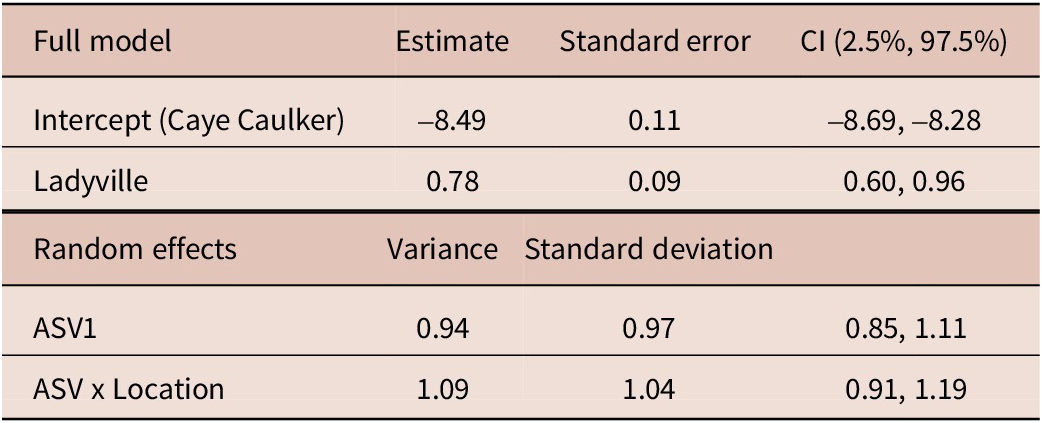
The model that best fitted the data include a fixed effect of the offset of the log sum for sequencing reads per sample, a fixed effect of location, a random effect of ASV identity, and a random effect of an interaction between location and ASV identity (AIC weight = 1; Table 1; Figure 2). This model significantly outperformed the next best model, which only dropped the random effect that included the interaction term (ΔAIC = 242.3). This suggests that variation in the D. helicina microbiome composition is dependent on the location from which the parasite is collected.
The estimates and associated standard errors of fixed effects, and the variance and associated standard deviation of random effects for the best-fitted generalized linear mixed model comparing microbiome β-diversity between sampling locations. Caye Caulker was the reference level in the model (intercept).

Dujardinascaris helicina microbiome β-diversity across sampling locations displayed as principal coordinate analysis of Bray-Curtis distances.

Using the conditional modes of the random effects estimates, taxa specific differential abundances showed strong ASV shifts between habitats (Figure 3). The general trend in abundance shifts showed higher enrichment of certain ASVs in Caye Caulker relative to Ladyville. The major shifts occurred in Firmicutes and Proteobacteria.
Differential abundances of ASVs when comparing Caye Caulker to Ladyville using the conditional modes of the random effect estimates (ASV x Location) from the best-fitted generalized linear mixed model. Differences centered around 0 indicate no differential abundance. Points to the right of the vertical line represent ASVs that had higher abundances in Caye Caulker. Points to the left of the vertical line represent ASVs that had higher abundances in Ladyville.

Discussion
Despite their widespread prevalence in nature, helminths have received little attention in microbiome research. One of the key goals of the Parasite Microbiome Project is to identify core and transient taxa within parasite-associated microbiomes. However, a major challenge to achieving that goal is the substantial lack of characterized parasite-associated microbiomes. In this study, we described for the first time the microbiome of Dujardinascaris helicina, a gastrointestinal nematode parasite of crocodilians and how it varies across different habitats.
The microbiome of D. helicina is dominated by four phyla: Actinobacteria, Bacteroidota, Firmicutes, and Proteobacteria. Prior research into the microbiomes of other nematode helminths have revealed similar patterns. For example, the microbiome of Trichuris muris, a gastrointestinal parasite of mice, is dominated by Bacteroidota, Firmicutes, and Proteobacteria (White et al. Reference White, Houlden, Bancroft, Hayes, Goldrick, Grencis and Roberts2018); however, those phyla are represented in different proportions in the T. muris microbiome with Bacteroidetes being the most dominant. Another study evaluated the microbiome of Haemonchus contortus, a gastrointestinal parasite of ruminants, and also showed the dominant taxa as Bacteroidota, Firmicutes, and Proteobacteria (Sinnathamby et al. Reference Sinnathamby, Henderson, Umair, Janssen, Bland and Simpson2018); however, Firmicutes were the most dominant in the H. contortus microbiome. Studies from a closely related parasite, Parascaris spp., showed that Firmicutes are dominant in the parasite microbiome (Cain et al. Reference Cain, Norris, Ripley, Suri, Finnerty, Gravatte and Nielsen2022) of juvenile worms. Cain et al. (Reference Cain, Norris, Swan and Nielsen2024) also investigated the microbiome of adult Parascaris spp. and showed that Tenericutes, mostly Mycoplasma, was the most dominant taxon; however, that study only investigated the microbiome of the female gonads, which could lead to higher abundance because of a tissue-specific effect. We also saw Mycoplasma in our data, but in much lower abundance likely because we used whole worms in our study, which would probably alter the abundance of a specific taxa when combining microbiomes from multiple tissues. While proportionally different in the microbiomes between helminths, that Bacteroidota, Firmicutes, and Proteobacteria are predominant across different helminthic nematode species may indicate a potential for being a core part of helminthic nematode-associated microbiomes. Those phyla were also observed in high abundances in trematode parasites in other studies (Jorge et al. Reference Jorge, Dheilly and Poulin2020; Jorge et al. Reference Jorge, Dheilly, Froissard, Wainwright and Poulin2022; Salloum et al. Reference Salloum, Jorge, Dheilly and Poulin2023) and therefore may potentially be a core part of parasite-associated microbiomes in general.
Beyond taxonomic descriptions of the microbiome, we investigated how microbiome community composition changes across sampling sites. Our best-fitted model showed that community composition was highly dependent on the sampling location, as evidenced by the interaction term in the model. Our model indicated that D. helicina microbiomes sampled from Caye Caulker were more enriched than Ladyville, with 136 more ASVs having higher abundances detected in Caye Caulker. A potential driver of differences in microbiome composition across those locations could be the degree of human activity, especially activity related to water use. Ladyville is an urbanized suburb of Belize City with high levels of human activity (e.g., industry, medical clinics, an international airport, and a major cruise port). Runoff from that infrastructure infiltrates the crocodile habitat from which we isolated D. helicina in Ladyville. Caye Caulker also has human activity; however, crocodile habitats are not closely associated with developed areas. The habitats are in outlying mangroves that receive little, if any, runoff from the island’s infrastructure.
Previous studies have shown the effects of human modified environments on the microbiomes of animals, particularly of those in captivity. We noted similar parallels in the microbiomes of D. helicina in this study. For example, Prevotella spp. were more enriched in D. helicina microbiomes from Ladyville, but not Caye Caulker. That pattern is consistent with previous results showing that animals in human captivity experience a proliferation of Prevotella spp. in their microbiomes (Clayton et al. Reference Clayton, Vangay, Huang, Ward, Hillmann, Al-Ghalith, Travis, Long, Tuan, Minh and Cabana2016; Gibson et al. Reference Gibson, Nguyen, Neumann, Miller, Buss, Daniels, Ahn, Crandall and Pukazhenthi2019; Wang et al. Reference Wang, Wang, Pan, Qi, Li, Zhang, Shen, Xiang and Li2021). We also saw major enrichment shifts of Sphingomonas spp. in Ladyville compared to Caye Caulker, another pattern consistent with microbiome shifts in captive animals (San Juan et al. Reference San Juan, Castro and Dhami2021). Previous studies have also noted an overall reduction in microbiome diversity of captive animals (Florkowski et al. Reference Florkowski, Hamer and Yorzinski2023; San Juan et al. Reference San Juan, Castro and Dhami2021). Although our samples did not come from captive animals, we saw similar patterns of reduced diversity in D. helicina microbiomes with closer proximity to human modified environments. It should also be noted that the sampling locations were geographically separated. Ladyville and Caye Caulker are approximately 40 km apart – which further supports the evidence that human modified habitats not only reduce overall microbiome diversity in animals, but they may also drive the microbiome composition towards specific taxa like Prevotella and Sphingomonas.
In conclusion, we show that the microbiome composition of Dujardinascaris helicina shares similarities with other helminth species, which potentially indicate the presence of a core set of microbes in helminth-associated microbiomes. However, we also demonstrate that the D. helicina microbiome is influenced by its host’s environment and that proximity to human activity causes directional shifts in certain microbial taxa associated with human modified environments. A crucial next step in helminth-associated microbiome research is to assess the function of the microbiome and its impact on helminth biology and physiology. Lastly, future research should also investigate how microbiome functional capacity is affected when environmental pressures substantially shift microbiome composition towards less taxonomic diversity and any subsequent impacts to the helminths themselves.
Acknowledgements
We would like to express our utmost gratitude to Miriam Boucher, Theresa Aller, Peter Lecuyer, and Dani Brianne for their assistance during fieldwork, as well as the Crocodile Research Coalition for their assistance, support, and feedback. We thank the Belize Forest Department for their support of this project, not only in providing us with the necessary research permits but also for their continuous efforts in furthering crocodile research, conservation, and management. We thank those at the IUCN-SSC Crocodile Specialist Group (CSG) for their support of this project and helpful feedback over the years. We thank Dr. Matthew Medieros, Dr. Floyd Reed, and the ReedMe Lab Hui: Dr. Priscilla Seabourn, Dr. Maria Constantini, Dr. Justin Walguarney, Danya Weber, Mamo Waianuhea, Dr. Maria Steadmon, Nicole Yoneishi, and Kirsten Nakayama for their assistance with the lab work, helpful discussion, and continuous support. We thank Tina Carvalho and the in her assistance in conducting the microscopy imaging, and the Integrative Center for Environmental Microbiomes and Human Health (ICEMHH) team.
Financial support
This work was supported by the National Science Foundation Postdoctoral Fellowship in Biology (M.T., grant number 1402172; C.G., grant number 2410205); the University of Hawai‘i at Mānoa UndergraduateResearch Opportunities Program (D.D. and D.S.); and the Achievement Rewards for College Scientist Foundation (ARCS) Honolulu Chapter Ellen M. Koenig Award in Zoology (H.S.).
Competing interests
The authors declare that they have no conflict of interest.
Ethical standard
The authors assert that all procedures contributing to this work comply with the ethical standards of the relevant national and institutional committees on human experimentation and with the Helsinki Declaration of 1975, as revised in 2008. The authors assert that all procedures contributing to this work comply with the ethical standards of the relevant national and institutional guides on the care and use of laboratory animals. The authors assert that all procedures contributing to this work comply with the ethical standards of the relevant national and institutional guides on the use of wild animals. All scientific and research collection permits were conducted with the Belize Forest Department (BFD) approval under research permits [Ref. No. CD/60/3/10(16), CD/60/13(37), and CD/60/3/14(47)].