Introduction
The aetiology of anorexia nervosa (AN) is complex and evidence indicates that both biological/genetic and psychosocial factors are involved (Collier & Treasure, Reference Collier and Treasure2004). Neurodevelopmental models emphasize the possible effects of in utero and postnatal factors (Gillberg et al. Reference Gillberg, Råstam and Gillberg1994a, Reference Gillberg, Råstam and Gillbergb, Reference Gillberg, Gillberg, Råstam and Johansson1996; Connan et al. Reference Connan, Campbell, Katzman, Lightman and Treasure2003; Galderisi et al. Reference Galderisi, Mucci, Monteleone, Sorrentino, Piegari and Maj2003; Treasure et al. Reference Treasure, Southgate, Tchanturia, Lopez and Collier2006).
Brain-derived neurotrophic factor (BDNF) is involved in neuronal proliferation, differentiation and survival during development (Lindsay et al. Reference Lindsay, Wiegand, Altar and Di Stefano1994; Lindvall et al. Reference Lindvall, Kokaia, Bengzon, Elmer and Kokaia1994; Snider, Reference Snider1994; Thoenen, Reference Thoenen1995). BDNF and its tyrosine kinase receptor (TrkB) are expressed in hypothalamic nuclei associated with eating behaviours (Kernie et al. Reference Kernie, Liebl and Parada2000). Furthermore, mice heterozygous for the BDNF gene exhibit hyperactivity and higher levels of anxiety in response to stress (Rios et al. Reference Rios, Fan, Fekete, Kelly, Bates, Kuehn, Lechan and Jaenisch2001).
In human studies, the importance of developmental factors in AN is also supported by genetic data. For example, there is a reported association between a polymorphism in BDNF (Val66Met; rs6265) and AN (Ribases et al. Reference Ribases, Gratacos, Armengol, de Cid, Badia, Jimenez, Solano, Vallejo, Fernandez and Estivill2003, Reference Ribases, Gratacos, Fernandez-Aranda, Bellodi, Boni, Anderluh, Cavallini, Cellini, Di Bella, Erzegovesi, Foulon, Gabrovsek, Gorwood, Hebebrand, Hinney, Holliday, Hu, Karwautz, Kipman, Komel, Nacmias, Remschmidt, Ricca, Sorbi, Wagner, Treasure, Collier and Estivill2004, Reference Ribases, Gratacos, Fernandez-Aranda, Bellodi, Boni, Anderluh, Cavallini, Cellini, Di Bella, Erzegovesi, Foulon, Gabrovsek, Gorwood, Hebebrand, Hinney, Holliday, Hu, Karwautz, Kipman, Komel, Nacmias, Remschmidt, Ricca, Sorbi, Tomori, Wagner, Treasure, Collier and Estivill2005; Koizumi et al. Reference Koizumi, Hashimoto, Itoh, Nakazato, Shimizu, Ohgake, Koike, Okamura, Matsushita, Suzuki, Murayama, Higuchi and Iyo2004, Reference Koizumi, Hashimoto and Iyo2006; Hashimoto et al. Reference Hashimoto, Koizum, Nakazato, Shimizu and Iyo2005). An association of AN restricting subtype and the Met66 variant within the BDNF gene was demonstrated by Ribases et al. (Reference Ribases, Gratacos, Armengol, de Cid, Badia, Jimenez, Solano, Vallejo, Fernandez and Estivill2003), who also reported an effect of the Met66 variant on lifetime lowest body mass index (BMI) (Ribases et al. Reference Ribases, Gratacos, Fernandez-Aranda, Bellodi, Boni, Anderluh, Cavallini, Cellini, Di Bella, Erzegovesi, Foulon, Gabrovsek, Gorwood, Hebebrand, Hinney, Holliday, Hu, Karwautz, Kipman, Komel, Nacmias, Remschmidt, Ricca, Sorbi, Tomori, Wagner, Treasure, Collier and Estivill2005).
Serum BDNF concentrations in AN patients are lower than in healthy controls (Nakazato et al. Reference Nakazato, Hashimoto, Shimizu, Kumakiri, Koizumi, Okamura, Mitsumori, Komatsu and Iyo2003, Reference Nakazato, Hashimoto, Yoshimura, Hashimoto, Shimizu and Iyo2006; Monteleone et al. Reference Monteleone, Tortorella, Martiadis, Serritella, Fuscino and Maj2004, Reference Monteleone, Fabrazzo, Martiadis, Serritella, Pannuto and Maj2005) and these decreased concentrations reportedly persist in individuals on their way to recovery (Nakazato et al. Reference Nakazato, Hashimoto, Yoshimura, Hashimoto, Shimizu and Iyo2006). These observations in peripheral tissues are of note because BDNF readily crosses the blood–brain barrier in both directions (Pan et al. Reference Pan, Banks, Fasold, Bluth and Kastin1998). However, to our knowledge, serum BDNF concentrations in those fully recovered from AN have not yet been investigated.
Genetic variants of BDNF and cognitive performance
Genetic variants of BDNF are associated with changes in cognitive function. Carriers of the Met66 allele of the pre-pro-protein of BDNF have diminished episodic memory (Egan et al. Reference Egan, Kojima, Callicott, Goldberg, Kolachana, Bertolino, Zaitsev, Gold, Goldman, Dean, Lu and Weinberger2003; Dempster et al. Reference Dempster, Toulopoulou, McDonald, Bramon, Walshe, Filbey, Wickham, Sham, Murray and Collier2005), and Rybakowski et al. (Reference Rybakowski, Borkowska, Skibinska and Hauser2006) reported that bipolar subjects with the Val66 genotype made significantly less perseverative errors and more correct categories and conceptual responses on the Wisconsin Card Sorting Test (WCST) compared to bipolar subjects with the Val66Met and Met66 genotypes.
These reports suggest that genetic variants of BDNF affect impairment of cognitive functions.
Set-shifting difficulties in AN
Set-shifting is the ability to move back and forth between multiple tasks, operations or mental sets and is a major component of executive functioning (Miyake et al. Reference Miyake, Friedman, Emerson, Witzki, Howerter and Wager2000). Neuropsychological studies of AN patients indicate that they have problems in executive functioning. Specifically, set-shifting difficulties have been found in people currently ill with AN (Fassino et al. Reference Fassino, Pieró, Daga, Leombruni, Mortara and Rovera2002; Steinglass et al. Reference Steinglass, Walsh and Stern2006), after recovery (Tchanturia et al. Reference Tchanturia, Morris, Anderluh, Collier, Nikolaou and Treasure2004, Reference Tchanturia, Campbell, Morris and Treasure2005) and in unaffected sisters (Holliday et al. Reference Holliday, Tchanturia, Landau, Collier and Treasure2005). Thus, set-shifting difficulties may represent an endophenotype of AN (Holliday et al. Reference Holliday, Tchanturia, Landau, Collier and Treasure2005; Southgate et al. Reference Southgate, Tchanturia and Treasure2005; Roberts et al. Reference Roberts, Tchanturia, Stahl, Southgate and Treasure2007).
Taken together, it is of great interest to examine whether decreased BDNF concentrations persist after recovery and whether lower serum BDNF concentrations are associated with set-shifting both in those with AN and in those recovered from AN.
The aim of this study was to (a) confirm reports of decreased serum BDNF concentrations in patients currently ill with AN, (b) measure serum BDNF in individuals recovered from AN, (c) establish whether set-shifting difficulties are present in people currently ill with AN and in those recovered from AN, and (d) examine whether serum concentrations of BDNF are correlated with set-shifting ability.
Method
Participants
Female patients with current AN (n=29), women who had recovered from restricting AN (ANRec) (n=18) and female healthy controls (HC) (n=28) were included in this study. The AN and ANRec groups were recruited from the South London and Maudsley National Health Service (NHS) Foundation Trust and from a volunteer register of individuals with past or current eating disorders (ED). The HC group was recruited from volunteers in the local community. The AN group met DSM-IV criteria (APA, 2000) for AN (21 with the restrictive subtype, eight with the binge-purge subtype). The ANRec group was defined using the following criteria: (1) a history of AN of the restrictive subtype as defined by DSM-IV, (2) maintenance of a stable BMI between 18.5 and 24 kg/m2, for a minimum of 1 year, (3) regular menstrual cycles during the past year (at least 10 cycles), (4) binge eating and purging behaviours absent for 1 year, and (5) no prescribed psychotropic medication during the year preceding the study. Inclusion criteria for the HC group were: (1) a BMI between 19 and 26 kg/m2, (2) no personal or family history of any psychiatric illness or ED, and (3) no current use of psychotropic medication.
Exclusion criteria for all participants included a history of brain injury, psychosis, neurological or other severe medical illness, alcoholism or drug abuse/dependence. All participants had English as their first language. Groups were matched for age, ethnicity and educational level. Ethical approval for the study was obtained from the Institute of Psychiatry and the South London and Maudsley NHS Foundation Trust Research Ethics Committee. All subjects provided written informed consent for participation in the study. The groups did not differ in age, years of education and ethnicity. Of the 85 women invited to participate, eight were excluded because they did not meet the inclusion/exclusion criteria (three from the HC group because of being overweight, one from the AN group and four from the ANRec group because three were on psychotropic medication and one was diagnosed as having had ED not otherwise specified (EDNOS). Two from the AN group withdrew from the study before the full assessment was completed. Therefore, 75 women participated in this study. In the AN group, 18 (62.1%) were in-patients and 11 (37.9%) were out-patients. In the AN group, nine had co-morbid psychiatric conditions and seven were diagnosed as having major depressive disorders, of which one had anxiety disorder and two had obsessive–compulsive disorder. All participants agreed to provide blood (10 ml) for serum BDNF measurement; blood was drawn between 09:00 and 12:00 ours into additive-free containers. Serum samples were stored at −80°C until assayed. Neuropsychological assessments were carried out in 70 subjects (24 AN, 18 ANRec, 28 HC); three in-patients and two out-patients did not complete the neuropsychological assessment.
Measures
Dimensional measures of psychopathology were used, including current and lifetime lowest BMI at adult height and the Eating Disorder Examination Questionnaire (EDEQ; Fairburn & Beglin, Reference Fairburn and Beglin1994), which has four subscales: Restraint (R), Eating Concern (E), Weight Concern (W) and Shape Concern (S). The Maudsley Obsessive–Compulsive Inventory (MOCI; Hodgson & Rachman, Reference Hodgson and Rachman1977) and the Hospital Anxiety and Depression Scale (HADS; Zigmond & Snaith, Reference Zigmond and Snaith1983) were used to assess current anxiety, depression and obsessive–compulsive symptoms.
Serum concentrations of BDNF
BDNF was measured using an Emax Immunoassay System kit (Promega, Madison, WI, USA). In brief, 96-well plates were coated with anti-BDNF monoclonal antibody and incubated at 4°C for 18 h, after which the plates were incubated in a blocking buffer (1 h, room temperature). Samples and BDNF standards were maintained at room temperature with shaking for 2 h, followed by washing with buffers. Plates were incubated with anti-human BDNF polyclonal antibody (2 h, room temperature), washed, and incubated with anti-immunoglobulin (Ig)Y antibody conjugated to horseradish peroxidase (1 h, room temperature). Plates were incubated in peroxidase substrate and tetramethylbenzidine solution to produce the colour. The reaction was stopped with 1 m hydrochloric acid and absorbance at 450 nm was measured with an automated microplate reader (Emax, Molecular Devices, Sunnyvale, CA, USA).
Assessment of set-shifting
The WCST (Computer Version 4, Psychological Corporation) was devised to study ‘abstract behaviour’ and ‘shift of set’ (Lezak, Reference Lezak1995). It provides accuracy and process measures; for example inefficient initial conceptualization, perseveration, failure to maintain set, and inefficient learning. Participants match each of the stimulus cards that appear at the bottom of the screen to one of four key cards. The category cards include a single red triangle, two green stars, three yellow crosses and four blue circles. The correct matching rule could be colour, number or shape. The subjects receive feedback after each trial as to whether they have matched the card correctly. However, the correct sorting rule changes unpredictably during the course of the task.
Statistical analysis
Data were analysed using SPSS version 13.0 (SPSS Inc., Chicago, IL, USA). Data are presented as mean±standard deviation (s.d.). One-way analysis of variance (ANOVA) was used to test for differences in clinical characteristics, neuropsychological tasks and serum BDNF concentrations between groups. If a significant overall difference between the groups was observed in ANOVA, then pairwise comparisons were carried out using Bonferroni/Dunn post-hoc tests to test the significance of different combinations of groups with respect to the outcome variables. Pearson's bivariate correlation coefficients were used to examine the relationship between two variables. Values of Cohen's d for small, medium and large effect size are 0.20, 0.50 and 0.80 respectively. p values <0.05 were considered statistically significant.
Results
Demographic and clinical characteristics
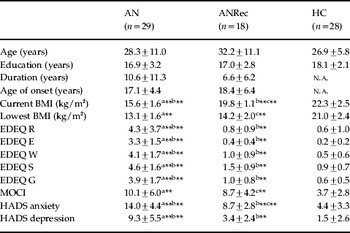
Table 1 shows the demographic and clinical characteristics for all the subjects. The groups did not differ in age, years of education or ethnicity. There were no significant differences in the age of onset, duration of illness, or lowest BMI between the AN group and the ANRec group. The ANRec group had been recovered for a mean of 7.2 years (s.d.=6.4, range 1–24). The AN group had a significantly lower BMI and a significantly higher level of psychopathology (EDEQ, HADS anxiety and depression scores) than the ANRec and the HC groups. As is usually the case in studies with patients who have recovered from AN, their BMI, although within the normal range, was lower than that in the HC group. In addition, the ANRec group showed significantly higher scores on the MOCI and HADS anxiety compared with the HC group.
Group demographics and clinical characteristics

AN, Anorexia nervosa; ANRec, recovered from anorexia nervosa; HC, healthy controls; BMI, body mass index; EDEQ R, Eating Disorder Examination Questionnaire Restraint Subscale; EDEQ E, Eating Concern Subscale; EDEQ W, Weight Concern Subscale; EDEQ S, Shape Concern Subscale; EDEQ G, Global Scale; MOCI, the Maudsley Obsessive–Compulsive Inventory; HADS, the Hospital Anxiety and Depression Scale; n.a., not applicable.
Values are given as mean±standard deviation.
a Comparisons between AN and HC.
b Comparisons between AN and ANRec.
c Comparisons between ANRec and HC.
** p<0.001.
Serum concentrations of BDNF
Serum BDNF concentrations (mean±s.d.) in the AN group (11.7±4.9 ng/ml) were significantly lower than those in the HC group [15.1±5.5 ng/ml, p=0.04, 95% confidence interval (CI) −6.7 to −0.07]. They were also significantly lower than those in the ANRec group (17.6±4.8 ng/ml, p=0.001, 99% CI −10.5 to −1.2). Values in the ANRec group were not significantly different from those in the HC group. The effect size of increased BDNF in the ANRec group is 0.5, which is a moderate sized increase.
Set-shifting tasks
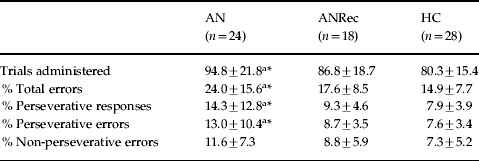
Group comparisons for set-shifting tasks are presented in Table 2 The AN group showed significantly impaired set-shifting on the WCST (both total errors and perseverative errors) compared to the HC group. Scores in the ANRec group were intermediate between those of patients who were currently ill and healthy controls but were not significantly different to the other groups.
The Wisconsin Card Sorting Test (WCST) (set-shifting ability)

AN, Anorexia nervosa; ANRec, recovered from anorexia nervosa; HC, healthy controls.
Values are given as mean±standard deviation.
a Comparisons between AN and HC.
* p<0.05.
Correlations between serum BDNF concentrations and WCST performance
There was no significant correlation between serum BDNF concentrations and performance on the WCST. Correlation coefficients for the association between BDNF and perseverative errors were r=−0.135 for the total group of subjects, r=−0.179 for the AN and the ANRec groups combined and r=−0.123 for the current AN group.
Correlations between serum BDNF concentrations and BMI
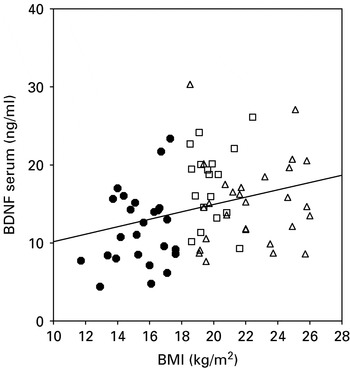
Figure 1 shows the correlations between serum BDNF concentrations and BMI. There was no significant correlation between serum BDNF concentrations and BMI in the AN group and in the ANRec group. In the total subjects, a positive correlation was shown between serum BDNF concentrations and BMI (p=0.01, r=0.304).
Correlations between serum brain-derived neurotrophic factor (BDNF) concentrations and body mass index (BMI) in women with current AN (•, AN group), women who had recovered from AN (□, ANRec group) and age-matched healthy controls (△, HC group). A positive correlation was shown in the total subjects (–––) (p=0.01, r=0.304).

Correlations between serum BDNF concentrations and psychopathological characteristics
In the AN group, a negative correlation tendency was shown between serum BDNF concentrations and HADS depression (p=0.083, r=−0.361), and EDEQ E (p=0.055, r=−0.388), and a positive correlation tendency was shown between serum BDNF concentrations and lowest BMI (p=0.072, r=0.359). In the total subjects, a negative correlation was shown between serum BDNF concentrations and the scores on HADS depression (p=0.046, r=−0.241), the scores on HADS anxiety (p=0.045, r=−0.242), EDEQ E (p=0.001, r=−0.391), EDEQ W (p=0.01, r=−0.304), EDEQ S (p=0.011, r=−0.301), and EDEQ Global Scale (G) (p=0.027, r=−0.325).
Discussion
This study demonstrated that serum BNDF concentrations in female patients currently ill with AN were significantly lower than in a healthy control group and also compared to women recovered from AN.
The AN group and the ANRec group were well matched for duration of illness and lowest lifetime BMI. However, 62% the AN group were in-patients (a marker of poor prognosis) whereas none of the individuals in the ANRec group had a history of hospitalization. Thus, it is possible that the AN and ANRec groups differ in other factors and not just stage of illness; for example, decreased serum BDNF may be associated with a poor prognosis. Alternatively, the higher BDNF concentration in the ANRec group (relative to the ill group) may be a consequence of an increase in BMI. In this study we found that the ANRec group differed from the healthy group in terms of lower BMI and higher levels of anxiety and obsessive–compulsive symptoms: these seem to be consistent phenotypical markers that may underpin the risk of developing AN; similar findings have been found in other studies that have used patients who have recovered from their illness (Wagner et al. Reference Wagner, Barbarich-Marsteller, Frank, Bailer, Wonderlich, Crosby, Henry, Vogel, Plotnicov, McConaha and Kaye2006).
In the present study, serum BDNF concentrations and BMI were positively associated in all the subjects, when the AN and ANRec groups were combined, but not in the AN group alone. It seems likely that there was no association within the AN group because of the restricted range of BMI (Fig. 1). Lower serum BDNF concentrations may be due to low BMI in the AN group. It is also possible that changes in BDNF concentrations in AN patients are secondary adaptive mechanisms aimed at counteracting the change in energy balance that occurs in these conditions.
The results from the WCST in the AN patient group is consistent with previous reports of impaired set-shifting abilities in acutely ill AN patients (Roberts et al. Reference Roberts, Tchanturia, Stahl, Southgate and Treasure2007). In addition, we found that there was no significant difference in performance in the WCST between the ANRec and the HC group, strongly suggesting that impairment of this aspect of executive function recovers when the patient recovers. This result does not fully replicate some studies that indicate that set-shifting is impaired in recovered AN patients using different tests of cognitive flexibility (Fassino et al. Reference Fassino, Pieró, Daga, Leombruni, Mortara and Rovera2002; Tchanturia et al. Reference Tchanturia, Morris, Anderluh, Collier, Nikolaou and Treasure2004, Reference Tchanturia, Campbell, Morris and Treasure2005; Holliday et al. Reference Holliday, Tchanturia, Landau, Collier and Treasure2005; Steinglass et al. Reference Steinglass, Walsh and Stern2006).
We should also consider to what extent the set-shifting difficulties in the WCST can be explained through other information processes, for example deficits in attention, sensitivity in reward and punishment mechanisms. The computerized version of the WCST shows participants whether the answers are ‘right’ or ‘wrong’, which may interact with reward/punishment sensitivity of the participants.
The limitations of this study are related to its small sample size and cross-sectional design, the latter prevented us from establishing whether set-shifting difficulties are likely to be state or trait related. In addition, because we did not perform any genetic studies, we could not establish whether serum BDNF concentrations are associated with AN-related polymorphisms in the BDNF gene.
In conclusion, in AN, decreased concentrations of serum BDNF are associated with illness, whereas in individuals recovered from illness, concentrations are in the higher part of the normal range. Changes in serum BDNF may be useful as a biological marker for eating-related psychopathology and recovery from AN. We found no evidence that serum BDNF concentrations are directly related to set-shifting difficulties as measured by the WCST. Longitudinal, genetically informed studies are necessary to establish whether there is an association between serum BDNF concentrations and neuropsychological traits.
Acknowledgements
We thank the participants for giving their time. We thank Tamaki Ishima for her assistance with the BDNF measurements.
Declaration of Interest
None.