INTRODUCTION
The Cancer Control Act and the Basic Plan to Promote Cancer Control Program were approved and implemented during June 2007 in Japan. The Basic Plan emphasizes the importance of palliative care, including assistance for physical and emotional suffering at the beginning of treatment. As a result, an increasing number of psychologists now contribute to cancer palliative care. As defined by the World Health Organization (WHO), “Palliative care is an approach that improves the quality of life of patients and their families facing the problems associated with life-threatening illness, through the prevention and relief of suffering by means of early identification, and impeccable assessment and treatment of pain and other problems, physical, psychosocial, and spiritual” (Sepúlveda et al., Reference Sepúlveda, Marlin and Yoshida2002). Palliative care is a holistic multi-professional approach based on skilled assessment and management of symptoms and related problems (Higginson & Evans, Reference Higginson and Evans2010). Multiple medical professionals collaborating as a team need to understand the roles and values of other team members (Shibusawa, Reference Shibusawa2002). However, the role of psychologists is not specified in the Basic Plan. As a result, many psychologists work in cancer palliative care without fully understanding their purpose (Iwamitsu et al., Reference Iwamitsu, Hirai and Oba2009).
The role of psychologists involved in cancer palliative care has been discussed in case reports and clinical experiences (Kurihara, Reference Kurihara2010; Ono et al., Reference Ono, Oba and Hasegawa2011). Kodama and colleagues (Reference Kodama, Shinagawa and Uchino2007) surveyed services provided by clinical psychologists in cancer palliative care and reported that they provide “consultation with palliative care team members,” “counseling and psychotherapy for patients with cancer,” “psychological interventions for their families,” and “psychological support for the other palliative care providers.” Iwamitsu and coworkers (Reference Iwamitsu, Hirai and Oba2009) conducted focus-group interviews of physicians and nurses regarding the role of psychologists in cancer palliative care with a particular emphasis on what is expected of the palliative care team. Their results demonstrated that psychologists are expected to communicate with other medical professionals based on a broad knowledge of cancer treatments and utilize their expertise to provide psychological support to patients, family members, and other medical professionals.
Although the services provided by and roles played by psychologists in cancer palliative care have been better defined as a result of these studies, we cannot truly understand the current situation in Japan because these studies did not cover all the psychologists involved in cancer palliative care. To this end, for the present study we conducted a nationwide survey of psychologists involved in cancer palliative care in Japan. Given that palliative care in Japan is mainly directed to cancer patients, psychologists in cancer palliative care were defined as those who were involved to some extent with cancer patients from diagnosis through to the terminal phase. Based on the results of our study, we have clarified the perception of what constitutes the necessary knowledge and skills for psychologists working in cancer palliative care, the expectations of other medical staff members, and the degree to which these expectations are met.
PARTICIPANTS AND METHODS
Participants
The subject pool included cancer palliative care psychologists from 1185 facilities. The facilities included all designated cancer hospitals as of June 2009 (315 of them), as well as all clinical training and university hospitals, excluding designated cancer hospitals as of June 2009 (834). Clinical training and university hospitals were included given the high probability that they were involved in cancer treatment. Because it was not possible to specifically identify psychologists at each facility, we used a double-envelope system. We sent one copy of the questionnaire to facility representatives with a participation request and explanation of the study. We also mailed five copies of the questionnaire for distribution to psychologists involved in cancer palliative care with a participation request and explanation.
Institutional representatives were asked to note their affiliation and the number of psychologists who worked at their facility and the number and affiliation of the psychologists to whom the questionnaire was distributed. Of the 1185 facilities, 403 responded (response rate, 34%). Among the 403 facilities, 136 did not employ psychologists and 267 employed 490 psychologists, including 326 full- and 164 part-time psychologists.
A total of 419 psychologists in cancer palliative care were provided with the questionnaire, which they were asked to fill out and return anonymously. A response was considered a consent to participate. A total of 401 psychologists responded (response rate, 95.7%), including 89 males, 310 females, and 2 unspecified, with a mean age (SD) of 37.2 (9.5) years. The study was approved by the ethics committee of the Kitasato University School of Medicine.
Questionnaire
The questionnaire was designed according to a literature review and the opinions of psychologists with five or more years of experience in cancer palliative care, professionals with experience in psycho-oncology, and other researchers. The document consisted of five main categories:
1. Basic participant characteristics, including sex, age, educational background, years of clinical experience, current workplace, whether or not the workplace employs psychologists and psychiatrists, clinical psychology qualifications, annual income, among others.
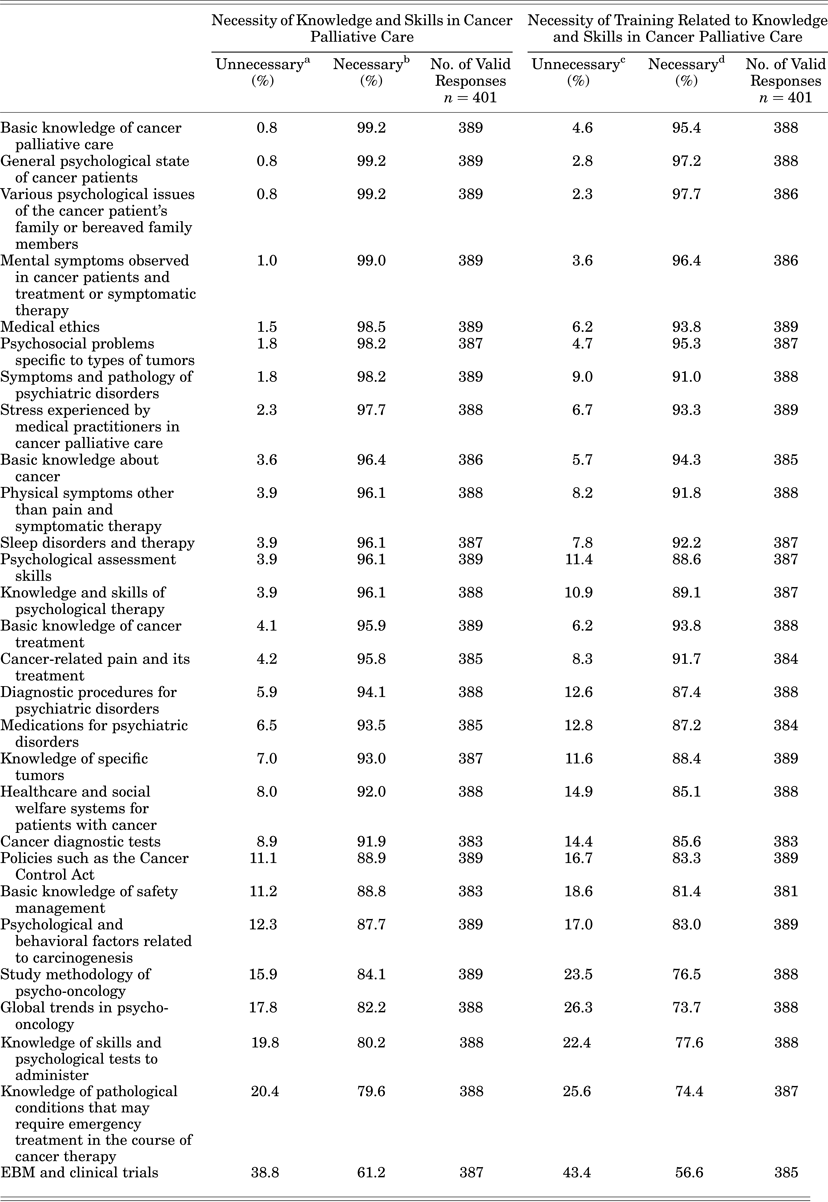
2. Knowledge and skills related to the field of cancer palliative care, including 28 items about the “necessity of knowledge and skills in cancer palliative care” and “necessity of training” (see Table 2). We asked participants to rate on a 4-point scale ranging from “0: unnecessary” to “3: necessary,” and collapsed these into the two categories of “unnecessary (0 or 1)” and “necessary (2 or 3)” for reporting purposes.
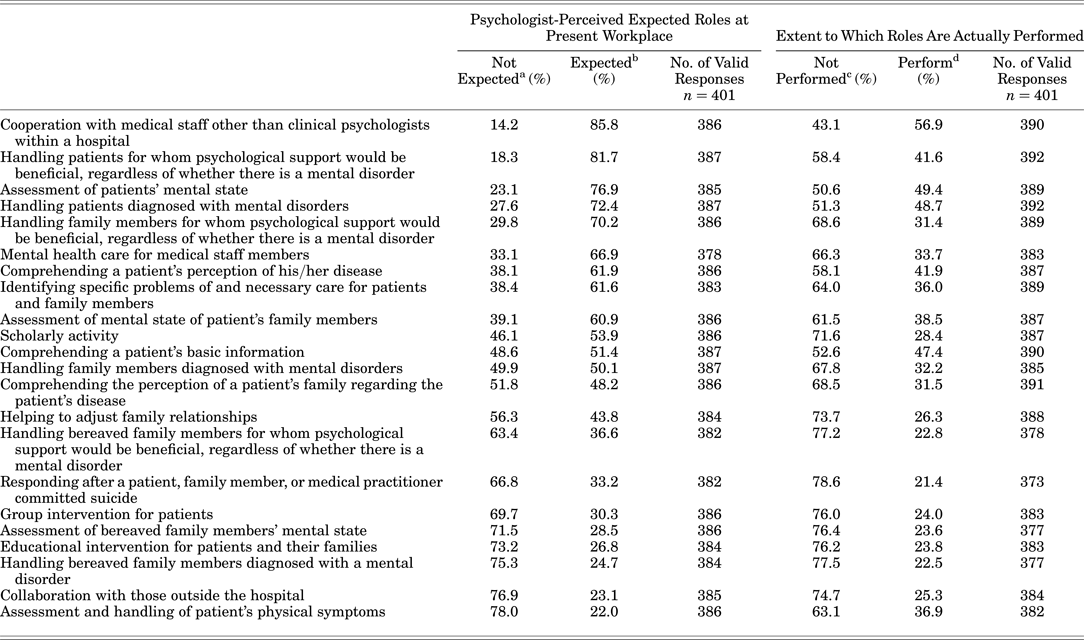
3. Work duties related to cancer palliative care, which included 22 items about “expected roles at current workplace” and “extent to which roles are actually performed” (see Table 3). On “expected roles at current workplace,” we asked participants to rate on a 4-point scale ranging from “0: not expected at all” to “3: often expected,” and collapsed these into two categories of “not expected (0 or 1)” and “expected (2 or 3)” for reporting purposes. On “extent to which roles are actually performed,” we asked participants to rate on a 4-point scale ranging from “0: often perform” to “3: do not perform at all,” and collapsed these into two categories of “perform (0 or 1)” and “not perform (2 or 3)” for reporting purposes.
4. Working conditions related to cancer palliative care at the present workplace, where subjects were asked what percentage of their duties during the past year were related to cancer palliative care, total number of cases, patients, and breakdown of types of work.
5. Problems faced by psychologists working in cancer palliative care, where subjects were asked to write freely about the troubles or hardships they have experienced while working in cancer palliative care.
We analyzed necessary knowledge and skills in cancer palliative care, expected roles in the workplace, and the extent to which roles are actually performed based on questionnaire answers in categories 1 (basic characteristics), 2 (knowledge and skills related to the field of cancer palliative care), and 3 (work duties related to cancer palliative care).
Analysis
To investigate the knowledge and skills that psychologists working in cancer palliative care feel are necessary, we evaluated “necessary” items with high percentages. We also evaluated “necessary” items with high percentages to examine the knowledge and skills for which psychologists in cancer palliative care require training,. To investigate expected roles at the current workplace, we evaluated “expected” items with high percentages. To examine the extent to which the roles were actually performed, we evaluated the percentage of “perform” responses.
RESULTS
Participant Characteristics
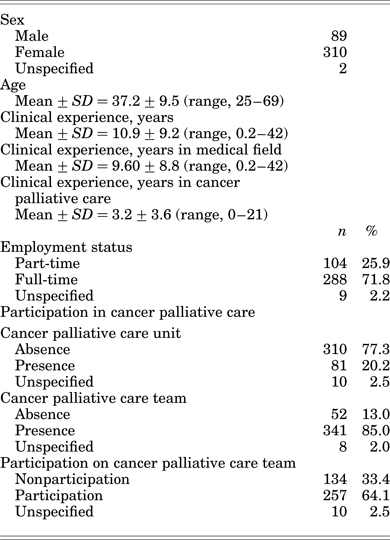
The sample consisted of 89 males, 310 females, and 2 of unspecified gender. The mean age (SD) was 37.2 (9.5) years. The mean number of years of clinical experience (SD) was 10.9 (9.0). The mean number of years of medical experience (SD) was 9.6 (8.8), and the mean number of years of experience in cancer palliative care (SD) was 3.2 (3.6). A total of 81 psychologists (20.2%) worked at hospitals with a palliative care unit. Some 341 psychologists (85.0%) indicated that their hospital had a palliative care team, and 257 psychologists (64.0%) participated in such a team (Table 1).
Participant characteristics

Necessary Knowledge and Skills in Cancer Palliative Care and Training
Regarding knowledge and skills in cancer palliative care, almost every item was considered necessary by more than 80% of participants. Items with “necessary” responses of more than 90% included 20 items, such as “basic knowledge of cancer palliative care” (99.2%), “general psychological state of cancer patients” (99.2%), and “various psychological issues of the cancer patient's family or bereaved family members” (99.2%) (see Table 2).
Necessity of knowledge, skills, and training in cancer palliative care
a Derived by adding the frequencies of “0: unnecessary” and “1: somewhat unnecessary.”
b Derived by adding the frequencies of “2: somewhat necessary” and “3: necessary.”
c Derived by adding the frequencies of “0: unnecessary” and “1: somewhat unnecessary.”
d Derived by adding the frequencies of “2: somewhat necessary" and "3: necessary.”
Psychologist-perceived roles as expected by medical staff members at their current workplace and the extent to which the roles are actually performed
a Derived by adding the frequencies of “0: not expected at all” and “1: rarely expected.”
b Derived by adding the frequencies of “2: sometimes expected” and “3: often expected.”
c Derived by adding the frequencies of “2: rarely perform” and “3: not perform at all.”
d Derived by adding the frequencies of “0: often perform” and “1: sometimes perform.”
Regarding training to obtain knowledge and skills, almost every item was considered “necessary” by more than 80% of participants. Items with percentages over 90% included 13 items, for example, “various psychological issues of the cancer patient's family or bereaved family members” (97.7%), “general psychological state of cancer patients” (97.2%), and “mental symptoms observed in cancer patients and treatment or symptomatic therapy” (96.4%) (Table 2).
Psychologist-Perceived Roles as Expected by Medical Staff Members at Their Current Workplace and the Extent to Which Roles Are Actually Performed
Psychologist-perceived expected roles at the present workplace, with percentages above 50%, comprised 12 items, including “cooperation with medical staff other than clinical psychologists within a hospital” (85.8%) and “handling patients for whom psychological support would be beneficial, regardless of whether there is a mental disorder” (81.7%) (Table 3).
Regarding the extent to which roles are actually performed, the percentage of “perform” responses was 21.4–56.9%, including “cooperation with medical staff other than clinical psychologists within a hospital” (56.9%), “assessment of patients' mental state” (49.4%), and “handling patients diagnosed with mental disorders” (48.7%) (Table 3). None of the items received more than 60% “perform” responses from participants.
DISCUSSION
Necessary Knowledge and Skills and the Necessity of Training for Psychologists in Cancer Palliative Care
More than 90% of participants responded that almost every item represented necessary knowledge and skills related to cancer. More than 80% of participants indicated a necessity for training in these items. These results reflect the relatively short mean number of three years of clinical experience in cancer palliative care and the lack of established education programs for psychologists in cancer palliative care in Japan (Iwamitsu et al., Reference Iwamitsu, Oba and Hirai2013). In the West, services provided by clinical psychologists in the medical setting have been called “clinical health psychology” since the 1990s (Belar & Deardorff, Reference Belar and Deardorff1995). Even then, the differences between clinical health psychology and traditional psychology or health psychology and training of clinical health psychologists were debated (Marzillier & Hall, Reference Marzillier and Hall1999). In Japan, the importance of psychologists being involved in cancer palliative care was stipulated by the 2007 Cancer Control Act. In addition, the 2012 Basic Plan for Cancer Control Measures stated that psycho-oncologists and psychologists involved in cancer palliative care should receive education related to providing psychological support for cancer patients and their families. The number of psychologists in cancer palliative care has increased rapidly during recent years. Although participants in this survey had more than 10 years of experience as clinical psychologists and approximately 10 years of experience working in medical settings, the average length of clinical experience in cancer palliative care was 3 years. This suggests that many psychologists in cancer palliative care provide services without adequate training.
The participants indicated a necessity for medical knowledge and skills, including such items as “medical ethics,” “symptoms and pathology of psychiatric disorders,” “diagnostic procedures for psychiatric disorders,” and “medications for psychiatric disorders.” More than 80% of participants indicated a need for training in these areas. Ebana (Reference Ebana2005) noted that psychologists in the medical field should acquire medical knowledge. Other studies have suggested that psychologists cannot play a role in medical settings due to inadequate graduate medical education (Sakano, Reference Sakano2004; Miyaoka, Reference Miyaoka2005; Murayama et al., Reference Murayama, Ashihara and Sata2005). Psychologists in cancer palliative care likely have similar issues as those in other medical settings.
Psychologist-Perceived Roles Expected in the Workplace and the Extent to Which Roles Are Actually Performed
Psychologist-perceived roles expected from medical staff members at their present workplace included such issues as “cooperation with medical staff other than clinical psychologists within a hospital,” “handling patients for whom psychological support would be beneficial,” and “assessment of patients' mental state.” The percentages of “perform” responses for every item were low (21.4–56.9%) relative to those of “expected” responses.
Specifically, the percentage of “expected” responses was 85.8% for “cooperation with medical staff other than clinical psychologists within a hospital,” while the percentage of “perform” responses was 56.9%. Although there are no clear criteria to determine if psychologists in cancer palliative care are fulfilling their roles, the fact that at least 70% of participants responded with “perform” suggests that psychologists in cancer palliative care are for the most part actually fulfilling their roles. It follows that psychologists involved in cancer palliative care cannot necessarily cooperate with medical staff other than clinical psychologists even though the percentage of “perform” responses about this role was highest. This suggests that psychologists in cancer palliative care should continue to strive for cooperation with other medical staff members within a hospital.
With regard to the role of psychological intervention in cancer palliative care, the figures were as follows: “handling patients for whom psychological support would be beneficial” (expected, 81.7%; perform, 41.6%), “handling patients diagnosed with mental disorders” (72.4, 48.7%), “handling family members for whom psychological support would be beneficial” (70.2, 31.4%), “comprehending a patient's perception of his/her disease” (expected, 61.9, 41.9%), “identifying specific problems of and necessary care for patients and family members” (expected, 61.6, 36.0%), and “handling family members diagnosed with mental disorders” (expected, 50.1, 32.2%). Additionally, the roles of psychological assessment in cancer palliative care—“assessment of patients' mental state” (expected, 76.9%) and “assessment of mental state of patient's family members” (expected, 60.9%)—showed percentages of “perform” responses at 49.4 and 38.5%, respectively. Less than 50% responded that they actually performed these roles. Because the mental state of cancer patients changes as a result of their physical condition, therapeutic course, and treatment side effects, psychologists involved in cancer palliative care must understand and apply knowledge regarding treatment when providing psychological support (Iwamitsu et al., Reference Iwamitsu, Hirai and Oba2009). The percentage of “perform” responses was also low (33.7%) for “mental health care for medical staff members” (expected, 66.9%). Knowledge of cancer palliative care is required in order to fulfill this role as well. In Japan, psychologists are trained in graduate schools that do not have a cancer palliative care curriculum (Iwamitsu et al., Reference Iwamitsu, Oba and Hirai2013). In Europe, the final report of the European Federation of Professional Psychologists' Associations (EFPPA) specified that clinical health psychologists have a responsibility to become appropriately trained and experienced to ensure that they only practice in areas of their competence, in conformance with the ethical code of the psychology profession. Additionally, the EFPPA noted the necessary components of clinical health psychologist training as follows: (1) academic knowledge base (psychology); (2) academic knowledge base (other); (3) application of psychological skills to health care; (4) research skills; (5) teaching and training skills; (6) management skills; (7) professional issues; and (8) ethical issues (Marks et al., Reference Marks, Brücher-Albers and Donker1998). The results of our study also show that more than 70% of participants felt that both knowledge and skills in cancer palliative care as well as training for psychologists in cancer palliative care are necessary. It follows that most psychologists in cancer palliative care in Japan require adequate knowledge and skills to work effectively.
Although the “expected” percentage for “scholarly activity” was 53.9%, the “perform” percentage was low (28.4%). As stated above, European clinical health psychologists involved in the medical field have a responsibility to acquire research skills in addition to a wide range of knowledge and practical abilities. Given that the “expected” percentage of “scholarly activity” in this study was not low, it seems that psychologists in cancer palliative care in Japan should make an effort to pursue further scholarly activity.
The roles for which the “perform” response was less than 30% included “group intervention for patients” (24.0%), “educational intervention for patients and their families” (23.8%), “assessment of bereaved family members” (23.6%), and “handling bereaved family members” (22.8%), among others. Psychologists in cancer palliative care in Japan may have limited opportunities to fulfill these roles due to the low “expected” percentages involved (22.0–43.8%).
LIMITATIONS OF THE STUDY
There are several limitations to our study. First, we used a double-envelope system in that we sent questionnaires to institution representatives and a questionnaire to the psychologists who worked at those facilities. Questionnaires were distributed to psychologists by institutional representatives. While the response rate of psychologists was 95.7%, the response rate of institutional representatives was 34%. Our results do not necessarily reflect the opinions of psychologists working at facilities in which representatives did not show an interest in the survey. In the future, we will employ a survey technique that reflects the opinions of as many psychologists as possible. Second, although we describe the number of years of experience in medical and cancer palliative care and participation on a palliative care team, evaluations were not performed to address these points. Iwamitsu and colleagues (Reference Iwamitsu, Oba and Hirai2013) reported that psychologists in cancer palliative care experience stress related to isolation, anxiety, internal conflicts, and burnout. Thus, future studies should focus on these issues as well as other factors, such as the personality and mental state of the psychologists, to gain a better understanding of the realities faced by psychologists in cancer palliative care in Japan.
ACKNOWLEDGMENTS
This study was supported in part by a grant-in-aid for cancer research from the Japanese Ministry of Health, Labour, and Welfare.