Implications
The results are of interest for farmers and technicians at artificial insemination (AI) centres because they present a technique using only extra light, which can be applied in open barns and that produces robust out-of-season sexual activity in rams during the spring, a period when they are usually in sexual rest.
Introduction
Seasonal breeding is one of the major technical and economic constraints of sheep reproduction in temperate latitudes because of a well-defined breeding season in both sexes. At temperate latitudes, rams and ewes are sexually active from the end-summer to the end of winter and are in sexual rest or anovulation the rest of the year (Ortavant et al., Reference Ortavant, Pelletier, Ravault, Thimonier and Volland-Nail1985). This results in the seasonal appearance of meat and milk products on the market, important changes in the price paid to farmers and major variations in the quality of milk and meat over the year (Chemineau et al., Reference Chemineau, Malpaux, Brillard and Fostier2007). The hormonal treatment of females, which uses synthetic progestagens to mimic the luteal phase of the cycle followed by gonadotropins extracted from pregnant mare serum (equine chorionic gonadotropin (eCG), previously called PMSG) to stimulate intra-ovarian follicular growth at the end of the progestagen treatment, has been widely used for more than 40 years and has allowed out-of-season breeding, associated with or without AI (Driancourt and Delgadillo, Reference Driancourt and Delgadillo2014).
The combination of hormonal treatments with AI has led to tremendous progress, such as in sheep milk production, ewe litter size (Martin et al., Reference Martin, Raoul and Bodin2014) and scrapie resistance (Sidani et al., Reference Sidani, Astruc, Bouchel, Bouffartigue, Du, Raoul and Barillet2013). These hormonal treatments, because of the use of hormonal compounds, have been criticized for various reasons and this has led to the development of new methods for inducing out-of-season breeding activity in sheep and goats (Lopez-Sebastian et al., Reference Lopez-Sebastian, Coloma, Toedano and Santiago-Moreno2014).
For two to three decades, light and/or melatonin treatments were developed to advance or displace the breeding season in sheep and goats, and these treatments are now largely and satisfactorily used in field conditions and/or in AI centres (Arranz et al., Reference Arranz, Lagriffoul, Guérin and Chemineau1995; Chemineau et al., Reference Chemineau, Malpaux, Brillard and Fostier2007; Delgadillo, Reference Delgadillo2011). They use an alternation between long days during the winter followed by short days or melatonin treatment during the spring and summer. This alternation was demonstrated as essential for controlling out-of-season sexual activity in goats (Chemineau et al., Reference Chemineau, Normant, Ravault and Thimonier1986 and Reference Chemineau, Malpaux, Delgadillo, Guerin, Ravault, Thimonier and Pelletier1992). The out-of-season cyclical activity in ewes and she-goats can then lead to high female fertility (Chemineau et al., Reference Chemineau, Malpaux, Pelletier, Leboeuf, Delgadillo, Deletang, Pobel and Brice1996), allowing farmers to sell milk and meat products at a high price on the market (Chemineau et al., Reference Chemineau, Malpaux, Brillard and Fostier2007). In rams, these treatments also induce an increase in out-of-season spermatogenesis associated with a dramatic improvement of libido, allowing the farmer to use them to fertilize ewes or to produce a large quantity of semen with good fertilizing ability at AI centres (Arranz et al., Reference Arranz, Lagriffoul, Guérin and Chemineau1995). However, the continuous quest for replacing exogenous hormones has led to the development of treatments in which melatonin can be replaced by a non-hormonal alternative.
In subtropical conditions (Delgadillo et al., Reference Delgadillo, Carrillo, Moran, Duarte, Chemineau and Malpaux2001) and/or in the Mediterranean area (Zarazaga et al., Reference Zarazaga, Gatica, Celi, Guzman and Malpaux2010a), it was demonstrated that the use of only the first part of the treatment, that is, 2 months of extra light without melatonin, was sufficient to induce a robust increase of sexual activity in bucks. However, this is not the case in rams (Arranz et al., Reference Arranz, Lagriffoul, Guérin and Chemineau1995) and female goats (Chemineau et al., Reference Chemineau, Normant, Ravault and Thimonier1986) at the latitude of the South of France. Therefore, it is important to determine whether we can replace melatonin treatment by a non-hormonal alternative, at least in temperate latitudes.
Interestingly, the suppression of any melatonin signalling by pinealectomy after 2 months of long day (LD) treatment during the winter gave the same reproductive response as short days (SD) and/or melatonin treatments (Wayne et al., Reference Wayne, Malpaux and Karsch1990). The conclusion of the authors was that the reproductive response following the shift from LD to SD was more the consequence of the cessation of LD rather that the presence of SD. Therefore, if Pinx, by suppressing endogenous melatonin, yields the same reproductive result as SD (or melatonin), it is theoretically possible to replace Pinx with continuous lighting, which also provokes a complete cessation of endogenous melatonin secretion. This hypothesis was tested in four successive experiments, which are described in the present study, performed in Ile-de-France rams. Compared with control rams, and/or with a 60-LD treatment applied in winter, we tested the effects of the replacement of SD and/or melatonin treatment with permanent light (LL) on reproductive characteristics. We evaluated various parameters, such as nocturnal melatonin, testis volume, testosterone secretion and ram fertility.
Material and methods
Animals and experimental conditions
Four experiments during 4 consecutive years (2004–07) were conducted on ‘Ile-de-France’ rams housed in the experimental facility of INRA (UEPAO) at 45° north latitude. All procedures were performed in accordance with the European directive 2010/63/EU on the protection of animals used for scientific purposes and under the authorization number 37–077. Rams were 3 to 7 years old at the beginning of the experiments and weighed (mean±SEM) 73±7, 94±3, 88±3 and 90±4 kg in experiments 1, 2, 3 and 4, respectively. In experiment 1, rams (n=11) were housed in a barn, completely lightproof to outdoor light, where it was possible to produce artificial darkness. In experiments 2, 3 and 4 (n=20, 56 and 21 rams, respectively), animals were housed in a classical open barn in which rams were submitted to a natural photoperiod, but where we can provide extra light during the natural hours of darkness. Long days (LD) were days with 16 h of light and 8 h of darkness/24 h.
Description of the four experiments
The first experiment was designed to determine whether permanent lighting after a period of long days could suppress endogenous melatonin secretion and stimulate spermatogenic activity. Two groups of rams were compared as follows: one group (LD group) was subjected to 200 LD from 15 March until 30 September and the other group (LD-LL1 group) was subjected to 60 LD from 15 March until 15 May followed by 120 days of permanent lighting. The light was ~300 lux at the animal’s eye level. We measured melatonin concentrations hourly once over a 30-h cycle on 18 June, weekly testosterone plasma concentrations from 27 April until 8 November and twice monthly ram testicular volume from mid-April until the end of October. The second experiment was designed to compare LD-LL treatment with natural photoperiod and compared two groups of rams as follows: one group (NatPhot2 group) was subjected to a natural photoperiod from 23 December to 22 June, and the other group (LD-LL2 group) was subjected to 60 LD from 23 December until 22 February followed by 120 days of permanent lighting. We measured ram testicular volume twice monthly and ram fertility in both groups. The third experiment was designed to determine whether the LD-LL schedule was as efficient as the ‘classic’ LD-melatonin schedule and compared three groups of rams as follows: one group (NatPhot3 group) was subjected to a natural photoperiod, one group (LD-LL3 group) was subjected to 60 LD from 1 December until 31 January followed by 120 days of permanent lighting, and one group (LD-Mel group) was subjected to 60 long days from 1 December until 31 January and then returned to a natural photoperiod and received three subcutaneous melatonin implants (Melovine®/Regulin®; CEVA-Santé Animale, Libourne, France), providing a constant plasma melatonin concentration of ~90 pg/ml for ~90 days (Chemineau et al., Reference Chemineau, Maurice and Daveau1993). We measured ram testicular volume twice monthly and ram fertility in both groups. The fourth experiment was designed to confirm the results of experiment 3 and consisted of a single group of rams (LD-LL4 group) subjected to 60 long days from 1 December until 31 January followed by 120 days of permanent lighting. We measured ram testicular volume twice monthly.
Hormone assays
The concentrations of testosterone were determined using a direct radioimmunoassay (RIA) method derived from Garnier et al. (Reference Garnier, Cotta and Terqui1978) and Hochereau-De Reviers et al. (Reference Hochereau-De Reviers, Perreau, Pisselet, Fontaine and Monet-Kuntz1990). For each sample, 100 µl of plasma was assayed in duplicate. To each tube, buffer containing 7.5 nCi-labelled testosterone and buffer with a specific antiserum from rabbit (diluted at 1/100 000) with 0.5 µl rabbit serum were added. After 1 h at 37°C, 50 µl of anti-rabbit γ-globulin sheep serum were added. After an overnight incubation at 4°C, 2 ml of a solution with polyethylene glycol at 80 g/l was added. After centrifugation and elimination of the supernatant, the remaining precipitate was dissolved with ethanol and 2 ml of scintillation liquid are then added. The level of radioactivity was measured with a beta counter. The antiserum cross-reacted with dihydrotestosterone (43%), androstenediol (4.5%), androstenedione (4.5%) androstanediol (3.5%) and less with other steroids (0.1%). The minimum level of quantification was 0.06 ng/ml. All samples were assayed in the same assay. The intra-assay coefficients of variation were 20.3%, 7.1% and 12.1% for samples containing 0.6, 2.3 and 4.2 ng/ml of testosterone, respectively.
Melatonin was determined as previously described (Zarazaga et al., Reference Zarazaga, Todini, Chemineau, Marnet, Locatelli and Malpaux2010b). Briefly, melatonin was assayed using a direct RIA with [125I]2-iodomelatonin as a tracer (Vakkuri et al., Reference Vakkuri, Leppaluoto and Vuolteenaho1984) and a previously described anti-melatonin antiserum (Tillet et al., Reference Tillet, Ravault, Selve, Evin, Castro and Dubois1986). This direct assay, originally described by Fraser et al. (Reference Fraser, Cowen, Franklin, Franey and Arendt1983), was performed according to the modifications of Webley et al. (Reference Webley, Mehl and Willey1985) and Ravault et al. (Reference Ravault, Arendt and Tobler1989). Briefly, 100 µl of rabbit anti-melatonin antiserum (final dilution: 1/400 000) and 300 µl of [125I]2-iodomelatonin (15 000 cpm/tube) were added to 100 µl of assay buffer (tricine) or undiluted plasma. After 16- to 18-h incubation at 4°C, the antigen–antibody complexes formed were precipitated by the addition of 1 ml of sheep anti-rabbit antiserum (INRA). After 1 h of incubation, the samples were centrifuged (2800×g for 30 min at 4°C), and the supernatant was then discarded and the pellet counted on a gamma counter. A standard curve obtained from successive dilutions from 1000 to 4 pg/ml of melatonin (Fluka 63610; Fluka, Sigma-Aldrich, Saint Ouen, Fallavier, France) was prepared in pinealectomized sheep plasma. The minimum level of quantification was 4 pg/ml. The CV was estimated by assaying three plasma samples (low, medium and high concentrations) in duplicate for every 50 unknown samples. The intra-assay coefficients of variation were 10% and 5% for samples containing 68 and 142 pg/ml of melatonin, respectively. All samples were analysed in the same assay.
Testicular volume
The testicular volume was manually assessed by comparative palpations with an ‘orchidometer’, a series of wooden bowls of increasing diameter previously designed using testis dimensions after slaughter, as described by Oldham et al. (Reference Oldham, Adams, Gherardi, Lindsay and McKintosh1978). Briefly, the technique consists of comparatively estimating the volume of one testicle in one hand with an orchidometer bowl of similar volume in the other hand.
Fertility measurements
Rams were used in experiments 2 and 3 for hand-mating with ewes previously synchronized with 30 mg fluorogestone acetate (FGA)-impregnated sponges left in place for 12 days followed by an i.m. injection of eCG/PMSG at sponge removal (FGA, Chrono-gest; Intervet S.A., Angers, France).
This measurement of fertility was performed within a flock owned by INRA-UEPAO, in which ewes must be fertilized by definite rams because of specific families. This was only possible for experiments 2 and 3. The fertility of rams was defined as the number of ewes pregnant, attested by lambing (experiment 2) or pregnancy diagnosis by plasma progesterone analysis (Terqui and Thimonier, Reference Terqui and Thimonier1974) at day 18 after mating (experiment 3), compared with the number of ewes hand-mated, in per cent.
Statistical analyses
For continuous data, the statistical analyses were performed using SAS software (SAS Institute Inc., Cary, NC, USA). In experiment 1, the daily melatonin concentrations were examined by ANOVA using a repeated measures model with the GLM procedure (Little et al., Reference Little, Henry and Ammerman1998). Classically for hormonal data and consistent with Guillaume et al. (Reference Guillaume, Zarazaga, Malpaux and Chemineau2006), data were previously transformed by a logarithmic transformation because of their limitation by 0, and for their normalization and the equality of variances between groups required by the ANOVA. The analysis tested the following factors: treatment, dark or light periods (in reference to the control group) and rams nested under treatment. The testicular volume variations in the four experiments and testosterone concentrations in experiment 1 were compared between periods and/or between treatments by ANOVA using a repeated measures model GLM procedure (Little et al., Reference Little, Henry and Ammerman1998). For the analysis, each period was defined relative to the beginning of the LL treatment (day 0: D0), such that the number of considered periods is not the same for the four experiments.
Statistical analyses conducted following the ANOVA consisted of comparing, intra-experiment, groups by separating data into different successive periods. The different measurements included in a given period are thus considered the repetition of the measurement within a physiological stage of response to treatment. These divisions are performed relatively arbitrarily, but they allow the comparison of 2 per 2 and all different interactions for groups×periods. In this type of analysis with repeated measures, the error term used for the group factor was the animal nested within the group, and the total number of periods to be tested should be inferior to the number of animals per group. Therefore, in experiment 1, for the melatonin analysis, we distinguished a nocturnal and a diurnal period. For the testosterone and testicular volume, four periods were distinguished relative to the evolution of the testicular volume of the LD-LL1 group, with a minimum during long days (T<0), growth during the onset of LL treatment (T0 to 50), plateau (T51 to 100) and decrease (T>100). In experiment 2, five periods were distinguished relative to the evolution of the testicular volume of the LD-LL2 group, with a minimum during long days (T<0), slow growth during the onset of LL treatment (T0 to 30), rapid growth (T31 to 50), plateau (T51 to 80) and decrease (T>80). In experiment 3, six periods were distinguished relative to the evolution of the testicular volume of the LD-LL3 group, with a decrease during long days (T<0), minimum then slow growth during the onset of LL treatment (T0 to 30), rapid growth (T31 to 50), beginning of the plateau (T51 to 81), end of the plateau (T81 to 110) and decrease (T>110). Finally, in experiment 4, five periods were distinguished relative to the evolution of the testicular volume of the LD-LL4 group, with a minimum during long days and during the onset of LL treatment (T<18), rapid growth (T18 to 61), onset of plateau (T62 to 90), end of plateau (T91 to 120) and decrease (T> 120). These periods were indicated in the results on different curves.
For discrete data, in experiments 2 and 3, the fertility between groups was compared using the number of pregnant ewes with a non-parametric Pearson χ 2 exact test using the StatXact® a statistical software developed by Cytel® (Paris, France Business Development Office, Batiment, Antony, France, http://www.cytel.com/software/statxact). All results are expressed as the mean±SEM.
Results
Experiment 1
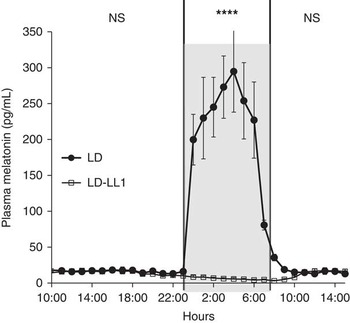
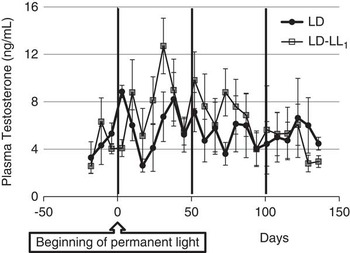
Plasma melatonin concentrations differed within groups and periods, and the interaction between group and period were significant (P=0.0004 or less). All rams of the LD-LL1 group experienced a complete suppression of their nocturnal melatonin concentration during the 30 h of sampling, whereas all rams of the LD group presented a highly significant increase in nocturnal melatonin plasma concentrations (Figure 1). Testosterone concentrations varied significantly with animal and period (both P<0.0001) but not with treatment or with the interaction between treatment and period (Figure 2).
The mean±SEM plasma melatonin concentrations in adult Ile-de-France rams from two groups: one group (LD group, closed circles) was subjected to 200 long days from 15 March until 30 September, and the other group (LD-LL1 group, open squares) was subjected to 60 long days from 15 March until 15 May followed by 120 days of permanent lighting. Rams of these two groups were sampled hourly during 30 h on 17 to 18 June. The grey area represents the dark phase of the LD group during which blood samples were taken under red light, and the vertical lines indicate the period taken into account in the statistical analysis. The significance of the statistical difference between the different periods×groups are presented on the top of the figure (****P<0.0001).

The mean±SEM testosterone plasma concentrations in adult Ile-de-France rams from two groups: one group (LD group, closed circles) was subjected to 200 long days from 15 March until 30 September, and the other group (LD-LL1 group, open squares) was subjected to 60 long days from 15 March until 15 May followed by 120 days of permanent lighting. Plasma samples were collected weekly from 27 April until 8 November. The vertical lines indicate the period taken into account in the statistical analysis. The differences were not significant.

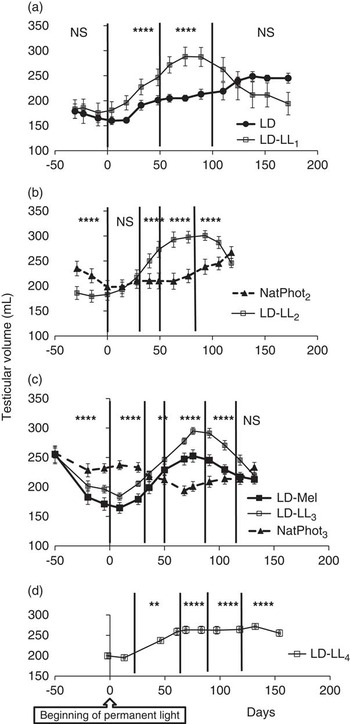
Testicular volume varied significantly with animal, period and with the interaction treatment×period (P<0.0001) but not with treatment (P=0.27). Testicular volume was significantly higher in rams of the LD-LL1 group than in rams of the LD group during the periods T0 to 50 and T51 to 100 (P<0.0001 in both periods). This volume was not different between groups in the periods T<0 and T>100 (P=0.29 and P=0.057, respectively) (Figure 3a).
The mean±SEM testicular volumes in adult Ile-de-France rams of different groups in successive experiments to test the effects of a sequence of long days-permanent lighting on sexual activity (a, b, c and d for experiments 1, 2, 3 and 4, respectively). (a) LD-LL1 group, open squares; LD group, closed circles. (b) LD-LL2 group, open squares; NatPhot2, closed triangles. (c) LD-LL3 group, open squares’ NatPhot3, closed triangles, LD-Mel closed squares. (d) LD-LL4 group, open squares. Day 0 of the X-axis is the beginning of permanent lighting after 2 months of long days (D0=15 May; 23 February; 1 February; and 1 February for experiments 1, 2, 3 and 4, respectively). The vertical lines indicate the different periods used in the statistical analyses. The significance of the statistical difference between different groups for each period is indicated by stars in the top of the figure (****P<0.0001, ***P<0.001, **P<0.01, *P<0.05). (c) Only the differences between groups LD-LL3 and NatPhot3 are plotted. (d) There is only one group (LD-LL4), only the differences between the first period and successive periods are plotted.

Experiment 2
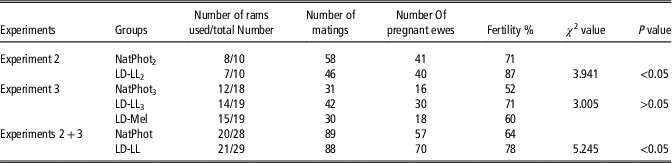
Testicular volume varied significantly with animal, period and with the interaction treatment×period (P<0.0001) but not with treatment (P=0.17). The testicular volume was significantly higher in rams of the LD-LL2 group than in rams of the NatPhot2 group during each of the three last periods of the experiment (T>30) (P<0.0001) (Figure 3b). The fertility of rams from group LD-LL2 was higher than that of rams of the NatPhot2 group (Table 1).
Fertility after hand-mating of Ile-de-France rams subjected to long days followed by permanent lighting (LD-LL) or melatonin implantation (LD-Mel) compared with rams left under natural photoperiod (NatPhot) in two consecutive experiments

Experiment 3
The testicular volume varied significantly with treatment (P=0.026) and was significant for animal, period and with the interaction treatment×period (P<0.0001). The testicular volume was significantly higher in rams of LD-LL3 group than in rams of LD-Mel group during the entire study (P=0.012), but no difference appeared between the LD-LL3 and the NatPhot3 group. The decrease of the testicular volume is significantly higher in rams of the LD-Mel group than in rams of the LD-LL3 group (P=0.0086) during the long days before LL. This difference between LD-LL3 and NatPhot3 was highly significant (P<0.001) during T31 to 50, T51 to 80 and T81 to 110. The difference between LD-LL3 and LD-Mel was also significant (P<0.01) during all different periods and was highly significant (P<0.0001) during the plateau (T51 to 80 and T81 to 110). Rams of the LD-Mel groups had a higher (P<0.001) testicular volume than NatPhot3 rams during the plateau (T51 to 80 and T81 to 110). At the end of the treatment (T>110), the testicular volume remained significantly higher in the LD-LL3 group than in the LD-Mel group (P=0.0083) but not higher than that of the NatPhot3 group (P=0.27). The testicular volume of NatPhot3 rams was significantly higher than the rams of the two other groups during T<0 and T0 to 30 (P<0.0001 for both) (Figure 3c). In experiment 3, the fertility of rams did not differ among groups. When the results of experiments 2 and 3 were pooled, rams of the LD-LL groups had significantly higher fertility than that of the NatPhot rams (Table 1).
Experiment 4
Testicular volume varied significantly with animal and period (P<0.0001). This volume increased quickly and significantly (P<0.0001) after the onset of LL. After the onset of LL, the testicular volume during the different periods (T18 to 61, T62 to 90, T91 to 120 and T> 120) did not differ among periods (Figure 3d).
Discussion
In all experiments presented here, the succession LD-LL induced a significant and robust increase in the testicular volume of treated rams compared with rams maintained under natural photoperiodic variations. As expected, in the first experiment, the LL treatment suppressed the endogenous melatonin secretion from the pineal gland. Control rams, which were subjected to a schedule of 16 h of light and 8 h of darkness, showed a ‘classical’ melatonin secretion at night, with nocturnal concentrations between 100 and 500 pg/ml of plasma contrasting with diurnal concentrations remaining below 30 pg/ml of plasma. Conversely, LL treatment maintained the melatonin secretion of the treated rams below 30 pg/ml of plasma during the entire sampling sequence, without any marked changes over the 24-h cycle. This absence of melatonin variations under LL indicates that in our experimental animals, we were able to completely suppress any photoperiodic signal and this was interpreted, after a long day sequence, as being equivalent to short days or melatonin treatment. The interpretation of the absence of melatonin secretion as a short day period or melatonin implantation is scientifically very intriguing but fits with results obtained previously (Wayne et al., Reference Wayne, Malpaux and Karsch1990). Therefore, it may be more the end of a long day period than the onset of melatonin presence, which is translated into a neural then a neuroendocrine process leading to the onset of the luteinizing hormone releasing hormone/luteinizing hormone (LHRH/LH) pulsatile activity (Viguie et al., Reference Viguie, Caraty, Locatelli and Malpaux1995; Malpaux et al., Reference Malpaux, Daveau, Maurice-Mandon, Duarte and Chemineau1998).
This sequence LD-LL induced a highly significant increase in testicular volume in spring compared with rams maintained under LD (experiment 1), rams subjected to natural photoperiodic changes (experiments 2 and 3) or initial testicular volume at the beginning of the experiments (experiment 4). The testicular volume increased from 150 to 200 ml at the end of the LD period to a maximum of ~250 to 300 ml between 60 and 80 days after the onset of LL treatment. This dramatic increase of ~60% between these two points is equivalent to that observed for rams of the same breed between spring and autumn when maintained under natural photoperiodic conditions (Thibault et al., Reference Thibault, Courot, Martinet, Mauléon, du Mesnil du Buisson, Ortavant, Pelletier and Signoret1966). This is also indicative of a dramatic change in the yield of spermatogenetic processes, leading to an associated increase in sperm output (Dacheux et al., Reference Dacheux, Pisselet, Blanc, Hochereau-de Revers and Courot1981), in sperm quality (Colas, Reference Colas1980) and sperm fertilizing ability (Colas, Reference Colas1981). These processes occurred under the control of the hypothalamic neurohormone LHRH, which likely increased its frequency of release in the portal blood to stimulate LH and FSH release, which stimulate different cells in the testis. The comparison of rams treated with the sequence LD-melatonin (experiment 3) showed that changes observed in the testicular volume were equivalent to those of LD-LL rams. This confirms the observation above that LL has the same effect along the hypothalamic–pituitary–gonadal axis as melatonin treatment.
Despite the dramatic evolution of testicular volume, the difference between the two groups for testosterone plasma concentrations (experiment 1) was not significant. This may be explained by the episodic nature of testosterone secretion over a 24-h cycle that is linked to corresponding LH pulses, which made the weekly frequency of sampling insufficient to reveal differences between the two groups which, in this experiment, have only a limited number of rams. Another explanation for this absence of difference between groups for testosterone plasma levels is that although we observed an increase in testis volume, this could also be due to the activity of Leydig cells producing testosterone in the testis, which was sufficient to stimulate the adjacent seminiferous tubules to increase the yield of spermatogenesis, but not sufficient in the general circulation (in which we followed the levels) to induce a significant difference between groups.
Fertility after hand-mating was significantly higher in the LD-LL groups in experiments 2 and 3, providing an increase of pregnancy by ~15 percentage points from LD-LL rams. If these results are confirmed in a larger set of rams and within AI centres, such an increase may represent an interesting advantage for farmers and/or AI centres using this treatment for their rams.
Therefore, this sequence LD-LL (long days followed by permanent light) was equivalent to the previously used sequence LD-melatonin or LD-short days, which have been used for some years now either in farms or AI centres. In the spring when rams are usually in sexual rest, this light treatment provides testicular volumes equivalent to those observed during the sexual season at the end-summer beginning of autumn, this was the case of the LD-LL Ile-de-France rams of the present study. Their fertility was higher than control rams. This new treatment, which can be applied easily in open barns and is of a very low cost, does not use any exogenous hormone. The results obtained in the four experiments presented here clearly confirmed the hypothesis of a possible replacement of short days or melatonin with continuous light (LL) after a long day treatment (LD) in rams to stimulate their sexual activity during the rest season.
Acknowledgements
The authors acknowledge the staff of the UEPAO experimental unit in Nouzilly who took care of all experimental animals during the experiment, the staff of the assay laboratory for performing the testosterone assay and Dr Matthieu Keller for his help in writing this manuscript.