

Introduction
Like other economic sectors, Swiss farming was also was hit by the liberalisation of international trade that began at the end of the last century. Confronted with greater market integration and increased pressure on prices, Swiss agricultural policy adapted to the new international trade conditions, abandoning price and export support. In the process, which quite paradoxically coincided with the decrease of peasants’ political influence in the country, despite the substantial growth of the SVP (Schweizerische Volkspartei), the party being traditionally very close to the rural world (Pilotti, Reference Pilotti2017: 239),Footnote 1 the sector underwent a rapid restructuring. Even though farmland did not change in any significant way, the number of farms shrank by a third, from 79,500 to 53,200 in just two decades (1996–2015). The contraction affected mainly small farms in mountain areas, which were most vulnerable to cuts in production prices, but it also affected those which, unable to benefit from economies of scale, were more at risk of indebtedness because of their financial commitments and increasingly sizeable investment in production.
Indebtedness is not a new problem in Swiss agriculture (Rieder, Reference Rieder2006). In the past, the problem was exacerbated by economic and political factors. During the first half of the nineteenth century, for example, the liberalisation of the land market led to an increase in land prices, which in turn caused increased indebtedness amongst farmers, who had no choice but to borrow (mostly informally) to finance their investments in land (Brugger, Reference Brugger1978; Lorenzetti, Reference Lorenzetti2010). A further period of indebtedness occurred during the 1870s, as a result of the European economic crisis of those years. Competition from cereal imports led to the ruin of many peasant farmers who were unable to repay debts incurred in previous years. It is estimated that almost a quarter of Swiss peasants found themselves bankrupt as a result of excessive debt (Rieder, Reference Rieder2006: 728) and more than 10,000 were forced to leave their farms and their land (Popp, Reference Popp2000: 32). The changes in production over the following decades were just as critical. The abandonment of cereal production in favour of forage production and livestock farming compelled many peasant farmers to make major investments, causing them to become further indebted after taking out loans with the cantonal and rural banks (Feldmann, Reference Feldmann1934–5).
Our analysis of Swiss agriculture begins during this restructuring phase and focuses on the period between the end of the nineteenth century and the outbreak of the Second World War, when for the first time the federal state intervened to alleviate agricultural debt. The article seeks to determine the reasons for the increase in agricultural indebtedness, despite the introduction of a ‘controlled market’ based on the support of production prices by the State. The article will also show that, though carrying out measures to ensure the smooth running of mortgage loans – integrated since 1930 into a system of guarantees designed to limit the risks for creditors – Switzerland continued to put off any debt relief measures, preferring to step in with precise measures, such as credit payments and extraordinary subsidies.
These two issues will be examined in three stages. First of all, we will illustrate the role of economic and political factors and of the restructuring of production in the face of growing agricultural indebtedness. We will then seek to outline the extent and the immediate impact of the changes, as well as the regional variations. Finally, the article will analyse the most important measures put in place to deal with the changes, highlighting their main features and the ways in which they were applied during this period.
1. The origins of agricultural indebtedness: economic trends and productive reconversion
Several factors have, directly or indirectly influenced (or even further) agricultural indebtedness in Switzerland from the end of the nineteenth century. These involve short-term trends, relating to short-term fluctuations (both political and economic in nature), and medium-term processes concerning the changes in the productive structure of the agricultural sector.
1.1. Economic trends and prices
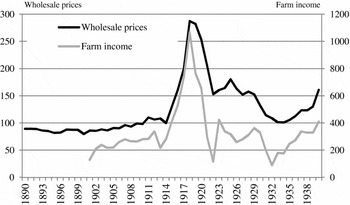
The economic performance of Swiss farms was strongly influenced by the evolution of the wholesale prices of agricultural products (Figure 1). In the years before the First World War their moderate rise – aided by the implementation of a ‘controlled market’ based on the price fixing agreements between the federal government and the key players of the agricultural industry (Brugger, Reference Brugger1978; Brugger, Reference Brugger1992; Moser, Reference Moser1994) – was accompanied by a slight rise in yields per hectare on the farms. However, the outbreak of war and the consequent food import ban caused a surge in agricultural prices, which in turn led to a sharp rise in average income. Income increased from about 374 francs per hectare in the period 1906–13 to 607 francs per hectare during the war years, peaking at 1,069 francs per hectare in 1918.
Evolution of wholesale prices of agricultural products (index for 1914 = 100) and of farm income (CHF/ha), 1890–1940.

The end of the conflict led to a sharp drop in the prices of agricultural produce and, more generally, in consumer prices, which nevertheless remained higher than in the prewar years. Prices declined further, however, during the economic crisis of 1921, when the price of milk for cheese production fell from 0.36 to 0.22 francs per litre (-37.5 per cent), the price of beef fell from 2.60 to 1.80 francs per kg (-30.8 per cent) and the price of pork from 3.10 to 2.00 francs per kg (-35.4 per cent).Footnote 2
It was mainly the alpine regions – whose agriculture was geared more towards the dairy sector – which suffered from these trends and which were exposed to higher risks of indebtedness. The drop in prices led to an abrupt decline in income. Between 1919 and 1922, the average income per hectare fell from 767 to 117 francs, and the rate of return (as a percent of assets) became negative (-1.61 per cent in 1922). Over the following years, there was much instability, with levels of income oscillating between 200 and 360 francs per hectare. It was not until 1932 that income levels began to rise, as prices recovered slightly, crossing the threshold of 400 francs per hectare in 1940.
1.2. Restructuring of production and production costs
Over the medium term, from the last third of the nineteenth century, the economic problems of the farms and the risks of indebtedness among the peasantry worsened as imported agricultural products arrived on the Swiss market. In Switzerland, as in other European countries, the consequent fall in cereal prices triggered a marked change in the type of farming. Crops (especially cereal production) suffered a sharp decline in favour of livestock and dairy farming (Brugger, Reference Brugger1978). At this time, cereal-producing areas contracted by 65 per cent, from 300,000 hectares in the mid-nineteenth century to 105,000 hectares in 1912 (Dérobert, Reference Dérobert1945).
In subsequent years, however, overproduction in the dairy sector (with a consequent fall in prices) and a contraction in exports meant that Swiss farmers faced a complicated dilemma, since a return to cereal production required major financial resources and higher protective tariffs (Baumann, Moser, Reference Baumann and Moser1999: 83; Müller, Reference Müller2010: 76). Thanks to government support (subsidies, grants, production price guarantees), in the 1920s and 1930s cereal production rose to 136,900 hectares on the eve of the Second World War, although it never reached the surface area covered a century earlier. Conversely, the extent of pasture land and forage crops contracted from 866,500 hectares in 1905 to 768,535 hectares in 1939.Footnote 3
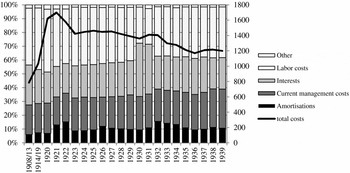
The absence of specific data makes it impossible to measure directly the impact of these reconversions on the economic fortunes of the peasant farms. Changes in the structure of production costs (Figure 2), however, suggest that after a period of growth, from the years before the First World War up to 1921, a constant decline in costs was registered in the following years until 1936. In addition to the decline in the number of small (less profitable) farms (less than 5 hectares), the rationalisation and modernisation of many farms were additional factors explaining the apparent decrease in production costs.
Evolution of production costs (CHF/ha) and their composition (in per cent), 1908/13–1939.

The effects on the cost structure, however, remained fairly modest. The relative weight of labour costs, for example, fell from 42 per cent in the years before the First World War to 36 per cent in the 1930s, while the share of current running costs, which were equivalent to about 21 per cent before the war, reached 25 per cent by the end of the 1930s.Footnote 4
Lower production costs, therefore, were not enough to contain rural debt, which, as we shall see later, increased significantly in those very years, the 1920s and early 1930s. As early as 1928, this became clear to the federal authorities: many farms had gone into decline mainly because of the ‘gap between the costs of production and the prices paid to producers’.Footnote 5 Ultimately, however, their economic decline was also due to the growing disparity between the net rate of return for farmers (that is, the relationship between total net return and gross assets) and the interest rate on debts (Gasser-Stager, 1963).
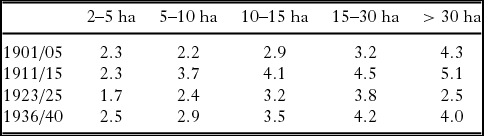
It should be pointed out, however, that a high debt burden did not translate into a higher risk of economic instability for farms. Their levels of net profitability in fact depended upon the level of performance.Footnote 6 According to the Swiss Farmers’ Secretariat, highly indebted farms were often the most profitable ones. Indeed their higher returns resulted from their larger size and from their strong market orientation (Table 1).
Yield per hectare (as percentage of assets) in areas under cultivation according to farm size.

Source: Ritzmann-Blickenstorfer, H., ed., 1996. Table I.28, p. 559.
In addition, larger farms recorded profitability indices (that is, the difference between gross returns and operating costs) that were on average higher than those of small farms. Indeed, these profitability indices tended to be higher than 1.15, a figure below which the return on assets would be negativeFootnote 7 (Gasser-Stäger, Reference Gasser-Stäger1963) (Appendix 1). From this perspective, agricultural debt seems to be a matter of economies of scale rather than of the mere difference between costs and benefits.
2. Indicators and effects of indebtedness
2.1. The extent of agricultural indebtedness
There is sufficient evidence to suggest that Swiss agriculture struggled during the first decades of the twentieth century, and that there were multiple factors limiting returns. In addition, the beginnings of rural credit and of the mortgage industry around the end of the nineteenth century point at the growth of private and of farmers’ debt, reflecting a rising demand for capital to finance investment (the purchase of fertile land, mechanisation, the modernisation of production, etc.). So, while the number of rural credit banks remained relatively stable between the end of the nineteenth century and 1940,Footnote 8 their balance sheets experienced a strong growth, from just over 500 million francs in 1890 to 1.4 billion in 1911 and 2.25 billion in 1940.Footnote 9
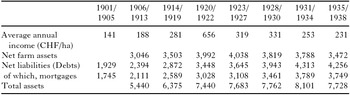
The trend is mirrored in data regarding mortgage debt in nine cantons of the Swiss Confederation.Footnote 10 Between 1914 and 1930, the total value of real estate transactions went from 406 to 997 million francs, a net increase of 145.7 per cent. At the same time, the value of mortgage debt registered in these cantons grew from 101.9 to 542.5 million francs, a net increase of 432.4 per cent.Footnote 11 It seems, therefore, that in those years the growth rate of mortgage debt was higher than the growth in the value of real estate transactions. Even though this growth was largely due to the recovery of the construction industry – and as such related mainly to urban areas or areas where urbanisation was underway – according to the authorities, the agricultural sector, too, registered a considerable increase in mortgage debt during those years.Footnote 12 This is confirmed by the investigations carried out by the Swiss Farmers’ Secretariat, which provides a very accurate insight into the evolution of the phenomenon. A survey of 55 rural communes in the canton of Bern showed that between 1856 and 1928 the registered value of land rose from 91.5 to 309.4 million francs (+238 per cent), while the registered debt went up during the same period from 29.1 to 114.4 million francs (+293 per cent).Footnote 13 According to the annual survey of the accounts of agricultural holdings,Footnote 14 the average value of liabilities per hectare went from 675 francs in 1856 to 1,929 francs in the early years of the twentieth century, reaching a peak of 4,313 francs in the first half of the 1930s (Table 2). So, if at the beginning of the century the value of the liabilities represented approximately 40 per cent of the value of the holding, by the 1930s the liabilities had reached 54 per cent of the value of the holding.Footnote 15
Average annual income and average value of the farm assets as surveyed by the Swiss Farmers’ Secretariat of peasant farmers, 1901/05–1935/38 (Fr/ha).

Source: For 1901/05: Feuille Fédérale (FF), 35 (1932), 416; for the other years: Secrétariat Suisse des paysans, Statistiques et évaluations agricoles, fasc. XVIII (1941), p. 103; Ibid., fasc. XIX (1942), p. 99.
According to the information available, in the early 1930s about 60 per cent of the 522 farms being surveyed were burdened with debts. This proportion, however, masks considerable variations. Thus, only 12 per cent of farms were found to be moderately in debt (less than 1,000 francs per hectare). On the other hand, 17 per cent were heavily in debt (5,000–7,000 francs per hectare) and 14 per cent were very heavily indebted (more than 7,000 francs per hectare).Footnote 16
Another investigation conducted by the Statistical Office of the canton of Bern, of nineteen communes containing a total of 1,631 farms, outlined a less alarming, though no less worrying, situation. From this it turned out that 40.9 per cent of farms were burdened with debts of less than 1,000 francs per hectare, while only 7 per cent and 5.8 per cent respectively had debts of 5,000–7,000 and more than 7,000 francs per hectare. According to the Bern report, it was precisely those farms in the last category (which corresponded to farms whose debt exceeded 125 per cent of the capital subject to property tax) that were considered to be ‘highly overburdened and compromised’, and therefore destined to fail. In addition, it was estimated that approximately 7,000–7,500 farmers in the canton were living in an economic situation such that they would not be able to recover through simple palliative measures.Footnote 17
It was the smaller farms especially which were weighed down by debt. Measured in francs per hectare of productive land, it seems to have been inversely proportional to the size of the farm. In 1935, for example, the debt reached 6,288 francs per hectare for farms of 3–5 hectares, but fell to 4,470 francs for farms of 5–10 hectares, 4,335 francs for those of 10–15 hectares, 3,589 francs for those of 15–30 hectares, and to 2,945 francs for those of more than 30 hectares.Footnote 18 Since the small farms were concentrated above all in Alpine and mountainous areas, it follows that the higher levels of debt were to be found in these areas; and these farms were also penalised by the sharp fall in livestock prices, owing to oversupply in the domestic market.
2.2. The effects of indebtedness: regional variations
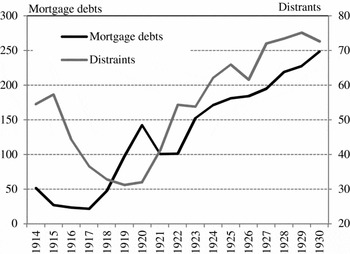
The increased vulnerability of landholders exposed to debt is reflected in the parallel increase in the number of distraints in those cantons.Footnote 19 Between 1914 and 1930, these distraints increased from 107,500 to 158,560 (+47.4 per cent). As well as following the economic trend, this growth in distraints is directly correlated with the value of mortgage debt (r = 0.73) (Figure 3).
Evolution in the value of mortgage debt per inhabitant (CHF) and distraints (actions/1,000 inhabitants) in Switzerland, 1914–30.

Although the number dropped considerably during the First World War (from 54.5 cases per 1,000 inhabitants in 1914 to 31.2 cases per 1,000 inhabitants in 1919), in the following years there was a significant increase, despite a temporary lull in 1921–2, because of the downturn in the market and in the broader economy. The growth in legal proceedings against farms because of over-indebtedness was duly registered also in the canton of Bern. Between 1921 and 1931, these actions increased by 65 per cent, from 10,549 to 17,444. At the same time, seizures for reasons of debt grew by 40 per cent (from 2,757 to 3,843), sales of property by auction by 58 per cent (from 55 to 87) and declarations of bankruptcy by 144 per cent (from 18 to 44).Footnote 20
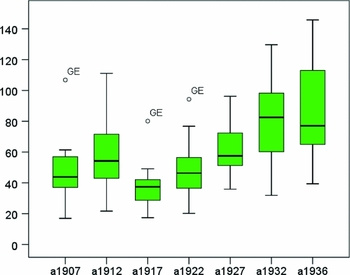
During the 1920s and early 1930s, the distraint rate steadily grew, slowed only by the enactment of the first measures to support farmers in difficulty. The rural cantonsFootnote 21 were particularly badly hit by the difficulties in the agricultural sector. The greater spread of distraint rates (Figure 4) precisely reflects this trend, relating as they do mainly to the farming sector. Inequalities within the country grew as a consequence of that.
The spread of distraint rates in the Swiss cantons, 1907–39.

3. Measures taken to deal with peasant indebtedness
3.1. Diagnostics of a disorder
Highlighted by the numerous bankruptcies that occurred as a result of the European agricultural crisis of 1870–80, the issue of rural debt became even more prominent during the last decade of the nineteenth century, when the consequences of overproduction had a knock-on effect on producer prices. It was in this climate that politicians tried to promote a more accurate understanding of the causes and extent of the phenomenon of indebtedness. In 1891, parliament instructed the federal government to prepare a report on agricultural debt and its consequences. The investigation that followed showed how in those years – surprisingly, given the events of the previous two decades – the difficulties in the agricultural sector were causing a drop in prices on the land market, particularly in agricultural areas. Those peasant farmers who in previous years had purchased land were experiencing a fall in the value of their investments, which was aggravated by excessive debts that made the costs of managing the land overly burdensome.Footnote 22
The problem took on new forms during the First World War, which fuelled demand in domestic production, and a consequent surge in demand for land. The growth in land prices pushed many buyers to take out loans in order to finance investment. Consequently, in the years after the war, Swiss agriculture experienced a high level of mortgage debt and very high land prices; a situation that proved ruinous when, in 1920, agricultural prices began to decline faster than production costs.Footnote 23 In the early 1930s, the Federal Government's diagnosis of the causes of agricultural debt did not fail to mention this fact, reporting that three quarters of farmers who urgently needed financial help had ‘bought their farms during the First World War or in the years just after, most at heavily inflated prices and without sufficient capital of their own’.Footnote 24
This situation was confirmed by an inquiry carried out on forty-four farms at the beginning of 1932. From this it emerged that, despite an average market value per hectare estimated at 4,359 francs, the average purchase price reached the sum of 5,121 francs.Footnote 25 Moreover, many farms took on a mortgage debt that exceeded the estimated cadastral value and also the market value; and so, many owners, particularly from the 1920s onwards, found themselves faced with increasingly high interest on the debt, unsustainable in the face of the fall in agricultural prices and exports. Suffice it to say that if in the early 1920s the interest on the debt accounted for about 22 per cent of the farm's outgoings, ten years later, in the two years 1930–1, the proportion reached 36–8 per cent.
3.2. State intervention: the guiding forces of moral conservatism and liberalism
In the liberal climate of the 1860s and 1870s, Switzerland refused to promote its agriculture through protectionist measures or price controls. Even the calls of the representatives of the peasant farmers to create a federal bank for agriculture and to introduce a ceiling on mortgage rates met with opposition from banks, which blocked the proposals. It was only due to the increasing global competition that the federal government – like other European countries (Tracy, 2003) – took measures to protect the agricultural sector; these included a federal law to promote agriculture (1893) and a law on general import tariffs (1902) (Brugger, Reference Brugger1978).
Neither did they fail to formulate proposals and measures that, at least indirectly, sought to contain the growing agricultural indebtedness. One of the most important of these led to the introduction in the Swiss Civil Code of a set of standards that ensured the continued integrity of farms despite the principle of equality amongst heirs. In practice, these provisions (art. 616–5) allowed farmers to designate a single heir to avoid the fragmentation and economic weakening of their farms. This measure was designed, among other things, to contain over-indebtedness by fixing the price of a farm based on its returns (Head-König, Reference Head-König, David, Groebner, Schaufelbuehl and Studer2010). This figure obtainable thanks to the recent introduction of calculations of the estimated value of peasant farms from agricultural accounts (Popp, 2010: 32). There are no indications whether such measures were effective, but there is enough to suggest that their application was limited.Footnote 26 Furthermore, their effects were dampened by the state of the economy, which had been declining since the 1920s, and by the steady drop in agricultural prices.
However, this measure was a sign of the farming sector's capacity to make their voice heard within the national political world. In fact, whereas in 1910 the peasants represented only 7.6 per cent of the deputies sitting in the national parliament, in 1937 – when the Bauern, Gewerbe und Bürgerpartei / Parti des artisans, des paysans et des bourgeois (BGB/PAB)Footnote 27 became a national party – their quota reached 12.4 per cent. Owing to the support of this party, the two historical parties (and namely the radical and conservative parties) sustained its claiming on agriculture (Müller, Reference Müller2010; Pilotti, Reference Pilotti2017: 115). With regard to this it must be reminded that besides their duties as elected members, the federal parliamentarians of the above party were sitting in Bern as leaders or representatives of peasants’ unions, such as the Swiss Farmers’ UnionFootnote 28 standing out as one of the most influential lobby within the Federal Assembly (Jost, Reference Jost2007; Moser, Reference Moser, Halbeisen, Müller and Veyrassat2012: 576–9; Mach, Reference Mach2015). The bourgeois bloc (Bürgerblock) found its final structure in 1929 with the entry of a representative of the BGB/PAB in the federal government (Müller, Reference Müller2010: 327). Thanks to the wide network distributed on the whole national territory and its numerous associates – but also thanks to the competences deriving from activities and researches of the Secretariat of the Swiss Farmers and administrative personnel (financed by the confederation), the Swiss Farmers’ Union played, during the 1920s and the 1930s, a fundamental role for agricultural policy issues, by orienting their choices towards the problem of indebtedness.
The economic crisis that broke out following the stock market crash of 1929 took a little time to reach Switzerland. However, fears for the stability of the banking system, both national and international, and the need to maintain sufficient liquidity in the mortgage lending sector, pushed the federal government to launch, in 1930, a law to promote the raising of capital for the funding of mortgage loans.Footnote 29 This law established two central mortgage funds,Footnote 30 the revenues of which were lent to banks (mainly the cantonal banks). This enabled the latter to finance their mortgage lending. This system enabled mortgage bondholders to be guaranteed a secure risk protection. In fact, they obtained a right of lien on the assets held by the central issuing bodies. The latter, for their part, were covered by a lien on mortgage loans made by banks to their clients.Footnote 31 With this system it was possible to have a pool of legally independent and delocalised providers, in as much as the shareholders and the borrowers were the banks receiving the capital from the central issuing bodies.
This banking tool helped to revive the construction industry, which took advantage of the insecurity in the financial markets and the demand for investment in real estate. In the meantime, however, this slowed down the mortgage rates, which remained substantially stable despite the strong foreign cash flow.Footnote 32 A stability supported, during the 1930s, by the rural world in order to avoid the currency depreciation of the Swiss franc which would have endangered the stability of the agricultural prices and the protection of the domestic market (Müller, Reference Müller2010: 138–9, 203, 690).
It is true that we do not know to what extent the mortgage bonds helped fuel the mortgage credit for agriculture. However, it is important to note that the new banking tool was formed following the intervention of the federal government, which in September 1928 allocated an extraordinary sum of 12.8 million francs to assist the growing number of farmers on the poverty line.Footnote 33 The money was to be divided between the cantons on the basis of the number of farms,Footnote 34 and it was to enable the purchase of fertiliser, fodder, seed, livestock and other things necessary for the maintenance of the farm. The appeals for financial aid were subjected to an audit by the authorities to determine the real needs of the applicants; and to make sure that their indebtedness was not due to irresponsible behaviour on their part. The loans were granted interest-free to them, while the interest paid by the cantons was fixed at 2 per cent.Footnote 35 This help proved of little effect (Moser, Reference Moser1994: 82–3) and was even more scaled down by the onset of the economic crisis. For this reason, in September 1932 the federal government decided to extend the financial aid, allocating another twelve million francs for the next four years (Brugger, Reference Brugger1992: 37–9).Footnote 36
At the same time, the Federal Government stressed the need for intervention, which would address the causes (and not just the effects) of the problem.Footnote 37 A federal decree issued in 1933 sanctioned the temporary suspension of the procedure for the seizure of assets and for the repayment of loans secured by real estate, as well as the reduction (or elimination) of interest payments for a period of four years on loans not covered. A further decree in 1934 ordered the lowering of mortgage interest rates to 4.5 per cent and a ban on increasing mortgages taken out at lower rates than this threshold. It also prohibited the most heavily indebted peasant farmers or the beneficiaries of the special government loans from taking out new loans. These farmers were forced to keep farm accounts, which were audited by the agricultural relief organisations or by auditors.Footnote 38
These measures prevented distraints from escalating out of control, thus making sure that creditors would not suffer disastrous losses, as conversion into cash of mortgage collateral would be minimal.Footnote 39 In addition, for a time they freed farmers from their unsecured debts (without a pledge) and from arrears on interest payments. They were not, however, intended to promote agricultural debt relief. For this reason, in 1936 the federal government submitted a bill to parliament to restructure rural debt. With this measure, mortgage debt borne by the farmers would have to be reduced to a level that would allow them to pay the interest, and at the same time assure them a ‘reasonable’Footnote 40 return from the farm. Likewise, the federal authorities had to be careful not to jeopardise the mortgages (and the interests of the creditors), and to ensure that the operation could be paid for from the public purse, supporting these measures.
The methods of debt relief precluded the simple cancellation of the debt burden, since such a solution would have made many mortgage lenders insolvent and would have somehow acquitted those farmers who were directly responsible for their debt. There was also a nod to the free market and to free enterprise in that neither the central government nor the cantons were prepared to take on the full load of the debt. For the federal government, in fact, ‘the renunciation of that principle, which responds to the common sense of our people, would have serious repercussions in all fields of law’.Footnote 41 It therefore opted for ‘a fair distribution of the sacrifices’ among the various interested parties: creditors, debtors, guarantors and public bodies.
According to the new bill, only unsecured mortgages could be the subject of debt relief measures. It also included the measures provided for in the decree of 1934, including the suspension of the repayment of covered loans or even the lowering of interest rates on such loans. But above all, the bill introduced a procedure for debt relief to be carried out over a period of twenty years. In practice, creditors would have to give up part of their claims in exchange for debt securities issued by the cantonal redemption fund, financed by the federal government and the cantons. These securities, transmissible and guaranteed by the same fund, had a value equal to the amortised capital of the debtor and of the redemption fund, and guaranteed a 4 per cent interest.Footnote 42 The duration of the debt relief process was fixed at twenty years and the debt had to be repaid in equal parts by the debtor and the redemption fund.
Despite the support of the powerful farming lobby, the bill on agricultural debt relief sparked much opposition from the banking world and in liberal-conservative political circles. Only in 1940 did it obtain the necessary political consensus to be approved by parliament.Footnote 43 In addition to these political and financial reasons for the opposition, the passage of the bill was slowed by the improving economic situation and by the gradual drop in interest rates,Footnote 44 which eased the debt burden and allowed farm returns to recover. The outbreak of war further delayed its application: the law only came into force in 1947. Once again, the war had affected the economic conditions of Swiss agriculture, saving the state the need to ‘interfere’ with the free market mechanisms.
Conclusion
Constantly threatened by economic uncertainty and market instability, from the end of the nineteenth century the farming industry of European countries gradually turned into a ‘debt economy’ (Gueslin, Reference Gueslin1988) based on mortgage credit. In the first half of the 1930s the severe economic crisis that hit Switzerland put the rural world in front of a dual scenario linked to the monetary policy of the Swiss National Bank: on the one hand the maintenance of the convertibility of the gold exchange standard, which would have guaranteed the stability of the agricultural prices, on the other hand the depreciation, which in turn would have favoured an inflationist mechanism and, thus, a reduction of the debts’ real value. The rural world's choice to support the convertibility needs to be interpreted within the frame of consolidation, from 1930 to 1932, of the confederation's agricultural policy implemented by protecting the domestic market and supporting agricultural prices through subventions. When the Swiss franc was devalued in 1936 the most acute phase of indebtedness was left behind thanks to the reduction of the interest rates. Furthermore, the feared inflationary effects were limited thanks to the abundant availability of capitals, which allowed to reduce the discount rate to very low levels (1.5 per cent).
On a more ideological level, paradoxically, although the conservative morality that permeated rural Switzerland (Forney, 2010) stigmatised debt as a mark of personal defeat (Lorenzetti, Reference Lorenzetti2014), modernising influences have identified rural credit as one of the key factors that helped the emancipation and dissemination of an ‘entrepreneurial mentality’ among the peasantry. Like in other European countries, this dual perspective is based on attempts to reconcile a modernised rural economy with the need to preserve the identity and values of the peasantry (Burchardt, Reference Burchardt2010). In a sense, it is indeed reflected in the role of the Swiss state, and the choices it made when faced with the indebtedness that gripped agriculture in the first third of the twentieth century. While the relief measures adopted by the confederation provided only for the needs of genuinely deserving farmers, not responsible for their predicament, on the other hand measures to protect credit were designed to ensure the efficient functioning of the economy and safeguard the principles of economic growth.
Acknowledgements
I would like to express my gratitude to Simon Stott, for his translation of this article from Italian and Simona Cain Polli, for her assistance and linguistic support.
Appendix 1
Profitability Index(a) of Swiss farming businesses, by surface area