INTRODUCTION
Ecotourism in developing countries is big business (Balmford et al. Reference Balmford, Beresford, Green, Naidoo, Walpole and Manica2009). Of the US$ 968.1 billion spent by international tourists in non-OECD countries in 2007 (WTTC [World Travel and Tourism Council] 2007), US$ 28.8 billion can reasonably be attributed to ecotourism and nature-based tourism (Appendix S1, see supplementary material at Journals.cambridge.org/enc). Largely consistent with estimates of the global ecotourism market (Goodwin Reference Goodwin1996; Simpson Reference Simpson1999; TIES [The International Ecotourism Society] Reference Tobias and Mendelsohn2006), this amount is two orders of magnitude greater than the concurrent combined spending on conservation projects in the developing world by official aid agencies and the United Nations Global Environment Facility (GEF; US$ 162–364 million yr−1, not counting GEF co-financing) (Pearce Reference Pearce2007). Huge revenues lead to a crucial implication: if just c. 1% of ecotourism revenues were spent on conservation actions, the ecotourism sector could match the official flow of conservation transfers to the developing world (Yu et al. Reference Yu, Hendrickson and Castillo1997; Gossling Reference Gossling1999; Archabald & Naughton-Treves Reference Archabald and Naughton-Treves2001) and finance large amounts of conservation in developing countries. Clearly, this estimate is very rough, with one source of error being the definition of ecotourism (Goodwin Reference Goodwin1996; Weaver & Lawton Reference Weaver and Lawton2007). Here, it is defined as ‘travel to natural areas to admire, study or enjoy natural landscapes and wildlife in a way that contributes to conservation and the welfare of local peoples.’ This definition is close to that used by The International Ecotourism Society (TIES Reference Tobias and Mendelsohn2006) and includes tourists who travel for the purposes of ‘environmental/ecological sights’, ‘camping/hiking’ or ‘hunting/fishing’, which are the three categories that TIES includes as ecotourists (Appendix S1, see supplementary material at Journals.cambridge.org/enc). However, no matter how narrowly ecotourism is defined, the general conclusion holds. There is a great deal of money available for conservation from this sector.
In recognition of this plausible link between tourism and conservation, billions of dollars worth of Integrated Conservation and Development Projects (ICDPs) have included ecotourism initiatives (Salafsky et al. Reference Salafsky, Cauley, Balachander, Cordes, Parks, Margoluis, Bhatt, Encarnacion, Russell and Margoluis2001; Kiss Reference Kiss2004; Pearce Reference Pearce2007). However, to date, this spending has been criticized on the grounds that ecotourism ventures fail to become economically self-sustaining (Blom Reference Blom2000; Kiss Reference Kiss2004), do not benefit protected areas (Lindberg et al. Reference Lindberg, Enriquez and Sproule1996; Simpson Reference Simpson1999; Blom Reference Blom2000), result in insignificant economic benefits for local people (Place Reference Place1995; Bookbinder et al. Reference Bookbinder, Dinerstein, Rijal, Cauley and Rajouria1998; Walpole & Goodwin Reference Walpole and Goodwin2000; but see Wunder Reference Wunder2000), and do not stabilize land-use patterns on a large scale (Yu et al. Reference Yu, Hendrickson and Castillo1997; Salafsky et al. Reference Salafsky, Cauley, Balachander, Cordes, Parks, Margoluis, Bhatt, Encarnacion, Russell and Margoluis2001; Kiss Reference Kiss2004). Ecotourism has been derided as ‘a desperate race to make money while you still can’ (Adam Reference Adam2007, p. A9), and there have been calls to abandon indirect financing in favour of direct payments for conservation actions (Ferraro & Kiss Reference Ferraro and Kiss2002; Ferraro & Simpson Reference Ferraro and Simpson2005), although this latter prescription assumes the ability to enforce contracts, which can be problematic (Damania & Hatch Reference Damania and Hatch2005; Ohl-Schacherer et al. Reference Ohl-Schacherer, Mannigel, Kirkby, Shepard and Yu2008).
Within the literature on ecotourism economics in developing countries, studies are based on gross revenues to private operators, focus on consumer surplus to derive a monetary measure of the benefits realized by visitors, or rely on travel-cost analysis to derive a monetary valuation of destination areas (Tobias & Mendelsohn 1991; Navrud & Mungatana Reference Navrud and Mungatana1994; Mercer et al. Reference Mercer, Kramer and Sharma1995; Menkhaus & Lober Reference Menkhaus and Lober1996) and others reviewed by Mullan and Kontoleon (Reference Mullan and Kontoleon2008). While there might be good reasons for focusing on revenues (for example poor access to real and reliable income and expense data), consumer surplus (for example justifying international aid) and travel cost (for example comparing relative values of destination areas), none of these measures gives insight into the economic viability of ecotourism businesses, nor of the businesses’ incentives to conserve biodiversity.
Thus, our motivating questions are:
(1) Are the incentives of the ecotourism industry compatible with biodiversity conservation, and
(2) Is the industry capable of bringing sustained economic and political power to bear on behalf of conservation efforts?
To answer these questions, at the least, measures of profit are required: the surplus of a business's revenues over its costs. Profitable ecotourism businesses are motivated to continue their operations, and given a current or potential future scarcity of suitable natural habitat, will endeavour to protect or even enhance it. However, measures of profit in ecotourism are rare in the literature (Barnes & de Jager Reference Barnes and de Jager1995; Wunder Reference Wunder2000; Malky-Harb et al. Reference Malky-Harb, Pastor-Saavedra, Limaco-Navi, Mamani-Capiona, Limaco-Navi and Fleck2007; Ohl-Schacherer et al. Reference Ohl-Schacherer, Mannigel, Kirkby, Shepard and Yu2008). We therefore analysed commercially sensitive financial data from one of the largest clusters of rainforest lodges in South America, the Tambopata region of Amazonian Peru, within a theoretical framework developed by Damania and Hatch (Reference Damania and Hatch2005); for a companion cost-benefit analysis of this sector, see Kirkby et al. (2010).
A contract model of ecotourism
Damania and Hatch (Reference Damania and Hatch2005) applied microeconomic contract theory to the question of whether the ‘partial privatization’ of a public protected area can result in improved wildlife stocks. Such privatization can take the form of licences (‘contracts’) for tourism concessions, in which private tour operators are given ‘residual claims’ to profits, which means that operators claim all profits above a fixed fee. The motivation for privatization is that because it is difficult to monitor and judge the effectiveness of fixed-wage park managers, managers might shirk responsibilities, resulting in environmental degradation. In contrast, private tour operators, whose profits rise with tourist volume, could be incentivized to engage in costly conservation actions to protect profits. The problem is that tourism itself causes (or attracts) environmental damage, so the operator might instead invest in tourist amenities (such as hot showers or internet access), ‘race to make profits while they still can’, and ultimately allow the environment to degrade.
Placed in the context of rainforest ecotourism, Damania and Hatch's model predicts that a lodge will engage in costly actions to protect forest cover if the lodge is profitable, if profits increase with tourist volume, if tourist demand depends on ‘an abundance and diversity of wildlife’ (Damania & Hatch Reference Damania and Hatch2005, p. 341) or some other aspect of forest cover, if the effort spent protecting an additional unit of forest cover is not too costly, if additional investments in tourist amenities are of limited value for attracting more tourists, and if tourist activities themselves do not cause much damage to rainforests. Technically, the marginal return on conservation actions must be higher than the marginal return on investing in tourist amenities. Intuitively, there is an inherent negative feedback to ecotourism, in that increasing tourist volume causes damage, which reduces future demand. A manager will be more likely to try to compensate for or prevent this damage if her action will work at low cost, and if the environmental improvements strongly increase future tourist demand. Both increase the expected return on conservation actions.
We show or argue that these conditions are achieved in the specific conditions of Tambopata, Peru, and thus, that lodges should invest in and protect rainforest concessions. We also show that the ecotourism industry distributes significant revenues to the local population, that conservation actions by lodges can substitute for and complement state-led conservation efforts, and that those actions have not been dependent on subsidies from conservation organizations. In summary, we argue that it is indeed possible for ecotourism to ‘close the loop’ from biodiversity to a profitable tourism industry to the conservation of biodiversity.
METHODS
Study area
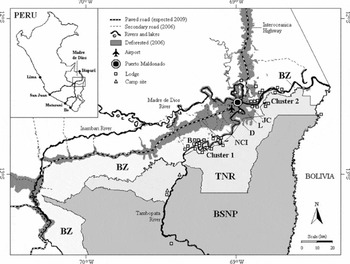
We conducted our study in Tambopata, a popular ecotourism destination area located in the Madre de Dios region of south-eastern Peru in the lowland rainforests of south-western Amazonia. The area includes a protected area complex consisting of the Tambopata National Reserve (TNR: 274 690 ha), the Bahuaja-Sonene National Park (BSNP: 1 091 416 ha), their buffer zones (455 274 ha), the provincial capital Puerto Maldonado, through which almost all visitors transit, and local communities (Fig. 1). Tambopata lies within the Tropical Andes biodiversity hotspot (Myers et al. Reference Myers, Mittermeir, Mittermeier, da Fonseca and Kent2000) and the TNR/BSNP complex is a key link in the Vilcabamba-Amboró Conservation Corridor (Appendices S2, S3, Fig. S1, see supplementary material at Journals.cambridge.org/enc). Tambopata has been an ecotourism destination since the 1970s (Yu et al. Reference Yu, Hendrickson and Castillo1997). By 2008, establishments numbered 37, ranging from 100-bed operations to small research stations, guesthouses and campsites (hereafter, all termed lodges). Most lodges are located within one-day travel time of Puerto Maldonado, and most visitors are on package tours, typically spending one day and two nights at a lodge, during which they immerse themselves in rainforest by taking long hikes, canoeing on lakes and observing clay-licks, with expectations of viewing monkeys, giant otters and macaws (Appendix S4, see supplementary material at Journals.cambridge.org/enc). Some tours add visits to local communities.
The Tambopata area showing the location of the Tambopata National Reserve (TNR), Bahuaja Sonene National Park (BSNP), their buffer zones (BZ), the Interoceánica Sur Highway (IOS; thick dashed line), secondary roads (thin dashed lines), ecotourism lodges (squares), campsites (triangles) and deforestation up to 2006 (darkest grey). ‘D’ denotes 2006 deforestation within the TNR associated with the communities of Jorge Chavez (JC) and Loero (L). Other communities mentioned in the text: Baltimore (B) and Native Community of Infierno (NCI). Most lodges belong to one of two clusters (1 and 2), on the Tambopata and Madre de Dios rivers, respectively.

Lodge finances
The owners of 16 lodges provided us with varying amounts of information pertaining to lodge capacity, visitor numbers and bed nights (n = 16), historical background (n = 14), full- and part-time employee numbers (n = 10), and economic information, including initial and ongoing investments (n = 7), annual revenue (n = 13) and annual expenditure (n = 13). The TNR administration provided entrance counts of tourists and researchers, by year and lodge, and the income generated from entrance and concession fees during 2000–2006. The lodge accountancy data were provided as yearly balance sheets and/or as monthly income and expense files.
The most comprehensive financial data in a single year (2005) included revenues and expenses for 13 of the 16 participating lodges, so this became our focal year. In addition to bed-night sales, four lodges supplied revenue data on beverages and handicrafts, averaging US$ 5.5 and US$ 1.0 per tourist, respectively, which we applied to all lodges. Total revenues for the sector were calculated by extrapolating the mean revenue per tourist to all lodges for which we did not have detailed data. Note that because we are limited to analysing only those lodges that (1) were in operation in 2005 and (2) were willing to reveal their financial data to us, our dataset is not a random sample. However, our dataset is close to complete, accounting for 89.9% of the tourist volume and 90.2% of the total revenues in 2005 (by extrapolating volume to the remaining lodges, and correcting prices for the fact that most of the remaining lodges are cheaper).
We subdivided expense data into 17 categories (Table 1), which were then scored as high- or low-leakage. Low-leakage expenses include products (such as fruit) originating in Tambopata, and service providers (for example local staff) who live permanently in the area. High-leakage expenses include products and services that are purchased locally but are essentially imported (for example gasoline and non-local staff). Finally, all other expenses outside of Tambopata were classified as national. No expenses in the accountancy data were identified as international (ex-national), except possibly some ‘marketing’ and ‘commissions paid’ expenses. However, these amounts are small. All spending in Peruvian currency was converted to US dollars using the rate applicable to each year based on official exchange rates (MEF [Ministerio de Economía y Finanzas] 2008). Total expenses were calculated by extrapolating the mean expense per category per tourist to lodges for which we did not have data (representing 10% of total expenses) and summing across the sector. We accounted for depreciation of capital goods (Appendix S5, see supplementary material at Journals.cambridge.org/enc).
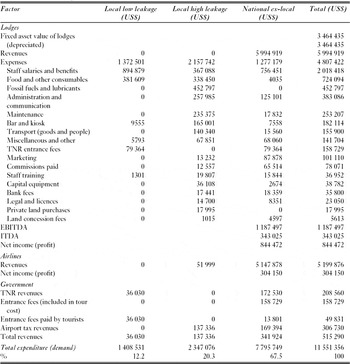
Lodge financial data. Lodge revenues (gross income) in 2005 from 39 565 tourists, the local and national distribution of lodge expense categories, lodge profits, spending on air travel between Cusco to Puerto Maldonado, and government income from Tambopata National Reserve (TNR) entrance fees and airport taxes, including amounts in all cases corresponding to high and low leakage expenses at the local level. EBITDA = earnings before interest, tax, depreciation and amortization; ITDA = interest, tax, depreciation and amortization.

Returns on investment (ROI) for nine lodges that began operations in or before 2000 were calculated annually from 2000–2006, using NPV(d=10%) (net present value) accumulated net profits divided by NPV accumulated investments. Data from two lodges were pooled because they have the same owner. We also calculated a mean profit per tourist per lodge for the years and lodges for which we had data, and this value was used to estimate net profits for those years and lodges for which we did not have data. Investments included actual or estimated sunk investment costs of capital assets (excluding working capital) in year zero (or as far back as 1980) and for each successive year until 2006. For those years (other than year zero) in which data were not available, capital investment was estimated indirectly based on available or estimated annual depreciation figures supplied, multiplied by 20 to calculate total depreciation over the standard 20-year period, and further corrected up or down depending on whether tourist numbers had grown or declined in that year (if they had grown, capital investment would likely have been required to service them), supplemented with secondary evidence for major investments, such as lodge infrastructure refurbishment.
The above datasets were used to generate time series for ecotourism variables including visitor numbers (1980–2006), revenues (2000–2006), expenses (2000–2006), net income (profits) (2000–2006), return on investment (2000–2006) and full-time equivalent employment (2000–2007). The value of the ecotourism sector's fixed assets for 2005 is the sum of the depreciated asset values across lodges. We also calculated revenues and profits for the local airlines and state income from TNR entrance fees and airport taxes (Appendix S6, see supplementary material at Journals.cambridge.org/enc). Finally, we reconstructed the history of conservation subsidies to the industry (Appendix S7, see supplementary material at Journals.cambridge.org/enc).
Conservation actions by lodges
Lodge owners have put forested land under direct control as ecotourism and conservation concessions (Appendix S4, see supplementary material at Journals.cambridge.org/enc). Owners provided maps of their land holdings and any concession proposals submitted to the government. Additional data on concessions (ecotourism, conservation and Brazil nut) were obtained from the Ministry of Agriculture and the non-government organization (NGO) Peruvian Environmental Law Society (SPDA [Sociedad Peruana de Derecho Ambiental] 2007; SPDA 2009). Additionally, interviews and direct observations made by C. Kirkby over several years allow us to describe how lodges have confronted threats to their concessions and titled lands.
Landscape-scale effects of ecotourism and conservation concessions
Finally, we ask whether conservation and ecotourism concessions, if protected, can aid in preventing deforestation from occurring in the TNR and the BSNP. To do this, we parameterized a stochastic cellular automata model running on DINAMICA EGO software (Soares-Filho et al. Reference Soares-Filho, Cerqueira and Pennachin2002, Reference Soares-Filho, Alencar, Nepstad, Cerqueira, Diaz, Rivero, Solorzano and Voll2004, Reference Soares-Filho, Nepstad, Curran, Cerqueira, Garcia, Ramos, Voll, McDonald, Lefebvre and Schlesinger2006) to project the pattern of deforestation in Tambopata for the period 2005–2040 (Appendix S8, see supplementary material at Journals.cambridge.org/enc). We created three scenarios, (1) no-ecotourism with unchecked agricultural expansion; (2) ecotourism, where we assumed that lodge-controlled lands as of first quarter 2008 were protected from deforestation, but that, conservatively, no further land was acquired; (3) Ecotourism + JCL gap protection measures, where we assumed additional protection measures in the Jorge Chavez-Loero (JCL) gap that lies between the two lodge clusters (Fig. 1). In all scenarios, the annual deforestation rate was increased in line with projected population growth, and we grew the secondary road network every five years, based on a logical extension of existing secondary roads, upgrades of major logging tracks, expected expansion of private land titles on state land, and the location and size of population centres. (Appendix S8, see supplementary material at Journals.cambridge.org/enc).
RESULTS
Growth and profitability of the industry
Ecotourists numbered less than 5000 yr−1 until 1994. From 1995 to 2005, visitors and bed-nights rose from 5665 to 39 565 and from 13 744 to 95 333, respectively (Fig. S2, see supplementary material at Journals.cambridge.org/enc), with most growth in lodges of 20–100 beds.
In 2005, ecotourism in Tambopata was responsible for US$ 11.6 million in spending, of which US$ 6.0 million were lodge revenues, and the rest airfares and entrance fees (Table 1). Of total spending, US$ 3.8 million (32.5%) was local, in that the first-order transaction took place in Tambopata (Table 1). This spending was further split into low- (12.2%) and high-leakage (20.3%) expenses. In 2005, the lodges and airlines earned profits of at least US$ 844 472 and US$ 322 091, respectively (Table 1). Our numbers are underestimates because: (1) we did not include independent tourist expenditures; (2) local populations extracted profits from local spending, (3) one airline enjoys a near-monopoly (>70% of seats), thus inflating profit margins on that route beyond the whole-company margin of 5.8%; and (4) incomplete data do not allow us to count wages to shareholders (owners) who also work at their lodges. The wages that owners pay to themselves are typically in excess of the market wage for standard employee management. This excess can be considered a way that owners extract part of the profits. For four lodges, we obtained data on the wages paid to working owners, from which we subtracted replacement annual salaries of US$ 35 000 to compensate for the value that these owners contributed to the lodge via salaried work. The remainder we considered to be extracted profits, and this increased lodge profits (beyond those reported in Table 1) by 68–125%. Finally, 2005 entrance fees exceeded the local parks management budget, allowing US$ 172 530 to be transferred to the national budget.
From 1998 to 2007, seven tour operators, managing 11 lodges, received conservation and development subsidies totalling US$ 2 127 746 in 2006 dollars (Table S1, see supplementary material at Journals.cambridge.org/enc). Of this, US$ 19 362 was legal aid to new lodges to establish concessions; the rest was used for infrastructure, training (local guides, lodge administrators and suppliers), concession management and marketing. Although some subsidies likely replaced private spending, the subsidies appear to have increased total spending on socially beneficial activities, such as widening local participation and possibly increasing the sizes of some concessions (Appendix S7, see supplementary material at Journals.cambridge.org/enc). Profitability has not depended on these subsidies, amounting to only 5.6% of total lodge revenues from 1998 to 2006 (US$ 38 212 427 in 2006 dollars). This can be contrasted with the 2005 profit margin alone of 14.1% (Table 1).
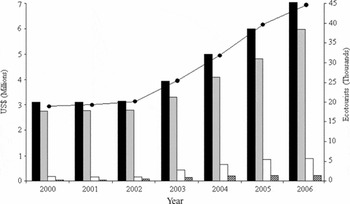
The major factor underpinning profitability is high-volume sales in the four-month high season, which reduces operating costs per tourist, as revealed by how profit margin increases with revenues (Fig. 2). A high-volume business requires large capacity (> 50 beds), marketing, maintenance of relationships with the inbound travel agencies, which broker most tourists, managerial skills, and investment in infrastructure and in staff training, salaries and incentives. Also important are complementary factors, such as a well-serviced airport, a local pool of specialist skills and access to intact forest.
Total revenues (black bars), expenses (grey bars) and profits (white bars) of lodges in Tambopata, after interest, tax and depreciation; total revenues captured by the TNR through entrance fees (hatched bars), and tourist numbers (black circles) for the period 2000–2006. Note that profit margins increase with revenues.

Little quantitative evidence suggests that variation in forest quality is affecting profitability now (although forest cover per se is necessary, and we return to this point below), as all lodges can provide the requisite forest immersion experience. Nonetheless, at an anecdotal level, Reserva Amazonica lodge installed a 200-m long canopy walkway at a cost of US$ 300 000, to counter a reduced sense of isolation and a reduced diversity and abundance of charismatic wildlife species of interest to ecotourists (for example primates and macaws). Reserva Amazonica lodge is located nearer to Puerto Maldonado than most of the other lodges. Environmental quality will become more important if intact forest becomes limited, as is expected to occur following the paving of the Interoceánica Sur Highway (IOS).
In 2005, the government of Peru secured US$ 892 million to pave an existing dirt-surface road that will connect Brazil's Trans-Amazon highway to the Pacific Ocean (Dourojeanni Reference Dourojeanni2006) (Appendix S9, see supplementary material at Journals.cambridge.org/enc). The IOS will be completed in 2010 and will encourage deforestation along its length (Soares-Filho et al. Reference Soares-Filho, Nepstad, Curran, Cerqueira, Garcia, Ramos, Voll, McDonald, Lefebvre and Schlesinger2006), thus directly threatening the lodges, which are on average only 18 km (8–62 km) from the highway, within the 50-km deforestation zone associated with paved roads in Amazonia (Nepstad et al. Reference Nepstad, Carvalho, Barros, Alencar, Capobianco, Bishop, Moutinho, Lefebvre, Lopez de and Prins2001; Alves Reference Alves2002).
Conservation actions by lodges
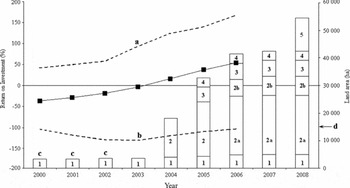
Lodge owners have a strong incentive to protect their businesses because the sector as a whole reached 50% return on investment in 2005, with 100% return on investment likely to have occurred in the following few years (see Methods, Lodge finances), even without counting salaries to working shareholders (Fig. 3). In other words, profits, relative to invested capital, appear to be sufficiently high that owners should be motivated to remain in this business rather than moving their investment capital elsewhere, especially those owners who have already earned back their investments.
Mean return on investment (ROI, ■) of nine lodges for the period 2000–2006, based on accumulated profits divided by accumulated investments (since 1980), including (a) maximum and (b) minimum ROI levels for the most and least profitable of these lodges; (c) the years over which national legislation was passed and then enacted permitting the establishment of forest concessions; (d) the historical (1979–1990) combined size of two private tourist reserves that were degazetted by the Peruvian government in 1990; and the increase in land area controlled by ecotourism operators in Tambopata between 2000 and 2008, where 1 = titled lands; 2a = ecotourism concessions (existing lodges); 2b = ecotourism concessions (planned lodges); 3 = conservation concessions; 4 = Brazil nut concessions; and 5 = proposed concessions being considered by the government as of end of 2008.

Privately managed rainforest concessions
Many lodges have taken advantage of 2002 legislation (Appendix S4, see supplementary material at Journals.cambridge.org/enc) that allows private businesses to lease public forest outside of protected areas for renewable 40-year terms. In essence, lodges gain the right to prevent incursions and the option to use their concessions for tourism purposes, in return for annual payments, which vary (US$ 0.04–5.00 ha−1 yr−1) depending on the type and size of a concession. Prices are largely based on the proposals made by lodges to the government during the process of concession acquisition. By 2006, lodges had leased 35 725 ha (Fig. 3). Importantly, 88% of lodge-controlled land in 2006 was acquired by the four most profitable tour operators (that manage eight lodges), as ranked by cumulative 2000–2006 profits. Another 12 803 ha were awarded or provisionally awarded to lodges as of end of 2008, for a total of 48 528 ha. In addition, 5830 ha have also been granted to local entrepreneurs and communities that to date have yet to build a lodge, thus totalling 54 358 ha of land controlled or destined for control by lodges. Nineteen lodges own and manage < 100 ha each. Lodge owners have stated several motives for acquiring concessions: personal interest in conservation, excluding competitors from forest with tourism potential (i.e. rent-seeking behaviour) and, most importantly, protecting and controlling the forest habitat, animal populations and trail systems needed for operations, either now or as expected in the future (i.e. acquiring forest with option, insurance and use values).
In addition to the profits and the concession legislation that have financed and legitimized acquired lands, respectively (Table 1, Figs 2 and 3), lodge owners have been able to draw on an endowment of managerial ability, accrued over three decades, to defend forest cover and biodiversity. Lodge owners have used court actions and direct patrols to evict illegal loggers and gold miners from their concessions, have struck benefit-sharing agreements with local communities in return for reduced extractive activities, and have contributed to a successful effort to counter the degazetting of a portion of the BSNP.
Incursions
The Picaflor Research Centre spent 2004–2007 fighting off illegal loggers in the local court system. The process started when the lodge owner obtained a conservation concession for 1334 ha on a parcel within 15 km of the IOS. In 2004, a logger was encountered within the concession extracting trees, which the lodge owner stopped temporarily by force. The owner then organized an inspection by the police charged with enforcing environmental laws (Policia Ecológica) and an investigative judge (Fiscal). In 2005, the same logger used documents granted by the state land titling authority (PETT [Proyecto Especial de Titulación de Tierras de Madre de Dios], now incorporated within COFOPRI [Comisión de Formalización de la Propiedad Informal]) to claim land within Picaflor's concession. Because concessions and land titles are granted by different agencies, conflicts can occur, sometimes by mistake and sometimes because of corruption. Timber extraction resumed, but once again, the owner of Picaflor stopped the operation and began judicial proceedings against the loggers and against PETT. In 2007, the logger's documents were ruled to be false, and logging has stopped.
The Reserva Amazonica lodge obtained approval in 2004 for a 10 000 ha ecotourism concession to the north and east of the lodge. During the concession approval process, land speculators obtained titles within the concession; in this case, the titles were ruled valid and, consequently, the lodge lost 3000 ha. At the same time, a miner illegally entered the concession and cleared trees for gold panning. Subsequently, archaeological remains (petroglyphs and potsherds) were discovered inside the ecotourism concession, and the government's Instituto Nacional de Cultura (INC) placed a protection order over the sites (Resolución Directoral Nacional No. 144/INC). The lodge provided evidence to INC that the miner in question was damaging some of these sites and got a court order to have the operation stopped.
Not all defences against incursions have involved legal action, because of the high transaction costs. For instance, the Native Community of Infierno (NCI, Fig. 1) runs patrols through their ecotourism concession on Lake Tres Chimbadas and, in 2007, confiscated timber and charcoal operations run by loggers who had accessed the area from the direction of the IOS. Similarly, the community of La Torre (AMTUSET [Asociación de Moradores de Tambopata para Uso Sostenible y Ecoturismo]), also located on the Tambopata River, and which includes among its residents the owner of Inotawa Lodge, has prevented loggers and hunters from outside of the community from operating on lands bordering and within their titled lands and ecotourism concession, which is communally owned. AMTUSET is planning to develop canopy access and other attractions to be marketed by Inotawa Lodge and a guesthouse.
Benefit-sharing agreements and community-based ecotourism
In addition to the co-ownership agreement signed in 1996 between NCI and Posada Amazonas Lodge (Stronza Reference Stronza2000), where full ownership of the lodge will pass to the community in 2016, the ecotourism association in the community of Baltimore (AMBRAE [Asociación de Moradores de Baltimore para Ecoturismo [AMBRAE]) (Fig. 1) is negotiating a joint venture agreement with two lodges to establish and co-manage a new ecotourism concession bordering the TNR, a process that will build on an existing low-volume, home-stay project funded by the European Union (Appendix S7, Table S1, see supplementary material at Journals.cambridge.org/enc) (CESVI [Cooperazione e Sviluppo] 2008). The terms of the new joint venture will provide income for Baltimore in return for monitored agreements to maintain forest cover and limit hunting (including sport hunting) in and around the proposed ecotourism concession. In 2005, loggers and gold miners built a dirt road from the IOS to Baltimore (Fig. 1) to avoid river transport costs, and the plan is to use the road to transport tourists.
Furthermore, two other lodges have struck compensation agreements with local hunters to prevent hunting in and near their trail systems. The Sachavacayoc Centre (which specializes in secondary-school groups) was involved, along with a private philanthropic organization, in an initiative to pay cash and foodstuffs to a family of hunters who used the forest frequented by the lodge's clients, including a number of mammal clay-licks where tapirs, peccaries and monkeys tend to congregate. The Refugio Amazonas lodge similarly used its own funds to pay foodstuffs to families of local hunters to reduce their incursions into forests used by this lodge. As of late 2007, the agreement struck by Sachavacayoc Centre had broken down because the main counterparty fell ill, but the Refugio Amazonas agreement is still in effect.
More generally, in the awarding of ecotourism and conservation concessions, the Ministry of Agriculture included a point-scoring system to encourage partnership between tour operators and local communities. For example, to earn their concessions, Reserva Amazonica lodge (in 2004) and Inotawa Lodge (in 2006) signed benefit-sharing agreements with neighbouring communities. The agreements prohibit forest clearance and extractive activities on land that was previously accessed by the communities but is now included in the concessions and, in exchange, the lodges have been making payments in cash and kind and also providing employment. Other examples exist, involving Bello Horizonte Lodge, Sandoval Lake Lodge, Tambopata Eagle Center and Taricaya Lodge.
State-led removal of protected-area status
In late 2007, it was leaked to the public that the Peruvian national government was planning to introduce a bill to congress that, if passed, would degazette 209 783 ha (Anon. 2007b) in the Candamo area of the BSNP, amounting to 20% of the Park, in order to allow oil and gas exploration. Even though the Candamo area is over 70 km from the nearest lodge cluster, many of the Tambopata-area lodges lobbied members of congress that degazetting would set a harmful legal precedent for all protected areas and that any oil spills would damage water quality, wildlife and the visual appearance of the rivers. The Rainforest Expeditions tour operator transported a film crew and journalists to the Candamo area, who subsequently reported the story on Cuarto Poder, a current affairs programme on Peruvian television. This was followed by a media campaign led by Peruvian institutions, especially the IOS Working Group (Ráez-Luna Reference Ráez-Luna2008), which is partly funded by Conservation International and which includes at least three lodge owners as members. Rainforest Expeditions also led an alliance of companies and organizations that set up online petitions against the de-gazetting proposal, garnering tens of thousands of Peruvian and international signatures (SCA [Save Candamo Alliance] 2007). This campaign was one reason that the American Congressman Earl Blumenauer wrote to remind the Peruvian government that a pending free-trade agreement with the USA was contingent on Peru's continued enforcement of its protected areas legislation (Blumenauer Reference Blumenauer2007). In October 2007, the degazetting proposal, which had not yet been submitted to the Peruvian congress, was effectively dropped when the Vice Minister of Energy, Pedro Gamio, denied its existence (Anon. 2007a).
The effect of ecotourism on deforestation at the landscape scale
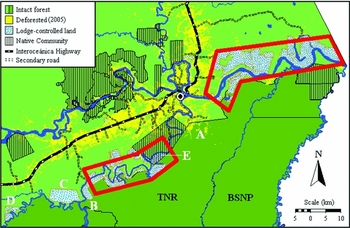
Finally, we ask to what extent the Tambopata ecotourism industry can aid efforts to prevent deforestation from encroaching on neighbouring protected areas (Fig. 1). The land parcels controlled by the lodges and the local communities with which the lodges have established joint ventures form an interrupted border along portions of the TNR (Fig. 4). If these parcels are protected, how much more land will need to be protected in order to prevent deforestation from entering the TNR and BSNP?
Lodge-controlled lands (ecotourism, conservation and Brazil nut concessions) showing the strategic location of two continuous blocks of ecotourism land (red boxes). These blocks lie between the deforestation fronts associated with both the Interoceánica Sur Highway (IOS) and the provincial capital of Puerto Maldonado, and the limits of the Tambopata National Reserve (TNR) and Bahuaja Sonene National Park (BSNP). ‘A’ marks the current 20-km wide gap between the two lodge clusters, associated with the communities of Jorge Chavez and Loero. ‘B’ and ‘C’ are proposed ecotourism concessions and ‘D’ is an ecotourism concession granted to a mestizo community that has historically been dedicated to mining alluvial gold deposits. ‘E’ is a triangular portion of forested land, located within the Native Community of Infierno, which, though not controlled by a lodge, has been set aside for their ecotourism joint venture with Posada Amazonas.

By 2040, the no-ecotourism scenario in DINAMICA projected a 1336% increase from 2005 in the combined deforested and regrowth area inside the TNR (to 38 734 ha) and an increase from 2005 of 408% inside the buffer zone to 130 896 ha (Fig. S4, see supplementary material at Journals.cambridge.org/enc). No deforestation was projected for the northern section of the BSNP. There was essentially no difference with the ecotourism scenario, for which we projected slightly less deforestation in the TNR by 2030 and then slightly more deforestation by 2040 (Fig. S3, see supplementary material at Journals.cambridge.org/enc). In the buffer zone, deforestation in the ecotourism scenario, relative to the no-ecotourism scenario, was reduced by 9836 ha (a reduction of 7.5%) by 2040. In summary, the current set of lodge-controlled lands alone is not likely to buffer the TNR from future deforestation.
This is because DINAMICA projects that deforestation will ‘leak’ around the lodge-protected lands and into the TNR. Crucially, in both scenarios, more than 90% of projected deforestation within the TNR occurred in the 20-km gap between the two main clusters of lodges, near the Jorge Chavez and Loero (JCL) communities (Figs 1 and 4, and Fig. S4, see supplementary material at Journals.cambridge.org/enc). The JCL gap already contains secondary roads and is close to Puerto Maldonado. Recall that the difference between the no-ecotourism and ecotourism scenarios lies in how DINAMICA distributes deforestation spatially, not in the total amount of deforestation. In reality, because some of the deforestation in the ecotourism scenario necessarily must be further from market in order to avoid lodge-controlled lands, less total deforestation is expected, due to greater transport costs. However, we did not have sufficient data to parameterize this effect.
With this in mind, given the existing ecotourism concessions, the TNR can largely be protected from deforestation for the next two decades by adding protection in the JCL gap (Appendix S8, see supplementary material at Journals.cambridge.org/enc). If deforestation in the JCL gap were reduced to zero by 2010, then a new DINAMICA scenario (ecotourism + JCL gap protection measures) projects that by 2040, total deforestation within the TNR will be 23 190 ha, 40% less than in the no-ecotourism scenario (Figs S3 and S4, see supplementary material at Journals.cambridge.org/enc). Most of the TNR deforestation in the ecotourism + JCL scenario occurs after 2030, when the deforestation front crosses the Malinowski River (Fig. S4, see supplementary material at Journals.cambridge.org/enc).
DISCUSSION
The relationship between ecotourism and conservation in Tambopata is complex and includes profit-seeking amongst lodge owners, the threat of deforestation, a projected scarcity of land suitable for ecotourism that is driving acquisitions under new land tenure legislation, and some financial aid. High-volume operations have monetized an ecosystem benefit (the hedonic value of rainforest to tourists) and earned several years of profits in the Tambopata ecotourism industry (continuing through 2009), distributed millions of dollars to the local economy and financed the local parks budget many times over. The sum of these efforts is amounting to the creation of a new governance structure in the Peruvian Amazon that derives its legitimacy from the state, but much of its finance and power from a private ecotourism industry. We did not find support for the hypothesis that ICDP subsidies were necessary for sustained profitability and conservation actions (Appendix S7, see supplementary material at Journals.cambridge.org/enc).
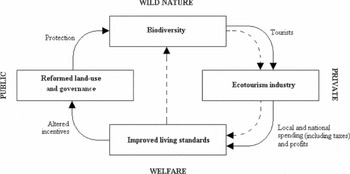
It is useful to contrast this situation with the ‘standard model’ that prevailed when ecotourism was first recognized as a conservation and development strategy (reviewed in Yu et al. Reference Yu, Hendrickson and Castillo1997), at which time ecotourism was promoted as a way to create a ‘self-sustaining cycle of increased tourism, increased incomes, and increased incentives for habitat protection’ (Fig. 5). The requirement for suitable institutions was not made explicit in the standard model, but we find here that legal innovations in Tambopata appear to have linked ecotourism to conservation actions (Fig. 5).
The standard model of ecotourism (dashed arrows), and the model as it works in Tambopata (solid arrows). The income received by private ecotourism lodges from tourists interested in viewing wild nature (biodiversity) improves the welfare of many beneficiaries at local and national levels. In Tambopata, the key beneficiaries are lodge owners and the government. The economic incentives of the beneficiaries are altered so that governance and land-use practices are altered, resulting in greater biodiversity protection. In contrast, the original ‘standard model’ of ecotourism implicitly assumed a direct link between increased welfare and increased protection (dashed lines). A similar but formally presented model of this process can be found in Damania and Hatch (Reference Damania and Hatch2005).

Comparison of results to a contract model of ecotourism
Damania and Hatch's (Reference Damania and Hatch2005) model provides a framework for explaining why these reforms have had this effect, although we needed to adapt their model to rainforest tourism. Tour operators are residual claimants on tourism profits, given that they pay a fixed entrance fee plus the fixed and sunk costs for starting a lodge. Also, lodges are profitable (Table 1), and profits (and margins) rise with volume (Fig. 2). Together, this produces a strong incentive to maintain tourist attractions.
In Tambopata, that attraction is immersion in a rainforest, which is accomplished via long hikes, during which there is the possibility of spotting charismatic fauna. This is a key requirement for closing the conservation-ecotourism loop because even biologically naive tourists can judge whether they are in a rainforest. Tourists are also effectively pre-screened for individuals who prioritize nature viewing over comfort, given that most have voluntarily purchased a ‘rainforest option’ to add to their package tour, despite knowing that the lodges are rustic affairs. As a result, it is reasonable for operators to assume that touristic demand is for rainforest and not for amenities like gourmet cuisine, and to gain access to this market, lodges must maintain access to large tracts of rainforest.
Lodges have therefore acquired state-legitimized concession areas and appear to have a reasonable expectation of enforcing their exclusive usage rights via the legal system, direct action and benefit-sharing agreements (see Results, Conservation actions by lodges). As a result, the expected returns to conservation actions seem to be high. We do not have quantitative data on whether those returns are higher than returns to touristic amenities, but tourists appear to be attracted to rainforest per se, and the lodges have claimed more concession land than is necessary for their current operations (Fig. 3), which is consistent with lodges acting to fulfil current and future demand for rainforest tourism, as opposed to general tourism.
The main mismatch between the Tambopata system and the Damania and Hatch (Reference Damania and Hatch2005) model is that local environmental damage is not caused endogenously by the tourists themselves, but exogenously by outsiders. That is, the amount of damage is not the direct result of profit-maximizing behaviour by tour operators, who seek to increase tour volumes, the possibility of which is included in the model. Instead, the amount of environmental damage is dependent on external events not included in the model. In short, rainforests are unharmed by tourists walking. This simplifies the analysis because endogenous damage results in a negative feedback, in that increasing tourist volume can promote or deter conservation actions, depending on the relative effects of damage on tourist demand versus the efficiency of environmental mitigation. Each situation must be analysed separately. In contrast, the virtual absence of this feedback in rainforest tourism simplifies analysis. As long as conservation actions remain efficient, we expect them to be undertaken. However, severe threats that cannot be deterred would be expected to force lodges into liquidation or other forms of tourism. In Tambopata, these threats take the form of violent action by commercial extractivists, such as industrial gold mining, which has the potential to overwhelm the socioeconomic power of the tourism industry (Yu et al. Reference Yu, Levi and Shepard2010).
In sum, the Damania and Hatch contract model identifies two key attributes of the Tambopata system that have helped to ‘close the loop’ the loop from biodiversity to increased human welfare (here, profits) to explicit conservation actions (Fig. 5). The first is that tourist demand is based on forest cover, which is easily verified by tourists. Forest cover acts as an umbrella for tropical species diversity and also potentially generates a spillover conservation benefit, in that concessions can protect most of the border of the TNR against incursions (Fig. S4, see supplementary material at Journals.cambridge.org/enc), allowing state-led efforts to concentrate on key areas, such as the JCL gap and, later, along the Malinowski river. The second is that the state-legitimized concessions open multiple channels through which lodges can enforce exclusive usage rights, which increases the efficiency of conservation actions.
Robustness to economic downturns
Although we did not have access to financial data from all lodges, our dataset covered 90% of total tourist volume in the focal year. Most of the missing lodges are small operations, meaning that overall profitability could have been overestimated. However, one of the missing lodges is one of the highest-volume operations, and we have not included the profits extracted via above-market wages to shareholders, which probably doubles the estimated overall profit margin of 14.1%. We expect that ecotourism profit margins are lower elsewhere in South America, since other locations are not located near feeder cities like Cusco, which allows high-volume operations. On balance, our results suggest that it is reasonable to think that tour operators can afford to spend 1% of their revenues in conservation. The conservation actions that we have documented here provide evidence that the lodges do spend nontrivial sums of money on conservation. We note in passing that the economic downturn of 2009 reduced tourist volume in the summer high season in Tambopata by an average of -8% (range -30% to +10%), as estimated by owners and administrators, returning volumes to 2007 levels, which strongly suggests that the sector remained profitable.
Nonetheless, for the conservation and development community, the Tambopata ecotourism industry bears close monitoring. Will a prolonged downturn in demand result in the abandonment of concessions, will some tour operators (especially community-based projects) shift to extractive activities such as logging or standard tourism, and/or will the state respond to a downturn in tax revenues by reneging on concessions and offering them to higher bidders? The next few years will likely provide a strong test of the hypothesis that ecotourism can protect large amounts of rainforest over the long term. The signs so far are encouraging. As of August 2009, demand for concessions has, if anything, increased, with the focus now on concessions within the TNR as opposed to the buffer zone, as a result of the recent (July 2009) Peruvian Tourism Management Plan (Plan de Uso Turístico), which allows such concessions. There is some concern as to the long-term fate of concessions in the buffer zone managed by smaller operators, who are finding it hard to deal with the global economic downturn, although no ecotourism concessions have been cancelled by the government due to non-payment of fees.
CONCLUSIONS
We take this opportunity to emphasize the importance of gaining a reliable estimate of the size and profitability of the global ecotourism industry and its distribution. Our rudimentary analysis (Introduction and Appendix S1, see supplementary material at Journals.cambridge.org/enc) suggests that ecotourism represents a flow of funds to developing countries that, at the least, could match the current flow of official aid monies to developing countries for the purpose of biodiversity protection. If this is true, then as much research effort should be expended on finding ways to leverage this independent revenue stream for conservation as is now being expended on devising methods for using existing conservation funds more efficiently. Even the prospect of greatly increased monetary flows for REDD (Reduced Emissions from Deforestation and Degradation) projects does not diminish the importance of ecotourism, since ecotourism operators could provide useful local sources of political clout and managerial skills required to make such projects successful.
Our results also provide some lessons that could be applied broadly. Firstly, the Damania and Hatch model appears to work well as a framework for diagnosing the failure and success of ecotourism as a conservation strategy. Secondly, the Tambopata sector is a potential source of conservation strategies and institutions that can be adapted for other settings. Thirdly, small-scale tourism projects are inherently unlikely to succeed as a source of conservation financing (Blom Reference Blom2000; Ohl-Schacherer et al. Reference Ohl-Schacherer, Mannigel, Kirkby, Shepard and Yu2008), as profitability relies on volume sales and, without profits, land acquisition and protection is impossible. Conversely, small-scale community-based ecotourism businesses can serve unique tourism niches and, in joint ventures, complement larger-scale operations that have the logistical and marketing expertise to generate reliable sales. In fact, small-scale operations in Tambopata, such as rural guesthouses, might benefit from the IOS, which is expected to lower transportation costs in general, attracting low-end backpackers and domestic tourists. Fourthly, although the evidence is still sparse, ecotourism businesses could be effective recipients of direct payments for conservation (Ferraro & Kiss Reference Ferraro and Kiss2002), as suggested by Reserva Amazonica lodge, which received funds to defray some of the costs of acquiring and managing two large concessions (Appendix S7, see supplementary material at Journals.cambridge.org/enc). In Tambopata, it is increasingly recognized that the ecotourism sector will play an important role in securing a conservation corridor across the IOS, possibly the last opportunity to maintain a connection between the southern and northern tropical Andes.
To summarize, we see ecotourism not as a conservation solution per se, but as a solution discoverer. Given sufficient financial surplus and the appropriate incentives and institutions, it is reasonable to expect an existing ecotourism cluster to discover locally effective mechanisms to achieve conservation (Yu et al. Reference Yu, Levi and Shepard2010). We expect that every individual strategy currently used or to be devised, such as formal legal challenges to benefit-sharing agreements to informal applications of extrajudicial violence, will enjoy successes and suffer failures. However, overall success or failure will depend on whether tour operators can learn from mistakes and improve and adapt to changing circumstances. There is clearly considerable scope for further academic study, and an important role for the conservation and development community to play in this discovery process, such as by helping the state to design legislation that promotes conservation action by tour operators or transferring best practice with regards to the design of benefit-sharing agreements with local communities. To conclude, we find much wisdom in Rodrik's (Reference Rodrik2007) argument that so-called universal strategies for creating economic growth do not work, and that the only effective approach for generating sustained economic growth is to diagnose each setting or country individually: the utility of general principles is that they help local conservationists and their allies to devise setting-specific solutions.
ACKNOWLEDGEMENTS
We thank the lodge owners, TNR-BSNP agency staff, and LAN staff for economic and land use data; the Centro de Datos para la Conservación (CDC), Ministerio del Ambiente (MINAM), Instituto Nacional de Recursos Naturales (INRENA), Frankfurt Zoological Society (FZS) for classified land cover maps and other georeferenced data; and three anonymous reviewers for insightful comments and suggestions. This work was supported by a UK ESRC/NERC Interdisciplinary studentship to CK (PTA-036-2005-00028). DY received support from the Yunnan provincial government (20080A001) and the Chinese Academy of Sciences (0902281081).