Introduction
The COVID pandemic has delivered dynamic changes in workplaces at a speed and level of intensity not experienced since the great depression. It has ushered in a need to physically distance and protect people from catching and spreading the virus either travelling to and from, or within the workplace. Even though the current global pandemic raises the need to sudden changes in workplaces, the changes in office designs have been gradual in the past (Appel-Meulenbroek, Clippard, & Pfnür, Reference Appel-Meulenbroek, Clippard and Pfnür2018; Appel-Meulenbroek, Kemperman, Kleijn, & Hendriks, Reference Appel-Meulenbroek, Kemperman, Kleijn and Hendriks2015; De Paoli, Arge, & Blakstad, Reference De Paoli, Arge and Blakstad2013; Hassanain, Reference Hassanain2006). The large open plan offices of the post war period have been reviewed by many organisations and found to no longer serve their needs. In recent years, we have become used to terms such as ‘agile working’ and activity-based workplaces (Gorgievski, van der Voordt, van Herpen, & van Akkeren, Reference Gorgievski, van der Voordt, van Herpen and van Akkeren2010; Peters, Poutsma, Van der Heijden, Bakker, & Bruijn, Reference Peters, Poutsma, Van der Heijden, Bakker and Bruijn2014). With the introduction of the Internet and the rapid development in IT technologies, the ability to work remotely has increased substantially in the first two decades of the 21st century. Indeed, remote working has become the norm since the global COVID pandemic took hold in early 2020 where many employees are encouraged, or required, to work from home.
The physical real estate of an organisation is a communicator of the existing culture of the organisation (Calori & Sarnin, Reference Calori and Sarnin1991; Knight Frank, 2017; Martin, Reference Martin1992; Schein, Reference Schein1992). When entering a workplace, the culture of the organisation can be determined by viewing its physical office layouts and configurations (Hamilton, Orr, & Raboin, Reference Hamilton, Orr and Raboin2008). Due to the changing perceptions of the office, the modern workplace is being looked at as an instrument that drives the preferred culture and productivity of organisations, affecting their financial, cultural and layout ethos (Knight Frank, 2017).
Changes in office layouts may lead to changes of work practices within an organisation. Similarly, such changes may lead to changes of leadership type and the organisation's main orientation. In whatever way the changes occur, the ultimate impact on the culture of the organisation is inevitable (Cawood, Reference Cawood2008; Hofstede, Hofstede, & Minkov, Reference Hofstede, Hofstede and Minkov2010; Rodriguez & Gomez, Reference Rodriguez and Gomez2009). However, there is a limited theoretical explanation and little empirical research on how the corporate culture of an organisation changes with the changes in office layout designs (Davis, Leach, & Clegg, Reference Davis, Leach and Clegg2011; Igo & Skitmore, Reference Igo and Skitmore2006). Therefore, a significant gap exists in understanding how the existing corporate culture of organisations changes with response to the introduction of flexible, non-territorial office layouts. The objective of this paper is to examine the influence of introducing activity-based work settings on the existing organisational culture. As part of a wider project, this paper examined the research question from the perspective of the organisations who implemented office layout changes. The research was conducted in Melbourne and Sydney in late 2019, just before the COVID pandemic affected property markets.
The next section reviews the key literature before outlining a mixed-methods research design to explore the question above. The data analysis describes in detail the changes in organisational culture after the changes in office layouts of both private and public sector organisations. The paper finishes by presenting the conclusions of the paper and outlining areas for further research.
Literature review
The increasing popularity of knowledge-intensive work, continuously improving information and communication technologies and the preference for flexibility in working have created new ways of working (Bal & De Lange, Reference Bal and De Lange2015; Knight Frank, 2017). The growth of flexible work practices has altered the perceptions of how office space is procured and utilised. Since the early 2000s, a wide range of flexible, non-territorial office layout arrangements has been introduced (Appel-Meulenbroek, Clippard, & Pfnür, Reference Appel-Meulenbroek, Clippard and Pfnür2018; Appel-Meulenbroek et al., Reference Appel-Meulenbroek, Kemperman, Kleijn and Hendriks2015; De Paoli, Arge, & Blakstad, Reference De Paoli, Arge and Blakstad2013; Fawcett & Rigby, Reference Fawcett and Rigby2009; French & Jones, Reference French and Jones2010; Hassanain, Reference Hassanain2006) to meet these changing work practices (Bosch-Sijtsema, Ruohomäki, & Vartiainen, Reference Bosch-Sijtsema, Ruohomäki and Vartiainen2009; Gorgievski et al., Reference Gorgievski, van der Voordt, van Herpen and van Akkeren2010; Peters et al., Reference Peters, Poutsma, Van der Heijden, Bakker and Bruijn2014; van der Voordt, Reference van der Voordt2004). Many of these office layouts no longer look like offices, but are transparent and open spaces with their own identity (van Meel & Vos, Reference van Meel and Vos2001). The objectives of these dynamic changes in workplaces are to increase productivity, flexibility, creativity and interaction among employees and to reduce corporate real estate costs (Haynes, Reference Haynes2008; Haynes, Reference Haynes2011; Joroff, Porter, Feinberg, & Kukla, Reference Joroff, Porter, Feinberg and Kukla2003; van Meel, Martens, & van Ree Hermen, Reference van Meel, Martens and van Ree Hermen2010).
Modern knowledge-based work practices require workers to switch more frequently between different activities, coworkers, tools and locations (Davenport, Reference Davenport2005; Mark, Gonzales, & Harris, Reference Mark, Gonzales and Harris2005; van Yperen, Rietzschel, & De Jonge, Reference van Yperen, Rietzschel and De Jonge2014). This development was the main motive for the introduction of a flexible office layout arrangement called activity-based working (ABW) which was introduced in the early 2000s (Cushman & Wakefield, 2013). The concept of ABW involves designing spaces to accommodate various activities that employees undertake rather than having a rigid allocation of space based on their status in the organisation (Brunia, De Been, & van der Voordt, Reference Brunia, De Been and van der Voordt2016; Engelen, Reference Engelen2019). With the emphasis on collaborative space, employees in activity-based offices have the ability to move from place to place during the workday, choosing the most appropriate space for their current activity (Schriefer, Reference Schriefer2005). Such changes in office layouts can lead to the changes of leadership, organisation orientation and its corporate culture (Cawood, Reference Cawood2008; Hofstede, Hofstede, & Minkov, Reference Hofstede, Hofstede and Minkov2010; Khanna, van der Voordt, & Koppels, Reference Khanna, van der Voordt and Koppels2013; Klingmann, Reference Klingmann2007; Mulville, Callaghan, & Isaac, Reference Mulville, Callaghan and Isaac2016; Rodriguez & Gomez, Reference Rodriguez and Gomez2009).
One of the most commonly accepted frameworks to distinguish the dimensions of organisational culture is known as the competing value framework (Fairs, Reference Fairs2016). Cameron and Quinn (Reference Cameron and Quinn2006) identified four dimensions of organisational culture in this framework:
(i) Hierarchy culture
(ii) Market culture
(iii) Clan culture
(iv) Adhocracy culture
(v) Hierarchy/consistency/bureaucracy culture: This culture type emphasises uniformity and strong control of the organisation with empowering coordination, evaluation and internal efficiency (Cameron & Quinn, Reference Cameron and Quinn2006). Seven main characteristics are observed being: hierarchy, rules, meritocracy, accountability, specialisation, separate ownership and impersonality (Übius & Alas, Reference Übius and Alas2009). Employees in this culture have a specific and formal place to work to achieve key values with fast, efficient and reliable production flows (Denison, Haaland, & Goelzer, Reference Denison, Haaland and Goelzer2004).
(vi) Market/rational culture: This culture emerged in the late 1960s since the hierarchy culture could not provide flexibility for organisations when meeting strong market competition (Cameron & Quinn, Reference Cameron and Quinn2006). The focus of this culture is on competing and reaching set goals with unsupportive external factors, such as government regulations, license restrictions, customers' expectations, suppliers' limitations, external contractors and trade unions (Übius & Alas, Reference Übius and Alas2009).
(vii) Clan/group/involvement/consensual culture: The main focus of this culture is maintaining better relationships and providing greater flexibility to employees to perform their job. Trust, involvement, teamwork and corporate commitment to staff are the key characteristics of this dimension (Übius & Alas, Reference Übius and Alas2009). Cameron and Quinn (Reference Cameron and Quinn2006) explain this culture as an extended family with the same goals, values and beliefs shared by all employees rather than an economic entity.
(viii) Adhocracy/development/role culture: This culture emerged when the developed world moved to the information age from the industrial age (Cameron & Quinn, Reference Cameron and Quinn2006). The focus of this dimension is on external layout and creativity, innovation, and resource acquisition (Fairs, Reference Fairs2016). Growth of the organisation, the acquisition of new resources, stimulation and developing a vision for the future are the main objectives (San Park & Kim, Reference San Park and Kim2009). This culture type is visible in industries such as research, software development, consulting and aerospace (Cameron & Quinn, Reference Cameron and Quinn2006).
The existing literature suggests that the full effects of flexible office layouts on human reactions to such workspaces are not well understood (Miller, Reference Miller2014; van der Voordt, Reference van der Voordt2004). Particularly, there is very limited theoretical explanation of and little empirical research on how the corporate culture of an organisation changes with dynamic changes in the workplace arrangements (Igo & Skitmore, Reference Igo and Skitmore2006). The aim of the research is to examine the influence of the introduction of dynamic changes in office layouts on the existing organisational culture of organisations. The competing value framework is used in this research to measure the changes in culture dimensions with the introduction of flexible office layouts.
Research methodology
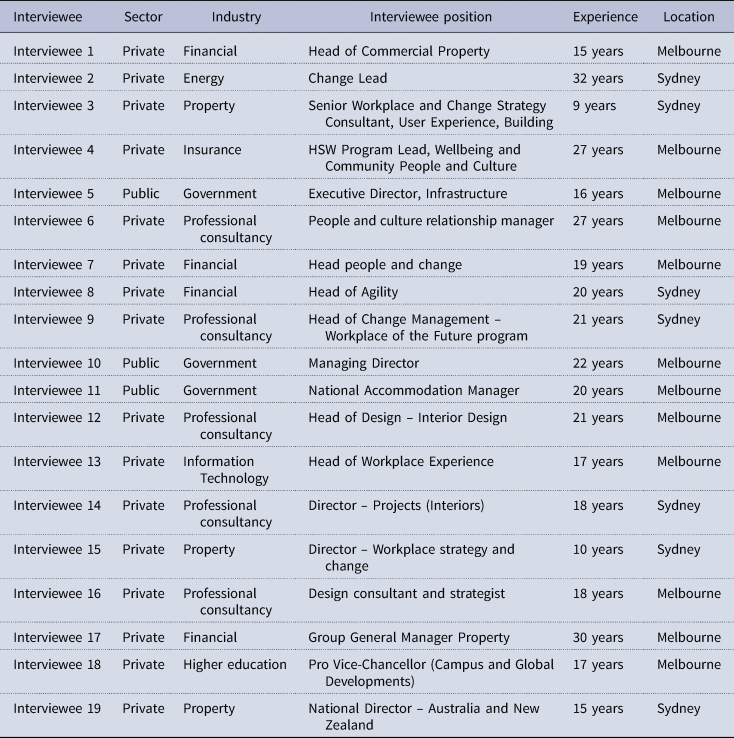
To obtain an in-depth understanding of the research problem, a sequential exploratory strategy, characterised by the collection and analysis of qualitative data followed by the collection and analysis of quantitative data, was adopted in this research (Creswell, Reference Creswell2003; Kumar, Reference Kumar2005). In the first stage, semistructured interviews were conducted with managers of 19 large corporate organisations which had introduced ABW office layouts in the past 7 years. Only large-scale corporate organisations were selected as such organisations have greater incentives and financial resources to adopt more efficient space utilisation models. Their size and significance in the industry, level of sophistication and the ability to provide the information that was sought were also considered as important factors when selecting the organisations for this study. Number of key informants interviewed was determined when it became apparent that few or no further themes were evident (Birks & Mills, Reference Birks and Mills2015). All interviewees held senior managerial level positions and were directly responsible for properties and workplaces, or held people and culture-related positions in their organisations. Selected organisations occupied large office premises and were categorised as major tenants in their buildings by the landlords. Table 1 provides further information on the participants and their respective organisations. The topics covered in the interviews included current and previous office layouts, the motives for the introduction of new office layouts and their perceptions and experiences of the influence of office layout changes on the existing corporate culture.
Profile of corporate organisations' interviewees

(Source: Authors).
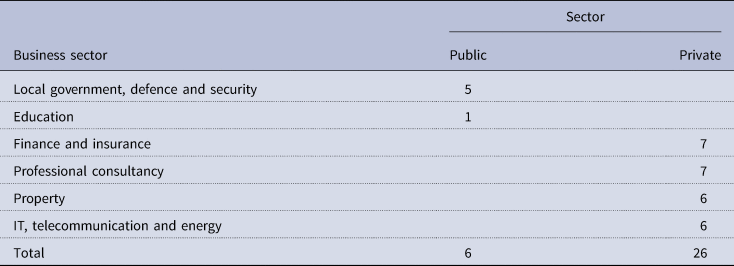
To further clarify the findings of the interviews and to quantitatively measure the possible changes of organisational culture with the changes of office layouts, a questionnaire survey was then implemented. Thirty-two large corporate organisations which had undergone office layout changes in the last 7 years were identified by using purposive sampling. The survey sample was selected carefully to represent both public and private sectors. Table 2 summarises the main characteristics of the survey participants.
Characteristics of survey participants

(Source: Authors).
The surveys were developed to measure the presence of four dimensions of organisational culture: adhocracy, clan, hierarchy and market, before and after implementing office layout changes in the participating organisations. Their responses were measured using a 9-point scale where 1 equals ‘no presence at all’, and 9 equals ‘extremely high presence’. A 9-point scale was used to measure any variation in their perceptions more precisely.
Qualitative data were analysed using thematic analysis which permitted the identification of patterns, similarities and differences in the perceptions and experiences of corporate organisations (Creswell, Reference Creswell2009). Survey responses were analysed using descriptive statistics, such as mean scores and contingency tables. The mean score given for each culture type, before and after implementing the office layout changes, was calculated by adding the responses for questions for each alternative and dividing the result by the number of questions related to each culture type. Before and after mean scores for each culture type were compared to measure how the dimensions of organisational culture changed with the introduction of new office layouts.
Results and discussion
Qualitative findings
Firstly, interviewees were asked to discuss their previous and current workplace arrangements. As shown in Table 3, the majority of organisations changed their office layouts from open-plan to ABW, while some organisations converted their traditional, cellular office layouts into ABW.
Previous and new work practices and office layouts

(Source: Authors).
In their previous office layouts, staff occupied static desks or offices and assigned individual spaces were often sized and equipped based on the employee's status within the company. However, current ABW layouts, which involve the design of spaces to accommodate various activities that office workers undertake, are based on the premise that no employee has an assigned workstation. The ratio of the total number of desks and total employees for the organisations interviewed was 70–80%. All, but three organisations, had also changed their work practices allowing their employees to work more collaboratively in their new office layouts. They had introduced major changes to their work patterns by implementing more agile working and greater collaboration with increased flexibility, including flexible time, flexible days, working from anywhere and result-only layout as opposed to physical presence.
Interviewees were then asked if they had thought about the possible impact on organisational culture before changing their office layouts. Eleven of the 19 interviewees shared a strong view that ‘the physical real estate is a silent communicator of the culture that existed in an organisation’ (Interviewee 1), and therefore the impact of layout changes on corporate culture was considered in the redesign process. They emphasised that their objective was to create an office layout that ‘created a sense of order, collaboration, continuity, and commitment from the organisation to both their employees and customers’ (Interviewee 15). Their new office layouts supported the mission of the organisation by providing workspaces that support their business tasks and activities more effectively, as well as positively influencing employee engagement and feelings of belonging. One interviewee summarised this by suggesting that they wanted to ‘shift our ‘I space’ to ‘we space’ by introducing ABW layouts’ (Interviewee 2).
Furthermore, five of the 19 interviewees highlighted that they used office layout changes as a means of eliminating undesirable values, practices and behaviours that existed within the organisation. They took advantage of this opportunity to upgrade technology, re-examine their work practices, review company vision and goals, change the existing corporate culture and improve the employee experience and amenities provided. As one interviewee explained:
I made it very clear that I didn't want this building to reflect the past, I don't expect to see some of the poor behaviours and poor practices, because some of them go back 20, 30 years. This is the time to leave them behind, if they don't add value to our business, leave them. (Respondent 10)
Organisations which understood the impact of changing office layouts on the corporate culture included cultural change programmes in their change management programmes. Sixteen of the 19 interviewees emphasised that their leadership was actively involved throughout the change management process, as they believed that ‘employees were more likely to follow when management was leading the way and exhibiting new ways of working’ (Interviewee 11). They highlighted that transparency and allowing employees to express their satisfaction or concerns were powerful ways of getting people on board. Five of the 19 interviewees reported that their organisations conducted workshops, guidance sessions or role-play activities to help both managers and employees to understand the preferred behaviours and workplace practices in their new office layouts. One organisation in particular allowed its employees to ‘select furniture and artwork sampling as part of the process of gaining support from employees and reducing their concerns and worries’ (Interviewee 5). Employees who successfully undergo onboarding programmes tend to achieve full productivity ahead of those who do not complete such programmes (Johnson & Senges, Reference Johnson and Senges2010).
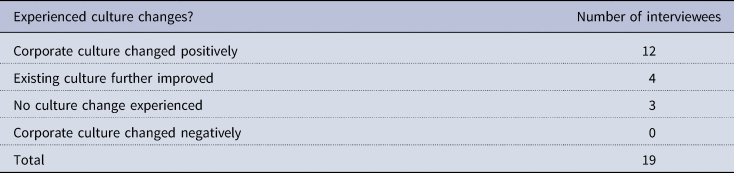
The interviewees were then asked to discuss whether they had experienced any changes in the corporate culture after introducing new workplaces and the findings provided a mixed picture (see Table 4).
Experience with culture change with the introduction of new office layouts

(Source: Authors).
Sixteen of the 19 interviewees experienced culture changes with the introduction of activity-based offices. They emphasised that the nature of office space had a role to play, not only in encouraging an organisational culture to change, but also in supporting an existing organisational culture. Their new ABW layouts were a main enabler of the implementation of ‘flatter and broader culture efforts that significantly increased the possibilities of people bumping into other people’ (Interviewee 10). Eleven advantages of their new flatter organisational culture were identified as follows:
(1) Support for new agile business initiatives and work practices introduced by the organisation.
(2) The ability to quickly create and dissolve teams for project-based activities.
(3) Greater collaboration between employees within and across various departments.
(4) Enhanced communication with management as managers also work in activity-based work settings.
(5) Employees have a greater degree of control over where and how they work.
(6) Less employee supervision while promoting increased involvement in the decision-making process.
(7) A more positive, creative and innovative workplace culture as employees feel more connected.
(8) Improved workplace productivity and efficiency as employees need to focus on one task at a time.
(9) Greater employee satisfaction from recognising individual working styles and feeling a greater degree of trust in them.
(10) Increased face-to-face interaction.
(11) Improved talent attraction and retention by supporting generational working styles, particularly those of generation Y and Millennial employees.
The most significant culture change they experienced was that employees were required to be more considerate of their coworkers and work more closely with them to complete tasks. As two interviewees explained:
You sit down at a dedicated desk and it's yours. All of a sudden it is an ABW, not only do I need to think about myself, I've got to think about other colleagues who are coming into that space next. The most significant culture change for us is that you need to think about others. (Interviewee 2).
Sometimes their bonuses or KPIs are linked to somebody else's performance. Previously they used to say; ‘I don't care, I'm not worried if that fails, I'm interested in mine’. Well now, they have to be interested, because if that person fails, they actually get a pay cut as well. So, they will go over now and say ‘Can I help you?’ (Interviewee 8).
Increased collaboration between employees and teams in ABW layouts reduced the silo mentality between departments under traditional work layouts. This is consistent with the existing literature which suggests that collaboration can improve integration and mitigate silo mentality as it produces shared construction of knowledge (LugoSantiago, Reference LugoSantiago2018). People tend to share their experiences and know-how with others if they have strong social ties with each other (Ashok, Al Badi Al Dhaheri, Madan, & Dzandu, Reference Ashok, Al Badi Al Dhaheri, Madan and Dzandu2021). ABW environments provide more opportunities for employees to be socially connected and develop such professional relationships.
Eleven of the 19 interviewees emphasised that they tend to be more client-centric in their new workplace arrangement rather than being individual product-centric. As explained by one interviewee:
The culture that we had before was a bit siloed, it was very product-centric. With this new vision, we changed our culture to be client-centric. So, we've made quite a shift that it's all about the client, and not about the products. We no longer have those silos; we now have collaborative teams that work together. (Interviewee 11)
Furthermore, interviewees from four organisations which already had relatively nonhierarchical, adaptive and innovation-friendly working cultures indicated that the level of integration, collaboration and collegiality among employees further improved in their new ABW layouts. As explained by one interviewee:
We were always a very strong value-based organisation, it isn't changed in ABW. But it feels much more like we are one big kind of…family might be a too strong word, but definitely more as one. There's much more sight of what everybody's doing, it feels much more connected. (Interviewee 14)
However, three of the 19 interviewees emphasised that the nature of the workplace is an enabler of broader culture efforts but it is not a main driver of culture changes. Justifying their rationale, they explained that a culture of an organisation comprised an interconnected set of goals, roles, processes, values, communication practices, attitudes and assumptions. Therefore, changing such features is a large-scale undertaking which cannot be achieved simply by changing the physical office layouts. One interviewee shared their experience of management expectations of culture change from office redesign as follows:
Our head of property asked me ‘when can we expect the change to start? We gave them a lovely office, it will change the culture!!’ He just thought they delivered this wonderful new office, they won lots of awards, and that something miraculously would happen with the culture. Superficially it will, but not fundamentally. (Interviewee 7)
They further emphasised that office layouts can be manifested, enhanced and enriched, but organisational culture may remain unchanged unless there is a holistic approach to change work practices, policies and other procedures. One interviewee explained this as follows:
If my boss measures my performance by how much he sees me in that flexible workspace, it doesn't matter how flexible the workspace is. That will be detrimental to my performance, because I have a boss who is working in an organisational culture that is still of a different mindset. So, my physical freedom makes no difference. But if the HR policies say that my boss has to change how he perceives my work outputs, then it starts to change the culture. (Respondent 17)
However, they strongly agreed that the workplace is an important element of culture and changes to office layouts can be used as a starting point for the culture change by revisiting an organisation's mission, vision, values, leadership styles, communication practices and work practices. As explained by one interviewee:
Whether it's at a black or white desk, that's not going to change their culture, it's the people who are managing and the people themselves who changing the culture. Moving to a new office is giving them a reason to change if they are really interested in the change. (Interviewee 10)
In summary, all interviewees either experienced culture changes with changes in office layouts or believed that such changes can be used as a starting point for culture changes. They shared a common view that workplaces supported by work practices can be used to support the organisational culture, business culture and business direction.
Quantitative findings
As the majority of interviewees acknowledged that their organisational culture changed due to office layout changes, in the next stage of data collection, the survey aimed to quantitatively measure such changes in the organisational culture. Out of 32 respondents, 19 participated in the interviews and the remaining 13 organisations were only available to complete the survey.
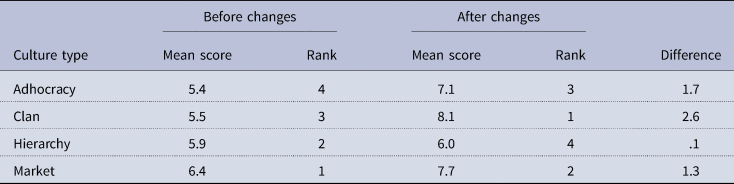
To measure the impact of office layout changes on corporate culture, respondents were asked to provide their perceptions of the presence of each organisational culture measurement criterion before and after implementing such changes. In the first stage of analysis, the entire survey sample responses were analysed as a whole. It is extremely rare for an organisation to have a pure hierarchy, market, clan or adhocracy culture, or to share equal traits of all four culture dimensions with no dominant culture type (Acar & Acar, Reference Acar and Acar2014; Gaál, Obermayer-Kovács, Csepregi, Antonova, & Jenei, Reference Gaál, Obermayer-Kovács, Csepregi, Antonova, Jenei, Uden, Szabó and Obermayer-Kovács2010). Organisations generally have a strong dominant culture, followed by a strong secondary culture component (Calori & Sarnin, Reference Calori and Sarnin1991; Cameron & Quinn, Reference Cameron and Quinn1999). Table 5 illustrates the mean scores given to the questions to measure the level of presence of four culture types before and after the implementation of layout changes.
Dimensions of organisational culture before and after layout changes (entire sample)

(Source: Authors).
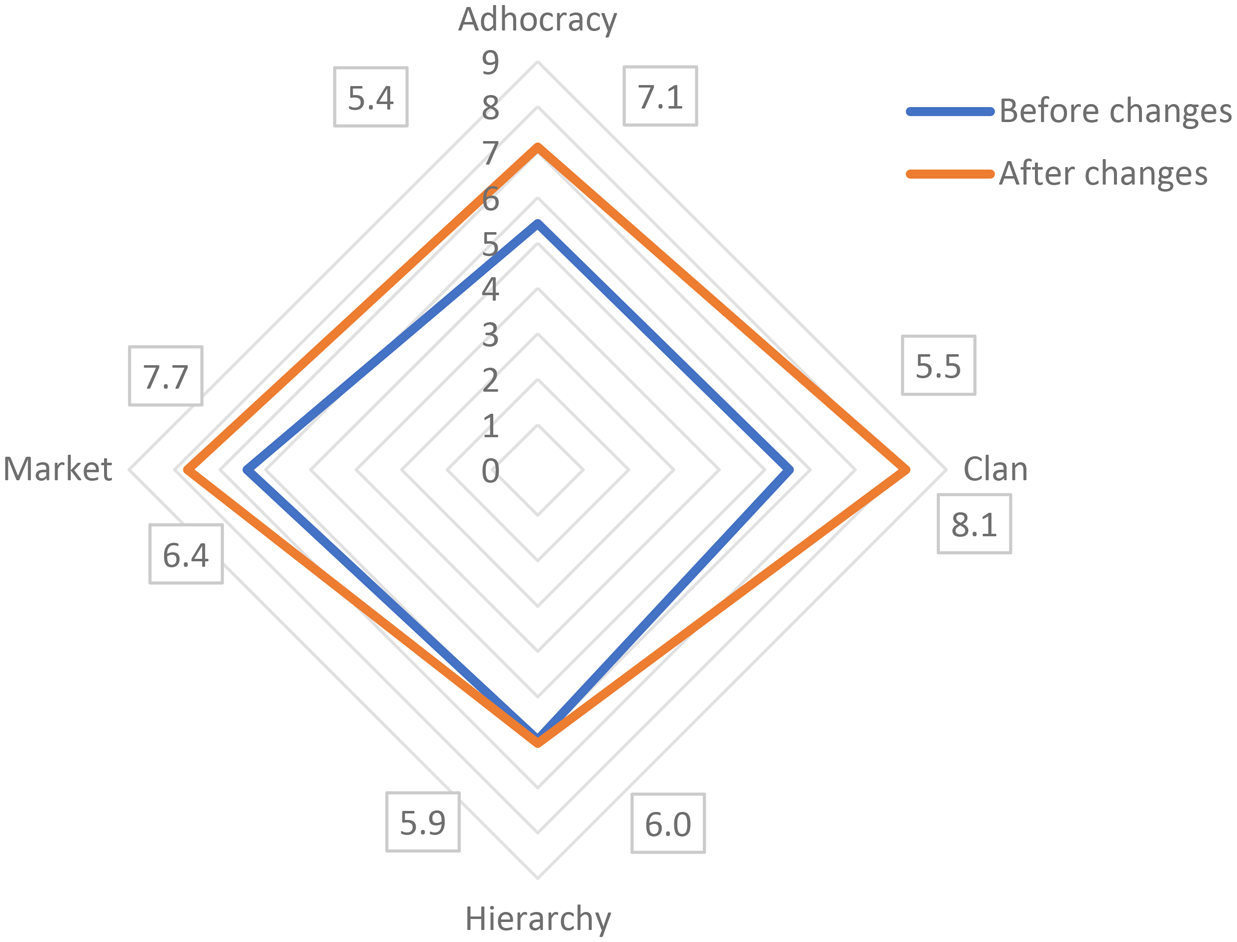
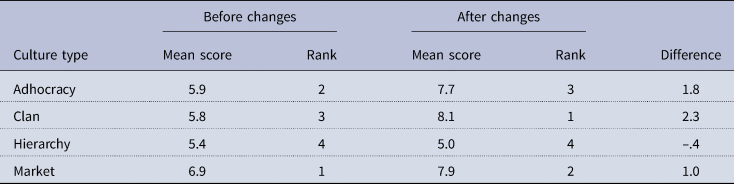
The most dominant culture presented before layout changes was the market culture, which emphasised competitiveness not only between the organisation and its market competitors, but also amongst employees. The market culture with its competing orientation appears as a culture type that hinders knowledge sharing among employees (Boster, Reference Boster2013). This was followed by the hierarchy culture, which focused on controlling procedures and the efficiency and stability of the organisation and its employees (Tharp, Reference Tharp2009). However, with office layout changes, the clan culture, which emphasises teamwork, collaboration, inter-personal relationships and doing things together (Fairs, Reference Fairs2016), became the dominant culture. This suggests that non-territorial ABW layouts increased the collaborative orientation and knowledge sharing within these organisations. It was followed by the market culture, which illustrated organisations' preference to be still competitive while achieving their goals collaboratively and flexibly. The results show that the importance of the hierarchy culture decreased with the introduction of flexible working and layouts, suggesting that the management procedures have become flatter and less hierarchical. The changes in the four dimensions of organisational culture after layout changes are further illustrated in Figure 1. The four axes of the graph represent the four culture dimensions, while the blue and orange lines represent the combination of the four culture dimensions before and after the implementation of layout changes.
Influence of layout changes on organisational culture (entire survey sample).
(Source: Authors).

The dominant culture of the organisations changed from a market culture to a clan culture with the introduction of flexible office layouts while their secondary culture changed from a hierarchy to a market culture. The participants believed that the strength of all four culture types within their organisations increased with the introduction of new workplace strategies. This suggests that collaboration and teamwork (clan culture), competitiveness and customer orientation (market culture), structure and decision-making (hierarchy culture), employee innovation and creativity (adhocracy culture) were further improved with the introduction of flexible office layouts.
To examine if the organisations' perceptions varied with their business sector and industry type, subanalyses were then performed and the results are discussed below.
Analysis by business sector (public vs. private)
The existing literature suggests that the organisational culture in public and private sectors differs in many obvious ways (Rainey, Reference Rainey2009). Public sector organisations continue to emphasise the values of a bureaucratic or hierarchical culture with strong emphasis on regulations, standards, uniformity and consistency while private sector organisations operate in profit-driven, competitive environment (Cameron & Quinn, Reference Cameron and Quinn2006; Rusa & Rusu, Reference Rusa and Rusu2014). Therefore, it was interesting to see how the corporate culture changed in public and private organisations with the introduction of ABW layouts.
Public sector organisations
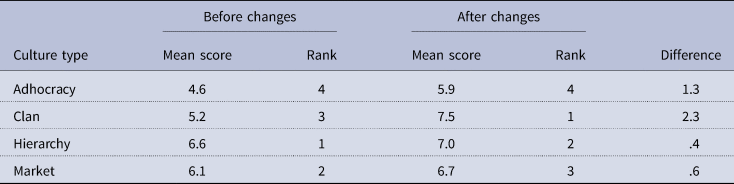
Unlike in the private sector, few government organisations have gone through workplace redesign processes; therefore, the survey sample consisted of only six government organisations. Table 6 summarises the public sector organisations' perceptions of the organisational culture that existed before and after implementing office layout changes.
Changes in organisational culture: public sector

(Source: Authors).
The hierarchy culture was the dominant culture prevailing in public sector organisations before they moved to ABW layouts. This suggests that the public sector organisations tended to have strong formal rules and policies with formalised and structured workplaces and an emphasis on stability and predictability (Tharp, Reference Tharp2009). Their secondary dominant culture was the market culture, which emphasises finishing work and completing jobs (Cameron & Quinn, Reference Cameron and Quinn2011). Adhocracy, which focuses on innovation, creativity, articulating future vision and entrepreneurship (Tharp, Reference Tharp2009) was the weakest culture type. It is consistent with the findings of earlier studies which found that the culture that existed in the public sector had little or no space or encouragement for their employees to be creative and innovative, and required high intensity of face-to-face communication to complete tasks (Rusa & Rusu, Reference Rusa and Rusu2014).
However, with the introduction of new workplaces, collaboration and teamwork improved noticeably, and as a result the clan culture emerged as the dominant culture type. The finding is consistent with the existing literature which suggests that the public sector organisations are increasingly implementing knowledge management practices to weather rapidly changing external environments and fiscal austerity (Al Ahbabi, Singh, Balasubramanian, & Gaur, Reference Al Ahbabi, Singh, Balasubramanian and Gaur2019).
Private sector organisations
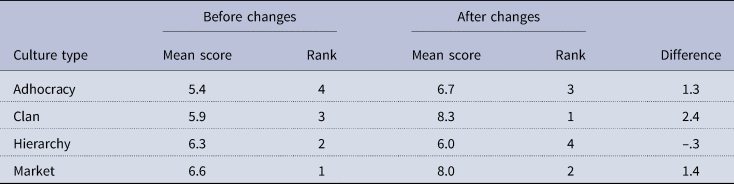
The survey sample consisted of 26 private sector organisations. Table 7 shows their perceptions of the changes in the corporate culture with the introduction of new office layouts.
Changes in organisational culture: private sector

(Source: Authors).
Consistent with the findings in the literature (Denison, Haaland, & Goelzer, Reference Denison, Haaland and Goelzer2004; Übius & Alas, Reference Übius and Alas2009), market culture, which focuses on competitiveness and goal achievement, was the dominant culture before office layout changes. Due to its competitive orientation, this culture type does not encourage collaboration and knowledge sharing, unless employees are explicitly rewarded for sharing what they know (Gaál et al., Reference Gaál, Obermayer-Kovács, Csepregi, Antonova, Jenei, Uden, Szabó and Obermayer-Kovács2010). This was followed by hierarchy culture while adhocracy and clan cultures shared the least dominant culture type. However, with the introduction of new office layouts, the presence of clan culture increased noticeably to become the dominant culture type. The findings are consistent with the previous literature that confirms that flexible work layouts enhance collaboration and knowledge sharing (Cameron & Quinn, Reference Cameron and Quinn2011; Rusa & Rusu, Reference Rusa and Rusu2014). The market culture, which emphasises competitiveness, fast responses, decisiveness and goal achievement (Rusa & Rusu, Reference Rusa and Rusu2014), is still very important in the new layouts, and is the secondary culture. Private sector organisations are profit-oriented and customer-focused and always look for more productive ways of doing business (Cameron & Quinn, Reference Cameron and Quinn2006). However, the findings indicate that modern private sector organisations tend to achieve these strong result-oriented targets by employing more collaborative and flexible approaches. The hierarchy culture became the least dominant suggesting that work practices have become more flexible, adaptable and less hierarchical.
The results show that both public and private sector organisations which participated in the survey experienced noticeable changes in their existing corporate culture. Private sector organisations that were previously dominated by external positioning, with a high degree of individualism, are now dominated by clan culture, which is characterised by collectivity and flexibility. Public sector organisations, which were dominated by internal maintenance with the need for stability and control, are now dominated by clan culture, which is characterised by internal maintenance with flexibility.
Analysis by industry type
Different organisations have different dominant culture orientations based on the nature of their business activities (Nahm, Vonderembse, & Koufteros, Reference Nahm, Vonderembse and Koufteros2004; San Park & Kim, Reference San Park and Kim2009). Therefore, the next step in the analysis examined if the organisations' perceptions varied with their industry sector.
Finance and insurance sector
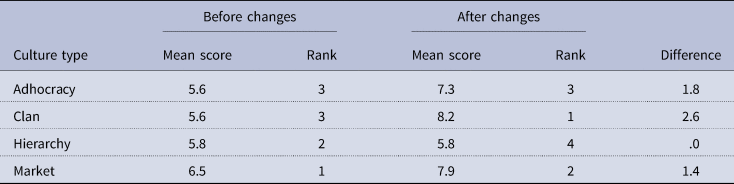
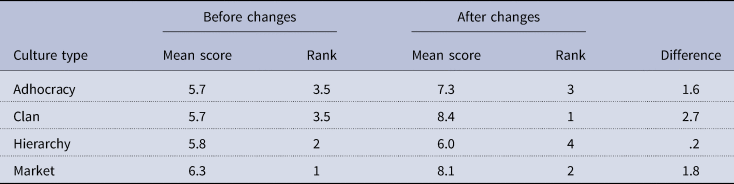
The survey sample consisted of six finance and insurance sector organisations who were leading Australian banks or capital fund management companies. Table 8 shows the organisational culture types that existed before and after layout changes.
Changes in organisational culture: finance and insurance sector

(Source: Authors).
The results revealed that the market culture, which is built upon competition and achieving concrete results (Cameron & Quinn, Reference Cameron and Quinn2011), was the dominant culture before layout changes. This was followed by the hierarchy culture, while clan and adhocracy cultures were the third and fourth ranked culture types. This finding supports the existing literature which suggests that the main drivers of finance sector organisations are enhancing profitability and market share with strict institutional procedures in place for guidance for goal achievement (Tsui, Wang, & Xin, Reference Tsui, Wang and Xin2006). Traditionally, collaboration and innovation are less important in this industry (O'Connor, Reference O'Connor1995), making clan and adhocracy cultures less important in their corporate culture.
However, with the introduction of flexible ABW layouts, the clan culture in these organisations increased, scoring an average score of 8.2 out of 9 and it has become the dominant culture type. The interview findings revealed that the main purpose of introducing ABW layouts was to increase collaboration, teamwork, communication and consensus; therefore, these results confirm that the managers believe that they have managed to achieve these objectives in their new work settings. The hierarchy culture, which was the second dominant culture, has become the least dominant culture even though the strengths of all culture types increased with the changes in office layouts.
Professional consultancy sector
The survey sample included seven professional consultancy organisations which represented various professional services such as legal, architecture, auditing, taxation and other consulting organisations. Professional services typically have traditional office layouts with cellular plan offices as their work requires concentration, confidentiality or strong expression of the status of the users (Hassanain, Reference Hassanain2006). These industries do not have strict rules and regulations to control employees as they are professionally qualified, highly skilled workers doing more intellectual tasks (San Park & Kim, Reference San Park and Kim2009). Their perceptions of the impact of office layout changes on the organisational culture are illustrated in Table 9.
Changes in organisational culture: professional consultancy sector organisations

(Source: Authors).
Similar to the finance sector, the goal-oriented market culture was the dominant culture type before layout changes. This was followed by adhocracy culture, which requires innovation and creativity, while the hierarchy culture, which is founded on structure and control, was the least dominant culture. The results are consistent with existing literature that suggests that knowledge-based industries require access to an layout which allows them to be able to conduct experiments, meet challenges, take risks and be innovative and creative (San Park & Kim, Reference San Park and Kim2009).
Interestingly, with the introduction of ABW layouts, clan culture has become the dominant culture type. The results suggest that these companies now tend to value flexibility, employee autonomy and teamwork rather than competition. The presence of the hierarchy culture further decreased while it remained the least dominant culture, suggesting that this industry continues to be less hierarchical.
Property sector
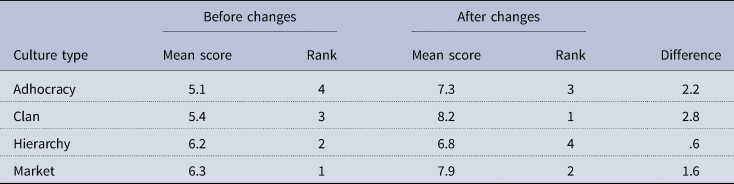
As experts in space utilisation, some major property companies actively use nonterritorial office layouts such as hot-desking, hoteling and ABW areas (CBRE, 2018). In addition, they provide professional advice to other organisations on office utilisation models and change management programmes related to layout redesigns. Many of these firms have adopted agile and flexible workplaces and use them to showcase new ways of working to their clients. Table 10 illustrates the organisational culture types before and after office layout changes.
Changes in organisational culture: property sector

(Source: Authors).
The market culture was the dominant culture before office layout changes followed by hierarchy and clan cultures. This confirms existing studies which concluded that firms in the property and real estate sector are highly competitive, and market-driven (Cameron & Quinn, Reference Cameron and Quinn2006; San Park & Kim, Reference San Park and Kim2009). Similar to other industries, the clan culture has become the dominant culture after layout changes with significant increases in collaboration, teamwork and knowledge sharing. Market culture is the secondary culture in their new work layouts which emphasises the importance of having common goals and ensuring profitability and a satisfactory market share (Gaál et al., Reference Gaál, Obermayer-Kovács, Csepregi, Antonova, Jenei, Uden, Szabó and Obermayer-Kovács2010). The presence of hierarchy culture decreased indicating that the hierarchical structures and authority have become less centralised.
IT, telecommunication and energy sector
There were six organisations representing the IT, telecommunications and energy sector in the survey sample. Although more organisations are moving towards more nonterritorial, equal status office layouts, it should be noted that the IT and telecommunication industries have taken the lead with new ways of working and new workplaces (Bosua, Gloet, Kurnia, Mendoza, & Yong, Reference Bosua, Gloet, Kurnia, Mendoza and Yong2013; Cooper, Reference Cooper1994). IT and telecommunication organisations' perceptions of the impact of office layout changes on the organisational culture are illustrated in Table 11.
Changes in organisational culture: IT, telecommunication and energy sector

(Source: Authors).
The analysis reveals that, traditionally, this industry was dominated by market culture which is built upon the dynamics of competition and achieving tangible results, followed by the hierarchy culture, which is founded on structure and control. This is consistent with the existing literature which suggests that IT and telecommunication industries operate in highly competitive environment and are united by a common goal to succeed and beat their rivals (Cameron & Quinn, Reference Cameron and Quinn2006; San Park & Kim, Reference San Park and Kim2009). However, after changing layouts, the presence of the clan culture increased noticeably, to be the most dominant culture. The hierarchy culture dropped from second position to the least dominant culture position. Therefore, the findings suggest that, according to the perceptions of management, the objectives of changing office layouts have been achieved by their organisations, leading to a new direction of organisational culture.
Overall, it is revealed that all profit-driven private sector industries participated in the survey had been dominated by the market culture before the introduction of flexible office layouts. The strong result-orientation and competitive behaviour of the market culture are aligned to the competition, not only between the organisation and its market competitors, but also amongst employees within the organisations. However, the results clearly show that with the introduction of flexible ABW layouts, the clan culture became the dominant culture type. This culture type has a collaborative orientation and is fundamentally based on trust among employees, which encourages knowledge sharing. The features of extended family, tradition and loyalty show that the members of the organisation are close and therefore knowledge sharing can be realised more easily (Rusa & Rusu, Reference Rusa and Rusu2014; Tharp, Reference Tharp2009). Clan cultures are the most collaborative and the least competitive of the four main corporate culture models. The findings confirm that organisations believe that productivity and business success can be achieved by better employer commitment and employee engagement. Overall, the results illustrate that management believes that the nature of work settings can have a clear impact on the corporate culture of an organisation.
Conclusion
The purpose of this paper was to examine corporate organisations' perceptions and experiences of the impact of changes in office layouts on the existing corporate cultures in their organisations. The study focuses on large-scale organisations that moved to ABW in Melbourne and Sydney in Australia. Most organisations participated in this study viewed the physical office space as a means of reinforcing the corporate culture, improving organisational performance and employee productivity and attracting new talent to the organisation.
The findings indicated that all organisations either experienced culture changes with changes in office layouts and work practices or believed that changes in office layouts and work practices can be used as a starting point for culture changes. They strongly believed that workplace design and organisational culture are closely linked as workplace designs directly influence culture by supporting the systems, symbols, engagement/motivation and behaviours of the organisation and employees over time. Whatever their business orientation or industry type, all organisations in this study found that, with the introduction of new workplaces and work practices, collaboration and teamwork improved considerably. As a result, the clan culture emerged as their dominant culture type. These organisations have developed different subdominant culture types based on their business orientation, industry type and nature of the work they do. The findings indicate that organisations are willing to redesign their office space as an element supporting desirable employee characteristics and corporate culture as well as a response to market trends. With the growing awareness of the impact of physical office on company dynamics, organisations are recognising the potential of office layouts and atmosphere as management tools. Therefore, it is clear that they treat improvements to the physical office layout as an investment, not as an expense. Furthermore, they strongly believe that their modern workplaces must be flexible and tailored to the needs of their business orientations and employees in order to ensure a competitive advantage in their business areas.
Contributing to the existing knowledge, the findings clearly identify that, with the introduction of flexible office layouts, the clan culture became the dominant culture of all industry types that participated in this study. The results show that the management of the organisations believed that the culture of their organisations had changed favourably to more collaborative, flexible, adaptable and knowledge-sharing settings. This suggests a decrease in traditional working hours, presentism in the office and hierarchical office arrangements. However, the findings indicate that their secondary cultures varied with industry type and business orientation. The results suggest that workplace designs are becoming a powerful tool impacting the corporate culture of an organisation and the extent to which knowledge workers are able to collaborate and interact within and across different sections of the organisation. Therefore, space planners need to consider this relationship and account for the important role the office settings play in the performance and cultural orientation of organisations.
The limitations of the study present new opportunities for future research. This study aimed to examine the experiences and perceptions of the management of organisations on the impact of workplace changes on the culture of organisations. In future studies, the authors aim to examine the experiences and perceptions of employees who moved to ABW and the office design firms who design such spaces. Moreover, given the significant impact of COVID on work practices and office usage, the authors aim to examine the changes in the culture of organisations as many employees continue working remotely. Such a broader analysis will provide the context for a more inclusive understanding of the operation and behaviours of various market participants in alternative office layouts.
Dr. Kusal Nanayakkara (PhD, BProp [Hons], BSc EMV[Sp][Hons], HNDA, MAAT) recently completed his PhD in Built Environment. His PhD research focused on how organisational culture would be influenced by changing office layouts and designs. It examined the issue from the perspectives of the management, employees and workplace specialist consultancy and design firms. Kusal's research interests are in the areas of new ways working and their impact on workplaces and organisation culture, corporate real estate-related issues and property markets in developing countries. He has been working as a casual academic and had industry experience as a property analyst for 6 years.
Professor Sara Wilkinson (BSc, MA, MPhil, PhD, FRICS, AAPI) is a chartered building surveyor and Australia's first female Professor of Property. Her transdisciplinary research programme sits at the intersection of sustainability, urban development and transformation, with a focus on green cities and preparing our urban environments for the challenges of climate change. Sara works with academics and industry partners in engineering, science, health and business to deliver building adaptation, sustainability and resilience, and green infrastructure projects. Australia's most cited property academic with highest ORCID, H and i10 scores, overall, within the discipline, She ranks #6 at h index, #3 at cites and #3 at i10. Sara has produced nine books, 30 book chapters, 33 research reports, 59 refereed journal and 105 refereed conference papers, and eight keynote presentations.