Introduction
The cotton aphid Aphis gossypii Glover is a cosmopolitan and polyphagous crop pest with more than 600 host species (Inaizumi, Reference Inaizumi1980; Blackman & Eastop, Reference Blackman and Eastop1984; Deguine et al., Reference Deguine, Martin, Merlier and Leclant1997; Ebert & Cartwright, Reference Ebert and Cartwright1997). However, A. gossypii populations are structured into host races specialized on Cucurbitaceae, cotton, eggplant, potato, chili- or sweet pepper, and strawberry (Vanlerberghe-Masutti & Chavigny, Reference Vanlerberghe-Masutti and Chavigny1998; Fuller et al., Reference Fuller, Chavigny, Lapchin and Vanlerberghe-Masutti1999; Brévault et al., Reference Brévault, Carletto, Linderme and Vanlerberghe-Masutti2008; Charaabi et al., Reference Charaabi, Carletto, Chavigny, Marrakchi, Makni and Vanlerberghe-Masutti2008; Carletto et al., Reference Carletto, Lombaert, Chavigny, Brévault, Lapchin and Vanlerberghe-Masutti2009). As evidenced by the few number of microsatellite multilocus genotypes (MLG) detected, each host race comprises some very specialized genotypes that are geographically widespread and persistent over time through parthenogenetic reproduction (Carletto et al., Reference Carletto, Lombaert, Chavigny, Brévault, Lapchin and Vanlerberghe-Masutti2009). In the cotton-producing regions of West and Central Africa (WCA), A. gossypii is a key pest of cotton that causes direct damage to seedlings and spoilage of fiber through honeydew production. Over this large geographic area, mainly two genotypes, exhibiting the Burk1 (>90%) and Ivo MLG's, have been repeatedly collected from cotton crops and Malvaceous vegetable crops such as roselle (Hibiscus sabdariffa L.) and okra (Abelmoschus esculentus (L.) Moench) (Brévault et al., Reference Brévault, Carletto, Linderme and Vanlerberghe-Masutti2008; Carletto et al., Reference Carletto, Lombaert, Chavigny, Brévault, Lapchin and Vanlerberghe-Masutti2009). These vegetable crops represent major relay host plants for cotton-adapted genotypes during the off-season when cotton crops are no longer available (Brévault et al., Reference Brévault, Carletto, Linderme and Vanlerberghe-Masutti2008).
Drift and selection, in combination with parthenogenetic reproduction, could both account for the low genotypic variability observed within populations of the cotton host race (Wright, Reference Wright1969). Brévault et al. (Reference Brévault, Carletto, Linderme and Vanlerberghe-Masutti2008) showed that the frequency of Burk1 in cotton crops significantly increased throughout the course of the growing season, especially when cotton fields were sprayed with insecticide. They proposed that selective pressures resulting from the intensification of cotton cultivation and related insecticide treatments have favored Burk1-related insecticide-resistant genotypes. A recent study on insecticide resistance traits within and among host races in A. gossypii, showed that, in comparison to Ivo, Burk1 was highly resistant to organophosphates (dimethoate, profenofos and monocrotophos), pyrethroids (cypermethrin) and DDT (Carletto et al., Reference Carletto, Martin, Vanlerberghe-Masutti and Brévault2010). Additional selective factors that could contribute to low genetic diversity and prevalence of Burk1 include interclonal competition for resources (Fuller et al., Reference Fuller, Chavigny, Lapchin and Vanlerberghe-Masutti1999; Rochat et al., Reference Rochat, Vanlerberghe-Masutti, Chavigny, Boll and Lapchin1999), ecological specialization on host plants, and superior ability to locate suitable host plants in the spatial and temporal heterogeneity of cotton-based agricultural landscapes (Brévault et al., Reference Brévault, Carletto, Linderme and Vanlerberghe-Masutti2008; Carletto et al., Reference Carletto, Lombaert, Chavigny, Brévault, Lapchin and Vanlerberghe-Masutti2009). Adaptation of some genotypes to environmental conditions, such as high temperatures and low relative humidity prevailing during the off-season, could also contribute to low genetic diversity (Vorburger, Reference Vorburger2004).
The objective of this study was to identify selective factors that account for the low genetic diversity within the A. gossypii cotton host race in WCA and prevalence of Burk1. We conducted laboratory and field experiments to assess the relative population growth of the two cotton MLGs, Burk1 and Ivo, in competition or not and according to selective pressures such as host plant, insecticide use and climatic conditions. We also collected A. gossypii alatae, both from field traps and cotton plants, early in the cropping season to evaluate the genetic diversity of the immigrant aphid population (‘inoculum’). When the cotton season ended, the same type of sampling was done in newly planted plots of okra and roselle, known to act as relay host plants for cotton-specialized aphids throughout the off-season. A. gossypii aphids were genotyped at eight specific microsatellite loci and characterized by their MLGs. Results are discussed in the light of interclonal competition within A. gossypii field populations and selection by insecticides.
Materials and methods
Insects and multilocus genotype analysis
The two clonal lineages Burk1 and Ivo were originally field-collected from cotton in northern Cameroon (Garoua, 9°23N and 13°45E) in 2006. Their multilocus genotype was established on the basis of the alleles observed at eight microsatellite loci as described by Brévault et al. (Reference Brévault, Carletto, Linderme and Vanlerberghe-Masutti2008) and Carletto et al. (Reference Carletto, Lombaert, Chavigny, Brévault, Lapchin and Vanlerberghe-Masutti2009). They were raised on cotton leaf discs of 9 cm in diameter (Gossypium hirsutum L., cv. Irma A1239, Cameroon) positioned on an agar-coated petri dish (20 g l−1 agar and 30 mg l−1 nipagin) and held in the laboratory under controlled conditions (25±2°C, 70±20% r.h. and a 14:10 h L:D photoperiod cycle). Aphids that were three days old (4th instar and adult) were used in the experiments. A batch of 10–20 aphids were genotyped at the beginning of each experiment to be sure that there was no contamination. As opposed to Ivo, Burk1 is highly resistant to cypermethrin (pyrethroid) due to the mutation super-kdr (M918L) in the voltage-gated sodium channel gene (para gene), and metabolic detoxification is mediated by esterase enzymes (Carletto et al., Reference Carletto, Martin, Vanlerberghe-Masutti and Brévault2010). This genotype also carries the mutation A302S in this gene, which confers moderate resistance to organophosphates such as profenofos and monocrotophos (Carletto et al., Reference Carletto, Martin, Vanlerberghe-Masutti and Brévault2010).
Whole plant experiments
The two clonal lineages Burk1 and Ivo were tested on whole host plants in the laboratory. Tested host plants were cotton (Gossypium arboreum, wild type N1301, and G. hirsutum, cv. Irma A1239), roselle and okra. The tetraploid cotton G. hirsutum probably originated about 1–2 million years ago from an interspecific hybridization of an Old World diploid species that was closely related with G. arboreum and a New World diploid species (Beasley, Reference Beasley1940; Wendel & Cronn, Reference Wendel and Cronn2003). Furthermore, a recent study showed that G. arboreum was less susceptible to A. gossypii than G. hirsutum (Nibouche et al., Reference Nibouche, Brévault, Klassou, Dessauw and Hau2008). Plants were grown in 20-cm diameter pots containing a 50:50 mixture of sand and potting mix. They did not receive any application of fertilizer and were used for experiments four weeks after planting. Cotton seeds were provided by CIRAD cotton germplasm. Four plants were grown in each pot and watered daily. Climatic conditions in the growth chamber were 23–30°C, 45–80% r.h., 12:12 h L:D and 14,000–18,000 lux at plant height.
In experiments 1 to 4, pots were surrounded by an insect-proof mesh to avoid aphid contaminations from neighbouring plants. The treatments in each experiment were replicated eight times and arranged in a randomized block design.
Experiment 1
Host plant (no competition). Four three-day-old apterous Burk1 or Ivo adults were separately transferred from the leaf discs onto four plants of G. arboreum, G. hirsutum, roselle or okra.
Experiment 2
Host plant (competition). The same plant species as in experiment 1 were used; but, here, two three-day-old apterous Burk1 and Ivo adults were concurrently transferred from the leaf discs onto each plant.
Experiment 3
Insecticide use (competition). On d0, two three-day-old apterous Burk1 and Ivo adults were concurrently transferred from the leaf discs to four G. hirsutum cotton plants. After ten days, the plants were sprayed with either water or with a mix of commercial formulations of cypermethrin (Cypercal 200 EC, 36 g ha−1) and profenofos (Profenalm 500 EC, 150 g ha−1) according to local cotton pest management recommendations (SODECOTON, 2007).
Experiment 4
Climatic conditions (competition). On d0, two three-day-old apterous Burk1 and Ivo adults were concurrently transferred from the leaf discs to eight G. hirsutum plants. Half of the plants were kept in the growth chamber (23–30°C and 45–80% r.h.) and other half were kept outdoors (16–41°C and 20–30% r.h.).
Experiment 5
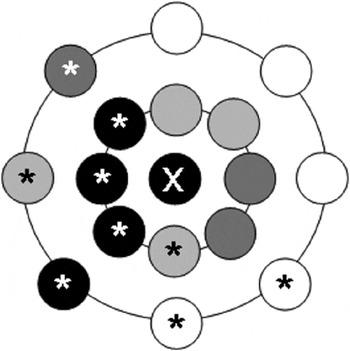
Genotype dispersion. A total of 16 pots containing four aphid-free G. hirsutum plants were placed on two rings around one central pot where ten three-day-old apterous Burk1 and Ivo adults were released at d0 (fig. 1). Aphids were allowed to move from one plant to another.
Density of Aphis gossypii genotypes Ivo and Burk1 concurrently inoculated (competition) onto whole cotton plants (G. hirsutum) and proportion of Ivo after 14 days, experiment 5. X, ten three-day-old apterous Burk1 and Ivo adults were released on d0 on the central plants; *, pots with mean proportion of Ivo >50% ( , <250;
 , 251–500;
 , 501–750;
 , >750).

On d14, the total number of aphids was assessed on each plant. To do this, plants were removed from pots and dipped in 70% ethanol to remove aphids for subsequent counting. To assess the total leaf area of plants, we reproduced leaves on a sheet of paper of known density (g cm−2) and related the resulting paper weight to its area. In experiments 2–5, the number of aphids and proportions of the two clones within the population at d14 were assessed using the discriminating dose of cypermethrin assay. Four batches of 30 individuals were exposed to leaf discs previously sprayed with a dose of 500 mg l−1 technical-grade cypermethrin (Arysta Life Science, France) which was assumed to kill only Ivo individuals (Carletto et al., Reference Carletto, Martin, Vanlerberghe-Masutti and Brévault2010), as confirmed by preliminary bioassays where the survivors were genotyped, or to non-treated leaf discs used as controls to evaluate natural mortality.
Field cage experiments
Experiment 6
Field assessment under insecticide pressure. Four insect-proof cages (250×250×250 cm) were positioned in a 0.25-ha cotton field in the early growing season. Cages contained three rows of ten cotton plants (G. hirsutum), each at the pre-flowering stage. On d0, five three-days-old apterous Burk1 and Ivo adults were concurrently transferred on each of two terminal leaves of four randomly chosen plants per cage (resulting in a total of 40 Burk1 and 40 Ivo per cage). Initially, infested plants were tagged with a coloured thread of wool. On d6, a mix of cypermethrin (Cypercal 200 EC, 36 g ha−1) and profenofos (Profenalm 500 EC, 150 g ha−1) was sprayed on plants in two cages with a low volume (10 l ha−1) hand held Ulva+ (Micron Sprayer, UK) sprayer. During application, treated plots were surrounded by a plastic tarpaulin to prevent insecticide drift to neighbouring cages. Control plots were sprayed with water only. Aphids from the five terminal leaves of the four tagged plants and four randomly chosen plants were counted on d14. One aphid was randomly collected on each observed leaf and held at −20°C in 95% ethanol for subsequent MLG analysis.
Field collection of alate aphids
To assess the identity of immigrant aphids (founders) on cotton crops, traps were placed in newly planted cotton fields during the early cropping season (June 2006) to sample alatae. Two sites, about 10 km apart, Djalingo (9°13′N, 13°26′E) and Mayo Dadi (9°15′N, 13°41′E), were selected in the cotton growing area of northern Cameroon. In each site, five traps were placed in a cotton plot and in a neighbouring corn (Zea maïs L., non-host plant) field as a control. Traps consisted of sticky yellow cards (Biosystèmes, France) and yellow plates filled with soapy water. Traps were inspected daily. Once some individuals were detected on traps, alatae were also collected on 20 tagged plants per plot. A similar trapping system was implemented in the early off-season (November) to sample alatae on early planted okra or roselle (Malvaceae) in irrigated plots at Gaschiga (9°25′N, 13°21′E) and Pitoa (9°23′N, 13°30′E). Once aphids were detected on traps, alatae were also collected on 20 tagged plants per plot. Aphids were individually observed under a binocular microscope to identify the species according to morphological criteria (Stroyan, Reference Stroyan1984). Samples were held at −20°C in 95% ethanol for subsequent MLG analysis.
Statistical analyses
In the whole plants and field cage experiments, aphid density was analysed using the Generalized Linear Model (GLM) with a Poisson distribution (count data) and log link. Proportions of aphid genotypes on plants were analysed using the GLM procedure with a binomial distribution and a logit link (JMP® 8.0.1, Sas Institute Inc., Cary, USA). Proportions of alate aphids collected from traps and plants were compared using a conventional χ2-test.
Results
Population growth on whole plants
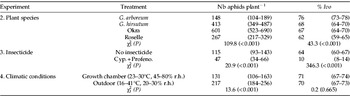
When Burk1 and Ivo aphids were transferred separately on whole plants, their population developed significantly better on roselle, okra and cotton G. hirsutum than on cotton G. arboreum (experiment 1; table 1). Generally, Burk1 performed as well as Ivo on the four plant species. When both MLGs were concurrently transferred on the same plants, the total population developed better on okra than on G. hirsutum, roselle, and G. arboreum (experiment 2; table 2). The proportion of Ivo was >60% on the four host plants. Insecticide spray had a detrimental effect on aphid density and proportion of Ivo (experiment 3; table 2). Aphid populations were higher under outdoors conditions (average 28.0°C, 23.2% r.h.) than in the growth chamber (average 24.8°C, 64.3% r.h.) but the proportion of Ivo remained unchanged (experiment 4; table 2). When both MLGs were initially released on the same central pot and were allowed to colonize neighbouring cotton plants, the mean density of aphids was greater in the inner ring of pots (712 aphids plant−1) than that in the outer one (405 aphids plant−1) (GLM, χ12=4.0, P=0.045) after 14 days. The mean proportions of Ivo on plants were 51 and 53% on the inner and the outer rings, respectively (GLM, χ12=3.5, P=0.060). A non-isotropic dispersal of aphids was observed whereas pots with dominance of Ivo (>50%) were not randomly distributed (experiment 5; fig. 1). Ivo was better represented than Burk1 on high-populated plants.
Mean density after 14 days of Aphis gossypii genotypes Ivo and Burk1 independently inoculated (no competition) onto whole plants of various species, experiment 1 (95% confidence limits).

Nb, number.
Mean density of Aphis gossypii genotypes Ivo and Burk1 concurrently inoculated (competition) onto whole plants and proportion of Ivo after 14 days as a function of host plant, insecticide use, and climatic conditions, experiments 2–4 (95% confidence limits).

Nb, number.
Population growth in field cages
In the field, insecticide application had no significant effect on the density of aphids on both initially inoculated and non-inoculated plants but exerted a strong selection on the MLG composition by suppressing the population of Ivo (experiment 6; table 3). In the absence of insecticide, the proportion of Ivo was greater on inoculated plants than that on non-inoculated plants (GLM, χ12=11.2, P<0.001), where Burk1 was dominant (79%).
Mean density of Aphis gossypii genotypes Ivo and Burk1 and proportion of Ivo on inoculated and non-inoculated cotton plants (G. hirsutum) in field cages eight days after application of a mix of cypermethrin and profenofos, experiment 6 (95% confidence limits).

Nb, number.
Identity of immigrant aphids
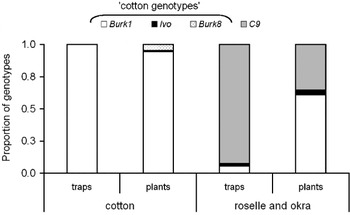
During the 2006 early cropping season, all A. gossypii alatae trapped within cotton fields presented the Burk1 MLG (fig. 2). On cotton plants, Burk1 represented 94% of the collected aphids, whereas Burk8 (differing from Burk1 only by one allele at locus Ago59) and Ivo represented respectively 4.5% and 1.5%. No A. gossypii alatae was trapped in corn fields. In the early off-season, Burk1 and Ivo were poorly represented in traps placed within fields of okra and roselle as opposed to C9, which characterizes the A. gossypii race on Cucurbitaceae (Carletto et al., Reference Carletto, Lombaert, Chavigny, Brévault, Lapchin and Vanlerberghe-Masutti2009). Nevertheless, Burk1 was collected in significantly higher proportion than Ivo on okra and roselle (χ12=51.45, P<0.001).
Relative frequency of Aphis gossypii genotypes specialized on cotton Burk1, Ivo and Burk8, and of the genotype C9 specialized on cucurbits, collected from traps and plants within the cotton cropping area of Cameroon (Djalingo, Mayo Dadi, Gaschiga and Pitoa) during 2006 early cropping season (n=28 and n=67, respectively) and early-off-season (n=77 and n=71, respectively).

Discussion
Competition and dispersal
When released concurrently with Burk1 on the same plants, Ivo became the most abundant MLG, whereas no difference was observed when both clones were released independently on different plants, indicating that competition occurred. In field cages (experiment 6), the high density of Burk1 on initially inoculated plants sprayed with insecticide (i.e. excluding Ivo), compared to unsprayed, initially inoculated plants indicates that competition with Ivo results in slowing down the population growth of Burk1. Fuller et al. (Reference Fuller, Chavigny, Lapchin and Vanlerberghe-Masutti1999) proposed possible interclonal competition to explain a significant decrease in clonal diversity over a crop season in A. gossypii populations in commercial cucumber glasshouses. Competition between clones of A. gossypii was experimentally demonstrated in two Curcurbitaceae-specific genotypes (Rochat et al., Reference Rochat, Vanlerberghe-Masutti, Chavigny, Boll and Lapchin1999). In field cage experiments (experiment 6), Burk1 was better represented than Ivo on low-populated neighbouring plants, suggesting that dispersal may be a way to avoid competition on crowded plants. Similarly, when small-scale dispersal to neighbouring plants was possible in the laboratory (experiment 5), frequency of Burk1 was >50% on some cotton plants where aphid density was low to moderate. This distribution pattern may have resulted from short-range dispersal behaviour in response to overcrowding (De Barro, Reference De Barro1992). In this experiment, we also observed a non-isotropic dispersal of aphids, possibly due to directional air flow created by the air conditioner.
The A. gossypii alatae trapped within or collected from newly planted cotton fields were all cotton-adapted genotypes but most presented the Burk1 MLG. Cucurbitaceae-adapted genotypes (C9) were mainly collected from newly planted relay host plants at the beginning of the off-season (roselle and okra), but Burk1 was again dominant among cotton-adapted genotypes. This prevalence of Burk1 among cotton-adapted ‘immigrants’ may simply reflect a higher frequency within host plants from which they dispersed (source). Previous results showed that Burk1 was highly prevalent on okra and roselle sampled during the 2003–2005 off-seasons in various locations in Cameroon (Brévault et al., Reference Brévault, Carletto, Linderme and Vanlerberghe-Masutti2008). We also hypothesize that Burk1 genotypes have higher dispersal ability than Ivo (experiment 6), possibly due to greater efficiency of host location (including flying ability and detection of host cues), greater quantity or earlier production of alatae. Long- and short-range dispersal by alate and apterous aphids, respectively, and subsequent colonization of new resources may be a way to avoid competition (Tilman, Reference Tilman1994; Friedenberg, Reference Friedenberg2003). Additional behavioural and demographic experiments could be considered to investigate such possibilities.
Selection by insecticides
Human-induced selective pressure, especially by widespread and repeated insecticide applications, probably shapes the genetic structure of A. gossypii populations feeding on cotton crops in favour of Burk1 (Brévault et al., Reference Brévault, Carletto, Linderme and Vanlerberghe-Masutti2008). A recent study showed multiple resistances to a broad range of insecticides and multiple mechanisms of resistance in Burk1, as opposed to Ivo (Carletto et al., Reference Carletto, Martin, Vanlerberghe-Masutti and Brévault2010). Insecticide resistance combined with clonal reproduction probably accounts for low genetic diversity and prevalence of the resistant genotype Burk1 within and among field populations of the cotton host race. In contrast, persistence of the more susceptible genotype Ivo may be maintained by spatial and temporal heterogeneity of the agricultural landscape (Vorburger, Reference Vorburger2006), including unsprayed host crops and wild plants from uncultivated habitats. Indeed, prevalence of Ivo was only observed in some populations collected from wild cotton plants (Ziguinchor, Senegal, 250 km away from the cotton-growing area) or untreated cotton plants from a collection (Maroua, Cameroon) planted during the off-season (Brévault et al., Reference Brévault, Carletto, Linderme and Vanlerberghe-Masutti2008). Selection by insecticide treatments has also been proposed to explain the low genetic variability observed in the peach-potato aphid, M. persicae, in cultivated oilseed rape (Zamoum et al., Reference Zamoum, Simon, Crochard, Ballanger, Lapchin, Vanlerberghe-Masutti and Guillemaud2005). Moreover, a clonal turn-over due to fitness costs associated with insecticide resistance was observed in M. persicae populations in the absence of insecticide selection (Fenton et al., Reference Fenton, Malloch, Woodford, Foster, Anstead, Denholm, King and Pickup2005; Kasprowicz et al., Reference Kasprowicz, Malloch, Pickup and Fenton2008a,Reference Kasprowicz, Malloch, Foster, Pickup, Zhan and Fentonb; van Toor et al., Reference van Toor, Foster, Anstead, Mitchinson, Fentonc and Kasprowicz2008). In cotton aphids, the population of Burk1 was smaller than that of Ivo when both genotypes were concurrently transferred on the same plants (competition), whether on cotton or relay host plants, suggesting potential pleiotropic effects conferred by resistance mutations which could affect the ability of insecticide-resistant aphids to respond to over-crowding conditions. For example, higher carboxylesterase levels in the peach-potato aphid appear to be closely associated with potential maladaptive behaviour in the form of lower tendencies to move between plants and from deteriorating leaves in particular (Foster et al., Reference Foster, Harrington, Dewar, Denholm and Devonshire2002). Natural enemies (pathogens, parasitoids and predators) are also selective factors that could affect the clonal diversity of aphid asexual populations, as demonstrated among genotypes of A. pisum Harris (Henter & Via, Reference Henter and Via1995; Ferrari et al., Reference Ferrari, Muller, Kraaijeveld and Godfray2001) and M. persicae (von Burg et al., Reference von Burg, Ferrari, Muller and Vorburger2008). In M. persicae, insecticide-resistant genotypes carrying different combinations of a kdr mutation and extreme carboxylesterase resistance show a reduced response to aphid alarm pheromones (Foster et al., Reference Foster, Denholm, Thompson, Poppy and Powell2005, Reference Foster, Tomiczek, Thompson, Denholm, Poppy, Kraaijeveld and Powell2007), which in turn may affect their ability to respond to predation and parasitism. Regarding cotton-adapted genotypes of A. gossypii in WCA, additional data are needed to understand how possible fitness costs could affect the ability of insecticide-resistant genotypes to respond to interclonal competition. In particular, demographic and behavioural studies of Burk1 and Ivo genotypes, including life history (longevity, fecundity, development time, production of winged morphs, etc.), interactions between individuals, dispersal ability, habitat selection and response to natural enemies, could provide relevant information. Climatic conditions typical of the dry season, i.e. high temperature and low relative humidity, had no significant effect on the distribution of the two genotypes on cotton plants compared to the conditions of lower temperature and higher humidity in the growth chamber, with Ivo again dominating Burk1. Nevertheless, genetic variation among clones in their temperature tolerance has been detected in other aphid species (Griffiths & Wratten, Reference Griffiths and Wratten1979; Vorburger, Reference Vorburger2004).
In WCA, cotton pest management has been largely based on the use of broad-range insecticides, mainly organophosphates and pyrethroids. Furthermore, these insecticides have been concurrently sprayed by smallholders on vegetable crops which act as relay host plants for cotton-adapted genotypes of A. gossypii. This time and area-wide selection pressure has probably led to the prevalence of a unique and multi-resistant genotype, Burk1, which threatens the sustainability of cotton-based cropping systems, both from an ecological and an economic perspective. In those agricultural landscapes, both cotton fields and relay host plants serve as sources for Burk1 and as sinks for Ivo. Accordingly, it would be of great interest to assess whether reduction in the use of broad-range insecticides to control cotton bollworms (e.g. integrated pest management) could restore genetic diversity in cotton-adapted aphids. Based on on-farm experiments, Achaleke et al. (Reference Achaleke, Vaissayre and Brévault2009) confirmed the suitability of selective insecticides such as spinosad and emamectin-benzoate for the control of bollworms. Also, the use of IPM-compatible insecticides, such as neonicotinoids (acetamiprid) or flonicamid, should be encouraged on vegetable crops to control aphids. As pointed out by Carletto et al. (Reference Carletto, Martin, Vanlerberghe-Masutti and Brévault2010), Burk1 is susceptible to acetamiprid.
The adoption of genetically engineered cotton that expresses Bacillus thuringiensis (Bt) toxins that do not control sap-sucking pests (Showalter et al., Reference Showalter, Heuberger, Tabashnik and Carrière2009) could also impact the genetic diversity of cotton-adapted aphids. Moreover, it has been shown that aphid density in Bt cotton crops did not increase dramatically compared to conventional cotton plots treated with insecticides for the control of Helicoverpa armigera (Hübner), probably because aphids natural enemies were preserved (Wu & Guo, Reference Wu and Guo2003). In WCA, high rates of A. gossypii parasitism by Aphelinus albipodus (Hayat and Fatima) (Hymenoptera: Aphelinidae) have been observed at the end of the cropping season when insecticides are no longer sprayed on cotton fields (S. Nibouche, unpublished data). On the other hand, a bivalent transgenic cotton expressing both a Bt endotoxin gene and a protease inhibitor gene (a cowpea trypsin inhibitor gene) was reported to negatively affect survival, fecundity, longevity and feeding behaviour of aphid in the first two generations, but aphid fitness soon increased in the third generation (Liu et al., Reference Liu, Zhai, Zhang and Zong2005). It was suggested that this adaptation to trypsin inhibitors resulted from phenotypic plasticity in clones across parthenogenetic generations. However, it would be interesting to demonstrate that there was no genetic variability between the clones used in this experiment that could be selected for to overcome trypsin inhibitors expressed in transgenic cotton.
Acknowledgements
We express our sincere gratitude to PRASAC/ARDESAC and the National Cotton Development Corporation, SODECOTON for their financial support. Special thanks go to Bachirou Kouly (IRAD Garoua) and N. Leroudier (IPMC/CNRS, Sophia-Antipolis) for technical assistance.