Introduction
Invasive alien species are recognized as one of the leading threats to biodiversity. The ways in which non-native species affect native species and ecosystems are numerous and usually irreversible (Parker et al., Reference Parker, Simberloff, Lonsdale, Goodell, Wonham, Kareiva, Williamson, Von Holle, Moyle, Byers and Goldwasser1999). Non-indigenous species also impose enormous costs on agriculture, forestry and human health (Pimentel et al., Reference Pimentel, McNair, Janecka, Wightman, Simmonds, O'Connell, Wong, Russel, Zern, Aquino, Tsomondo and Pimentel2002b). Rapidly accelerating human trade, tourism, transport and travel over the past century have dramatically enhanced the spread of invasive species, allowing them to surmount geographic barriers. Since this tendency is likely to increase (Levine & D'Antonio, Reference Levine and D'Antonio2003), national and international strategies are required to assess the full scope of the threat of invasive alien species and to deal with it effectively.
Insects represent the majority of living organisms and, hence, form a large part of the alien species problem. In many regions, such as North America, Australasia and South Africa, exotic insect pests are considered as important as native pests, if not more so (Pimentel, Reference Pimentel, McNair, Janecka, Wightman, Simmonds, O'Connell, Wong, Russel, Zern, Aquino, Tsomondo and Pimentel2002b). Traditionally, problems have been less severe in Europe (Niemelä & Mattson, Reference Niemelä and Mattson1996). However, in recent years, several pests of economic importance have invaded Europe, inducing more interest in the issue of alien insects. For example, the western corn rootworm, Diabrotica virgifera virgifera LeConte, is seriously threatening European maize production (Baufelt & Enzian, Reference Baufeld, Enzian, Vidal, Kuhlmann and Edwards2005); and the horse-chestnut leaf miner, Cameraria ohridella Deschka and Dimic, an insect of unknown origin, is causing much public concern because of its spectacular damage to urban trees in Central Europe (Freise & Heitland, 2004).
Management of alien species invasion requires a good knowledge of invasion processes, i.e. pathways of introduction, establishment processes, species traits and habitat characteristics that favour invasion (Williamson, Reference Williamson1996; Wittenberg & Cock, Reference Wittenberg and Cock2001). It also requires a precise assessment of economic and ecological hazards caused by the alien species in order to improve risk assessments, define tolerance thresholds and evaluate the benefits of control measures to be weighted against costs of control (Parker et al., Reference Parker, Simberloff, Lonsdale, Goodell, Wonham, Kareiva, Williamson, Von Holle, Moyle, Byers and Goldwasser1999). Invasion processes in invertebrates and pathogens are rather different from those observed in other invasive organisms such as plants and vertebrates and, thus, require different strategies and research priorities. Firstly, the introduction of invertebrates is usually accidental, biological control agents being an exception (Causton et al., Reference Causton, Peck, Sinclair, Roque-Albelo, Hodgson and Landry2006). The introduction phase is rarely observed and pathways of introduction are poorly known (National Research Council, 2002). Secondly, when established in a new region, an insect quickly spreads to invade new regions and habitats. In general, there is no obvious ‘lag phase’, as is often seen in plant invasions (e.g. Lonsdale, Reference Lonsdale1993); and when a lag phase is observed, it is usually of short duration (Memmott et al., Reference Memmott, Craze, Harman, Syrett and Fowler2005; Drake & Lodge, Reference Drake and Lodge2006). Consequently, an alien insect is usually discovered when it is already firmly established, spreading and causing damage. An invasion process is usually studied a posteriori, and management methods focus on the control of already invasive, or damaging, populations; whereas, ideally, management efforts should be directed to the first stages of the invasion processes by preventing introduction or developing early eradication programmes (Puth & Post, Reference Puth and Post2005).
Nevertheless, a posteriori studies of already established alien insects are useful to assess which taxonomic or bioecological groups of alien species are better invaders or more harmful to the economy or environment and which ecosystems or habitats are more at risk (Mondor et al., Reference Mondor, Tremblay and Messing2007). Pathways and vectors of introduction can often be guessed from the biology of the insect, supported by interception data from national phytosanitary services. Such information allows the development or improvement of invasion risk assessment methods for species, ecosystems or pathways (Wittenberg & Cock, Reference Wittenberg and Cock2001).
Some European countries have recently established national lists of non-indigenous organisms, including insects, as part of a national strategy to address invasive alien species (e.g. Essl & Rabitsch, Reference Elton2002: for Austria; Geiter et al., Reference Geiter, Homma and Kinzelbach2002: for Germany; Hill et al., Reference Hill, Baker, Broad, Chandler, Copp, Ellis, Jones, Hoyland, Laing, Longshaw, Moore, Parrot, Pearman, Preston, Smith and Waters2005: for UK; Šefrová & Laštůvka, Reference Šefrová and Laštůvka2005: for the Czech Republic; Wittenberg, Reference Wittenberg2005: for Switzerland). The objectives of the present study were to extract, from a combination of the Swiss and Austrian lists, information relevant to invasion processes and invasive alien species management in Central Europe. In particular, we assessed insect species traits that correlate with the ability to invade and determined which habitats have been particularly susceptible to invasion. We also identified the most likely pathways or vectors for insect introductions and compared the results with a dataset of interceptions of non-indigenous insects in Europe, collected by national services of inspection and quarantine. Finally, we evaluated the actual and potential economic and environmental hazards linked to insect invasions in Central Europe and propose recommendations for management and conservation.
Material and methods
Datasets
A dataset of 341 non-indigenous insects of Austria and Switzerland has been built, based on recent lists for Austria (Essl & Rabitsch, Reference Elton2002) and Switzerland (Kenis, Reference Kenis and Wittenberg2005). The criteria for including an insect species in the dataset were those used to build the Swiss list (Kenis, Reference Kenis and Wittenberg2005): (i) it is believed to be non-indigenous in Austria and Switzerland; (ii) there is proof, or at least a high probability, that the insect has been introduced into Europe by human activities (or into Austria and Switzerland for insects of European origin); and (iii) it is permanently established in Austria and Switzerland, i.e. it is self-reproducing and would maintain populations even without new introductions (this includes also insects that survive only in heated environments such as houses, stores, greenhouses, compost heaps, etc.). The Austrian list (Essl & Rabitsch, Reference Elton2002) also includes non-established species and, thus, only the insects that match the criteria mentioned above were incorporated in our dataset. Archaeozoans, originally included in the Swiss list but not in the Austrian list, were included in our analyses. A few non-indigenous insects have been added to the Austrian list since its publication, and data for some groups not treated therein (e.g. Diptera, Psocoptera, Anoplura) were added from Fauna Europaea (Reference Freude, Harde and Lohse2005).
Another dataset was built from data on the interceptions of non-indigenous plant pest insects in Europe made by the national services of inspection and quarantine for the period 1995–2004. These data were regularly reported as notifications of non-compliance (detection of regulated pests) by the European and Mediterranean Plant Protection Organisation (EPPO) and were recently synthesized by two of the authors (Roques & Auger-Rozenberg, Reference Roques and Auger-Rozenberg2006). It does not include all insects intercepted but focuses primarily on alien insects that are on the quarantine list of the EPPO or on insect groups that are potentially dangerous for plant health. This database contains 6743 interceptions of non-indigenous insects from 28 European countries, involving 13,558 individual specimens and 285 species identified to the species level of which 255 can be considered non-European. A sizable amount of intercepted alien insects were identified at genus or family level only. From these, 19 genera were added to our dataset because no species of these genera had been identified to the species level and, thus, these genera represent additional species. Hence, the list of intercepted insects comprises a total of 274 species.
To test the hypothesis that the taxonomic distribution of the non-indigenous insect fauna in Switzerland and Austria is similar to the native European fauna, we used Fauna Europaea (Reference Freude, Harde and Lohse2005) as reference for the insect fauna in Europe. To test the hypothesis that the taxonomic distribution of the non-indigenous insect fauna of North American origin in Switzerland and Austria is similar to the native North American fauna, we used the data presented by Simberloff (Reference Simberloff, Mooney and Drake1986).
Area of origin of the insects
The area of origin of each alien insect established in Austria or Switzerland was classified by one of the following regions: North America; Central and South America; Asia (except Mediterranean area, but including Continental Asian Turkey); Africa (except Mediterranean area); Eastern Europe; Southern Europe and Mediterranean region (including Northern Africa and Middle East); Pacific region (Australia, New Zealand and other Pacific islands); or unknown. When the insect was thought to originate from two of these regions, the closest region to Central Europe was chosen. A similar classification was used for the interception data, but the origin was that of the commodity on which the insect was found rather than that of the origin of the species.
Feeding niche
Each insect of the dataset was categorized into one of the following feeding niches: external defoliators (including leaf rollers and webbers); sap feeders; leaf miners; gall makers; casebearers; wood borers; root borers/feeders; seed borers/feeders; stem borers (including twigs, buds and flowerhead borers); fruit borers; parasitoids; predators; ectoparasites; detritivores (including saprophages, coprophages and mycetophages); or omnivores. Insects whose larvae and adults occupy a different feeding niche were classified by the feeding niche of the larval stage. When the larva passes through two feeding niches, we chose the feeding niche in which it spends the longest time. Insects for which the biology is not known were assigned to the ‘most-likely’ feeding niche, i.e. that occupied by taxonomically closely related species.
An identical feeding niche classification was built for the European insects listed in Fauna Europaea (Reference Freude, Harde and Lohse2005), which comprises about 93,000 insect species. In this case, the approximate proportion of each feeding niche was estimated by assigning each insect of the list to the feeding niche encountered in its family or sub-family. For species-rich families and sub-families showing two or more feeding niches, an approximate proportion of each feeding niche was used, based on proportions calculated from regional or national checklists (e.g. for diverse Coleoptera families and sub-families, we used Freude et al. (1965–Reference Freise and Heitland1983)). We then tested the hypothesis that the proportion of the feeding niches in the non-indigenous insect fauna is similar to that of the native fauna.
Environment, host plant and EUNIS habitat
The following types of environments and host plants were used to classify the insects: stored products (including non-food products such as fabrics, but not wood products); domestic (i.e. living only in heated buildings, but not on stored products and not on living plants in greenhouses); greenhouses; outdoors on indigenous host plant; outdoors on non-indigenous host plant; outdoors on decaying matters (including compost heaps); aquatic; and ectoparasite on vertebrates. Predators and parasitoids were categorized into the environment of their main prey/hosts. Insects living in different environments were classified in the one where they are most commonly found in Austria and Switzerland. Insects that are found frequently on both indigenous and exotic plants were classified in the category ‘indigenous host plant’.
In addition, each insect was categorized into one of the major habitat classes of the EUNIS classification (EEA, Reference Essl and Rabitsch2005) present in Austria and Switzerland: C, inland surface waters; D, mires bogs and fens; E, grasslands and lands dominated by forbs, mosses or lichens; F, heathland, scrub and tundra; G, woodland, forest and other wooded land; H, inland unvegetated or sparsely vegetated habitats; I, regularly or recently cultivated agricultural, horticultural and domestic habitats; or J, constructed, industrial and other artificial habitats. When an insect is known to occur in two or more habitat classes, the habitat in which it has been most frequently reported was chosen.
Pathways and vectors of introduction
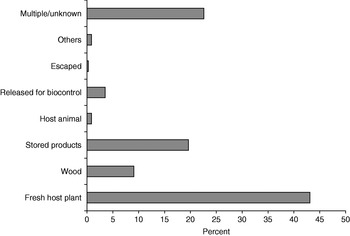
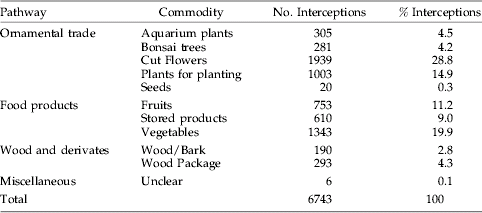
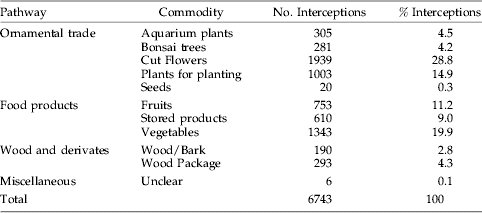
For each insect, a pathway or vector of introduction into Europe (for non-European insects) or into Austria or Switzerland (for European insects) was allocated. Since, in most cases, the exact pathway is not known, the most likely vector was deduced by considering their preferred habitats, lifestyle or food plant. The categories used were: host plant; wood material; stored products; biological control agents; host animal; others; and multiple/unknown. Insects with two or more possible pathways or vectors were categorized as ‘multiple/unknown pathway’. The proportion of these estimated pathways and vectors was compared with those of the interception dataset. The commodities associated with interceptions were classified into the following categories: ornamental trade (aquarium plants, bonsai trees, cut flowers, plants for planting, seeds); plant products for consumption (fruits, stored products, vegetables); and wood and its derivates (wood, bark, wood packing material).
Economic and ecological impacts
An insect was categorized as having an economic impact when we found at least one web page from Austrian, Switzerland or a neighbouring country describing damage and suggesting control methods. Similarly, an insect was considered as having an ecological impact when a publication or a web page from the same geographic region was found describing an environmental hazard associated with this insect.
Results and discussion
Comparison between the Austrian and the Swiss databases
Despite their proximity and similarity in size, geography, climate, environment and number of international ports of entry, Switzerland and Austria have rather different alien insect faunas. Of the 341 species of the combined database, approximately one-third of the species (35%) are known only for Switzerland (90 species) or only for Austria (30 species). A significant proportion of species are recent invaders, and their presence in the other country is expected for the near future. Table 1 shows a selection of alien insects that are presently recorded from one of the two countries only. Another factor that may explain the variation between the two countries is the difference in taxonomic expertise in the two countries. Some groups are better known in Switzerland (e.g. Diptera, Psocoptera, Sternorrhyncha), whereas others are particularly well covered in Austria (e.g. Lepidoptera, part of Coleoptera).
A selection of alien insect species recorded only in Switzerland or only in Austria.

Origin of alien insects in Switzerland and Austria
For nearly one-third of the alien insects in Austria and Switzerland, the region of origin is unclear. In some cases, such as the horse-chestnut leaf miner, Cameraria ohridella, the insect appeared in Europe without having been described elsewhere; and the only data on its population ecology, parasitism and dispersal biology lead to the conclusion that it probably originated from another continent (Kenis et al., Reference Kenis, Tomov, Svatos, Schlinsog, Lopez Vaamonde, Heitland, Grabenweger, Girardoz, Freise and Avtzis2005). However, most insects classified as of ‘unknown origin’ are species whose distribution is cosmopolitan and for which there is no agreement regarding their area of origin. This is particularly the case for the numerous stored-product pests and some ectoparasites on animal pets that presently occur on most continents.
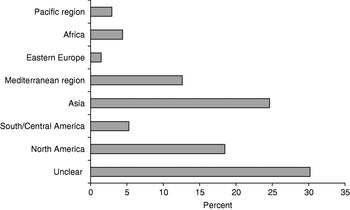
The majority of the alien insects, for which the area of origin is known, came from Asia and North America (fig. 1), two continents that include regions climatically and ecologically similar to Central Europe. A sizeable number of alien insects came from the Mediterranean region, probably on their host plants imported to Central Europe as crop planting material or products or as ornamentals. In recent years, Southern European species, e.g. moths and dragonflies, have been increasingly observed in Austria and Switzerland. Many of them are thought to migrate naturally, probably because of global warming, and are thus not included in the list (Kenis, Reference Kenis and Wittenberg2005).
Proportional representation of the areas of origin of the 341 non-indigenous insects established in Austria and Switzerland.

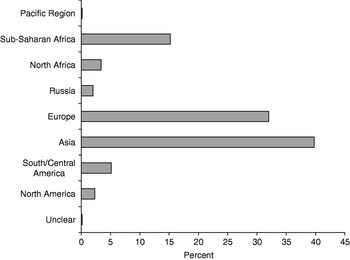
Among the alien insects intercepted by European phytosanitary services, many were found on commodities from Asia (39.8%) and other European regions (32.0%). Surprisingly few were found on commodities from North America (2.3%) (fig. 2), although North American insects account for 18% of the alien insect fauna in Switzerland and Austria (fig. 1). This discrepancy between interception data and the origin of established insects may be explained by the climatic similarity between Europe and North America that allow smaller numbers of North American species and individuals to establish more easily in Europe than tropical species. In addition, the interception data being based on recent records only (1995–2004), the apparent difference with the alien fauna dataset may also reflect changes in foreign trade in recent years, increasing exchange being made with more ‘exotic’ regions, particularly Asia for ornamental plants. Since the interception data nearly exclusively concerned plant pests, it is not surprising to find many interception records on Asian commodities. In their analysis of alien plant pests established in Great Britain, Smith et al. (Reference Smith, Baker, Malumphy, Hockland, Hammon, Ostojá-Starzewski and Collins2005) also noted that Asia supplied a relatively high number of recent introductions. Similarly, Haack (Reference Haack2001, Reference Haack2006) noted that the most recent establishments and interceptions of bark- and wood-boring Coleoptera in North America were of Asian origin. Furthermore, it cannot be ruled out that the low occurrence of insects in North American imports may be due to better sanitary practices in North America than in other regions.
Proportional representation of the origin of the commodities on which non-indigenous insects were intercepted by the national phytosanitary services in Europe during the period 1995–2004.

Taxonomic groups
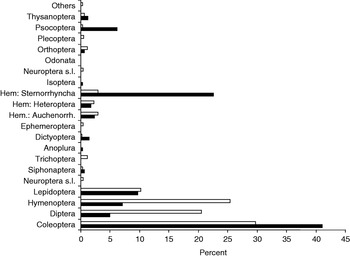
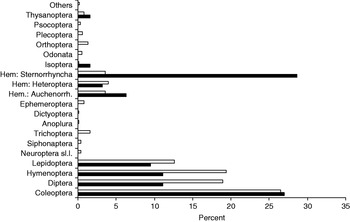
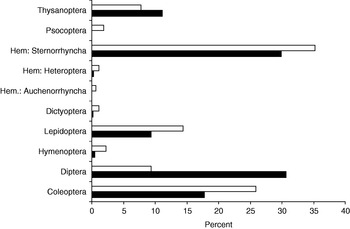
Figure 3 shows the taxonomic composition of the alien insects in Austria and Switzerland, which significantly differs from the composition of the native insect fauna in Europe (goodness of fit χ2 test; χ2=568.50, P<0.001; the 12 smallest orders of fig. 3 being pooled together to avoid low expected frequencies). Three insect orders and sub-orders are particularly overrepresented in the alien fauna compared to the native fauna: Coleoptera, Sternorrhyncha and Psocoptera. In contrast, Diptera and Hymenoptera are underrepresented. A comparison between the alien insects of North American origin in Switzerland and Austria and the native insect fauna in North America shows the same pattern (goodness of fit χ2 test; χ2=111.69, P<0.001; the 12 smallest orders of fig. 4 being pooled together to avoid low expected frequencies), with American Sternorrhyncha having been more successful in invading Europe than other insect groups (fig. 4). Alien insects in the USA show the same pattern, except that alien Hymenoptera are proportionally much more abundant in North America, partly because of the large number of exotic parasitoids introduced into North America for biological control purposes (Simberloff, Reference Simberloff, Mooney and Drake1986). Nevertheless, there are also many more alien herbivorous Hymenoptera, particularly sawflies, in North America than in Europe (Mattson et al., Reference Mattson, Niemelä, Millers and Inguanzo1994). This overrepresentation of Coleoptera and Sternorrhyncha may be explained by the fact that beetles are easily transported in, or with, stored products whereas aphids, scale insects and whiteflies are often carried inconspicuously with their host plant.
Proportions of insect orders and sub-orders in the 341 non-indigenous insect species in Austria and Switzerland (black bars) compared to the European insect fauna (source: Fauna Europaea, Reference Freude, Harde and Lohse2005) (white bars). Orders that were not treated in the Austrian and Swiss lists (e.g. all Apterygote, Mallophaga) were excluded from the analysis. ‘Others’ include small orders (<0.4%) for which no non-indigenous species are known from Austria and Switzerland, i.e. Dermaptera, Mecoptera, Odonata, Phasmatodea, Strepsiptera.

Proportions of insect orders and sub-orders in the 341 non-indigenous insect species in Austria and Switzerland originating from North America (black bars) compared to the North American insect fauna (Simberloff, Reference Simberloff, Mooney and Drake1986) (white bars). Orders that were not treated in the Swiss and Austrian lists (e.g. all Apterygote, Mallophaga) were excluded from the analysis. ‘Others’ include small orders (<0.4%) for which no non-indigenous species are known from Switzerland and Austria, i.e. Dermaptera, Mecoptera, Phasmatodea, Strepsiptera.

The interception data show a somewhat different pattern (fig. 5). Sternorrhyncha were also frequently intercepted but, surprisingly, Diptera accounted for the highest number of interceptions. Two-thirds of these were agromyzid leaf miners and the remaining one-third were mainly fruit flies of the Tephritidae family. However, the number of species intercepted per order led to a larger representation of Sternorrhyncha and Coleoptera, whose respective proportions were similar to those observed in the established alien fauna. Moreover, interception data are strongly biased by the fact that surveys concentrate on plant pests. For example, Hymenoptera, the vast majority of which are parasitoids, predators or nectar/pollen feeders, are hardly represented in the interception data. Nevertheless, many plant pests intercepted by phytosanitary services probably contained hymenopteran parasitoids that have the potential to become established and invasive.
Proportion of insect orders and sub-orders in the non-indigenous insects intercepted by the national phytosanitary services in Europe during the period 1995–2004. Black bars, number of interceptions; white bars, number of species intercepted.

Feeding niche
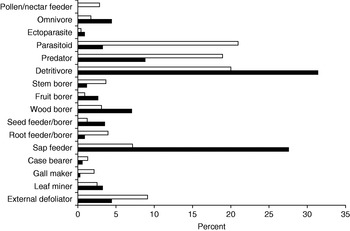
The proportion of feeding niches in the alien fauna is significantly different from that of the European fauna (goodness of fit χ2 test, χ2=366.57, P<0.001). Sap feeders and detritivores are clearly the dominant feeding niches in the alien insect fauna of Austria and Switzerland. Their proportion in the alien fauna is much higher than in the European fauna (fig. 6). The majority of the sap feeders are Sternorrhyncha, followed by other Hemiptera and Thysanoptera. Small sap feeders are unnoticeably carried from one region to another attached to seedlings, cut flowers, vegetables, etc. Detritivores are well represented in the alien list because many stored-product pests belong to this category. Other guilds that are proportionally more represented in the alien fauna than in the European fauna are wood borers, fruit borers, seed feeders/borers and omnivores. In contrast, external defoliators, root feeders/borers, stem borers, gall makers, predators and parasitoids seem to travel or establish less successfully. The number of parasitoids is most probably underestimated in our dataset. The frequency of parasitoids in insect faunas varies from 8.5– 25% according to different estimations (Godfray, Reference Godfray1994). Hence, in Austria and Switzerland, only 11 alien parasitoid species (3% of the dataset) are recorded as probably established. All were released in Europe as biological control agents. The absence of naturally introduced and established parasitoids may suggest that these insects do not establish new populations easily. However, it almost certainly also reflects their cryptic life-history and the taxonomic difficulties related to this group. New indigenous parasitoid species are still described every year in Europe. Many species are recorded from two or more continents, and it is probable that several of these species invaded Europe from Asia or North America recently.
Proportional representation of the feeding niches of the 341 non-indigenous insects in Austria and Switzerland (black bars) and of the European insect fauna (white bars).

Environment, host plant and EUNIS habitat
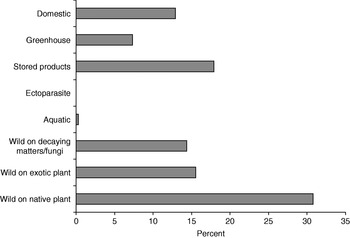
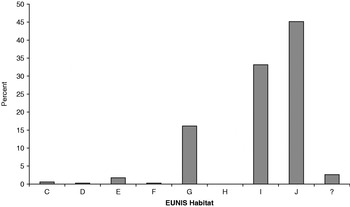
Figure 7 shows that nearly 40% of the alien insects in Austria and Switzerland live only indoors, in houses, stores, greenhouses, etc. Another 15% live outdoors but exclusively or predominantly on exotic plants. Following the EUNIS classification, less than 20% of the alien insects live in a ‘natural environment’, the majority of them occurring in regularly or recently cultivated agricultural, horticultural and domestic habitats, or in constructed, industrial and other artificial habitats (fig. 8). Among those insects that occur in ‘natural environments’, the vast majority are found in forest habitats, which includes plantations. It is a common observation that simple, disturbed, human habitats are more readily invaded by insects and other invaders than complex, undisturbed, natural habitats. Elton (1958) attributes this phenomenon to the ‘biotic resistance’, i.e. natural enemies and competitors that are more prevalent in natural habitats than in disturbed habitats. Simberloff (Reference Simberloff, Mooney and Drake1986) suggests two other, more simple, hypotheses to which we adhere. Firstly, disturbed, man-made habitats (i.e. agricultural and domestic habitats) are more important to humans and, thus, are studied more carefully than natural habitats. As a result, new establishments are more likely to be detected. Secondly, insects linked to human environments and activities (e.g. pests) are more likely to be carried by human transports into a new region than insects living in natural areas. The second hypothesis is confirmed by interception data that invariably contain far more agricultural and domestic pests than insects linked exclusively to natural habitats. The first hypothesis should be tested by extensive and specific surveys for alien species in natural habitats.
Proportional representation of the environments and host plants of the 341 non-indigenous insects in Austria and Switzerland.

Proportional representation of the main habitat classes (EUNIS classification) of the 341 non-indigenous insects in Austria and Switzerland. C, inland surface waters; D, mires bogs and fens; E, grasslands and lands dominated by forbs, mosses or lichens; F, heathland, scrub and tundra; G, woodland, forest and other wooded land; H, inland unvegetated or sparsely vegetated habitats; I, regularly or recently cultivated agricultural, horticultural and domestic habitats; J, constructed, industrial and other artificial habitats; ?, habitat unclear.

Pathways and vectors of introduction
Among the 341 alien insects established in Austria and Switzerland, the exact pathway of introduction is known with confidence for only the 12 biological control agents deliberately released in Europe. However, for nearly 80% of the alien insect species, a likely vector, usually a commodity, could be deduced or assumed based on their biology, plant or animal host, etc. (fig. 9). The main vectors of introduction were, in decreasing order, host plants (accounting for nearly half of the introductions), stored products and wood material. Of those insects that were probably introduced with their host plant (wood excluded), at least 40% undoubtedly came on ornamentals and 20% on vegetables and fruits. From insects assumed to have arrived with wood material, about two-thirds are associated with wood (logs, processed lumber or fresh wood packaging) and one-third with old wood material (e.g. furniture). The relative proportion of vectors assessed from the establishment data and the importance of the ornamental plant trade as pathway is confirmed by the interception data (table 2). Cut flowers, seedlings (nearly exclusively for ornamental purposes), bonsai trees, seeds and aquarium plants represented 52.7% of the commodities on which insects were intercepted. Nearly 30% of the insects were intercepted on cut flowers, which is about the same proportion found on fresh food (vegetables and fruits). The relative efforts put on inspection of these different commodities is not known; however, considering that the food trade is far more extensive than the ornamental trade, one can assume that proportionally many more alien insects were found on ornamentals than on vegetables and fruits. Interestingly, more insects were intercepted on wood packaging (4.3%) and bonsai trees (4.2%) than on logs, processed lumber and bark (2.8%) (χ2=22.08, P<0.01 and χ2=19.40, P<0.001, respectively). The origin of the commodity on which insects were intercepted strongly varies with the type of commodity. Asia seems to be the major source for insects on bonsai trees (96.7%) and wood packaging (76.9%), whereas 47.9% of the insects intercepted on fresh wood and bark came from Russia.
Proportional representation of the most likely pathways and vectors of introduction for the 341 non-established insects in Austria and Switzerland. Fresh host plant refers to live or freshly cut host plants.

Relative importance of pathways and commodities associated with insect interceptions in Europe during 1995–2004.
Economic and ecological impact
For 124 alien insects established in Austria or Switzerland (40% of all species), data on economic damage are available from Austria, Switzerland or a neighbouring country. In contrast, the rate of native insects reaching pest status in temperate countries is probably much lower than 5% (our estimates derived from numbers given in Pimentel (Reference Pimentel and Pimentel2002) and Pimentel et al. (Reference Pimentel, Lach, Zuniga, Morrison and Pimentel2002a, Reference Pimentel, McNair, Janecka, Wightman, Simmonds, O'Connell, Wong, Russel, Zern, Aquino, Tsomondo and Pimentel2002b)). Although alien insects represent only about 1% of the insect fauna in Austria (Rabitsch & Essl, Reference Rabitsch and Essl2006) and 1.7% in continental United States (Simberloff, Reference Simberloff, Mooney and Drake1986), it is usually estimated that between 30 and 45% of the insect pests in agriculture and forestry worldwide are of alien origin (Pimentel et al., Reference Pimentel, Lach, Zuniga, Morrison and Pimentel2002a, Reference Pimentel, McNair, Janecka, Wightman, Simmonds, O'Connell, Wong, Russel, Zern, Aquino, Tsomondo and Pimentel2002b). The higher rate of pest species among non-indigenous faunas compared to indigenous faunas may be explained by three factors that are not mutually exclusive. Firstly, alien insects causing economic damage are more likely and more rapidly discovered than insects that are economically harmless. Thus, it is very likely that many alien insects, established in Austria or Switzerland in natural habitats, are yet to be discovered (Kenis, Reference Kenis and Wittenberg2005). Secondly, insects are more likely to become pests as introduced aliens than in their region of origin. Many alien insects having economic impact are in fact of little, or of no, importance in their region of origin, where they are controlled by natural enemies and host resistance derived from co-evolutionary history (e.g. Löhr et al., Reference Löhr, Varela and Santos1990; McClure & Cheah, Reference McClure and Cheah1999). Thirdly, pests are more likely to invade new areas because they are more abundant, their habitats are increasing in size and connectivity, and they feed on economically important plants or goods (Kenis, Reference Kenis and Wittenberg2005). This is particularly the case with stored-product insects that have become pests in many regions and are regularly transported with the commodities in which they live.
To our knowledge, no study has been carried out to investigate the ecological impact of alien insect species in Austria and Switzerland, and only limited data are available for Europe in general. A few alien insect species present in Austria or Switzerland cause ecological concerns in other regions. The ladybird, Harmonia axyridis (Pallas), originally from eastern Asia, is believed to out-compete and displace native aphidophagous species by predation and competition for food in North America (Koch, Reference Koch2003). This species has been recently recorded in the wild in Europe, including Switzerland, where it is expected to cause similar damage (Klausnitzer, Reference Klausnitzer2004; Majerus et al., Reference Majerus, Strawson and Roy2006). The argentine ant, Linepithema humile (Mayr), is a serious environmental pest in many regions in the world. It has been causing changes in invertebrate and plant communities in the Mediterranean region by predation and displacement of native species (Gómez & Oliveras, Reference Gómez and Oliveras2003). It has been occasionally reported in Switzerland, where it reaches its ecological and climatic limit and will probably never cause damage.
Species comparison between establishment and interception lists
The most frequently intercepted alien insect species are already established in Europe, if not in the wild, at least in greenhouses and other heated environments, e.g. Bemisia tabaci (Gennadius) (Hem.: Aleyrodidae, 1502 interceptions); Liriomyza huidobrensis (Blanchard) (Dipt.: Agromyzidae, 658); Helicoverpa armigera (Hübner) (Lep.: Noctuidae, 447); Frankliniella occidentalis (Pergande) (Thysan.: Thripidae, 222). However, several other species are very frequently intercepted and are not yet established in Europe, e.g. Tinocallis takachihoensis Higushi (Hem.: Aphidae, 62 records) or Asian Monochamus spp. (Col.: Cerambycidae, 65). On the other hand, many species that are already established in Europe have been very rarely or never intercepted. An interesting case is the recent introduction and spread of the western corn rootworm, Diabrotica virgifera virgifera. A recent study showed that the different established populations in Europe originate from different introductions (Miller et al., Reference Miller, Estoup, Toepfer, Bourguet, Lapchin, Derridj, Kim, Reynaud, Furlan and Guillemaud2005), yet our interception list contains only one record for D. v. virgifera. Altogether, out of the 341 alien insect species in Switzerland and Austria, only 34 (10.0%) were intercepted by phytosanitary services. On the other hand, only 34 out of the 274 (12.4%) non-European alien species intercepted are known to be established in Switzerland or Austria. Similarly, only 42 intercepted species are found in the list of 381 (11.0%) alien insects established in the Czech Republic (Šefrová & Laštůvka, Reference Šefrová and Laštůvka2005).
It is not clear why some species are frequently intercepted but never become established, while others are rarely or never intercepted but become established. There are probably numerous factors linked to the species biology and ecology (e.g. climate matching, life cycle, host plant availability, taxonomic isolation of host plants, etc.) or to pathway characteristics (e.g. phytosanitary regulations better implemented for some pathways). It must be noted that more than half of the intercepted species are of tropical or subtropical origin, which decreases the probability of establishment in the wild in most of Europe.
Another major constraint to investigate establishment successes is the lack of reliable, rigorous interception data. It may simply be that insects that are established but never intercepted are often introduced but not intercepted on the right pathways at the right moment using the right method. Work et al. (Reference Work, McCullough, Cavey and Komsa2005) estimated that even rigorous inspections probably detected only 19–50% of the imported species, depending on the pathway. In addition, interception surveys focus mainly on quarantine plant pests and targeted commodities (Haack, Reference Haack2006). Insects belonging to economically unimportant groups are not searched for or not identified, and only species under quarantine can be denied entry when found at ports of entry. Furthermore, non-indigenous insects that are already widely established in Europe are removed from quarantine lists.
Implications for further studies and management strategies against alien insects
Evaluation of species traits and habitat characteristics that make insects and habitats prone to invasion is a rewarding step towards understanding insect invasion processes, as shown for plant or vertebrate invasions (Williamson, Reference Williamson1996; Alpert et al., Reference Alpert, Bone and Holzapfel2000; Kolar & Lodge, Reference Kolar and Lodge2001). Such studies, unfortunately, are limited by lack of knowledge of the biology and ecology of most insects, their distribution (especially in natural habitats) and their pathways of introduction. Nevertheless, we were able to determine general patterns characterising invading insects and invaded habitats. For example, our study clearly showed that sap sucking Sternorrhyncha feeding on ornamental plants are more likely to be introduced into a new region than, e.g. Lepidoptera defoliators or Coleoptera root feeders living in natural habitats. However, it is not clear whether such generalizations are of much help in building strategies for the prevention and management of invasive insects. Exceptions are definitively too important to be neglected. For example, the two most damaging alien insects to outdoor agriculture in Europe, the Colorado potato beetle, Leptinotarsa decemlineata (Say), and the western corn rootworm, Diabrotica virgifera virgifera, are both exceptional. Firstly, they are the only alien representatives of the species-rich family Chrysomelidae, which does not seem to include successful invaders in general. Secondly, they belong to two feeding niches, ‘external defoliators’ and ‘root feeders’, for which we have found relatively few alien species. Thirdly, a clear pathway of introduction could not be identified for either of these two insects. Finally, they originate from Mexico and Central America, regions that have not provided many other outdoor-living invaders in Europe. Furthermore, many of the most damaging alien insects are not pests in their region of origin. The two examples cited above were known before their introduction to Europe because they had reached pest status when they invaded the USA and Canada. However, other invasive species, such as the horse-chestnut leaf miner, Cameraria ohridella, the silver fir woolly aphid, Dreyfusia nordmannianae Eckstein, and the eastern subterranean termite, Reticulitermes flavipes Kollar, were unknown before reaching Europe.
These examples unambiguously show that, with invasive alien insects, economic and/or ecological threats arise from different geographic, taxonomic and ecological directions, as observed with other taxa (e.g. Levine et al., Reference Levine, Vilà, D'Antonio, Dukes, Grigulis and Lavorel2003). The unpredictability of insect introductions and invasiveness, and the fact that the introduction of alien insects is usually accidental and often detected only long after their establishment, put doubts on the usefulness of species-based risk assessments for invasive alien insects (Simberloff, Reference Simberloff2005). Standard protocols for species-based risk assessment are most suitable for alien organisms introduced deliberately, and for which an assessment is needed before the probable establishment in the wild, e.g. ornamental plants, fishes, biological control agents, etc. (National Research Council, 2002; Louda et al., Reference Louda, Arnett, Rand and Russell2003) In contrast, strategies against invasive alien insects should focus on specific pathways and awareness building of the relevant authorities (Simberloff et al., Reference Simberloff, Parker and Windle2005). There are few published examples of risk assessments for insects aimed at specific pathways. Notable exceptions are the risk assessment procedures developed by the US Department of Agriculture to evaluate the risk of importing unprocessed larch from Russia and pine from New Zealand and Mexico (e.g. Tkacz, Reference Tkacz2002), but these were also calculated on a species-based analysis by combining risks of introducing each particular species that may be transported through these pathways. A better goal would be to define approaches to identify and compare all key pathways and commodities, determine risks associated with each, and sever or restrict the riskiest (Simberloff, Reference Simberloff2005). However, until now, too little has been known about the pathways of introduction for alien insects to produce risk assessments for key pathways. Interception data in Europe and elsewhere are usually strongly biased according to detection priorities, which depend on pest or commodities of current concern (Haack, Reference Haack2001, Reference Haack2006). In addition, there are large discrepancies among countries, ports of entries, etc. Furthermore, insects are not always determined to species level. In the EPPO interception list, 69.8 and 88.1% of the insects were determined to species or genus level, respectively, because interception efforts focused mainly on insects of quarantine significance. However, in more systematic interception surveys the percentage of insects identified to species level is usually much lower (e.g. 23% in Work et al., Reference Work, McCullough, Cavey and Komsa2005; 35% in Haack, Reference Haack2006). More importantly, interception data only record positive data, whereas to fully analyse pathways and rates of introduction, negative interceptions also need to be recorded. More studies should focus on specific pathways, using a scientific approach that will produce statistically robust data, such as that of Work et al. (Reference Work, McCullough, Cavey and Komsa2005). They used statistically-robust data collected by USDA APHIS at US ports of entry as part of the Agricultural Quarantine Inspection Monitoring Protocol (AQUIM: Venette et al., Reference Venette, Moon and Hutchison2002) to estimate arrival rates of non-indigenous insects via four cargo pathways: air cargo, refrigerated and non-refrigerated maritime cargo and US-Mexico border cargo. They determined the risks of invasion associated with each of these pathways and were able to evaluate the effectiveness of current efforts to monitor arrival of alien species. We strongly encourage the development of similar investigations on pathways of introduction in Europe.
Despite important limits and bias, our analyses of pathways and vectors of introduction were useful in identifying important patterns. In particular, they clearly showed that host plants, especially ornamentals, are the most important vector for the introduction of alien insects into Europe. More than half of the interceptions of alien insects into Europe were made on cut flowers, seedlings, potted plants or bonsai trees. Our results on the most likely pathways for introductions of established insects in Austria and Switzerland also emphasized the role of ornamental plants as vectors. Similarly, Smith et al. (Reference Smith, Baker, Malumphy, Hockland, Hammon, Ostojá-Starzewski and Collins2005) found that all but one of the significant invertebrate plant pests established in Great Britain after 1970 were on ornamentals. Work et al. (Reference Work, McCullough, Cavey and Komsa2005) showed that 69% of the insect interceptions in air cargo were on cut flowers; whereas, in the US-Mexico border cargo, 75% of the insect interceptions were associated with ornamental palms. Interestingly, the ornamental trade is also responsible for the introduction and establishment of the majority of the most serious invasive plants in Europe (Pyšek et al., Reference Pyšek, Sádlo and Mandák2002) and elsewhere (Reichard & White, Reference Reichard and White2001). Similarly, many of the most invasive vertebrates in Europe, such as the grey squirrel, Sciurus carolinensis, and the ruddy duck, Oxyura jamaicensis, were initially introduced for aesthetic purposes (Wittenberg, Reference Wittenberg2005). Ornamental plants are by no means essential commodities for human welfare. Therefore, their intercontinental trade should be more regulated. Instead, priority should be given to locally grown indigenous plants. The importance of minor ornamental trades in the introduction of invasive species is exemplified by the trade in bonsai trees. Nearly twice as many pest insects are intercepted on bonsai trees as on timber. Insects intercepted on bonsai trees include many aphids, such as Cinara spp., Tinocallis viridis (Takahashi) and T. takachihoensis, and scales, such as Saissetia neglecta DeLotto, but also long-horned beetles of the genus Anoplophora. The bonsai trade is known to be responsible for the introduction of at least one major tree pest in France, Italy and the USA in recent years, the citrus long-horned beetle, Anoplophora chinensis (Förster) (Hérard et al., Reference Hérard, Jollivet and Reynaud2005; Haack, Reference Haack2006).
This survey also showed that there is little information on the ecological impact of invasive insects in Europe. In other parts of the world, quite a few invasive insects are known to cause serious damage to the environment, but the impact is most often noticed when ‘valuable’ plant or animal species or entire ecosystems are affected, such as the hemlock and balsam woolly adelgids, Adelges tsugae and A. piceae, destroying forest ecosystems in North America, or the red fire ant, Solenopsis invicta, and the Formosan termite, Coptotermes formosanus, causing structural damage to various ecosystems in Southern USA (Pimentel et al., Reference Pimentel, Lach, Zuniga, Morrison and Pimentel2002a). There is a need for studies to properly assess the ecological impact of invasive alien insects and take the appropriate conservation measures. In this paper, we showed that only a minority of the alien insects in Central Europe live in natural habitats and, consequently, have the potential to be detrimental to natural ecosystems. However, it is not clear whether these data reflect a balanced view or just a lack of entomological and ecological investigations in natural habitats compared to human habitats.
Acknowledgements
We would like to thank F. Petter, A. Orlinski and A.S. Roy (EPPO Secretariat, Paris) for access to the EPPO database on plant pest interceptions in Europe, Y. de Jong (Fauna Europaea) for quantitative data on European insects, and M. Cock (CABI Bioscience Switzerland Centre) and two anonymous reviewers for their comments on the manuscript. This work was funded by the EU 6th FWP projects ALARM (GOCE-CT-2003-506675) and DAISIE (SSPI-CT-2003-511202).