Introduction
Since the 1990s improving or stabilizing quality of life (QoL) has become a focus in dementia care. As such, QoL in dementia has been conceptualized and a number of instruments have been developed that aim to measure QoL (Lawton, Reference Lawton1994; Brod et al., Reference Brod, Stewart, Sands and Walton1999; Logsdon et al., Reference Logsdon, Gibbons, McCurry and Teri1999). Dementia is used as an umbrella term to refer to a number of different conditions that affect the brain, resulting in a decline in a number of cognitive functions, social functioning, and changes in mood and behavior. It is a progressive disorder that can be characterized by several stages ranging from (very) mild to (very) severe. In early to moderate stages of the disorder, patients’ self-reports can be used to obtain information on QoL. However, as the degeneration continues/disease progresses, cognitive functions decline and information obtained from patients becomes increasingly difficult to interpret.
An alternative to patients’ self-reports on QOL in the more severe stages of dementia are assessments from proxies (informal or formal caregivers). The Qualidem (Ettema et al., Reference Ettema, Dröes, de Lange, Mellenbergh and Ribbe2007a; Ettema et al., Reference Ettema, Dröes, de Lange, Mellenbergh and Ribbe2007b) is a frequently used (Koopmans et al., Reference Koopmans, van der Molen, Raats and Ettema2009; Verbeek et al., Reference Verbeek, Zwakhalen, van Rossum, Ambergen, Kempen and Hamers2010; Wetzels et al., Reference Wetzels, Zuidema, de Jonghe, Verhey and Koopmans2010a; Reference Wetzels, Zuidema, de Jonghe, Verhey and Koopmans2010b; Zwijsen et al., Reference Zwijsen2011; Oudman and Zwart, Reference Oudman and Zwart2012; Schouten et al., Reference Schouten, Knol, Egberts, Schobben, Jansen and van Marum2012; Wolf‐Ostermann et al., Reference Wolf‐Ostermann, Worch, Fischer, Wulff and Gräske2012; Teut et al., Reference Teut2013) dementia-specific proxy-rated QoL instrument developed specifically for people with dementia living in nursing homes/long-term care facilities. The instrument consists of 37 items that address observable behavior and has been regarded as valid and reliable in several studies (Ettema et al., Reference Ettema, Dröes, de Lange, Mellenbergh and Ribbe2007a; Reference Ettema, Dröes, de Lange, Mellenbergh and Ribbe2007b; Bouman et al., Reference Bouman, Ettema, Wetzels, van Beek, de Lange and Dröes2011). A review by Moyle and Murfield (Reference Moyle and Murfield2013) identified a number of instruments that can be used to measure QoL of people who have (very) severe dementia. They concluded that the Qualidem is applicable and practical. Additionally, a German study compared numerous QoL instruments and concluded that the Qualidem was one of their preferred instruments to assess QoL in people with dementia in shared housing arrangements (Gräske et al., Reference Gräske, Verbeek, Gellert, Fischer, Kuhlmey and Wolf-Ostermann2014). Nonetheless, Moyle and Murfield advocate a more thorough psychometric assessment of the instrument to be undertaken because of contradictory findings regarding the domain structure (Dichter et al., Reference Dichter, Bartholomeyczik, Nordheim, Achterberg and Halek2011).
Currently, the instructions of the Qualidem instrument differ depending on the severity of dementia measured by the global deterioration scale (GDS) stage (Ettema et al., Reference Ettema, Dröes, de Lange, Mellenbergh and Ribbe2007b), also called the Reisberg scale. This particular scale divides Alzheimer's disease into seven stages of ability, with stage 1 regarding no cognitive decline and stage 7 regarding very severe cognitive decline. In stages 2 through 6, all 37 Qualidem items are deemed applicable, while for stage 7 only 18 items are. The restrictions for severe dementia were imposed by the original authors because of the hypothesized inability to observe specific behaviors in people classified as GDS 7, which was confirmed after inspecting their initial data. For example, people classified as GDS 7 have lost all verbal abilities, and some basic psychomotor skills (Reisberg et al., Reference Reisberg, Ferris, de Leon and Crook1982), which causes difficulties in scoring items that rely on these abilities. This complicates the use of the Qualidem for monitoring persons with dementia over time in daily practice and in longitudinal studies; as people with dementia deteriorate during the follow up time, they might end up in GDS stage 7. With regard to analyzing data from longitudinal studies, two subgroups have to be created causing a loss of power for analyses. For these reasons some researchers choose to exclude participants who are in GDS stage 7 (Ven-Vakhteeva et al., Reference Ven-Vakhteeva, Bor, Wetzels, Koopmans and Zuidema2012). The fact that GDS classifications might be unstable over time (e.g. people who are at one time classified as GDS 7 can revert to GDS 6 (Wetzels et al., Reference Wetzels, Zuidema, de Jonghe, Verhey and Koopmans2010b)) complicates the use of the Qualidem further.
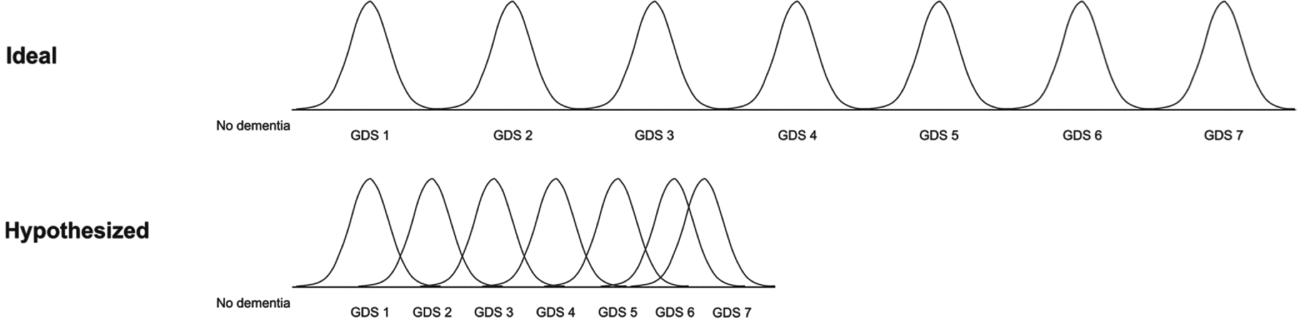
Additionally, the classification of the GDS might be too crude that causes people classified as GDS 7 to be a very heterogeneous group (Figure 1). Such heterogeneity might result in some scales to still be useful for comparisons and monitoring at the group level in the GDS 7 group, despite the fact that items in such scales cannot be used for all individuals. To overcome the above-mentioned difficulties, it would be ideal if all the Qualidem items could be used in the GDS 7 group. This would allow a more comprehensive assessment of QoL as well as improved applicability in daily practice and in longitudinal research.
The amount of heterogeneity in GDS classifications.

The aim of the current study is to investigate the applicability of all Qualidem items in people with all stages of dementia severity.
Methods
Respondents
The current study combines data of participants from four different studies, all conducted in nursing homes throughout the Netherlands. The first study was the WAALBED-II-study, which investigated neuropsychiatric symptoms and physician's drug prescription rates among people with dementia in nursing homes (Wetzels et al., Reference Wetzels, Zuidema, de Jonghe, Verhey and Koopmans2010b). The second study investigated the effects of a care program for managing challenging behavior of nursing home residents with dementia (Zwijsen et al., Reference Zwijsen2011). The third study evaluated the effects of small-scale living facilities in dementia care on residents, family caregivers, and staff (Verbeek et al., Reference Verbeek, Zwakhalen, van Rossum, Ambergen, Kempen and Hamers2010). The fourth study evaluated the (cost-)effectiveness of dementia-care mapping, a cyclic person-centered intervention in nursing homes (van de Ven et al., Reference van de Ven2012; Reference van de Ven2013). All studies had in common that they assessed QoL on an individual level over time using the Qualidem. It should be noted that each of the four studies was carried out in a nursing home setting, which makes the study samples comparable. Residents of Dutch nursing homes are mainly elderly people with an average age of 85 years. Those with dementia usually live in dementia special care units, which provide 24-hours a day nursing care, assistance with daily living, psychosocial, paramedical, and personal care. Dutch nursing homes employ multidisciplinary teams, which include nursing staff, an elderly care physician, a psychologist, a recreational therapist, a physical therapist, and a speech therapist. For the samples in the current study we report on age, sex, marital status, education, and severity of cognitive decline (GDS).
Instruments
The Qualidem is an often used and applicable (16, 17, 18) proxy-rated QoL instrument specifically developed for people with dementia in nursing homes, with 37 items intended to measure observable behavior related to QoL. It is filled in by nursing staff members. The items have the response options: “never,” “seldom,” “sometimes,” and “often.” Ettema et al. (Reference Ettema, Dröes, de Lange, Mellenbergh and Ribbe2007b) identified nine homogenous subscales that they labeled: “care relationship,” “positive affect,” “negative affect,” “restless tense behavior,” “positive self-image,” “social relations,” “social isolation,” “feeling at home,” and “having something to do.” Its validity and reliability have been deemed acceptable (Ettema et al., Reference Ettema, Dröes, de Lange, Mellenbergh and Ribbe2007a; Reference Ettema, Dröes, de Lange, Mellenbergh and Ribbe2007b).
The GDS (Reisberg et al., Reference Reisberg, Ferris, de Leon and Crook1982) is a classification instrument indicating cumulative cognitive decline in dementia and can be used as an indicator to assess the severity of dementia. It has seven stages ranging from no memory complaints (stage 1) to loss of verbal skills, incontinence, and deterioration in simple psychomotor skills (stage 7).
Analyses
The four datasets (Verbeek et al., Reference Verbeek, Zwakhalen, van Rossum, Ambergen, Kempen and Hamers2010; Wetzels et al., Reference Wetzels, Zuidema, de Jonghe, Verhey and Koopmans2010b; Zwijsen et al., Reference Zwijsen2011; van de Ven et al., Reference van de Ven2012) were combined and descriptive statistics were carried out. One dataset (Zwijsen et al., Reference Zwijsen2011) was longitudinal and omitted some items at the first measurement, which made the calculation of four subscales impossible. For this reason, all data on that study's first measurement were excluded from the current study. All longitudinal datasets were restructured to provide several measurements of the same individual. A missing value analysis was performed on the Qualidem items using IBM SPSS version 20. Subsequently, missing data were imputed via a predictive mean matching algorithm (because Mokken scaling (see below) requires complete data records). All items with more than 10% missing data were excluded from further analyses, items with less than 5% missing data were considered to have data missing at random. Subsequently, the data file was imported into statistical package R (Team, Reference Team2005). To validate whether the previously identified data structure (Ettema et al., Reference Ettema, Dröes, de Lange, Mellenbergh and Ribbe2007b) could be re-established in external datasets, the package “mokken” (Van der Ark, Reference Van der Ark2007) was used. This package can be used to test unidimensional latent trait models as identified by Mokken (Reference Mokken1971). Mokken proposed two different models, the first is the monotone homogeneity model (MHM), the second is the double monotone homogeneity model (DMM). The application of the package “mokken” allows testing the goodness of fit for both these models.
The MHM assumption specifies whether or not a scale is cumulative. A cumulative scale implies the following: (1) the trait to be measured is a single trait and can be represented as a unidimensional continuum; (2) the probability of giving the positive response (saying “yes” to an item or response category of an item) does not decrease for subjects with increasing values of the latent trait; and (3) the probability of giving the positive response to each item and response category depends only on the value of the subject on the latent trait, and not on any other systematic influence. When these assumptions are met, a higher score on the scale implies more of the latent trait. The DMM is more restricted than the MHM. It has the added assumption that the order of the probabilities of the positive response to all items and response categories is the same for all subjects, regardless of their value on the latent trait. This assumption means that all subjects, independent of their scale values agree about the order of the “difficulty” of the items (the probability of saying “yes” to an item or response category). If a scale is found to conform to the DMM this means that in any population, any sample, any time period or any other experimental condition the ordering of subjects according to their scale value is the same (van Schuur, Reference van Schuur2011).
In terms of model fit the scales are evaluated using Loevinger's coefficient of homogeneity H (Loevinger, Reference Loevinger1947). H is defined as the ratio between observed error and expected error (under statistical independence). This coefficient can be defined between items (H ij), between an item and a scale (H i), and for a scale as a whole (H). These values can be interpreted as follows: 0–0.3 is insufficiently homogenous, 0.3–0.5 indicates weak homogeneity, and larger than 0.5 indicates strong homogeneity (Sijtsma and Molenaar, Reference Sijtsma and Molenaar2002). In addition, we investigate the “crit” values for the MHM and the DMM as defined by Sijtsma and Molenaar (Reference Sijtsma and Molenaar2002). Crit values are calculated per item and take into account the number of comparisons with other items, the number of violations in these comparisons, the magnitude of these violations, the sum of the violations, the number of statistically significant violations, and a low Hi. Sijtsma and Molenaar regard crit values below 40 as explainable from random fluctuations and values above 80 as serious violations of homogeneity. Scale reliability was assessed using Cronbach's α and ρ (Sijtsma and Molenaar, Reference Sijtsma and Molenaar2002). We investigated the nine scales that were originally identified by Ettema et al. (Reference Ettema, Dröes, de Lange, Mellenbergh and Ribbe2007b) to see if we could replicate the results of the Mokken scaling in the entire group, in a group with GDS 1–6 and in a group with only GDS 7.
Finally, an item analysis was carried out to determine the percentage of answers per category per item. This was done to further illustrate potential differences between people with very severe dementia (GDS 7) and less severe dementia (GDS 1–6).
Results
Respondents
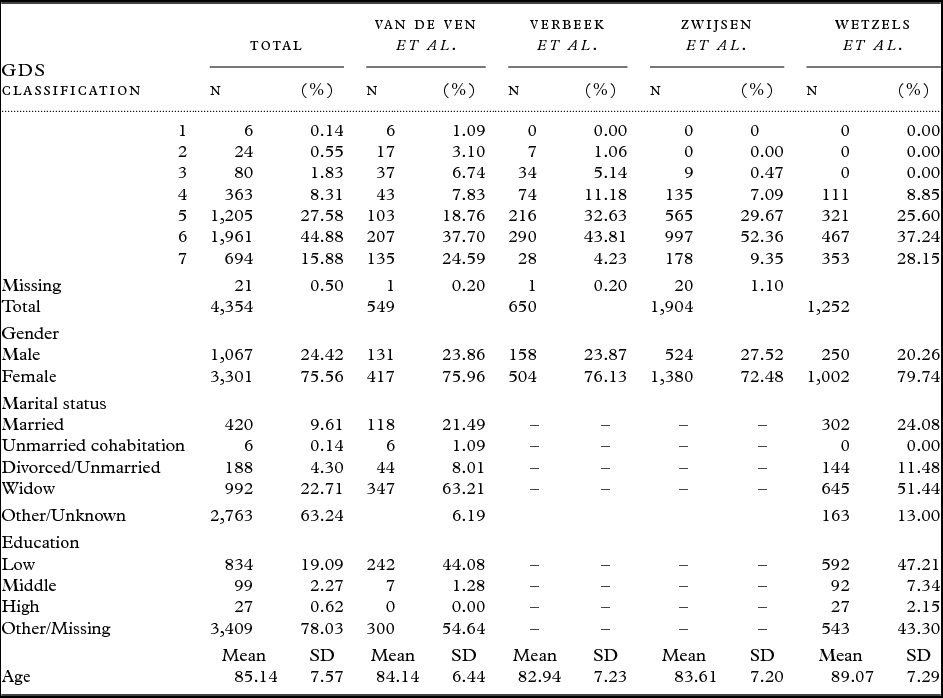
Combining the datasets of Verbeek et al. (Reference Verbeek, Zwakhalen, van Rossum, Ambergen, Kempen and Hamers2010), Wetzels et al. (Reference Wetzels, Zuidema, de Jonghe, Verhey and Koopmans2010b), Zwijsen et al. (Reference Zwijsen2011), and van de Ven et al. (Reference van de Ven2012) resulted in a sample of 4,354 measurements, which consists of a combination of single and multiple measurements of 2,158 different respondents. The mean respondent age was 85.2 (SD 7.6, range 49–108) and 75.6% were female. Most individuals were classified as having moderate to (very) severe dementia (Table 1).
GDS classifications of the combined samples

Missing value analysis
Item “Feels at home on the ward” had 2.9% missing values. All other items had less than 1% missing values.
Mokken scale analyses
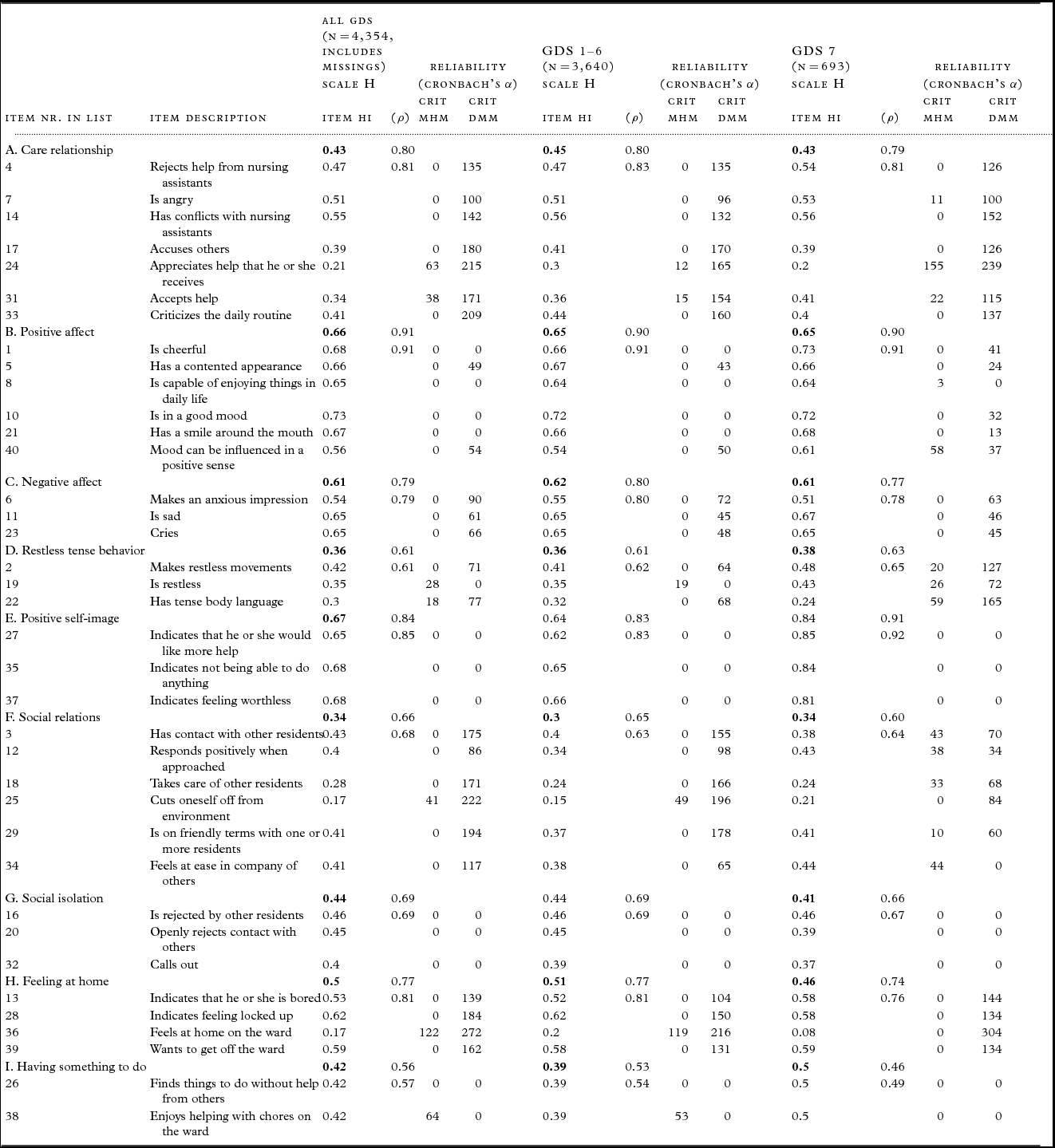
There were two scales that adhere to the most restricted model, DMM. These were “positive self-image” and “social isolation.” The scales “positive affect,” “negative affect,” “positive self-image,” and “feeling at home,” were considered strong scales (H > 0.5) (Table 2), although “feeling at home” was not considered perfectly homogenous with a crit MHM value of 119 for the item “Feels at home on the ward.” The reliability (ρ) of these scales ranged from 0.81 to 0.91, which was considered good to excellent. All the other scales were considered weakly homogenous (0.3 ≥ H ≤ 0.5) and their reliability varied from 0.56 to 0.79, which was considered poor to acceptable. In the “Social relations” scale, there were two items that fell below the 0.3 threshold in all groups: “Takes care of other residents” and “Cuts oneself off from environment,” both do not fit well with the other items in the scale. There was one item that weakened the “Care relationship” scale: This scale could be improved if the item “Appreciates help that he or she receives” would be removed.
Scale characteristics

There were minor deviations between the GDS 1–6 group and the GDS 7 group for all of the scales. However, none of the scales had insufficient homogeneity in either group. For both groups there was a single, albeit different, item that had a seriously high crit MHM value. These were “Feels at home on the ward” for the GDS 1–6 group, and “Appreciates the help he or she receives” for the GDS 7 group. The GDS 1–6 group had two additional items that were (suspicious of) violating homogeneity, while the GDS 7 group has four such items. In the GDS 7 group, the scale “Restless tense behavior” had weak homogeneity and it contains an item “Has tense body language” that falls below the 0.3 threshold.
Item analysis
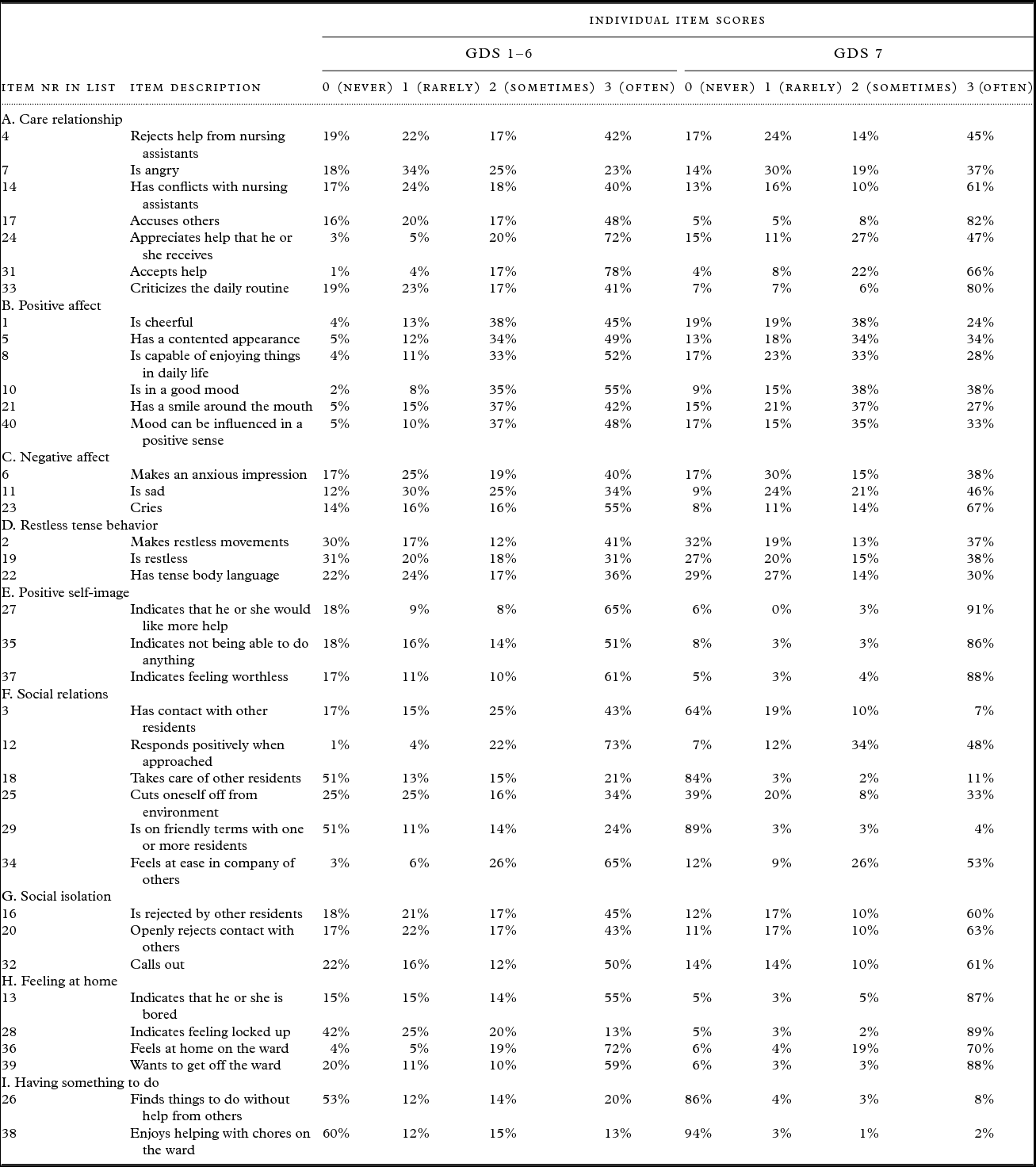
The individual item analysis (Table 3) showed that especially for items 3 (Has contact with other residents), 18 (Takes care of other residents), 29 (Is on friendly terms with one or more residents), and 38 (Enjoys helping with chores on the ward) that the GDS 7 group had > 60% of the scores in the category “never.” In the GDS 1–6 group, this was only applicable to item 38. These items fall in the scales of “Social relations” and “Having something to do.”
Individual item distributions of the QUALIDEM for people with GDS 1–6 and GDS 7

Discussion
The aim of the current study was to investigate the applicability of all Qualidem items in people with all stages of dementia severity. Our main finding is that all the scales as identified by Ettema et al. (Reference Ettema, Dröes, de Lange, Mellenbergh and Ribbe2007b) can be classified as having sufficient homogeneity using all items for the total group (GDS 1–7) and the GDS 1–6 group, but also for the subjects with very severe cognitive decline (GDS 7). Together with the fact that there were few missing values, which implies that all items could be answered meaningfully, this suggests that the statistical evidence points in a different direction than previous recommendations by Ettema et al.; although some scales could be improved by the omission of one or more items, the Qualidem's scalability is sufficient and, importantly, irrespective of the severity of dementia. In addition, the current findings do not indicate that the 18 items originally proposed by Ettema et al. (Reference Ettema, Dröes, de Lange, Mellenbergh and Ribbe2007b) for measuring QoL in people with very severe dementia have higher scalability than the non-chosen items. This finding was corroborated by the individual item analysis, which showed that only a few items, especially on the scale “Social relations” show a marked difference between people with very severe dementia and less severe dementia.
These findings can be explained conceptually. Although some items may be difficult to rate in severe dementia, (e.g. “Wants to get off the ward” and “Finds things to do without help from others”) the question is whether the difference between “no” and “not applicable” is relevant. In both cases, the resident's quality of life is expected to be lower than it would be if the response is “yes.” This is not because severe dementia implies a lower quality of life, but because the resident has less resources and/or abilities that help him in achieving quality of life, which is in line with resource and capability-based approaches to quality of life (Finnema et al., Reference Finnema, Dröes, Ribbe and van Tilburg2000; Ettema et al., Reference Ettema, Dröes, de Lange, Ooms, Mellenbergh and Ribbe2005). Nevertheless, for a scale to have content validity in severe dementia, it is essential that it also contains items that reflect behavior shown in very severe stages of dementia.
The scale “Care relationship” might be improved by omitting the item “Appreciates the help he or she receives.” The scale “Restless tense behavior” is a weak scale overall and it contains one item “Has tense body language” that falls below the 0.3 threshold in the GDS 7 group. In the “Social relations” scale, there are two items that fall below the 0.3 threshold in all groups; “Takes care of other residents” and “Cuts oneself off from environment” both do not fit well with the other items in the scale. There was one item that performed poorly in the “Care relationship” scale. This scale could be improved when the item “Appreciates help that he or she receives” would be removed. The scale “Feeling at home” might be improved by omitting the item “Feels at home on the ward.”
The results of this study support from a statistical point of view the notion that all Qualidem items can be used to measure QoL in each GDS stage. This could have important implications for future studies as it will be easier, for example, to perform a power analysis, compare groups with different GDS scores, and use the Qualidem in longitudinal studies, thus greatly improving the instrument's applicability. For measurement in individuals, the applicability of all Qualidem items might still be open to debate, but the results of this study support the notion that its use at group-level measurement seems justified.
The results from the current study support the notion that in daily practice the Qualidem could be administered to all participants and all items should be administered. This is advantageous, as nurses will not have to worry or wonder which items are applicable or not. Moreover, when the Qualidem is translated and investigated in a different country (e.g. in Germany (Dichter et al., Reference Dichter, Bartholomeyczik, Nordheim, Achterberg and Halek2011; Dichter et al., Reference Dichter2013)), future studies will not have to perform analyses for separate groups, which makes the instrument much easier to apply and the results easier to interpret. We argue that at a group level all the Qualidem items can be applied in all levels of cognitive decline of people with dementia. This makes the Qualidem suitable for demonstrating effectiveness of interventions. Future studies could optimize the instrument further by performing in-depth analyses of which items deteriorate the validity and reliability of the instrument, and might be dropped. Additionally they could investigate the inclusion of items still under investigation.
A major strength of the current study is the number of respondents in the combined dataset, and if one agrees with the pooling of the datasets as has been performed in the current study, should thus supersede the results of previous studies such as Ettema et al. (Reference Ettema, Dröes, de Lange, Mellenbergh and Ribbe2007a; Reference Ettema, Dröes, de Lange, Mellenbergh and Ribbe2007b) and Bouman et al. (Reference Bouman, Ettema, Wetzels, van Beek, de Lange and Dröes2011). It is the largest dataset on which the Qualidem structure has been evaluated and thus provides the greatest confidence in its underlying domain structure, based on statistical conclusions. It could be considered a limitation that the study solely regards these statistical conclusions. Indeed, we are by no means ready to disregard the conceptual framework on which the Qualidem was built. Instead, we would like to invite fellow researchers and formal caregivers to join in this discussion of statistical versus conceptual-based reasoning.
Conclusion
In conclusion, the current study contributes to the literature regarding the validity and reliability of the Qualidem in particular, and to measurement in dementia in general. It suggests that measurement of quality of life in people with very severe dementia is possible.
Conflict of interest
None.
Description of authors’ roles
All authors participated in the individual study concept and design; RBW, SZ, HV, GvdV, TPE collected the data; AMMA and RBW participated in acquisition of the different databases, AMMA merged the different databases and was responsible for the statistical design of the study and for carrying out the statistical analysis, AMMA wrote the draft article and RBW, SZ, HV, GvdV, TPE, RTCM, DLG assisted with writing the article.
Acknowledgments
This research was sponsored by VERENSO (the Dutch Association of Elderly Care Physicians and Social Geriatricians).