

Introduction
Pedicularis L. is a large genus of hemiparasitic herbs that has traditionally been placed in Scrophulariaceae. Recent molecular work (e.g. Olmstead et al., Reference Olmstead, dePamphilis, Wolfe, Young, Elisons and Reeves2001) has suggested that the genus and the other hemiparasitic ‘scrophs’ would be better removed to Orobanchaceae, where Pedicularis and its relatives would occupy a near-basal (Wolfe, Reference Wolfe2005) or a derived (Bennett & Mathews, Reference Bennett and Mathews2006) phylogenetic position. Other recent authors have adopted this ‘new position’ (e.g. Cai et al., Reference Cai, Liang and Wang2003; Ree, Reference Ree2005; Sun et al., Reference Sun, Guo, Gituru and Huang2005). However, the matter is not yet completely settled and the complex of families that includes Orobanchaceae and traditional Scrophulariaceae can be regarded as forming a continuum. Therefore a conservative approach was favoured by Fischer (Reference Fischer, Kubitzki and Kadereit2004) and will also be adopted by Flora of Pakistan. Nevertheless the new placement is accepted here and in Mill (Reference Mill2011).
The genus Pedicularis comprises between 600 and 700 species, distributed mainly in Eurasia, especially China and the Himalaya, but also in North and Central America (Ivanina, 1981; Mill, Reference Mill2001a; Fischer, Reference Fischer, Kubitzki and Kadereit2004). Regardless of whether it is placed in Scrophulariaceae or Orobanchaceae it is by far the largest genus of its family. There is no up-to-date worldwide revision or monograph of Pedicularis, nor even a complete worldwide conspectus of all the species that is more recent than that of Limpricht (Reference Limpricht1924). Recent revisions covering particular areas include Yamazaki (Reference Yamazaki, Ohba and Malla1988; Nepal), Yang et al. (Reference Yang, Holmgren, Mill, Zheng-yi and Raven1998; China) and Mill (Reference Mill, Grierson and Long2001b; Bhutan and Sikkim). I recently revised the genus for the forthcoming Scrophulariaceae fascicle of Flora of Pakistan. This paper deals with a group of species, centred mainly in Pakistan and NW India, that has usually been called Pedicularis ser. Pectinatae Prain (e.g. Prain, Reference Prain1890, but actually unranked in that work; Bonati, Reference Bonati1910, Reference Bonati1921; Limpricht, Reference Limpricht1924; Li, Reference Li1948a, Reference Li1948b; Hurusawa, Reference Hurusawa1949; Tsoong, Reference Tsoong1956a, Reference Tsoong1963; Yamazaki, Reference Yamazaki, Ohba and Malla1988; Yang et al., Reference Yang, Holmgren, Mill, Zheng-yi and Raven1998). It comprises Pedicularis pectinata Wall. ex Benth., P. tenuirostris Benth., P. pyramidata Royle ex Benth. and several closely allied rarer species. The purposes of the paper are twofold: to provide a critical morphology-based revision of this taxonomically difficult group of species and to clarify the nomenclature of the infrageneric group (series) in which they are placed. Several novelties (new taxa and lectotypifications) have already been published in advance of this paper by Mill (Reference Mill2010) in order to expedite their validation prior to publication of the Flora of Pakistan treatment but one further species new to science is described here. It is demonstrated below that the correct name for this series when circumscribed as here defined is, unfortunately, not Pedicularis ser. Pectinatae but P. ser. Tenuirostres Maxim.
It is recognised that morphology-based classifications do not always reflect the relationships recovered using molecular phylogenetic techniques. However, for Pedicularis there is as yet only one published broad-based phylogeny, that of Ree (Reference Ree2005). This sampled 71 species belonging to 43 series but included no members of Pedicularis ser. Tenuirostres. That study revealed considerable homoplasy and many, but not all, of the morphologically defined sections and series were not supported. A much larger analysis is currently being carried out by R. Ree, P. Kuss and others (Ree and Kuss, pers. comms. 2010) and brief comments on the version of their phylogeny made available to me are included where relevant to the species discussed in this paper.
Taxonomic History and Discussion
Early authors such as Bentham (Reference Bentham1835, Reference Bentham and De Candolle1846) and Bunge (Reference Bunge1843) regarded those species of the Pedicularis pectinata / P. tenuirostris group that had been described up until then as members of a group that had been called Tribus Verticillatae (Steven, Reference Steven1823; rank misplaced, name invalid), Pedicularis sect. Verticillatae Benth. (Bentham, Reference Bentham1835), Pediculares verticillatae (Bunge, Reference Bunge1841), Pedicularis sect. Cyclophyllum Bunge (Bunge, Reference Bunge and Ledebour1849) or Pedicularis ser. Verticillatae Benth. (Bentham, Reference Bentham and De Candolle1846; rank misplaced). This group was frequently circumscribed much more widely than is the present-day Pedicularis ser. Verticillatae, whose authority is usually (but incorrectly) given as Maximowicz (Reference Maximowicz1888). For example, Bentham’s treatment (1846) included 21 species in ‘ser. Verticillatae’, divided between three ‘sections’ ‘Longirostres’, ‘Brevirostres’ and ‘Erostres’ (the rank of section is misplaced and therefore those ‘names’ are all invalid under Art. 33.9 of the International Code of Botanical Nomenclature (McNeill et al., Reference McNeill, Barrie, Burdet, Demoulin, Hawksworth and Marhold2006); moreover, in several cases, including the three ‘names’ above, Bentham used the same sectional ‘name’ more than once in the same work). These 21 species are now divided among no fewer than 15 series following the most recent relevant regional accounts or revisions, such as those of Yamazaki (Reference Yamazaki, Ohba and Malla1988), Ivanina & Popova (Reference Ivanina and Popova1998) and Yang et al. (Reference Yang, Holmgren, Mill, Zheng-yi and Raven1998). Even the eight that Bentham (Reference Bentham1835) included in his sect. Verticillatae (Pedicularis gracilis Wall. ex Benth., P. pectinata, P. pyramidata, P. tenuirostris, P. porrecta Wall. ex Benth., P. brevifolia D.Don, P. mollis Wall. ex Benth. and P. verticillata L., type of the section by application of Art. 22.6), are now divided among five different series. Bentham himself (Bentham, Reference Bentham1835) divided them into two informal subgroups defined respectively by their beaked galea (the first six of those listed above; in 1846 these were his ‘section Longirostres’) or beakless galea (Pedicularis mollis and P. verticillata; in 1846 these formed the core of his ‘section Erostres’).
Maximowicz (Reference Maximowicz1877) began the work of dividing up the old Pedicularis ser. Verticillatae in the first of his three systems of the genus Pedicularis. In this, he restricted Pedicularis ser. Verticillatae to eight species and treated P. pectinata, P. pyramidata, P. tenuirostris, P. tianschanica Rupr., P. porrecta, P. brevifolia and P. gracilis as the original members of his new series, P. ser. Graciles Maxim., which was thus almost directly equivalent to Bentham’s ‘section Longirostres’ of P. ser. Verticillatae (P. tianschanica was described in 1869 [Osten-Sacken & Ruprecht, Reference Osten-Sacken and Ruprecht1869], between the two treatments of Bentham and Maximowicz). In his second conspectus Maximowicz (Reference Maximowicz1881) added three more species, Pedicularis roborowskii Maxim., P. fetisowii Regel and P. scolopax Maxim., and provided a key.
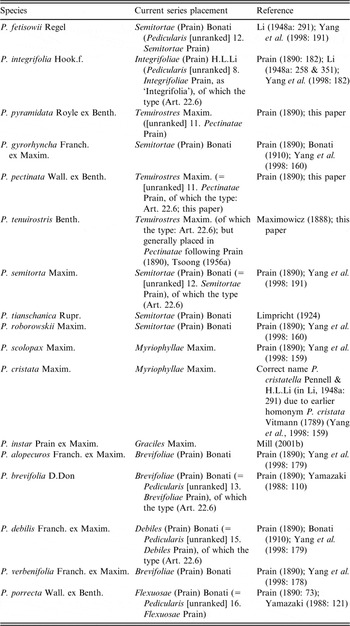
Maximowicz (Reference Maximowicz1888) was the first author to segregate a group of species containing Pedicularis tenuirostris, P. pyramidata and P. pectinata from P. ser. Graciles and give it its own validly published name at the rank of series, namely P. ser. Tenuirostres Maxim. His circumscription of that series encompassed 17 species, listed in Table 1 with their current placements. Most of them had been classified in Pedicularis ser. Graciles of his 1877 and 1881 classifications, but crucially P. gracilis itself was not; in his 1888 system that species was grouped in the new P. ser. Axillares Maxim., which, with its original circumscription, should have been called P. ser. Graciles because it included the type of another earlier series name. As Table 1 shows, 14 of Maximowicz’s original 17 species of Pedicularis ser. Tenuirostres are now classified in other series and only three of them remain in either P. ser. Tenuirostres or P. ‘series’ Pectinatae Prain, the two names with which this paper is concerned. These three are Pedicularis pectinata, P. pyramidata and P. tenuirostris. Under Art. 22.6 of the ICBN (McNeill et al., Reference McNeill, Barrie, Burdet, Demoulin, Hawksworth and Marhold2006), Pedicularis pectinata and P. tenuirostris are respectively the types of Pedicularis [unranked] 11. Pectinatae Prain (Reference Prain1890; frequently but incorrectly regarded as series: see Husain et al., Reference Husain, Garg, Agnihotri and Mill2006) and P. ser. Tenuirostres Maxim. (Reference Maximowicz1888).
Species of Pedicularis included in Maximowicz’s original concept of Pedicularis ser. Tenuirostres (Maximowicz, Reference Maximowicz1888) with their current placements

Prain (Reference Prain1890: 77) treated Maximowicz’s Pedicularis ser. Tenuirostres as Pedicularis [unranked] A.—Tenuirostres Maxim.) Prain (traditionally but incorrectly regarded as subsection, as by Mill, Reference Mill2001a and Ivanina & Popova, Reference Ivanina and Popova1998). Within Pedicularis [unranked] A.—Tenuirostres, Prain recognised two lower groups usually regarded as series: Pedicularis [unranked] 11. Pectinatae Prain with five species (P. pectinata, P. tenuirostris, P. pyramidata, P. fetisowii and P. alopecuros Franch.) and Pedicularis [unranked] 12. Semitortae Prain with six (P. oliveriana Prain, P. scolopax, P. tianschanica, P. roborowskii, P. semitorta Maxim. and P. cristata Maxim. for which the correct name is P. cristatella Pennell & H.L.Li; see Table 1).
However, Prain was not the first author to use the name ‘Pectinatae’ for a group of species within Pedicularis. Much earlier, Bunge (Reference Bunge and Ledebour1849: 285) had named three groups within Pedicularis sect. Lophodon Bunge, called a. Ramosae, b. Pectinatae and c. Comosae. The group named ‘b. Pectinatae’ was further subdivided into ‘b. Pectinatae α Elatae’ (comprising Pedicularis striata Pallas and P. elata Willd., both from China, Mongolia and Russia with P. elata extending to Kazakhstan), and ‘b. Pectinatae β Humiles’ (comprising P. sudetica Willd. [circumboreal extending south to Poland and Czech Republic], P. songarica Schrenk [Xinjiang and Kazakhstan] and P. langsdorffii Fisch. [distribution pan-arctic]; the first two are now classified in P. ser. Sudeticae Maxim. and the latter in P. ser. Hirsutae Maxim.). The group named ‘b. Pectinatae’ was given the description ‘caulibus simplicibus, foliis pectinato-partitis, laciniis serrulatis crenatisve’. The rank of these groups is uncertain but they are definitely below the rank of section; ‘b. Pectinatae’ must therefore be construed as either a subsection or a series, or as an unranked taxon under the terms of ICBN Art. 35.3 (McNeill et al., Reference McNeill, Barrie, Burdet, Demoulin, Hawksworth and Marhold2006). The latter course is preferable since Bunge did not recognise any formal infrageneric taxa within Pedicularis below the rank of section in any of his three slightly different infrageneric systems (Bunge, Reference Bunge1841, Reference Bunge1843, Reference Bunge and Ledebour1849; and see Tsoong, Reference Tsoong1955b). Article 35.3 states that such unranked names are validly published and must be taken into account in cases of homonymy. The name Pedicularis [unranked] 11. Pectinatae Prain Reference Prain1890 is therefore a later homonym of Pedicularis [unranked] Pectinatae Bunge Reference Bunge and Ledebour1849; hence, Prain’s taxon would require a new name if its type (P. pectinata) were to be regarded as belonging to a different series from P. tenuirostris. Currently, no such name is available. In the present revision, Pedicularis tenuirostris and P. pectinata are regarded as belonging to the same series, for which the correct name is P. ser. Tenuirostres.
Bonati (Reference Bonati1910, Reference Bonati1921) provided two enumerations of the group that he called Pedicularis ser. Pectinatae – he was the first author to definitely assign series rank to this group. In 1910 he recognised nine species: Pedicularis pectinata, P. tenuirostris, P. pyramidata, P. dichotoma Bonati, P. duclouxii Bonati, P. pectinatiformis Bonati, P. ramosissima Bonati, P. fetisowii and P. alopecuros. To these he added four others in his 1921 treatment, making a total of 13; these four were Pedicularis smithiana Bonati (Bonati, Reference Bonati1911), P. atuntsiensis Bonati (Bonati, Reference Bonati1913), and two described in the 1921 paper, P. birmanica Bonati and P. praealta Bonati.
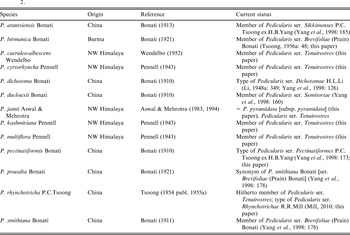
Since Prain’s Reference Prain1890 work, 13 other species (Table 2) have been added to Pedicularis ser. Tenuirostres [ser. Pectinatae (Prain) Bonati]. Three of them, Pedicularis cyrtorhyncha Pennell, P. kashmiriana Pennell and P. multiflora Pennell, were described by Pennell (Reference Pennell1943) from the NW Himalaya; P. caeruleo-albescens Wendelbo (Wendelbo, Reference Wendelbo1952) and P. jainii Aswal & Mehrotra (Aswal & Mehrotra, Reference Aswal and Mehrotra1983) also fall into that category although the latter name (also used by Aswal & Mehrotra, Reference Aswal and Mehrotra1994) has been found to be superfluous and illegitimate (see below, under P. pyramidata). All these NW Himalayan species are still regarded as members of Pedicularis ser. Tenuirostres.
Species added to Pedicularis ser. Pectinatae since Prain (Reference Prain1890)

Eight species have at some time been treated as members of Pedicularis ser. Tenuirostres (= Pectinatae) that were described on the basis of material collected outwith the NW Himalayan region: P. pectinatiformis (W Sichian, China; Bonati, Reference Bonati1907 & Reference Bonati1910), P. dichotoma and P. duclouxii (both from Yargong, Sichuan, China; Bonati, Reference Bonati1908 & Reference Bonati1910), P. atuntsiensis (NW Yunnan, China; Bonati, Reference Bonati1913), P. smithiana and P. praealta (both from Yunnan, China; Bonati Reference Bonati1911 & Reference Bonati1921 respectively – the latter was synonymised with the former by Yang et al., Reference Yang, Holmgren, Mill, Zheng-yi and Raven1998), P. birmanica (Bonati, Reference Bonati1921) from northern Burma and P. rhynchotricha P.C.Tsoong from SE Xizang, China (Tsoong, Reference Tsoong1955a, Reference Tsoong1955c).
The first seven species in the above list have since been removed to other series (Table 2): Pedicularis dichotoma as the type of P. ser. Dichotomae H.L.Li, P. duclouxii to P. ser. Semitortae (Prain) Bonati, P. pectinatiformis as the type of P. ser. Pectinatiformes P.C.Tsoong ex H.B.Yang (Yang, Reference Yang1995), P. atuntsiensis to P. ser. Sikkimenses P.C.Tsoong ex H.B.Yang (Yang et al., Reference Yang, Holmgren, Mill, Zheng-yi and Raven1998), P. smithiana (incl. P. praealta) to P. ser. Brevifoliae (Prain) Bonati (Yang et al., Reference Yang, Holmgren, Mill, Zheng-yi and Raven1998) and P. birmanica also to P. ser. Brevifoliae (Tsoong, Reference Tsoong1956a; see further discussion below).
Most of these decisions seem correct. The recognition of Pedicularis ser. Pectinatiformes as distinct from P. ser. Tenuirostres requires some comment, however. The name Pedicularis ser. Pectinatiformes P.C.Tsoong first appeared without a Latin diagnosis or description in Tsoong (Reference Tsoong1956a). Yang (Reference Yang1995: 246) validated the name with the following description, without any discussion or indication of circumscription other than the type:
Folia 3–4-verticillata, ovato-lanceolata vel lineari-oblonga, pinnatipartita vel pinnatisecta. Inflorescentia racemosa. Calycis dentes 5. Galea longe rostrata; rostro sigmoide vel in circulum dimidium. Typus: P. pectinatiformis Bonati.
This description does not contain any characters that serve to separate the new series from Pedicularis ser. Tenuirostres whose species also have 3–4-verticillate pinnatipartite or pinnatisect leaves, racemose inflorescences, usually 5 calyx teeth, and a long-beaked corolla, the beak often arcuate or semicircular. The three species currently regarded as members of Pedicularis ser. Pectinatiformes are P. pectinatiformis, P. weixiensis H.P.Yang and P. komarowii Bonati (Tsoong, Reference Tsoong1956a: 48). All these species have two characters in common that were not mentioned in the validating diagnosis of Pedicularis ser. Pectinatiformes (Yang, Reference Yang1995), although the second one was included in the English series description (Yang et al., Reference Yang, Holmgren, Mill, Zheng-yi and Raven1998):
• corolla with ciliate lower lip
• middle lobe of lower lip cucullate or hood-like.
These characters both serve to diagnose Pedicularis ser. Pectinatiformes from all members of P. ser. Tenuirostres as here defined. Furthermore, molecular phylogenetic work being carried out by R. Ree, P. Kuss and others has demonstrated that Pedicularis pectinatiformis, the only species of P. ser. Pectinatiformes so far studied by them, is very far removed from the members of P. ser. Tenuirostres included in their study (Kuss, pers. comm. 2010) and, in the version seen of their work, the nearest allies would appear to be P. gyrorhyncha Franch. ex Maxim. and P. densispica Franch. ex Maxim. These belong respectively to Pedicularis ser. Semitortae and P. ser. Abrotanifoliae H.Limpr. This supports the separation of this series from Pedicularis ser. Tenuirostres established on morphological grounds, but further work is required.
The Classification of Pedicularis rhynchotricha
Pedicularis rhynchotricha was classified in P. ser. Pectinatae (i.e. Tenuirostres) by Tsoong (Reference Tsoong1955a, Reference Tsoong1955c, Reference Tsoong1956b) and by Yang et al. (Reference Yang, Holmgren, Mill, Zheng-yi and Raven1998). Superficially it has many features in common with the NW Himalayan members of Pedicularis ser. Tenuirostres. They include a similar erect perennial habit with leaves in whorls, large pinkish-purple corollas, and long-beaked galea. However, Pedicularis rhynchotricha would be unique in P. ser. Tenuirostres in having a beak that is densely tomentose in its middle part (Tsoong, Reference Tsoong1955a, Reference Tsoong1955c; confirmed by examination of specimens) and it is also very disjunct geographically from all the other remaining species of the series, being confined to SE Xizang (Tsoong, Reference Tsoong1955a, Reference Tsoong1955c; Yang et al., Reference Yang, Holmgren, Mill, Zheng-yi and Raven1998). These facts led me to re-evaluate the placement of this species. Examination of the type and three paratypes (see citations in taxonomic account) suggests that its present classification in Pedicularis ser. Pectinatae (i.e. Tenuirostres) is incorrect. As well as the tomentose beak and geographical disjunction noted above, Pedicularis rhynchotricha differs from the NW Himalayan species of P. ser. Tenuirostres (= Pectinatae) in several other characters:
• The bracts are considerably longer than the calyx, linear, dentate and, very distinctively, are deflexed at anthesis, rendering the calyces readily visible, whereas in the Pedicularis pyramidata species complex the bracts are subequal to or only slightly longer than the calyx, lanceolate, entire and forwards adpressed, covering the calyx. In Pedicularis pectinata the lower bracts are crenate-dentate to -pinnatifid but the middle and upper ones are subentire and at least partly cover the calyx, while the same is true for P. tenuirostris which has subentire bracts. The deflexed bracts of Pedicularis rhynchotricha are therefore quite different from any of the NW Himalayan species.
• The calyces of Pedicularis rhynchotricha have very indistinct veins, much less visible than the 10 dark, easily visible veins of all the NW Himalayan species; instead, the calyx of P. rhynchotricha has indistinct slightly raised rib-like structures.
• The calyx tube of the NW Himalayan species has a perfectly smooth surface that is villous or pilose on the veins. In Pedicularis rhynchotricha, however, the cellular structure is such that it gives a false impression that the calyx tube is densely covered all over with papillae or sessile glands. The calyx is completely glabrous externally, including the veins, but is villous inside around the sinuses.
• The middle lobe of the lower lip is shallowly and broadly emarginate, and ciliate (as is the distalmost region of each of the lateral lobes), whereas in all the NW Himalayan species the lobes of the lower lip are completely entire and glabrous. However, it is not cucullate as in the members of Pedicularis ser. Pectinatiformes, which also have ciliate lower lip margins.
• The lower, vertical part of the galea is long-ciliate on the anterior margin; in all the NW Himalayan species the corresponding region is glabrous.
Staminal characters vary among the species and are not diagnostic for the series as a whole (either including or excluding Pedicularis rhynchotricha) but do allow the separation of three species-groups:
(i) In Pedicularis tenuirostris and at least the typical state of P. pectinata, as well as in two of the new species treated here (P. staintonii and P. yamazakiana), the filaments are hairy at the point of insertion and in the distal half but are glabrous in between.
(ii) All the members of the Pedicularis pyramidata group, including the new species P. murreeana validated by Mill (Reference Mill2010) and fully described here, have both pairs of filaments distally hirsute but glabrous at the point of insertion and in the proximal half.
(iii) In Pedicularis rhynchotricha the filaments are all glabrous throughout except for dense long hairs at the point of insertion, which is in the upper third of the tube. The filaments of all four stamens of Pedicularis rhynchotricha, particularly the two anterior ones, are also unusual in having a ‘beaded’ appearance throughout their length. This has not been observed in the Himalayan species, whose filaments are flattened and otherwise unremarkable.
Pedicularis rhynchotricha also differs in the presentation of its flowers to their pollinators. In the NW Himalayan species the lower lip is spread flat and the galea is raised above it, directed forwards. However, Pedicularis rhynchotricha has a more complex presentation. Examination of reconstituted flowers from one of the paratypes revealed that the lateral lobes of the lower lip are bent upwards to partly enfold the beak. The latter bends down, with its tip touching the tip of the slightly pouched middle lobe. The glabrous, proximal and distal parts of the galea beak are on either side of the base of the lower lip while its curved, tomentose middle portion lies across the base of the lower lip.
These and other less important differences, when all combined, suggest that despite its superficial similarities to Pedicularis pectinata, P. pyramidata and their allies, P. rhynchotricha has little in common with them and should not be grouped in the same series. Accordingly, the new Pedicularis ser. Rhynchotrichae was erected for it by Mill (Reference Mill2010); this is described fully in the present paper (see Taxonomy). It would be desirable to test the morphology-based classification presented here using molecular phylogenetic techniques. However, although a large molecular phylogenetic tree of the genus is currently being assembled by R. Ree, P. Kuss and others, Pedicularis rhynchotricha has not yet been sampled (Kuss, pers. comm. 2010) so its phylogenetic placement is currently unknown.
The Classification of Pedicularis birmanica
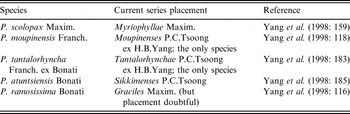
The placement of Pedicularis birmanica Bonati has not been re-evaluated for half a century. Bonati himself likened his new species Pedicularis birmanica to P. ramosissima, a species he had earlier described from Sichuan, China (Bonati, Reference Bonati1908). Pedicularis ramosissima and P. birmanica were both placed in P. ser. Pectinatae by Bonati (Reference Bonati1910) and Limpricht (Reference Limpricht1924). Bonati’s concept of Pedicularis ser. Pectinatae (Bonati, Reference Bonati1910: 17) was, by comparison with some other authors of the period, relatively narrow (nine species; P. semitorta and six others were separated as P. ser. Semitortae) but Limpricht’s concept of the series was broader (13 species; 20 in the whole Tenuirostres group which he subdivided into Semitortae and Pectinatae). Li (Reference Li1948a) had treated Pedicularis ramosissima as related to P. scolopax, placing them both in his concept of what he called P. ser. Pectinatae (for a complete list of species included see Table 3; note that he only treated Chinese taxa and therefore neither P. pectinata itself nor the other NW Himalayan members of P. ser. Pectinatae were included). However, Tsoong (Reference Tsoong1963), Yang et al. (Reference Yang, Holmgren, Mill, Zheng-yi and Raven1998) and Yang et al. (Reference Yang, Hong and Wang2003) all placed Pedicularis scolopax in P. ser. Myriophyllae Maxim. and P. ramosissima in P. ser. Graciles Maxim.; Limpricht (Reference Limpricht1924) had earlier also put P. scolopax in P. ser. Semitortae and the other two (P. birmanica and P. ramosissima) in P. ser. Pectinatae.
Chinese species of Pedicularis ser. Pectinatae in the classification of Li (Reference Li1948a) with current placements of the species. Li did not list non-Chinese species, such as Pedicularis pectinata itself

Pedicularis birmanica differs from the NW Himalayan members that constitute the bulk of the restricted P. ser. Tenuirostres in several characters. These include rounded calyx lobes, a corolla tube twice the length of the calyx, a galea beak that is straight and not at all twisted or coiled, the absence of basal leaves, and the much smaller cauline leaves that are opposite below and in whorls of 3 above. These leaves are much less deeply dissected than all members of Pedicularis ser. Tenuirostres except P. tenuirostris, and with far fewer pairs of segments. The Chinese Pedicularis specialist P. C. Tsoong, on an annotation slip on the type specimen of P. birmanica that was probably written in the 1950s, wrote: ‘The nearest ally of this species is P. verbenaefolia Franch., by possessing opposite and ternate leaves and similar floral structure; this should belong to Ser. Brevifoliae’. He formalised this view in his system of the genus (Tsoong, Reference Tsoong1956a), in which Pedicularis ser. Brevifoliae comprised the six species P. verbenifolia, P. smithiana, P. tsaii H.L.Li, P. birmanica, P. porrecta and P. brevifolia. Examination of the type and other members of that series confirms Tsoong’s view that the correct position for Pedicularis birmanica is in P. ser. Brevifoliae.
Taxonomy
In the species accounts that follow, distributions by countries, territories and provinces are given in the following order: Pakistan (Gilgit-Baltistan, Khyber Pakhtunkhwa, Federally Administered Tribal Areas [abbreviated FATA], Azad Kashmir, Punjab); Kashmir; India (Himachal Pradesh, Uttarakhand); Nepal. The Indian state of Jammu and Kashmir, the whole of which is covered by Flora of Pakistan, is here treated separately from both Pakistan and the rest of India, as ‘Kashmir’, but this is purely for convenience. The abbreviation ‘d.’ preceding a place name stands for district; for example, d. Swat = Swat district.
Proposed IUCN conservation assessments are given for each taxon, following the criteria of IUCN Red List Categories and Criteria Version 3.1 (IUCN, 2001) and according to Version 8.0 of the guidelines for applying these criteria published by the IUCN Standards and Petitions Subcommittee (2010). The abbreviations EOO and AOO used in the assessments respectively denote extent of occurrence and area of occupancy, as used and defined in the above works.
Key to distinguish Pedicularis series Tenuirostres, Pectinatiformes and Rhynchotrichae
1a. Lower lip of corolla stipitate at base, margins of lobes glabrous; most or all bracts forwards adpressed and at least partly obscuring the calyx Ser. Tenuirostres
1b. Lower lip of corolla not stipitate at base, margins of lobes ciliate; bracts various 2
2a. Beak of galea with a central tomentellous portion; middle lobe of lower lip ± rectangular, not hood-like; bracts deflexed Ser. Rhynchotrichae
2b. Beak of galea glabrous; middle lobe of lower lip cucullate or hood-like; bracts deflexed or not Ser. Pectinatiformes
Pedicularis series Rhynchotrichae
Pedicularis series Rhynchotrichae R.R.Mill, Edinburgh J. Bot. 67: 186 (2010).
Differs from Pedicularis ser. Tenuirostres Maxim. (= Pedicularis [unranked] 11. Pectinatae Prain) by the bracts deflexed (not adpressed and covering the calyces), by the vertical part of the galea long-ciliate anteriorly and the beak tomentellous in its middle portion, by the middle lobe of the labellum slightly emarginate (not entire) and all three lobes ciliate (not glabrous), the staminal filaments long-pilose at their insertion but otherwise glabrous (instead of distally villous and otherwise glabrous except near the base) and with a beaded appearance (not flat). – Type: Pedicularis rhynchotricha P.C.Tsoong. – Monospecific; distributed in China (SE Xizang).
Pedicularis rhynchotricha P.C.Tsoong, Acta Phytotax. Sin. 3: 299 (Jan. 1955); P.C.Tsoong, Bull. Brit. Mus. (Nat. Hist.), Bot. 2(1): 21 (Nov. 1955). – Type: China, SE Tibet [Xizang], Pasum Tso, Kongbo, 3597 m [11,800 ft], on moist ground, calyx green, corolla violet with long violet tube, 21 vii 1947, Ludlow, Sherriff & Elliott 15501 (holo BM).
Perennial. Roots rather fusiform, fleshy. Stems 1 or several, to 70 cm, erect, unbranched, glabrous below, with 4–5 lines of pubescence above. Radical leaves withered at anthesis. Lower cauline leaves in whorls of 4, middle and upper in whorls of 5; nodes 7–9; petioles much shorter than lamina (lowest ones to 15 mm, others 5–10 mm or almost absent), glabrous; lowest ones small (c.16 mm), middle and upper ones 40–70 × 15–30 mm, elliptic, elliptic-ovate or ovate-oblong in outline, pinnatipartite with winged rachis; segments (6–)10–15 pairs, triangular-oblong, to 17 × 4 mm, serrate, with thickened inrolled margins beneath; surfaces glabrous, the lower one white-furfuraceous proximally. Inflorescence a lax, interrupted terminal raceme opening from base, 100–130 mm or more; fascicles 5–12. Bracts linear-elliptic from a broad base, all much longer than the calyx and deflexed, not hiding the calyx, 15–22 × 1–2.5 mm, lower ones coarsely toothed to pinnatifid, upper ones subentire. Calyx cylindrical, gently inclined forwards, 9–12 mm, not split anteriorly; tube 5.5–7 mm, greenish but not pale, with inconspicuous slightly darker veins, glabrous but surface appearing minutely papillate or ‘glandular’ due to cell structure (actual glands absent); teeth 5, very unequal, posterior tooth filiform, the other 4 triangular-oblong, acute, 2–4 mm, the two anterior ones smaller than the two laterals, all glabrous externally but tomentose around sinuses inside. Corolla 30–36 mm; tube wine-red, pale at throat, 9–17 mm, cylindrical, only slightly expanded at base, loosely pilose above top of ovary, proximally glabrous; lower lip wine-red, pale at throat, broadly oblong-rectangular, not attenuate at base, 14–18 × 11–13 mm, margins slightly undulate (the lateral lobes with distal ‘shoulders’) and ciliate; middle lobe rather rectangular, 1.5–2 × 2.5–3.5 mm, emarginate; lateral lobes 11.5–14.5 × 5.5–7 mm; galea wine-red, very dark at apex but white at base, the lower part 2–4 mm, long-ciliate on anterior margin, the anther-bearing part 4–5 × 2.7–3.5 mm, unequally conical, gradually attenuate into slender beak; beak 10–12 mm, decurved and sigmoidally coiled, facing outwards, very densely brownish-tomentellous on a medial-proximal section 4–4.5 mm long just in front of the anther-bearing part. Stamens inserted in middle of tube, well above ovary; long-pilose at point of insertion but otherwise glabrous, the filaments all beaded in the proximal half (the beading more prominent in the anterior pair than the posterior); anthers ovoid-ellipsoid, cells distinctly acute at base. Capsule (fide Yang et al., Reference Yang, Holmgren, Mill, Zheng-yi and Raven1998) 2/3 enclosed by accrescent calyx, long ovoid, c.1.2 cm. Seeds unknown.
Distribution. China (SE Xizang: Kongpo, especially near Pasum Tso and Tripe). As well as the specimens cited here, Tsoong (Reference Tsoong1955c) mentioned a collection from Atsa Pass, 4800 m, Kingdon Ward 6167 which has not been seen by me. Marquand (Reference Marquand1929) listed this number under Pedicularis longiflora Rudolph, a totally unrelated species. Atsa Pass is about 110 km northwest of the nearest collections seen, from Pasum Tso. The localities from which Ludlow and his collectors gathered their specimens of this species were also visited by Kingdon Ward who included most of them on his expedition map (Kingdon Ward, Reference Kingdon Ward1926).
Habitat and ecology. Little is known. Collected on moist ground, amongst bracken; 3350–3650 m (excluding the Atsa Pass material that may belong to this species).
Proposed IUCN conservation assessment. Data Deficient (DD). Insufficient is known about the EOO (very approximately 20,000 km2) and AOO of this species, and of its current abundance, to make an assessment. The few collections that have been seen were all collected more than 60 years ago.
Additional specimens examined. China.SE Tibet [Xizang]: Kongbo Province, Kulu Phu Chu near Paka, 29°15′N, 94°25′E, 11,500 ft, 8 vii 1938, Ludlow, Sherriff & Taylor 5983 (E, isoparatype); valley above Tripe, 29°39′N, 94°59′E, 11,000 ft, 25 vii 1938, Ludlow, Sherriff & Taylor 5395 (E, isoparatype); Je, Pasum Tso, Kongbo, 11,700 ft, 7 vii 1947, Ludlow, Sherriff & Elliott 14086 (BM, paratype).
Tsoong (Reference Tsoong1955a, Reference Tsoong1955c) described the corolla tube as glabrous but the specimens examined have the upper part of the tube hairy.
Pedicularis series Tenuirostres
Pedicularis series Tenuirostres Maxim., Bull. Acad. Imp. Sci. Saint-Pétersbourg sér. 3, 32: col. 544 (1888). – Type [by application of Art. 22.6, and also designated as such by Ivanina & Popov, Bot. Zhurn. 83(10): 98, 1998]: Pedicularis tenuirostris Benth.
Pedicularis [unranked] 11. Pectinatae Prain, Ann. Roy. Bot. Gard. (Calcutta) 3: 71 (1890), nom. illegit. (non Pedicularis [unranked] Pectinatae Bunge (Reference Bunge and Ledebour1849: 285)). – Pedicularis ser. Pectinatae Bonati, Mem. Soc. Bot. Fr. 18: 17 (1910), syn. nov. – Type (by application of Art. 22.6): Pedicularis pectinata Wall. ex Benth.
Perennial herbs. Leaves basal and cauline; cauline leaves in whorls of 3, 4 or 5 or occasionally some opposite. Inflorescence a raceme, varying from short and head-like to lax or dense and sometimes very long and/or spike-like (especially Pedicularis kashmiriana and P. multiflora). Bracts at least partly covering calyx, lowest ones sometimes leaf-like, middle and upper ones usually lanceolate to ovate and subentire or entire. Calyx ovoid to campanulate, often inflated, straight or slightly curved, sometimes cleft anteriorly. Corolla usually reddish or purplish, rarely cream, yellow or white, often with a pale patch at throat; tube equalling or slightly longer than calyx, glabrous externally though sometimes hairy inside near insertion of stamens; lower lip ± stipitate at base, distinctly 3-lobed, the margins entire and glabrous; galea toothless, with long, strongly curved or coiled beak. Stamens inserted near ovary (sometimes in a sac-like structure) or in middle of corolla tube; all filaments hairy distally (above the middle) and often also at base, otherwise glabrous. Capsule equalling or scarcely longer than calyx, ± broadly ovoid, valves shortly acuminate. Seeds with variously reticulate testa. – Twelve species; restricted to the NW Himalaya (Afghanistan to western Nepal).
After removal of Pedicularis birmanica, P. rhynchotricha and the other species discussed in foregoing sections of this paper, P. ser. Tenuirostres, in the circumscription adopted here, appears morphologically to be a very natural grouping. Only two of the 12 species recognised here have so far been scrutinised by molecular phylogenetic techniques, namely Pedicularis pectinata and P. pyramidata (the latter sampled under its synonym P. jainii). They group together at the base of a large subclade (Kuss et al., pers. comm. 2010) but three or more taxa from the series require to be sampled before it can be stated that the series is a monophyletic group.
Key to species of Pedicularis series Tenuirostres
1a. Corolla normally pale yellow, cream or white; cauline leaves all sessile or subsessile, not narrowed at base 1. P. tenuirostris
1b. Corolla purple, mauve, rose, pink or reddish; most or all cauline leaves distinctly petiolate, or at least narrowed into petiole-like bases (sessile only in rare colour variant of Pedicularis tenuirostris) 2
2a. Cauline leaves sessile or subsessile 1. P. tenuirostris (rare rose-coloured variant)
2b. Cauline leaves petiolate or narrowed into petiole-like bases 3
3a. Bracts, including lowest, with entire margins 4
3b. Bracts, at least lower ones, with margins partly or wholly crenate or pinnatifid 7
4a. Beak of galea 12–17 mm; calyx not cleft anteriorly 8. P. pyramidata
4b. Beak of galea 6–10.5 mm; calyx at least slightly cleft anteriorly 5
5a. Corolla very pale bluish, almost white, when fresh; galea beak 6–7 mm; basal leaves always present at anthesis, cauline ones 10–15 mm 11. P. caeruleoalbescens
5b. Corolla reddish, purple, lavender or mauve; galea beak 7–10.5 mm; basal leaves almost always withered at anthesis, cauline ones 25–90 mm 6
6a. Calyx teeth 5, none fused, larger four 2–4 mm; corolla tube 12–14 mm, longer than calyx 9. P. kashmiriana
6b. Calyx teeth 3 or 4 by reduction through unequal fusion of lateral teeth, 1–2 mm; corolla tube 6–8 mm, ± included in calyx 10. P. multiflora
7a. Cauline leaves in whorls of 4 8
7b. Cauline leaves in whorls of 3 or opposite 10
8a. Calyx deeply split anteriorly; capsule shorter than calyx 4. P. stewartii
8b. Calyx not split anteriorly; capsule scarcely exserted from calyx 9
9a. Lower whorls of inflorescence never remotely separated at anthesis; cauline leaves 15–45 mm wide, 1.7–2.7 × as long as wide 2a. P. pectinata subsp. pectinata (occasional forms with leaves in whorls of 4)
9b. Lower whorls of inflorescence always remote at anthesis; cauline leaves 4–12 mm wide, 5–11 × as long as wide 6. P. staintonii
10a. Beak of galea 4.5–8.5(–9) mm 11
10b. Beak of galea (9–)10–16 mm 12
11a. Whorls of inflorescence rather distant, internodes longer than calyces; calyx 9–11 mm; beak of galea coiled downwards and inwards 7. P. murreeana
11b. Whorls of inflorescence mostly ± contiguous, only the lowest more remote; calyx 6–9 mm; beak of galea turned upwards 12. P. cyrtorhyncha
12a. Petioles of cauline leaves ± expanded and flattened in proximal half and ciliate 13
12b. Petioles of cauline leaves not expanded or flattened in proximal half, glabrous 2. P. pectinata
13a. Inflorescence short and head-like, mostly 20–45 mm, occasionally reaching 90 mm if lowest whorl remote from others; erect part of galea c.4 mm, subequalling anther case; dilation of cauline leaf petioles conspicuous 3. P. bipinnatifida
13b. Inflorescence pyramidal and racemose, dense, 50–100 mm; erect part of galea c.8 mm, longer than anther case; dilation of cauline leaf petioles weak and inconspicuous 5. P. yamazakiana
1. Pedicularis tenuirostris Benth., Scroph. Ind. 52 (1835). – Type: Kashmir, ‘ad Pyr Pundjal’, Royle (holo LIV).
Tall, sturdy perennial. Rootstock much thickened, rhizome-like, crustaceous in texture. Stems 40–80 cm, unbranched, strict and erect, 1 or several per crown, ridged, thinly pubescent, mainly in 4 rows along main ridges. Basal leaves withering by anthesis; petiole 70–100 mm, slender; lamina pinnatifid with winged rachis, the segments oblong-ovate, dentate with c.5 teeth per side, very narrowly white-callused-margined; both surfaces glabrous, lower surface reticulate-veined. Cauline leaves in whorls of 4, the whorls remote, all sessile or the lowest whorls very shortly petiolate (petiole 5–10 mm); lamina 40–115 × 7–30 mm, (3–)4–8 × as long as broad, triangular-lanceolate, pinnatifid; segments 9–20 pairs, ovate-triangular to narrowly elliptic, regularly decreasing in size towards leaf apex, obtuse, serrate, both surfaces glabrous, lower net-veined; margins callused, slightly inrolled. Inflorescence a dense, elongate imbricate spike, 60–160 × 25–40 mm at anthesis but elongating to 300 mm in fruit, opening from base upwards, of 11–40 whorls; flowers sessile. Bracts broadly ovate, (6.5–)7–10 × 4–6 mm, acuminate, entire, sparingly hirsute to base; margins ciliolate to tip. Calyx campanulate, 8–10.5 mm; tube 7–9 mm, pale green with darker veins, hairy on veins, scarcely split on anterior side; teeth 5, broadly lanceolate, subequal, acute, entire, minutely ciliate-margined, otherwise glabrous. Corolla 21–28 mm, tube and lower lip usually yellow or cream (very rarely rose-pink), galea purplish-red or mauve; tube 9–10 mm, equalling calyx, straight but saccate inside on anterior side, glabrous; lower lip obovate, 8–10 × 10–13 mm, middle lobe broadly ovate-orbicular, 3–4 × 3–3.5 mm, much smaller than laterals but projecting beyond them, stipitate; lateral lobes ovate, 8–9 × 5–6.5 mm, tapered proximally, entire, glabrous; galea with lower part 4–5 × 3 mm, erect, anther-bearing part 5–6 × 2.5–3 mm, inflated, incurved at a right angle so that the anther-bearing part is horizontal with the tip of the beak pointing inwards towards the inflorescence axis; beak 5–8 mm, porrect at base, abruptly becoming decurved towards apex, gradually tapered and very slender, the tip acute, entire, stigma not exserted. Stamens inserted in a small sac above the ovary, formed by base of corolla tube on its anterior side; all filaments rufous-villous at base and above the middle, glabrous in between; anthers 2.5–2.7 × c.1.5 mm, ellipsoid, cells obtuse at base. Capsule broadly ovoid, acuminate, valves slightly asymmetric, acute, c.11 × 6 mm. Seeds ovoid, fawn or pale brown, 3 × 1.8 mm, rugose and strongly reticulate, the reticulations transversely rectangular or square.
Distribution. Pakistan (Gilgit-Baltistan, Khyber Pakhtunkhwa, Azad Kashmir, Punjab), NW India (Himachal Pradesh, Uttarakhand).
Habitat and ecology. Forest clearings, meadows, alpine pastures, dry stream-beds, etc.; (1800–)2300–3350 m.
Proposed IUCN conservation assessment. Least Concern (LC). Apparently widespread and fairly abundant. There does not appear to have been a significant decline in EOO or AOO. The medicinal use mentioned below appears to be purely local and does not give rise for concern at the present time.
Additional specimens examined. Pakistan. Gilgit-Baltistan: Kala Pani, 10,000 ft, Giles Gilgit Exped. 673 (K). Kamri Valley, 10–11,000 ft, 24 viii 1892, J.F. Duthie 12536 (BM). Khyber Pakhtunkhwa (Hazara Division): d. Mansehra: Kagan Valley, 17 viii 1896, Inayat 19997 (K; flowers white); between Naran and Kaghan, 6 ix 1988, S. Omar & M. Qaiser 2747 (KUH); near P. W. D. Rest House, Kaghan, 7000 ft, 1 viii 1971, Sultan-ul Abedin & Qaiser 8859 (KUH); 8 miles from Mahartaion on way to Kagan, 31 viii 1972, M. Qaiser & A. Ghafoor 5222 (KUH); 2 miles from Kaghan on way to Naran, 8 vii 1977, Kamal & M. Qaiser 285 (KUH). d. Swat: Jhamra, 7500 ft, 23 viii 1962, Stewart, Nasir & Siddiqi 1093 (RAW 30742); Utror, 9 viii 1970, P. Grohmann 6258 (RAW 45821); above Utror, 8000–9000 ft, 21 vii 1953, R.R. Stewart & A. Rahman 25254 (RAW 30749). Azad Kashmir: otherwise unloc., 6000 ft, 27 vi 1952, R.R. Stewart & E. Nasir 23808 (RAW 30745). Punjab: Murree Hills, viii 1907, Deane s.n. (K). Kashmir. Bandkot–Bandipur (Wular Lake), Falconer 792 (K); Shenthar valley, Kishenganga, 10,000 ft, 11 viii 1935, Ludlow & Sherriff 1510 (E). Chorwan, Gilgit Rd., 8500–9000 ft, 22 vii 1940, R.R. Stewart 19635 (RAW 30752); Pahlgam, 18 viii 1920, R.R. & I.D. Stewart 5700a (K); Gadsar nullah, 11,000 ft, 16 viii 1940, P.M. Pinfold 331 (BM); Rajparyan Sanctuary, Upper Bringhi, 8500 ft, 20 viii 1943, Ludlow & Sherriff 9341 (BM); Kunzalwar [Kazalwan], 7500 ft, 21 vii 1876, Clarke 29382C (BM); Sonamarg, 10,500 ft, 29 viii 1876, Clarke 30817B (BM); Sonamarg, Sind Valley, 8000 ft, 28 vii 1891, G.A. Gammie s.n. (K; annotated by Prain, ‘an interesting specimen as the species has not hitherto been found with any but “yellow” flowers’); Liddar Valley near Tanin, 10,000 ft, 29 vii 1893, J.F. Duthie 13318 (BM); Kostorkut, 8 miles NW of Vishensar, 11,000 ft, 6 ix 1956, O. Polunin 56/697 (BM, E); mt. opposite Pahlgam, 10–11,000 ft, 28 viii 1945, R.R. Stewart 21808 (K); Suru, viii 1912, R.R. Stewart s.n. (RAW 30742); Tragbal Pass, 10,000 ft, 4 viii 1919, R.R. & I.D. Stewart 4815 (RAW 30749). Baltal, 9000 ft, 14 vii 1977, Stainton 7939 (E); Upper Chenab, 1880, R. Ellis 620 (K). India. Himachal Pradesh: Chamba, Pangi, Pargraon, 10,000 ft, 15 viii 1897, J.H. Lace 1632 (E, 3 sheets); Chamba, Dharwas, Pangi, 28 vi 1896, Lace 1476 (E). Pangi, Chenab valley, 9000 ft, vii 1879, G. Watt 79 (E); Bashahr, prope vicum Kilba nunc in regno Bassahir, 8000 ft, 15 viii 1886, Ranu Baksh (Drummond 5175) (E); Bashahr, nr Rukti Gad, 20 vii 1890, J.H. Lace 420 (E, 2 sheets, one with extensive field notes). Lahul, Sissu, 10,000 ft, 7 viii 1916, Cooper 5209 (E); ibid., 10,000 ft, 31 viii 1916, Cooper 5539 (E); Lahul, Gondla, 27 vii 1941, N.L. Bor 9944 (E); Bilong, 10,500 ft, 14 vii 1941, N.L. Bor 14999 (E); Lahul, Udaipur, Karpal, 3150 m, 3 viii 1990, R. McBeath 2330 (E); Lahul, Miyar Nullah, 10,500 ft, 29 vii 1984, Stainton 8828 (E). Uttarakhand: Tihri-Garhwal, Ganges valley above Derali, 8000–9000 ft, 6 vi 1883, Duthie 561 (BM).
A mixture of equal amounts of the dried, powdered flowers of Pedicularis tenuirostris and P. pectinata is used to cure stomach pain and swelling by the Bhotia (Bodh) tribal people of Lahul (Singh & Lal, Reference Singh and Lal2008).
2. Pedicularis pectinata Wall. ex Benth., Scroph. Ind. 52 (1835). – Type: [India, Himachal Pradesh] Choor, Royle (lecto K, designated by Mill (Reference Mill2010: 187)). See discussion below.
Key to subspecies
1a. Leaves pinnatisect; inflorescence spike-like; calyx inflated 2a. P. pectinata subsp. pectinata
1b. Leaves pinnatipartite; inflorescence short and head-like; calyx not inflated 2b. P. pectinata subsp. palans
2a. Pedicularis pectinata subsp. pectinata
Perennial herb; roots not fleshy. Stems 20–70 cm, erect, often branched above, subglabrous throughout or with 4 lines of short pubescence above. Basal leaves clustered, several; petiole 50–140 cm or more, shorter or longer than lamina; lamina oblong to elliptic-ovate in outline, 70–160 × 20–65 mm, 2.4–3.7(–4.2) × as long as broad, pinnatisect, segments 8–15 pairs, oblong, pinnatifid (appearing almost undivided in smallest leaves), the lobules denticulate or dentate, mucronate, chondroid; both surfaces glabrous, reticulate-veined and paler beneath. Cauline leaves usually in whorls of 3, occasionally 4 or upper ones opposite; petiole 20–40 mm, shorter than lamina, slender, not laminar, expanded only at base; lamina ovate or ovate-oblong or ovate-elliptic, 40–110 × 15–45 mm, 1.7–2.7 × as long as broad, pinnatisect like basal leaves. Inflorescence a spike-like raceme, usually dense but sometimes fairly lax although never with remotely separated whorls, flowers 3 per whorl. Bracts shorter than calyx, lower ones lanceolate, upper ones ovate or orbicular-ovate and shortly acuminate, glabrous, margins serrate-dentate. Calyx ovoid, inflated, 10–12 × 5–6 mm; tube 7–8 mm, pale greenish with darker veins, glabrous, not split anteriorly; teeth 5, lanceolate, tapered just below apex, acute, 1.5–4 mm, unequal (posterior smallest), green, glabrous. Corolla 28–33 mm, rose-pink to purple with white throat and darker galea; tube cylindrical, 10–12 mm, equalling calyx, expanded slightly at top, glabrous outside, with transverse furrow inside on anterior side at insertion of stamens; lower lip 3-lobed, projecting beyond galea, 12–14 × 14–16 mm, the lateral lobes c.10 × 6 mm, the middle lobe 2.5–3 × c.3 mm, margins of lower lip weakly undulate to entire, glabrous; galea dark purple, its lower part c.4 × 3 mm, its anther-bearing part 4.5–5 × 2.7–3.5 mm, its beak 9.5–12 mm, proximally gradually tapering and porrect for about 1/3 of its length then uniformly slender and circinately deflexed at first, later straightening to become shallowly sigmoid with upturned, acute, entire apex. Stamens inserted in small sac-like structure near base of corolla tube on anterior side of ovary; all filaments densely rufous-villous at base and in upper half, glabrous in between; anthers yellowish-cream, ovoid, cells acute at base. Capsule broadly ovoid, scarcely exserted from calyx, c.11 × 6 mm. Seeds creamy-brown, irregularly ellipsoid, 3.2–4.3 × 1.5–1.8 mm, rugose, deeply reticulate, the lumina small, rather narrow, elliptic-quadrangular, arranged in rows. Flowering and fruiting July to early October.
Distribution of subspecies. NW India (Himachal Pradesh and Uttarakhand).
Habitat and ecology. Among shrubs in wet meadows and under Betula forest; 2440–3960 m. Rather little seems to be known about the ecology of this subspecies as many older herbarium sheets do not give details.
Proposed IUCN conservation assessment. Least Concern (LC). This is a fairly widespread and locally abundant taxon. Part of the population, in Uttarakhand, lies within Nanda Devi and Valley of Flowers National Parks which are also a Biosphere Reserve and UNESCO World Heritage Site and therefore afforded protection.
Additional specimens examined. India. Unloc., Schlich (E); 1871, J.L. Stewart s.n., p.p. (E; mixed with several other species incl. P. pyramidata). Himachal Pradesh: Lahul, Koti, 10,000 ft, 1 viii 1941, N.L. Bor 15527 (E). Rakcham, Baspa Valley, Simla Hills States, 13,000 ft, 24 vii 1939, Ludlow & Sherriff 7480 (E). Simla, Mashobru, ix 1884, G. Watt s.n. (E). Simla, Nagkanda, 9000 ft, ix 1883, G. Watt s.n. (E). Mushoban to Nagkonda, 8000–10,000 ft, ix 1887, G. Watt s.n. (E); ibid., 24 ix 1887, G. Watt s.n. (E). Nagkonda, 9–10,000 ft, 30 viii 1849, Hooker & Thomson s.n. (K). Jagatsur Nullah, Kulu, 12,000 ft, 12 viii 1973, Stainton 8014 (E). Suri Nal, Kulu, 11,000 ft, 20 vii 1916, Cooper 5660 (E). Hill above Bashd, nr Saraban, Kulu, 12,000 ft, 19 ix 1890, G. Watt 13628 (E, 2 sheets, one without locality details). Baji, Simla, 9500 ft, x 1888, G. Watt s.n. (E). Kalba Kunda, 11,000 ft, E.G.G. Minniken (hb. G. Watt 3304, p.p., left-hand specimen) (E). Nula ladh, 11,000–12,000 ft, 5 viii 1886, J.F. Duthie s.n. (E). Jubal, 9000 ft, 1883, Schlich s.n. (BM). Karang, 9000 ft, Brandis 3161 (BM). Uttarakhand: Kumaon, Wallich 420 (K, 2 sheets, one also with a fragment of P. pyramidata; isosyntypes). Jaunsar, Deoban, 9000 ft, ix 1898, J.S. Gamble 27332 (K).
Typification of Pedicularis pectinata in order to preserve current usage of the name has proved not to be straightforward. Four elements were mentioned in the original protologue: ‘Hab. in Kamaon, Wallich, ad Choor, Pyr Pundjal, et versus Cashmere, Royle’. The Pyr Pundjal element (BM!) and the one from ‘versus Cashmere, Royle’ (K!) are both referable to Pedicularis pyramidata Royle (indeed, that one of the three Royle specimens listed in the protologue is the type of the latter name), published simultaneously in Bentham (Reference Bentham1835), and so must be excluded to preserve current usage of P. pectinata. Pennell (Reference Pennell1943: 132) wrote of his Pedicularis pectinata typica (i.e. P. pectinata subsp. pectinata): ‘To be typified by Wallich’s plant from Kumaon; this not studied but all collections seen from so far east are the subspecies now considered. The description favors this in describing the plant as tall, and the leaf-segments as lanceolate’. The specimen referred to as ‘Wallich’s plant from Kumaon’ by Pennell is no. 420 in Wallich’s Numerical List (Wallich, Reference Wallich1829). There are three sheets of this number at Kew – one in K-WALL and two in the general herbarium (K). All of them more closely match Pennell’s subsp. bipinnatifida than they do material of typical Pedicularis pectinata as understood by both Prain (Reference Prain1890) and Pennell (Reference Pennell1943); further confusion is introduced by the fact that, on one of the two sheets in K, several upper whorls of a detached inflorescence of P. pyramidata Royle are mounted close to the main Wallich specimen in such a way that they could be interpreted as forming part of it until the flowers of the two inflorescences are compared, when they are found to differ in characters of the galea. Pennell’s comment concerning Wallich 420 is here not considered to constitute a formal statement of lectotypification, chiefly because he explicitly stated he had not seen it (and so was unable to form any taxonomic opinion) but also because his phraseology can be considered anticipatory rather than a statement concerning a definite act. Thus, his comment is deemed irrelevant and the Choor plant collected by Royle was selected as lectotype by Mill (Reference Mill2010) since only it, of the four elements mentioned in the protologue, agrees in its characters with Pedicularis pectinata subsp. pectinata as currently understood.
As here defined, Pedicularis pectinata subsp. pectinata is restricted to NW India. Most material from Kashmir and Pakistan belongs to Pedicularis pectinata subsp. palans (Prain) Pennell. Some plants from Chitral, Gilgit and Hazara in Pakistan with very lax inflorescences, that were mostly previously named Pedicularis pectinata, were validated as the new species P. staintonii R.R.Mill by Mill (Reference Mill2010); this species is described fully here.
The powdered flowers of Pedicularis pectinata, mixed with those of P. tenuirostris, are used to cure stomach pain and swelling (Singh & Lal, Reference Singh and Lal2008).
2b. Pedicularis pectinata subsp. palans (Prain) Pennell, Monogr. Acad. Nat. Sci. Philadelphia 5: 133 (1943). – Pedicularis pectinata var. palans Prain, J. Asiat. Soc. Bengal 58(2,3): 255 (1889); Prain, Ann. Bot. Gard. Calcutta 3: 130 (1890). – Type: [Kashmir] Kishtwar, 11,000 ft, 20 vi 1848, J.D. Hooker & T. Thomson (lecto K, designated by Mill (Reference Mill2010: 187)). See discussion following the description.
Delicate to robust perennial. Roots not fleshy. Stems 13–75 cm, slender to fairly stout, ascending to erect, several per plant, unbranched or with 1 or 2 (opposite) side branches below main inflorescence, glabrous below or throughout or with lines of very short white pubescence in upper part. Basal leaves clustered; petiole 30–170 mm, shorter or longer than lamina; lamina ovate to ovate-oblong in outline, 40–130 × 15–60 mm, 1.7–4 × as long as broad, pinnatipartite, segments 11–19 pairs, linear-oblong to narrowly elliptic-oblong, deeply dentate-pinnatifid with the teeth or lobules ovate, mucronate and becoming white-chondroid; both surfaces glabrous. Cauline leaves few, in whorls of 3; petiole 4–35 mm, shorter than lamina, lacking an expanded flattened proximal portion; lamina 20–115 × 10–55 mm, ovate-oblong, pinnatipartite, otherwise similar to basal leaves. Inflorescence a short, head-like raceme of 3–8(–12) whorls, pyramidal at first, becoming slightly laxer post-anthesis, (20–)35–90(–140) × 15–40 mm; flowers in whorls of 2 or 3, at 70–80° to axis. Lowest bracts narrowly oblong-lanceolate, crenate distally, caudate; middle and upper ones ovate, subentire, acuminate, glabrous or occasionally with very sparse pubescence along mid-vein. Calyx campanulate or ovoid-campanulate, not inflated, ± straight, 10–13 mm; tube 6.5–10 mm, green often tinged pink or purple and with 5 darker veins, not split anteriorly, glabrous; teeth 5, unequal, 1–4 mm, ovate or ovate-oblong, apex roundish to subacute and frequently shortly aristate. Corolla 25–33 mm overall, rose-pink with darker purple galea; tube cylindrical, subequal to calyx, glabrous; lower lip spreading and projecting beyond galea, 11–12 × 12–14 mm, the middle lobe suborbicular-ovate, 1.5–2 × 2.5–3 mm, not stipitate, all lobes entire and glabrous; galea with lower part 3–4.5 mm, anther-bearing part 3.5–5 × 2–3.5 mm, beak (9–)11–14 mm, gradually tapered in proximal 1/3 then slender, porrect proximally then curved downwards and inwards with tip out-turned like a hook. Stamens inserted in furrow near base of corolla tube on anterior side above ovary; all filaments hirsute basally and above the middle, glabrous in between; anthers ovoid, cells subacute at base. Capsule broadly ovoid, 9–11 × 4.5–6 mm, barely exceeding calyx, dark brown. Seeds not seen.
Distribution of subspecies. Pakistan (Gilgit-Baltistan, Khyber Pakhtunkhwa, Azad Kashmir), Kashmir, NW India (Himachal Pradesh as far as Bashahr).
Habitat and ecology. Damp or irrigated meadows and grassy alpine slopes near water; 2400–4300 m.
Proposed IUCN conservation assessment. Least Concern (LC). This is a widespread subspecies.
Additional specimens examined. Pakistan. Gilgit-Baltistan: Karakoram, 12,000 ft, 10 viii 1876, Clarke 30385 A (BM). Minapin Glacier, Nagar State, ridge to W of glacier, 12,500 ft, 22 viii 1961, Lloyd & Megaw 130 (BM – in fr.); Zangia Harar, Hunza Valley, 13,500 ft, 5 vii 1939, R. Scott-Russell 1056 (BM). Between Gudai and Chilam, 2 ix 1988, S. Omer & M. Qaiser 2518 (KUH 43480). Above Kapalan, 14,000 ft, 25 vi 1890, A.G. Hunter-Weston 10259 (K). Upper end of Hushe Valley, Ghondakoro Glacier basin at the foot of the Masherbrum, 14,000 ft, 20 vii 1955, G.L. Webster & E. Nasir 6180 (K). Khyber Pakhtunkhwa: Hazara Division, nr Nalikin Gali, 1960, D. McVean s.n. (E); Naran, 19 vii 1976, S. Qasim 8263 (RAW 48614). Kagan Valley between Balakot (34°35′N, 73°20′E) and Babusar Pass (35°10′N, 74°02′E), vii–ix 1954, J. Abel 148 (BM). Babusar village, 11,000 ft, 4 ix 1988, S. Omer & M. Qaiser 2622 (KUH 43481). d. Swat, Ushu, 8000 ft, 26 vii 1953, R.R. Stewart & A. Rahman 25327a (RAW 30649); beyond Ushu, 9000 ft, R.R. Stewart & A. Rahman 25327 (BM). Azad Kashmir: Skardu, 23 ix 1958, J. Mohd 112a (RAW 30799). d. Muzaffarabad, Bathwar Gali, Leepa Valley Rd., 10,000 ft, 26 viii 1972, M. Qaiser & A. Ghafoor 5101 (KUH); ibid., 26 viii 1972, M. Qaiser & A. Ghafoor 5121 (KUH). Kashmir. In clivis supra Astan Marg, 12,000 ft, Liddar fl., 11 vii 1902, J.R. Drummond 14240 (K); Butin Pankad, Wangal Valley, 11,000 ft, 13 viii 1940, P.M. Pinfold 271 (BM); Sind Valley, 8500 ft, 3 ix 1936, Clarke 30963 (BM). Gureg to Chorwan, 8000–8500 ft, 22 vii 1940, R.R. Stewart 19620 (RAW 30674); Sinthan Pass, 9–11,000 ft, 28 vii 1917, R.R. & I.D. Stewart 3168½ (K); unloc., ‘Himal. Bor. Occ. 7–10,000 ped.’, T. Thomson s.n. (E, possible isolectotype); Kishtawar Dist., Bangas, 12,000 ft, 31 vii 1943, Ludlow & Sherriff 9282 (BM); Barnaj Nullah near Sapphire Mines, Kishtawar, 10,000 ft, 7 vii 1943, Ludlow & Sherriff 9135 (BM); Kirikama Range, Nagmarg, 9000 ft, G.L.C. Fuller 76 (K); Pahlgam, 4 viii 1920, R.R. & I.D. Stewart 5528a (RAW 30622); Pahlgam, 8600 ft, 19 viii 1945, R.R. Stewart 21711 (K). d. Udhampur, Chenab Valley, ascent to Sach Pass, 12,000 ft, 30 vi 1881, R. Ellis 1543 (K); Chenab Valley, Ajok valley, 10,000 ft, R. Ellis 1486 (K). India. Himachal Pradesh: Lahul, ad rivulos etc. in dit. Lahaul, 10,000 ft, 10 vi 1888, J.R. Drummond 8915 (E); Lahul, Keylang, 12,000 ft, G. Watt 2469 (E); Chamba, Pangi, Rangi forest, 2 ix 1897, Lace 1651 (E); Bashahr, above Sdeeling, 10,000 ft, 30 vi 1890, Lace 318 (E, 2 sheets, one without altitude information).
There has been much confusion in the literature concerning this taxon since Prain published its protologue in 1889 and a full account in 1890. Pennell (Reference Pennell1943), Stewart (Reference Stewart1972) and Yamazaki (Reference Yamazaki, Ohba and Malla1988) all appear to have misunderstood the taxon to which Prain originally applied the name, although Stewart did point out that the type needed to be examined. After due consideration of relevant original material at Kew I lectotypified the name by a specimen from Kishtwar, Kashmir, collected by Hooker and Thomson in 1848 (Mill, Reference Mill2010: 187). This has pinnatipartite leaves and acute calyx teeth, characters stressed in Prain’s original diagnosis.
Pedicularis pectinata subsp. palans is a rather variable taxon as here defined but always distinguishable from typical P. pectinata on the basis of calyx characters. Because of this and its well-defined distribution it is here regarded as a subspecies. Plants from Pakistan and Kashmir, which include the lectotype, are generally much more delicate than those from Himachal Pradesh, having smaller basal and cauline leaves, more slender stems and sometimes slightly smaller corollas. However, overlaps occur and there are no essential differences in characters of calyx or corolla. It has therefore proved impossible to separate the Indian plants from the Pakistan ones and despite the striking extremes in leaf size all are regarded as belonging to the one taxon. This is distributed from Hazara in the northwest, southeastwards through Kashmir and southern Baltistan to Himachal Pradesh, where its distribution overlaps with typical Pedicularis pectinata.
Much of the material seen, particularly the state with smaller leaves and delicate habit that occurs in much of Kashmir and includes the lectotype, is very similar in general habit and inflorescence size to Pedicularis bipinnatifida (Pennell) R.R.Mill, formerly a subspecies of P. pectinata. However, the two taxa can be readily distinguished by a character not noted by Pennell: the expanded cauline leaf petioles that are diagnostic for Pedicularis bipinnatifida are lacking in P. pectinata subsp. palans, which has cauline leaf petioles non-laminar and only dilated, if at all, at the node itself.
Yamazaki (Reference Yamazaki, Ohba and Malla1988: 123–124) treated a taxon from central and western Nepal under the name Pedicularis pectinata subsp. palans but this was another misapplication of the name and the material is described below as the new species P. yamazakiana R.R.Mill. A specimen from Pakistan: Rawalpindi: Mari, viii 1880, A.P. Young s.n. (BM) is a most unusual much-branched variant that is only tentatively classified under Pedicularis pectinata subsp. palans. The only other member of the group to occur in Murree (the present name of Mari) is Pedicularis murreeana R.R.Mill, which does not have a much-branched upper stem and inflorescence.
3. Pedicularis bipinnatifida (Pennell) R.R.Mill, Edinburgh J. Bot. 67: 186 (2010). – Pedicularis pectinata Wall. ex Benth. subsp. bipinnatifida Pennell, Monogr. Acad. Sci. Nat. Philadelphia 5: 134 (1943). – Type: Pakistan: Khyber Pakhtunkhwa Province, Hazara region: Kagan, Sarul, 13 viii 1897, Inayat 22051 (holo PH – photo; iso K).
Perennial. Rootstock sturdy; roots fusiform, ± not fleshy. Stems (7–)12–27(–40) cm, usually numerous, decumbent at base then ascending to erect, with 2 faint lines of pubescence above, glabrous below. Basal leaves clustered, numerous; petiole 20–50(–100) mm, slender; lamina ovate-oblong to oblong, 20–70 × 8–17(–26) mm, (1.9–)2.3–4.6 × as long as broad, pinnatisect, the segments 7–16 pairs, pinnatifid, linear-oblong to narrowly oblong, alternate or subopposite; upper surface glabrous, or white-furfuraceous along midline, lower surface glabrous, with network of darker veinlets. Cauline leaves in 1 or 2 whorls of 3; petiole 5–22 mm, shorter than lamina, flattened and expanded proximally and often red-tinged; lamina ovate or ovate-oblong, 10–30 × 3–8(–16) mm, usually 2–3 × as long as broad, segments 6–11 pairs, both surfaces glabrous, marginal teeth never becoming chondroid-tipped. Inflorescence a short dense head-like raceme, mostly 20–45 × 20–33(–52) mm at anthesis, lengthening slightly later and occasionally reaching 90 mm when lowest whorl remote. Lower bracts narrowly oblong, pinnatifid, upper ones lanceolate-ovate, tapered apically, entire, usually glabrous, occasionally pilose on margins. Calyx ovoid-campanulate, 8–12 mm; tube 6–8.5 mm, green (sometimes red-tinged) with darker veins, usually glabrous but occasionally pilose on veins, not split anteriorly; teeth 5, narrowly triangular to triangular-ovate, 1–3.5 mm, acuminate, green, glabrous. Corolla c.33 mm; tube cylindrical, scarcely exserted from calyx, glabrous; lower lip magenta or wine-red with white at base and in throat, 11–14 × 13.5–18 mm, lateral lobes 8–11 × 3.5–8 mm, very weakly undulate to subentire, glabrous-margined but surface with small glands, middle lobe ovate-orbicular, obtuse, not notched, 2.5–4 × 2.8–5 mm; galea dark magenta or dark wine-red, its lower part c.4 mm, anther-bearing part 2.5–4 × 2.5–3.5 mm, beak 10–16 mm, uniformly slender, porrect proximally then strongly curved downwards and inwards at first to form a crozier-like hook, later straightening with upturned tip due to torsion. Stamens inserted just above ovary; all filaments pilose below anthers but otherwise glabrous. Capsule and seeds not seen.
Distribution. Pakistan (Gilgit-Baltistan, Khyber Pakhtunkhwa, Azad Kashmir), Kashmir, NW India (Himachal Pradesh).
Habitat and ecology. Wet alpine meadows, rocky hillsides, coniferous forest; (2440–)2750–4100 m.
Chromosome number. 2n = 16 (Saggoo & Srivastava, Reference Saggoo and Srivastava2009 as Pedicularis pectinata subsp. bipinnatifida).
Proposed IUCN conservation assessment. Least Concern (LC). Widely distributed and often abundant.
Additional specimens examined. Pakistan. Gilgit-Baltistan: d. Astore, Rama above Astor, 10,000 ft, 25 vii 1946, R.R. Stewart 22919 (K); Rama, 10,000 ft, 11 viii 1955, E. Nasir & G.L. Webster 6438 (RAW 30802); Nanga Parbat, NE slopes nr Rama, 10,000 ft, 11 viii 1955, G.L. Webster & E. Nasir 6438 (K); Rama Valley, SW of Astor, 35°20′N, 75°50′E, 2 viii 1967, T.E. Lankester & T.A.S. Pearson TEL 1351 (BM). Khyber Pakhtunkhwa (Hazara Division): d. Mansehra, Gali Musalla, 20 viii 1899, Inayat s.n. (K); Mahra, Kagan, 13,000 ft, 16 vii 1899, Inayat s.n. (BM); Kagan Valley, 9000 ft, 18 vii 1896, Inayat 20002 (BM, E); Musa Ka Musalla, Saran Range, 21 viii 1899, Inayat s.n. (K, DD n.v.); Kagan, Sarul, 13 viii 1897, Inayat 22051a (K); Kharsu, Nila Kagan, 24 vii 1899, Inayat s.n. (E, DD n.v.); nr Saif ul Maluk, vii 1954, C.S. Ali 26279 (RAW 30807); Naran to Saif ul Maluk, 10 vii 1954, C.S. Ali s.n. (RAW 30874); Sarsangarh, 14 vii 1899, Inayat s.n. (K, DD n.v., PH n.v., UCLA n.v.). Azad Kashmir: below Bedori, 9000–10,000 ft, 1 vii 1952, R.R. Stewart & E. Nasir 23930 (BM); d. Muzaffarabad, Chobsar, 17 vii 1899, Duthie’s coll. s.n. (BM, K, DD n.v., PH n.v., UCLA n.v.). Kashmir. Otherwise unloc., 8000–10,000 ft, vii & viii 1929, Steane 77 (E). Apharwat, 12,500 ft, 23 viii 1919, H.H. Rich 365 (K); Apharwat, 13,300 ft, 12 viii 1956, O. Polunin 56/225 (E); Apharwat, above Gulmarg, 13,000 ft, summer 1969, O. Polunin 9593 (BM); Apharwat, nr Galmarg [sic], 12,000 ft, 15 vii 1940, P.M. Pinfold 215A (BM); Gulmarg, viii 1922, J.H. Barbour s.n. (BM); Pir Panjal, 11,000 ft, 6 vii 1876, Clarke 28759A (BM); crest of Pir Panjal above Tilputra forest near Ranpur, Jhelum Valley, 10,000–12,000 ft, 7 vii 1940, Ludlow & Sherriff 7751 (BM, E); Gadasar, 3500 m, 7 viii 1989, C.C. Townsend 89/270 (K); Gangabal Lakes, 12,000 ft, 10 viii 1939, R.R. & I.D. Stewart 18203 (RAW 30803); Liddar valley, 34°10′N, 75°15′E, 12,000 ft, 2 viii 1965, Stainton 5018 (BM); Sinthan pass, 12,000 ft, 28 vi 1939, Ludlow 152 (BM); Srinagar, Vishensar, 11,500 ft, 5 vii 1978, C.R. Lancaster 198 (BM); Lolgul Sar, 13,000 ft, summer 1969, O. Polunin 9646 (BM); Gangabal, 11,500 ft, 10 vii 1977, Stainton 7900 (E); Haramukh, 13,000 ft, 29 vii 1940, Ludlow & Sherriff 7847 (BM, E); Tulion above Pahlgam, 12,000 ft, 30 viii 1945, R.R. Stewart 21879 (K). India. Himachal Pradesh: Lahul, Punkor, 15,000 ft, 19 vii 1941, N.L. Bor 15473 (E); Lahul, Kyelang, 10,500 ft, 30 vi 1941, N.L. Bor 16938 (E).
As noted above, this species is superficially very similar in habit and inflorescence to Pedicularis pectinata subsp. palans; indeed, many of the older collections were originally so named. However, all the material has one feature that is diagnostic yet was not noticed by Pennell (Reference Pennell1943) when he first recognised the taxon as a subspecies of Pedicularis pectinata. The cauline leaf petioles are dilated and expanded throughout their length to form a laminar structure that is often tinged red and frequently ciliate-margined. None of the material here assigned to Pedicularis pectinata (including subsp. palans) has this feature. This plus the evident bipinnatifid leaves make the taxon instantly recognisable. Although it is largely sympatric with Pedicularis pectinata subsp. palans the two taxa keep their respective diagnostic features and I have seen no intermediates between them.
4. Pedicularis stewartii Pennell, Monogr. Acad. Nat. Sci. Philadelphia 5: 135 (1943). – Type: Kashmir, Pahlgam, 2400–2800 m, dry ridge in forest, 30 vii 1927, R.R. Stewart 9248 (holo PH, photo seen; iso RAW n.v.).
Tall perennial. Roots sparingly branched, not fleshy. Stems several, erect or ascending, 40–80 cm, simple in vegetative part, glabrous or with lines of pubescence on angles. Basal leaves deciduous by anthesis. Cauline leaves in whorls of 4; nodes 3–7; petioles 3–15 mm, much shorter than lamina, not expanded proximally; lamina ample, ovate to ovate-lanceolate in outline, 30–130 × (12–)23–60 mm, pinnatipartite with winged rachis; segments 8–21 pairs, lanceolate-linear, 8–36 × 0.7–5.5 mm, doubly dentate or dentate-lobed (9–10 pairs of teeth per pinna), glabrous on both surfaces, reticulate-veined beneath. Inflorescence terminal at end of stem and short upper branches, 40–135 × 12–30 mm, of (5–)7–17 whorls, axis brownish-crispate-pubescent. Lower bracts leaf-like, others narrowly lanceolate, crenate-dentate or denticulate, 10–16 × 1–3 mm, longer than calyx tube. Calyx ovoid, 8–10(–12) mm; tube 7–9 mm, hyaline with 5 narrow ribs, glabrous, deeply split ventrally to more than halfway; teeth 5, narrowly ovate, tapering to an acute tip, subequal (c.0.6–1.2 × 0.2 mm), glabrous. Corolla c.25 mm; tube purple, decurving from anterior slit of calyx, 7–8 mm, glabrous outside but hairy at base inside at level of insertion of stamens; lower lip purple, transversely elliptic, c.12 × 14 mm, margins shallowly sinuous, glabrous; lateral lobes reniform, c.9 × 6 mm, middle lobe suborbicular, c.2.5–2.7 × 2.5–3 mm, entire; galea purple (darker than rest of corolla), anther-bearing part c.3 × 3 mm, beak 6–9 mm, tapered distally, shallowly S-shaped, deflexed, its apex truncate, entire; flowers orientated so that anther case points downwards and beak hangs ± vertically downwards with tip pointing outwards. Stamens inserted at top of ovary. All filaments hairy at base and below anthers but glabrous in between; anthers glabrous, thecae acute at base. Capsule ovoid, c.11–13 × 8 mm, blackish, shorter than calyx. Seeds 4 × 1.3 mm, testa loosely alveolate-reticulate.
Distribution. Pakistan (Khyber Pakhtunkhwa Province: Hazara Division), Kashmir, NW India (Himachal Pradesh).
Habitat and ecology. Abies and mixed forest and among shrubs on more open hillside; 2400–3350 m.
Proposed IUCN conservation assessment. Vulnerable (VU B1ab(iii)+2ab(iii)). The EOO is estimated to be about 20,000 km2. Only three locations are known. Threats in the Liddar and Pahlgam areas include damage to the fragile ecosystem as a result of unsustainable levels of tourism resulting in sewage pollution; there has also been recession of the glaciers in the valley. The species has its main centre of distribution in Kashmir, especially the Sind and Liddar valleys. There is a disjunct subpopulation in Khyber Pakhtunkhwa along the Kaghan valley and an even more disjunct, possibly extinct, subpopulation in Himachal Pradesh (India) whose only known voucher was collected well over 100 years ago; searching for the species in this area is desirable. Temperature and rainfall are both projected to rise significantly over the next 40 years and even more by 2090 (Globalis), posing longer-term (> 10 years) threats to the habitat.
Additional specimens examined. Pakistan. Khyber Pakhtunkhwa (Hazara Division): d. Mansehra, Shogran, 21 vii 1958, A.R. Beg s.n. (RAW 30729). Battakundi, vii 1960, M.A. Zahur s.n. (RAW 30631). Kashmir. Gagangir, Sind valley, 8000 ft, 21 viii 1940, Ludlow & Sherriff 7958 (BM); Pahlgam, 9–10,000 ft, 30 viii 1945, R.R. Stewart 21873 (K, RAW 30731); Sind Valley, 34°20′N, 75°05′E, 10,000 ft, 3 viii 1965, Stainton 5024 (BM); Zaiwan, Sind valley, 11,000 ft, 1 viii 1940, Ludlow & Sherriff 7940 (BM); Zur Nar, W Lidder Valley above Pahlgam, 11,000 ft, 3 viii 1945, R.R. Stewart 21566 (K; cited as ‘21556’ by Stewart, Reference Stewart1972). Baltal, 28 ix 1848, T. Thomson (K, 2 sheets, among original material of P. pectinata var. palans; one with altitude 9500 ft). India. Himachal Pradesh: Chamba State, Rangi Forest, Pangui, 10,000 ft, 2 ix 1897, Lace 1651 (E, det. Tsoong 1949). Additional paratypes (not seen). Pakistan. Khyber Pakhtunkhwa (Hazara Division): Kagan Valley between Malkandi and Shogran, A. Hafiz Khan (DD). Kashmir (Liddar Valley): above Kainmul, Duthie 13161 (DD); above Tanin, Duthie 13319 (DD); Tulion, above Pahlgam, Irshad Ullah s.n. (NY, PH); (Sind Valley) above Kullan, Duthie 13853 (DD); Zaiwan, Stewart 12533 (RAW), 12545 (NY, PH); Sonamarg, Stewart 6717 & 6856 (repositories not stated by Pennell, Reference Pennell1943).
Pedicularis stewartii is clearly a member of the P. pectinata species-group since it has a short corolla tube not exceeding the calyx. However, its calyx tube is cleft anteriorly; in this respect Pedicularis stewartii, like P. murreeana, is a counterpart of P. multiflora in the P. pyramidata species-group. In Pedicularis stewartii the calyx is glabrous and split to more than halfway while in P. murreeana it is hairy along the veins and cleft less deeply (to c.1/3). The two species also differ in the shape of the galea beak, this being shallowly S-shaped in Pedicularis stewartii but distally coiled to form a semicircle in P. murreeana.
5. Pedicularis yamazakiana R.R.Mill, sp. nov.
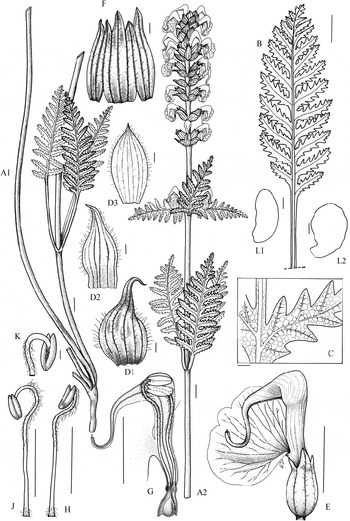
A Pediculare bipinnatifida (Pennell) R.R.Mill (P. pectinata subsp. bipinnatifida Pennell) galeae parte inferiore longiore partem antherigeram fere duplo longiore haud subaequanti, inflorescentia laxiore differt. – Type: Nepal. Mid-Western, Karnali Zone. Jumla District, Ratamata, Chakure Lekh, 12,500 ft, open grassy slopes, 13 viii 1952, Polunin, Sykes & Williams 412 (holo E; iso BM, illustrated on Plate 15 in Yamazaki, Reference Yamazaki, Ohba and Malla1988, as Pedicularis pectinata subsp. palans). Fig. 1.
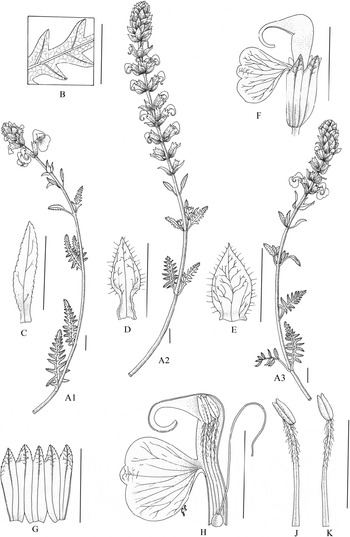
Fig. 1.Pedicularis yamazakiana R.R.Mill. A1, lower part of plant. A2, upper part of plant including inflorescence. B, lamina of basal leaf. C, leaf venation. D1–D3, inflorescence bracts: D1, bract from lowest part of inflorescence; D2, bract from middle of inflorescence; D3, bract from top of inflorescence. E, calyx and corolla. F, calyx dissected out. G, corolla (longitudinal section). H, posterior stamen. J, anterior stamen. K, anterior stamen showing filament attachment. L1 and L2, immature ovules. Each with scale. Drawn from the holotype (Polunin et al. 412, E) by Gülnur Ekşi. Scale bars: A, B, E, G, H, J = 1 cm; C, D, F, K = 1 mm; L = 0.1 mm.

Pedicularis pectinata Wall. ex Benth. subsp. palans sensu Yamazaki, Revis. Pedic. Nepal 123–124 (1988) non P. pectinata var. palans Prain, J. Asiat. Soc. Bengal 58(2,3): 255 (1889).

Erect perennial herb from short rootstock. Stems 30–60 cm, unbranched, pilose with lines of cream eglandular hairs, and with numerous white dots all over stem surface. Basal leaves clustered from crown; petiole 100–110 mm, longer or slightly shorter than lamina; lamina oblong-elliptic to oblong in outline, 65–120 × 20–35 mm, 3.5–4 × as long as wide, pinnatisect, segments 13–15 each side of rachis, alternate to subopposite (the lowest 3 or 4 more distant and clearly alternate), pinnatifid; lobules triangular, untoothed, tapered to acute tip; upper surface pilosulous along midrib groove, otherwise glabrous, lower surface glabrous, paler than upper but with network of darker veinlets. Cauline leaves in 2–3 whorls of 3, ± patent or ascending; petiole short, slightly flattened and expanded at base, lamina ovate to ovate-triangular in outline, pinnatisect with 11–13 pairs of segments, otherwise similar to basal leaves. Inflorescence a terminal raceme, 50–100 × 20–40 mm, of 7–12 whorls of flowers, opening from below; flowers mostly opposite, some in whorls of 3, the lowest few becoming distant. Bracts red or reddish-green, lower ones narrowly oblong-lanceolate, 9–12(–27) × 2–5(–6) mm, abruptly narrowing near middle to a caudate apex, entire or the very lowest ones crenate-pinnatifid; middle and upper bracts shorter, more broadly ovate, 7–9.5 × 3.3–6.5 mm, pinnatifid distally but entire proximally, patent-pilosulous on margins of entire proximal portion. Calyx ovoid to ovoid-campanulate, 9–12 mm overall, slightly curved but lacking an anterior split; tube 7–10 mm, heavily purple-tinged and with darker veins, eglandular-pilose on veins; teeth 5, triangular-lanceolate to lanceolate-oblong, unequal, 1.5–2.5 × 1–1.5 mm, purplish-tinged like tube, glabrous, apex shortly aristate. Corolla 25–30 mm; tube dark magenta, cylindrical from a greatly expanded bell-like base, c.9 mm, scarcely longer than calyx, dilated distally, glabrous externally; lower lip 3-lobed, magenta with a whitish or paler magenta patch at base, c.12 × 15 mm, the middle lobe small (c.3 × 4.5 mm), semicircular, firmer than laterals and slightly cup-shaped, not stipitate; laterals c.10 × 5 mm, entire, glabrous; galea dark wine-red, its lower part c.8 mm, longer than anther case, anther case c.5 × 3.5 mm, tapered distally into beak; beak c.13 mm, porrect proximally then coiled downwards and inwards, finally becoming sigmoid or question-mark-shaped, truncate at apex with stigma slightly exserted. Stamens inserted at base of corolla tube above ovary; all filaments pubescent at base, glabrous in middle part, the anterior pair villous distally but glabrous immediately below the anthers, the posterior pair villous distally as far as the anthers. Anthers ellipsoid, rounded at base, acute at apex. Ripe capsule and seeds not seen; immature ovules irregularly reniform without obvious ornamentation.
Distribution. Endemic to western Nepal.
Habitat and ecology. Open grassy slopes; 3200–3960 m.
Proposed IUCN conservation assessment. Endangered (EN B1ab(iii)). The estimated EOO is about 1200 km2. Within this area it is only known from three subpopulations and locations that are centred on Jumla; the flora of both Jumla district and the neighbouring district of Humla is known to be suffering continued loss of biodiversity due to habitat degradation. Causes include forest clearance, over-grazing and human population increase (Subedi, Reference Subedi1998).
Additional specimens examined. Nepal. Mid-Western, Karnali Zone, Jumla dist.: Maharigaon, 10,500 ft, 15 vii 1952, Polunin, Sykes & Williams 184 (E), Bhurchula Lekh, near Jumla, 13,000 ft, 13 vii 1952, Polunin, Sykes & Williams 4619 (E).
This new species is named in honour of the late Takasi Yamazaki (1921–2007), long-time specialist on Pedicularis and other Scrophulariaceae, and author of the current revision of the Nepalese species of Pedicularis (Yamazaki, Reference Yamazaki, Ohba and Malla1988). In that work, he treated this entity under the name Pedicularis pectinata subsp. palans although noting that the Nepalese material differed in some characters, including glabrous calyx with aristate-acuminate teeth. His description of the filaments as being entirely glabrous is incorrect; they are all villous at their apices below the anthers, as shown in his illustration (Yamazaki, Reference Yamazaki, Ohba and Malla1988: fig. 9). While being drawn for this paper, however, it was noticed that the anterior and posterior pairs differ in that in the anterior filaments the hairs stop short of the anther while in the posterior pair the filaments are hairy right up to the anthers. These Nepalese specimens are distinct from other material of the Pedicularis pectinata group although they clearly belong to that group rather than to the group of taxa centred on P. pyramidata, by virtue of the fact that the corolla tube is expanded at the base and hardly longer than the calyx. They resemble Pedicularis bipinnatifida in having cauline leaves in whorls of 3; as in that species the cauline leaf petioles are flattened and expanded at the base but the degree of flattening and expansion in P. yamazakiana is much less. Pedicularis bipinnatifida has a denser inflorescence whereas that of P. yamazakiana is lax like that of typical P. pectinata though not as lax as in P. staintonii from the Khyber Pakhtunkhwa Province of Pakistan. In floral characters Pedicularis yamazakiana is very similar to P. bipinnatifida except for the much longer lower part of the galea, which is almost twice as long as the anther case, instead of subequal to it. Pedicularis bipinnatifida occurs in Pakistan (Khyber Pakhtunkhwa), Kashmir and NW India (Himachal Pradesh); it is absent from Nepal, reaching its southeastern limit in Bashahr (Himachal Pradesh).
6. Pedicularis staintonii R.R.Mill, Edinburgh J. Bot. 67: 187 (2010). – Type: Pakistan (Khyber Pakhtunkhwa Province): Chitral district, Chumarkhan Pass E of Mastuj, on open slopes, 12,000 ft, 15 vii 1958, J.D.A. Stainton 2897 (holo E; iso RAW, BM [excluding one detached inflorescence of Pedicularis pyramidata also mounted on the sheet]). Fig. 2.
Pedicularis staintonii R.R.Mill. A, base of plant with basal leaves. B, C, upper parts of two stems with inflorescences. D, leaf venation. E, calyx and corolla. F, calyx opened out. G, corolla (longitudinal section). H, beak of galea. J, posterior stamen. K, anterior stamen. L, fruiting calyx and capsule. M, capsule. N, seed. Each with scale. Drawn from the holotype (Stainton 2897, E) by Gülnur Ekşi. Scale bars: A–C, E, G = 1 cm; D, F, H, J–N = 1 mm.

Perennial herb. Rootstock short and stout, roots not fleshy. Stems 25–60 cm or more, ascending or suberect, 2–6 or more per plant, unbranched, glabrous below, with 4 lines of very short white pubescence above. Basal leaves clustered, numerous, though often not always present at anthesis, not persisting till fruiting; petiole slender, 60–80 mm, equalling or shorter than lamina; lamina oblong, oblong-ovate, narrowly oblong or linear-oblong in outline, with unwinged rachis, 70–130 × 16–25 mm, 4.1–5.6 × as long as broad, pinnatipartite, segments 13–19 pairs, oblong or upper ones ovate, weakly pinnatifid to crenate, upper ones subentire, tips white-chondroid; both surfaces glabrous but lower surface white-furfuraceous on reticulate veinlets. Cauline leaves in whorls of 4, held erect or narrowly patent; petiole 10–15 mm, shorter than lamina, not laminar or expanded but node ± swollen and petiole bases forming incomplete girdle round stem; lamina narrowly oblong to oblong-ovate in outline, 35–80 × 4–12 mm, 5–11 × as long as broad, pinnatisect or pinnatipartite; segments 6–19 pairs, ± alternate, oblong or ovate-oblong, otherwise similar to basal leaves. Inflorescence a pyramidal raceme opening from below, flowers in whorls of 4, the lower whorls always remote at anthesis, the upper ones condensed, whole inflorescence denser in fruit (on evidence of single fruiting specimen) on account of swollen calyces. Bracts oblong-elliptic, obtuse or subacute, 9–12 × 2.5–3 mm, entire, or crenate distally, surface loosely white-hirsute in proximal 2/3, distal 1/3 pinkish-tinged and glabrous. Calyx campanulate, not inflated, somewhat curved, 7–9 mm; tube 5–6 mm, tinged pinkish-red with darker veins, glabrous, not cleft anteriorly; teeth 5, unequal, 1–2.5 mm, the posterior narrow, the anterior ones deltoid, the laterals ovate-triangular, all ending in a short, robust mucro, green with paler, ± pinkish edges and minute ciliate on margins. Corolla pinkish; tube subequal to and scarcely exserted from calyx, cylindrical with expanded base, glabrous outside but hairy inside near insertion of anthers; lower lip 3-lobed, stipitate at base, 11–13 × 11.5–14 mm, longer than galea, its middle lobe 2.5–3 × 2.5–3 mm, not stipitate, the lateral lobes 9–9.5 × c.5 mm, the margins of all lobes entire, glabrous; galea darker than lower lip, its lower part 2.5–3 mm, anther-bearing part 4–5 × 2.5–3.5 mm, beak 8–11 mm, decurved and coiled inwards, gradually straightening with age. All filaments densely pubescent at sac-like points of insertion and sparsely so for short distance above, glabrous in middle portion and densely white-hirsute in distal half; anthers subacute at base. Capsule ovoid, scarcely exserted from calyx, deep brown, c.9.5 mm. Seeds whitish with blackish base and tip, irregularly narrowly ellipsoid, 3.1–3.2 × c.1.2 mm, testa lacking longitudinal ridges but with very large open reticulum, the lumina large with narrow walls. Flowering mid-June to mid-August; fruiting September.
Distribution. Endemic to Pakistan (Chitral district of Khyber Pakhtunkhwa Province and neighbouring parts of Gilgit-Baltistan).
Habitat and ecology. Often occurs at the foot of glaciers, and on peaty soil beside streams and on open rocky slopes; 3100–4300 m.
Proposed IUCN conservation assessment. Endangered (EN B1ab(iii)). This species is known from three disjunct locations with the type locality to the southwest of the main centre of distribution and Polunin’s collection from the Gharesa Glacier being disjunct to the east. These disjunctions may however be due to insufficient collecting in this very inhospitable terrain. The main centre of distribution is the glaciers to either side of the Yasin and Yarkhun valleys. Global warming is likely to result in further retreat of the glaciers combined with decreasing precipitation; temperature is projected to increase by 2–4°C by 2050 and by 4–7°C by 2090 while corresponding projected changes in rainfall are –5 to +5 mm (2050) and –50 to –150 mm (2090) (Globalis, accessed 11 August 2010). These projected changes in climatic parameters are likely to pose a threat to the species in the longer term.
Additional specimens examined. Pakistan.Gilgit-Baltistan: d. Ghizar, Darkot, 10,200 ft, 18 vi 1976, Bowes Lyon 8103 (K, RAW 48578); Ishkoman Pass, 13,000–14,000 ft, viii 1954, Schmid s.n. (RAW 30801). Barum Bar glacier c.40 miles W of Yasin, 14,000 ft, 18 viii 1975, D.J. Broadhead 7808 (RAW 47681). d. Gilgit, Gharesa Glacier, N-facing slope 12 miles E of Nagar, 12,750 ft, 14 viii 1960, O. Polunin 6262 (E). Khyber Pakhtunkhwa: Malakand Div., d. Chitral, Tirich Valley, above base camp, 3620 m, 12 ix 1984, W.J. Gudenberg 57 (K). Yarkhun, 36°30′N, 72°40′E – 36°48′N, 73°05′E, 10,500 ft, 21 vi 1958, S.A. Bowes Lyon 981 (E). Thui region c.200 km NW of Gilgit near watershed separating the Gilgit Agency from Chitral, 4265 m, 22 vii 1975, D.J. Broadhead 17 (E).
Named after Adam Stainton (1921–1991), plant collector in the Himalaya, especially of Nepal and Pakistan, and (co)author of Flowers of the Himalaya (Polunin & Stainton, Reference Polunin and Stainton1984, reissued 1997) and its Supplement (Stainton, Reference Stainton1988, reissued 1998).
All the material of this recently validated species was previously named as Pedicularis pectinata. However, it does not match the type or agree with other specimens of Pedicularis pectinata from NW India, differing in numerous characters. The narrow, oblong leaves, always more than 4 times as long as wide, and especially the very large lumina of the seed testa are very characteristic. The flowers and cauline leaves are in whorls of 4, not 3 as in nearly all specimens seen of Pedicularis pectinata.
7. Pedicularis murreeana R.R.Mill & R.Bone, Edinburgh J. Bot. 67: 187 (2010). – Type: Pakistan: Khyber Pakhtunkhwa: d. Abbottabad, Changla Jali, Murree Hills, 8000 ft, sunny cliffs, viii 1948, R.R. Stewart 23467 (holo K). Fig. 3.
Pedicularis murreeana R.R.Mill & R.Bone. A1–A3, inflorescences: A1, young; A2, slightly older; A3, mature. B, leaf venation. C–E, bracts of inflorescence: C, bract from lowest part of inflorescence; D, bract from middle part of inflorescence; E, bract from top of inflorescence. F, calyx and corolla. G, calyx opened out. H, corolla, stamens and style (longitudinal section). J, posterior stamen. K, anterior stamen. Each with scale. All drawn by Gülnur Ekşi from Fleming 328 (E) which is a slightly atypical specimen. Scale bars: A–H, J, K = 1 cm.

Pedicularis pectinata Wall. ex Benth. subsp. palans sensu Pennell, Monogr. Acad. Nat. Sci. Philadelphia 5: 133 (1943, as comb. et stat. nov. based on Pedicularis pectinata var. palans Prain), non P. pectinata var. palans Prain, J. Asiat. Soc. Bengal 58(2,3): 255 (1889) and Ann. Bot. Gard. Calcutta 3: 130 (1890).
Perennial from short woody rootstock. Stems 13–30(–57) cm, simple or sometimes branched in inflorescence, 1 or few per plant, glabrous below, with 2–4 lines of short pubescence above and usually shortly hirsute all round (sometimes only in lines) along inflorescence axis. Basal leaves clustered; petiole 20–70 mm, shorter than lamina; lamina ovate-triangular to oblong in outline, pinnatisect, 40–75 × 15–22 mm, 2.6–3.4 × as long as broad, with 8–11 pairs of segments; segments pinnatipartite with usually 5–6 pairs of subopposite, sharply dentate lobules; both surfaces glabrous. Lower cauline leaves opposite, upper ones in whorls of 3, all petiolate (petiole shorter than lamina); lamina of middle ones 22–70 × 12–25 mm, ovate-oblong to ovate-lanceolate in outline, pinnatisect with 8–16 pairs of subopposite to alternate segments; segments pinnatipartite; both surfaces glabrous. Inflorescence (35–)50–150 × 18–36 mm, of (3–)6–14 pairs of opposite flowers, each pair well spaced from the ones above and below with internodes longer than calyces. Lower bracts oblong-lanceolate, upper ones more broadly lanceolate or lanceolate-elliptic, the lower ones slightly longer than the calyx and the other ones subequalling it; lower portion of bract flattened and laminar, entire, the upper portion broader and pinnatifid (lower bracts) or irregularly lobed or dentate or ± entire (middle and upper ones), all shortly pilose on midrib and teeth of margins. Calyx cylindrical-campanulate, slightly curved, not inflated, greenish with darker ribs, 9–11 mm; tube cleft to 1/3 anteriorly, with hairs along the veins; posterior tooth very small and linear, laterals triangular and subacute, largest, anterior lobes slightly smaller than laterals but similar in shape. Corolla pale mauve with tube and basal parts of lower lip white or still paler mauve, 21–26.5 mm; tube 9–10.5 mm, shortly exserted from calyx, cylindrical with expanded base, glabrous; lower lip 3-lobed, 9.5–11.5 × c.11.5 mm, the lateral lobes 6–7 × 4–5.5 mm, the middle lobe 2.2–2.5 × 2.2–3 mm, suborbicular, all lobes glabrous and not papillate on their weakly undulate margins which are proximally sometimes more distinctly denticulate; galea darker mauve than rest of corolla, its erect lower part 3.5–5 mm, the anther-bearing part 2.5–3.5 × 2.5(–3.5) mm; beak of galea (4.5–)5.5–8.5(–9) mm, its proximal part morphologically porrect but pointing downwards, its distal part coiled inwards to form a semicircle, truncate at the apex. Filaments densely pubescent at base, densely villous in distal half but glabrous in between; anthers yellow, subacute at base. Capsule broadly ovoid, slightly shorter than fruiting calyx, 8–9.5 × 4.5–5.5 mm, dark brown. Seeds not seen.
Distribution. Endemic to Pakistan (Punjab and adjoining Khyber Pakhtunkhwa Provinces: Murree Hills). Changla Gali, the type locality, is just over the border in Abbottabad district of Khyber Pakhtunkwa Province, although the grid reference ‘C-7 Rawalpindi’ was used in the protologue (Mill, Reference Mill2010).
Habitat and ecology. Sunny cliffs and rocky places; 1980–2440 m.
Proposed IUCN conservation assessment. Endangered (EN B1ab(ii,iii,iv,v)). Known from a single location, the Murree Hills. The EOO is estimated to be about 250 km2. The lower slopes of the Murree Hills below c.2500 m have suffered extensive deforestation and this has resulted in severe erosion to the steeper slopes (Ellis et al., Reference Ellis, Taylor and Masood1994). Much of the deforestation is due to illegal felling that is difficult to police, especially in winter. Replanting efforts are hindered by the area falling within two different administrative units. The Murree Hills sustained the pressure of tourism, which began under British colonial rule, until 1985 when an all-weather road was built resulting in year-round tourism and a multiplication in the number of hotels (Haroon, Reference Haroon2002). These factors will have greatly reduced the available habitat for the species. Only two post-1950 collections have been seen, suggesting that the population size has already been severely depleted. Precipitation in the area is projected to increase by 100–950 mm per annum by 2050 and 100–2200 mm per annum by 2090 (Globalis); this will serve to increase the amount of erosion.
Additional specimens examined. Pakistan. Province uncertain (probably Punjab): Murree Hills, Miss E.M. Saunders s.n. (K). Khyber Pakhtunkhwa: d. Abbottabad, Murree Hills, Changla Gali, 7500 ft, 19 viii 1949, R.R. Stewart s.n. (RAW 30642). Punjab: d. Rawalpindi, Ghora Gali, Murree Hills, 7000 ft, 3 x 1931, R.R. Stewart 12419 (RAW). Ghora Gali etc., 6500 ft, x 1936, Mohindar Nath s.n. (RAW 30465). Upper Topa (Murree Hills), ix 1920, J.H. Barbour s.n. (BM). Murree, 26 vii 1851, A. Fleming 328 (E, K). Murree, 1 x 1955, A. Majid 73 (RAW 30637). Murree Hills, Patriata, 7000 ft, 1 viii 1970, M.A. Siddiqi & Y. Nasir 6044 (KUH, RAW 45713).
Pennell (Reference Pennell1943) treated this taxon as Pedicularis pectinata var. palans but his interpretation of that taxon was flawed, as discussed above. He only cited one specimen under his ‘var. palans’ (Stewart 12419 at PH, not seen by me although I have seen a duplicate of that number conserved at RAW; see citation above and discussion below) and he considered this to represent a local taxon of the Murree Hills. He speculated that Prain’s var. palans might have been founded upon material collected by T. Thomson on a side trip to somewhere near the Murree Hills, although he pointed out that there was no documentary evidence, such as on Thomson’s maps, to support such speculation. Nevertheless he held the view that Pedicularis pectinata subsp. palans was probably collected in the Murree Hills because of the combination of the epithet palans (meaning ‘straggling’) and a long inflorescence – this last because of the ‘allusion [in Prain’s account] to the description of Pedicularis pectinata pyramidata in Hooker’s Flora of British India (4: 306, 1884) where the most distinctive character is “spikes sometimes 1 ft long”.’ There are no grounds to support any of this speculation; indeed, neither the single specimen Pennell cited under his concept of ‘subsp. palans’ nor any of the others I have seen have either a straggling habit or spikes 30 cm long. The only members of Pedicularis ser. Tenuirostres to have spikes reaching 30 cm or more are P. tenuirostris itself, which is very distinct and not confusable with any of the other species of the series, and P. multiflora Pennell. Very likely the plants mentioned in Hooker’s Flora of British India as having inflorescences a foot long were specimens of Pedicularis multiflora. It appears that Pennell simply misunderstood what Pedicularis pectinata var. palans of Prain (Reference Prain1889) actually was. As indicated above I have lectotypified that name by a T. Thomson specimen from Kishtwar, Kashmir. Since Pennell’s revision, more material of this Murree Hills taxon has been collected and all of it shows several distinct, constant differences from Pedicularis pectinata, including weakly undulate corolla lower lip, calyx tube cleft anteriorly, and much laxer inflorescence (more recalling that of P. stewartii Pennell). Accordingly Pennell’s taxon is recognised here as a distinct entity and given the rank of species because of the differences in calyx and corolla. It has a very restricted distribution, being endemic to the Murree Hills, chiefly in Rawalpindi district of Punjab Province but extending into neighbouring Abbottabad district of Khyber Pakhtunkhwa. The single specimen of this taxon seen by Pennell (Stewart 12419) has not been chosen as type since the only duplicate of it seen (conserved at RAW and determined by him as Pedicularis pectinata subsp. palans) does not show the essential characters of the species as well as some of the other ones that have been collected since. It is one of the latest-flowering members of the series, if not the genus as represented in Pakistan, continuing to bloom until well into October.
Fleming 328 (E, illustrated here) is somewhat different from the rest of the material but is nevertheless assigned to Pedicularis murreeana.
8. Pedicularis pyramidata Royle ex Benth., Scroph. Ind. 52 (1835). – Pedicularis pectinata Wall. ex Benth. var. pyramidata (Royle ex Benth.) Hook.f., Fl. Brit. India 4: 306 (1883). – Pedicularis jainii Aswal & Mehrotra, J. Econ. Taxon. Bot. 4: 1027 (1983), nom. superfl. (see discussion). – Type: [Kashmir] ‘Hab. in Himalaya versus Cashmere’, Royle (holo LIV, from Pir Panjal; iso K).
Pedicularis tenuirostris sensu Aitchison, J. Linn. Soc., Bot. 18: 84 (1880) & 19: 181 (1882), non Benth. (1835).
Perennial with stout rootstock from crown. Stems (1–)several, (15–)20–60(–70) cm, erect or ascending, simple below inflorescence, sometimes there with 1 or more side branches, shortly white-pubescent in lines, sometimes nearly glabrous. Basal leaves several, clustered; petiole 35–120 mm, shorter or longer than lamina; lamina elliptic-ovate in outline, 25–85(–140) × 8–30 mm, pinnatisect to pinnatipartite, glabrous on both surfaces, net-veined beneath; segments 7–15 pairs, narrowly oblong or narrowly elliptic, pinnatifid. Cauline leaves in whorls of (2, 3 or) 4; nodes usually 2 or 3; petiole 5–40 mm, equalling or shorter than lamina, not expanded towards base but rachis ± winged; lamina 25–80 × 5–35 mm, ovate-elliptic in outline, pinnatisect or pinnatipartite or bipinnatisect or bipinnatipartite; segments 12–19 pairs, linear-lanceolate to linear-oblong, 5–20 mm, dentate or dentate-lobed. Inflorescence a terminal raceme (or several racemes), 45–100(–120) × 25–50 mm excl. galea beaks; whorls 3–13, 4-flowered, the lower whorls ± distant; axis white-villous or -pubescent in 4 lines. Bracts lanceolate, 6–20 × 2.5–5.5 mm, entire, gradually attenuate to apex, sparsely ciliate proximally but glabrous distally. Calyx ± inflated, ovoid, 8–12 mm; tube (6–)7–10 mm, whitish with 5 dark veins to apices of lobes and 5 narrower ones to sinuses, not split anteriorly, loosely pilose on veins; teeth 5, ovate-lanceolate, acute, 1–2.5 mm. Corolla 30–35 mm, purple with darker galea; tube narrowly cylindrical, 8–12 mm, glabrous; lower lip stipitate at base, 3-lobed, 10.5–15.5 × 9–16 mm, middle lobe semicircular to suborbicular, (1.5–)2–3.5 × (2.2–)2.5–4.5 mm, laterals 8–10 × 4–7 mm, entire, glabrous; galea dark purple, lower part 1.5–2.5 mm, anther-bearing part 4–4.5 × 2.5–3 mm, beak 12–17 mm, porrect then coiled downwards forming a circle, often with an out-turned question-mark-shaped tip, glabrous. Stamens inserted at top of corolla tube; all filaments hirsute distally but otherwise glabrous; anthers ovoid, blunt apically and basally. Capsule broadly ovoid, shortly apiculate, dark chestnut, 13–14 × 7–9.5 mm, scarcely exceeding calyx. Seeds irregularly ovoid-ellipsoid, 4–4.5 × 1.5–2 mm, testa with 8–9 rows of reticulations per side, lumina square, shortly rectangular or pentagonal.
Distribution. NE Afghanistan, Pakistan (Gilgit-Baltistan, Khyber Pakhtunkhwa, Azad Kashmir), Kashmir, NW India (Himachal Pradesh, Uttarakhand).
Habitat and ecology. Betula /Abies forest, Salix scrub, alpine pastures and hillsides, and by springs, streams and margins of rice fields; 2100–4900 m.
Proposed IUCN conservation assessment. Least Concern (LC). Probably the most widespread and abundant species of the whole series, with a vast EOO more or less throughout the western Himalaya stretching from NE Afghanistan to Uttarakhand in NW India. However, some subpopulations are threatened, for example by the construction of the Kishenganga Dam, the effect of which will be to dry up the valley of the Kishenganga in Azad Kashmir.
Additional specimens examined. Afghanistan. Takhar: Khost-o-Ferang, mittleres Echani-Tal, 2800 m, 17 vii 1965, D. Podlech 11835 (E). Kapisa: oberes Panjir-Tal, Jishta (Parian), 2800 m, 11 viii 1965, D. Podlech 12290 (E); oberes Panjir-Tal, 6 km oberhalb Kar-Petan, 3100 m, 17 viii 1965, D. Podlech 12474 (E); Panjir-Tal, Darrahi-Zuria, nördlich Safed Jir, 3100 m, 24 viii 1965, D. Podlech 12562 (E). Badakhshan: oberes Anjuman-Tal, Umgebung des Ortes Anjuman, 3100 m, 14 viii 1965, D. Podlech 12364 (E). Parvan: Panjshir Valley, Mudani, 2500 m, 16 vii 1962, I. Hedge & P. Wendelbo W. 5113 (E). Pakistan. Gilgit-Baltistan: d. Gilgit, Jutial Nullah, 1 viii 1954, R.R. Stewart 22635 (BM, RAW). Haramosh Range, 36°N, 75°E, Mani Basin, 12,300 ft, viii 1957, R.C. Culbert 20 (BM). d. Skardu, Biafo Glacier, right bank, 13,500 ft, 5 ix 1939, R. Scott-Russell 1799 (BM); Ghandakoro Glacier, 13,500 ft, 14 vii 1955, E. Nasir & G.L. Webster 6103 (RAW 30658); Makerum, Hispar Glacier, 12,500–13,500 ft, 2 viii 1939, R. Scott-Russell 1420 (BM); Hispar Glacier, left bank, Turmun Makerum, 11,000–11,500 ft, 18 vii 1939, R. Scott-Russell 1228a (BM); Kero Lugma Glacier, left bank, 14,500 ft, 24 vii 1939, R. Scott-Russell 1273 (BM); Skardu, Hushe Tal, 7 viii 1970, Österreichische Karakorumexpedition 1970, s.n. (K); Thalle La, 16,000 ft, 28 viii 1930, J.R. Graham s.n. (RAW). Satpura La, 14,000–15,500 ft, 1 viii 1940, R.R. Stewart 20207 (RAW, GH n.v.). Burzil Pass, N. slope, 12,000 ft, 1 viii 1946, R.R. Stewart 22087 (K); Thale La to Bagmahardl, NE of Skardo and Shigar, 30 viii 1856, Schlagintweit 5965 (E, GH n.v., isoparatype of P. kashmiriana var. ornata). Sokha Glacier, right bank, 15,000 ft, 21 viii 1939, R. Scott-Russell 1622 (BM). Skardu, 23 ix 1958, J. Mohd 112 (RAW 30873). Khyber Pakhtunkhwa: Malakand Div., d. Chitral, otherwise unloc., Toppin 617 (K); Golen Gol, 36°01′N, 72°10′E, 10,000 ft, 13 vii 1958, Bowes Lyon 66 (BM, E). Hazara Div.: d. Mansehra, Kagan Valley, 9000 ft, 18 vii 1896, Inayat 20000 (E); Kaghan Valley, Naran, 7800 ft, vi 1958, B.L. Burtt & Ali B.821 (E). d. Swat: Bishigram Valley, 11 vii 1953, R.R. Stewart & A. Rahman 25030 (RAW 30659); above Utror, in forest, 8000–9000 ft, 21 vii 1953, R.R. Stewart & A. Rahman 25255a (RAW); ibid., same details, R.R. Stewart & A. Rahman 25255 (BM); Sho Nala, 8000–9000 ft, 24 vii 1953, R.R. Stewart & A. Rahman 25197 (BM, RAW); ibid., R.R. Stewart & A. Rahman 25196 (BM, RAW); ibid., 21 viii 1955, A. Rahman 155 (BM). Azad Kashmir: Kishenganga valley, x 1954, J. Mohd s.n. (E). Kashmir. Otherwise unloc.: ‘versus Kashmir’, 1835, Royle (K, isotype). Marpu nullah, 12,000–13,000 ft, 3 vii 1892, Duthie 11784 (E, K; isoparatype of P. kashmiriana var. ornata); Suk nullah, Dras valley, 11,000–12,000 ft, 30 vi 1892, Duthie 11690 (BM, E; isoparatype of P. kashmiriana var. ornata). Erin valley near Bandapur, 11,000 ft, 24 vii 1940, Ludlow & Sherriff 7814 (BM, E). Gadsar, 12,000 ft, 11 vii 1977, Stainton 7916 (E); Gadsar Nullah, 11,000 ft, 16 viii 1940, P.M. Pinfold 328 (BM); Gandabal lake near Mt. Haramakh, 11,700 ft, 14 viii 1940, P.M. Pinfold 279 (BM); Gangerbal, 34°25′N, 74°58′E, 13,500 ft, 9 viii 1965, Stainton 5647 (BM); Khelanmarg, c.10,000 ft, 10 viii 1956, O. Polunin 56/131 (BM); Kolohoi valley, Pass 14,422 ft, 14,200 ft, 27 viii 1956, O. Polunin 56/541 (BM, E); Pahlgam, 10–11,000 ft, 28 viii 1945, R.R. Stewart 21809 (BM, RAW); Rajparyan Sanctuary, 11,000 ft, 23 viii 1943, Ludlow & Sherriff 9364 (BM); Shisha Nag, 12,000 ft, viii 1936, M.K. Timins 202 (BM); Sind valley, 34°20′N, 75°05′E, 7000 ft, 4 viii 1965, Stainton 5029 (BM); near Sinthan Pass, 10,500 ft, 8 vii 1939, Ludlow 206 (BM); Sonamarg, 9000 ft, 30 vi 1919, H.H. Rich 365 (BM); Sonamarg, 10,000 ft, 20 viii 1946, R.R. Stewart 22396 (RAW, GH n.v., NY n.v.); Sonamarg, 34°20′N, 75°20′E, 10,500 ft, 5 viii 1966, Stainton 5032 (BM); Sonamarg, 12,500 ft, 23 viii 1922, R.R. Stewart 7384 (K; beak unusually long); ad clivos graminosos supra Astan Marg in alv. Liddar flum., 12,000 ft, 11 vii 1902, J.R. Drummond 14239 (K; beak extremely long for the species); Thajwas, near Sonamarg, 11,500 ft, 13 viii 1940, Ludlow & Sherriff 7917 (BM); rock ledge on a NE facing bluff in the Nichina Valley c.22 km NW of Sonamarg, 3400 m, 27 vii 1987, C.C. Townsend 87/213 (K); Tulion above Pahlgam, 12,000 ft, 30 viii 1943, R.R. Stewart 21878 (K); Yamharu Pass, 13,000–14,000 ft, 13 viii 1893, J.F. Duthie 13564 (E); above Zaiwan, Sind valley, 11,000 ft, 29 viii 1956, O. Polunin 56/601 (E); Zojibal, 12,500 ft, 18 viii 1940, P.M. Pinfold 306 (BM). Ladakh, E of Parkachick Pass, 3180 m, Southampton Univ. Exped. 1980: 58 (K). Zanskar, Barai valley, Kishinganga, 30 vii 1935, Ludlow & Sherriff 1486 (E). India. Himachal Pradesh: Panji, Chenab Valley, 20 viii 1879, G. Watt 48 (E); Chumba State, 8500–9000 ft, viii 1879, G. Watt 48 (E). Lahul, Lot, 12,000 ft, 16 vi 1941, Bor 9742 (E); Sissu, 10,300 ft, 8 vii 1941, Bor 11910 (E); ibid., 10,100 ft, 5 vii 1938, Bor 12321 (E); Kyelang, 13 vii 1938, Bor 9233 p.p. (E); ibid., 10,000 ft, 20 vi 1941, Bor 14876 (E); Rotang, 14,000 ft, 11 vii 1941, Bor 9817 (E); Patseo, 12,000 ft, 3 vii 1941, Bor 13163 (E); unloc., J.L. Stewart s.n. (E p.p. mixed with P. cheilanthifolia s.l.); Koksin, 10,000 ft, viii 1916, Cooper 5206 (E); nr Pakhnuta, 9 ix 1895, J.R. Reid s.n. (E); route from Manali to Kali Hind Pass, 13,000 ft, ix 1987, G. Kirkpatrick 36 (E). Uttarakhand: Tehri-Garhwal, Rudugaira Gad, W side, 14,000 ft, 2 ix 1952, P.P. Huggins H28 (BM).
Aitchison’s uses (1880, 1882) of Pedicularis tenuirostris, which are listed in Index Kewensis (Jackson, Reference Jackson1895) and The International Plant Names Index (IPNI, 2010), have been treated as homonyms (‘P. tenuirostris Aitch.’) by some authors, for example Aswal & Mehrotra (Reference Aswal and Mehrotra1983). However, they should be regarded as misapplications. His specimen from Kurram Valley, ‘Afghanistan’ (now in Pakistan territory because of subsequent boundary changes), Aitchison 0, = 796 (K), was re-determined as ‘P. pyramidata subsp. kashmiriana (Pennell) Tsoong’ by P. C. Tsoong in 1950. In the later of the two publications, Aitchison himself (1882: 181) stated that a specimen ‘without number’ from Shend-toi had previously been distributed as Pedicularis tenuirostris ‘but it is not that species’.
Pedicularis jainii was proposed by Aswal & Mehrotra (Reference Aswal and Mehrotra1983) as a new name (nomen novum) for P. pyramidata Royle ex Benth. (1835) non Pallas ex Steven (Reference Steven1823). The authors mistakenly believed (possibly as a result of perusing Index Kewensis, which lists the name) that Pedicularis pyramidata Pallas ex Steven, Mem. Soc. Nat. Moscou 9: 46 (1823) was an earlier homonym which thus rendered the well-known name P. pyramidata Royle ex Benth. illegitimate. However, Steven’s original publication has been examined and it was found that he, at the end of his taxonomic account of Pedicularis comosa L., was simply quoting a manuscript name used by Marschall von Bieberstein in his herbarium. Hence, ‘Pedicularis pyramidata Pallas ex Steven’ is a nomen nudum that has no nomenclatural standing and is synonymous with P. comosa, the type of P. ser. Comosae Maxim. and totally unrelated to P. pyramidata Royle or any species of P. ser. Tenuirostres. Aswal & Mehrotra’s name Pedicularis jainii (also used by them in their 1994 Flora of Lahaul-Spiti) was consequently superfluous; the name P. pyramidata Royle ex Benth. is legitimate and should continue to be used for this species.
A specimen from Kamri Pass, 12,000–13,000 ft, 26 viii 1892, Duthie s.n. (K, DD n.v.), previously determined as this species, shows fusion of calyx teeth and may belong to Pedicularis multiflora.
9. Pedicularis kashmiriana Pennell, Monogr. Acad. Nat. Sci. Philadelphia 5: 137 (1943). – Type: Kashmir, 6 miles S of Karagbal, 8000 ft, 1 viii 1936, W. Koelz 9233 (holo US, photo seen; iso NY, photo seen).
Perennial. Roots stout, non-fleshy. Stems 20–80 cm, ascending to usually ± erect, unbranched below inflorescence but often with several side branches in inflorescence, with 4 lines of whitish pubescence throughout or glabrous below. Basal leaves clustered, almost always deciduous by anthesis (rarely persistent fide Pennell, loc. cit., but no specimens seen with basal leaves). Cauline leaves in whorls of 4 or sometimes opposite; nodes 3–5 or more; petiole 10–35 mm, shorter than lamina, not expanded proximally; lamina (30–)45–80(–90) × (5–)16–35 mm, elliptic-ovate in outline, pinnatipartite with (8–)11–15(–18) pairs of segments; segments linear to linear-lanceolate, 10–20 × 1.5–5 mm, dentate or dentate-lobed, the teeth often cuspidate and callused-margined; both surfaces glabrous, lower surface with darker veinlets. Inflorescence a terminal spike-like raceme, (70–)100–270 × (15–)20–35 mm; whorls (9–)11–25, 4-flowered, crowded but lowest ones often slightly remote; axis clad with whitish villous indumentum. Bracts lanceolate, 10.5–15 × 3.5–6 mm, slightly abruptly narrowed distally, entire, ciliate on broader proximal portion. Calyx ovoid, not inflated, (9–)10–12 mm; tube 7–9 × c.4.5 mm, greenish with darker veins, loosely villous on veins, slightly cleft anteriorly; teeth 5, subequal, ovate-triangular and 2–4 mm except for smaller subulate and cuspidate posterior one 0.5–2 mm. Corolla c.30–35 mm; tube purplish, narrowly cylindrical, 12–14 mm, glabrous; lower lip pinkish-purple or rose, ± stipitate at base, 3-lobed, spreading, 8–10.5 × 10⁻¹² mm, margins entire and glabrous, the middle lobe suborbicular, 1.5–2.5 × 2–2.5 mm, lateral lobes 7–8 × 4.5–5.5 mm; galea purple, darker than rest of corolla, lower part 2.5–3 mm, anther-bearing part 3.5–4.5 × 2.5–3 mm, beak 7–10.5 mm, slender, decurved, coiled and often question-mark-shaped at tip. Stamens inserted at top of corolla tube; all filaments distally hairy, otherwise glabrous. Capsule ellipsoid, 10–12 × 5–6 mm, valves ± equal. Seeds pale brown, ellipsoid or ovoid-ellipsoid, testa finely reticulate with c.15 rows/side of reticulations, the lumina small, square or shortly rectangular, relatively thick-walled.
Distribution. Restricted to Pakistan (Gilgit-Baltistan, Khyber Pakhtunkhwa, FATA, Azad Kashmir) and especially Kashmir. The localities cited by Pennell (Reference Pennell1943: 138) from Afghanistan (Kurram Valley) and Tibet (Nubra) are no longer in those territories.
Habitat and ecology. Moist open places; 1670–4100 m.
Proposed IUCN conservation assessment. Currently Least Concern (LC) since none of the criteria for threatened status are met at present. However, a significant part of the range of the species is likely to be very adversely affected by the construction of the Kishenganga Dam project.
Specimens examined. Pakistan. Gilgit-Baltistan: Gilgit, 1909, Toppin 1020 (K); 1 mile from Belmar village on way to Gilgit, 2 ix 1972, Qaiser & Ghafoor 5391 (KUH). Khyber Pakhtunkhwa (Hazara Division): Kagan Valley, 15 viii 1906, Inayat 19999 (BM). FATA (Kurram Agency): Kurrum Valley, Shendtoi, 9000–11,000 ft, 27 viii 1879, Aitchison 0 (E, K). Azad Kashmir: d. Muzaffarabad, Kishenganga valley and road to Nanga Parbat, Keran to Reshna, 5500 ft, 19 vii 1939, R.R. & I.D. Stewart 17708 (RAW 30582). Kashmir. Marpo La, descent to Dras, 12,000 ft, 10 viii 1946, R.R. Stewart 22331 (RAW 30575). Kolohoi valley, 12,000 ft, 27 viii 1956, O. Polunin 56/583 (BM); Kostorkut, 8 miles NW of Vishensar, 11,000 ft, 6 ix 1956, O. Polunin 56/707 (E); Minimarg, 2 viii 1946, R.R. Stewart 22106 (RAW 30574); Minimarg to Burzil Chowki, 9000–11,000 ft, R.R. Stewart 19809 (RAW 30676); Pahlgam to Aru, 8000 ft, viii 1927, R.R. Stewart 9489 (RAW 30580); Pahlgam, 10,000 ft, 10 viii 1945, R.R. Stewart 21926 (E); Kishenganga valley and road to Nanga Parbat, Keran to Reshna, 5500 ft, 19 vii 1939, R.R. & I.D. Stewart 17708 (RAW 30582); near Chillam, north slope, Burzil Pass, 11,000 ft, 31 vii 1946, R.R. Stewart 22019 (RAW 30578); Sallar (and Pahlgam etc.), M.A. Evershed s.n. (BM); Lambal, 8000 ft, G.S.C. Fuller 207 (K); Kero Lugma Glacier, left bank, 10,000–11,000 ft, 26 vii 1939, R. Scott-Russell 1349 (BM); Kunzalwan [Kazalwan], 7500 ft, 21 vii 1876, Clarke 29365B and 29367C (both BM); Liddar Valley, Kukarnag, Baranginala, 3 viii 1901, Inayat 25724a (K).
10. Pedicularis multiflora Pennell, Monogr. Acad. Nat. Sci. Philadelphia 5: 139 (1943). – Pedicularis pyramidata Royle ex Benth. subsp. multiflora (Pennell) P.C.Tsoong, Bull. Brit. Mus. (Nat. Hist.), Bot. 1: 22 (1955). – Type: [Kashmir]: along stream, Tangmarg, below Gulmarg, 7000 ft [2135 m], vii 1929, R.R. Stewart 10648 (holo PH n.v.; iso NY, photo seen).
Perennial. Roots stout, spreading, fleshy. Stems 35–120 cm, simple or frequently much-branched in inflorescence region, erect, ± angled, with lines of short pubescence, or subglabrous especially below. Basal leaves mostly withered by anthesis; petiole 100–125 mm, subequalling lamina; lamina elliptic in outline, 85–120 × 25–40 mm, pinnatisect; segments c.8–11 pairs (or more), narrowly oblong, pinnatifid with c.6 pairs of crenate, chondroid-tipped lobules, glabrous on both sides but white-furfuraceous and reticulate-veined beneath. Cauline leaves in whorls of 4 (rarely 5); petiole 5–25(–35) mm, much shorter than lamina; lamina 25–80 × (8–)15–30(–40) mm, ovate-triangular in outline, pinnatipartite with rachis narrowly winged; segments 9–15 pairs, linear-lanceolate, 10–20 × 1.5–2.5 mm, dentate-lobed or crenate-dentate, the teeth entire or denticulate, callose-cuspidate; surfaces glabrous or glabrate, the lower surface reticulate-veined. Inflorescence a dense spike-like raceme, sometimes interrupted below, the terminal one (55–)125–320 × 18–28 mm in flower, of (9–)11–30 whorls (the lower whorls somewhat disjunct), opening from below and rapidly maturing. Bracts lanceolate to ovate-lanceolate, sessile but slightly narrowed at truncate base, 9–12 × c.3.5 mm, entire throughout, tapered and purple-tinged at apex, densely and loosely villous on midline and margins below. Calyx 6.5–10 mm; tube 4.5–6.5 mm, light green (sometimes tinged violet) with 10 dark veins, glabrous, or loosely villous on veins only, cleft anteriorly; teeth 3 or 4 (by reduction from 5 by unequal fusion of lateral teeth), ovate to ovate-lanceolate, 1–2 mm, green (often heavily tinged violet), glabrous. Corolla c.22 mm, rose pink or pinkish-purple; tube cylindrical, straight, slightly broader at base, 6–8 mm, ± included in calyx, glabrous; lower lip 3-lobed, spreading horizontally, c.7–8 × 8.5–9 mm, the middle lobe rounded and 2 × 3 mm, the laterals c.6 × 3 mm, all entire and glabrous but ciliate on stipe at junction of labellum and galea; galea darker purple than rest of corolla but tip of beak noticeably paler, the lower part 2–2.5 mm, anther-bearing part 2–2.5 × 2.5 mm, beak 7–9.5 mm, upcurved and sigmoidally coiled from porrect base, usually glabrous [hairy on lower side, Ludlow & Sherriff 7949]. Stamens inserted near base of corolla tube (furrow absent); all filaments distally hairy but otherwise glabrous; anthers glabrous, cells acute at base. Capsule obliquely ellipsoid, 10–11 × 5–6 mm, glabrous. Seeds pale brownish-white, irregularly ellipsoid with constriction at one end, 2.2–3.2 × 1.1–1.3 mm, testa alveolate to reticulate, longitudinally ridged, the lumina of the reticulum narrowly transverse rectangular.
Distribution. Endemic to Kashmir, particularly the Kishenganga and Sind river systems and the area around Wular Lake near Srinagar.
Habitat and ecology. Open swampy places, stream-beds, etc.; 1670–2600 m.
Proposed IUCN conservation assessment. Vulnerable (VU B1ab(iii)). The EOO is estimated to be greater than 5000 km2 but less than 20,000 km2. Currently, this species is only known from three locations: in the Sind and Kishenganga river valleys and a single collection from near Gulmarg. The Kishenganga Dam project poses multiple major threats to the subpopulation in that location, including inundation of the valley, reduction of water flow below the dam, major environmental damage and probable increased seismicity as a result of construction of the tunnel that will divert the Kishenganga River underground, and increased water levels of Wular Lake (KEWA, 2010).
Specimens examined. Kashmir. Near Kail, 24 ix 1987, P. Ali, M. Qaiser & M. Ajmal Khan 556 (KUH 43486). Chorwan, 8500 ft, 22 vii 1940, R.R. Stewart 19630 (RAW, isoparatype originally named by Pennell ‘P. ciliata’, an unpublished manuscript name; PH n.v., paratype); Goorai, 8700 ft, 20 vii 1876, Clarke 29323A (K); Gund, Sind Valley, 6000–7000 ft, 15 viii 1940, Ludlow & Sherriff 7949 (BM, E; galea hairy on lower side); Kashmir Valley, 5500 ft, 21 vii 1977, Stainton 7965 (BM, E); Scinde Valley near Kangan, 6000 ft, 8 ix 1922, R.R. Stewart s.n. (K); Weyil, Sind valley, 5500 ft, 7 viii 1939, R.R. & I.D. Stewart 18088 (RAW 30613, isoparatype; GH n.v., NY n.v., PH n.v.); Kanzalwain [Kazalwan], 7500 ft, 21 vii 1876, Clarke 29367 (K). Other paratypes (cited by Pennell, Reference Pennell1943; not seen): Kashmir. Ganderbal to Kangan, Stewart 6230 (herb. not stated); Mamur, near Sonamarg, Stewart 6931 (herb. not stated); Sind Valley, Stewart 10062 (PH, RAW, US), 21337 (herb. not stated); near Srinagar, Schlagintweit 4408 (GH, PH); Tangmarg below Gulmarg, Stewart 10556 (PH, RAW).
11. Pedicularis caeruleoalbescens Wendelbo, Nytt. Mag. Bot. 1: 57, t. 19 (1952, ‘caeruleo-albescens’). – Type: Pakistan (Khyber Pakhtunkhwa): Chitral District: Barum Gol, Zapotili on the western side of Main Barum Glacier, c.3400 m, 20 vii 1950, Wendelbo s.n. (holo O n.v.; iso BM, K).
Perennial. Rootstock stout, vertical, unbranched. Stems 18–30 cm, decumbent, ascending or suberect, unbranched, shortly and sparsely white-pubescent in 4 rows (hairs extremely short, scarcely 0.1 mm), glabrate below. Basal leaves numerous, clustered; petiole 15–20 mm, shorter than lamina, flattened, subglabrous; lamina narrowly ovate-lanceolate in outline, 30–70 (reported to 140) × 8–12 (reported to 17) mm, pinnatisect with broadly winged rachis (wings as broad as midrib); segments 6–9 pairs, linear to linear-ovate, pinnatifid or dentate (teeth whitish-chondroid), subglabrous but rather mealy above, glabrous beneath. Cauline leaves in whorls of 4 or opposite, distant; nodes 2 or 3; petiole 1–4 mm, shorter than lamina; lamina narrowly ovate, 10–15 × 2.5–7 mm. Inflorescence an interrupted spike; axis pilose; flowers whorled. Bracts ovate-rhombic, subequalling calyx, entire, pilose on margins and lower part of lamina, apex rounded but ending in a very short, blunt mucro. Calyx tubular, 7–7.5 mm, not distinctly split anteriorly; tube 4–4.5 mm, hyaline with 10 darker, pilose ribs; teeth 5, ovate, entire, subacute, 1–2 mm, unequal. Corolla c.25 mm, very pale blue or whitish-blue when fresh; tube c.7 mm, wholly included in calyx, glabrous; lower lip c.8 × 12 mm, margins entire and glabrous but surface microscopically white-papillate, the middle lobe much smaller than the laterals; galea slightly darker bluish, its lower part very reduced, the anther-bearing part c.3 × 2 mm, beak 6–7 mm, gently sigmoid, directed upwards with rounded or truncate tip. Stamens inserted immediately below middle of corolla tube; all filaments brown-pilose at base and in distal half, glabrous in between; anthers cream, thecae obtuse at base. Style c.25 mm. Capsule and seeds unknown.
Distribution and ecology. This taxon is endemic to Chitral (Tirich Mir) in Khyber Pakhtunkhwa Province where it is reported to be locally very abundant in alpine meadows at an altitude of c.3400 m. It has apparently only been collected once and its taxonomic status requires evaluation. Wendelbo’s protologue states that the radical leaves can be up to 14 cm long and 17 mm wide. There is no evidence of such large leaves on either of the isotypes or his illustration of the Oslo holotype, which appear to be the only specimens. He did, however, mention that the species also occurred at Owir Gol (Wendelbo, Reference Wendelbo1952: 58) but was not collected there. Therefore, his description could have been made partly on the basis of field observations of those plants; nevertheless, confirmation of the upper size limit for the leaves of this species is necessary. When dried, the galea at least appears dark purplish, as in other members of the Pedicularis pyramidata group.
Proposed IUCN conservation assessment. Endangered (EN B1ab(iii)). This species is only known from a single location encompassing the Barum Gol and its tributary the Owir Gol which flow east from the Barum Glacier on Tirich Mir. The EOO is estimated to be about 150 km2. At Barum Gol it was said (nearly 60 years ago) to be locally very abundant. However, since then the areas below have been heavily deforested which has had anthropogenic effects on the climate above the tree line, such as more unpredictable snowfall (in 2008/2009 the Chitral district had no snow: Khan, Reference Khan2009), melting of glaciers, and avalanches. Khan (Reference Khan2009) identified Owir Gol as a potential location for a hydro-electric power station. Were that to be developed, that part of the population would be lost.
12. Pedicularis cyrtorhyncha Pennell, Monogr. Acad. Nat. Sci. Philadelphia 5: 126 (1943). – Type: Pakistan (Khyber Pakhtunkhwa), Chitral District, Beori, Pustuson, 4000 m, 9 vii 1899, S.A. Harriss (holo DD n.v.).
Perennial. Rootstock vertical, unbranched or sparingly branched, ± stout, fleshy. Stems 6–40 cm, decumbent, ascending or suberect, unbranched, angled, shortly pubescent with 4 lines of hairs along angles, the hairs quite dense, c.0.2–0.3 mm. Radical leaves numerous, clustered, suberect or prostrate; petiole slender, to 40 mm, equalling or longer than lamina; lamina ovate-lanceolate to ovate in outline, apex obtuse or subacute, 15–50 × 10–15 mm, pinnatipartite with narrowly winged rachis and 5–9 pairs of segments; segments 3–5 × 1–3 mm, narrowly oblong to linear, dentate, the margins (especially of the teeth) often whitish-callose, both surfaces glabrous, the lower not reticulate-veined. Cauline leaves in whorls of 2 or 3, usually only 2(–3) whorls per stem; all shortly petiolate (petiole shorter than or subequalling lamina, those of uppermost leaves sometimes expanded and flattened), lamina similar in shape, dissection and indumentum to radical. Inflorescence a short to elongated raceme of up to 15 whorls (but sometimes far fewer), all aggregated or the lowest slightly remote, opening from base upwards; axis with 3 lines of short, white, crisped hairs. Bracts ovate to narrowly ovate or obovate, c.6 × 2 mm, apex acute but not mucronate, the lower ones larger and pinnately lobed, the upper smaller and more entire, margins entire or denticulate, lower ones villous-hirsute, upper ones glabrate or glabrous. Calyx ovoid-campanulate, 6–9 mm at anthesis, narrowly 10-ribbed, glabrous including ribs, without a distinct anterior cleft but (fide Pennell loc. cit.) ‘slightly more cleft medianly’; teeth 5, ovate, acute, the two largest narrowly oblong, c.3 × 0.7 mm, the laterals c.1.5–2 mm, the posterior very short but broad-based, triangular. Corolla c.17 mm; tube purple or pale purple, 6.5–10 mm, just exserted from calyx, glabrous; lower lip spreading, 8–10 × 12–14 mm, its margins entire, glabrous, the middle lobe small, c.2 × 1.5 mm; galea purple, glabrous, lower part c.5 mm, anther-bearing part 3–3.5 × 1.5–2.2 mm, abruptly decurved distally over c.130° and abruptly contracted into beak; beak (5–)6–7 mm, slender, slightly coiled, turned upwards and shaped like a question mark, truncate at apex. Stamens inserted towards base of corolla tube, just above the ovary; all filaments pubescent basally and densely hirsute distally, glabrous for most of length; anthers glabrous, thecae acute at base. Capsule ovoid, nearly symmetric, c.12 × 5 mm, tips of valves acute and slightly reflexed. Seeds pale cream, ovoid-elliptic, c.2 × 1 mm; testa very light, with strong longitudinal ridges and intervening reticulations.
Distribution. Apparently endemic to Pakistan (Khyber Pakhtunkhwa Province, Chitral and Dir districts). Recorded from along the Ashret Gol, Beori Gol, Drosh Gol and Purit Gol streams to the southeast of Drosh and from Arnawai to the west. Arnawai is extremely close to the border with Afghanistan so it is possible that the species also occurs in that country.
Habitat and ecology. Dry turf on hillsides; reported from 2000–4360 m by Pennell (Reference Pennell1943) and Wendelbo (Reference Wendelbo and Rechinger1981).
Proposed IUCN conservation assessment. Endangered (EN B1ab(ii,iii)). Known from several scattered sites in a relatively small area (EOO = approximately 700 km2) centred on Drosh (Chitral). One of the sites where it has been collected (Lowari) is currently the subject of a major construction site, the Lowari Tunnel, that opened temporarily during winter 2009/10 and is expected to open fully in 2012 (Chitral Today, 2010).
Specimens examined. Pakistan. Khyber Pakhtunkhwa: Malakand Div., d. Chitral, Drosh Gol, 35°33′N, 71°48′E, 11,000 ft, 31 vii 1958, S.A. Bowes Lyon 168 (BM, E); Drosh (Painogh), 35°33′N, 71°48′E, 11,500 ft, 31 xii 1958 (sic, but in full flower! probably meant to be 31 vii 1958 especially since locality same as Bowes Lyon 168), S.A. Bowes Lyon 175 (BM, E).
Neither the type nor the several paratypes from Khyber Pakhtunkhwa Province cited by Pennell (Reference Pennell1943) (Chitral, Arnawai [Arandu] Valley, Gatacre 17386; Chitral, Lowari Range, Gatacre 17389; Chitral, Purit Gol, Harriss s.n.; Dir, Mirga, Gatacre 17388; all DD) have been seen. The description is based on Pennell’s protologue and the two specimens cited above collected in Chitral by Bowes Lyon.
A doubtful species, known from few specimens, that might be better reduced to a subspecies of Pedicularis pyramidata. Weakly distinguished from typical forms of Pedicularis pyramidata by the fewer leaf segments and shorter beak of the galea, which in its length is similar to that of P. kashmiriana. The epithet has sometimes been incorrectly spelled ‘cyrtorrhyncha’ (e.g. Wendelbo, Reference Wendelbo and Rechinger1981: 207).
Acknowledgements
This work is partly based on an unpublished revision of Pedicularis ser. Tenuirostres by Ruth Bone as part of her course work for the MSc in the Biodiversity and Taxonomy of Plants (RBGE/University of Edinburgh, 2003). Gülnur Ekşi drew the excellent illustrations. Philip Thomas kindly helped with the IUCN conservation assessments. I am grateful to Patrick Kuss and an anonymous reviewer for their constructive reviews that have helped to improve the paper. To Rick Ree (Harvard University) and Patrick Kuss (Bern), who made available to me their unpublished draft large phylogenetic trees of Pedicularis, I am extremely grateful. The Royal Botanic Garden Edinburgh is supported by the Scottish Government’s Rural and Environment Research and Analysis Directorate.