Children with bilingual typical language development (BITLD) and children with specific language impairment (SLI) present similarities in their linguistic performance (e.g., vocabulary and verb inflections). These observed similarities (Paradis Reference Paradis2010) have led to an influx of studies exploring the sources of these similarities and pointing to areas of disparity aiming to dissociate the effects of SLI and bilingualism in bilingual children with SLI (BISLI). The intriguing link, explored in the Pierce et al. (Reference Pierce, Genesee, Delcenserie and Morgan2017) keynote, between early language experience and the development of phonological working memory (PWM) seamlessly ties into this discussion. Bilinguals, and particularly simultaneous bilinguals, it is claimed, experience an enriched linguistic environment in early childhood that is expected to enhance their PWM. By contrast, children with SLI are claimed to have a neurocognitive impairment that negatively affects their PWM. This commentary explores, first, how both age of onset (AoO) of bilingual exposure and the neurocognitive impairment associated with SLI impact PWM and, second, how this impact might be related to the observed similarities as well as evident differences that emerge from studies comparing children with BITLD to children with SLI (monolingual and bilingual).
Pierce et al. (Reference Pierce, Genesee, Delcenserie and Morgan2017) propose, following Baddeley, Gathercole, and Papagno (Reference Baddeley, Gathercole and Papagno1998), that “language acquisition is supported by the creation of adequate phonological representation within the phonological store” and delineate the ways in which differences in PWM might emerge. Special attention is paid to early experience in language acquisition in the first year of life, arguing for enriched language input for simultaneous bilinguals compared to impoverished language input for children with repeated occurrences of otitis media or with cochlear implants. Bilingual enriched input, they claim, leads to the establishment of phonological representation for two different phonological systems, which in turn is expected to enhance phonological processing in PWM. Degraded language exposure is expected to result in weaker phonological representations that lead to less efficient support for processing within PWM. This proposal implies (a) that an advantage in PWM is more expected for simultaneous bilinguals than for sequential bilinguals and, (b) if the linguistic intake of children with SLI is impoverished, it is expected to result in weakened PWM. These two implications are addressed below.
AoO OF BILINGUALISM AND PWM
Pierce et al. (Reference Pierce, Genesee, Delcenserie and Morgan2017) argue that enriched input is available early on for simultaneous bilingual children, but not for sequential bilingual children for whom the AoO of bilingual exposure marked by the onset of exposure to the societal languages (SL) is after the age of 2 or 3. Thus, PWM is expected to differentiate between simultaneous and sequential bilinguals in recall tasks that require phonological processing and the use of PWM, such as forward digit span (FWD), nonword repetition (NWR), and sentence repetition (SR). These tasks relay on processing in short-term memory, but vary in their reliance on representations stored in long-term memory (LTM) to varying degrees, with SR relying on LTM the most and FWD the least.
Following the argumentation in Pierce et al. (Reference Pierce, Genesee, Delcenserie and Morgan2017), one might expect that the environmental enrichment related with younger AoO yields PWM advantages in both the first language and the second language of simultaneous bilinguals. By contrast, with older AoO, the sensitive period for phonological development has been closed, so no impact is expected for sequential bilinguals. The authors address this issue, stipulating that extensive stimulation of PWM by the introduction of a new language might open a developmental window, enabling a bilingual advantage as well. The authors claim, however, that this advantage in sequential bilingual children depends on having several years of exposure to the second language and a minimal level of proficiency in the language. This latter claim questions the role of early exposure and raises the role of linguistic proficiency in the two languages.
Studies of the AoO usually focus on its impact on achievements in the SL, with very few studies exploring the impact of AoO on the heritage language (HL), and even fewer looking at both. Moreover, while language proficiency is often related to AoO, length of exposure, and amount of exposure, tasks that tap on PWM seem to be less sensitive to these variables (Chiat, Reference Chiat, Armon-Lotem, de Jong and Meir2015; Marinis & Armon-Lotem, Reference Marinis, Armon-Lotem, Armon-Lote-Lotem, de Jong and Meir2015). Armon-Lotem and Chiat (Reference Armon-Lotem, Chiat, Biller, Chung and Kimball2012) explored the impact of bilingual exposure on PWM using an NWR task in both languages of Russian–Hebrew bilingual preschool children compared with monolingual children. They showed that the sequential bilingual children were performing as well as their monolingual peers in both HL Russian and the SL Hebrew, despite a wide variation in AoO (SD = 17.9 months) and length of exposure (SD = 18.6 months) to the SL within the bilingual group. Moreover, a gap observed between the two languages in the bilingual group with a better performance in HL Russian was a gap between the Russian and Hebrew tasks, observed for monolinguals as well. This gap was traced to specific properties of each language that made it easier for both monolingual and bilingual speakers of Russian to handle longer words. This replicates Summer, Bohman, Gillam, Peña, and Bedore (Reference Summers, Bohman, Gillam, Peña and Bedore2010) findings for HL Spanish, and their proposal that the language difference resides entirely in the properties of the nonwords relative to properties of the target language rather than in language exposure. Another support for the language specificity of the performance on PWM measures comes from Thorn and Gathercole (Reference Thorn and Gathercole1999). They report a bilingual advantage for English–French bilingual children over monolingual English-speaking children on French NWR and digit span tasks, showing language-specific advantage in PWM, as the advantage was not observed in English. That is, PWM is sensitive to the properties of the target language in NWR, but is not necessarily enhanced by bilingual exposure.
Nonetheless, other studies report that monolinguals outperform sequential bilinguals. Messer, Leseman, Boom, and Mayo's (2010) Dutch monolingual group, for example, outperformed their Turkish–Dutch bilingual group in Dutch NWR. Yet, effects of phonotactic probability did not differ between the two groups, suggesting that the difference did not emerge from PWM. In sum, limited exposure to each of the languages does not necessarily yield lower scores among bilingual children, who show no disadvantage. Yet, the above studies do not show an advantage either in terms of PWM compared to monolingual, unless we stipulate that a bilingual advantage in PWM offers a compensation for the limited exposure yielding similar performance for monolinguals and bilinguals.
The lack of bilingual advantage can also reflect the characteristics of the participants who were mostly sequential rather than simultaneous bilinguals in the studies reported above. Goldstein (Reference Goldstein2017) found that when simultaneous and sequential bilinguals are compared to each other and to monolinguals, a similarity is observed between simultaneous bilinguals and monolinguals in lexical knowledge in the SL while both groups outperform sequential bilinguals. As PWM has been associated with word learning and lexical knowledge (Gathercole, Reference Gathercole2006), the lexical superiority might be attributed to an advantage in PWM.
However, it is difficult to separate the impact of AoO of bilingualism from proficiency in the SL. A study by Meir, Walters, and Armon-Lotem (Reference Meir, Walters and Armon-Lotem2016) that addressed the impact of AoO on both languages, using SR tasks, showed, similar to Goldstein (Reference Goldstein2017), an advantage for simultaneous bilinguals over sequential bilinguals with a similarity to monolingual children in the SL. The study demonstrated that Russian–Hebrew bilingual children acquiring SL Hebrew before the age of 2 often manifested monolingual abilities in the SL, but in their HL, they were several standard deviation below monolinguals, and more than two standard deviations below their sequential bilingual peers whose exposure to the SL started after the age of 4. That is, the gap between simultaneous and sequential bilinguals brings further support to the language specificity of PWM and might be related to their proficiency and language-specific phonological representation that are stronger for simultaneous bilingual in the SL, but for the sequential bilingual in the HL due to uninterrupted exposure to the HL.
If this is the case, early exposure to both languages does not necessarily effect positively the phonological representation in both languages. Moreover, the above findings support the gap in PWM between simultaneous and sequential bilinguals but do not show an advantage for simultaneous bilinguals over monolinguals in either of the languages. It might well be the case that it is not only the early exposure that matters but also the amount of minimal exposure as well. This idea can be supported by Thordardottir (Reference Thordardottir2011), who argues that exposure to a language for 60% of the waking hours of a bilingual child is enough for the productive vocabulary in that language to be similar to that of monolinguals. As vocabulary size has been associated with PWM (Gathercole, Reference Gathercole2006), this proportion might be relevant for an advantage in PWM as well. Yet, this again suggests that the advantage is language specific as this level of exposure cannot be reached in both languages.
The above suggests that lack of bilingual advantage in PWM over the monolingual groups in NWR and SR might be related to morphophonological and syntactic representations of each language in LTM. Tasks that rely on LTM less, such as a “quasi-universal NWR” (Chiat, Reference Chiat, Armon-Lotem, de Jong and Meir2015) or a digit span task might be better for identifying a bilingual advantage in PWM. Table 1 presents findings from 60 preschool children ages 62–78 months (M = 68.6, SD = 3.9): 16 monolingual, 18 Russian–Hebrew simultaneous bilinguals, and 26 Russian–Hebrew sequential bilinguals, matched for chronological age, IQ, and maternal education as a measure of socioeconomic status. The children were tested with a quasiuniversal NWR task and a FWD task in the SL, Hebrew. The study was approved by Bar Ilan University Ethics Committee, and consent was secured from all parents.
Table 1.
Performance of monolingual, simultaneous and sequential bilingual children on a Q-NWR and a FWD task in societal language Hebrew
As evident from the data in Table 1, no significant differences were found between any of these groups on either task. That is, no advantage was found for simultaneous bilinguals over sequential bilinguals or for bilinguals over monolinguals when tested in the SL, with tasks that were less sensitive to linguistic knowledge.
The above findings seem to suggest that the advantage of enriched bilingual exposure is not manifested equally in both languages of a bilingual child and is not as robust as the impact of impoverished exposure might be. It might well be the case that the enriched bilingual exposure has no impact on the phonological representation, beyond making a representation available in more than one language. Any advantages observed in previous studies were related to the HL of the bilingual children in comparison to monolinguals who do not speak that language. Differences between simultaneous and sequential bilinguals were more pronounced on PWM tasks when LTM was involved, supporting the role of language proficiency rather than PWM. Yet, it might be the case that the similar performance of monolinguals and bilinguals despite less exposure to the SL among bilinguals emerges from an advantage, not in phonological representation, but as reported in some studies, in processes of attention, inhibition, or shifting that impacts PWM and offers a compensation for the limited exposure.
PWM IN BISLI
Turning from enhanced input to degraded situations, Pierce et al. (Reference Pierce, Genesee, Delcenserie and Morgan2017) argue that impoverished language input might result in reduced PWM abilities. Yet, it might also be argued that reduced PWM capacity might weaken the ability to make use of the input. Weakness in PWM has been observed among children with SLI (e.g., Archibald & Gathercole, Reference Archibald and Gathercole2006; van Daal, Verhoeven, van Leeuwe, & van Balkom, Reference van Daal, Verhoeven, van Leeuwe and van Balkom2008) and traced to impairment in procedural memory (e.g., Ullman & Pierpont, Reference Ullman and Pierpont2005) or to a representational deficit (Marshall, Harris, & van der Lely, Reference Marshall, Harris, van der Lely, Hall, Markopoulos, Salamoura and Skoufaki2003). Moreover, some research attributes the linguistic difficulties of children with SLI to limitations in processing the input that might result in impoverished input as the intake of PWM. If children with SLI have impairment in phonological processing while bilingual children have enhanced processing skills that enable them to compensate for impoverished exposure in one of their languages, it is expected that bilingual children will show an advantage even in their weaker language when compared to children with SLI who have innate impairment that impacts their phonological processing.
This is addressed in a recent study (Meir & Armon-Lotem, Reference Meir, Armon-Lotem, LaMendola and Scott2017) that compares performance on SR and NWR tasks of bilinguals with typical language development (TLD) in their weaker language to bilingual children with SLI. The children in both populations were matched for chronological age (M = 72 months, SD = 2) and language proficiency in the target language. Bilinguals with TLD whose HL was weak (N = 39) had early exposure to the SL (AoO M = 23 months, SD = 24), that is, enriched exposure at an early age. Bilinguals whose SL was weak (N = 19) had later exposure to the SL (AoO M = 47 months, SD = 15), that is, typical monolingual exposure to the HL at an early age, and bilingual exposure only after the sensitive period for phonological development had been closed. The AoO of children with BISLI (N = 23; M = 38 months, SD = 15) was similar to that of bilinguals with weak SL and significantly late than those with weak HL. That is, they did not benefit from an enriched input in early childhood, but had rather typical monolingual exposure to the HL at an early age. Crucially for this comparison, there was no significant difference between the proficiency of the BITLD children in their weaker language and the proficiency of the BISLI children in that language. Yet children with BISLI demonstrated low performance in both languages while the children with BITLD showed typical linguistic performance in their stronger language.
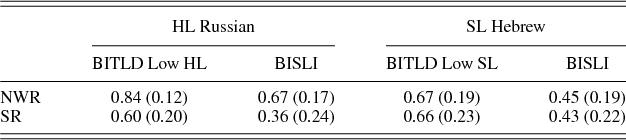
Table 2 summarizes the performance on the two tasks for the three groups of children. Meir and Armon-Lotem (Reference Meir, Armon-Lotem, LaMendola and Scott2017) compared the bilinguals in their weaker language to bilinguals with SLI, and reported a significant difference for all comparisons with large effect sizes. On NWR, bilinguals with SLI were outperformed by bilinguals with weak HL, t (60) = 4.53, p < .001, Cohen d = 1.56, and by bilinguals with weak SL, t (38) = 3.67, p = .001, Cohen d = 1.16. Likewise, in SR, bilinguals with SLI were outperformed by bilinguals with weak HL, t (59) = 4.13, p < .001, Cohen d = 1.09, and by bilinguals with weak SL, t (37) = 3.14, p = .003, Cohen d = 1.02. These differences already provide support for PWM abilities in BITLD compared to BISLI that are not related to their language proficiency. That is, despite the similarity in language proficiency in the language of comparison, BITLD outperformed BISLI on PWM tasks.
Table 2.
Performance on NWR and SR in HL Russian and SL Hebrew
Different error profiles were reported for the weaker language in BITLD and for BISLI. Specifically, the BISLI group produced more errors that reflect weaker representation, such as syllable omission and cluster simplification on NWR and simple clauses instead of complex ones on SR. By contrast, the errors produced by the bilingual children with TLD in their weaker language provided evidence for processing competition between the two languages, mostly substitutions in NWR, case errors in HL Russian, and definiteness errors in SL Hebrew in the SR task. This qualitative analysis of the errors suggests that children with SLI are impaired in their phonological representation while children with BITLD are not. This observation is strengthened by Meir et al. (Reference Meir, Walters and Armon-Lotem2016), who reported that the difference between BITLD and monolinguals on SR was selective in a way that reflected the linguistic distance between the two languages rather than a general deficit in PWM. The bilingual children in that study performed like monolinguals in both the HL and the SL in marking agreement on the verbs as both languages inflect the verbs for subject–verb agreement. By contrast, bilinguals with earlier exposure to the SL Hebrew had in their HL Russian more errors of case and aspect, which are not marked in Hebrew; and all bilinguals found definiteness in the SL Hebrew challenging as it is not marked overtly in Russian.
This error profile supports the proposal that in SLI, the difficulties emerge from innately reduced representational capacity that impact PWM, and thus the ability to make use of language exposure in early childhood, enriched or not, is impoverished. By contrast, bilinguals whose difficulties are attributed to competing processing can still benefit from a bilingual advantage in PWM. This nicely ties in with the explanation proposed above for the ability of bilinguals to perform on a par with monolinguals on PWM tasks despite differences in the amount of exposure.
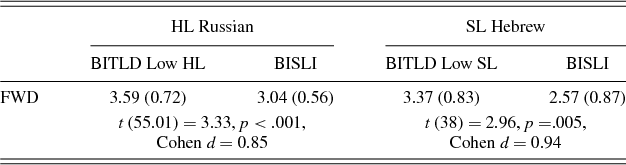
Further support for the proposal that the benefit to processing in PWM goes beyond tasks that heavily depend on language proficiency comes from novel findings from a FWD task tested with the same groups of children from Meir and Armon-Lotem (Reference Meir, Armon-Lotem, LaMendola and Scott2017), presented in Table 3.
Table 3.
Performance on FWD task in HL Russian and SL Hebrew
For FWD, as was shown for NWR and SR, the t tests yielded a significant difference between children with TLD and SLI with large effect sizes. This strengthens the above suggestion that differences in PWM are what distinguish these two populations even when they are matched on language proficiency.
LTM AND PWM
The findings presented above for simultaneous bilinguals versus sequential bilinguals and for BITLD versus BISLI shed light on the nature of bilingual processing in PWM and impaired representation in LTM that might result in variations in PWM. These findings can also contribute to the debate on the nature of SLI. The notion of linguistic representation in SLI is frequently associated with the generative framework and the availability of innately acquired structures. Domain-specific accounts treat SLI as impairment in innate linguistic representations, including phonological representations (Marshall et al., Reference Marshall, Harris, van der Lely, Hall, Markopoulos, Salamoura and Skoufaki2003). This approach assumes that linguistic representations are invariant or at least stable. However, variations in linguistic representations can also result from reduced input due to a hearing impairment or later exposure to the input in the SL as in the case of international adoptees or sequential bilinguals targeted in Pierce et al. (Reference Pierce, Genesee, Delcenserie and Morgan2017).
The term representation is further used, in the context of bilingualism, for intralanguage (i.e., the representation of language that is influenced by both languages). Language transfer, for example, affects the bilingual representation. Later exposure to the SL might have a similar impact for language-specific phonological representation. Yet, no one would propose that the bilingual representation is an impaired representation. Similarly, deficits in processing and PWM are frequently associated with nongenerative models of language impairment seen as non–domain-specific accounts. However, even within these accounts, processing takes different forms from auditory processing of speech sounds (Miller, Kail, Leonard, & Tomblin, Reference Miller, Kail, Leonard and Tomblin2001; Tallal & Piercy, Reference Tallal and Piercy1973, Reference Tallal and Piercy1975) to processing of linguistic features (Leonard, Dromi, & Adam, Reference Leonard, Dromi and Adam2000), from statistical processing, which is strongly related to the quantity of input (Paradis & Jia, Reference Paradis and Jia2016), to cognitive processing, which involves PWM (Archibald & Gathercole, Reference Archibald and Gathercole2006). Moreover, in the context of bilingual development, competing processing of the two languages adds to this variety by stimulating PWM on the one hand and by increasing the processing load on the other.
The findings cited above suggest that the innate capacity of children with SLI yields an impaired representation in LTM that impacts PWM as evidenced in the representation of nonwords. It is the impaired representation that is responsible for the reductions of clusters, for example, or the use of simple clauses for complex ones. PWM might in turn impact the linguistic performance of children with SLI beyond the ability to repeat nonwords and to use function words, for example, as PWM is active in processing input across all linguistic domains.
As for children with BITLD, there is no reason to assume that their linguistic representations are impaired, although they might be different than those of monolinguals because of variation resulting from input, or more specifically, because of intralanguage effects related to AoO of bilingualism. These differences are expected exactly where languages differ from each other at the phonological level or the functional grammatical categories, but these differences will lead to omission or cluster reduction only if one of the languages of the child supports them. Otherwise, only substitution errors are expected. Bilingual processing is also expected to impact the performance of children with BITLD to the extent that the competing representations might yield longer reaction times, code switching, and code interference. In contrast, enhanced PWM might balance these difficulties and act as a compensatory mechanism yielding the reported similarities on PWM tasks in the SL. Children with BISLI manifest variations of both types: both omissions due to impaired representation and substitution due to bilingual processing and intralinguistic influence. Yet, they might also show some benefit of early bilingual exposure.
To conclude, the studies explored above lend support to the first stipulation in Pierce et al. (Reference Pierce, Genesee, Delcenserie and Morgan2017) that exposure to more than one language in the sensitive period for phonological development might give an advantage in that language compared to those who were not exposed to it. Yet, this advantage seems to be language specific, showing, as stipulated in Pierce et al., that the development of PWM is tied to a specific language and does not manifest itself equally in both languages of bilingual children. This commentary suggests interpreting that similarity between monolinguals and bilinguals (despite the often limited exposure of bilinguals) as a possible support for a bilingual compensation for less exposure in a particular language. Finally, reduced PWM in children with SLI was not found to yield the same linguistic patterns observed in bilinguals with reduced exposure, suggesting that the innate capacity of children with SLI yields an impaired representation in LTM that in turn might impact PWM.






 You have
Access
Children with bilingual typical language development (BITLD) and children with specific language impairment (SLI) present similarities in their linguistic performance (e.g., vocabulary and verb inflections). These observed similarities (Paradis Reference Paradis2010) have led to an influx of studies exploring the sources of these similarities and pointing to areas of disparity aiming to dissociate the effects of SLI and bilingualism in bilingual children with SLI (BISLI). The intriguing link, explored in the Pierce et al. (Reference Pierce, Genesee, Delcenserie and Morgan2017) keynote, between early language experience and the development of phonological working memory (PWM) seamlessly ties into this discussion. Bilinguals, and particularly simultaneous bilinguals, it is claimed, experience an enriched linguistic environment in early childhood that is expected to enhance their PWM. By contrast, children with SLI are claimed to have a neurocognitive impairment that negatively affects their PWM. This commentary explores, first, how both age of onset (AoO) of bilingual exposure and the neurocognitive impairment associated with SLI impact PWM and, second, how this impact might be related to the observed similarities as well as evident differences that emerge from studies comparing children with BITLD to children with SLI (monolingual and bilingual).
Pierce et al. (Reference Pierce, Genesee, Delcenserie and Morgan2017) propose, following Baddeley, Gathercole, and Papagno (Reference Baddeley, Gathercole and Papagno1998), that “language acquisition is supported by the creation of adequate phonological representation within the phonological store” and delineate the ways in which differences in PWM might emerge. Special attention is paid to early experience in language acquisition in the first year of life, arguing for enriched language input for simultaneous bilinguals compared to impoverished language input for children with repeated occurrences of otitis media or with cochlear implants. Bilingual enriched input, they claim, leads to the establishment of phonological representation for two different phonological systems, which in turn is expected to enhance phonological processing in PWM. Degraded language exposure is expected to result in weaker phonological representations that lead to less efficient support for processing within PWM. This proposal implies (a) that an advantage in PWM is more expected for simultaneous bilinguals than for sequential bilinguals and, (b) if the linguistic intake of children with SLI is impoverished, it is expected to result in weakened PWM. These two implications are addressed below.
AoO OF BILINGUALISM AND PWM
Pierce et al. (Reference Pierce, Genesee, Delcenserie and Morgan2017) argue that enriched input is available early on for simultaneous bilingual children, but not for sequential bilingual children for whom the AoO of bilingual exposure marked by the onset of exposure to the societal languages (SL) is after the age of 2 or 3. Thus, PWM is expected to differentiate between simultaneous and sequential bilinguals in recall tasks that require phonological processing and the use of PWM, such as forward digit span (FWD), nonword repetition (NWR), and sentence repetition (SR). These tasks relay on processing in short-term memory, but vary in their reliance on representations stored in long-term memory (LTM) to varying degrees, with SR relying on LTM the most and FWD the least.
Following the argumentation in Pierce et al. (Reference Pierce, Genesee, Delcenserie and Morgan2017), one might expect that the environmental enrichment related with younger AoO yields PWM advantages in both the first language and the second language of simultaneous bilinguals. By contrast, with older AoO, the sensitive period for phonological development has been closed, so no impact is expected for sequential bilinguals. The authors address this issue, stipulating that extensive stimulation of PWM by the introduction of a new language might open a developmental window, enabling a bilingual advantage as well. The authors claim, however, that this advantage in sequential bilingual children depends on having several years of exposure to the second language and a minimal level of proficiency in the language. This latter claim questions the role of early exposure and raises the role of linguistic proficiency in the two languages.
Studies of the AoO usually focus on its impact on achievements in the SL, with very few studies exploring the impact of AoO on the heritage language (HL), and even fewer looking at both. Moreover, while language proficiency is often related to AoO, length of exposure, and amount of exposure, tasks that tap on PWM seem to be less sensitive to these variables (Chiat, Reference Chiat, Armon-Lotem, de Jong and Meir2015; Marinis & Armon-Lotem, Reference Marinis, Armon-Lotem, Armon-Lote-Lotem, de Jong and Meir2015). Armon-Lotem and Chiat (Reference Armon-Lotem, Chiat, Biller, Chung and Kimball2012) explored the impact of bilingual exposure on PWM using an NWR task in both languages of Russian–Hebrew bilingual preschool children compared with monolingual children. They showed that the sequential bilingual children were performing as well as their monolingual peers in both HL Russian and the SL Hebrew, despite a wide variation in AoO (SD = 17.9 months) and length of exposure (SD = 18.6 months) to the SL within the bilingual group. Moreover, a gap observed between the two languages in the bilingual group with a better performance in HL Russian was a gap between the Russian and Hebrew tasks, observed for monolinguals as well. This gap was traced to specific properties of each language that made it easier for both monolingual and bilingual speakers of Russian to handle longer words. This replicates Summer, Bohman, Gillam, Peña, and Bedore (Reference Summers, Bohman, Gillam, Peña and Bedore2010) findings for HL Spanish, and their proposal that the language difference resides entirely in the properties of the nonwords relative to properties of the target language rather than in language exposure. Another support for the language specificity of the performance on PWM measures comes from Thorn and Gathercole (Reference Thorn and Gathercole1999). They report a bilingual advantage for English–French bilingual children over monolingual English-speaking children on French NWR and digit span tasks, showing language-specific advantage in PWM, as the advantage was not observed in English. That is, PWM is sensitive to the properties of the target language in NWR, but is not necessarily enhanced by bilingual exposure.
Nonetheless, other studies report that monolinguals outperform sequential bilinguals. Messer, Leseman, Boom, and Mayo's (2010) Dutch monolingual group, for example, outperformed their Turkish–Dutch bilingual group in Dutch NWR. Yet, effects of phonotactic probability did not differ between the two groups, suggesting that the difference did not emerge from PWM. In sum, limited exposure to each of the languages does not necessarily yield lower scores among bilingual children, who show no disadvantage. Yet, the above studies do not show an advantage either in terms of PWM compared to monolingual, unless we stipulate that a bilingual advantage in PWM offers a compensation for the limited exposure yielding similar performance for monolinguals and bilinguals.
The lack of bilingual advantage can also reflect the characteristics of the participants who were mostly sequential rather than simultaneous bilinguals in the studies reported above. Goldstein (Reference Goldstein2017) found that when simultaneous and sequential bilinguals are compared to each other and to monolinguals, a similarity is observed between simultaneous bilinguals and monolinguals in lexical knowledge in the SL while both groups outperform sequential bilinguals. As PWM has been associated with word learning and lexical knowledge (Gathercole, Reference Gathercole2006), the lexical superiority might be attributed to an advantage in PWM.
However, it is difficult to separate the impact of AoO of bilingualism from proficiency in the SL. A study by Meir, Walters, and Armon-Lotem (Reference Meir, Walters and Armon-Lotem2016) that addressed the impact of AoO on both languages, using SR tasks, showed, similar to Goldstein (Reference Goldstein2017), an advantage for simultaneous bilinguals over sequential bilinguals with a similarity to monolingual children in the SL. The study demonstrated that Russian–Hebrew bilingual children acquiring SL Hebrew before the age of 2 often manifested monolingual abilities in the SL, but in their HL, they were several standard deviation below monolinguals, and more than two standard deviations below their sequential bilingual peers whose exposure to the SL started after the age of 4. That is, the gap between simultaneous and sequential bilinguals brings further support to the language specificity of PWM and might be related to their proficiency and language-specific phonological representation that are stronger for simultaneous bilingual in the SL, but for the sequential bilingual in the HL due to uninterrupted exposure to the HL.
If this is the case, early exposure to both languages does not necessarily effect positively the phonological representation in both languages. Moreover, the above findings support the gap in PWM between simultaneous and sequential bilinguals but do not show an advantage for simultaneous bilinguals over monolinguals in either of the languages. It might well be the case that it is not only the early exposure that matters but also the amount of minimal exposure as well. This idea can be supported by Thordardottir (Reference Thordardottir2011), who argues that exposure to a language for 60% of the waking hours of a bilingual child is enough for the productive vocabulary in that language to be similar to that of monolinguals. As vocabulary size has been associated with PWM (Gathercole, Reference Gathercole2006), this proportion might be relevant for an advantage in PWM as well. Yet, this again suggests that the advantage is language specific as this level of exposure cannot be reached in both languages.
The above suggests that lack of bilingual advantage in PWM over the monolingual groups in NWR and SR might be related to morphophonological and syntactic representations of each language in LTM. Tasks that rely on LTM less, such as a “quasi-universal NWR” (Chiat, Reference Chiat, Armon-Lotem, de Jong and Meir2015) or a digit span task might be better for identifying a bilingual advantage in PWM. Table 1 presents findings from 60 preschool children ages 62–78 months (M = 68.6, SD = 3.9): 16 monolingual, 18 Russian–Hebrew simultaneous bilinguals, and 26 Russian–Hebrew sequential bilinguals, matched for chronological age, IQ, and maternal education as a measure of socioeconomic status. The children were tested with a quasiuniversal NWR task and a FWD task in the SL, Hebrew. The study was approved by Bar Ilan University Ethics Committee, and consent was secured from all parents.
Performance of monolingual, simultaneous and sequential bilingual children on a Q-NWR and a FWD task in societal language Hebrew
Note: Q-NWR, quasiuniversal nonword repetition task; FWD, forward digit span.
As evident from the data in Table 1, no significant differences were found between any of these groups on either task. That is, no advantage was found for simultaneous bilinguals over sequential bilinguals or for bilinguals over monolinguals when tested in the SL, with tasks that were less sensitive to linguistic knowledge.
The above findings seem to suggest that the advantage of enriched bilingual exposure is not manifested equally in both languages of a bilingual child and is not as robust as the impact of impoverished exposure might be. It might well be the case that the enriched bilingual exposure has no impact on the phonological representation, beyond making a representation available in more than one language. Any advantages observed in previous studies were related to the HL of the bilingual children in comparison to monolinguals who do not speak that language. Differences between simultaneous and sequential bilinguals were more pronounced on PWM tasks when LTM was involved, supporting the role of language proficiency rather than PWM. Yet, it might be the case that the similar performance of monolinguals and bilinguals despite less exposure to the SL among bilinguals emerges from an advantage, not in phonological representation, but as reported in some studies, in processes of attention, inhibition, or shifting that impacts PWM and offers a compensation for the limited exposure.
PWM IN BISLI
Turning from enhanced input to degraded situations, Pierce et al. (Reference Pierce, Genesee, Delcenserie and Morgan2017) argue that impoverished language input might result in reduced PWM abilities. Yet, it might also be argued that reduced PWM capacity might weaken the ability to make use of the input. Weakness in PWM has been observed among children with SLI (e.g., Archibald & Gathercole, Reference Archibald and Gathercole2006; van Daal, Verhoeven, van Leeuwe, & van Balkom, Reference van Daal, Verhoeven, van Leeuwe and van Balkom2008) and traced to impairment in procedural memory (e.g., Ullman & Pierpont, Reference Ullman and Pierpont2005) or to a representational deficit (Marshall, Harris, & van der Lely, Reference Marshall, Harris, van der Lely, Hall, Markopoulos, Salamoura and Skoufaki2003). Moreover, some research attributes the linguistic difficulties of children with SLI to limitations in processing the input that might result in impoverished input as the intake of PWM. If children with SLI have impairment in phonological processing while bilingual children have enhanced processing skills that enable them to compensate for impoverished exposure in one of their languages, it is expected that bilingual children will show an advantage even in their weaker language when compared to children with SLI who have innate impairment that impacts their phonological processing.
This is addressed in a recent study (Meir & Armon-Lotem, Reference Meir, Armon-Lotem, LaMendola and Scott2017) that compares performance on SR and NWR tasks of bilinguals with typical language development (TLD) in their weaker language to bilingual children with SLI. The children in both populations were matched for chronological age (M = 72 months, SD = 2) and language proficiency in the target language. Bilinguals with TLD whose HL was weak (N = 39) had early exposure to the SL (AoO M = 23 months, SD = 24), that is, enriched exposure at an early age. Bilinguals whose SL was weak (N = 19) had later exposure to the SL (AoO M = 47 months, SD = 15), that is, typical monolingual exposure to the HL at an early age, and bilingual exposure only after the sensitive period for phonological development had been closed. The AoO of children with BISLI (N = 23; M = 38 months, SD = 15) was similar to that of bilinguals with weak SL and significantly late than those with weak HL. That is, they did not benefit from an enriched input in early childhood, but had rather typical monolingual exposure to the HL at an early age. Crucially for this comparison, there was no significant difference between the proficiency of the BITLD children in their weaker language and the proficiency of the BISLI children in that language. Yet children with BISLI demonstrated low performance in both languages while the children with BITLD showed typical linguistic performance in their stronger language.
Table 2 summarizes the performance on the two tasks for the three groups of children. Meir and Armon-Lotem (Reference Meir, Armon-Lotem, LaMendola and Scott2017) compared the bilinguals in their weaker language to bilinguals with SLI, and reported a significant difference for all comparisons with large effect sizes. On NWR, bilinguals with SLI were outperformed by bilinguals with weak HL, t (60) = 4.53, p < .001, Cohen d = 1.56, and by bilinguals with weak SL, t (38) = 3.67, p = .001, Cohen d = 1.16. Likewise, in SR, bilinguals with SLI were outperformed by bilinguals with weak HL, t (59) = 4.13, p < .001, Cohen d = 1.09, and by bilinguals with weak SL, t (37) = 3.14, p = .003, Cohen d = 1.02. These differences already provide support for PWM abilities in BITLD compared to BISLI that are not related to their language proficiency. That is, despite the similarity in language proficiency in the language of comparison, BITLD outperformed BISLI on PWM tasks.
Performance on NWR and SR in HL Russian and SL Hebrew
Note: NWR, nonword repetition task; SR, sentence repetition; HL, heritage language; SL, societal language; BITLD, bilingual typical language development; BISLI, bilingual children with specific language impairment.
Different error profiles were reported for the weaker language in BITLD and for BISLI. Specifically, the BISLI group produced more errors that reflect weaker representation, such as syllable omission and cluster simplification on NWR and simple clauses instead of complex ones on SR. By contrast, the errors produced by the bilingual children with TLD in their weaker language provided evidence for processing competition between the two languages, mostly substitutions in NWR, case errors in HL Russian, and definiteness errors in SL Hebrew in the SR task. This qualitative analysis of the errors suggests that children with SLI are impaired in their phonological representation while children with BITLD are not. This observation is strengthened by Meir et al. (Reference Meir, Walters and Armon-Lotem2016), who reported that the difference between BITLD and monolinguals on SR was selective in a way that reflected the linguistic distance between the two languages rather than a general deficit in PWM. The bilingual children in that study performed like monolinguals in both the HL and the SL in marking agreement on the verbs as both languages inflect the verbs for subject–verb agreement. By contrast, bilinguals with earlier exposure to the SL Hebrew had in their HL Russian more errors of case and aspect, which are not marked in Hebrew; and all bilinguals found definiteness in the SL Hebrew challenging as it is not marked overtly in Russian.
This error profile supports the proposal that in SLI, the difficulties emerge from innately reduced representational capacity that impact PWM, and thus the ability to make use of language exposure in early childhood, enriched or not, is impoverished. By contrast, bilinguals whose difficulties are attributed to competing processing can still benefit from a bilingual advantage in PWM. This nicely ties in with the explanation proposed above for the ability of bilinguals to perform on a par with monolinguals on PWM tasks despite differences in the amount of exposure.
Further support for the proposal that the benefit to processing in PWM goes beyond tasks that heavily depend on language proficiency comes from novel findings from a FWD task tested with the same groups of children from Meir and Armon-Lotem (Reference Meir, Armon-Lotem, LaMendola and Scott2017), presented in Table 3.
Performance on FWD task in HL Russian and SL Hebrew
Note: FWD, forward digit span; HL, heritage language; SL, societal language; BITLD, bilingual typical language development; BISLI, bilingual children with specific language impairment.
For FWD, as was shown for NWR and SR, the t tests yielded a significant difference between children with TLD and SLI with large effect sizes. This strengthens the above suggestion that differences in PWM are what distinguish these two populations even when they are matched on language proficiency.
LTM AND PWM
The findings presented above for simultaneous bilinguals versus sequential bilinguals and for BITLD versus BISLI shed light on the nature of bilingual processing in PWM and impaired representation in LTM that might result in variations in PWM. These findings can also contribute to the debate on the nature of SLI. The notion of linguistic representation in SLI is frequently associated with the generative framework and the availability of innately acquired structures. Domain-specific accounts treat SLI as impairment in innate linguistic representations, including phonological representations (Marshall et al., Reference Marshall, Harris, van der Lely, Hall, Markopoulos, Salamoura and Skoufaki2003). This approach assumes that linguistic representations are invariant or at least stable. However, variations in linguistic representations can also result from reduced input due to a hearing impairment or later exposure to the input in the SL as in the case of international adoptees or sequential bilinguals targeted in Pierce et al. (Reference Pierce, Genesee, Delcenserie and Morgan2017).
The term representation is further used, in the context of bilingualism, for intralanguage (i.e., the representation of language that is influenced by both languages). Language transfer, for example, affects the bilingual representation. Later exposure to the SL might have a similar impact for language-specific phonological representation. Yet, no one would propose that the bilingual representation is an impaired representation. Similarly, deficits in processing and PWM are frequently associated with nongenerative models of language impairment seen as non–domain-specific accounts. However, even within these accounts, processing takes different forms from auditory processing of speech sounds (Miller, Kail, Leonard, & Tomblin, Reference Miller, Kail, Leonard and Tomblin2001; Tallal & Piercy, Reference Tallal and Piercy1973, Reference Tallal and Piercy1975) to processing of linguistic features (Leonard, Dromi, & Adam, Reference Leonard, Dromi and Adam2000), from statistical processing, which is strongly related to the quantity of input (Paradis & Jia, Reference Paradis and Jia2016), to cognitive processing, which involves PWM (Archibald & Gathercole, Reference Archibald and Gathercole2006). Moreover, in the context of bilingual development, competing processing of the two languages adds to this variety by stimulating PWM on the one hand and by increasing the processing load on the other.
The findings cited above suggest that the innate capacity of children with SLI yields an impaired representation in LTM that impacts PWM as evidenced in the representation of nonwords. It is the impaired representation that is responsible for the reductions of clusters, for example, or the use of simple clauses for complex ones. PWM might in turn impact the linguistic performance of children with SLI beyond the ability to repeat nonwords and to use function words, for example, as PWM is active in processing input across all linguistic domains.
As for children with BITLD, there is no reason to assume that their linguistic representations are impaired, although they might be different than those of monolinguals because of variation resulting from input, or more specifically, because of intralanguage effects related to AoO of bilingualism. These differences are expected exactly where languages differ from each other at the phonological level or the functional grammatical categories, but these differences will lead to omission or cluster reduction only if one of the languages of the child supports them. Otherwise, only substitution errors are expected. Bilingual processing is also expected to impact the performance of children with BITLD to the extent that the competing representations might yield longer reaction times, code switching, and code interference. In contrast, enhanced PWM might balance these difficulties and act as a compensatory mechanism yielding the reported similarities on PWM tasks in the SL. Children with BISLI manifest variations of both types: both omissions due to impaired representation and substitution due to bilingual processing and intralinguistic influence. Yet, they might also show some benefit of early bilingual exposure.
To conclude, the studies explored above lend support to the first stipulation in Pierce et al. (Reference Pierce, Genesee, Delcenserie and Morgan2017) that exposure to more than one language in the sensitive period for phonological development might give an advantage in that language compared to those who were not exposed to it. Yet, this advantage seems to be language specific, showing, as stipulated in Pierce et al., that the development of PWM is tied to a specific language and does not manifest itself equally in both languages of bilingual children. This commentary suggests interpreting that similarity between monolinguals and bilinguals (despite the often limited exposure of bilinguals) as a possible support for a bilingual compensation for less exposure in a particular language. Finally, reduced PWM in children with SLI was not found to yield the same linguistic patterns observed in bilinguals with reduced exposure, suggesting that the innate capacity of children with SLI yields an impaired representation in LTM that in turn might impact PWM.