I. INTRODUCTION
Lithium-ion batteries of lithium-insertion compounds as cathode materials, which are mainly used in portable electronics and electric transportation in the contemporary era, continue to gain extensively in scientific and commercial importance. These cathode materials should have high-energy density, high rate capability, be environmentally friendly, inexpensive, safe, and sustainable (Tarascon and Armand, Reference Tarascon and Armand2001; Armand and Tarascon, Reference Armand and Tarascon2008). It is widely recognized that the olivine-based phosphate family LiMPO4 (M = Fe, Mn, Co, or Ni) (Padhi et al., Reference Padhi, Nanjundaswamy and Goodenough1997a, Reference Padhi, Nanjundaswamy, Masquelier, Okada and Goodenough1997b) is an environmentally friendly cathode material for rechargeable lithium-ion batteries, particularly for the hybrid electric vehicles. LiFePO4 shows a flat voltage curve with a plateau about 3.5 V (Padhi et al., Reference Padhi, Nanjundaswamy and Goodenough1997a, Reference Padhi, Nanjundaswamy, Masquelier, Okada and Goodenough1997b; Yamada et al., Reference Yamada, Chung and Hinokuma2001) corresponding to the Fe3+/Fe2+ redox energy and a theoretical capacity of 170 mAh g−1. However, LiFePO4 has a key limitation, an extremely low electronic conductivity because of its insulating nature. One method to increase LiFePO4 conductivity is through the efficient formation of carbon-coated small particles (Dominko et al., Reference Dominko, Gabersčěk, Drofenik, Bele and Pejovnik2001; Huang et al., Reference Huang, Yin and Nazar2001; Chung et al., Reference Chung, Blocking and Chiang2002); another method is the perturbative amount of supervalent cation M (M = Mg2+, Al3+, Ti4+, Zr4+, Nb5+, and W6+) into the Li site together with the point defects and partial replacement of Fe2+/Fe3+ by some other transition metals of the type Mn, Co, Ni, or alkaline-earth metal Mg, etc. (Chung et al., Reference Chung, Blocking and Chiang2002; Morgan et al., Reference Morgan, Van der Ven and Ceder2004; Wang et al., Reference Wang, Li, Shi, Huang and Chen2005). In addition, Na-doping at Fe sites has also been purposed (Li et al., Reference Li, Wang, Chen and Huang2009).
In the LiMPO4 (M = Fe, Mn, Co, or Ni) olivine family, LiFePO4 has the lowest operating potential, ~3.5 V vs. ~4.1 V for LiMnPO4, ~4.8 V for LiCoPO4, and ~5.2 V for LiNiPO4, respectively (Padhi et al., Reference Padhi, Nanjundaswamy and Goodenough1997a; Amine et al., Reference Amine, Yasuda and Yamachi2000; Li et al., Reference Li, Azuma and Tohda2002; Zhou et al., Reference Zhou, Cococcioni, Kang and Ceder2004; Wolfenstine and Allen, Reference Wolfenstine and Allen2005). In LiFe1−x Mn x PO4 solid solution, two plateaus at 3.5 and 4.1 V appeared on manganese doping. Molenda et al. (Reference Molenda, Ojczyk and Marzec2007) revealed that the charge-transfer impedance in Li x Fe1−y Mn y PO4 is much lower than that of Li x FePO4. Yao et al. (Reference Yao, Bewlay, Konstantionv, Drozd, Liu, Wang, Liu and Wang2006) revealed that the electrochemical performance of LiFe1−x Mn x PO4 degrades with increasing Mn content.
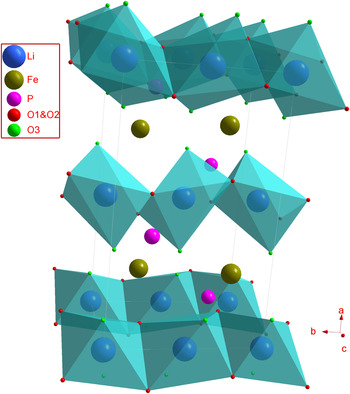
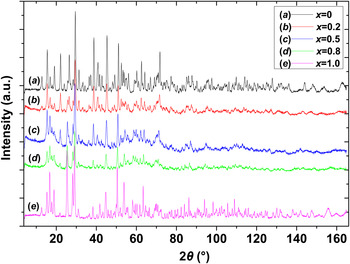
Figure 1 shows the LiFePO4 crystal structure of olivine-type with the oxygen atoms arranged in a hexagonal close-packed arrangement. The space group of LiFePO4 is Pnma (Streltsov et al., Reference Streltsov, Belokoneva, Tsirelson and Hansen1993; Padhi et al., Reference Padhi, Nanjundaswamy and Goodenough1997a) with Li1+ occupying octahedral (4a) sites and Fe2+ octahedral (4c) sites, respectively, in the olivine structure. Neutron powder diffraction (NPD) patterns of LiFe1−x Mn x PO4 (x = 0, 0.2, 0.5, 0.8, and 1.0) are shown in Figure 2. In this work, we investigate the crystallographic structure of LiFe1−x Mn x PO4 in detail by high-resolution neutron diffraction, and attempt to define a relationship between the structure and electrochemical properties.
(Color online) The LiFePO4 crystal structure of olivine-type.

(Color online) NPD patterns of LiFe1− x Mn x PO4 (x = 0, 0.2, 0.5, 0.8, and 1.0) compounds.

II. EXPERIMENTAL
LiFe1−x Mn x PO4/C was prepared by a solid-state reaction (Zhang et al., Reference Zhang, Wang, Liu and Huang2010, Reference Zhang, Wang, Liu and Huang2011). Stoichiometric amounts of Li2CO3 (Shanghai China Lithium, 99.9%), FeC2O4·2H2O (Hefei Yalong, 99%), MnC2O4·2H2O (Hefei Yalong, 99%), NH4H2PO4 (Beijing Chemical, 99.5%), the appropriate quantity of citric acid (Beijing Chemical, 99.5%) and sugar were mixed by using high-energy ball milling using a zirconia container for 5 h. The mixture was then sintered at 650°C for 10 h under argon atmosphere (99.9999%). To confirm the chemical composition of these samples, the Fe/Mn ratios were determined using ICP (IRIS Intrepid II) after the complete dissolution of the powder into a hydrochloric acid solution. All samples are close to the target composition (Zhang et al., Reference Zhang, Wang, Liu and Huang2010, Reference Zhang, Wang, Liu and Huang2011). The structure was analyzed by an X-ray diffraction (XRD) (Rigaku Rint-2400) with CuKα radiation at a scan rate of 0.02° (2θ) s−1.
Neutron diffraction was carried out on powder samples of LiFe1−x Mn x PO4 (x = 0, 0.2, 0.5, 0.8, and 1.0) at room temperature on the diffractometer HRPD (Fischer et al., Reference Fischer, Frey, Koch, Könnecke, Pomjakushin, Schefer, Thut, Schlumpf, Bürge, Greuter, Bondt and Berruyer2000), installed at the Swiss Spallation Neutron Source SINQ of Paul Scherrer Institute (PSI), Switzerland. The incident neutrons of a wavelength λ = 1.154 Å were extracted from a Ge (822) monochromator with an effective intensity of 79%. Data were collected over the 2θ range of 4°–165° with a step increment of 0.05°, and analyzed by the Rietveld technique (Rietveld, Reference Rietveld1969) via the program FullProf [suite version July-2011] (Rodríguez-Carvajal, Reference Rodríguez-Carvajal1993, Reference Rodríguez-Carvajal1997). As the mean neutron scattering length of Mn (−0.373 fm) differs greatly from that of Fe (0.945 fm), the two elements mixing will cancel each other to weaken the intensity of neutron diffraction as shown in Figure 2, we collected the LiFe1−x Mn x PO4 (x = 0.5 and 0.8) NPD data two times under the same condition.
The refinement included the five NPD data in the 2θ range of 10°–155°. The shape of the diffraction peaks were modeled by a pseudo-Voigt function and the background level was described by a 6-Coefficients polynomial function for LiFe1−x Mn x PO4 (x = 0, 0.2, and 1.0) compounds. As the refinement of the LiFe1−x Mn x PO4 (x = 0.5 and 0.8) data was not able to reach a convergent result with the same background level, we selected about 80 background points via user-selected by the program WinPLOTR to refine it subsequently, which proved to be very effective. The angles below 100° in 2θ (°) of LiFe1−x Mn x PO4 (x = 0, 0.2, and 1.0) compounds and 80° of LiFe1−x Mn x PO4 (x = 0.5 and 0.8) were, respectively, made for peak asymmetry corrections. The atomic positional parameters were refined for all atoms except Li. The isotropic displacement parameters were refined for all atoms, and finally, the occupancy parameters were refined for Li and Fe/Mn, respectively.
In order to test the possibility a mixture of site occupation of Li/Fe atoms proposed by LiFePO4 NPD refined results, an XRD pattern of LiFePO4 was collected on a Rint-2400 diffractometer (Rigaku Corporation) with CuKα radiation. The diffraction intensity was measured from 10 to 86° using a step interval of 0.02°.
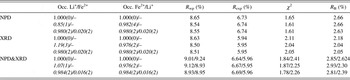
In the XRD data refinement, we first deal with the scale factor, the diffractometer zero point, the background function, and the unit-cell parameters, and then with the profile function, the atomic coordinates, and the isotropic displacement parameters, and finally, with the Li and Fe/Mn atomic occupancies deviated from nominal chemical stoichiometry. There are no excluded regions in the XRD data refinement and the limit angle for asymmetry correction is 38° for the XRD and 73° for the NPD in the Table I refinement process. The results are listed in Table I.
The occupancy results obtained from the Rietveld refinement of the LiFePO4 sample.

Refined parameters are in italics.
III. RESULTS AND DISCUSSION
Our previous investigation suggested that the kinetic property of the Mn2+/Mn3+ redox couple is improved with forming a solid solution and a mesoporous structure and that the reversible capacity and rate performance decrease with the increase of Mn content (Zhang et al., Reference Zhang, Wang, Liu and Huang2010, Reference Zhang, Wang, Liu and Huang2011).
LiFePO4 NPD data were used to solve the structure by the program FOX (Favre-Nicolin and Černý, Reference Favre-Nicolin and Černý2002) initially. Ab initio crystal structure solution via the program FOX indicates demonstrably that the space group of LiFePO4 is Pnma. Thus, the olive structure of LiFePO4 from Inorganic Crystal Structure Database (ICSD) was employed as the initial structure model in the following Rietveld refinement, with Li1+ on the 4a site and Fe2+ on the 4c site.
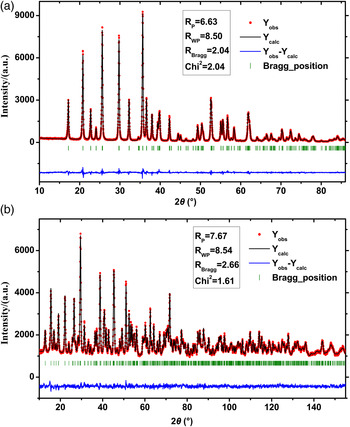
We focused on the occupancy of Li and Fe sites in LiFePO4, respectively, to test the conclusion of the mixed Li/Fe occupation in a small amount in previous works (Chung et al., Reference Chung, Choi, Yamamoto and Ikuhara2008, Reference Chung, Choi, Lee and Ikuhara2012; Gardiner and Islam, Reference Gardiner and Islam2010; Hoang and Johannes, Reference Hoang and Johannes2011). First, all the occupancies were fixed to 100%, perfect chemical ordering, and the agreement between the computed and observed patterns is already good with R B = 2.66% and R wp = 8.65% (χ 2 = 1.65). Then, we released to refine all the occupancies of Li and Fe sites, and found that the Li (4a) and Fe (4c) occupancy became less than full occupation, and the R-factors improved quite slightly to R B = 2.66% and R wp = 8.54% (χ 2 = 1.61). Finally, we refined the mixture rate of Li/Fe atoms with a constraint of full occupancy in total, and the R-factors scarcely changed to R B = 2.63% and R wp = 8.55% (χ 2 = 1.61). If the mixture of Li/Fe is true, it can be speculated that the similar result should be concluded from XRD since the X-ray atomic form factors are significantly distinguished between Li and Fe. We used the XRD data calculate as the same strategy for above. We also mixed X-rays and neutrons data for a combined refinement. The results are provided in Table I. The mean neutron-scattering length of Li (−0.190 fm) differs greatly from that of Fe (0.945 fm), so that some Fe2+ distributed over Li1+ sites will reduce the average neutron-scattering length in the Li1+ sites, which will decrease the result of Li1+ occupancy. On the contrary, the X-ray atomic form factors increase with the addition of atomic number, so that some Fe2+ distributed over Li1+ sites will increase the average atomic form factor value of XRD, which will raise the Li1+ occupancy and will make the occupancy value larger than 1.0 as in Table I. It seems to imply that about 2% mixed Li/Fe occupation (antisite defects) occurs, whereas the statistical R-factors just have a tiny improvement. The antisite defects could decrease the ionic conductivity of the cathode material and increase the polarization, because Li1+ ion diffusion occurs preferentially via one-dimensional channels oriented along the [010] direction (b-axis) (Morgan et al., Reference Morgan, Van der Ven and Ceder2004; Islam et al., Reference Islam, Driscoll, Fisher and Slater2005; Nishimura et al., Reference Nishimura, Kobayama, Ohoyama, Kanno, Yashima and Yamada2008); these antisite defects would add additional electrostatic repulsion and impede the diffusion easily. Chung et al. (Reference Chung, Choi, Yamamoto and Ikuhara2008, Reference Chung, Choi, Lee and Ikuhara2012) have directly demonstrated the disordered occupations by Fe atoms on Li sites in LiFePO4 with high-angle annular dark-field scanning transmission electron microscopy (HAADF-STEM). An intrinsic defect type with the lowest energy is the cation antisite defect, in which Li and Fe/Mn ions exchange positions (Gardiner and Islam, Reference Gardiner and Islam2010). The antisite exchange defects have been demonstrated theoretically for LiMnPO4 and LiFePO4 by M. Saiful Islam and Michelle Johannes et al. (Gardiner and Islam, Reference Gardiner and Islam2010; Hoang and Johannes, Reference Hoang and Johannes2011), respectively. The observed and calculated NPD and XRD patterns of LiFePO4 are shown in Figure 3, from which it can be found that the profile calculated is statistically in agreement with the observed data.
(Color online) Rietveld refinement on the XRD pattern (a) and NPD pattern (b) of the LiFePO4 sample at room temperature. Observed intensity Y obs and calculated intensity Y calc are represented by red dot signs and the black solid line. The green bar represents the Bragg peaks position and the blue curve at the bottom represents the residual difference Y obs − Y calc.

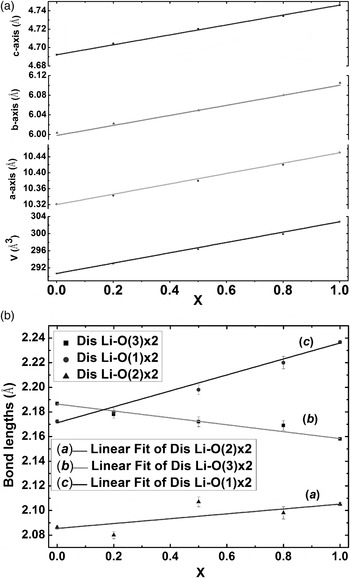
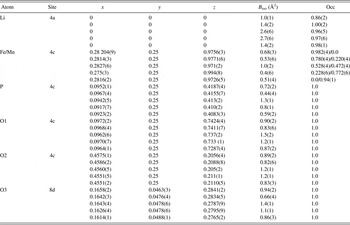
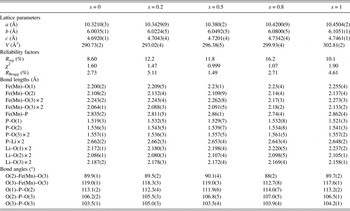
It was reasonably assumed that the Mn2+ replacement takes place at the Fe-sites (Yao et al., Reference Yao, Bewlay, Konstantionv, Drozd, Liu, Wang, Liu and Wang2006; Molenda et al., Reference Molenda, Ojczyk and Marzec2007; Hong et al., Reference Hong, Wang, Wang and Graetz2011) in Rietveld refinement of LiFe1−x Mn x PO4 (x = 0, 0.2, 0.5, 0.8, and 1.0) compounds. Table II gives the structural parameters obtained from the Rietveld refinement of the structures; some structural data obtained from the Rietveld refinement are also provided in Table III. No impurity phase was identified, and the crystal structure was successfully refined with the space group Pnma. The cell parameters a, b, and c increase linearly as the Mn content increases, inducing a linear increase in the unit-cell volume (Table III, Figure 4). This is supported by the XRD results of Padhi et al. (Reference Padhi, Nanjundaswamy and Goodenough1997a). This result is reasonable since the Mn2+ (r = 0.80 Å) has a larger radius than that of the Fe2+ (r = 0.74 Å).
Structural data of LiFe1−x Mn x PO4 (x = 0, 0.2, 0.5, 0.8, and 1.0) compounds. The lattice parameters of olivine phase for LiFe1−x Mn x PO4 (x = 0, 0.2, 0.5, 0.8, and 1.0) compounds increase linearly as a function of Mn content (x) (a) and the interatomic distances (in Å) of Li–O(2) and Li–O(1) increase, while the interatomic distances (in Å) of Li–O(3) decrease on the addition of Mn (b).

Structural parameters refined using the NPD data for the LiFe1 − x Mn x PO4 (x = 0, 0.2, 0.5, 0.8, and 1.0) compounds.

For each atom the rows are, in order (from the top): x = 0; x = 0.2; x = 0.5; x = 0.8; and x = 1.0, respectively.
Structural data of LiFe1 − x Mn x PO4 (x = 0, 0.2, 0.5, 0.8, and 1.0) compounds from the Rietveld analysis.

The selected interatomic distances and angles for all LiFe1−x Mn x PO4 compounds are, respectively, described in Table III. The interatomic distances (in Å) of Li–O(2) and Li–O(1) increase while the interatomic distances (in Å) of Li–O(3) decrease on the addition of Mn (Figure 4), respectively, which partially explains a higher potential plateau of ~4.1 eV in LiMnPO4 than ~3.5 eV in LiFePO4. An XRD study of LiFe1−x Mn x PO4 interatomic distance was not able to demonstrate a linear relationship described by Yao et al. (Reference Yao, Bewlay, Konstantionv, Drozd, Liu, Wang, Liu and Wang2006), because the X-ray is scattered by the extranuclear electron density, but the neutrons are by the nuclei. The Li1+ ion diffusion occurs preferentially via one-dimensional channels oriented along the [010] direction (b-axis) (Morgan et al., Reference Morgan, Van der Ven and Ceder2004; Islam et al., Reference Islam, Driscoll, Fisher and Slater2005; Nishimura et al., Reference Nishimura, Kobayama, Ohoyama, Kanno, Yashima and Yamada2008); so the interatomic distances (in Å) of Li–O(3) decrease while the cell parameters increase, which will make the Li1+ ion diffusion become difficult. As a result, LiMnPO4 has a higher potential plateau than LiFePO4, consistent with our previous investigated electrochemical behaviors (Zhang et al., Reference Zhang, Wang, Liu and Huang2010, Reference Zhang, Wang, Liu and Huang2011).
IV. SUMMARY
Five different phase-pure compositions of LiFe1−x Mn x PO4 (x = 0, 0.2, 0.5, 0.8, and 1.0) have been synthesized and studied by NPD. Rietveld refinements (FullProf program suite version July-2011) for the NPD and XRD profiles measured for LiFePO4, respectively, show that about 2% Fe2+ may distribute over Li1+ sites, which could decrease the ionic conductivity of the cathode material and increase the polarization. The a, b, and c cell parameters increase linearly, and the interatomic distances (in Å) of Li–O(2) and Li–O(1) increase, while the interatomic distances (in Å) of Li–O(3) decrease with the addition of Mn, respectively. The interatomic distances (in Å) of Li–O(3) decrease will also make the Li1+ ion diffusion more difficult.
ACKNOWLEDGEMENTS
The authors are indebted to Dr. D. Sheptyakov of SINQ/PSI, Switzerland, for his help in neutron diffraction experiment. Financial support from “973” project (Grant No. 2010CB833102) is acknowledged. This work was also supported by the National Natural Science Foundation of China (NSFC) Grant No. 11174334 and CAS innovation project (Grant No. KJCX2-YW-W26).
SUPPLEMENTARY DATA
CIF files pertaining to the compounds described have been deposited with ICDD®. For information please contact info@icdd.com.