Welfare states are not designed to offset all inequality. They often fail to redress inequalities in the distribution of income and wealth and more often than not they refuse to do so and instead endorse and reinforce status distinctions and social differentiation. This holds especially for social insurance systems, in which benefits targeted to the poor play a relatively minor role and entitlement to insurance benefits reflect differences in status and merit. Welfare states in that sense are systems of stratification, as Gøsta Esping Anderesen (Reference Esping-Andersen1990) has aptly observed, and they protect people unequally. They draw boundaries between those who deserve generous social benefits and the “non-deserving” poor, or between people entitled to special treatment and membership in exclusive occupational insurance plans and those who must share risks and costs with everyone else in the general scheme. They make membership in the social insurance system mandatory, but permit some people to opt out of the public programs. Social insurance benefits are often highly unequal and financing narrowly based on payroll taxes. This inequality in social rights is deliberate: it is institutionally based and publicly sanctioned, and it changes in the wake of major welfare reforms. What explains such reform decisions? What leads social reformers to embrace ideals of equal social rights when they restructure welfare states, and what makes them endorse status distinctions and social differentiation as underlying principles of social protection?
Posing the question this way shifts the center of attention from the institutional models, on which much of the comparative welfare state literature focuses – “welfare regimes”, “Bismarckian social protection systems”, “varieties of capitalism”, “patterns of democracy” – toward the decisionmaking and political dynamics within these models. While institutional generalizations about national models have done much to further our understanding of the welfare state, their claims about the logic of welfare state development are often only rather loosely connected with the political dynamics and specific choices involved in policy development. This is being recognized in a growing literature questioning the continuing validity of such institutional generalizations, given recent developments in policymaking dynamics and policy outcomes (see Kitschelt and Streeck Reference Kitschelt and Streeck2004 and Palier and Martin Reference Palier and Martin2009). There is also the question as to whether the institutional generalizations ever provided truthful models of specific political dynamics. German policy dynamics – the empirical focus of this paper – provide an excellent case in point for examining this question. In the cross-national comparative literature the German case often figures as “the paradigmatic instance”, the “typical example”, or the closest real-world approximation to an institutional type: a clear example of a Bismarckian social insurance system, the prototypical conservative welfare state, or the model of a coordinated market economy. Yet, these images all more or less hinge on careful analyses of institutional arrangements, and analyses of political dynamics serve illustrative, rather than analytic purposes (Mätzke Reference Mätzke2009: 316).
In-depth comparative case studies of major social reform initiatives take another route to offering generalizations. They maintain a focus on the key actors’ policy preferences surrounding specific policy proposals. They analyze these actors’ political influence as it is brought to bear on decisions about these policies. Such studies avoid the problems of long causal chains (Kitschelt Reference Kitschelt2003: 59) between specific events and institutional generalizations. But they are plagued, as Theodore Lowi put it long ago, with “the debilitating handicap of all case studies, the problem of uniqueness.” (Lowi Reference Lowi1964: 686). Policy studies do not lend themselves easily to overarching claims about institutional models, and the price of proximity to the real world of policy development is country-level generalization. Since it is legitimate to ask how generalizations can be drawn from an examination of specific policy choices, one of the main challenges for such studies is to develop an adequate understanding of the kind of generalization that can be derived from the close observation of policymaking dynamics.
This paper argues that a focus on policymaking dynamics can produce generalizations about the political process producing social reform rather than generalizations about institutional models. The goal of the paper is to develop the conceptualization needed for such generalization. It introduces categories that allow us to relate qualitatively distinct – “debilitatingly unique” – reform initiatives to one another such that one can say something about decision-dynamics in these initiatives. It then develops a model that tells us something about which actors in the party and organized interest group arenas are keenly interested and actively involved in a reform initiative, and what they will reasonably want to see accomplished by the policy decision. This paper starts by showing that who is involved and what their policy preferences are cannot be established a priori. They do not so much flow from power resources, institutionalized points of access to the policy process, or overarching redistributional commitments. Instead, they depend on which specific policy issues are centrally important in a reform initiative. These salient policy issues have to be determined empirically, and generalizing ambitions reach their limits here. Once crucial reform issues are known, however, much else can be known about the structure of political conflict: participants, their preferences and the lines of conflict among the participants.
Then the paper addresses the question how that structure of conflict over a reform will produce a reform decision. It goes on to develop a theory of the political process in which certain interests in reform controversies are empowered while others are marginalized. Political power, too, is not a quality that exists independently from contextual and situation-specific influences. Specific items of welfare reform, it turns out, are tools which social reformers use to build membership and support for their organizations. In that dynamic, political competition tends to empower strategically positioned minorities – groups and organizations who can easily shift their allegiance between contestants in the political arena. Their interests gain disproportionate influence on reform decisions. In the second half of the paper this analytic framework is shown at work explaining four instances of major social reform in the development of the Federal Republic of Germany's welfare state. The paper examines the specific substantive reform proposals, the broader repercussions of these reforms for inequality in the welfare state, and the legislative dynamics of these reform initiatives.
The political dynamic that guides reformers in their choices about the amount and structure of inequality in the welfare state cannot be set out in generalizations that take no account of the situations in which these choices take place and of the issues involved. Such decisions are tied to institutional details, and choices on equality or inequality often come in “through the back door.” (Baldwin Reference Baldwin1990: 284). This paper demonstrates, however, that it is possible to develop reasonable expectations about the structure and the results of political conflicts over such specific features of welfare state redesign by looking at the substantive policy issues on the reform agenda.
Welfare Policies and their Differences in Kind
Unequal entitlement in the welfare state is not defined in the abstract. It is ingrained in welfare state institutions in the formulae used for calculating welfare benefits, the criteria of access to social protection programs, the financing mode, or the organizational setup of major social protection schemes. Unequal social rights in modern welfare states, therefore, are in part the product of institutional choices. Legislative decisions about specific policy measures affect different groups of people unequally, and they employ different means of social policy intervention. Accordingly, the political dynamic of decision-making is also distinctive for different kinds of reform policies. Not all welfare reforms attract the attention of all major actors in a polity equally, and not all actors that are deeply concerned about certain reform options are equally powerful. Explanations of welfare reform must take account of such distinctions. This can be done by distinguishing social protection institutions and reform decisions about them along two substantive dimensions, which bring to the fore the relevant political aspects of social policy choices:
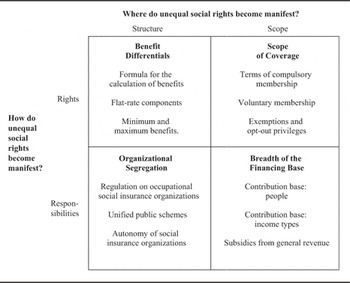
(1) Where do unequal social rights become manifest: Structure or Scope?
Unequal entitlement may take the form of differentiation and unequal treatment within a given group of social policy beneficiaries, but it may also manifest itself in the boundaries and inclusiveness of the group of people covered.
(2) How do unequal social rights become manifest: Rights or Responsibilities?
The second dimension makes a distinction between rights and responsibilities as the main instruments of political intervention, through which citizens encounter state activity. Inequality can be the result of unequally distributed rights or unequally imposed financing burdens.
Cross-tabulating the two dimensions yields four types of welfare policies that significantly influence unequal entitlement in social protection arrangements (see Bonoli Reference Bonoli1997; Leitner and Lessenich Reference Leitner and Lessenich2003 for similar classifications). Table 1 presents these types and gives examples of such policies. Legislation about the structure of rights typically takes the form of decisions about differences in benefit levels and the basis on which these are justified. The scope of rights is a function of coverage under public schemes and exemptions from compulsory membership. The financing mode is the most important aspect of welfare states pertaining to the scope of responsibilities. Organizational segregation within public schemes determines who has to share risks and benefits and thus the structure of responsibilities.
Typology of reform policies

The twofold distinction allows us clearly to connect specific policy measures with the broader theme of inequality in the welfare state. Each of the policy types has the potential to increase, ameliorate, or restructure the amount and pattern of inequality built into the institutions of social protection. Extending the scope or equalizing the structure of rights and responsibilities amounts to social rights’ being granted more equally; defining rights and responsibilities more narrowly and distributing benefits more unequally increases social differentiation in welfare state entitlements. Thus, even in very specific, seemingly narrow and often outright technical reform measures larger charged questions of inequality are also on the agenda. Institutional choices can move the welfare system in the direction of the universal welfare state, with equal rights for all citizens, or they can accentuate the character of social protection as an entitlement granted unequally and conditionally on the basis of status or merit. In this sense welfare reform measures can be egalitarian or, as Peter Baldwin (Reference Baldwin1990) aptly puts it, “socially separatist”. To grasp the logic of their politics, however, it is necessary to examine the welfare reforms that define the design of social protection institutions and their underlying rationales of entitlement. Broad normative commitments on equality or social differentiation more often than not do not inform these reform decisions, they follow in their wake, after the details in the functioning of welfare institutions have been worked out.
Political Process Characterizations of the Policy Types
To understand the specific politics of restructuring social rights three questions must be answered: First, who is affected by a reform, and is thus involved in the reform controversies? Second, what would these different participants want to see the reform accomplish? And third, whose interests become influential in the reform process and whose are ignored? Carefully analyzing the policy types introduced in the previous section brings us a long way toward answers to the first two questions. The third question directs attention to the constellation of political competition at the time of reform. It will be addressed in the next section of the paper.
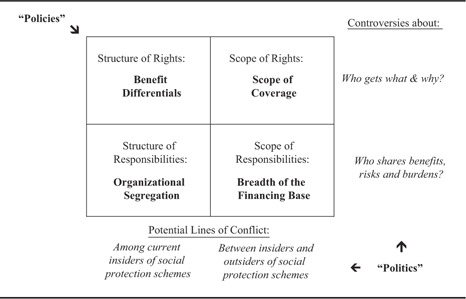
Turning first to the actors and preference structures in reforms, we see that the four types of policies outlined in the previous section all affect inequality in the structure of social rights, but they do so in different ways. This has a profound impact on the social policy preferences and the political dynamic of welfare reform. The analytic procedure here takes its lead from Theodore Lowi (Reference Lowi1964, Reference Lowi1972), his famous dictum that policies determine politics, and the implication that “a distinct set of moral and political-process consequences is associated with each kind of governmental commitment or political intervention” (Lowi Reference Lowi1972: 299). The type of policy thus determines the broad parameters of the reform dynamic.Footnote 1 Specifically, the first dimension – where do unequal social rights become manifest? – selects the actors most keenly involved in reform controversies. Legislation affecting the structure of existing social protection institutions reallocates privileges and burdens among those currently inside public schemes. Non-members have no stake in decisions about these issues and are therefore less likely to be interested in this kind of reform issue. Policies altering the scope of the public schemes, by contrast, reallocate rights and responsibilities between those inside and outside the current systems and conflicts potentially arise there. Structure and scope, therefore, indicate where social policy issues polarize and thus reveal the potential sites of conflict in reform discussions. The second dimension – how do unequal social rights become manifest? – suggests the type of demands that participants in reform debates will bring to the bargaining table. In policies where the reallocation of benefits is at issue, the controversy will revolve around access, entitlement, or exclusion. In policies centered on reallocating responsibilities, nobody will raise demands for gaining access to these responsibilities. Instead, controversy will revolve around exemptions from the obligations of membership, possibilities of opting out from public schemes, or, conversely, demands for spreading obligations more broadly.
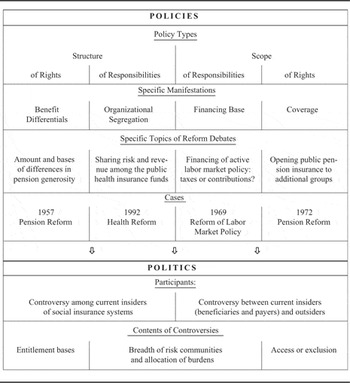
The policy types thus give us a clear understanding of the political process characteristics of reform. They suggest hypotheses about the actors likely to be most actively involved in reform controversies. They also indicate what these different actors will reasonably want from legislative changes. Analyzing the substantive contents of reform measures in a sense yields a conceptual map of the structure of political conflict over a reform – a map that shows the connections between specific reform policies and the rationale of the decision making surrounding these issues. Since the specific policy issues can be linked back to the broader theme of inequality in a welfare state's pattern of benefits and obligations (as argued in the previous section), this conceptual map also connects the political dynamic of reform to its broad redistributive outcomes. Table 2 sets out the connection between reform policies and the politics of reform.
Political process characteristics of reform policies
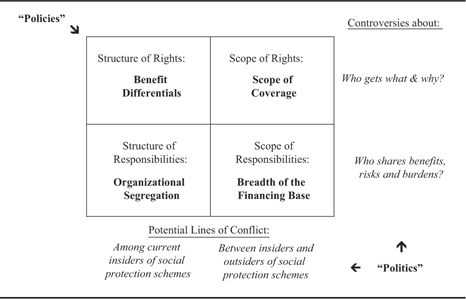
Specific issues are the stuff of which welfare reforms are made. Specific issues have broader repercussions, however, for inequality in the welfare state. Explaining the rationale of preference formation and decisionmaking for such specific options while maintaining their connection with the broad redistributive issues which they affect is the key analytic challenge. While the analysis of political process characteristics conveys an understanding of potential conflicts over reform, it makes no predictions about reform outcomes. In order to understand specific reform outcomes it is necessary to know whose demands are heard loudest and most clearly, that is, which actors in the legislative process are empowered and which are marginalized.
Political Competition and the Empowering Process
The political process by which welfare reform settles on policies that cater to the demands of some groups rather than others cannot be discerned from reform policies themselves. It has an independent causal dynamic. Large literatures on the role of social groups’ interests in the process of welfare state development have demonstrated the importance of class-based preferences (primarily for the expansion of welfare benefits, see Shalev Reference Shalev1983 and Green-Pedersen and Haverland Reference Green-Pedersen and Haverland2002), of the welfare state's clientele in slowing down retrenchment (Pierson Reference Pierson1994), or they have focused on other social actors’ part in shaping the social protection institutions of different countries (Baldwin Reference Baldwin1990; Mares Reference Mares2001; Swenson Reference Swenson2002). As the previous section has shown, patterns of inequality in the welfare state hinge on rather detailed institutional characteristics of social protection systems. This has two major consequences. First, institutional choices take the form of predominantly legislative decisionmaking, so that societal preferences are “filtered through the parliamentary membrane” (Baldwin Reference Baldwin1990: 53) and party politics is the crucial arena of social reform. Secondly, the groups benefiting from, or being hurt by, social policy measures – Pierson's (Reference Pierson1994: 29f.) clients of the welfare state, for instance – rarely correspond to the constituencies represented by the major political parties. Interest diversity in political parties, and waning class-based ideologies have been diagnosed long ago in the literature on political parties and party systems (see Kirchheimer Reference Kirchheimer1966 and Katz and Mair Reference Katz and Mair1995). Because we are dealing with specific issues, the strategically important groups are also narrower constituencies. They are united neither by party-membership nor their allegiance to a particular political movement, but by the way in which a welfare reform will affect them. Interest diversity and heterogeneity in their bases of membership and support, therefore, is a fact of life for the key partisan agents of social policymaking.
The challenge of bringing together people with varied preferences for different social policies informs the activities of policymakers and gives rise to a dynamic of competition in the politics of social reform: competition over (mass) political support, as well as allegiance of members of parliament, important lobbyists, or factions within the major parties. In such heterogeneous settings, political support is precarious. Political competition of course informs electoral politics, but even between elections we find “policymaking-electioneering” as political elites attempt to consolidate their bases of support by making laws and changing institutions.Footnote 2 While lawmakers at the top of broad-based organizations will reasonably avoid courses of action that are bound to alienate their core constituencies,Footnote 3 the “support-mongering” dynamic of policymaking suggests that there are also centrifugal forces at work. Competition takes place at the margin, as 120 years of microeconomic theory have taught us, and that also holds for political competition. Social policy proposals then become a tool in the hands of political entrepreneurs as they try to attract support, or keep voters and supporters with shaky loyalties within their ranks. Here partisan policymakers have little reason to pay most attention to their loyal supporters, but instead are keenly aware of the separatist factions within their ranks and devote much attention to the demands of people who could easily find their interests represented by a political competitor.
Such “marginal supporters” (Stinchcombe Reference Stinchcombe1985) can be swing voters, activists with shaky loyalties or lobbyists who could easily withdraw their allegiance (and perhaps financial support). They can also be veto players within the political system, who could withhold consent and thus jeopardize the success of a legislative initiative. These pivotal actors may do little to define the political parties’ basic platforms, but in the competitive dynamic over specific policy choices they play a significant role (Kitschelt Reference Kitschelt2001: 265). Political competition thus strengthens people with exit options – minorities occupying pivotal positions in the constellation of political parties. Political competition renders their preferences and demands disproportionately influential, while the established core constituencies of parties and organized interests have much less leverage and often find themselves engulfed by the peripheral factions within their own organizations. Accordingly, the policies selected from the conceptual map of possibilities outlined above (see Table 2) serve the interests of strategically important, and not necessarily those of “weighty” actors in the polity.
Political conditions, then, are influenced by both centripetal and centrifugal forces. Centrist tendencies, by which partisan elites look after the interests of their core constituencies, form the basis of political competition and establish an underlying thread of policymaking, as they comprise the logic by which parties seek to appeal to the majorities that bring them to power. However, “policymaking-electioneering” between formal elections is concerned with rather specific institutional choices, which despite their significance for inequality can be rather narrow and technical, affecting only particular social groups. Such institutional choices, unlike general policy principles in party manifestos or election programs, have real tangible consequences for the groups affected, so that reactions are likely to be stronger. Hence, “support-mongering” reformers will keep a keen eye on groups with credible political alternatives, and the centrifugal competitive dynamic becomes more pronounced. In many legislative decisions the empowering dynamic of political competition does not simply translate into policies and laws the preferences of the dominant socioeconomic groups, or of the political system's principal organizational actors. Instead, it privileges the interests of strategically located minorities, that is, constituencies who could easily shift their allegiance between the competing political camps.
Welfare reforms, then, change the broad outline of social protection arrangements since they entail decisions about inequality in social rights. While these decisions have an overall impact on inequality in the welfare state, the causal dynamic of welfare reform is not defined at that overarching level (Mätzke Reference Mätzke2009: 313). Instead, the dynamic is more transient, situational, and issue-specific and defined by the details of reform proposals and by the patterns of political competition among the organizations in the political arena. Borrowing from standard arguments on party systems, party organization and party strategies (Katz and Mair Reference Katz and Mair1995; Kirchheimer Reference Kirchheimer1966; Kitschelt Reference Kitschelt1994, Reference Kitschelt2001; Laver Reference Laver2005), one can thus identify an “empowering mechanism” that captures this transient political dynamic, while at the same time keeping track of its broad overarching consequences for inequality in the welfare state. The next section demonstrates how it plays out differently in various major instances of social reform in Germany.
The Politics of Welfare State Inequalities in Four Instances of Major Social Reform in Germany
In demonstrating how the structure of political conflict over social policies and the constellation of political competition act together to produce choices affecting inequality in the welfare state, this paper analyzes major social reforms, that is, instances of political decisionmaking. This approach is an alternative and a complement to the current practice in historical institutionalist scholarship of examining reform choices entirely in the context of broader time frames (Pierson Reference Pierson2004, Reference Pierson2005; Thelen Reference Thelen2004). While policy history offers nuanced and intriguing insights into the path-dependent properties of policymaking and the interplay of slow-moving contextual influences with more short-term political dynamics, taking instances of political choice, rather than policy trajectories, as units of analysis has a number of advantages too (see also Mätzke Reference Mätzke2009). Most important in our context is its ability to analyze the important issue-specific political dynamics.
All four reforms selected for comparison entailed major decisions about inequality in the German welfare state. In Peter Hall's (Reference Hall1993) categories they are “third order” changes because they not only altered policy measures, but also policy goals. Among other things, they all addressed the question of whether social rights should be allocated (more) equally, or if entitlement should be differentiated by status and merit. In that sense the decisions made choices about the type of inequality to be built into the German welfare institutions. Yet, they did so in very different ways. As the reforms are located in different subfields of social insurance policy,Footnote 4 this comes as no surprise. Rendering an unwieldy group of different reforms comparable despite their substantive differences is one of the goals of this paper's policy typology. Beyond the mere differences in the substantive policy issues involved, one can also see the four cases of major reform as representing our four policy types.
a) The first reform, in 1957, put the calculation of pension benefits on an entirely new footing, ensuring that public pensions would evolve largely in sync with labor market incomes. This decision was about the structure of benefits, so we will expect reform controversies to be largely among insiders of the public pension system, and revolving around questions of social differentiation or equal entitlement to pension benefits.
b) The second pension reform, enacted in 1972 altered the scope of benefits under the statutory scheme by opening it to additional groups of people (notably the self-employed). Those inside and outside the public scheme can be expected to be outspoken participants in reform debates, and the decision should reflect these outsiders’ pivotal position in the constellation of political competition at the time.
c) The crucial issue in the large-scale launch of an active labor market policy in 1969 was the mode of financing it, the question, that is, of whether this new public responsibility should be financed from taxes or unemployment insurance contributions. As a decision about the scope of responsibilities, lines of conflict would potentially run between actors outside the scope of unemployment insurance (the ministerial bureaucracy seeking to gain control, for instance) and insiders (beneficiaries, financiers, and organizations in control of the system).
d) The 1992 health reform, finally, enacted one of the biggest structural changes in the history of West Germany's public health insurance system. It removed organizational boundaries within the system and thus impinged on the structure of obligations: the question of who would share the risks and revenues. We expect the reform to have become possible because those inside the statutory scheme, previously disadvantaged in the segregated organizational structure, gained critical political influence.
The four reforms, therefore, all affected the structure of inequality in the welfare state, but each one in a distinctive way. As will be demonstrated below, political processes reflect those typological distinctions. Table 3 summarizes this information about policy types and the way they shape political dynamics. Analysis of these major social reforms will allow us to probe these expectations about the political dynamics involved and to see the political process characteristics and the empowering dynamics at work. In order to keep these narratives brief, they needed to be focused on only the aspects relevant for the paper's analysis. They do not claim to recount the episodes in their full breadth. They do shed light on some of the lesser-known aspects of these major episodes of social reform, which may not appear relevant in the overarching political histories of the German welfare state. For a fuller picture of these four empirical instances see Mätzke (Reference Mätzke2005).
Policies shape political dynamics in German social reform

Differentiating the structure of rights: The 1957 pension reform
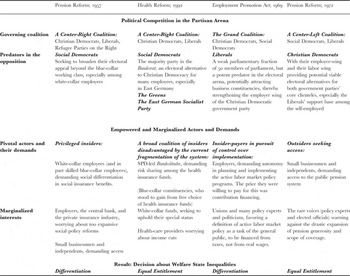
The 1957 pension reform is often portrayed as a typical project of the then dominant center-right Christian Democratic Party in Germany (Baldwin Reference Baldwin1990: 203 f.; Huber and Stephens Reference Huber and Stephens2001: 147–51). Removing all flat-rate components, the reform reinforced merit- and status-based distinctions in membership and pension entitlements; it simultaneously drastically made pensions more generous.Footnote 5 Despite these conservative leanings, depicting the reform as a conservative victory over the wishes of a universalistically-minded working class would mischaracterize both the political dynamic and the outcome of that reform. The political dynamic was instead shaped by the centrifugal forces of political competition. It was indeed defined by the fact that benefit levels were the center of attention. This brought to the fore the question of benefit differentiation, and with regard to that question, a clearly identifiable pattern or conflict can be discerned.
The Christian Democratic Party had within its ranks an extremely strong labor wing, in which most of the party's leading social policy experts had their roots. The major opposition, the Social Democrats, were in the middle of making their peace with the existing social and political order (Katzenstein Reference Katzenstein1987: 37), a process that was concluded, rather than induced, by the new party manifesto of Bad Godesberg (1959) (Klotzbach Reference Klotzbach1982: 311; von Berlepsch Reference von Berlepsch1982: 467–70). The two major parties had very similar goals both in terms of social ′policy and in the electoral arena. The most salient and ideologically charged division over social policy at the time was that between blue-collar and white-collar employees, and the terrain on which this distinction was created and reproduced was social policy. It has always been a distinctive feature of German salaried employees’ activism that they defined their status as “a class” with reference to their status in labor law and social policy regulations (see Kocka Reference Kocka1981; Prinz Reference Prinz1991). During the 1950s white-collar employees, often significant in the tactical calculations of political elites, gained particular influence as both major parties sought to mobilize this group within their ranks. Their position was further accentuated by a rare situation of union competition in Germany, where the confederation of industrial labor unions (the DGB) and a separate white-collar employees’ union (the DAG) both sought to represent the same segment of the workforce. While the white-collar unions aggressively lobbied for special privileges, the blue-collar union confederation DGB, in courting white-collar employees, had to tone down its demands for uniform rights and obligations (Mätzke Reference Mätzke2003).
The 1957 pension reform responded to these demands for social differentiation. Based on nearly identical proposals by the two major political parties, it devised a highly stratified pension scheme, in which social differences in the labor market continue into retirement. Skilled blue-collar workers and especially salaried white collar employees came both out as the big winners of the reform in the long run.Footnote 6 Catering to the demands of the important white-collar segment of the electorate was so attractive in the election year 1957 that influential participants in social and economic policy, such as the finance ministry, the central bank, the employers’ associations, and even highly renowned economics minister Ludwig Erhard remained unsuccessful in their resistance to the expensive reform (Hockerts Reference Hockerts1980: 377–94). “Rationalized inequality” (Mätzke Reference Mätzke2003) with drastic benefit increases was the politically attractive solution.
Extending the scope of rights: The 1972 pension reform
In the next major pension reform other constituencies had to be satisfied, and it was again surprising ones, judging from the composition of the government. Since 1969 a coalition of Social Democrats and Liberals governed Germany, and its chancellor, Social Democrat Willy Brandt, had promised to enact “old Social Democratic demands” in social policy. While the 1972 pension reform did this in some respects, it would be incorrect to describe its two important structural measures as typical parts of a leftist reform agenda. Instead, they are more “Social Democratic” in their outer appearance than in their effects and their legislative histories: The reform opened the public pension scheme to additional social groups, and it introduced a minimum pension component. Both issues to some extent addressed real problems of the contemporary pension system, which left sizable numbers of people uninsured or underinsured. Both were also well-established items in the toolbox of the universal welfare state. However, in their specific institutional form, their universalistic thrust remained limited.
Opening the pension scheme to additional social groups had been on the agenda of all political parties since the mid-1960s. Contrary to what one would expect from a Social Democratic government, it was mainly the self-employed and small businessmen that politicians had in mind. The 1972 pension reform allowed them to join the public pension system on a voluntary basis and it also allowed them to opt out of the public scheme again. Although access was thus broadened only the scope of rights was extended to cover additional groups, while the scope of obligations remained unaffected. Only the mandatory members of the pension scheme were enlisted to share the long-term risks of public pension provision, while for the new members a public pension remained an option. Labor unions and many Social Democrats were accordingly unenthusiastic, and the most consistent promoter of the idea was the Social Democrats’ Liberal coalition partner, whose clientele had traditionally been small businessmen, independents and the self-employed. The second structural issue, the minimum pension component, sparked little conflict among those involved at the time. While it had a significant effect on pension benefits at the low end of the income distribution, it was one of several measures in the reform primarily perceived as expanding generosity (Hockerts Reference Hockerts1992: 918 f.). It did little to define the political dynamic of reform. Interestingly it also fell short of “universalistic expectations”. Tight eligibility criteria restricted access among low-income earners to long-term members who would have their pension levels raised, if necessary, by actuarially upgrading their contribution payments and thus benefit entitlements (see Hermann Reference Hermann1988).
The 1972 pension reform originated in a period of intense electoral competition. The Christian Democrats had decided to “to make the highly popular pension reform their own” (Hockerts Reference Hockerts1992: 927) and aggressively pushed for ever-expanding reform measures. They were also quick to put “opening the pension scheme” on their social policy agenda, thereby presenting themselves as a convincing alternative to the Social Democrats’ smaller coalition partner, the Liberals, who had called for the measure for years and took charge of it in the government coalition (Hockerts Reference Hockerts1992: 909). The demands of the self-employed were thus politically resonant at the time, Liberals and Christian Democrats were competing for the support of this segment of the electorate. By contrast, the minimum pension component had no strong and vocal advocates in the political parties or organized interests. But its feebleness, its refusal to endorse principles of universal entitlement, was also the most striking aspect about this measure. It was a relatively modest step, designed to improve the lot of the “deserving poor,” mostly female pensioners, certainly noble, but not overly so given the amount of resources spent for other measures in the same reform. Its main purpose was to offset the potential damage of granting extremely favorable benefit increases to nearly everyone, while leaving pensions for some people below the poverty level (Hermann Reference Hermann1988: 19). Thus, the 1972 pension reform did render German pension insurance more broadly accessible; it did equalize social rights, to some extent. When it came to the specific measures that conveyed this, however, they were not informed by any actor's pronounced egalitarian ideals. Instead, lawmakers and opposition politicians seized the opportunities of the moment and responded to the demands of the pivotal marginal supporters of the government coalition, the self-employed, a group who had alternatives among the competitors, and was influential for that reason.
Restricting the scope of responsibilities: The 1969 employment promotion act
The Employment Promotion Act of 1969 was the Federal Republic's crucial step toward developing an active labor-market policy. It launched large-scale training programs and publicly funded employment (Kühl Reference Kühl1982: 252). Financing the new programs – the scope of responsibilities – was the critical aspect of the legislation. Funding active labor market policy from unemployment insurance contributions did not recognize it as a genuinely public responsibility, available for all citizens equally and funded from general revenue. It defined active labor market policy measures as a somewhat exclusive responsibility – and entitlement. Contribution financing not only meant that financial burdens were narrowly allocated to employers and employees, it also implied that in principle only people who had paid contributions in the past had access to benefits.Footnote 7 Moreover, the design of the new programs was biased in favor of skilled workers who sought to upgrade their occupational skills, leaving many unskilled and semiskilled workers ineligible (Blankenburg et al. Reference Blankenburg, Schmid and Treiber1976: 272–5). Thus, the new active labor-market policy programs remained essentially narrow: narrowly financed, first and foremost, somewhat exclusive in access to benefits and narrowly controlled by the unemployment insurance agency in implementation and organization. What role does political competition play in accounting for that narrowness?
Large surpluses and substantial reserves of the unemployment insurance scheme had made contribution financing an attractive solution from the perspective of the finance ministry, especially in view of the mounting public deficit in the wake of the 1966/67 recession. However, favoring this financing mode is one thing; getting it to prevail in the legislative process is something else. Funding active labor-market policy from unemployment insurance contributions was opposed by labor leaders, staff at the labor ministry and many policy experts and lawmakers. If contribution funding still prevailed, then this was because it received crucial support from an unlikely heavyweight in the arena of labor politics: the employers’ associations. Employers opted for contribution funding, in order to maintain control over the implementation of active labor-market policy, especially its training measures.Footnote 8 Contribution financing ensured that the semiautonomous employment agency, the Bundesanstalt für Arbeit and not the ministerial bureaucracy, was in charge of program implementation. Support for the “narrow” model was thus informed by very specific advantages from the viewpoint of an influential player in labor policy. It was not informed by pronounced commitments to social differentiation.
Why were employers so influential? Their demands always tend to carry some weight in political decisionmaking, but they do not automatically determine the reform dynamic. In the two pension reforms their calls for restraining the expansive thrust of the reform measures went unheard, for instance. The answer is in the constellation of partisan competition at the time. A governing Grand Coalition of Christian Democrats and Social Democrats left only the small Liberal Party in the opposition. That Liberal opposition, though, presented employers with a viable alternative to the government coalition (Knorr Reference Knorr1975: 124 ff.). That constellation held the labor wing of Christian Democracy in check, as the party's business faction watched with suspicion any reform initiatives that were too friendly to labor.Footnote 9 We see here the centrifugal tendencies of “support-mongering”, but we also see that these were biased in the Grand Coalition, as potential leftist voters did have not alternative parliamentary representation.Footnote 10 Therefore the “labor bloc” at the center of that coalition turned out to be weaker than expected, and while the Grand Coalition indeed produced many innovative reforms in the social and economic policy field, many of them fell short of Social Democratic hopes. Among them was the reform of active labor market policy.
Unifying the structure of responsibilities: The health reform of 1992
The 1992 Health Reform adopted a broad range of cost-containment measures, but it also contained two institutional changes that would transform the landscape of health care financing in Germany: the reform allowed all members of the public health insurance system to choose their insurance provider. Previously only wealthier members had enjoyed that freedom of choice. The reform thus eliminated long-contested status privileges (Lamping Reference Lamping1994: 257). Together with the 1992 reform's second major institutional innovation, risk pooling and financial transfers within the statutory health insurance system, the reform equalized social rights. It unified the structure of obligations: Health insurance funds with a poorer blue-collar membership base used to have high expenses despite less generous benefits, and because of their unfavorable risk-structure and contribution base, they needed the highest contribution rates to cover their costs.Footnote 11 Free choice of funds and large-scale redistribution of resources greatly reduced the disparity in contribution rates among the funds. Being centered on the structure of responsibilities, reform controversies were taking place among insiders of the system, and institutional reform was possible because of an unlikely alliance of supporters.
Financing reform was guided by the (then widely accepted) idea of installing market competition to attain efficiency gains (Wanek Reference Wanek1994: 417). Competition, however, could be beneficial only when (all) patients could indeed freely choose their health insurance company. Risk pooling, in turn, leveled the playing field among funds prior to the start of free choice, which was necessary for market competition to work. Because of its egalitarian impetus, risk-pooling and organizational de-segregation, however, also received crucial support from partisan politicians, interest groups, and constituencies who were otherwise critical of the idea of market competition as a cost-containment strategy (Wasem Reference Wasem1993: 33). What political constellation lent voice to this coalition of supporters?
It was again a political constellation with centrifugal competitive forces. The government at the time was a center-right coalition (of Christian Democrats and Liberals), which had lost its majority in the German Bundesrat, the legislative chamber that represents the interests of the Bundesländer at the national level. Important elements of the 1992 health reform needed Bundesrat-consent, so that the threat of a veto there necessitated reform items palatable for the Social Democratic Bundesländer. These Länder, many of them in East Germany, were especially interested in the long-term prospect of risk pooling (and in short term side payments). For the Christian Democrats cooperation with the Social Democratic opposition was acceptable as they could associate market competition in public health insurance system with structural reform. They also saw distinct benefits in cooperation with the Social Democrats, as this marginalized the Christian Democrats’ coalition partner, the Liberal Party und thus weakened its long-standing resistance to health reform (see Webber Reference Webber1988: 164), and spread responsibility for the reform with its unpopular cost containment measures more broadly (Lauer-Kirschbaum Reference Lauer-Kirschbaum1994: 235 f.). There were, therefore, good reasons to yield to the Social Democratic demands for structural reform. Their threat to withhold consent in the Bundesrat – a Social Democratic exit option – was instrumental in bringing about the reform.
Under a market-liberal banner the 1992 health reform thus delivered a major blow to long-contested status privileges and unequal social protection standards in the statutory health insurance system of Germany. Support came from a broad spectrum of actors who converged on supporting free choice and risk sharing. These advocates of financing reform in large part had no egalitarian goals in mind. They sought to install a market. Or they sought to share financial burdens more broadly. These divergent and mundane motives notwithstanding, crucial results of the reform were less segregation and fewer status privileges in the welfare state.
Conclusion
Major welfare reforms do affect inequality in the structure of social rights, but they do not do so in the abstract. The vehicle of change is always – by necessity – specific reform policies, affecting the lives of different social groups in ways that one cannot directly deduce from the overall – egalitarian or “socially separatist” – direction of welfare state redesign. Policymakers’ broad programmatic intentions often remain in the background, and the crucial themes that define support or rejection of reform options in these issue-specific controversies are more pragmatic, more narrowly focused on the task at hand, and often outright technical in character.
The driving forces of welfare reform, then, are defined in relation to an issue-specific reform dynamic. Issue-specific explanations, however, do not automatically reveal broader significance. Connecting specific, qualitatively distinct policy choices to the broader direction of welfare state redesign is the key analytic challenge. Drawing on Lowi's notion of the connection between the policies and the politics of reform, this paper has suggested a model for analyzing the social policy process, which allows us to analyze policy-specific reform dynamics without losing sight of the broader repercussions of these reforms for inequality in the welfare state. The analysis began by examining the substantive content of reforms. Specific, tangible policy changes define the overall direction of a reform. At the same time different types of such policies select the actors most affected by the policy changes and indicate what these different actors will reasonably want to see accomplished by these changes. We then turned to the political dynamic empowering some of these actors while marginalizing others. As the four brief case-studies have shown, the reform decisions actually made depended on who had decisive influence over the reform process. Social reformers did not necessarily pay most attention to their organizations’ core constituencies. Instead, they were keenly aware of the demands of people whose support was precarious could be withdrawn. Competition takes place at the margin. So there were centrifugal forces at work, and it was strategically placed minorities, people with exit options, who gained disproportionate amounts of influence in political decisions.
The 1957 pension reform decision in favor of meritocratic, highly unequal pensions responded to privileged employees’ prominent demands for social differentiation. The expansion of access to the public pension system in 1972 reflected the importance of the self-employed for the Social Democratic/Liberal government coalition at the time. Contribution financing of active labor-market policy in 1969 reflected the pivotal position of employers, who opted for narrow financing and exclusive control, and social reformers in the Grand Coalition were careful not to alienate them lest they shift their support to the opposition Liberal Party. Risk-sharing and equal rights for all members in the public health insurance system were acceptable for market liberal policymakers, who sought mobilize efficiency reserves by installing competition in the public system, but redistribution and equal rights were also old Social Democratic demands, and as such instrumental for getting the reform passed in the Bundesrat. Table 4 summarizes the information about the empowering process in the four cases.
The empowering dynamic

While parties do respond to the politicized demands of key actors (socio-economic groups, segments of the electorate, organized interests, and even constitutional veto players) they do not first do so through programmatic pledges. Instead, the primary responses come in the form of tangible policies, catering to the specific demands of these strategically important actors. Institutional choices first and foremost please rather narrow interests. They may or may not be informed by the notion that pleasing these interests is just, but overarching ideas about the fairness of welfare state design are not decisive in shaping these specific decisions. In this sense reform processes are “local” – confined to specific issues, at a specific point in time – and not necessarily closely related to notions of equality and social justice. Their consequences do not remain “local”, however. They ultimately determine how much inequality a society tolerates, and in fact, endorses and reproduces by institutional design. Therefore, one may conclude that change in the amount of publicly sanctioned inequality in the welfare state progresses analogously to grammatical change in a language: The results of the development can be systematized in terms of overarching principles – it is possible to write a grammar for any language at any point in its development. The process of change, however, is driven by local practice, not by principles.
Acknowledgements
I wish to thank Scott L. Greer and the reviewers and editor of the Journal of Public Policy for their helpful commentary and suggestions. The final version of this paper was written during a Jean Monnet Fellowship at the University of Michigan's School of Public Health. I greatly benefited from financial support and the productive work environment while there, and I gratefully acknowledge that help.